
Judge, 1884-11-15 · page 2 of 16
Judge — November 15, 1884 — page 2: what you’re looking at
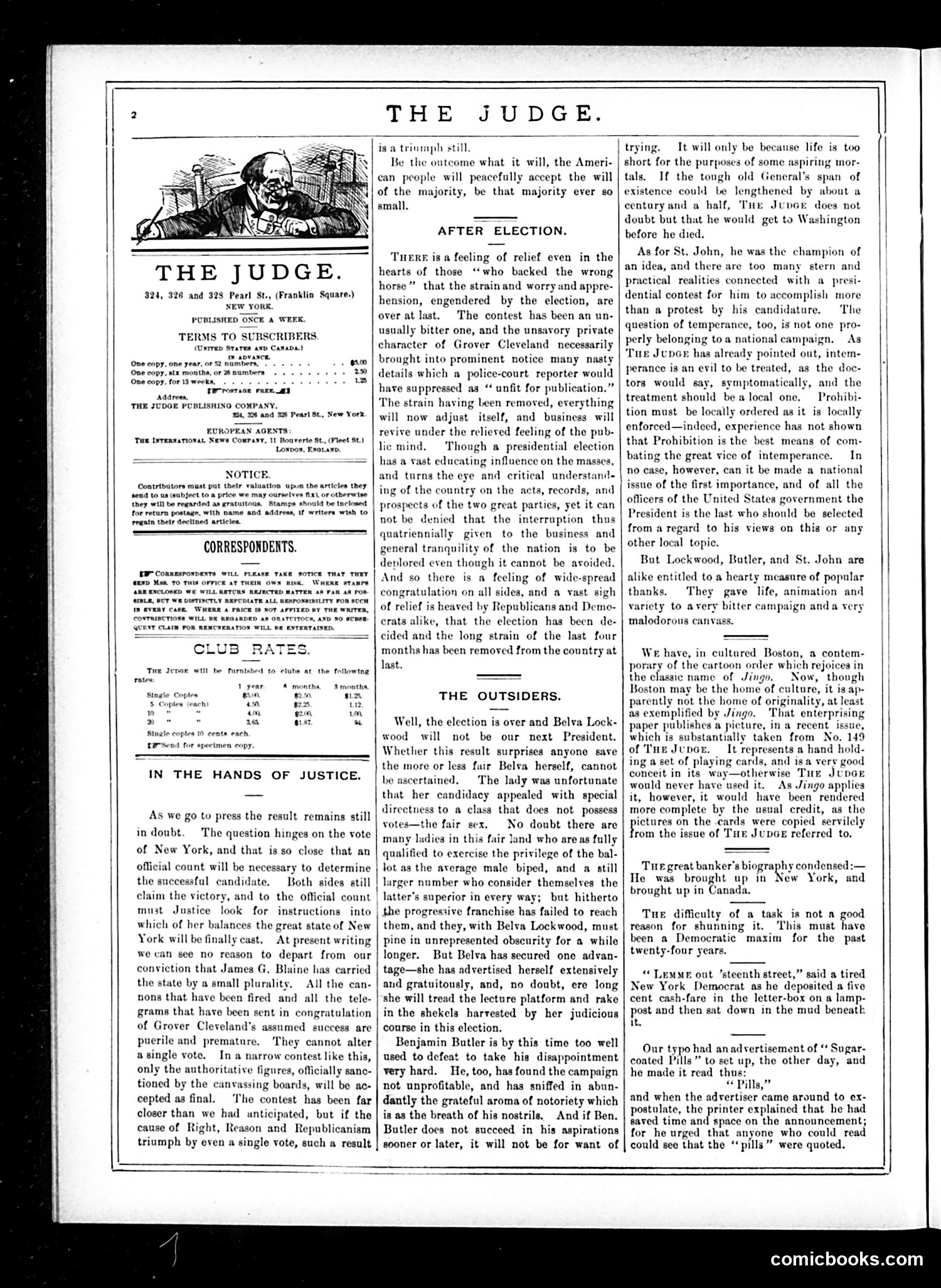
What you’re looking at
This page appears to be from the 1884 presidential election aftermath. The main editorial discusses the extremely close New York result that determined whether **James G. Blaine (Republican)** or **Grover Cleveland (Democrat)** won the presidency. Judge, a Republican publication, initially expected Blaine's victory by "a small plurality," though the actual outcome (Cleveland won) is already evident in the text's conceding tone. The satirical content mocks those who "backed the wrong horse"—presumably Cleveland supporters—while praising the American public's willingness to accept the democratic result peacefully. References to Cleveland's "unsavory private character" allude to his well-known illegitimate child scandal that dominated the campaign. The page emphasizes that only "official count" and "authoritative figures" matter legally, reflecting the real uncertainty and contested nature of this historically significant election.
📄 Transcribed text from this page (OCR, searchable)
Machine-transcribed from the original scan — historical spelling and the odd misread are preserved.
THE UDGE. PUBLISHED ONCE A WERK. TERMS TO SUBSCRIBERS. (Osrrep Staves axp Ca One copy. one year, or 2 numbers, Ove copy, atx or % numbers One copy. for IS weeks, « PORTAGE FRER MD Address, THE JUDOR PUBLISHING COMPANY. 24, 26 and {8 Pearl St, New York. RUROPRA: News C AGENTS. (PANY, 11 Bouverte St., (Fleet St.) Loxvox, Rxataxp, NOTICE. Contributors must pat thetr valuation upun the articles they send to us (subject toa price we may ourselves fix), or otherwise they will be regarded as gratuitous Stamps should be toctosed for return postage, with name and address, if writers wish to regain thetr declined articles. 7 CORRESPONDENTS. ; GW ConnesrosperTs Witt rLEASR Take SOTICE THAT THEY fuxp Maa To THIA OFFICE AT THEIR OWS Rink, WHERE sTAMPe ENCLOSED WHE WILL RETCRS REJECTED MATTER A FAR A8 FOS. IBLE, BCT WE DUFTINCTLY REFCDLATE ALL REAPONRIRILITY FOR AUCH tw EVERY Case WHERE 4 PRICE I SOT AFFITED RY THE WRITER, COSTRISCTIONS WILL BE RROARDED 48 ORATCITOC, AND 40 ACERS QUENT CLAIM FOR REMUNERATION WILL RE ENTERTAINED. CLUB RATES. Tie Sener wilt be turnt rates to clube at the following 1 year gun rey , Poy & montha —% monthe a 112 > * State cop EP-Send for specimen copy. 0 cents each IN THE HANDS OF JUSTICE. As we go to press the result remains still in doubt. ‘The question hinges on the vote of New York, and that is so close that an official count will be necessary to determine the successful candidate. Both sides till claim the victory, and to the official count must Justice look for instructions which of her balances the great state of York will be finally cast. we into At present writing can see no reason to depart from our conviction that James G. Blaine has carried the state by a small plurality. All the can- nons that have been fired and all the tele- grams that have been sent in congratulation of Grover Cleveland's assumed success are puerile and premature. They cannot alter asingle vote. In a narrow contest like this, only the authoritative figures, officially sanc- tioned by the canvassing boards, will be ac- cepted as final. The contest has been far closer than we had anticipated, but if the cause of Right, Reason and Republicanism triumph by even a single vote, such a result isa tri still. Be the outcome what it will, the Ameri- can people will peacefully accept the will of the majority, be that majority ever so small. AFTER ELECTION. Tuenre is a feeling of relief even in the hearts of those ‘‘who backed the wrong horse” that the strainand worry and appre- hension, engendered by the election, are over at last. The contest has been an un- usually bitter one, and the unsavory private character of Grover Cleveland necessarily brought into prominent notice many nasty details which a police-court reporter would have suppressed as ‘unfit for publication.” The strain having Leen removed, everything will now adjust itself, and business will revive under the relieved feeling of the pub- lic mind. Though a presidential election has a vast educating influence on the masses, and turns the eye and critical understané ing of the country on the 8, records, prospects of the two great parties, yet it not be denied that the interruption thus quatriennially given to the business and general tranquility of the nation is to be deplored even though it cannot be avoided. And so there is a fecling of wide-spread congratulation on all sides, and a vast sigh of relief is heaved by Republicans and Demo- crats alike, that the election has been de- cided and the long strain of the last four months has been removed from the country at last. THE OUTSIDERS. Well, the election is over and Belva Lock- wood will not be our next President. Whether this result surprises anyone save the more or less fuir Belva herself, cannot be ascertained. ‘The lady was unfortunate that her candidacy appealed with special directness to a class that does not possess votes—the fair sex. No doubt there are many ladies in this fair land who areas fully qualified to exercise the privilege of the bal- lot as the average male biped, and a still | larger number who consider themselves the latter's superior in every way; but hitherto the progressive franchise has failed to reach them, and they, with Belva Lockwood, must pine in unrepresented obscurity for a while longer. But Belva has secured one advan- tage—she has advertised herself extensively and gratuitously, and, no doubt, ere long she will tread the lecture platform and rake in the shekels harvested by her judicious course in this election, Benjamin Butler is by this time too well used to defeat to take his disappointment very hard. He, too, has found the campaign not unprofitable, and has sniffed in abun- dantly the grateful aroma of notoriety which ia as the breath of his nostrils, And if Ben. Butler does not succeed in his aspirations sooner or later, it will not be for want of | trying. Tt will only be because life is too short for the purposes of some aspiring mor- If the tough old General’s span of existence could be lengthened by about a century and a half, Tue Juvce does not doubt but that he would get to Washington before he died. As for St. John, he was the champion of an idea, and there are too many stern and practical realities connected with a presi- dential contest for him to accomplish more than a protest by his candidature. ‘The question of temperance, too, is not one pro- perly belonging toa national campaign. As Tue Jupor has already pointed out, intem- perance is an evil to be treated, as the doc- tors would say, symptomatically, and the treatment should be alocal one. — Prohibi tion must be locally ordered as it is loc: enforced—indeed, experience has not shown that Prohibition is the best means of com- bating the great vice of intemperance. In no case, however, can it be made a national issue of the first importance, and of all the officers of the United States government the President is the last who should be selected from a regard to his views on this or any other local topic. tals. But Lockwood, Butler, and St. John are alike entitled to a hearty measure of popular thank: They gave life, animation and variety to avery bitter campaign anda very malodorous canvass. We have, in cultured Boston, a contem- porary of the cartoon order which rejoices in the classic name of Jingo. Now, though Boston may be the home of culture, it isap- parently not the home of origi ity, at least as exemplified by Jingo. That enterprising paper publishes a picture, in a recent issue, which is substantially taken from No. 149 of Tue Jup It represents a hand hold- ing a set of playing cards, and isa very good conceit in its —otherwise THe Jupor would never have used it. As Jingo applies it, however, it would have been rendered more complete by the usual credit, as the pictures on the cards were copied servilely From the issue of Tur Jupce referred to. Tuegreat banker's biography condensed: He was brought up in New York, and brought up in Canac Tue difficulty of a task is not a good reason for shunning it. This must havo been a Democratic maxim for the past twenty-four years. “Lexar out ’steenth street,” said a tired New York Democrat as he deposited a five cent cash-fare in the letter-box on a lamp- post and then sat down in the mud beneath It. Our typo had an advertisement of ‘ Sugar- coated Pills” to set up, the other day, and he made it read thus: Pile,” and when the advertiser came around to ex- postulate, the printer explained that he had saved time and space on the announcement; for he urged that anyone who could read could see that the “pills” were quoted. comicbooks.com