
Judge, 1884-11-15 · page 10 of 16
Judge — November 15, 1884 — page 10: what you’re looking at
What you’re looking at
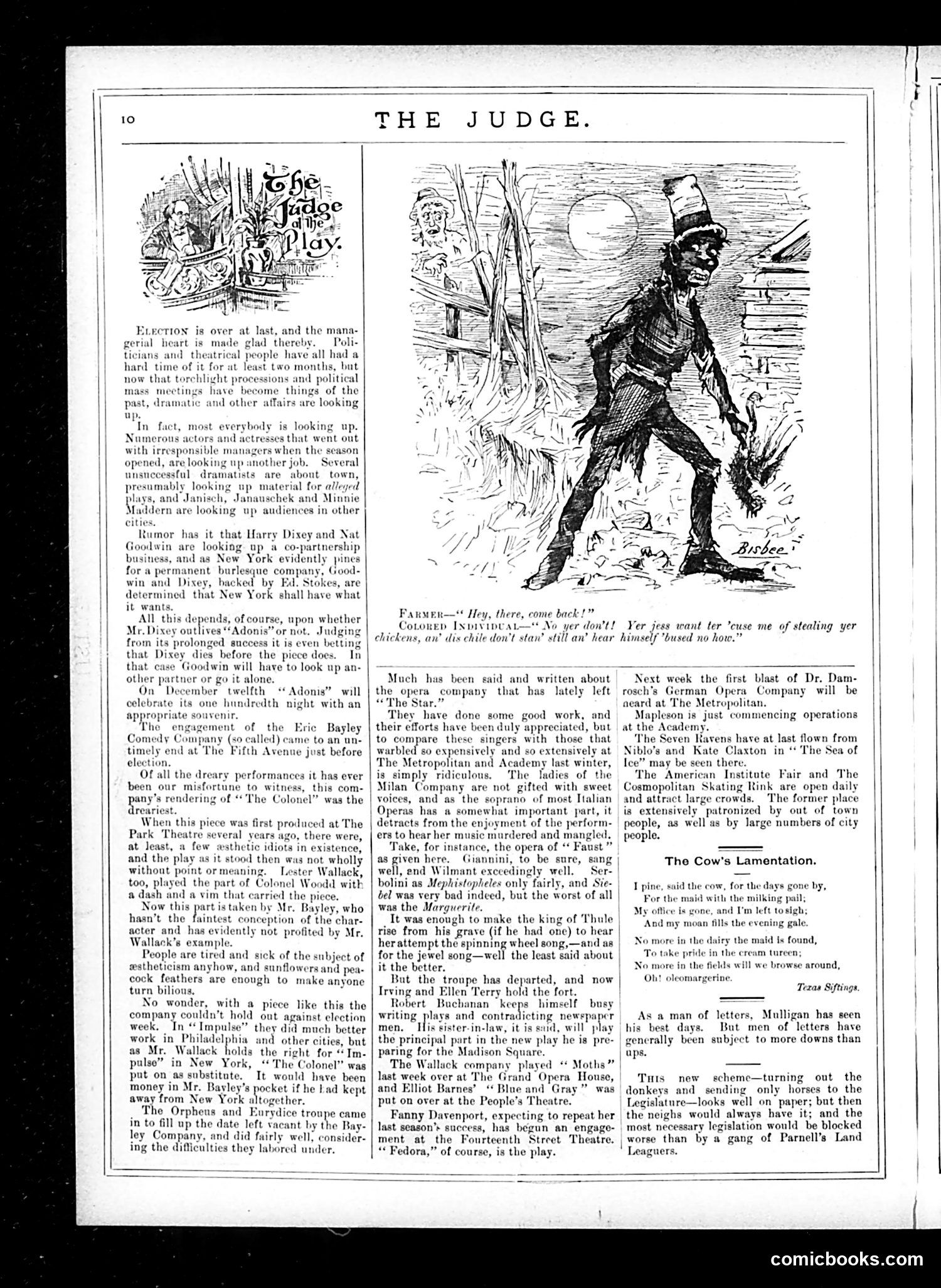
This page from *Judge* satirizes the post-election theater world of the 1880s. The main cartoon depicts a caricatured Black man labeled "Colored Individual," shown in exaggerated stereotypical style typical of period racist imagery. The dialogue parodies dialect humor common to minstrelsy, with the figure protesting about stolen chickens. The surrounding text discusses theatrical matters: the revival of "Adonis" (a burlesque), criticism of an "Aestheticism"-themed play called "The Colonel," and reviews of an opera company performing "Faust." **Key context for modern readers:** This page exemplifies how *Judge* combined political/social commentary with entertainment industry gossip, while openly featuring racist caricature as humor—reflecting the deeply prejudiced attitudes of 1880s American media. The chicken-stealing stereotype represents the dehumanizing racial mockery standard to the era's popular comedy.
📄 Transcribed text from this page (OCR, searchable)
Machine-transcribed from the original scan — historical spelling and the odd misread are preserved.
ELection is over a gerial heart is made gl ticians and theatrical pe hard time of it for at t two months, but | now that torchlight processions and political mass meetings have become things of the past, dramatic and other affairs are looking up. ‘in fact, most everybody is looking up. Numerous actors and actresses that went out with irresponsible managers when the season opened, are looking up another job. Several unsuce ul dramatists about town, amably looking up 1 al for alleged and Jani chek and Minnie idiences in other Pol ple have all had it that Harry Dixey and Nat looking up a co-partnership | and as New York evidently pines for a permanent burlesque cor win and Dixey, backed by Ed. Stokes, are determined that New York shall have what it wants All this depends, of course, upon whether Mr. Dixey outlives **Adonis” or not. Judging from its prolonged success it is even betting Goodw n that Dixey dies before the piece . In that case Goodwin will have to look up an- other partner or go it alone. On December twelfth ‘* Adonis” will ate its one hundredth night with an priate souvenir. nee ment of the Comedy Company (so called) ean end at The Fifth Avenu election. Of all the dreary performances it has ever been our misfortune to witness, this com- pany’s rendering of “The Colonel” was the dreariest. When this piece was first produced at The Park Theatr veral years ago, there we: at least, a few wsthetic idiots in existence, and the play as it stood then was not wholly without point ormeaning. Lester Wallack, too, played the part of Colonel Woodd with a dash and a vim that carried the piece. Now this part istaken by Mr. Bayley, who hasn’t the Krinw conception of the char- acter and has evidently not profited by Mr. Wallack’s example. . People are tired and sick of the subject of estheticism anyhow, and sunflowers and pea- cock feathers are enough to make anyone turn bilious, = No wonde Bayley to an un- ¢ just before with a piece like this the company couldn’t hold out against election week. In “Impulse” they did much better work in Philadelphia and other cities, but as Mr. Wallack holds the right for “Im- pulse’ New York, ‘The Colonel” was put on as substitute. It would have been money in Mr. Bayley’s pocket if he Lad kept away from New York altogether. The Orpheus and Eurydice troupe came | in to fill up the date left ¢ nt by the B ley Company irly well, consider- ing the difficulties they labored under. Fanwen— Hey, there, come back!” Coroner INpivipvat— No yer don’t! chickens, an’ dis chile don’t stan’ still an? hear Much the oper “The Star. They have done some good work, and their efforts have been duly appreciated, but to compare these singers with th that warbled so expensively and so extensively at The Metropolitan and Academy last winter, is simply ridiculous, The ladies of the Milan Company are not gifted with sweet voices, and as the soprano of most Italian Operas has a somewhat important part, it detracts from the enjoyment of the perform- ers to hear her music murdered and mangled. ‘Take, for instance, the opera of “« Faust ” as given here. nnini, to be sure, sang well, end Wilmant exceedingly well. § bolini as Mephistopheles only fairly, and Sie- bel was very bad indeed, but the worst of all was the Margueri It was enough to make the king of Thule rise from his grave (if he had one) to } her attempt the spinning wheel song,—and ag for the jewel song—well the least said about it the better. But the troupe has departed, and now Irving and Ellen Terry hold the fort. Robert Buchanan “keeps himself writing plays and contradicting news men. His sister-in-law, it is said, will 1 the principal part in the new play he is pre- paring for the Madison Square. The Walluck company played “ Moths last week over at The Grand Opera House, and Elliot Barnes’ a put on over at the People’s Theatre. Fanny Davenport, expecting to repeat her last seagon’s success, has begun an engage- ment at the Fourteenth Street Theatre. “Fedora,” of course, is the play has been said and written about company that has lately left busy Der Yer jess want ter ’cuse me of stealing yer himself "bused no how.” Next week the first blast of Dr. Dam- rosch’s German Opera Company will be aeard at The Metropolita Mapleson is just commencing operations at the Academy. ‘The Seven Ravens have at last flown from Niblo’s and Kate Claxton in ‘ The Sea of Ice” may be seen there. The American Institute Cosmopolitan Skating and attri is extensive people, as w people. Fair and ‘The Rink are open daily . The former place cd by out of town s by large numbers of city ell a The Cow’s Lamentation. I pine, said the cow, for the days gone by, For the maid with My office is gone, an ‘And my moan fills the pail; left tosigh; vening gale. more aid is found, Key re in th dairy thi ide in the fields wil am tureen, 1 we browse around, Tezas Siftings a man of letters, Mulligan has seen But men of letters have en subject to more downs than Tuts new scheme—turning out the donkeys and sending only horses to the Legislature—looks well on’ paper; but then the neighs would always have it; and the most necessary legislation would be blocked worse than by a gang of Parnell’s Land ' Leaguers. comicbooks.com