
A complete issue · 16 pages · 1884
Judge — September 20, 1884
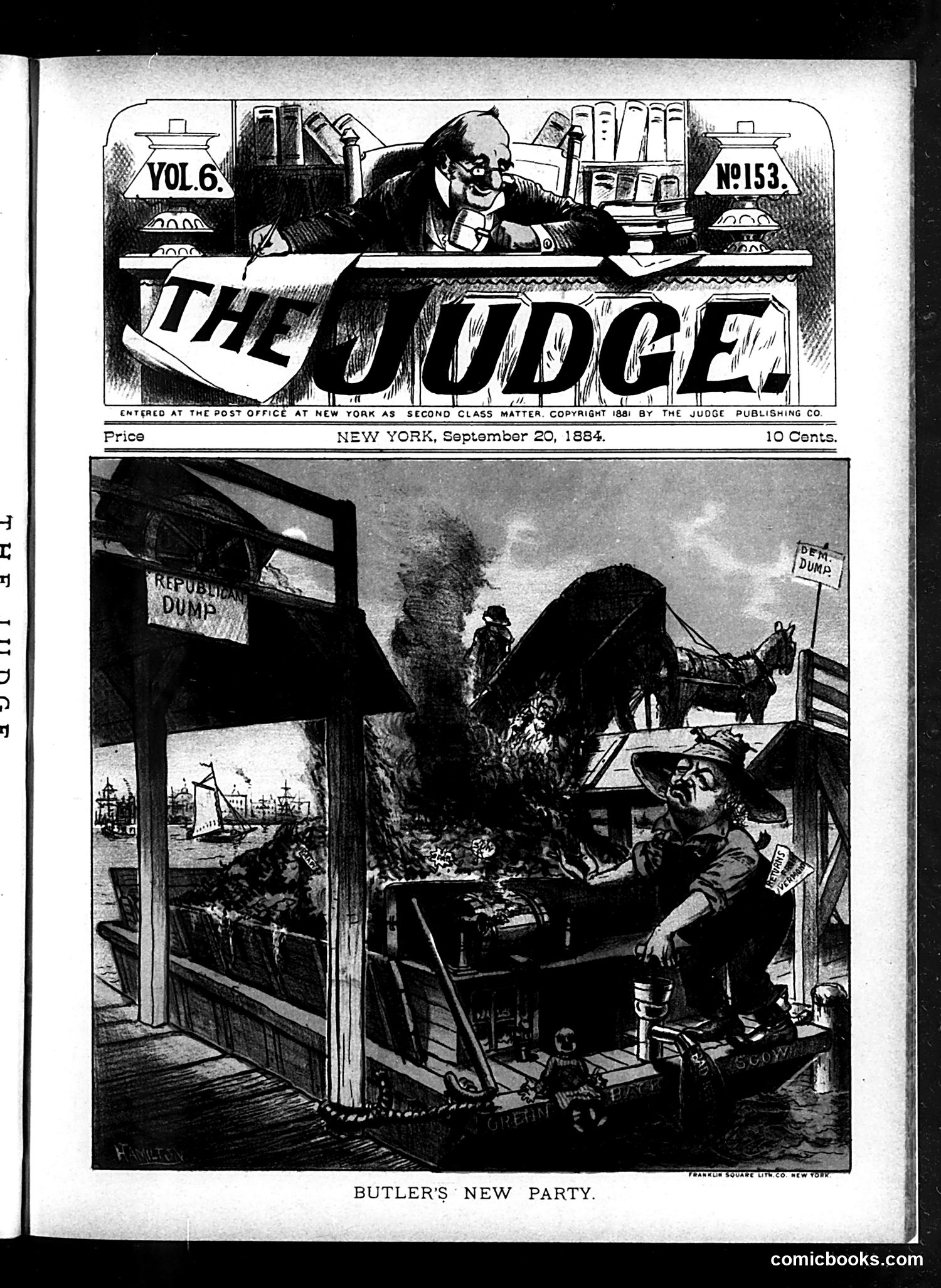
This political cartoon satirizes General Benjamin Butler's third-party presidential campaign of 1884. The main illustration shows Butler as a disheveled figure dumping garbage—labeled with names including "Greenback Party" and "Anti-Monopoly"—into a waste receptacle marked "Dem Dump." The satire mocks Butler's attempt to unite various splinter political movements under a single candidacy. By depicting his coalition as literal garbage being discarded, the cartoonist ridicules both the viability of his campaign and the quality of the political movements he's attempting to consolidate. The Judge masthead figure above surveys this chaos from his editorial desk, positioning the magazine as an observer of political absurdity during the 1884 election cycle.
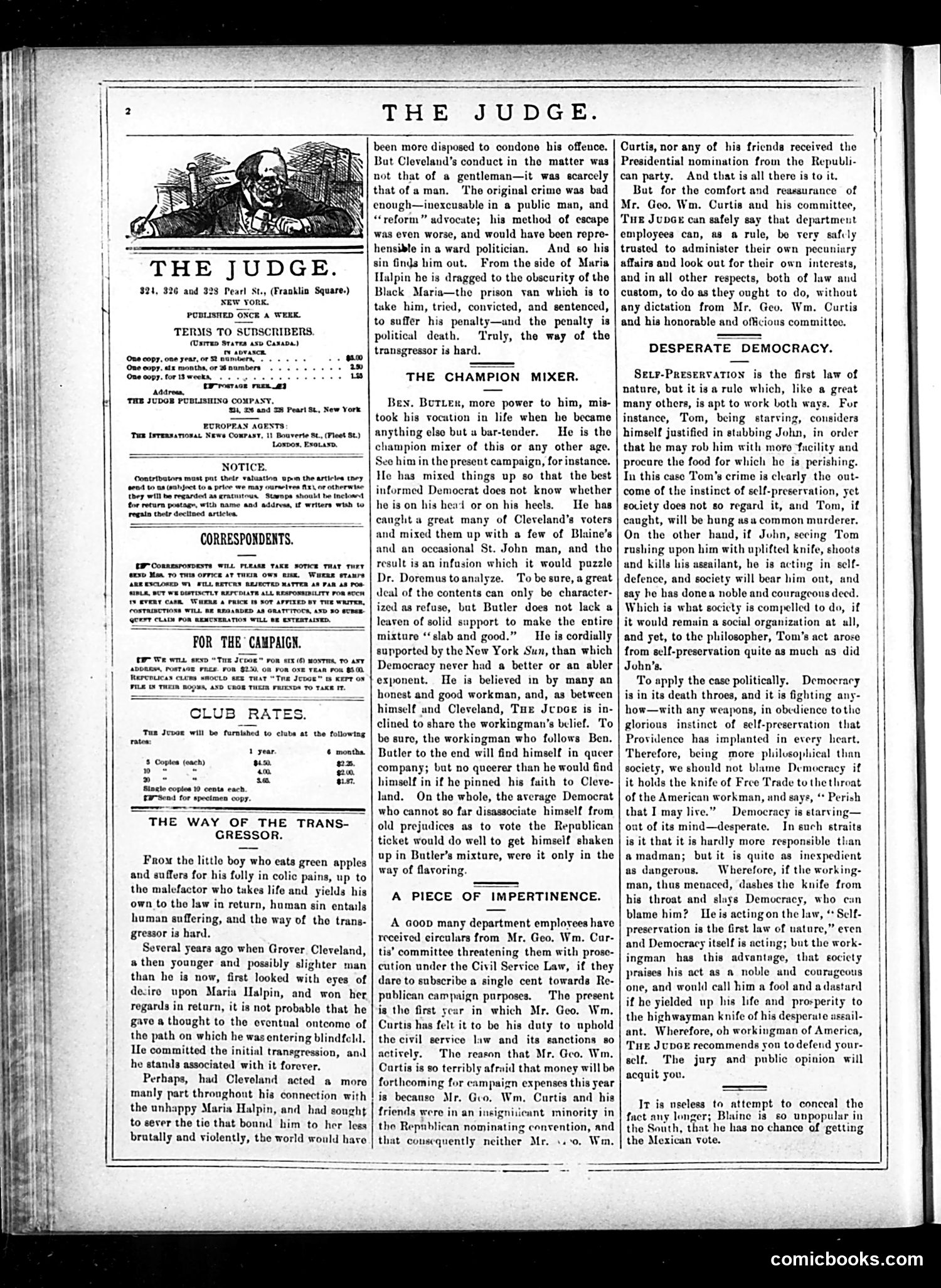
This 1884 page from Judge magazine contains two political satirical pieces attacking Democratic figures: **"The Way of the Transgressor"** targets **Grover Cleveland**, the Democratic presidential nominee. Judge condemns Cleveland for his affair with Maria Halpin years earlier, arguing he behaved unmanously in abandoning her. The piece uses religious language ("transgressor") to frame his past conduct as inevitable political doom. **"The Champion Mixer"** attacks **Benjamin Butler**, a political independent/Greenback candidate. Judge sarcastically praises Butler as a "mixer" who has confused voters by drawing support from multiple parties (Cleveland Democrats, Blaine Republicans, and St. John Prohibitionists). The satire suggests Butler's campaign is incoherent "refuse" masquerading as legitimate politics, while praising the New York Sun for supporting him. The page reflects 1884 campaign mudslinging and Judge's Republican sympathies, weaponizing Cleveland's personal scandal and mocking Butler's third-party challenge.
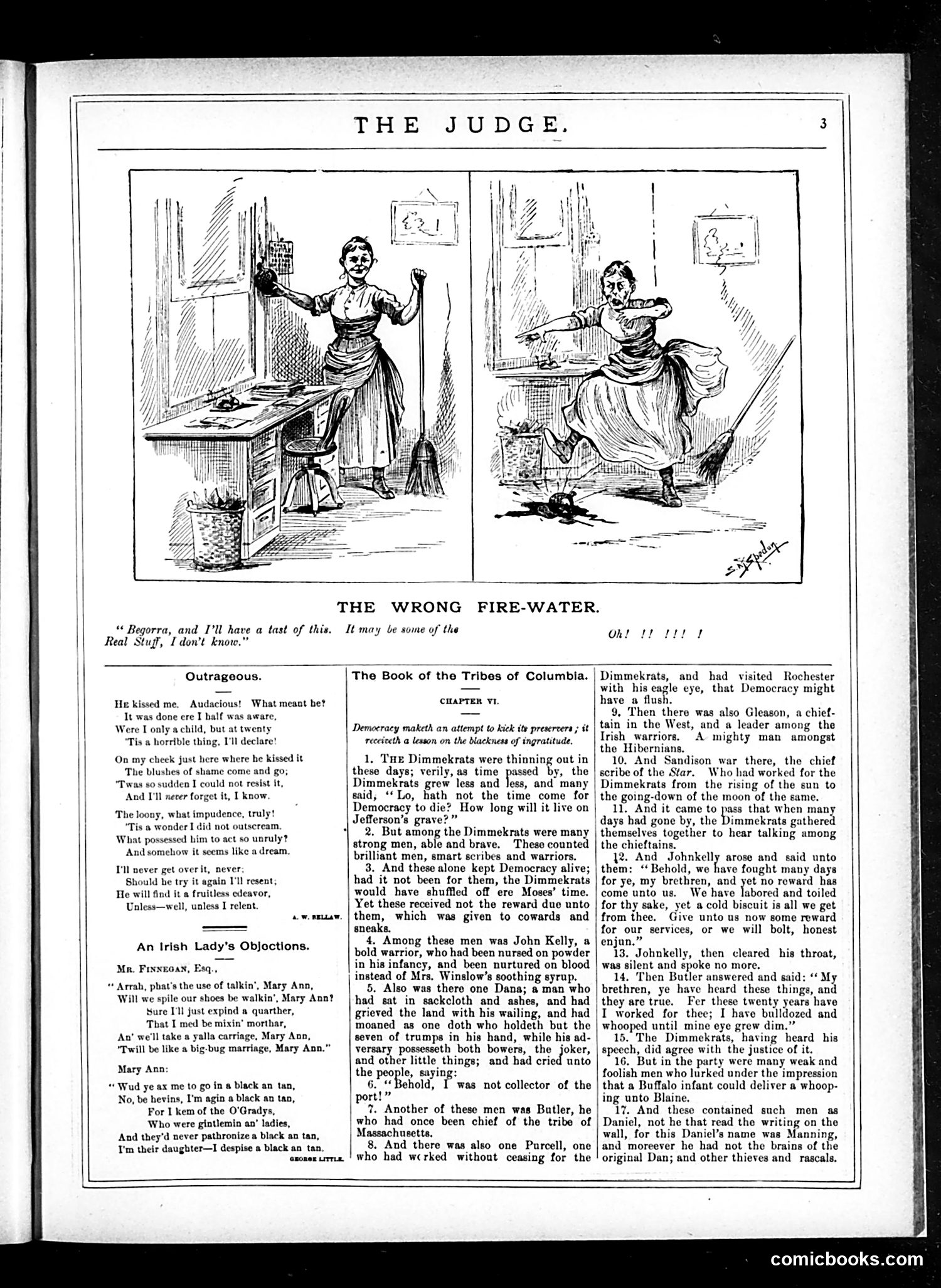
This Judge magazine page contains three satirical pieces mocking Irish-American stereotypes and Democratic Party politics circa the 1880s-90s. **"The Wrong Fire-Water"** (top): A woman reacts with exaggerated shock to being kissed, protesting indignantly while her body language suggests she actually enjoyed it—satire on Victorian feminine propriety and restraint. **"An Irish Lady's Objections"** (left): Mocking Irish immigrant speech patterns and class consciousness. A woman named Mary Ann refuses to ride in a "black and tan" (a carriage type, but also referencing British police), claiming her O'Grady ancestry. The satire ridicules both Irish accent stereotypes and snobbish pretension among working-class Irish-Americans. **"The Book of the Tribes of Columbia"** (right): Biblical-style parody of Democratic Party infighting. It names real figures like John Kelly and Benjamin Butler—prominent Democrats—complaining they've received no rewards for their political labor, threatening to "bolt" (abandon the party). This satirizes internal Democratic corruption and patronage disputes.
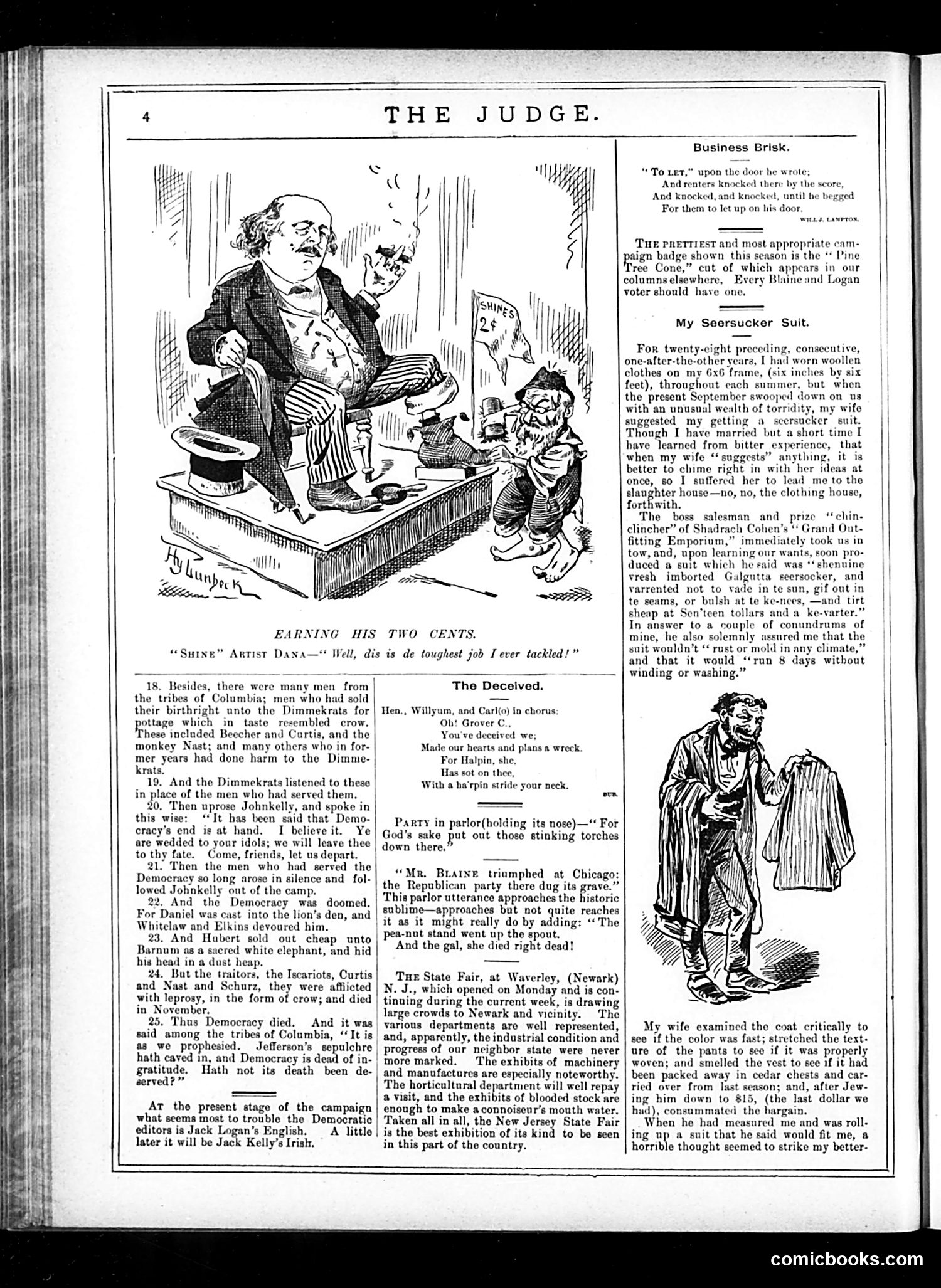
This 1884 page satirizes the Democratic Party's internal collapse, particularly targeting figures like Grover Cleveland (referenced as "Grover C."). The main cartoon, "Earning His Two Cents," depicts artist Thomas Nast earning modest payment—likely mocking Democratic criticism of Republican cartoonists like Nast who'd switched allegiances. The biblical-style text mocking Democratic leadership references party defectors (Beecher, Curtis, Nast, Schurz) who abandoned Democrats, portraying this exodus as the party's doom. "The Deceived" section attacks Cleveland over the Halpin affair (his relationship with Maria Halpin), suggesting he betrayed Democratic supporters' trust. The satire characterizes Democrats as self-destructing through internal betrayal while Republicans (Blaine and Logan) gain strength. The tone is viciously partisan, employing religious parody and personal attacks typical of 1880s campaign journalism. Minor sections cover a New Jersey State Fair and humorous personal anecdotes, standard filler for such magazines.
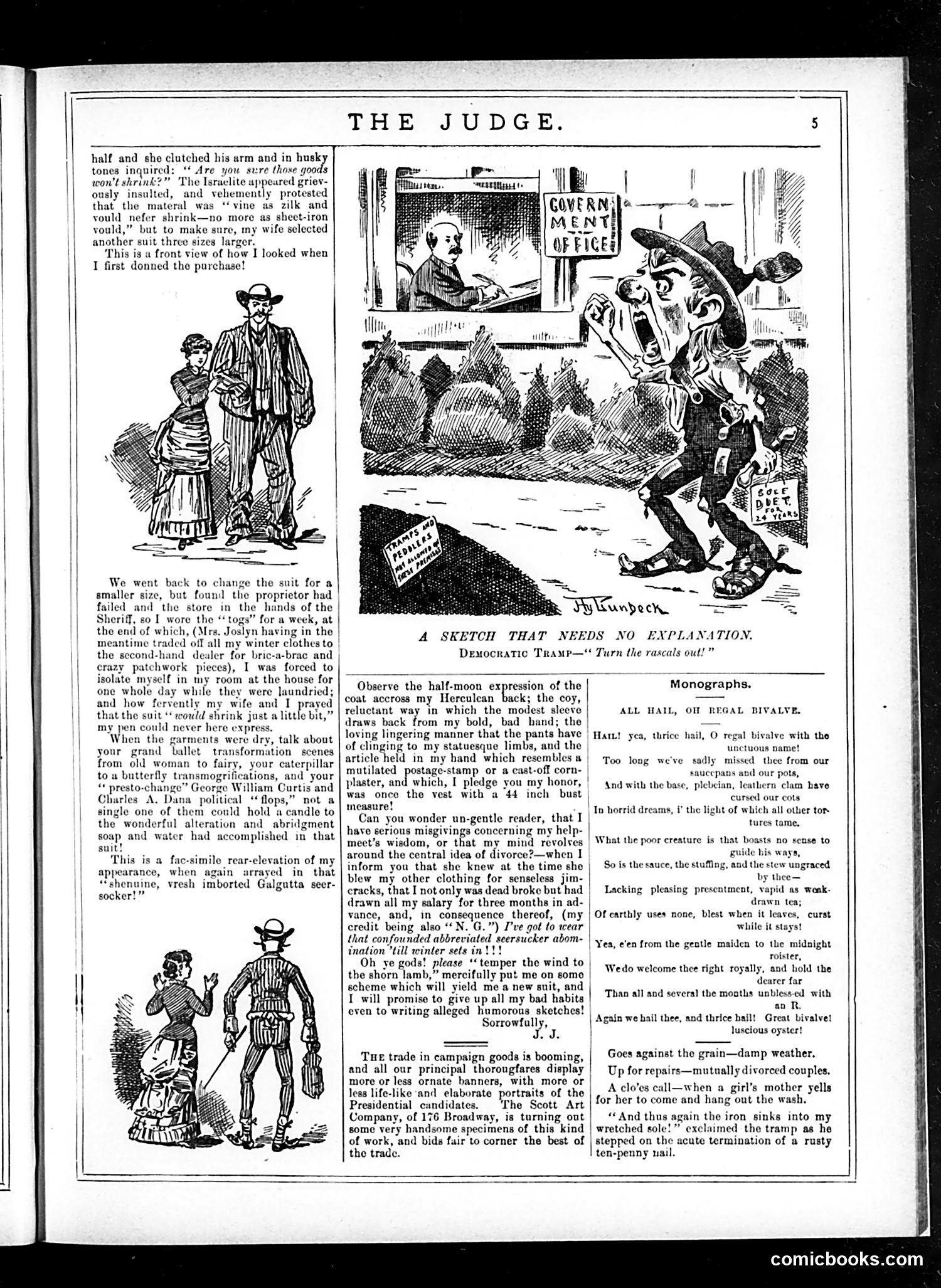
This page contains three satirical pieces: **Main narrative comic**: A humorous first-person account of purchasing a poorly-made suit from a Jewish clothing merchant (indicated by stereotyped dialect spelling: "vine," "vould"). The narrator buys an oversized garment that shrinks dramatically after washing, leaving him comically undersized and unable to afford replacement clothes. The satire mocks both cheap imported clothing and the narrator's domestic predicament with his spendthrift wife. **Political cartoon** ("A Sketch That Needs No Explanation"): Titled "Democratic Tramp—'Turn the rascals out!'" This appears to reference campaign-season attacks on the Democratic party, depicting a disheveled figure—likely representing Democratic political opposition—demanding reform. **"All Hail, Oh Regal Bivalve"**: A humorous poem celebrating oysters, suggesting their recent unavailability or scarcity. The page reflects late 19th-century Judge content: ethnic stereotyping, domestic humor, and partisan political satire alongside literary pieces.
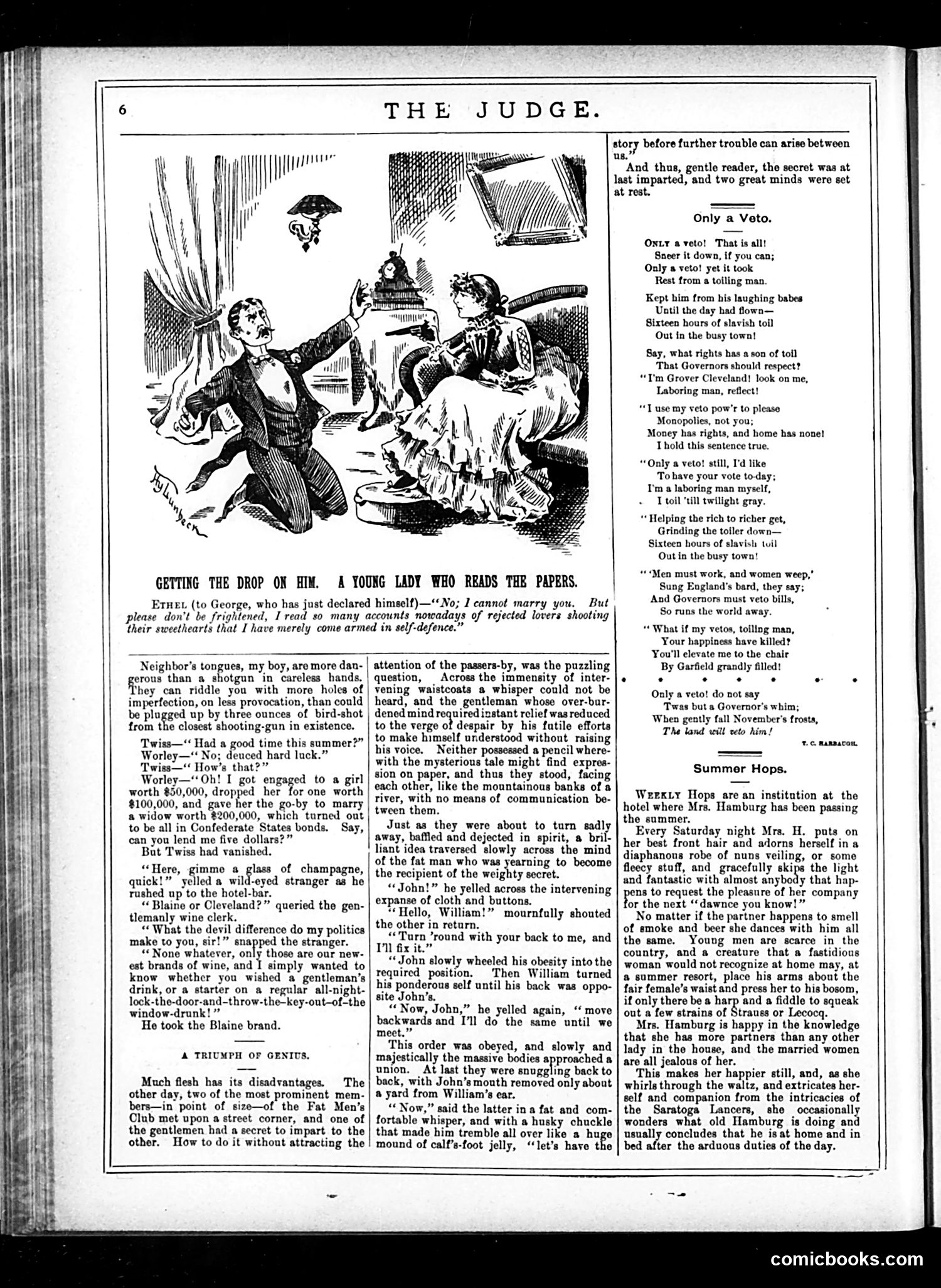
The main cartoon depicts a young woman rejecting her suitor's marriage proposal while armed with a gun. Her explanation references a grim social trend: newspapers constantly reporting stories of rejected lovers murdering their sweethearts before committing suicide. The satire works on two levels: it mocks both the prevalence of such violent incidents in 1880s America and the absurdity of a woman needing armed self-defense *against her own romantic suitors*. By having her cite "accounts" she's "read," Judge ridicules how sensationalized newspaper coverage normalized this tragedy, making it seem routine enough that women must protect themselves. The accompanying poem "Only a Veto" addresses political power and workers' rights, suggesting even a single veto (likely presidential) can devastate ordinary laborers. The page also includes humorous anecdotes about courtship, Confederate bonds, and two obese men attempting to whisper secrets back-to-back—typical Judge fare mixing social commentary with crude humor.
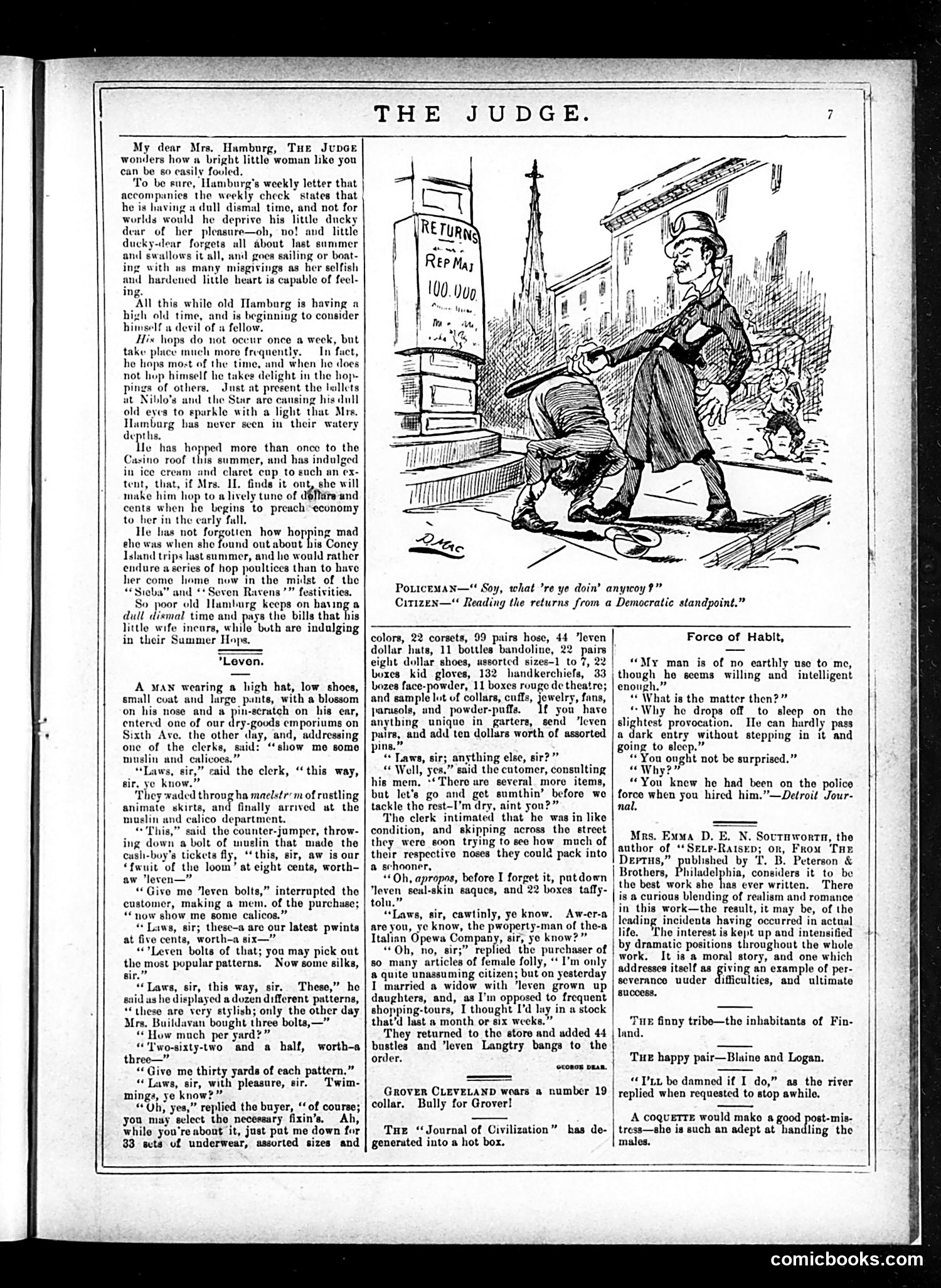
This page mocks two distinct targets: **The main cartoon** shows a policeman confronting a man reading Democratic election returns, asking what he's doing. The joke appears to satirize how Democrats (or their political opponents) interpret election data—suggesting selective or delusional reading of results. The "Democratic standpoint" implies a skewed perspective. **"Leven" (below)** satirizes an eccentric wealthy customer obsessed with the number eleven. He repeatedly demands "eleven" of everything—bolts of fabric, pairs of shoes, hats—regardless of actual need or value, creating absurd bulk purchases. This likely mocks nouveau riche excess or irrational consumption habits of the newly wealthy. The upper letter about "Hamburg" satirizes marital deception: a husband claims to lead a "dull dismal" life while his wife vacations, but secretly frequents theaters and casinos. The satire critiques both his dishonesty and her gullibility in believing obvious lies. All three pieces target human folly—political delusion, wasteful excess, and marital infidelity.
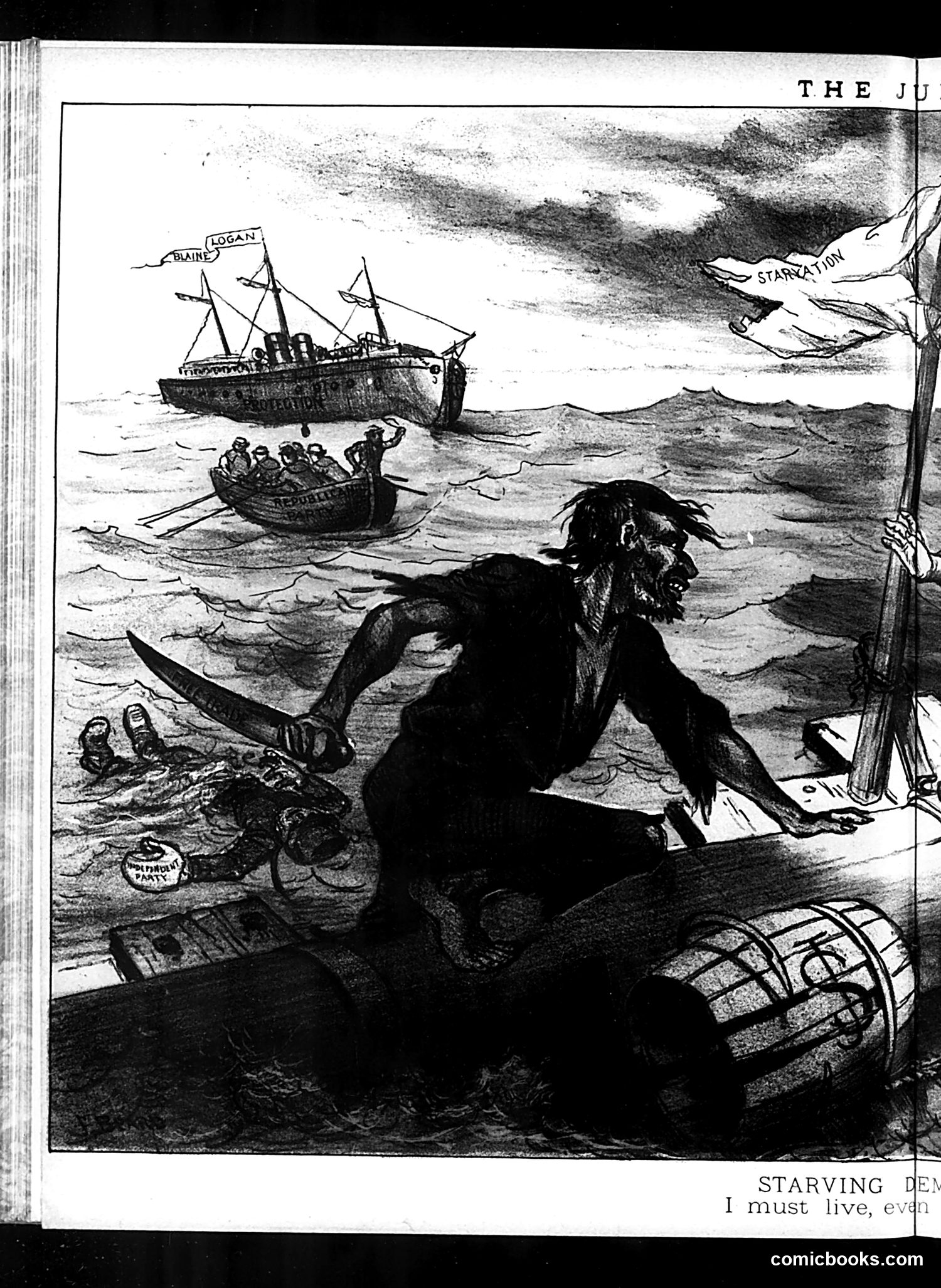
This appears to be a shipwreck scene from *Judge* magazine's satirical commentary. A disheveled, starving man sits on a beach with a sword, watching a ship labeled with names including "LOGAN" and "BLAINE" in the distance. A lifeboat carries passengers away from the vessel. The caption reads "STARVING DEN" and "I must live, even..." suggesting this depicts someone in desperate straits, possibly commenting on political figures' survival tactics or ruthlessness. The ship names—likely referencing politicians James G. Blaine and John A. Logan (figures from the Gilded Age)—suggest this satirizes political maneuvering or competition. The exact historical event remains unclear without additional context, but the imagery critiques political self-preservation at others' expense.
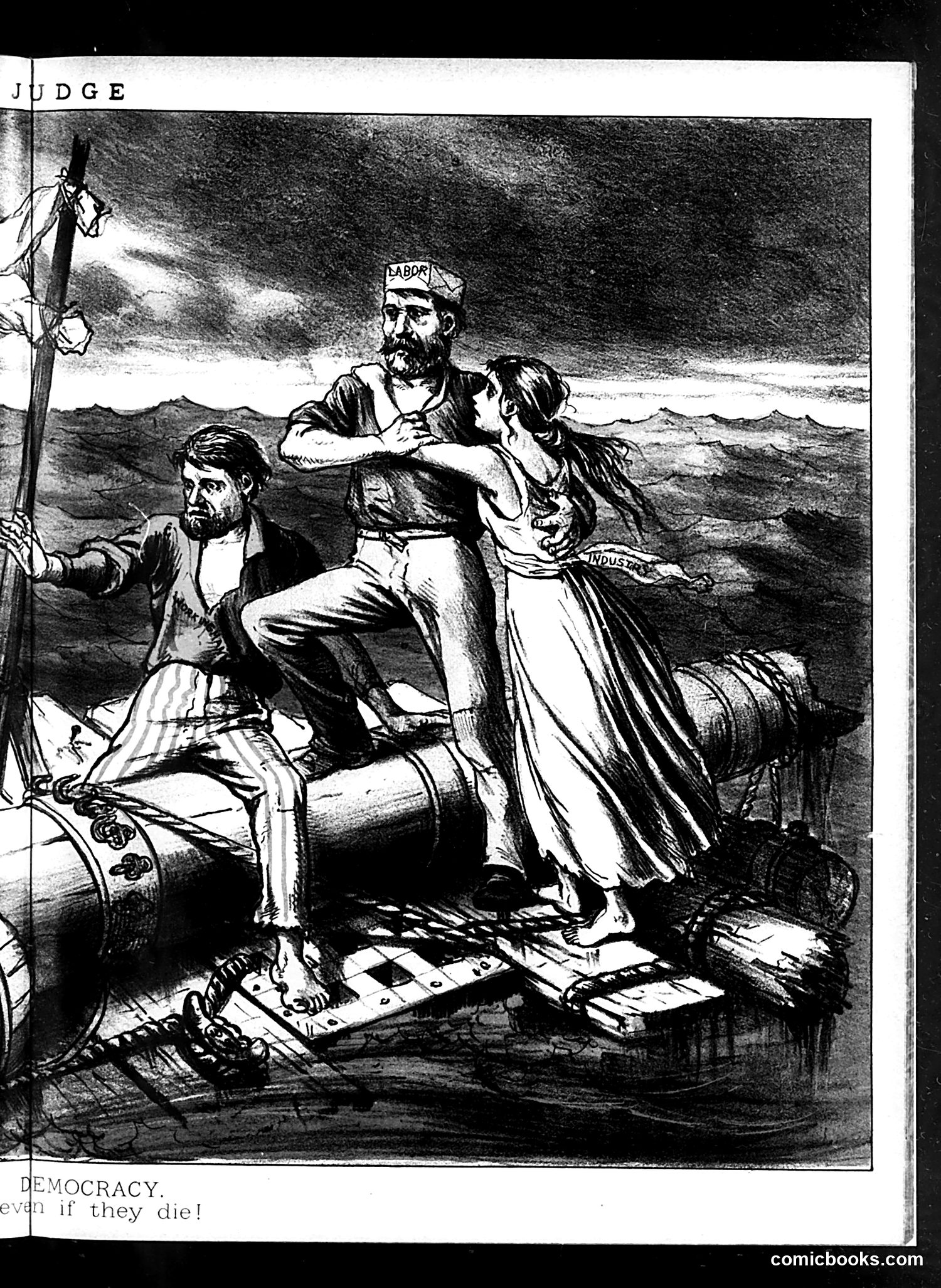
This cartoon titled "Democracy" depicts a bearded man labeled "Labor" protecting two women (likely representing Liberty and Justice or similar democratic ideals) from danger. A man on the left appears to be a judge or authority figure holding a staff or weapon. The scene is dramatic and turbulent, with stormy skies and rough waters below, suggesting crisis or threat. The caption reads "even if they die!" — implying Labor is willing to sacrifice everything to defend democracy's principles. This appears to be pro-labor political satire, likely from the late 19th or early 20th century, criticizing judicial or governmental opposition to labor movements. The cartoon suggests authorities threaten democratic values that Labor fights to preserve.
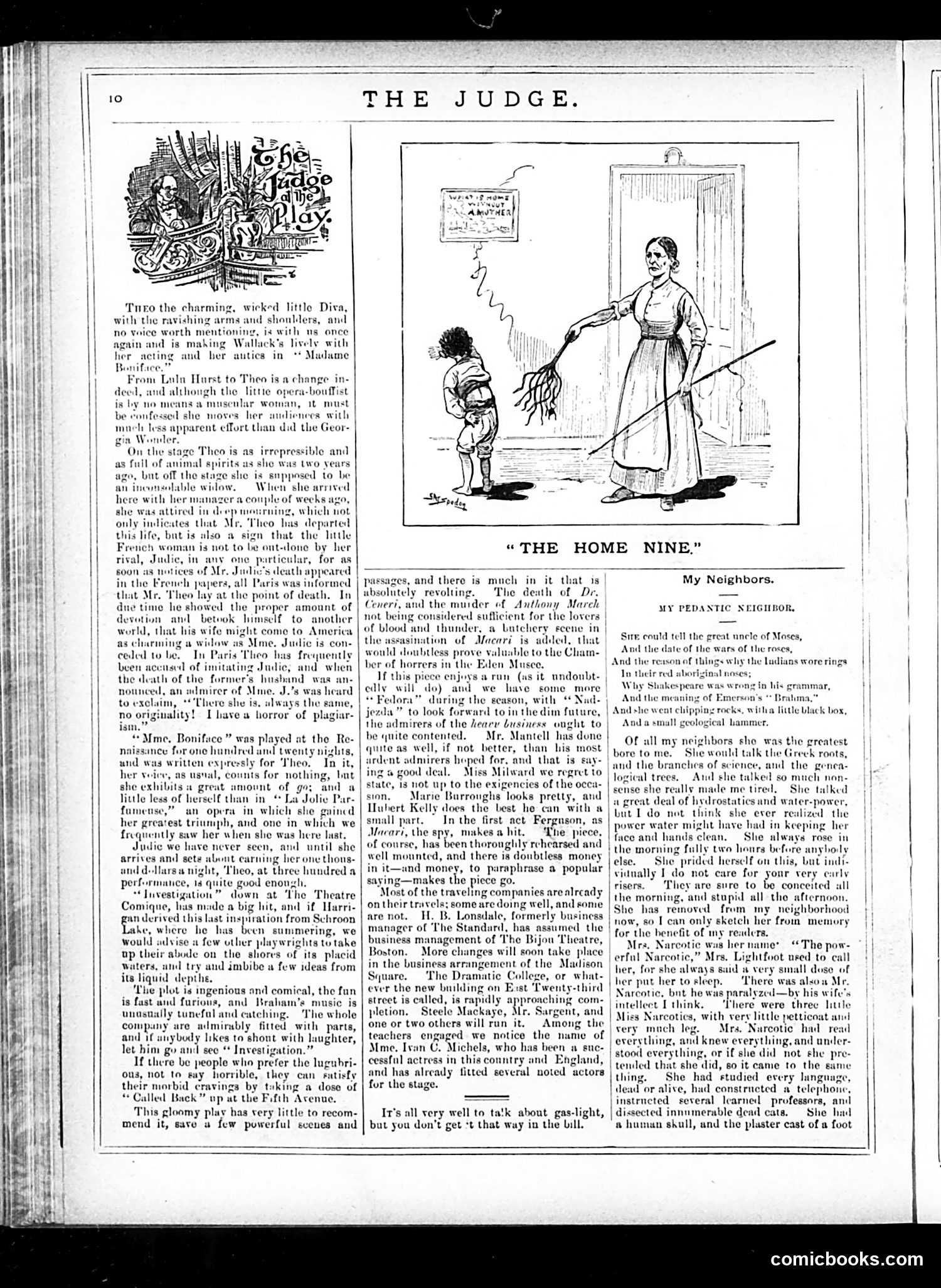
This page contains theatrical criticism and a domestic cartoon titled "The Home Nine." The illustration shows a woman wielding a broom or stick toward a small child, depicting marital/domestic conflict through sports metaphor. The accompanying text, "My Neighbors," is a satirical poem mocking a neighbor woman—apparently well-educated and pretentious (she "studied every language" and "dissected innumerable dead cuts")—yet uses her intelligence chiefly for dominating her household. The satire suggests the absurdity of an accomplished woman reducing herself to domestic tyranny. The upper portion reviews theatrical performances, particularly critiquing actress "Theo" (a French opera performer) who arrived in mourning following her husband's death—the magazine implies this was imitative performance, mirroring rival actress Judic's recent widowhood. The cartoons mock both theatrical pretension and domestic power dynamics of the era.
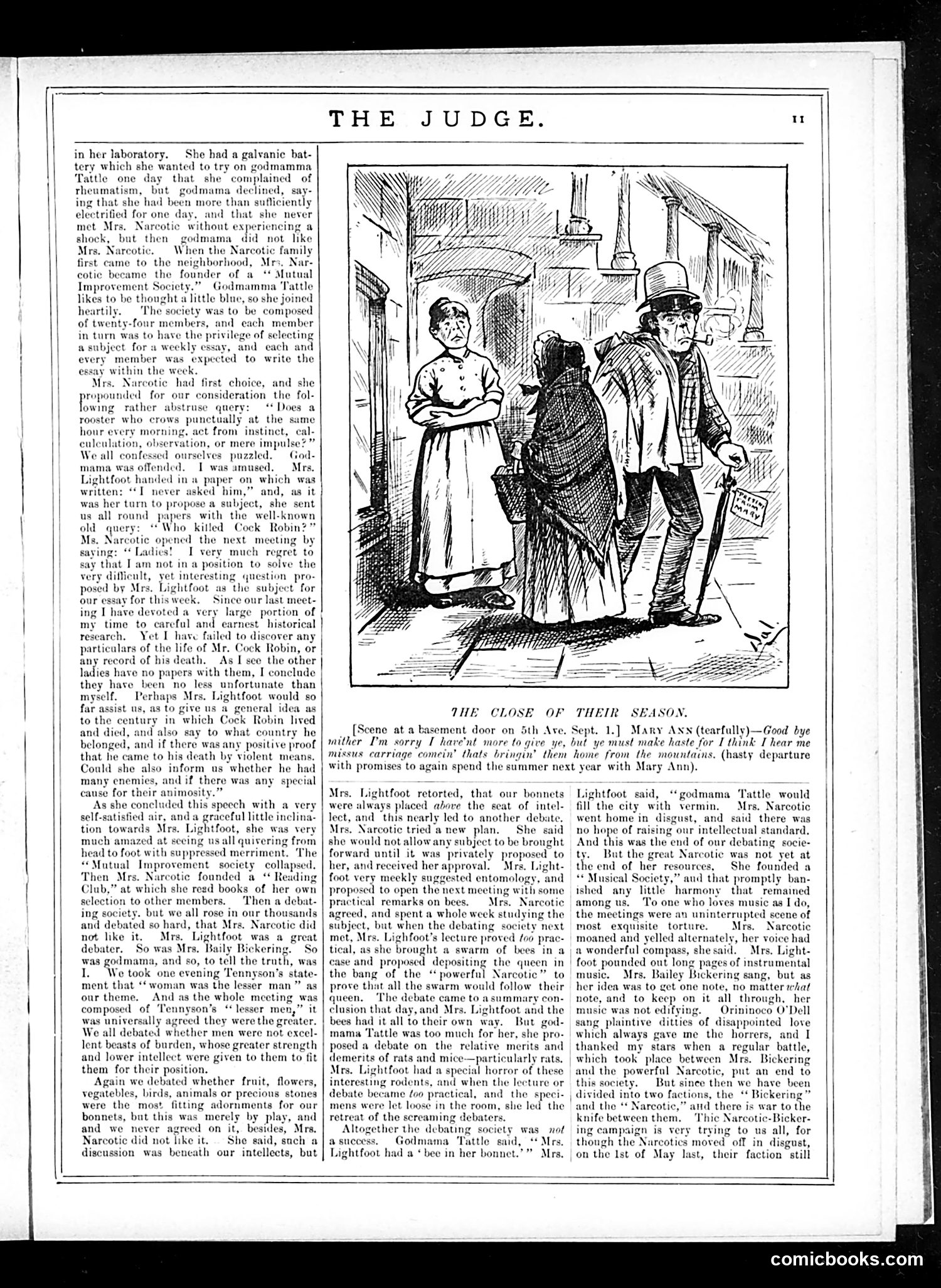
This satirical illustration depicts the dissolution of a "Mutual Improvement Society"—a women's club founded by the officious Mrs. Narcotic. The cartoon mocks the pretensions and failures of such organizations. The humor centers on Mrs. Narcotic's embarrassment when she asks members to research "Cock Robin" (the nursery rhyme character) for a scholarly essay, expecting historical documentation. When members realize she's seriously treating a children's rhyme as factual history, they collapse in laughter. The society subsequently attempts debating forums on Tennyson's "woman was the lesser man," bonnets, and other topics, but these devolve into chaos because Mrs. Narcotic—who founded the club—dislikes actual intellectual discourse. The final image shows the tearful end-of-season parting at a basement door, suggesting the society's ignominious collapse. The satire targets both women's self-improvement aspirations and those who establish such clubs not from genuine intellectual commitment, but for social pretension and personal authority.
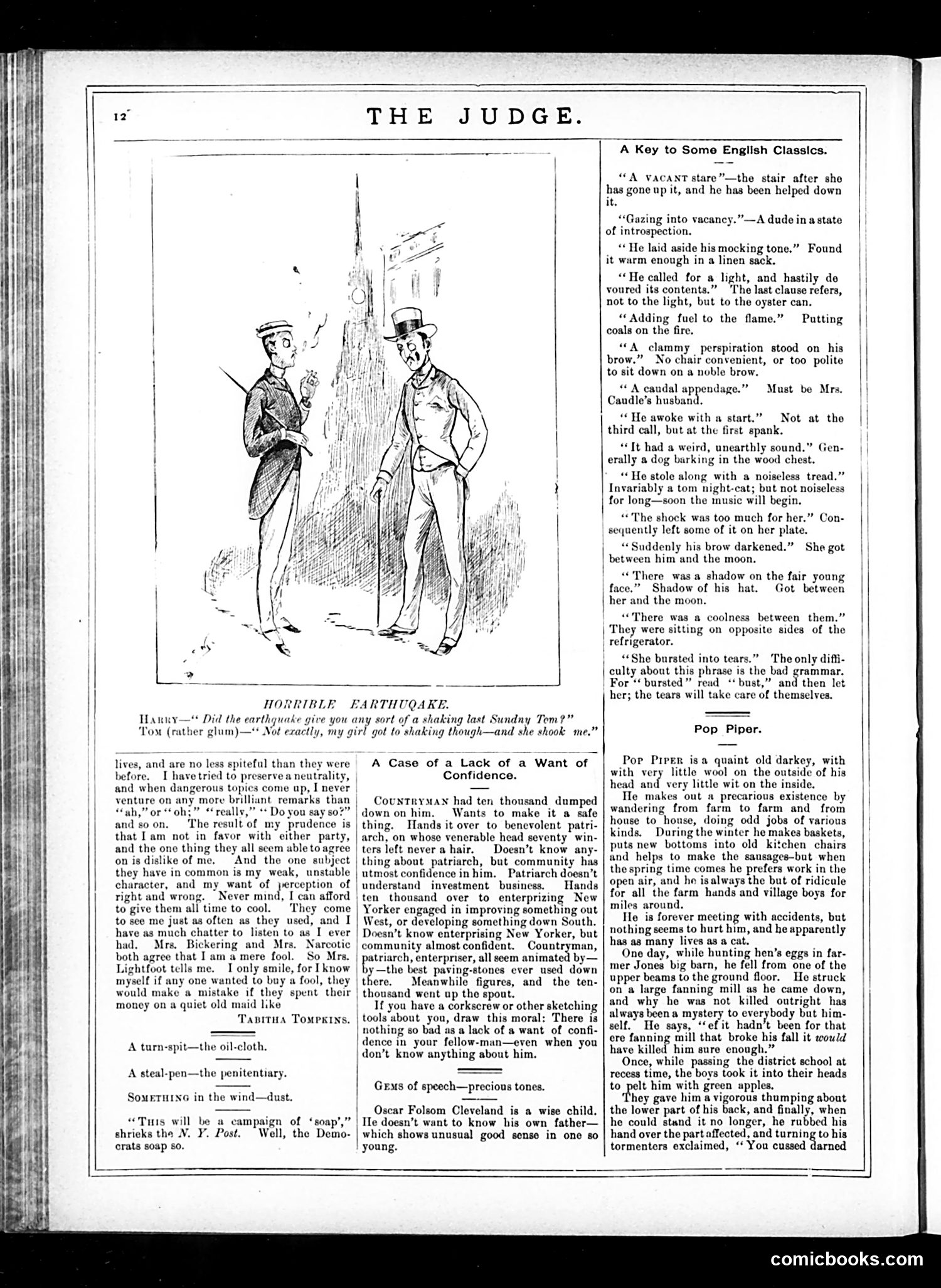
This page from the satirical magazine *Judge* contains several distinct pieces of humor targeting American society and politics circa the 1880s-90s. The main cartoon depicts two men discussing an earthquake, where one claims his girlfriend "shook" him—a crude double entendre joke about romantic/marital discord. Below is a longer satire about financial mismanagement: a countryman entrusts money to a patriarch, who passes it to a New York businessman, who squanders it. The piece ridicules blind trust in authority figures and the financial incompetence of chain-of-command investment. The page also includes political jabs at Cleveland (likely President Grover Cleveland, referenced as "Oscar Folsom Cleveland") and the Democratic Party ("campaign of soap"—possibly referencing either dishonesty or actual soap manufacturing interests). The "Key to English Classics" section humorously translates Victorian literary phrases into crude realities (a "vacant stare" = a woman after sexual relations), mocking the pretensions of contemporary literature.
This is a page from *Judge* magazine containing short humorous anecdotes and jokes rather than political cartoons. The humor reflects late 19th-century American social attitudes: **Key pieces:** - "The Rent Hadn't Been Raised" mocks a tenant who leaves because his landlord *won't* raise rent—he wants the place to seem desirable enough to warrant increases. - "A Cruel Remark" is a sexist "burn" where a man is compared to a hog after a woman asks him to move his feet. - "Should Marry a Burglar" makes a cruel pun about a woman's appearance (false locks/false keys). - "Light Literature" satirizes Cleveland's political letter as frivolous reading. The overall tone is snobby, mocking working-class people, women, and immigrants. These weren't sophisticated political satires but rather brief jokes appealing to middle-class sensibilities of the era—much like joke collections in modern magazines.
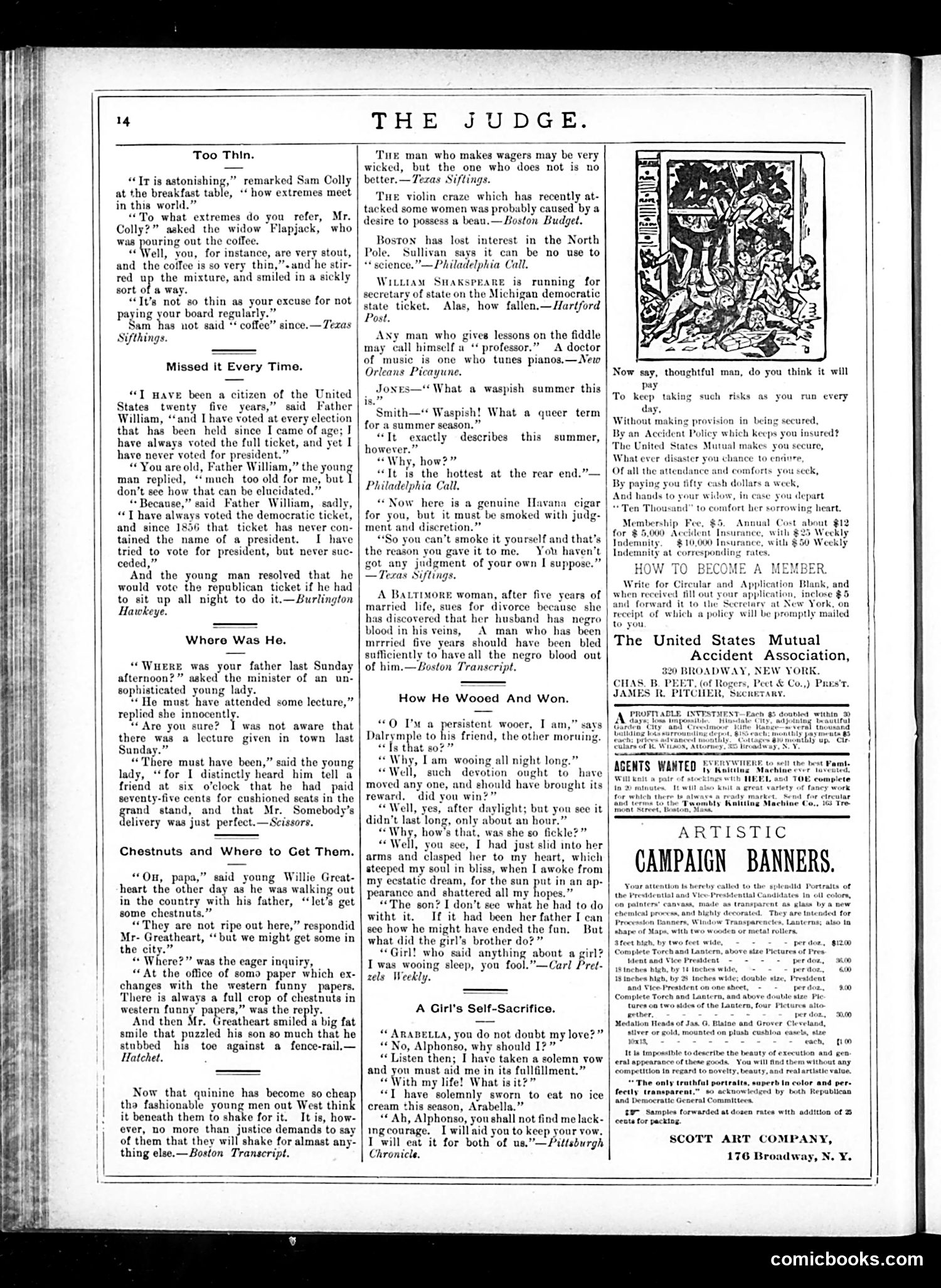
This page from **Judge** (a satirical weekly) contains primarily **short humor pieces and jokes** rather than political cartoons. The content reflects late 19th-century American humor conventions. **Key pieces:** - **"Too Thin"** mocks a widow's excessive weight through a domestic joke - **"Missed it Every Time"** satirizes the Democratic Party's electoral failures since 1856, suggesting they haven't nominated viable presidential candidates - **"Where Was He"** uses a child's innocent misunderstanding of her father attending a lecture (implied to be a baseball game based on "cushioned seats") - **"Chestnuts"** is a meta-joke—"chestnuts" were stale, repeated jokes, and the piece jokes that newspapers' funny pages are full of them - **Various one-liners** mock topics like violin lessons, summer heat, and fake cigars The small **woodcut illustration** (top right) appears decorative rather than tied to specific content. The page is typical Judge fare: light domestic humor, mild social commentary, and puns—designed for middle-class readers seeking entertainment rather than hard political satire.
This page is primarily **advertisements and reprinted jokes** from other newspapers, not original political cartoons. The notable political content is the "Republican Campaign Badges" section, which advertises cone-shaped campaign pins supporting **James G. Blaine's 1884 presidential campaign** against Grover Cleveland. The joke section includes mild satire: references to Cleveland as seeing "angels of light" (mocking his moral character claims), a pun about an Ohio oarsman arrested for counterfeiting (conflating "forging ahead" with forging money), and various newspaper humor about marriage ceremonies, milkmen's shoes, and a wood engraver arrested in a lumber yard. The page reflects Judge magazine's role as a **Republican-leaning satirical publication** during the contentious 1884 election, mixing advertising with reprinted editorial humor that subtly favors Blaine while mocking Democratic opponents and contemporary social absurdities.
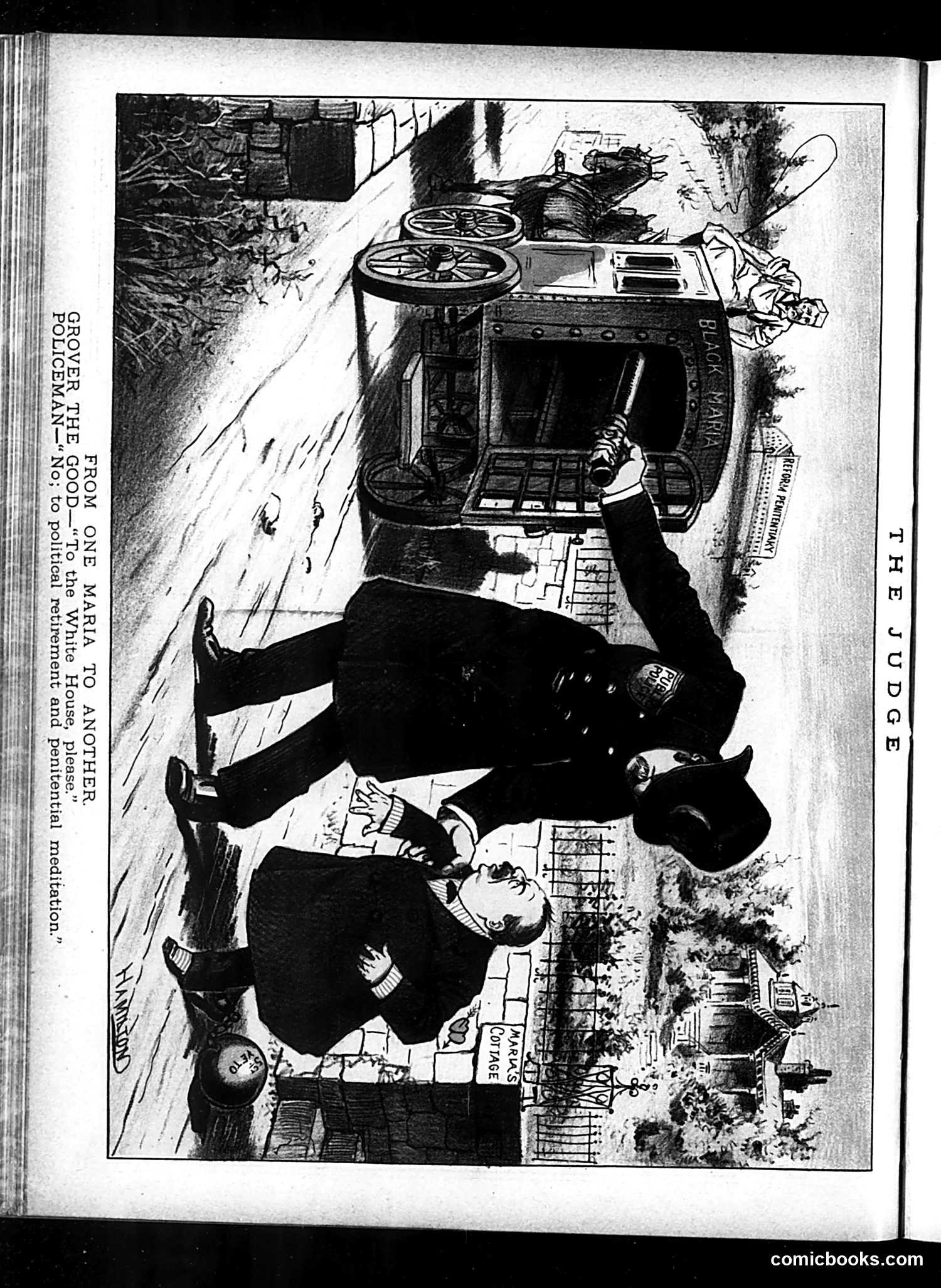
This cartoon depicts President Grover Cleveland (labeled "Grover the Good") arriving by carriage at what appears to be the White House. However, a policeman redirects him, telling him to go to "political retirement and penitential meditation" instead. The satire criticizes Cleveland's presidency, suggesting he doesn't deserve to enter the White House but rather should retire in disgrace. The caption's reference to "one Maria to another" likely alludes to a personal scandal involving Cleveland—he had faced controversy over an illegitimate child with a woman named Maria Halpin during his earlier career. The cartoon presents Cleveland as morally unfit for office, using the policeman as a voice of public judgment. "The Good" in his nickname appears ironic, mocking his reputation or self-presentation versus the cartoonist's view of his actual conduct.