
Judge, 1884-09-20 · page 13 of 16
Judge — September 20, 1884 — page 13: what you’re looking at
What you’re looking at
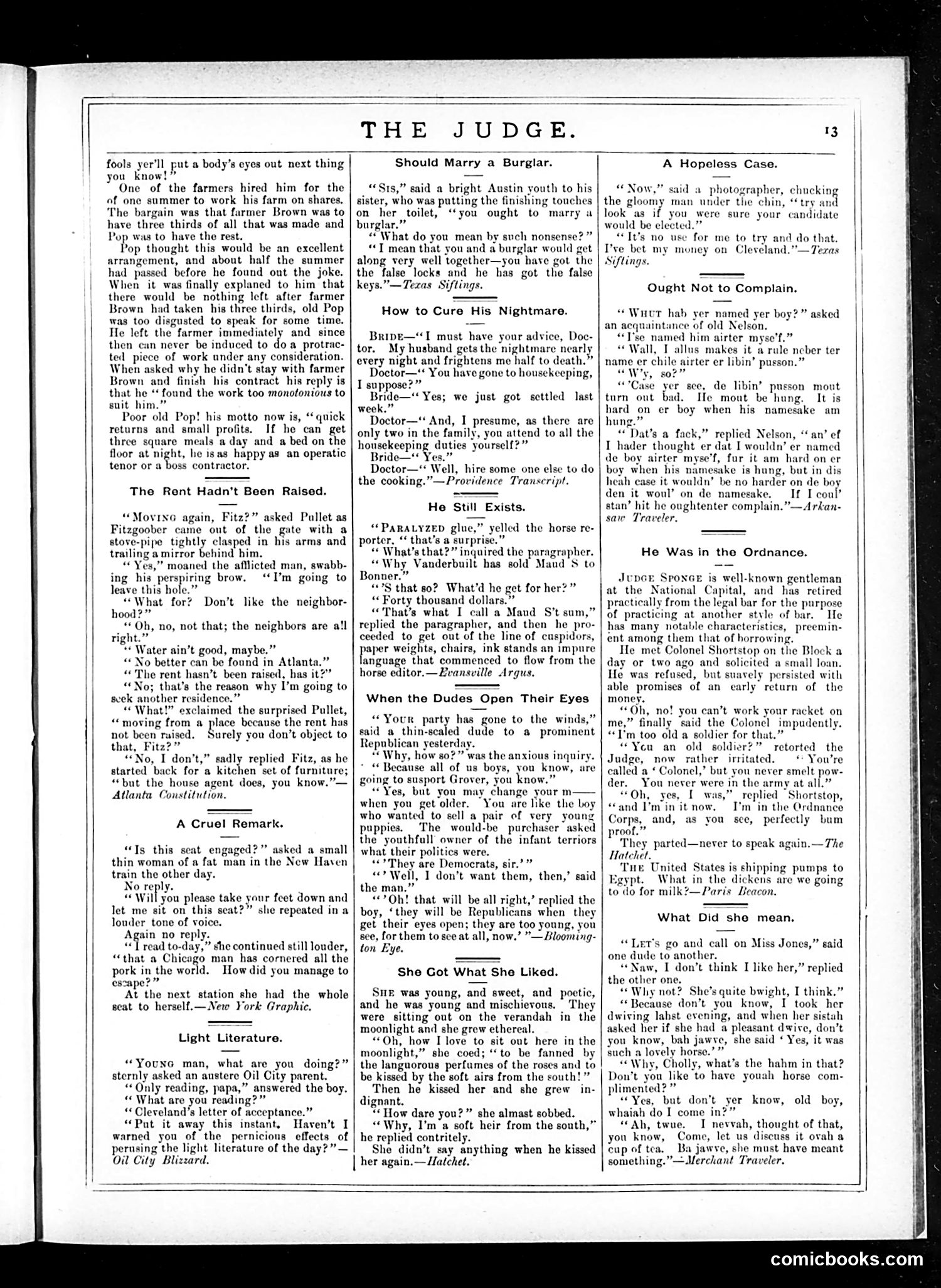
This is a page from *Judge* magazine containing short humorous anecdotes and jokes rather than political cartoons. The humor reflects late 19th-century American social attitudes: **Key pieces:** - "The Rent Hadn't Been Raised" mocks a tenant who leaves because his landlord *won't* raise rent—he wants the place to seem desirable enough to warrant increases. - "A Cruel Remark" is a sexist "burn" where a man is compared to a hog after a woman asks him to move his feet. - "Should Marry a Burglar" makes a cruel pun about a woman's appearance (false locks/false keys). - "Light Literature" satirizes Cleveland's political letter as frivolous reading. The overall tone is snobby, mocking working-class people, women, and immigrants. These weren't sophisticated political satires but rather brief jokes appealing to middle-class sensibilities of the era—much like joke collections in modern magazines.
📄 Transcribed text from this page (OCR, searchable)
Machine-transcribed from the original scan — historical spelling and the odd misread are preserved.
fools yer'll put body’s eyes out next thing you know!” One of the farmers hired him for the of one summer to work his farm on shares, ‘The bargain was that farmer Brown was to have three thirds of all that was made and Pop was to have the rest. Pop thought this would be an excellent arrangement, and about half the summer had passed before he found out the joke. When it was finally explaned to him that there would be nothing left after farmer Brown had taken his three thirds, old Pop was too disgusted to speak for some time. He left the farmer immediately and since then can never be induced to doa protrac- ted piece of work under any consideration. When asked why he didn’t stay with farmer Brown and finish his contract his reply is that he ‘found the work too monotonious to suit him.” Poor old Pop! his motto now is, ‘quick returns and small profits. If he can get three square meals a day and a bed on the floor at night, he isas happy as an operatic tenor or a boss contractor. The Rent Hadn’t Been Raised. “MovinG again, Fitz?” asked Pallet as Fitzgoober came out of the gate with a stove-pipe tightly clasped in his arms and ing a mirror behind him. “Yes,” moaned the afflicted man, swabb- ing his perspiring brow. ‘I’m going to leave this hole.” Don’t like the neighbor- “Oh, no, not that; the neighbors are all right.” “Water ain’t good, maybe.” “No better can be found in Atlanta, “The rent hasn’t been raised, has it? “No; that’s the reason why I’m going to seek another residence.” “What!” exclaimed the surprised Pullet, “moving from @ place because the rent has not been raised. Surely you don’t object to that, ” “No, I don’t,” sadly replied Fitz, as he started back for a kitchen set of furniture; “but the house agent does, you know.”— Atlanta Constitution. A Cruel Remark. “Ts this seat engaged?” asked a small thin woman of a fat man in the New Haven train the other day. No reply. “ Will you please take your feet down and let me sit on this seat?” she repeated in a louder tone of voice. Again no reply. “1 read to-day,” she continued still louder, “that a Chicago man has cornered all the pork in the world. How did you manage to escape?” At the next station she had the whole seat to herself.—New York Graphic. Light Literature. “YounG man, what are you doing?” sternly asked an austere Oil City parent. “Only reading, papa,” answered the boy. “What are you reading?” “ Cleveland’s letter of acceptance.” “Put it away this instant, Haven't I warned you of the pernicions effects of perusing the light literature of the day?” — Oil City Blizzard. THE JUDGE. Should Marry a Burglar. “Sts,” said a bright Austin youth to his sister, who was putting the finishing touches on her toilet, ‘‘you ought to marry a burglar.” “What do you mean by such nonsense?” “T mean that you and a burglar would get along very well together—you have got the the false locks and he has got the false keys.”—Tezas Siftings. How to Cure His Nightmare. Bripe—‘“‘I must have your advice, Doc- tor. My husband gets the nightmare nearly every night and frightens me half to death.” Doctor—“ You have gone to housekeeping, I suppose?” Bride—‘ Yes; we just got settled last week.” Doctor—‘ And, I presume, as there are only two in the family, you attend to all the housekeeping duties yourself? Bride—‘* Yes.” Doctor—‘ Well, hire some one else to do the cooking.”—Providence Transcript. He Still Exists. “PARALYZED glue led the horse re- porter, ‘ that’s a surprise.” “ What’s that?” inquired the paragrapher “Why Vanderbuilt has sold Maud S to Bonner.” “?’S that so? What'd he get for her?” “Forty thousand dollars.” “That’s what I call a Maud S’t sum,” replied the paragrapher, and then he pro- ceeded to get out of the line of cuspidors, paper weights, chairs, ink stands an impure janguage that commenced to flow from the horse editor.—Evansville Argus. When the Dudes Open Their Eyes “Your. party has gone to the winds,” said a thin-scaled dude to a prominent Republican yesterd “Why, how 80?” was the anxious inquiry. « Because all of us boys, you know, are going to susport Grover, you know.” “Yes, but you may change your m—— when you get older. You are like the boy who wanted to sell a pair of very young puppies. The would-be purchaser asked the youthfull owner of the infant terriors what their politics were. “?They are Democrats, sir.’” “? Well, I don’t want them, then,’ said the man.” “Oh! that will be all right,’ replied the boy, ‘they will be Republicans when they get their eyes open; they are too young, you see, for them to see at all, now.’ "—Blooming- ton Eye. She Got What She Liked. Sng was young, and sweet, and poetic, and he was young and mischievous, They were sitting out on the verandah in the moonlight and she grew ethereal. “Oh, how I love to sit out here in the moonlight,” she coed; ‘‘to be fanned by the languorous perfumes of the roses and to be kissed by the soft airs from the south!” Then he kissed her and she grew in- dignant. “How dare you?” she almast sobbed. “Why, I’m a soft heir from the south,” he replied contritely. She didn’t say anything when he kissed her again.— Hatchet. A Hopeless Case. “Now,” said a photographer, chuckin the gloomy man under the chin, try aid look as if you were sure your candidate would be elected.” ° ‘It’s no use for me to tr I've bet my money on Cle Siflings. nd do that. and.""—Teras Ought Not to Complain. “Wut hab yer named yer boy?” asked an acquaintance of old Nelson “T’se named him airter myse’f.” “Wall, I allus makes it a rule neber ter name er chile airter er libin’ pusson.” “Case yer sce, de libin’ pnsson mout turn out bad. He mout be hung. It is hard on er boy when his namesake am hung.” “ Dat’s a fack,” replied Nelson, ‘an’ ef I hader thought er dat I wouldn’ er named de boy airter myse’f, fur it am hard on er boy when his namesake is hung, but in dis heah case it wouldn’ be no harder on de boy den it woul’ on de namesake. If I coul? stan’ hit he oughtenter complain.” —Arkan- saw Traveler. He Was in the Ordnance. Jupe is well-known gentleman at the National Capital, and has retired practically from the legal bar for the purpose of practicing at another style of bar. He has many notable characteristics, preemin- ent among them that of borrowing. Ife met Colonel Shortstop on the Block a day or two ago and solicited a small loan. He was refused, but suavely persisted with able promises of an early return of the money. “Oh, no! you can’t work your racket on me,” finally ‘said the Colonel impudently. “I'm too old a soldier for that.” “You an old soldier?” retorted the Judge, now rather irritated. «© You're called a ‘ Colonel,” but you never smelt pow- der. You never were in the army at all.” “Oh, yes, [wa replied “Shortstop, ‘Cand min it now. I’m in the Ordnance Corps, and, as yon sce, perfectly bum proof.” They parted—never to speak aga Hatchet. Tue United States is shipping pumps to Egypt. What in the dickens are we going to do for mil Paris Beacon. n.—The What Did she mean. “Let's go and call on Miss Jones,” said one dude to another. “Naw, I don’t think I like her,” replied the other one. “Why not? She’s quite bwight, I think.” “ Because don’t you know, I took her dwiving lahst evening, and when her sistah asked her if she had a pleasant dwive, don’t you know, bah jawve, she said ‘ Yes, it was such a lovely horse.’ ” “Why, Cholly, what’s the hahm in that? Don't you like to have youah horse com- plimented?” “Yes, but don't yer know, old boy, whaiah do I come in?” “Ah, twue. I nevvah, thought of that, you know, Come, let us discuss it ovah a cup of tea. jawve, she must have meant something.” —Merchant Traveler. comicbooks.com