
A complete issue · 16 pages · 1884
Judge — August 30, 1884
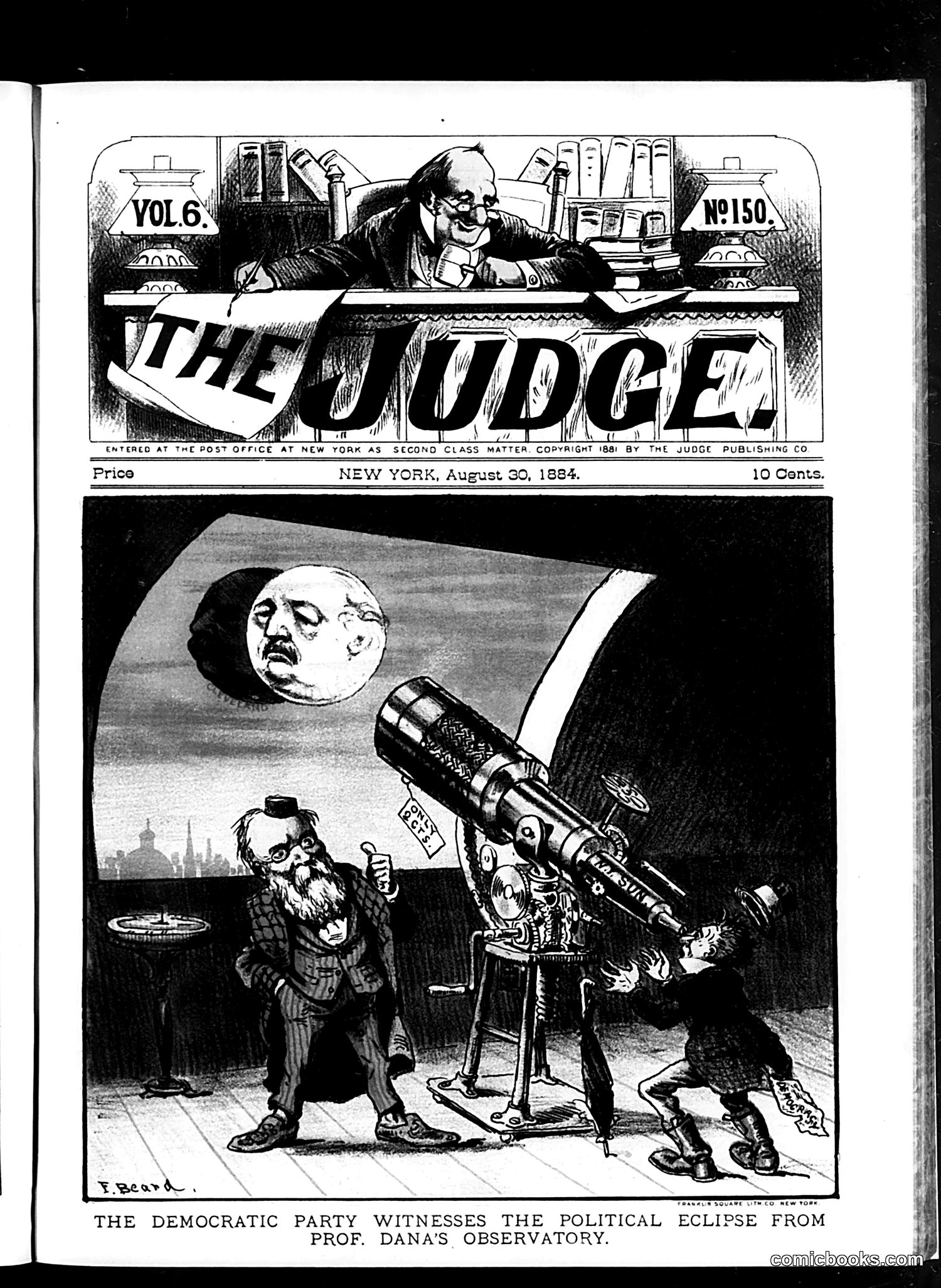
This political cartoon satirizes the Democratic Party's response to the 1884 presidential election. The main image shows figures observing through a telescope as a disembodied face (likely a political opponent) appears above a cityscape. The caption references "the political eclipse from Prof. Dana's Observatory." The satire appears to mock the Democrats' pessimistic outlook during the campaign period. The telescope observation suggests they're witnessing something disappear or fade—presumably their electoral prospects. The celestial/eclipse metaphor implies the Democratic Party's fortunes are dimming. Without additional context, the specific candidates or events referenced remain unclear, though 1884 was a significant presidential election year. The cartoon uses astronomical imagery as metaphor for political decline.
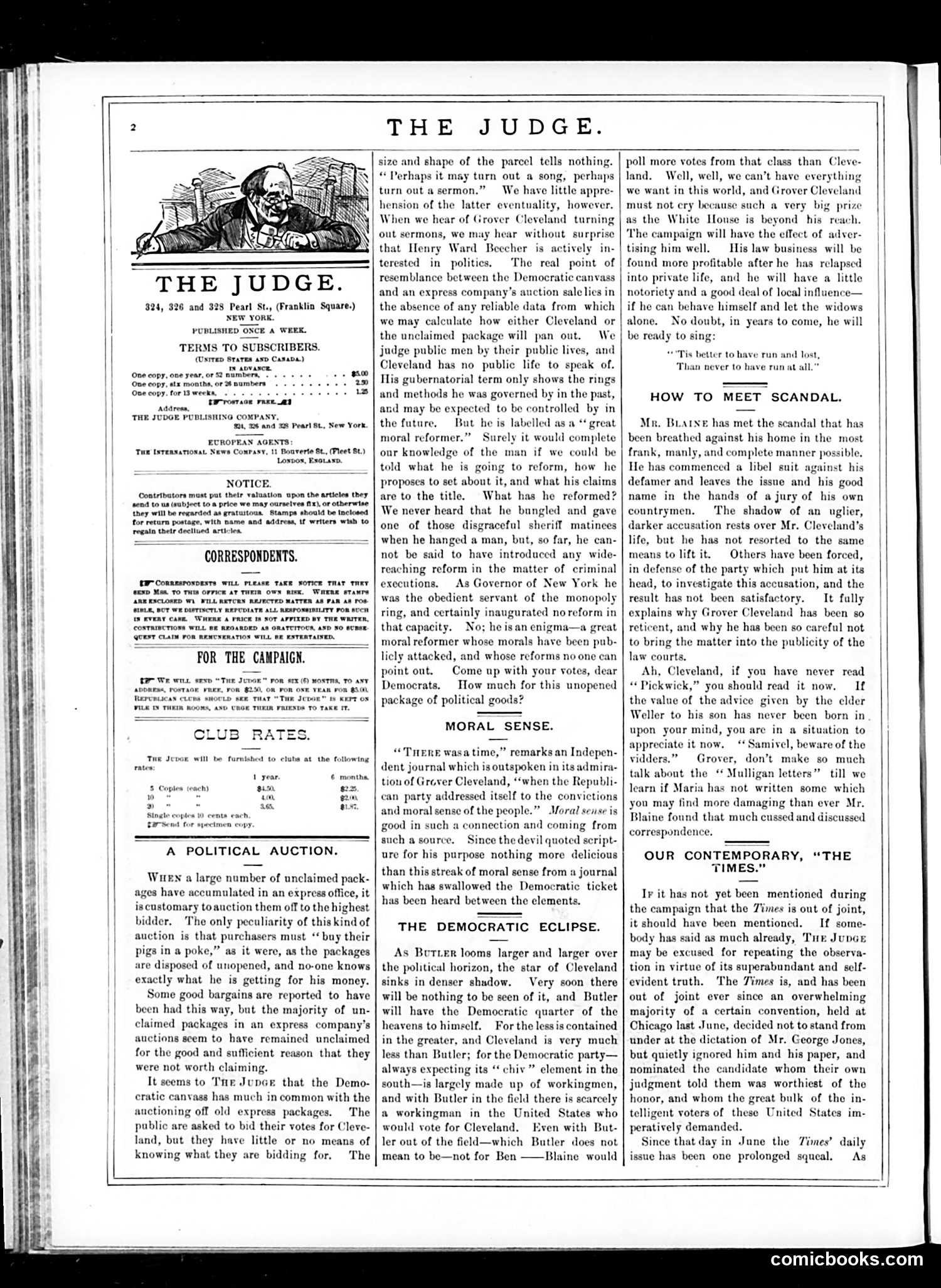
This page attacks Democratic presidential candidate **Grover Cleveland** through two main critiques: **"A Political Auction"** compares Cleveland to an unopened, unclaimed express package—voters are asked to bid (vote) for him without knowing what they're getting. The satire argues Cleveland has **no public record to evaluate**: his governorship merely shows he served monopoly interests without meaningful reform. He's labeled a "great moral reformer" but Judge demands specifics—*what* has he reformed? The piece sarcastically notes they'll believe he's a reformer when Henry Ward Beecher enters politics. **The cartoon** (top left) appears to show a disheveled figure amid chaos, likely representing Cleveland or Democratic disorder. The related articles ("How to Meet Scandal," "The Democratic Eclipse") continue attacking Cleveland's vagueness and suggesting Butler will overshadow him politically. The *Times* newspaper is criticized for bias toward Cleveland. This reflects the 1884 presidential campaign where Judge, a Republican-leaning publication, sought to undermine Cleveland's outsider "reformer" image through ridicule of his lack of substantive platform.
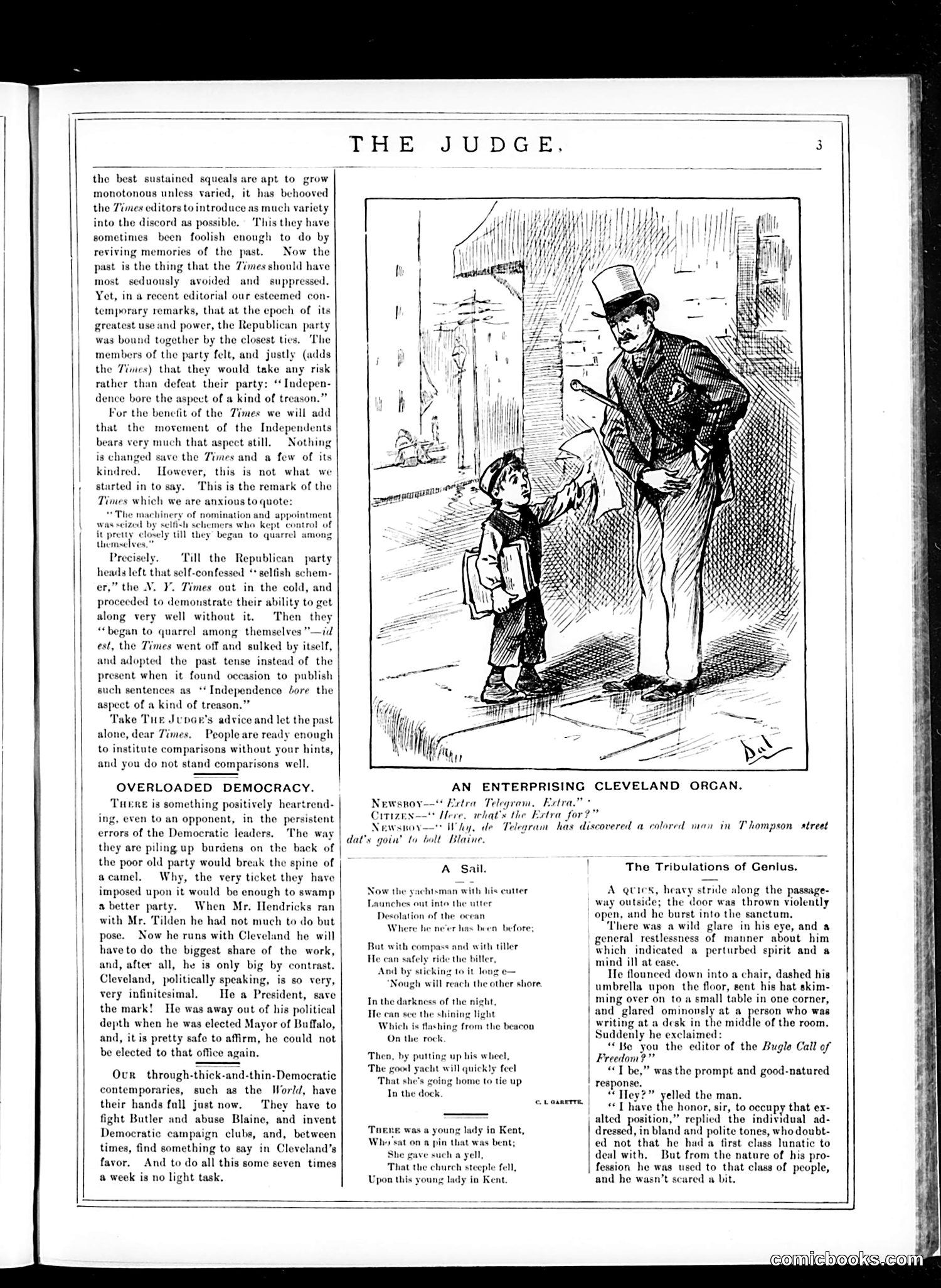
This page contains political satire attacking the New York Times and Democratic leadership during what appears to be the 1884 presidential election era. **Main Cartoon**: "An Enterprising Cleveland Organ" mocks the Times's desperate efforts to support Democratic candidate Grover Cleveland. The newsboy's discovery of "a colored man in Thompson street dat's goin' to bait Blaine" satirizes how trivial and absurd the Times must make its endorsements to help Cleveland against Republican James G. Blaine. **"Overloaded Democracy" section**: Ridicules the Democratic ticket, suggesting Cleveland is politically incompetent—"infinitesimal" and unfit even for his previous role as Buffalo mayor. The piece mocks Democratic papers struggling to manufacture support for an inadequate candidate. **Times Editorial Critique**: Judge attacks the Times for selectively invoking Republican Party history to defend independents, while hypocritically condemning Democratic independence as "treason." The satire assumes readers recognize Cleveland as weak and Blaine as the stronger candidate, reflecting Judge's Republican perspective.
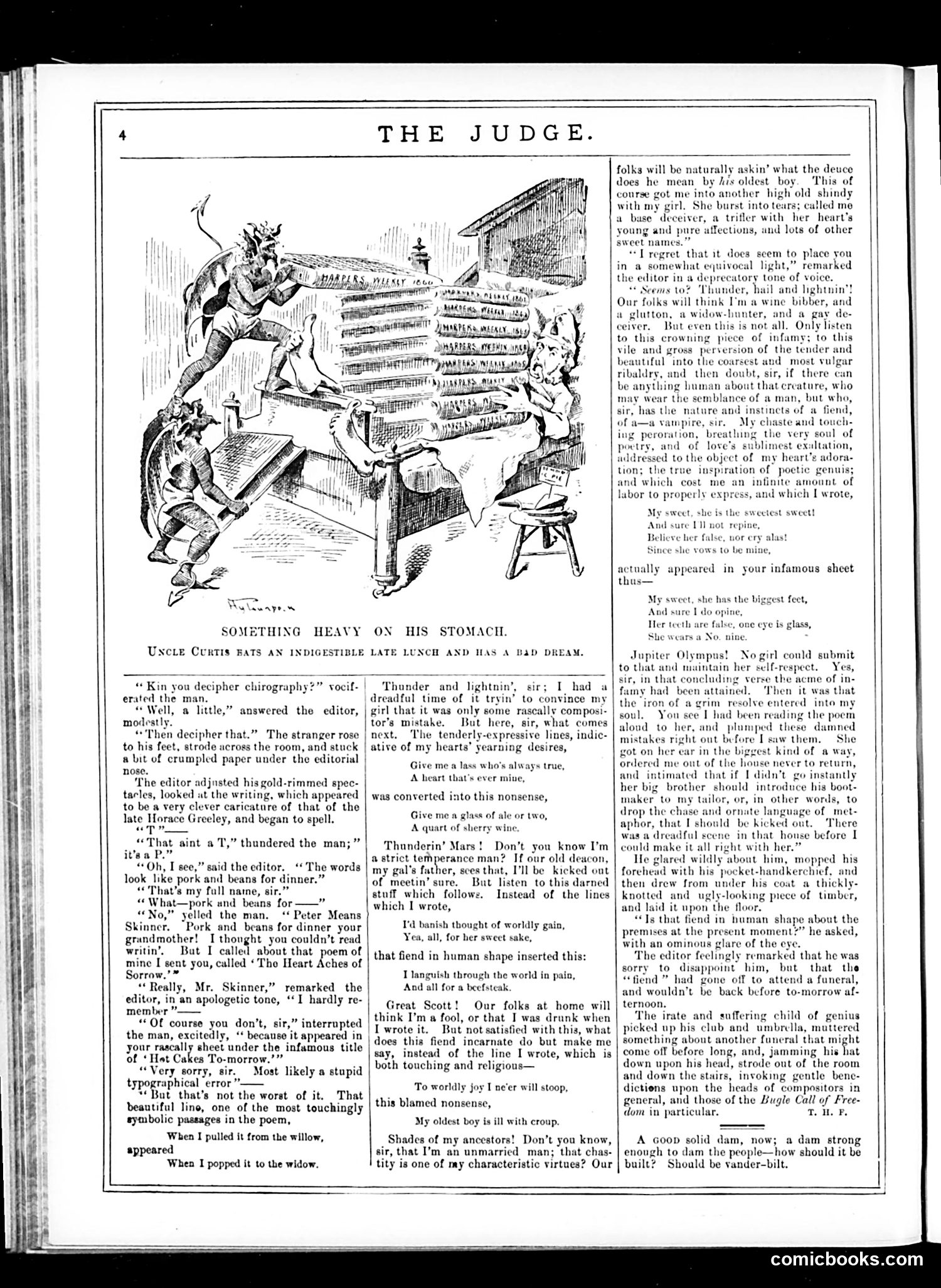
This page satirizes the frustrations of a poem submission gone wrong through editorial incompetence. A man named Peter Means Skinner confronts a magazine editor about systematic typographical errors that mangled his romantic, moralistic verse into embarrassing nonsense. The humor relies on specific botched corrections: "When I pulled it from the willow" became "When I popped it to the widow"; romantic lines about "a lass who's always true" transformed into drinking references ("a glass of ale or two"); and his chaste declaration became boastful claims about an "oldest boy"—humiliating for an unmarried temperance advocate. The cartoon above depicts Uncle Curtis suffering indigestion-induced nightmares from bad food, visualizing the chaos of misread documents and editorial confusion—a visual parallel to the textual chaos described below. The satire mocks both typographical errors and the editor's dismissive, incompetent responses to legitimate complaints about ruined reputations.
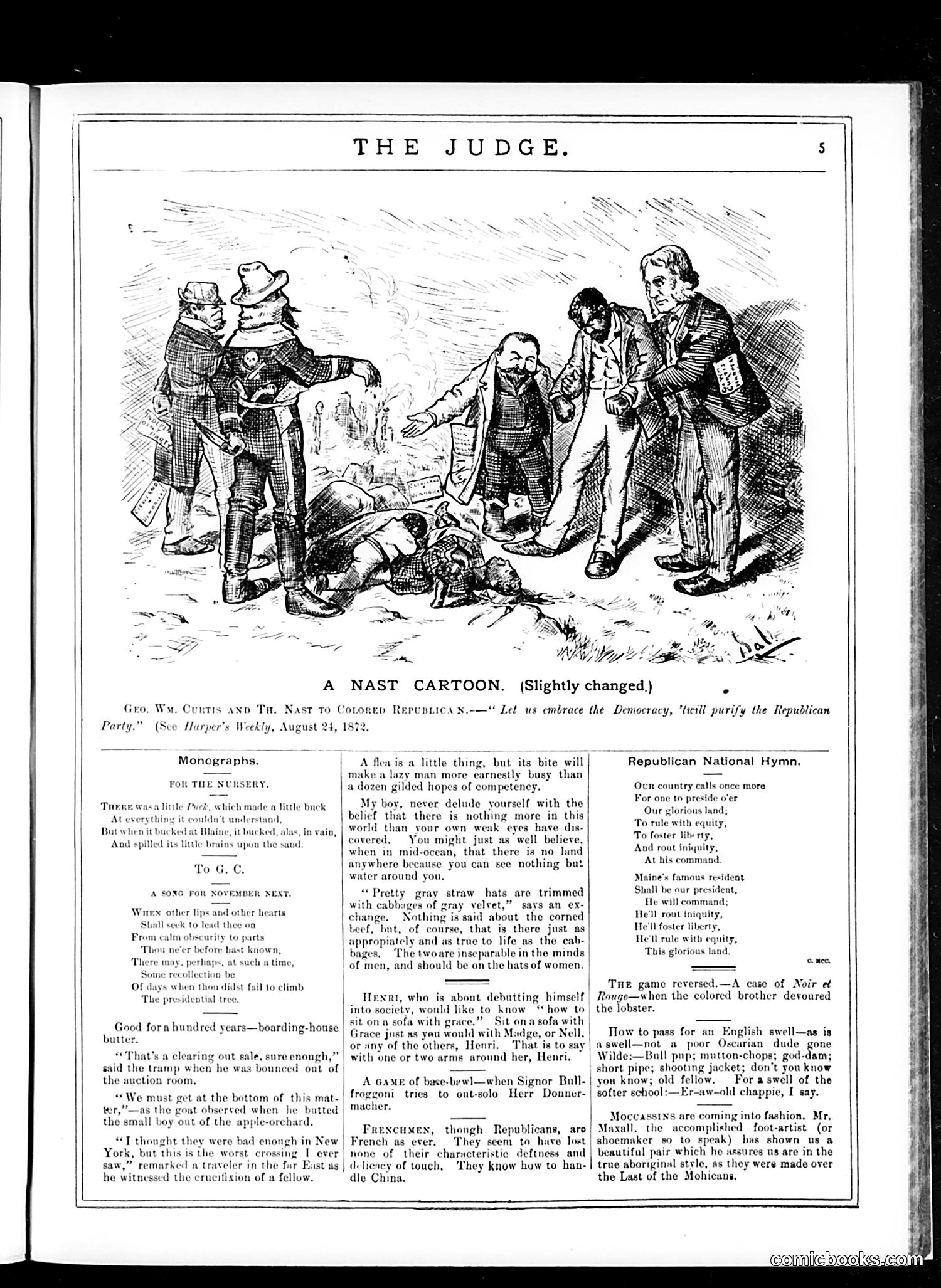
This page reproduces a Thomas Nast cartoon (originally from Harper's Weekly, August 24, 1872) criticizing Republican efforts at reconciliation with Democrats. The caption quotes George William Curtis and Nast addressing "Colored Republicans," proposing they "embrace the Democracy" to "purify the Republican Party." The cartoon depicts well-dressed men (likely Republican politicians) surrounding a prone figure (representing the colored/Black Republican voter or the Republican Party itself), appearing to manipulate or control rather than genuinely reconcile. The satire suggests Republican overtures toward Democrats were insincere and would harm Black Republican interests. The page also contains unrelated humor pieces and a "Republican National Hymn" mocking GOP campaign rhetoric. This reflects Judge's role as a satirical weekly targeting political hypocrisy during the contested 1872 presidential election period, when Republican unity fractured over Reconstruction and civil rights issues.
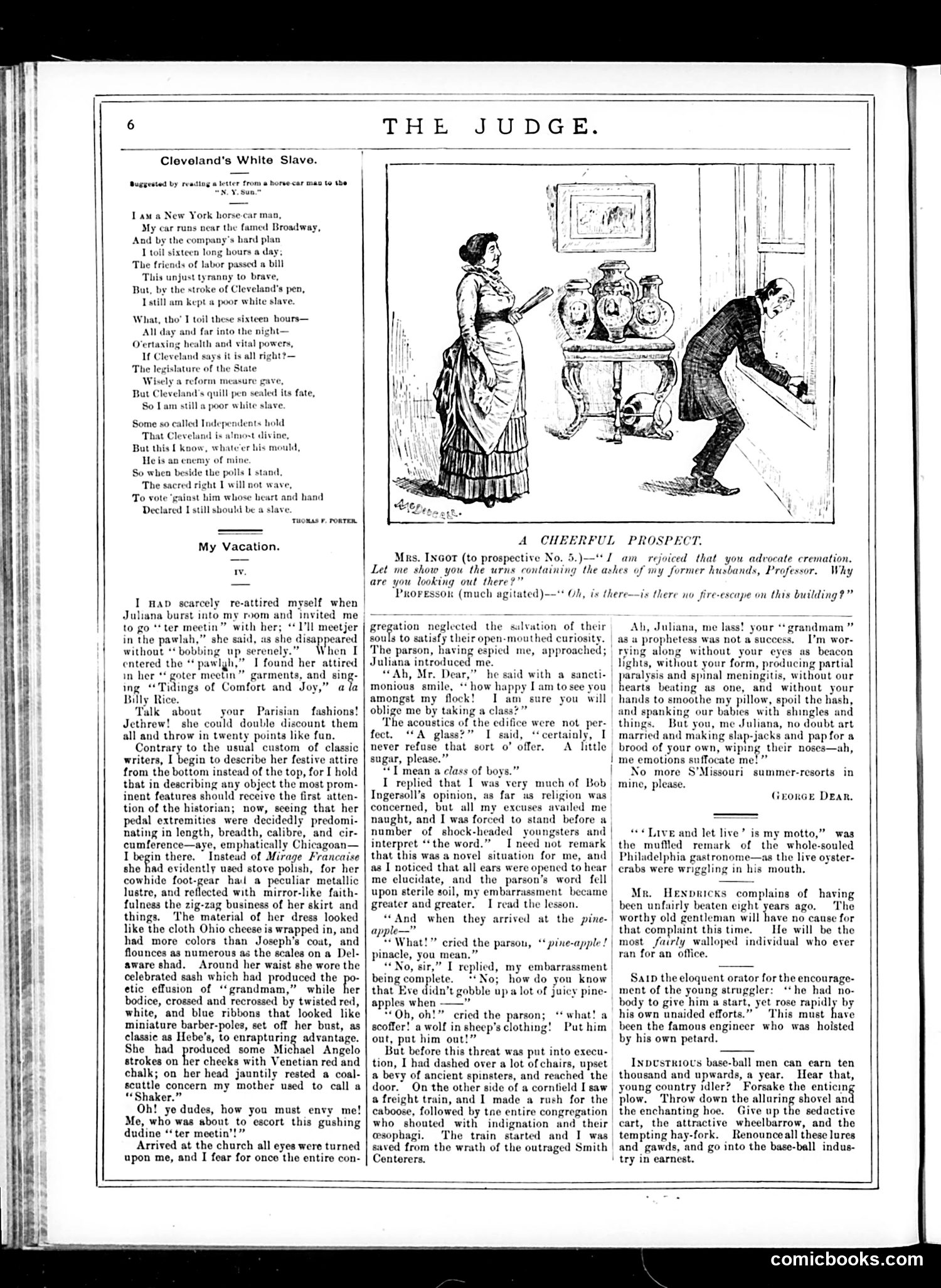
This page satirizes President Grover Cleveland's veto of labor-protection legislation. A New York horse-car (streetcar) conductor complains that despite a bill from labor advocates limiting his workday, Cleveland's presidential veto kept him enslaved to grueling sixteen-hour shifts. The poem's bitter irony—calling a laborer a "white slave"—attacks Cleveland for siding with business interests over workers' rights. The cartoon "A Cheerful Prospect" (top right) depicts the same tension: a woman and man (likely representing labor and management, or competing political interests) debate before decorative pottery, symbolizing industrial commerce. The satire criticizes Cleveland's anti-labor stance and suggests he betrayed working-class supporters who expected Democratic protection of their interests. The remainder of the page contains unrelated humorous fiction.
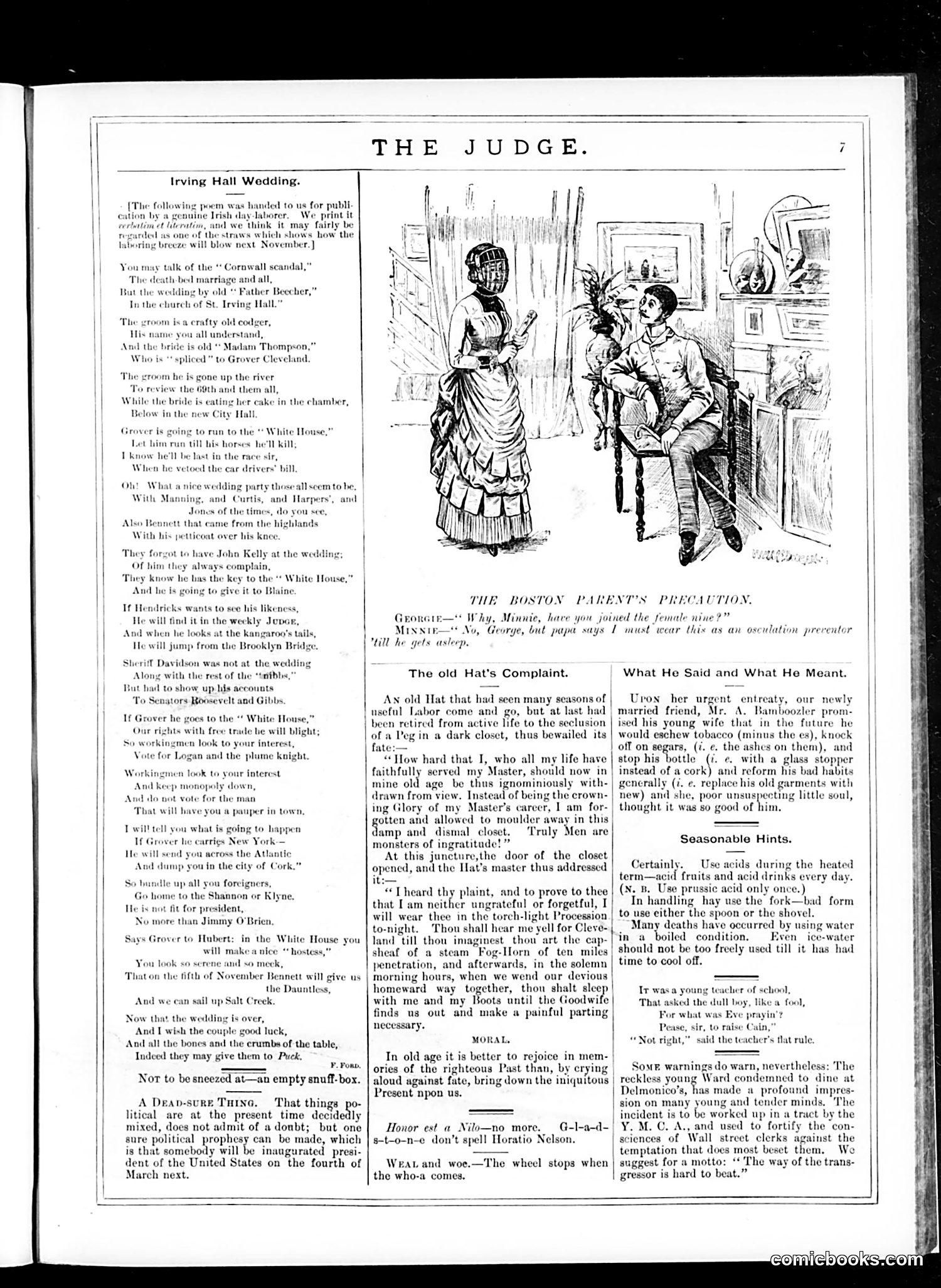
This page satirizes the 1884 American presidential election. The main poem, "Irving Hall Wedding," uses a wedding as an extended metaphor for political corruption and incompetence. "Irving Hall" likely refers to a Democratic political venue; the "groom" appears to be a political figure (possibly Grover Cleveland, explicitly mentioned), and the wedding chaos represents factional Democratic disorder. The satire mocks Cleveland and associated politicians (Manning, Curtis, Bennett, Logan) as unfit leaders. References to the "White House" and vetoed bills critique Cleveland's political record. The poem warns Irish-American workers ("foreigners") not to support Democratic candidates, predicting economic disaster if Grover "carries New York." The secondary pieces—"Boston Parent's Precaution" and "The Old Hat's Complaint"—employ lighter humor but continue the election-year political messaging typical of Judge's partisan Republican stance during this pivotal election year.
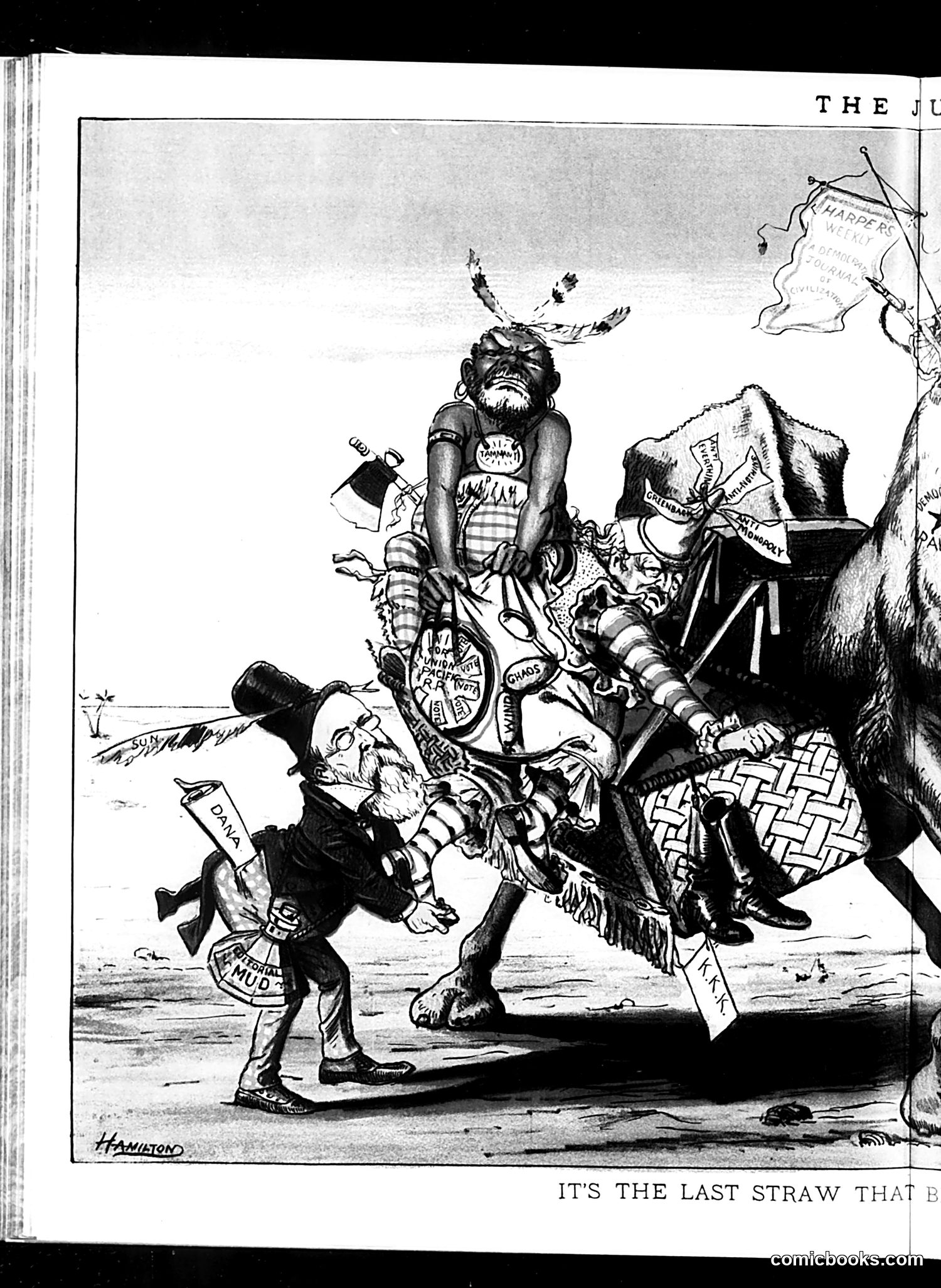
This cartoon by Hamilton depicts what appears to be a camel—a traditional symbol representing the breaking point of tolerance—literally breaking under accumulated burdens. The figures riding or loading the camel wear labels suggesting different political or social issues (text is partially legible but difficult to read with certainty). The caption "IT'S THE LAST STRAW THAT B[REAKS THE CAMEL'S BACK]" references the proverbial expression about incremental problems eventually causing collapse. The cartoon satirizes how multiple political crises or policy failures, when combined, create an unsustainable situation that finally provokes public reaction or governmental failure. The specific issues being referenced are unclear from this image alone, suggesting this required contemporary context readers in Judge magazine would have immediately recognized.
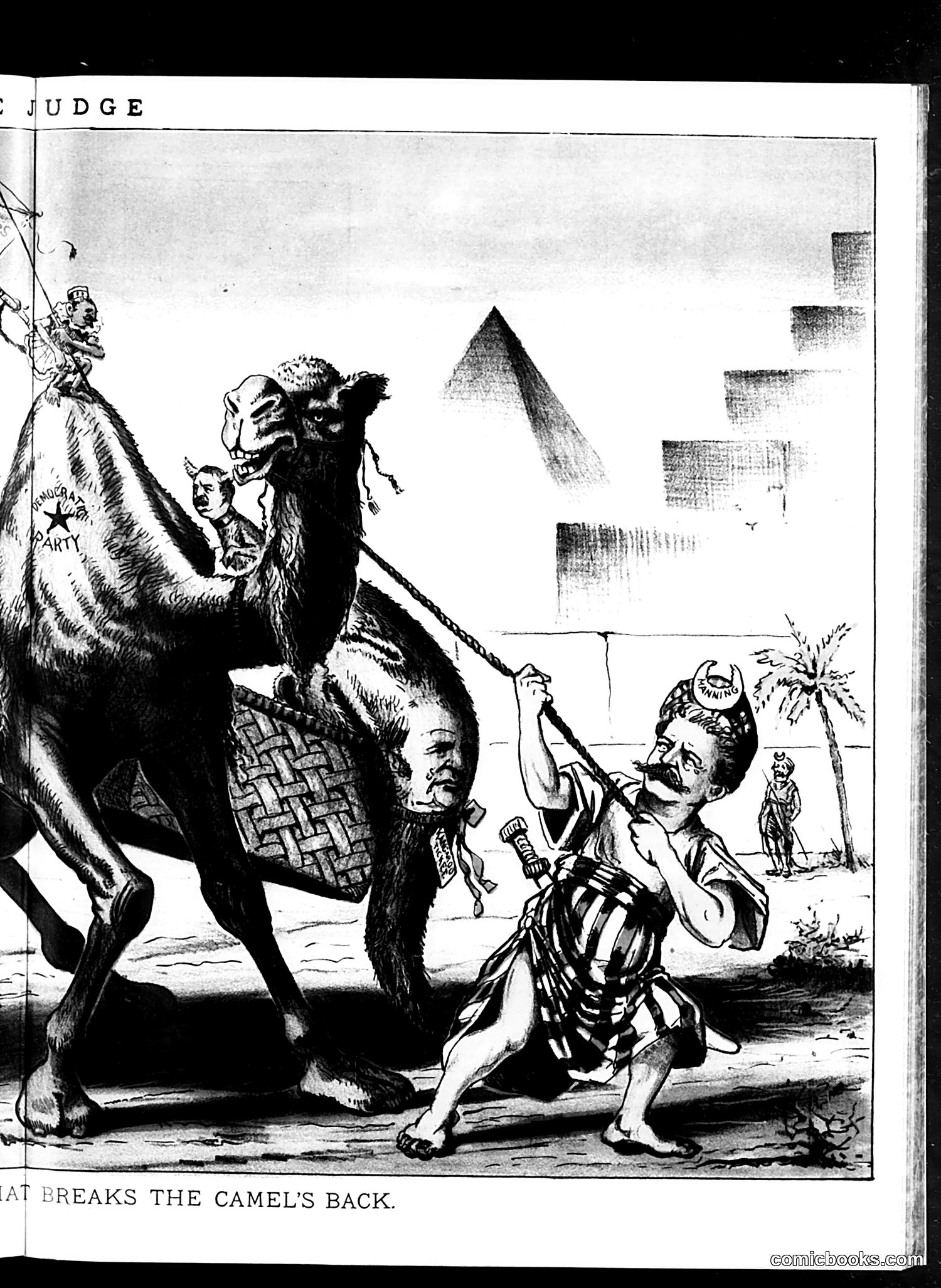
This Judge magazine cartoon illustrates the phrase "that breaks the camel's back" — meaning a final burden that causes collapse after many prior stresses. The image shows a camel bearing a heavy load, with a figure on the right preparing to add one more item. On the camel's back rides what appears to be a Democratic Party figure (marked with party insignia), suggesting the Democratic Party is already heavily burdened. The pyramids in the background indicate an Egyptian or colonial context, likely referencing imperial or foreign policy matters. The cartoon satirizes how one additional political problem or policy decision would overwhelm an already-stressed political party. Without a specific date visible, the exact political crisis referenced remains unclear, but the message criticizes Democratic Party overextension.
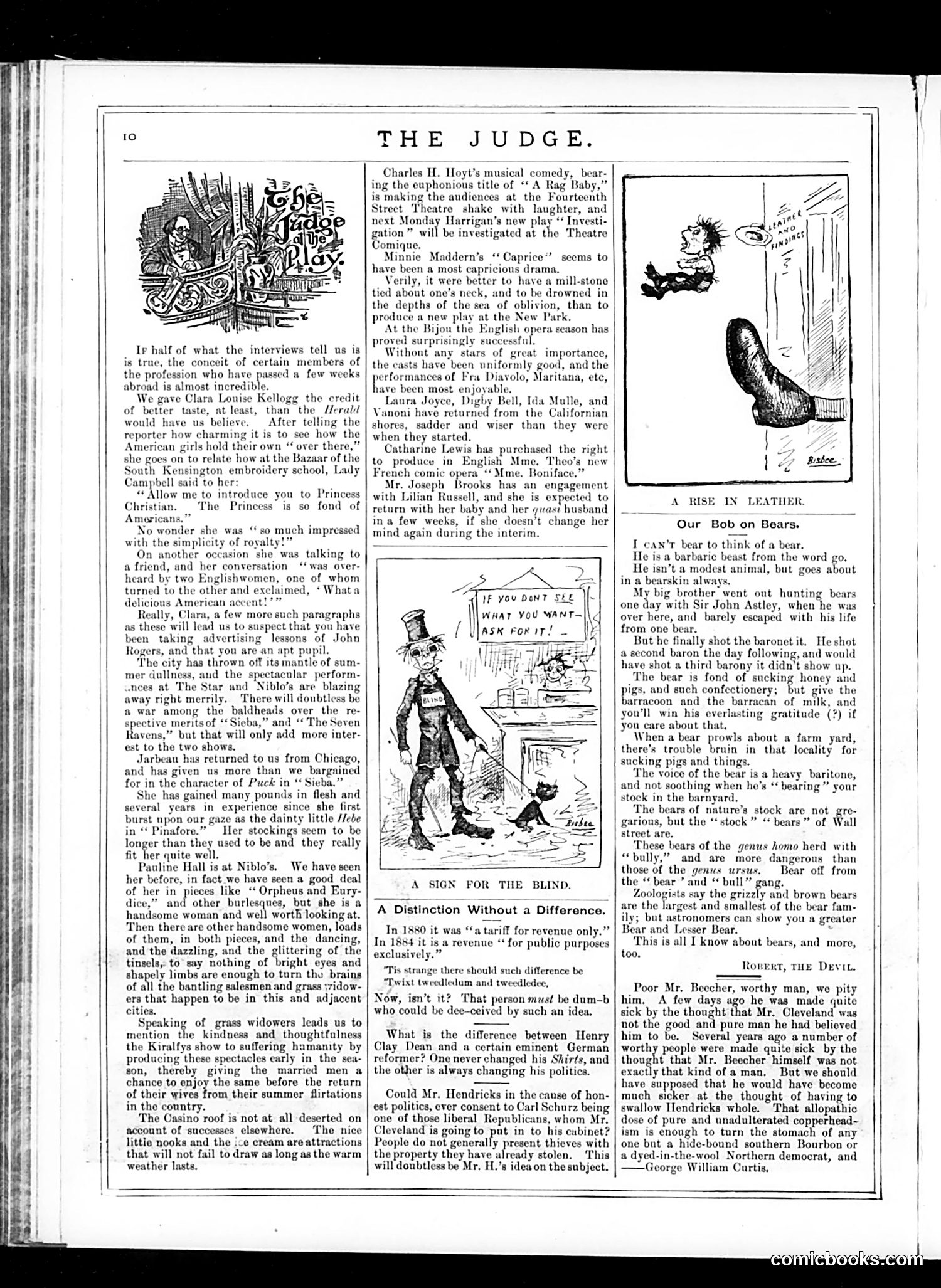
This page from Judge combines theater criticism with social satire. The main target is American performers abroad, particularly soprano Clara Louise Kellogg, who the critic mocks for boasting about European encounters. When Kellogg claims a British princess found Americans charming for their "simplicity," Judge sarcastically suggests she's become as self-promotional as John Rogers (likely referencing a famous sculptor known for commercial appeal). The cartoons labeled "A Sign for the Blind" and "A Rise in Leather" appear to be unrelated visual gags. The second article, "A Distinction Without a Difference," critiques political hypocrisy—specifically referencing Cleveland and Henry Clay Dean, suggesting politicians' principles shift based on self-interest. The theater reviews discuss contemporary productions like "Sieba" and "The Seven Ravens," critiquing actress Jarbeau's physical changes since her earlier roles.
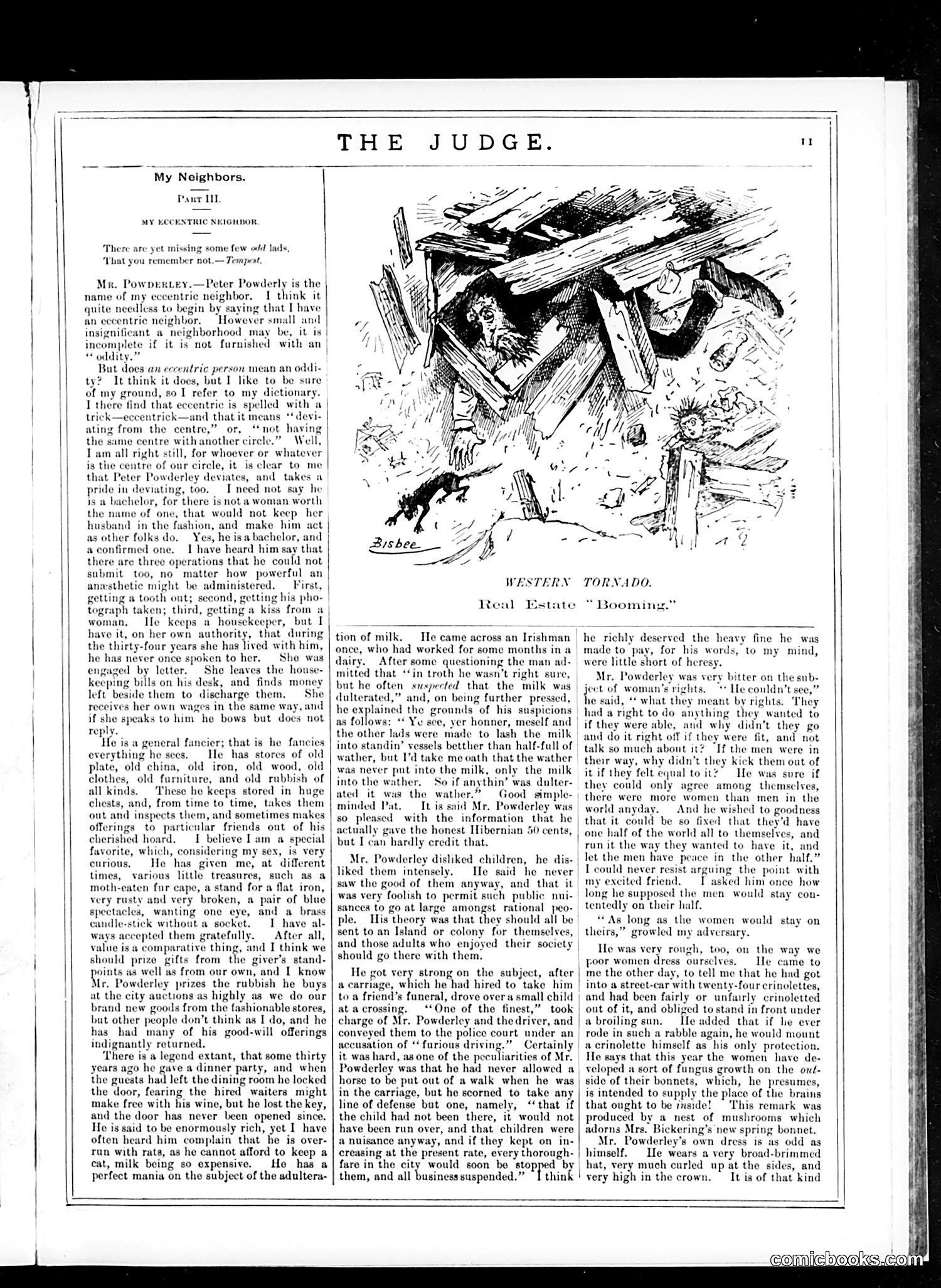
This page contains a humorous character sketch titled "My Neighbors, Part III," focusing on Peter Powderley, an eccentric bachelor. The accompanying cartoon illustrates a "Western Tornado"—likely depicting a violent weather event destroying property. The text satirizes Powderley's peculiar habits: he refuses to speak to his housekeeper of 34 years (communicating only by letter), obsessively hoards worthless junk from city auctions, and gives unwanted gifts to neighbors. He's portrayed as miserly despite being wealthy, refusing to buy a cat because milk is "expensive." His obsession with milk adulteration is presented as comical paranoia. The "Real Estate 'Blooming'" caption likely connects to the tornado image, suggesting ironic commentary on property development or land values during destructive weather—a typical Judge satirical juxtaposition of aspirations versus reality. The cartoon mocks eccentricity and miserliness as character flaws, particularly bachelor behavior.
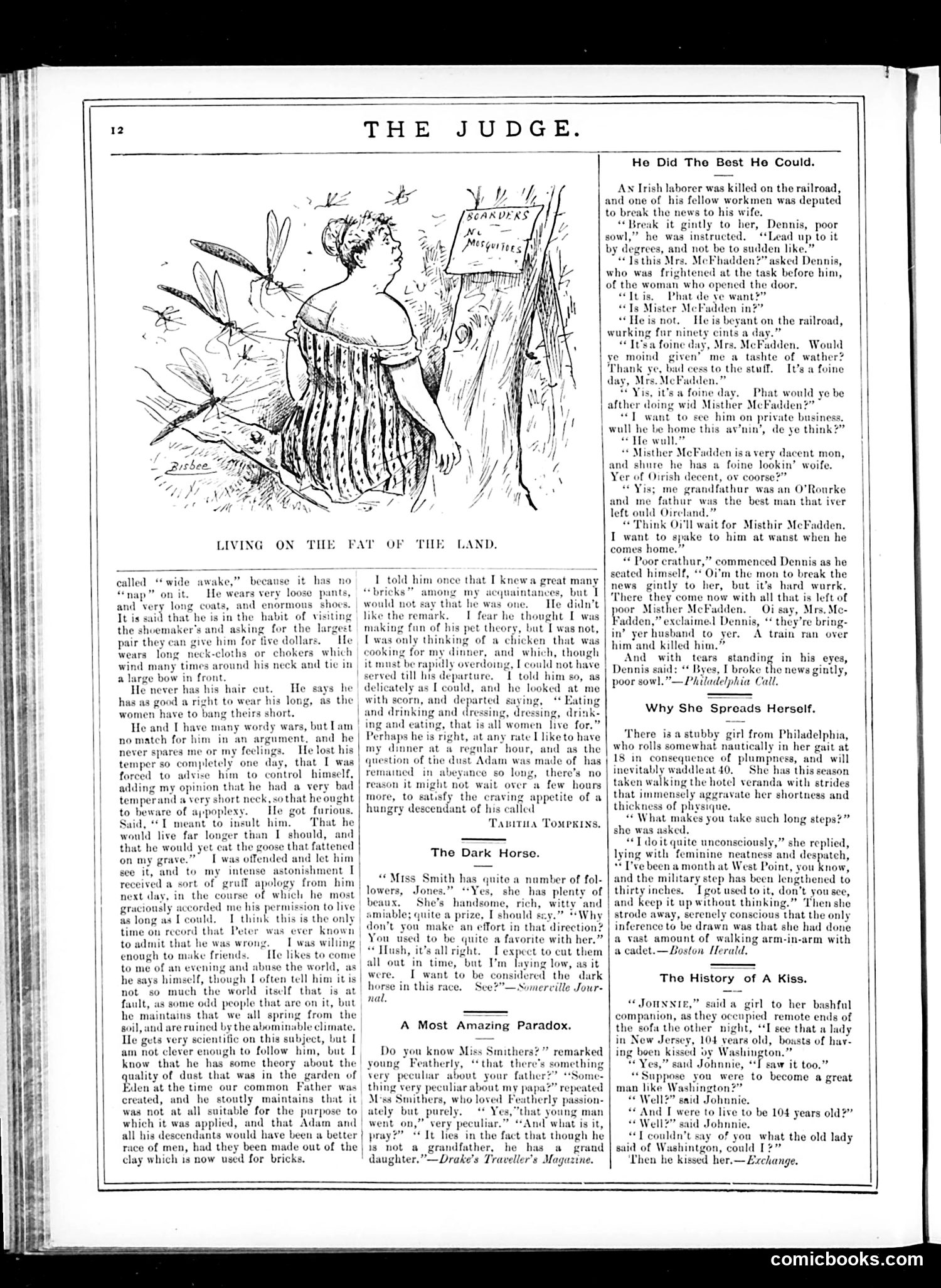
This page from *Judge* magazine contains several short satirical pieces mocking Irish immigrants and period stereotypes. **"He Did The Best He Could"** depicts an Irish laborer tasked with breaking news of a coworker's death to his widow. The humor relies on ethnic dialect humor (phonetic Irish-English spelling like "foine" for "fine," "av'nin'" for "evening") and the character's bumbling attempts at delicacy—he spends time complimenting the widow and her family before finally revealing the tragedy. **"Living on the Fat of the Land"** mocks a wealthy man's pretentious lifestyle and his eccentric theories about diet and living. The satire targets his affected manners and pseudo-intellectual beliefs. The remaining pieces—"Why She Spreads Herself," "The Dark Horse," "A Most Amazing Paradox," and "The History of a Kiss"—are brief anecdotal humor pieces about various social situations. The cartoon illustration shows a figure among reeds or plants. Overall, this represents typical *Judge* content: ethnic caricature and genteel social satire aimed at middle-class readers.
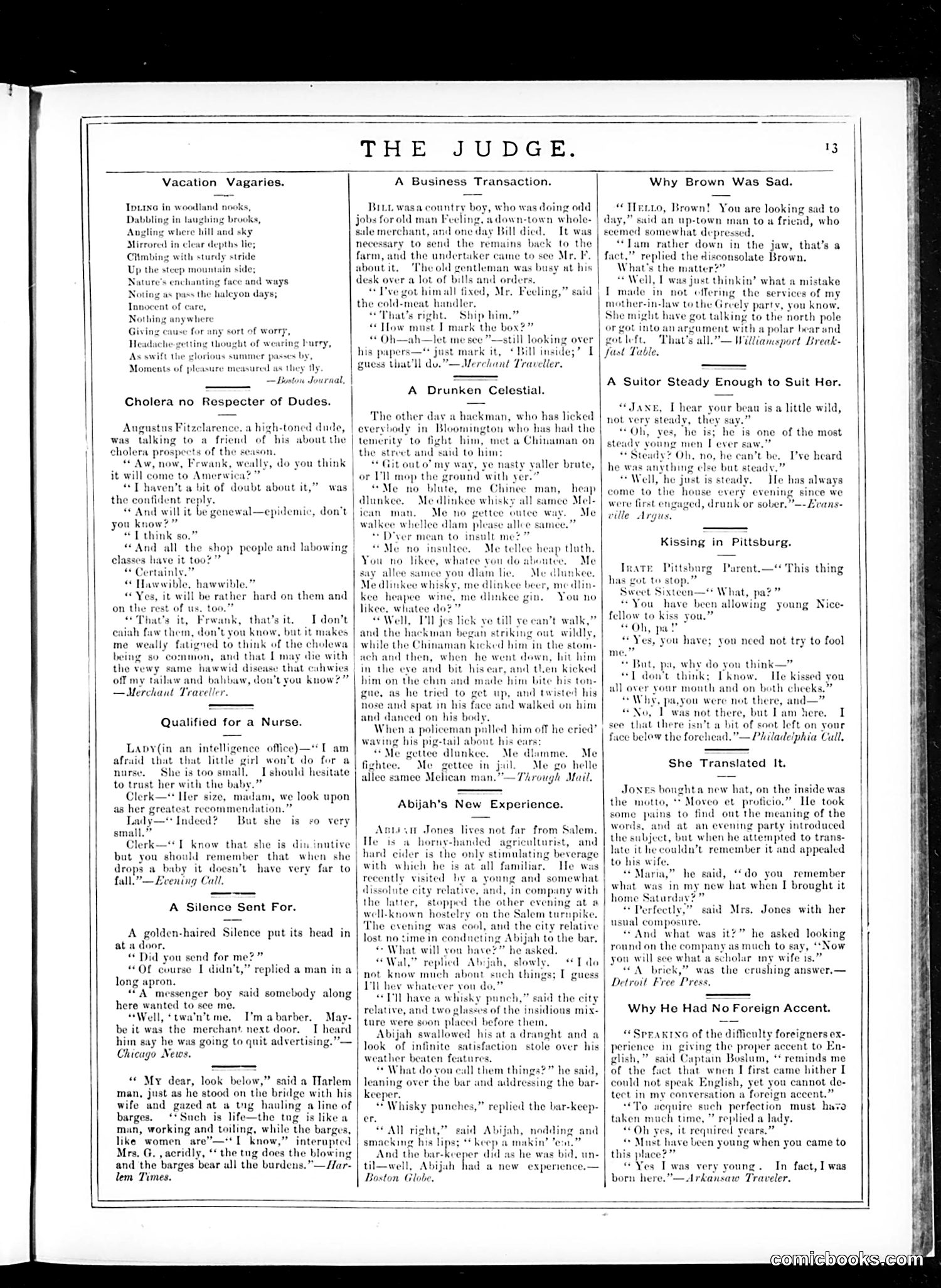
This page from Judge contains several brief satirical pieces typical of late 19th-century American humor magazines: **"Cholera no Respecter of Dudes"** mocks an upper-class dandy (Augustus Fitzclareence) who, upon hearing cholera may reach America, expresses concern mainly about how it will affect fashionable society rather than common people—the satire being that social class won't protect him from disease. **"A Drunken Celestial"** presents a racist caricature depicting a Chinese immigrant in a fight with a hackman, using exaggerated dialect ("Me no blute," "dlunkee"). This reflects period anti-Chinese sentiment common in American satire. **Other pieces** like "A Business Transaction," "A Silence Sent For," and "Qualified for a Nurse" are light domestic humor involving miscommunication and social observations. The page demonstrates Judge's formula: mixing class satire, ethnic caricature (by modern standards offensive), and gentle social comedy, all aimed at middle-class readers' amusement at various groups' expense.
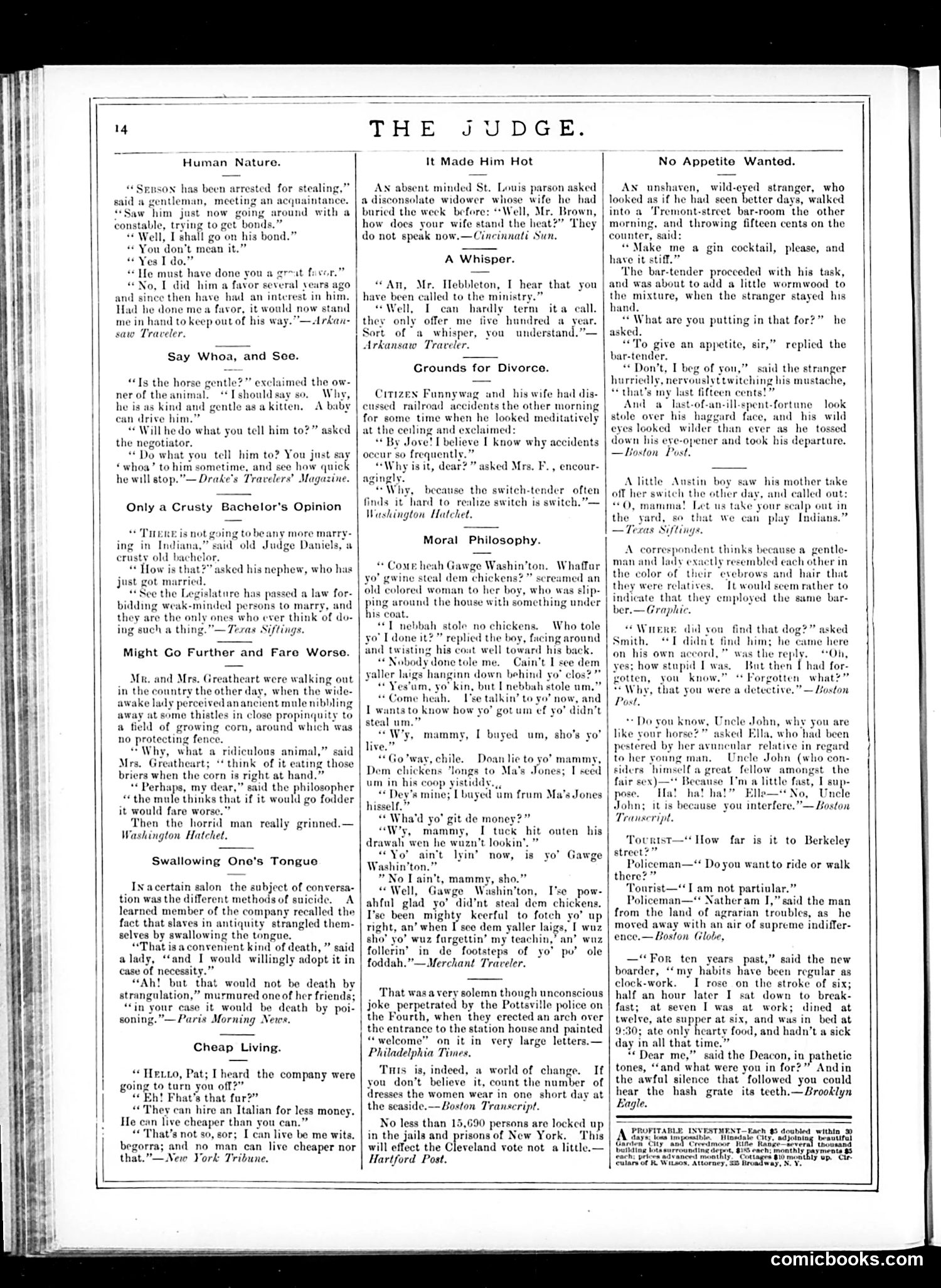
This page from Judge presents a collection of short humorous anecdotes typical of the era's satirical journalism. The pieces mock various aspects of human behavior and social conventions: **"Human Nature"** satirizes blind loyalty—a man bails out a thief simply because the thief once did him a favor, creating an absurd obligation. **"Only a Crusty Bachelor's Opinion"** uses the bachelor character to mock marriage itself, suggesting only fools marry. **"Moral Philosophy"** presents a racist dialect piece featuring a Black child stealing chickens, playing on period stereotypes for crude comic effect. **"Grounds for Divorce"** jokes about the disconnect between husband and wife—he blames mechanical switches for train accidents, she questions his logic. **Other brief pieces** target absent-minded clergy, immigrant labor economics, and philosophical pretensions. The humor relies on wordplay, ironic situations, and period stereotypes. While some pieces offer gentle social observation, others (particularly the dialect humor) reflect deeply offensive racial attitudes common to late 19th-century American humor.
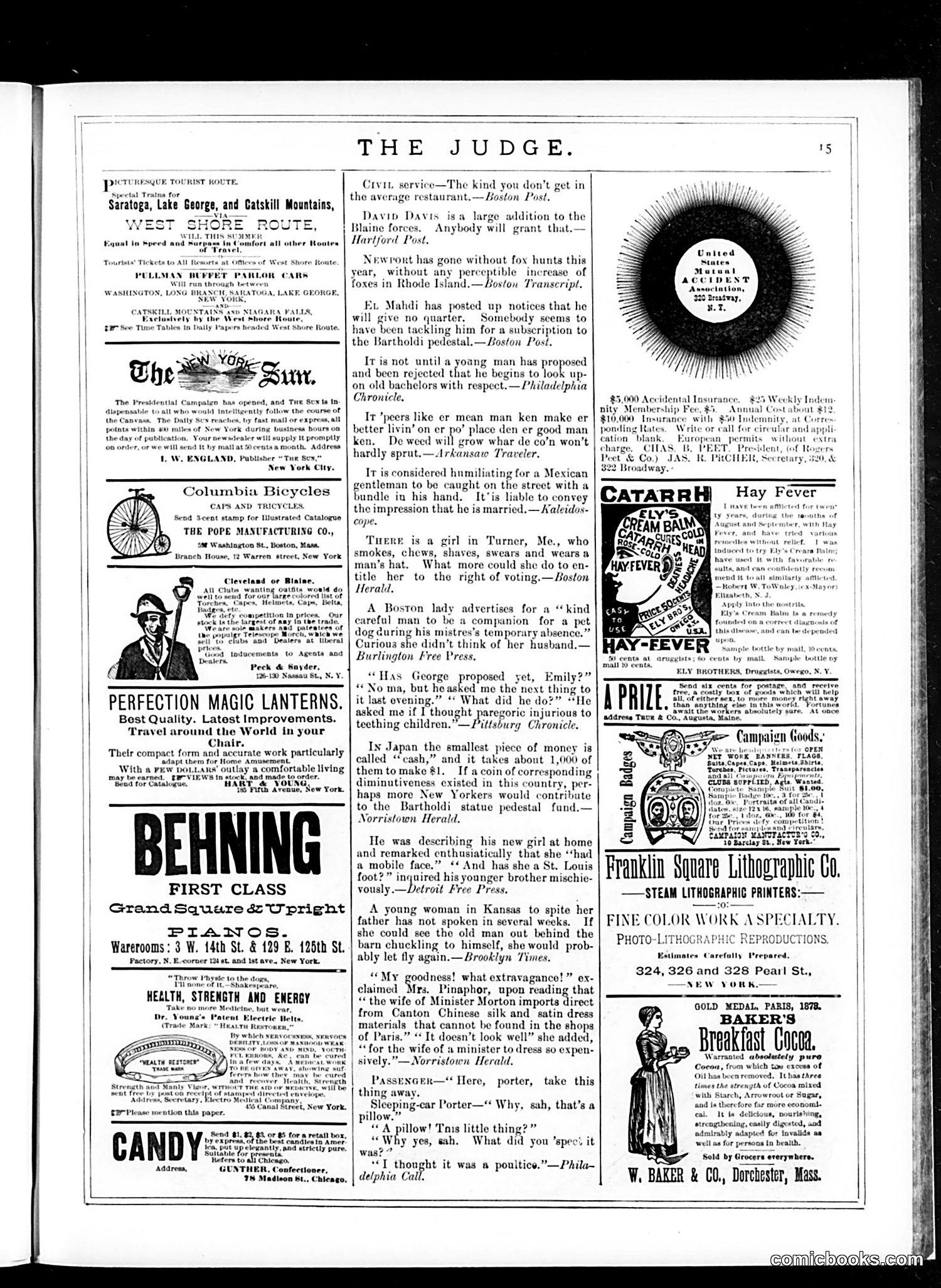
This page from Judge magazine is primarily **advertisements and humorous anecdotes** rather than political cartoons. The satirical content consists of brief, witty observations about contemporary American life. Key humor pieces include: **References visible:** - **Bartholdi Pedestal Fund**: Multiple jokes about wealthy New Yorkers reluctant to contribute to the Statue of Liberty's pedestal—suggesting public fundraising struggled - **Civil Service Reform**: A jab at restaurant service quality, referencing ongoing government reform debates - **David Davis & Blaine**: Political figures referenced regarding military appointments - **Minister Morton**: A joke about the wife of a government minister wearing expensive imported fabrics—implying questions about ministerial propriety and wealth **Social commentary targets:** Women's voting rights, racial dialect humor (then standard), class consciousness, and marriage dynamics. The page reflects 1880s American concerns: infrastructure funding, patronage vs. merit-based civil service, and women's social roles—all delivered through brief, sardonic quips typical of Judge's satirical approach.
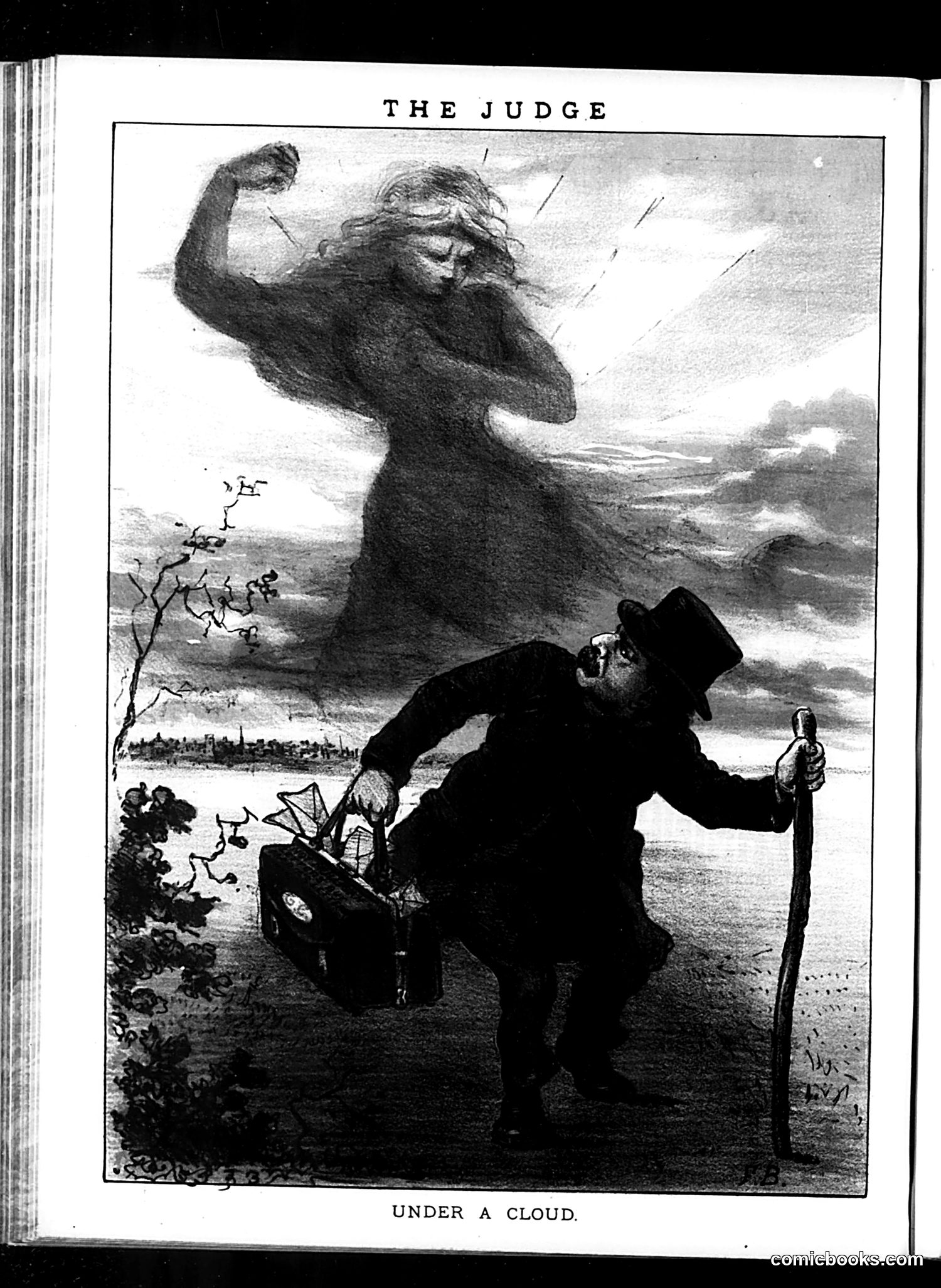
This political cartoon depicts a man in formal attire with a cane, looking upward anxiously at a massive, threatening cloud formation shaped like a judge's face looming over a landscape. The judge's giant fist is raised menacingly. The satire appears to comment on legal persecution or judicial threat hanging over a specific political figure or group. The man's worried posture and the ominous cloud suggest he faces legal jeopardy or judicial judgment. The title "Under a Cloud" is a period idiom meaning under suspicion or facing trouble. Without additional context about *Judge* magazine's publication date and prominent legal cases of that era, the specific target remains unclear, though the imagery suggests this mocked someone facing serious legal consequences or fear thereof.