
Judge, 1884-08-30 · page 4 of 16
Judge — August 30, 1884 — page 4: what you’re looking at
What you’re looking at
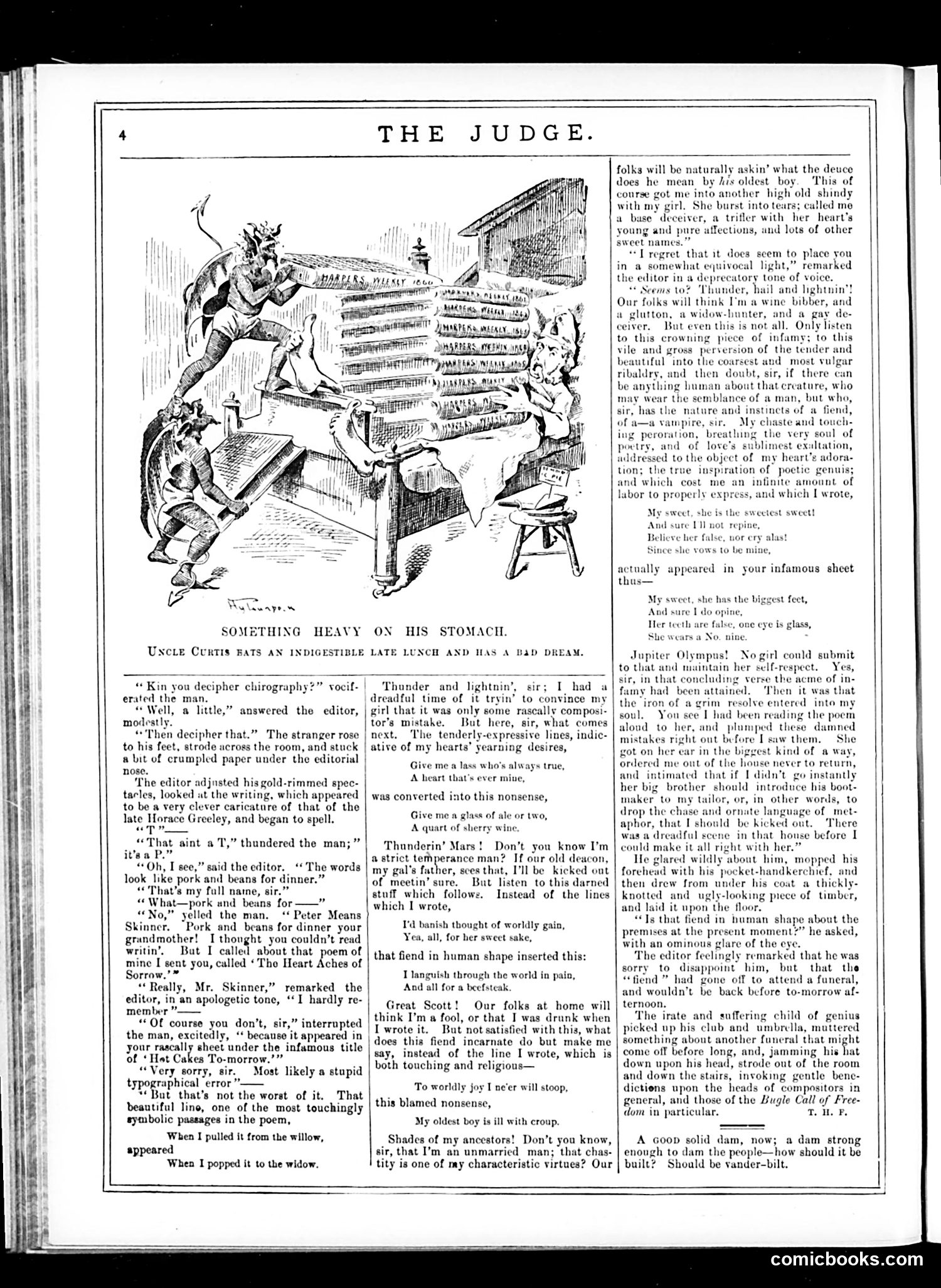
This page satirizes the frustrations of a poem submission gone wrong through editorial incompetence. A man named Peter Means Skinner confronts a magazine editor about systematic typographical errors that mangled his romantic, moralistic verse into embarrassing nonsense. The humor relies on specific botched corrections: "When I pulled it from the willow" became "When I popped it to the widow"; romantic lines about "a lass who's always true" transformed into drinking references ("a glass of ale or two"); and his chaste declaration became boastful claims about an "oldest boy"—humiliating for an unmarried temperance advocate. The cartoon above depicts Uncle Curtis suffering indigestion-induced nightmares from bad food, visualizing the chaos of misread documents and editorial confusion—a visual parallel to the textual chaos described below. The satire mocks both typographical errors and the editor's dismissive, incompetent responses to legitimate complaints about ruined reputations.
📄 Transcribed text from this page (OCR, searchable)
Machine-transcribed from the original scan — historical spelling and the odd misread are preserved.
THE JUDGE. Wa laeapes SOMETHING HEAVY Uncie CURTIS BATS AN INDIGESTIBL! a JM aN trata) prom STEEN vn - ON HIS STOMACH. E LATE LUNCH AND HAS A BaD DREAM. “ Kin you decipher chirography?” erated the man. “Well, a little,” answered the editor, hen decipher that.” ‘The stranger rose to his feet, strode across the room, and stuck a bit of crumpled paper under the editorial nose. ‘The editor adjusted his gold-rimmed spec- tarles, looked at the writing, which appeared to be a very clever caricature of that of the late Horace Greeley, and began to spell. opr “That aint aT,” thundered the man;” it'ea P.” “Oh, I see,” said the editor. The words look like pork and beans for dinner.” “That’s my full name, sir.” “ What—pork und beans for “No,” yelled the man. ‘‘ Peter Means Skinner. “Pork and beans for dinner your grandmother! I thought you couldn’t read writin’. But I called about that poem of mine I sent you, called ‘Tho Heart Aches of Sorrow.” ‘Really, Mr. Skinner,” remarked the editor, in an apologetic tone, “I hardly re- member ”—— “Of course you don’t, sir,” interrupted the man, excitedly, ‘ because it appeared in your rascal sheet under the infamous title of ‘Hat Cakes To-morrow.’” “Very sorry, sir, Most likely a stupid typographical “error ”— “But that’s not the worst of it. That beautiful lino, one of the most touchingly symbolic passages in the poem, ‘When I pulled it from the willow, appeared When I popped it to the widow. vocif- Thunder and lightnin’, sir; I had a dreadful time of it tryin’ to convince my girl that it was only some rascally composi- tor’s mistake. But here, sir, what comes ni The tenderly-expressive lines, indic- ative of my hearts’ yearning desires, Give me a lass who's always true, A heart that’s ever mine, was converted into this nonsense, Give mea glass of ale or two, A quart of sherry wine, Thunderin’ Mars! Don’t you know I’m a strict semnperance man? If our old deacon, my gal’s father, sces that, I'll be kicked out of meetin’ sure. But listen to this darned stuff which follows. Instead of the lines which I wrote, h thought of worldly gain, 11, for her sweet sake, that fiend in human shape inserted this: T languish through the world in p And all for a beefsteak. Great Scott! Our folks at home will think I’m a fool, or that I was drank when I wrote it. But not satisfied with this, what | does this fiend incarnate do but make me say, instead of the line I wrote, which is both touching and religious— To worldly joy I ne‘er will stoop, this blamed nonsense, My oldest boy is ill with croup. Shades of my ancestors! Don’t you know, sir, that I’m an unmarried man; that chas- tity is one of my characteristic virtues? Our folks will be naturally askin’ what the deuce does he mean. by his oldest boy. ‘This of course got me into another high old shindy y girl. She burst into tears; catled me a trifler with her heart's young and pure affections, and lots of other sweet names. “Tregret that it does seem to place in a somewhat equivocal light,” remarked the editor in a deprecatory tone of voice. ‘Thunder, hail and hghtnin’! Our folks will think I'ma wine bibber, and a glutton, a widow-hunter, and a gay de- ver, But even this is not all. Only listen to this crowning piece of infamy; Vile and gross perversion of the tender and est and most vulgar nd then doubt, sir, if there can pout thatcreature, who n, but who, a fiend, you * Seems to? sir, has the of a—a vampire, r and touch: ing peroration, breathing the very soul of poetry, and of love limest exaltation, addressed to the object of my heart’ adora- tion; the true ration of poetic genuis; and which cost me infinite amount of labor to properly express, and which I wrote, My the sweetest sweet! And sure LI] not repine, Believe her fal Since she vows to be m weet, she is actually appeared in your infamous sheet thus— My sweet, she has th And sure | Her tecth are f She wears a) ggest feet, . one cye is glass, > ni Jupiter Olympus! No girl conld submit to that and muintain her self-respect. Yes, sir, in that concluding ve the acme of in- famy had been attained. Then it was that the iron of a grim resolve entered into my soul. You sce I had been reading the poem aloud to her, plumped these damned mistakes right out before I saw them. She got on her ear in the biggest kind of a way, ordered me out of the house never to return, and intimated that if [didn’t go instantly her big brother should introduce his boot- maker to my tailor, or, in other words, to drop the chase and ornate language of met- aphor, that I should be kicked out. There was a dreadful scene in that house before I could make it all right with her. He glared wildly about him, mopped his foreh with his pocket-handkerchief, then drew from under his coat a thickly- knotted and ugly-looking piece of timber, and laid it upon the floor. “Ts that fiend in human shape about the premises at the present moment?” he asked, with an ominous glare of the eye. The editor feelingly remarked that he was sorry to disappoint him, but that the “fiend ” had gone off to attend a funeral, and wouldn’t be back before to-morrow af- ternoon. The irate and suffering child of genius picked up his club and umbrella, muttered something about another funeral that might come off before long, and, jamming his That down upon his head, strode out of the room and down the stairs, invoking gentle bene- dictions upon the heads of compositor in general, and those of the Bugle Call of Free- dom in particular. T. Me Pe A Goop solid dam, now; a dam strong enough to dam the people—how should it be built? Should be vander-bilt. comicbooks.com