
Judge, 1884-08-30 · page 11 of 16
Judge — August 30, 1884 — page 11: what you’re looking at
What you’re looking at
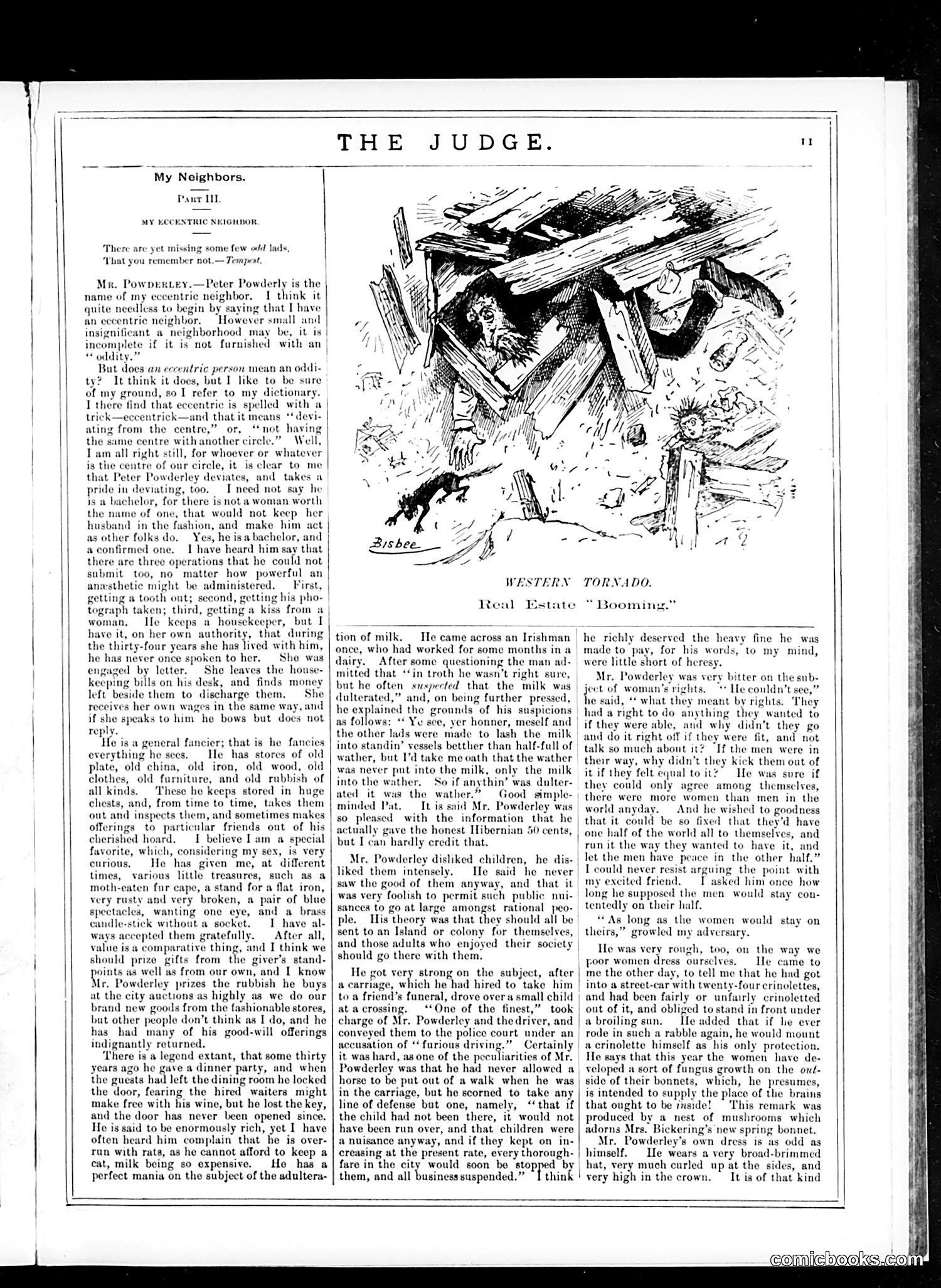
This page contains a humorous character sketch titled "My Neighbors, Part III," focusing on Peter Powderley, an eccentric bachelor. The accompanying cartoon illustrates a "Western Tornado"—likely depicting a violent weather event destroying property. The text satirizes Powderley's peculiar habits: he refuses to speak to his housekeeper of 34 years (communicating only by letter), obsessively hoards worthless junk from city auctions, and gives unwanted gifts to neighbors. He's portrayed as miserly despite being wealthy, refusing to buy a cat because milk is "expensive." His obsession with milk adulteration is presented as comical paranoia. The "Real Estate 'Blooming'" caption likely connects to the tornado image, suggesting ironic commentary on property development or land values during destructive weather—a typical Judge satirical juxtaposition of aspirations versus reality. The cartoon mocks eccentricity and miserliness as character flaws, particularly bachelor behavior.
📄 Transcribed text from this page (OCR, searchable)
Machine-transcribed from the original scan — historical spelling and the odd misread are preserved.
‘My Neighbors. Pant IL There few odd lads, ‘That you remember not.— Tempest, are yet missing som Mr. Pownen r name of my eccentric neighbor. I think it quite needless to begin by saying that I have an eccentrie neighbor. How small and insignificant a neighborhood may be, it is incomplete if it is not furnished with an “oddity.” But does an eccentric person mean an oddi- ty? It think it does, but I like to be sure of my ground, so I refer to my dictionary. I there find that eccentric is spelled with a trick—eccentrick—and that it means ‘*devi- ating from the tre,” or, ‘not having the same centre with another circ Well, Tam all right still, for whoever or whatever is the centre of our circle, it is clear to me that Peter Powderley deviates, and ta a pride in deviating, too. I need not say he 13 a bachelor, for there is not a woman worth the name of one, that would not p her husband in the f nd make him ac other folks do. es, he is a bache aconfirmed one, I have heard him say there are three operations that he could not submit too, no matter how powerful an anwsthetic might be administered. — First, getting a tooth out; second, getting his pho- tograph taken; third, getting a kiss from a woman, He ‘kee housekeeper, but I have it, on her own authority, that during the thirty-four years she has lived with him, he has never once spoken to her. — She d_by letter, She leaves the house ¢ bills on his desk, and finds mor left beside them to discharge them. — She receives her own wages in the same way, and if she speaks to him he bows but does not reply. He is a general fancier; that is he fancies everything he He has stores of old old china, old iron, old wood, old clothes, old furniture, and old rubbish of all kinds. ‘These he keeps stored in huge chests, and, from time to time, takes them out and inspects them, and sometimes makes offerings to particular friends out of h cherished hoard. I believe I am a spec! favorite, which, considering my sex, is ve curious. He has given me, at different times, various little treasures, such as a moth-eaten fur cape, a stand for a flat iron, very rusty and very broken, a pair of blue spectacles, wanting one eye, and a b candle-stick without a socket. Ihave ways accepted them gratefully. After all, ue is a comparative thing, and I think v should prize gifts from the giver’s stand- points as well as from our own, and I know Mr. Powderley prizes the rubbish he buys at the city auctions as highly as we do our brand new goods from the fashionable stores, but other people don’t think as I do, and he has had many of his good-will offerings indignantly returned. ‘There is a legend extant, that some thirty years ago he gave a dinner party, and when the guests had left the dining room he locked the door, fearing the hired’ waiters might make free with his wine, but he lost the key, and the door has never been opened since. He is said to be enormously rich, yet I have often heard him complain that he is over- run with rats, as he cannot afford to keep a cat, milk being so expensive. Ho has a perfect mania on the subject of the adultera- zY.—Peter Powderly is the | WE Real tion of milk. He came across an Irishman once, who had worked for some months in a dairy. After some questioning the man ad- mitted that ‘‘in troth he wasn’t right sure, but he often suspected that the milk was dulterated,” and, on being further pressed, he explained the grounds of his suspicions as follow ce, yer honner, meself and the other lads were made to lash the milk into standin’ vessels betther than half-full of ather, but I’d take me oath that the wather was never put into the milk, only the milk into the w ated it ther. So if anythin’ was dulter- was the wather.” Good simp! Tt is snid Mr. Powderley was with the information t he actually gave the honest Hibernian 50 cents, | but I can hardly credit that. | Mr. Powderley disliked children, he dis- liked them intensely, He said he never saw the good of them anyway, and that it was very foolish to permit such public nui- sances to go at large amongst rational peo- ple. His theory was that they should all be sent to an Island or colony for themselves, and those adults who enjoyed their society should go there with them. He got very strong on the subject, after | a carriage, which he had hired to take him to a friend’s funeral, drove over a small child atacrossing. ‘One of the finest,” took charge of Mr. Powderley and thedriver, and conveyed them to the police court under an accusation of ‘furious driving.” Certainly it was hard, as one of the peculiarities of Mr. Powderley was that he had never allowed a horse to be put out of a walk when he was in the carriage, but he scorned to take any line of defense but one, name “that if the child had not been there, it would not have been run over, and that children were a nuisance anyway, and if they kept on in- creasing at the present rate, every thorough. fare in the city would soon be stopped b: them, and all business suspended.” Pehink ans TORNADO. * Boomir he richly deserved the heavy fine he was made to » for his words, to my mind, were little short of heresy Mr. Powderley was vers i tof woman's rights. He couldn’t see,” he said, ** what they meant by rights. They had a right todo anything they wanted to if they were able, and why didn’t they go and do it right off if they were fit, and not talk so much about it? “If the men were in their way, why didn’t they kick them out of it if they felt equal to it?” He was sure if they could only agree among themselves, there were more women than men in the world anyday. And he wished to goodness that it could be so fixed that they’d have one half of the world all to themselves, and run it the they wanted to have it, and let the men have peace in the other half.” I could never resist arguing the point with my excited friend. T asked him once how long he supposed the men would stay con- tentedly on their half. bitter on the sub- “As long as the women would stay on theirs,” growled my adversary. He was very rough, too, on the we poor women dress ourselves. — He came to me the other day, to tell me that he had got into a street-car with twenty-four crinolettes, and had been fairly or unfairly crinoletted out of it, and obliged to stand in front under a broiling sun. He added that if he ever rode in such a rabble again, he would mount acrinolette himself as his only protection. He says that this year the women have de- veloped a sort of fungus growth on the oué- side of their bonnets, which, he presumes, is intended to supply the place of the brains that ought to be izside! ~~ This remark was produced by a nest of mushrooms which adorns Mrs. Bickering’s new spring bonnet. Mr. Powderley’s own dress is as odd as himself. Ile wears a very broad-brimmed hat, very much curled up at the sides, and very high in the crown. — It is of that kind