
Judge, 1884-08-30 · page 2 of 16
Judge — August 30, 1884 — page 2: what you’re looking at
What you’re looking at
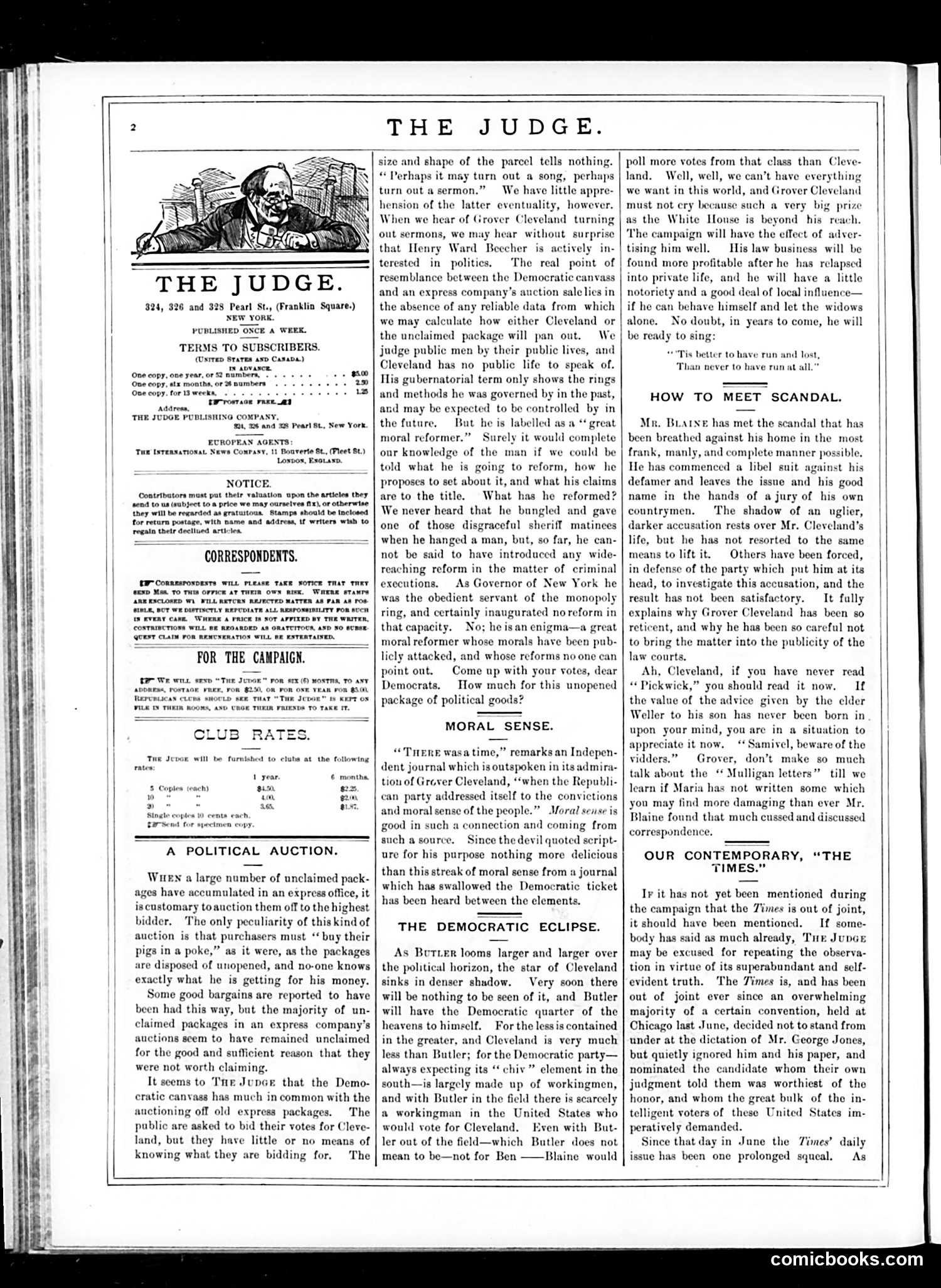
This page attacks Democratic presidential candidate **Grover Cleveland** through two main critiques: **"A Political Auction"** compares Cleveland to an unopened, unclaimed express package—voters are asked to bid (vote) for him without knowing what they're getting. The satire argues Cleveland has **no public record to evaluate**: his governorship merely shows he served monopoly interests without meaningful reform. He's labeled a "great moral reformer" but Judge demands specifics—*what* has he reformed? The piece sarcastically notes they'll believe he's a reformer when Henry Ward Beecher enters politics. **The cartoon** (top left) appears to show a disheveled figure amid chaos, likely representing Cleveland or Democratic disorder. The related articles ("How to Meet Scandal," "The Democratic Eclipse") continue attacking Cleveland's vagueness and suggesting Butler will overshadow him politically. The *Times* newspaper is criticized for bias toward Cleveland. This reflects the 1884 presidential campaign where Judge, a Republican-leaning publication, sought to undermine Cleveland's outsider "reformer" image through ridicule of his lack of substantive platform.
📄 Transcribed text from this page (OCR, searchable)
Machine-transcribed from the original scan — historical spelling and the odd misread are preserved.
appa ccarereas = —— aoe THE JUDGE. THE JUDGE. 824, $26 and 328 Pearl St., (Franklin Square.) NEW YORK. PUBLISHED. TERMS TO SUBSCRIBERS. ‘One copy, one year, or 2 numbers, « Ove copy, alx months, or 3 numbers One copy. for 13 weeks, tarrosr, Address, THE JUDGE PUDLISHING COMPANY. 21, SS and 8 Pearl St, New York. EUR ORNTS. Tue ixrensationat. News Co: NOTICE. Contribators must pat thelr valuation upon the articles they send to us (subject to a price we may ourselves fix), or otherwise they will be regarded as gratuitous. Stamps should be Inclosed for return postage, with pame and address, if writers wish to regain thelr deeliued articles . CORRESPONDENTS, — Q-ConnEsroNDENTS WILL FLEAKE TAKE NOTICE THAT THEY Maa To Tut OFFicR Ay THER OWN Rink. WHERE eTaxre XCLOSED Wi FILL RETCRS REJECTED MATTER AS PAR AB TOS: RPUDIATE ALL REAFONAIRILITY FOR SUCH PRICK 18 NOT AFVIXED BY THE WRITER, FOR THE CAMPAIGN. £27 We wns. sexp “Tue Jevor™ vor ex (6) MoSTMa, TO ANY ADDRESS, POSTAGE FREE, FOR $29). OR FOR ONE YEAR FOR 831 RevURLscay CLCRS SHOULD KER THAY “Tu JCDOR” Is KEFT Os FILE {8 THKIR ROOMS, ASD CRO THEIR FRIESDA TO TAKE IT. CLUB RATES. Tne Jevor will be furnished to elute at the following A POLITICAL AUCTION. Wuew a large number of unclaimed pack- ages have accumulated in an express office, it iscustomary toauction them off to the highest bidder. The only peculiarity of this kind of auction is that purchasers must ‘buy their pigs in a poke,” as it were, as the packages are disposed of unopened, and no-one knows exactly what he is getting for his money. Some good bargains are reported to have been had this way, but the majority of un- claimed packages in an express company’s auctions seem to have remained unclaimed for the good and sufficient on that they were not worth claiming. It seems to Tne JupGr that the Demo- cratic canvass has much in common with the auctioning off old express packages. The public are asked to bid their votes for Cleve- land, but they have little or no means of knowing what they are bidding for. The size and shape of the parcel tells nothing. “ Perhaps it may turn out a song, perhaps turn out a sermon.” We have little appre- hension of the latter eventuality, however. When we hear of Grover Cleveland turning out sermons, we may hear without surprise that Henry Ward Beecher is activ in- | terested in politics. The real point of | resemblance between the Democrat express company’s auction sale lics in the absence of any reliable data from which we may calculate how either Cleveland or the unclaimed package will pan out. We judge public men by their public lives, and Cleveland has no public life to speak of. His gubernatorial term only shows the rings and methods he was governed by in the past, and may be expected to be controlled by in the future. But he is labelled “* great moral reformer.” Surely it would complete our knowledge of the man if we could be told what he is going to reform, how he proposes to set about it, and what his claims are to the title. What has he reformed? We never heard that he bungled and gave one of those disgraceful sheriff matinees when he hanged a man, but, so far, he can- not be said to have introduced any wide- reaching reform in the matter of criminal executions. As Governor of New York he was the obedient servant of the monopoly ring, and certainly inaugurated no reform in that capacity. No; he isan enigma—a great moral reformer whose morals have been pub- licly attacked, and whose reforms no one can point out, Come up with your votes, dear Democrats. How much for this unopened package of political goods? MORAL SENSE. ““THere wasa time,” remarks an Indepen- dent journal which is outspoken in its admira- tion of Grover Cleveland, “when the Republi- can party addressed itself to the convictions and moral sense of the people.” good in such a connection and coming from such a source. Since the devil quoted seript- ure for his purpose nothing more delicious Moral sense is than this streak of moral sense from a journal which has swallowed the Democratic ticket has been heard between the elements. THE DEMOCRATIC ECLIPSE. As Betver looms larger and larger over the political horizon, the star of Cleveland sinks in denser shadow. Very soon there will be nothing to be seen of it, and Butler will have the Democratic quarter of the ‘ens to himeclf. For the less is contained in the greater, and Cleveland is very much less than Butler; for the Democratic party— always expecting its “ chiv” element in the south—is largely made up of workingmen, and with Butler in the field there is scarcely a workingman in the United States who would vote for Cleveland, Even with But- ler out of the field—which Butler does not mean to be—not for Ben ——Blaine would poll more votes from that class than Cleve- land. Well, well, we can’t have everything we want in this world, and Grover Cleveland must not cry because such a very big prize as the White House is beyond his reach. ‘The campaign will have the effect of adver- tising him well. — His law business will be found more profitable after he has relapsed into private life, and he will have a little notoriety and a good deal of local influence— if he can behave himself and let the widows alone. No doubt, in years to come, he will be ready to sing: “Tis better to have run and lost, ‘Than never to have run at all. HOW TO MEET SCANDAL. Mr. Biatne has met the scandal that has been breathed against his home in the most frank, manly, and complete manner possible. He has commenced a libel suit against his defamer and leaves the issue and his good name in the hands of a jury of his own countrymen. The shadow of an uglier, darker accusation rests over Mr. Cleveland’s life, but he has not resorted to the same means to lift it. Others have been forced, in defense of the party which put him at its head, to investigate this s ion, and the result has not been satisfactory. It fally explains why Grover Cleveland has been so reticent, and why he has been so careful not to bring the matter into the publicity of the law courts, Ah, Cleveland, if you have never read “Pickwick,” you should read it now. If the value of the advice given by the elder Weller to his son has never been born in upon your mind, you are in a situation to appreciate it now.“ Samivel, beware of the vidders.” Grover, don’t make so much talk about the ‘ Mulligan letters” till we learn if Maria has not written some which you may find more damaging than ever Mr. Blaine found that much cussed and discussed correspondence. OUR CONTEMPORARY, “THE TIMES.” Ir it has not yet been mentioned during the campaign that the Jimes is out of joint, it should have been mentioned. If som body has said as much already, Tuk Jupce may be excused for repeating the observa- tion in virtue of its superabundant and self- evident truth. The Zimes is, and has been out of joint ever since an overwhelming majority of a certain convention, held at Chicago last June, decided not to stand from under at the dictation of Mr. George Jones, but quietly ignored him and his paper, and nominated the candidate whom their own judgment told them was worthiest of the honor, and whom the great bulk of the in- telligent voters of these United States im- peratively demanded. Since that day in June the Times’ daily issue has been one prolonged squeal. As comicbooks.com