
A complete issue · 16 pages · 1884
Judge — August 23, 1884
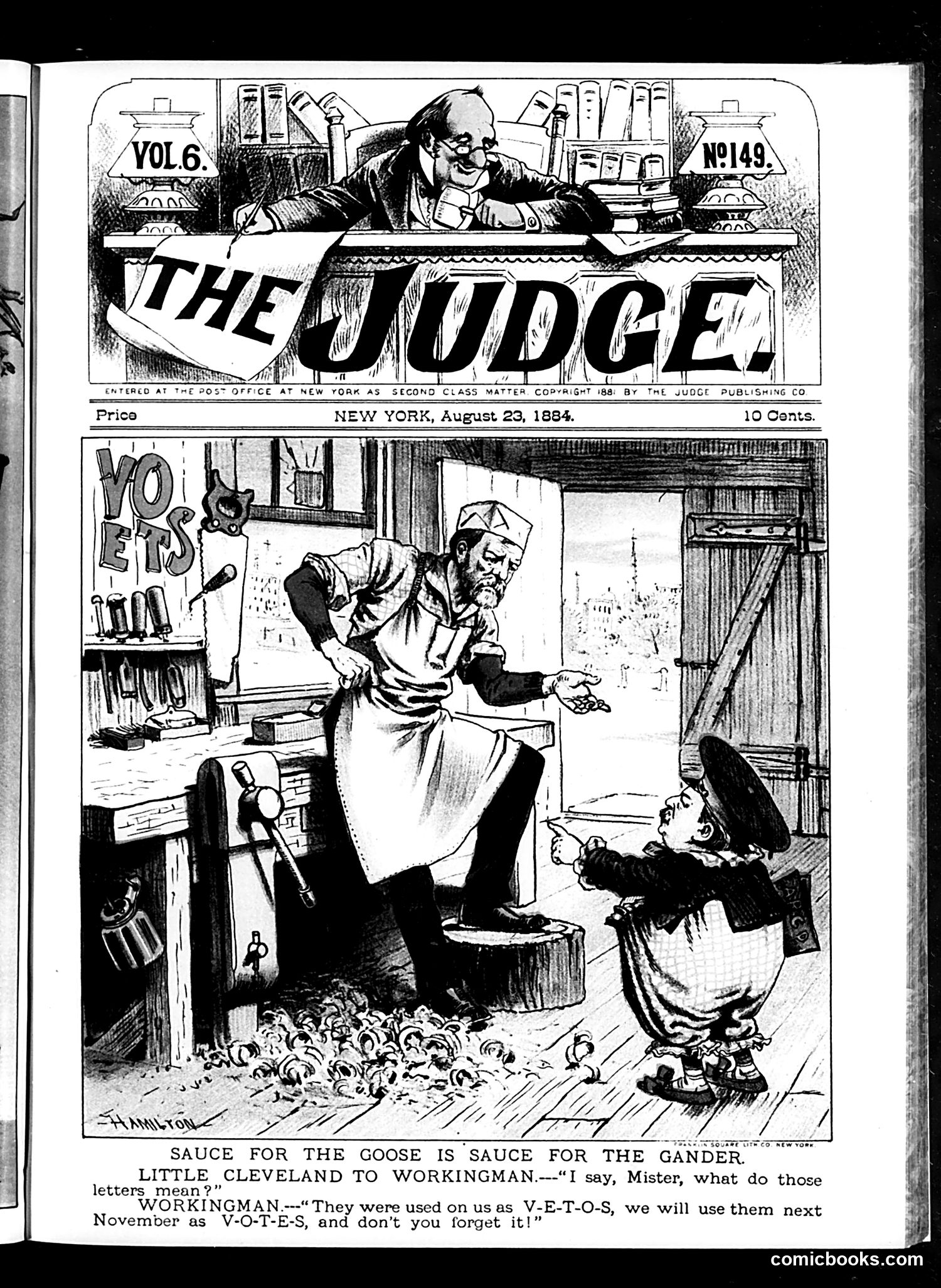
This August 1884 *Judge* cartoon satirizes political hypocrisy regarding voting rights. The title "Sauce for the Goose is Sauce for the Gander" compares Little Cleveland (likely President Grover Cleveland) to a "Workingman." The joke hinges on V-E-T-O-S (vetoes): Cleveland apparently vetoed legislation benefiting workers, who now question why they should support him politically. The workingman's response—"they were used on us as V-E-T-O-S, we will use them next November as V-O-T-E-S"—warns that voters will reject Cleveland at the ballot box, just as he rejected their interests through vetoes. The cartoon criticizes Cleveland's anti-labor stance and predicts electoral consequences.
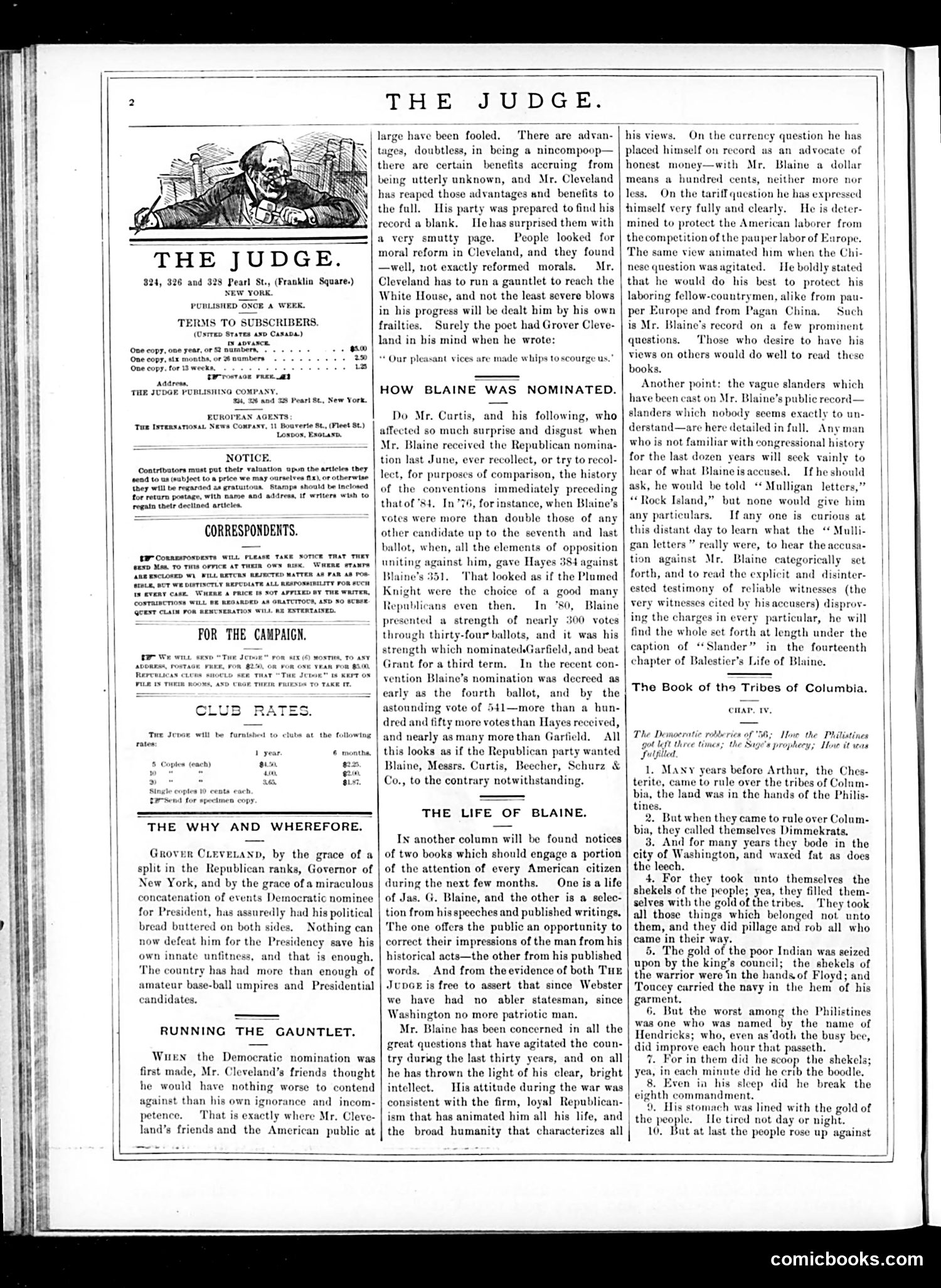
This 1884 page defends **Grover Cleveland's** Democratic presidential nomination against Republican critics, particularly targeting **James G. Blaine** supporters. The left column's editorial "The Why and Wherefore" sarcastically defends Cleveland as nominee, acknowledging he's an unknown figure with a blank record—admitting this was actually advantageous since reformers couldn't yet criticize his actual record. "Running the Gauntlet" continues this theme, suggesting Cleveland will face attacks from his own party over his personal moral failings. The right column's "How Blaine Was Nominated" responds to Republican complaints about their own nominee. It argues Blaine received substantial support in previous conventions (1876, 1880), so his 1884 nomination wasn't imposed on the party—Republicans genuinely wanted him, contrary to critics like Curtis, Beecher, and Schurz. The cartoon (upper left) likely depicts Cleveland, though the specific satire is unclear from this image alone.
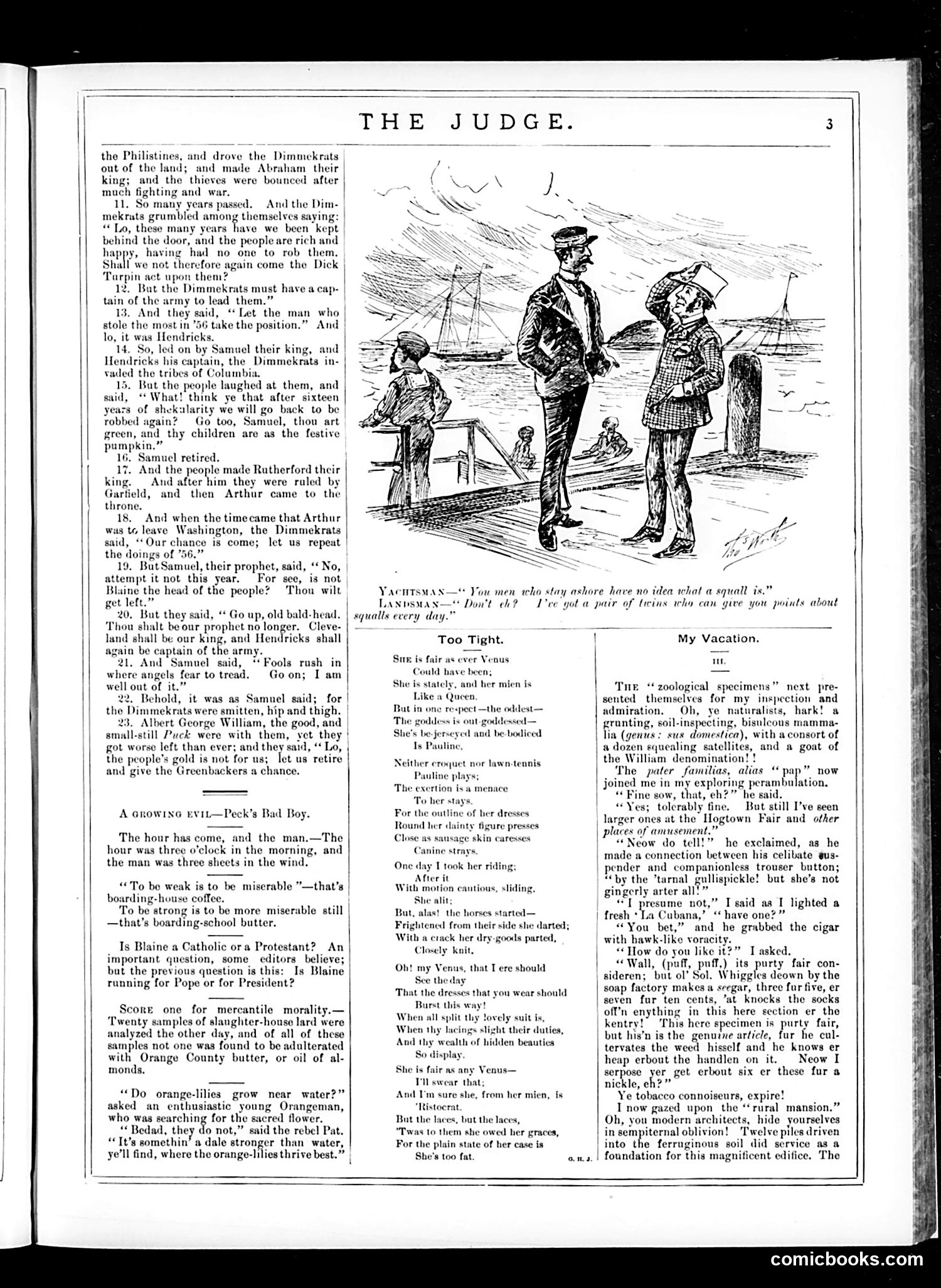
This page from the satirical magazine *Judge* contains a biblical parody mocking Democratic Party politics. The main text uses Old Testament language to satirize recent U.S. electoral history: **The Satire:** The "Dimmekrats" (Democrats) are portrayed as perpetual losers and would-be thieves ("Dick Turpin act"—highway robbery). After 16 years out of power under Republican administrations (Rutherford Hayes, Garfield, Arthur), Democrats attempt a comeback with Samuel Tilden's protégé Samuel Hendricks as "captain." The joke: voters reject them, preferring Republican James G. Blaine. **The Political References:** - "1856" likely references pre-Civil War politics - Hendricks appears to be Thomas A. Hendricks - The narrative mocks Democratic hopes while celebrating Republican governance **The Cartoon:** Shows well-dressed men at a harbor, apparently discussing yacht-club matters—a leisure-class scene emphasizing the gap between political satire and genteel society. The remaining content includes minor political jabs at Blaine's religion and "Peck's Bad Boy" humor columns typical of period *Judge* issues.
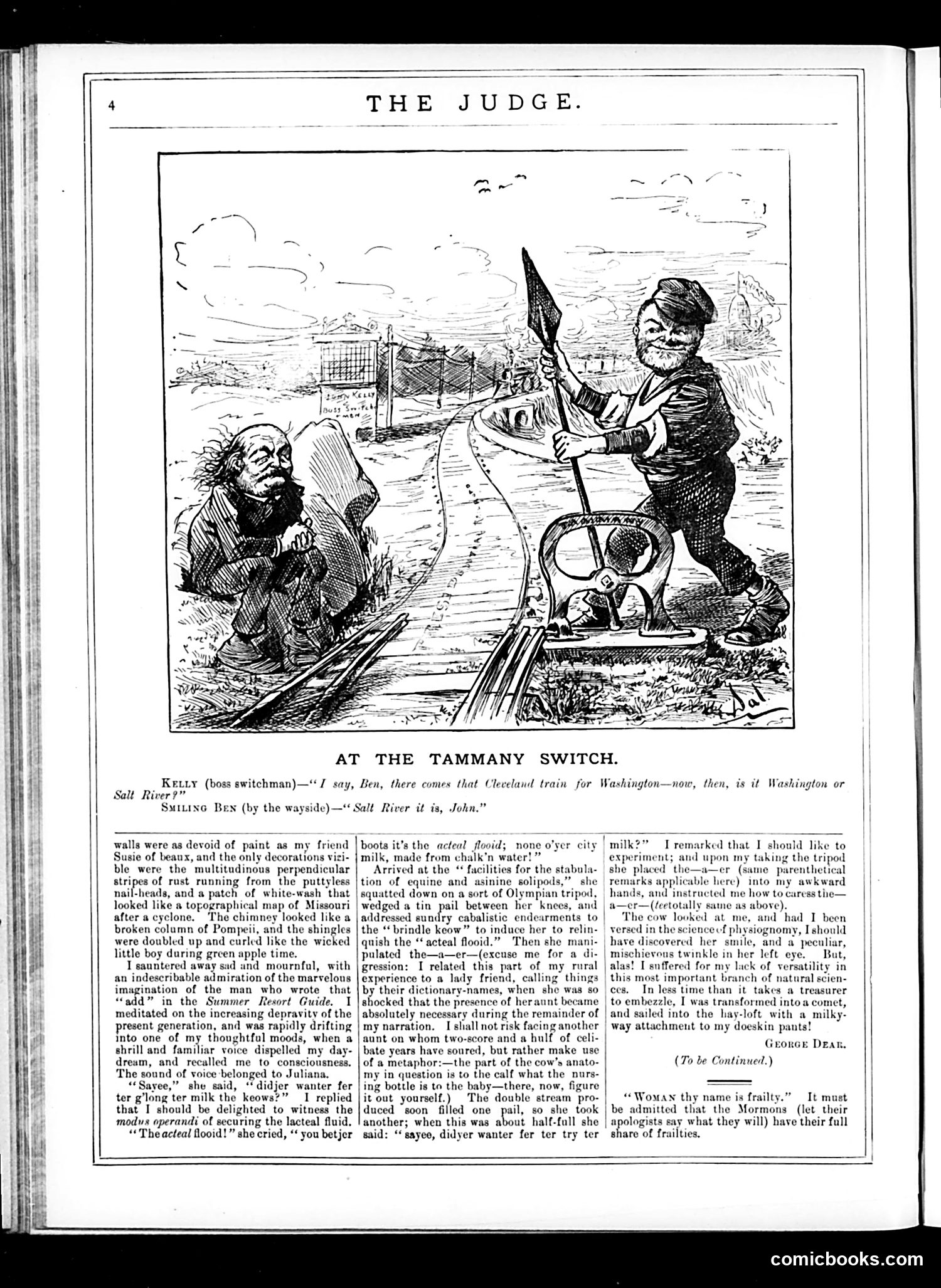
This political cartoon satirizes **Tammany Hall**, New York's powerful Democratic political machine, by depicting a railroad switch operator deciding which train goes where — a metaphor for political manipulation. The two figures appear to be **Boss Switchman Kelly** (representing Tammany leadership) and **Salt River Ben** (a common name for a political operative or underling). The dialogue references routing a "Cleveland train for Washington," likely alluding to **President Grover Cleveland** and political patronage decisions. "Salt River" was a period euphemism for political defeat or being sent away. The joke: Tammany Hall controlled which politicians and policies got "switched" into power through backroom dealings and corruption — they literally controlled the tracks, deciding outcomes like railroad switches determine destinations. The accompanying humorous rural narrative is filler/secondary content typical of Judge magazine's mixed format.
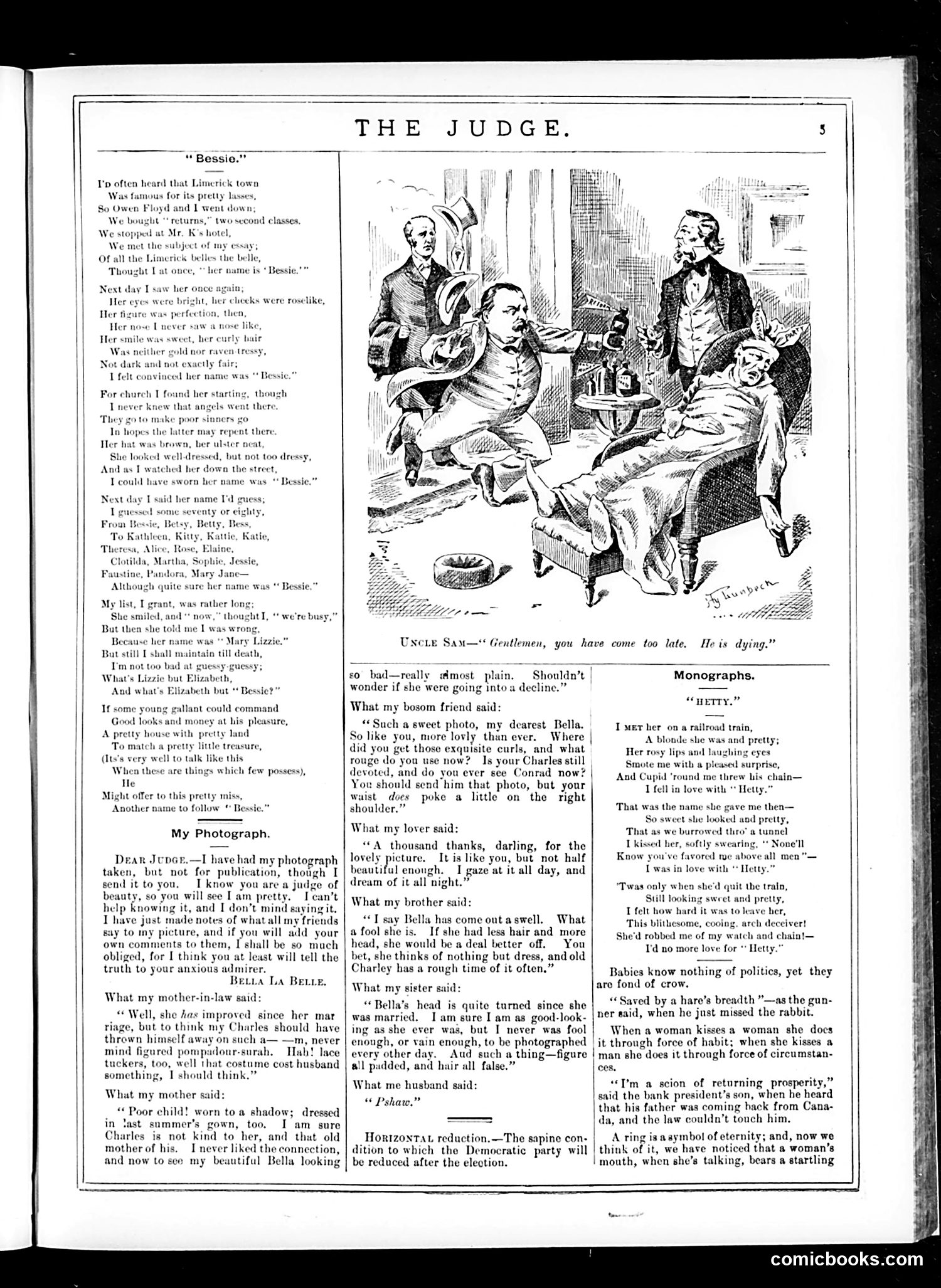
This page contains two distinct pieces from *Judge* magazine (a 19th-century American satirical publication): **"Bessie"** (left): A humorous poem about a man who visits Limerick, Ireland, becomes infatuated with a girl named Bessie, and compiles contradictory descriptions of her from various townspeople—each person describes her differently, yet insists her name is "Bessie." The satire mocks how people project their own biases onto others' appearances. **"My Photograph"** (right): A satirical piece where a woman shares her photograph and reports what different people said about it—her mother-in-law criticizes her, her mother frets over her health, her lover flatters her, her brother insults her vanity, her sister expresses jealousy, and her husband dismisses it with "Pshaw." The humor lies in the contradiction between the woman's self-perception and others' often-unflattering observations. Both pieces satirize vanity, social pretension, and the gap between self-image and reality—common *Judge* themes targeting middle-class affectations of the era.
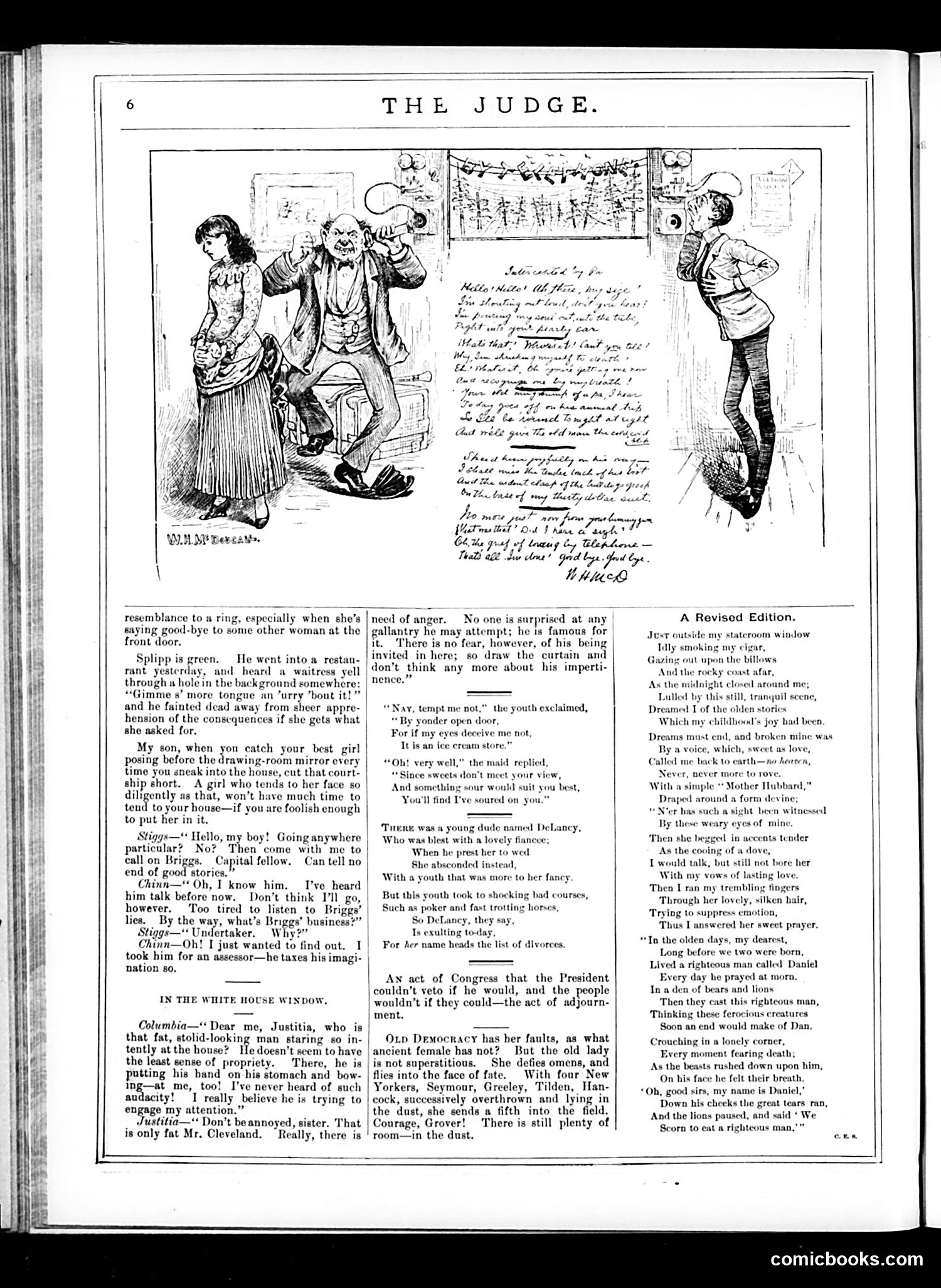
This page contains two main satirical cartoons about social behavior and politics. **The upper cartoon** depicts a domestic scene where a man (appearing to be a suitor or unwanted visitor) is being shown out by a woman and her maid. The satire mocks pretentious or overly familiar male behavior—the man's impertinence in forcing his attention on the woman despite clear rejection. The accompanying dialogue emphasizes that this particular man is known for such gallantry but won't be welcome "here." **"In the White House Window"** features Columbia (America personified) and Justitia (Justice) observing a "fat, stolid-looking man" staring at the White House with his hand on his stomach. This appears to be political satire about an unnamed official or politician behaving inappropriately or audaciously—perhaps someone seeking influence or attention at the seat of government. The women's indignation at his brazen behavior carries the satirical point. The poems and other text on the page appear to be unrelated literary content. Overall, the page satirizes both social impropriety and political presumption.
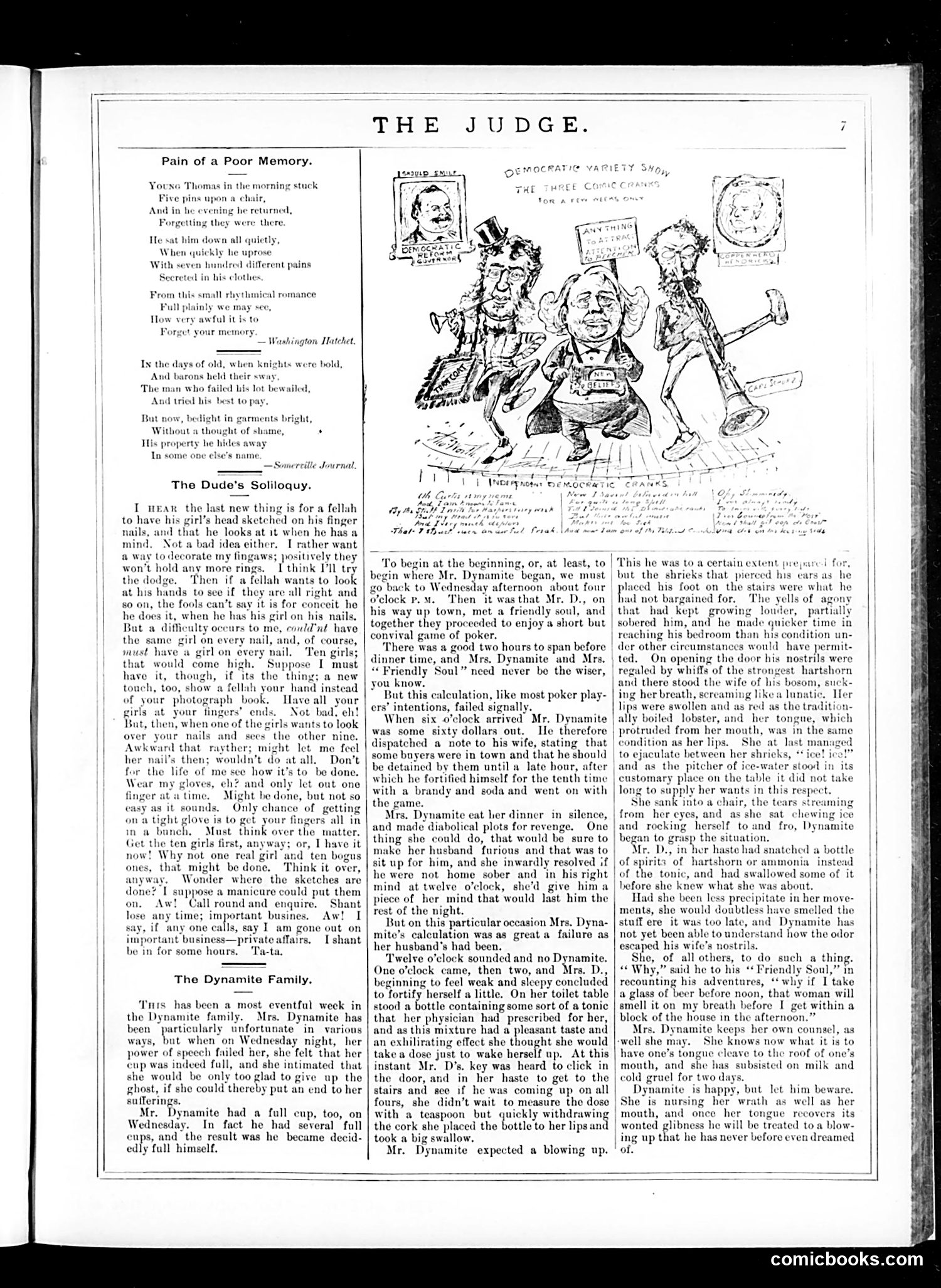
This satirical piece mocks a married couple's domestic dispute. Mr. Dynamite loses sixty dollars at poker, then lies to his wife about working late with clients. Mrs. Dynamite suspects deception and plans revenge. The humor targets both spouses: Mr. Dynamite for his gambling habit and dishonesty; Mrs. Dynamite for her scheming retaliation. The accompanying cartoon shows them as caricatured figures engaged in their conflict, with supporting characters observing the drama. The "Dynamite" surname itself is the joke—suggesting the couple's explosive, volatile relationship. The piece satirizes Victorian-era marital tensions, middle-class pretense (lying about business), and the gender dynamics of the period. The narrative style adopts a gossipy, breathless tone that mocks how such domestic scandals were discussed in society.
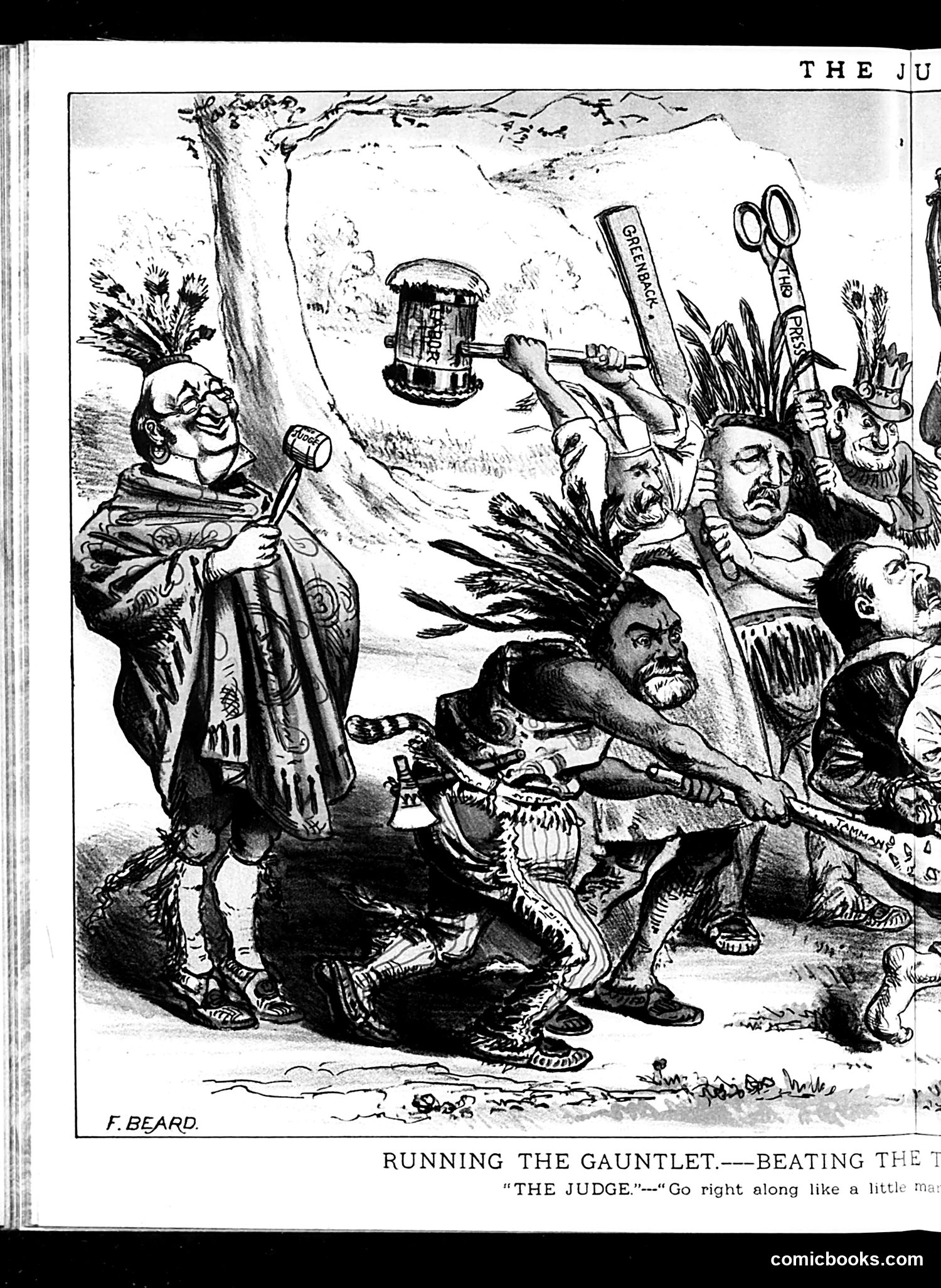
This cartoon by F. Beard depicts a figure labeled "THE JUDGE" (left) being subjected to physical punishment by a group of aggressive figures wielding clubs and other weapons while displaying Native American imagery (headdresses, weapons). The title "Running the Gauntlet—Beating the Judge" references the historical Native American punishment ritual where a condemned person runs between two lines of attackers. The satire appears to criticize judicial decisions or the Judge magazine itself, showing the publication under assault from critics or opponents. The Native American imagery likely carries problematic 19th-century racial stereotyping typical of the era. The incomplete caption suggests the full context is cut off, making complete interpretation difficult. The cartoon represents political/editorial commentary on institutional judgment or criticism, rendered through period-specific caricature.
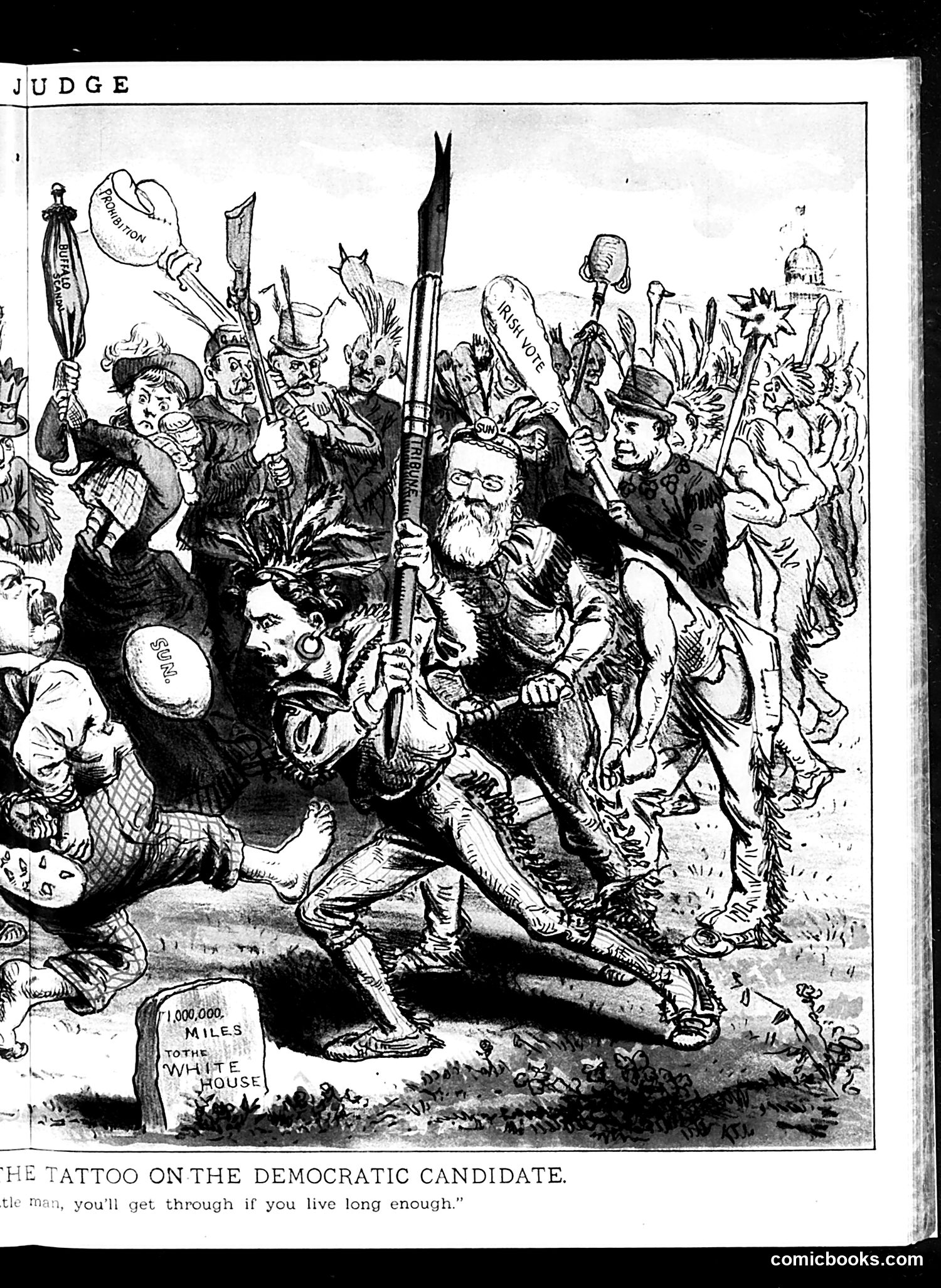
This political cartoon satirizes the Democratic presidential candidate (identity unclear from visible text) by depicting him surrounded by various symbolic "marks" or "tattoos"—labels representing controversial associations or positions that the Republicans wanted to highlight against him. Visible labels include "Prohibition," "Irresponsible," and "Scandal." The bearded central figure is shown as a target of criticism from a mob-like crowd wielding weapons and torches, suggesting the candidate bears multiple damaging political "tattoos" or stigmas. The caption's quote—"you'll get through if you live long enough"—implies the candidate's political survival depends on waiting out opposition rather than addressing substantive criticisms. This reflects late 19th or early 20th-century campaign attack tactics.
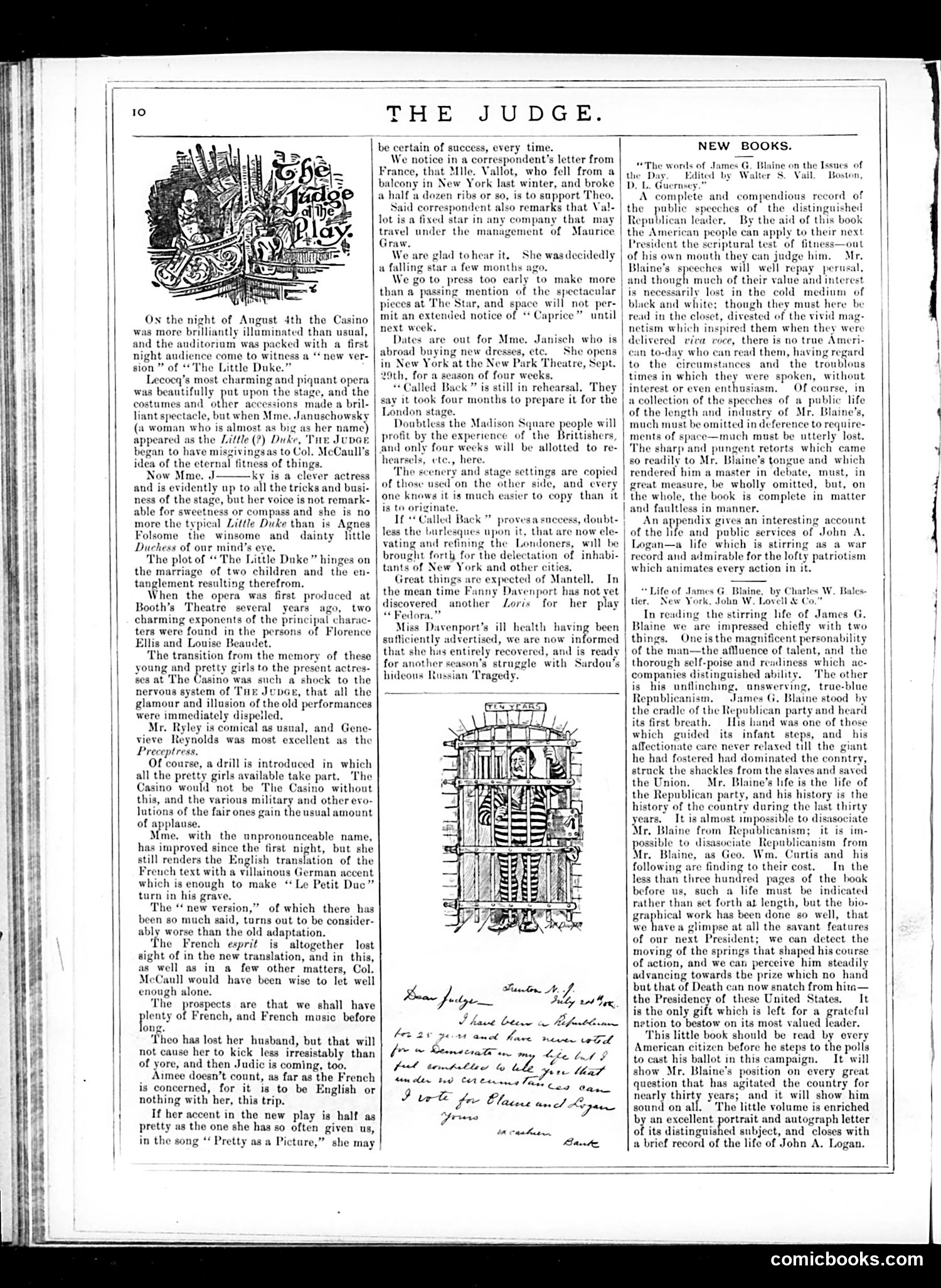
This page from **Judge** magazine contains theater criticism rather than political cartoons. The main content reviews a production of "The Little Duke," a French operetta at The Casino theater. **The Satire:** The critic mocks the casting of Mme. Januschowsky as the titular "Little Duke," sarcastically noting she's "almost as big as her name" and unsuitable for a role requiring a delicate young performer. The reviewer nostalgically compares her unfavorably to actresses Florence Ellis and Louise Beaudet from an earlier production at Booth's Theatre. **Key Complaints:** - The new English translation loses the original French wit and charm - Januschowsky's thick German accent mangles the English dialogue - The production lacks the grace of its predecessor **Context:** This reflects 1880s theater culture, where casting, translation quality, and performer skill were hotly debated in entertainment journalism. The humor relies on readers' familiarity with the original operetta and previous New York productions.
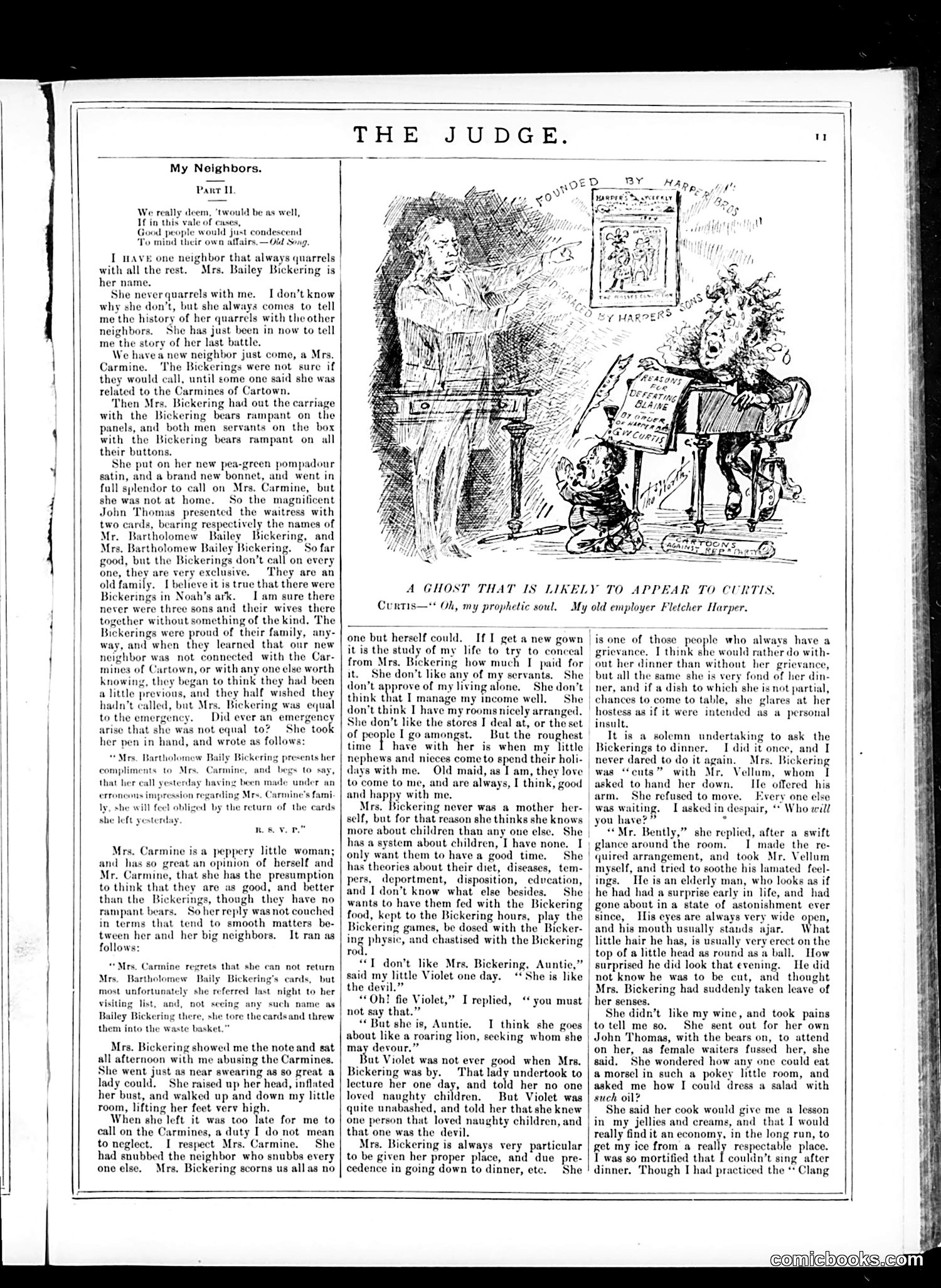
This page satirizes social snobbery and petty neighborhood conflicts through the character **Mrs. Bailey Bickering**, a pretentious, quarrelsome woman obsessed with status and family lineage. The narrative describes how Mrs. Bickering makes an elaborate formal call on a new neighbor, Mrs. Carmine, displaying her family's heraldic "bears rampant" and servants—only to discover the Carmines lack prestigious connections. When Mrs. Carmine witheringly refuses to return the visit (implying Mrs. Bickering isn't worth knowing), Mrs. Bickering is mortified. The cartoon illustrates the narrator's dry commentary: Mrs. Bickering is a busybody who constantly criticizes others' servants, homes, and choices while being "very exclusive" and self-important. The humor targets her hypocritical class-consciousness—she obsesses over rank while being ridiculous. The accompanying illustration shows what "a ghost that is likely to appear to Curtis" (the narrator), presumably depicting Mrs. Bickering's intrusive presence haunting him.
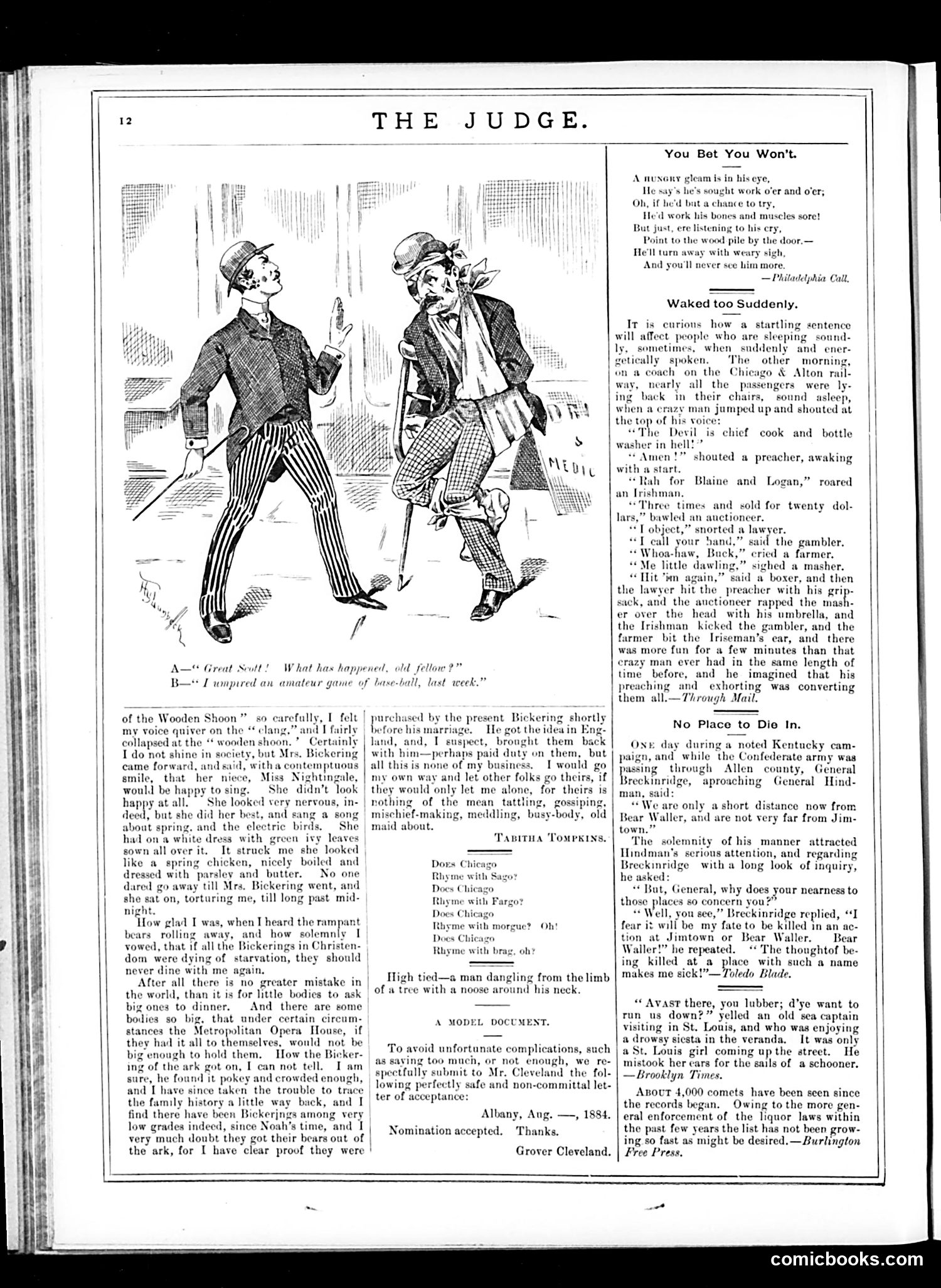
This page from *Judge* magazine (1884) contains several satirical pieces: **Main Cartoon**: Two men in period dress debate baseball. One claims to have "umpired an amateur game of base-ball, last week"—likely satirizing how people exaggerate minor involvement in events to seem important. **"You Bet You Won't"**: Social commentary on poverty and prejudice. Despite a poor man's willingness to work, a householder points him toward the woodpile (menial labor), refusing genuine opportunity. The satire critiques class dismissal. **"Waked too Suddenly"**: Humorous chaos when a madman shouts blasphemy on a train, causing various passengers (preacher, Irishman, lawyer, gambler, farmer, boxer) to react according to stereotype, creating pandemonium. The joke mocks both the man's outburst and passengers' predictable reactions. **"A Model Document"**: Political satire on President Grover Cleveland's brief, noncommittal letter accepting the 1884 Democratic nomination—poking fun at his careful avoidance of controversial statements.
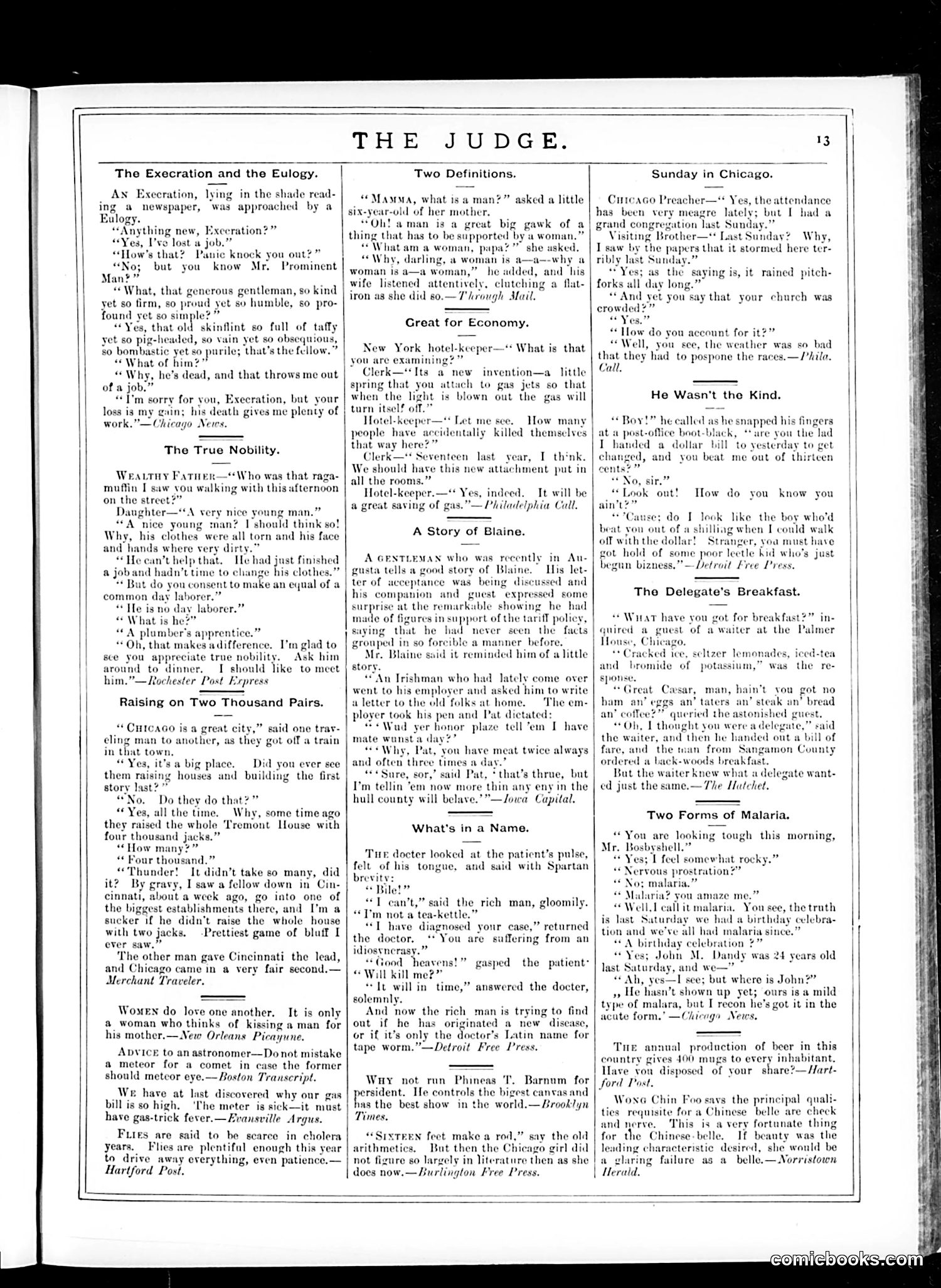
This page from *Judge* magazine contains several brief satirical pieces typical of 1880s-90s American humor: **"The Execration and the Eulogy"** personifies abstract concepts debating a man's death—a "Prominent Man" who was simultaneously generous yet stingy, humble yet proud. The joke mocks how people's reputations shift after death, with opposite characterizations both seeming true. **"The True Nobility"** satirizes class pretension: a wealthy father initially objects to his daughter dating a poorly-dressed man, assuming he's a common laborer. Upon learning he's a plumber's apprentice, the father suddenly approves, valuing the trade over appearance—mocking arbitrary social hierarchies. **"Raising on Two Thousand Pairs"** is a tall tale comparing house-raising with con games ("jacks" likely puns on both mechanical jacks and card-playing tricks), suggesting both cities use deceptive schemes. The remaining pieces are brief quips on gender relations, astronomy, gas meters, and a story about **Blaine** (likely James G. Blaine, 1880s political figure) regarding tariff policy debates. The content reflects period concerns about class, labor, politics, and gender.
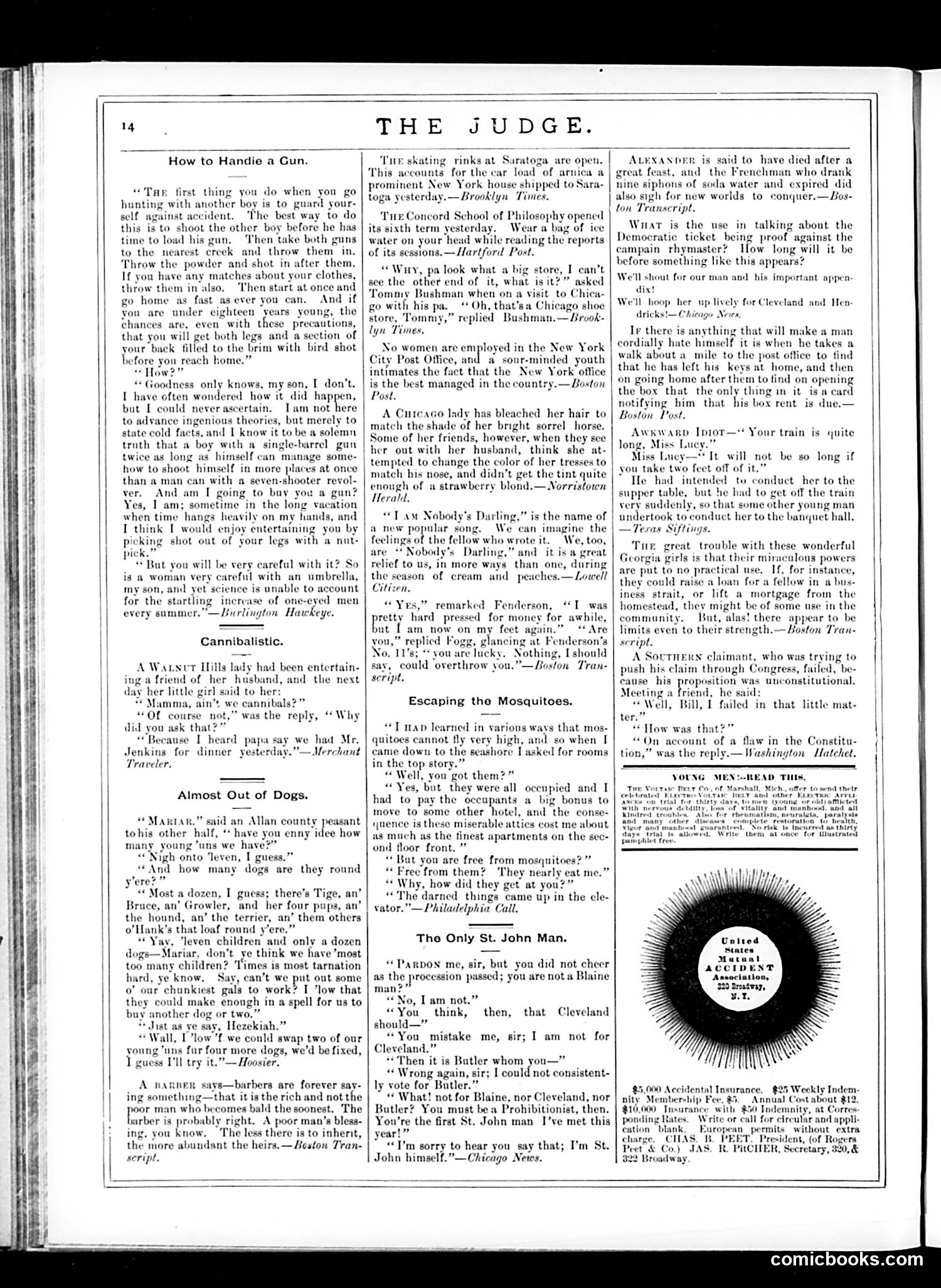
This page from the satirical magazine *Judge* contains several humorous short pieces mocking contemporary social attitudes and absurdities: **"How to Handle a Gun"** satirizes parental anxiety about children's safety with firearms through deadpan absurdist advice—suggesting shooting the other boy first, then discarding weapons. The joke critiques both gun culture and overprotective parenting rhetoric. **"Cannibalistic"** plays on the innocent misunderstanding of a child who hears her father say they "had Mr. Jenkins for dinner" (as a guest), thinking it means they ate him. **"Almost Out of Dogs"** mocks rural poverty and large families through a dialect-heavy conversation where a farmer suggests trading daughters for more dogs—satirizing both economic desperation and callous attitudes toward children. The remaining snippets mock contemporary trends: women working in post offices, hair-bleaching fashions, and philosophical pretension. The *Judge* logo (an eye) appears on the right. This is advertising/masthead material for the magazine itself.
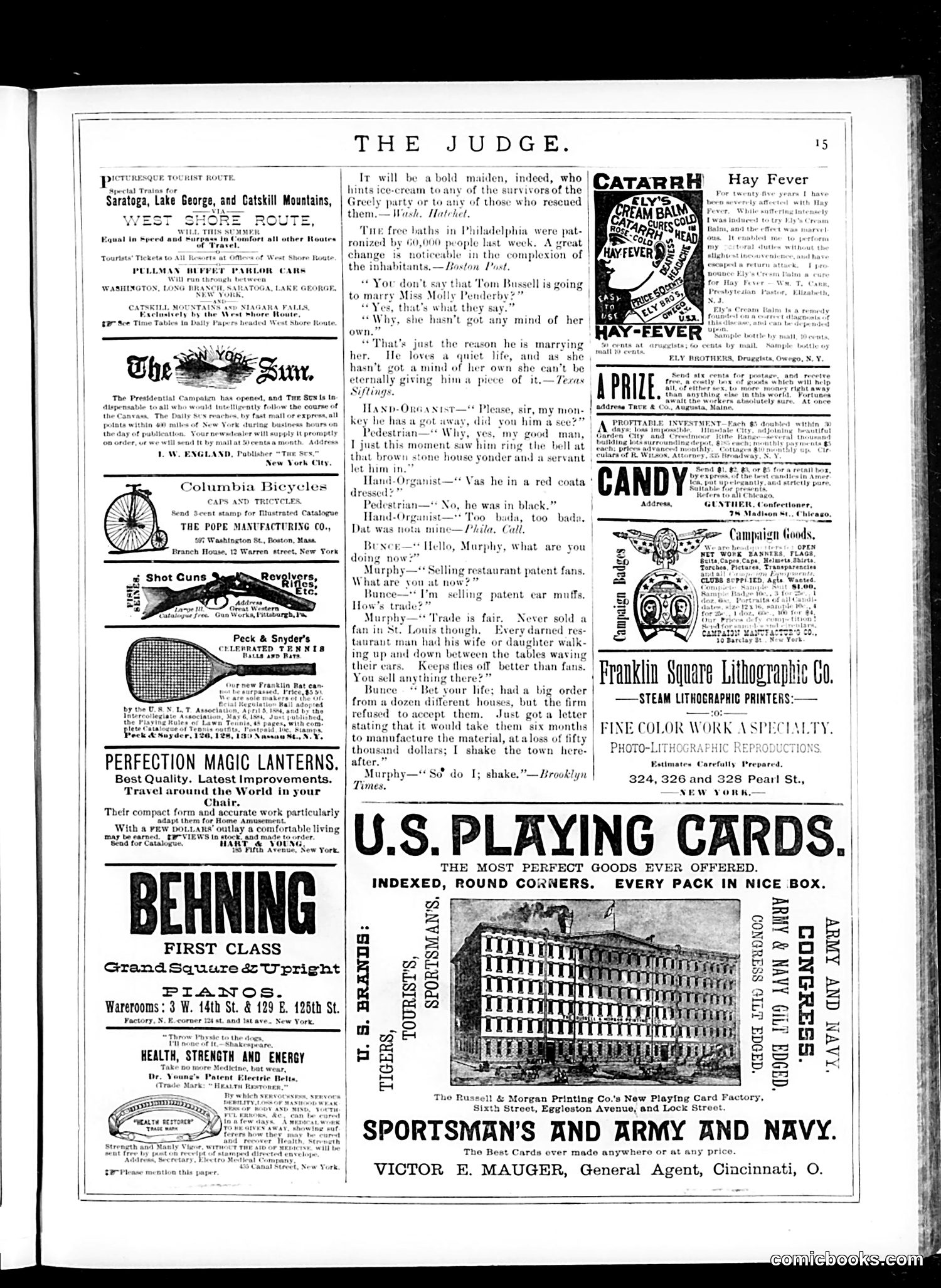
This is primarily an **advertising page** rather than editorial content. While it contains miscellaneous jokes and humorous brief items at the top, the bulk consists of late-19th-century advertisements. **The humor content** includes genteel comic vignettes: a hand-organist trying to sell someone a monkey that escaped, confusion about a servant letting "him" into a house, and Murphy chattering about selling patent fans and muffs. These appear to be generic newspaper-style filler jokes with no obvious political or topical reference. **The advertisements** showcase period products: Columbia Bicycles, shot guns, "magic lanterns" (early projectors), Behning pianos, and prominently, **U.S. Playing Cards** manufactured by Russell & Morgan. The cards are categorized for "Tourists," "Sportsmen," and "Army and Navy." **For modern readers**: This reflects an era when advertising subsidized satirical magazines. The ads reveal what Americans valued (bicycles, firearms, entertainment devices) while the throw-away humor demonstrates the casual, mild comedic sensibility of the period.
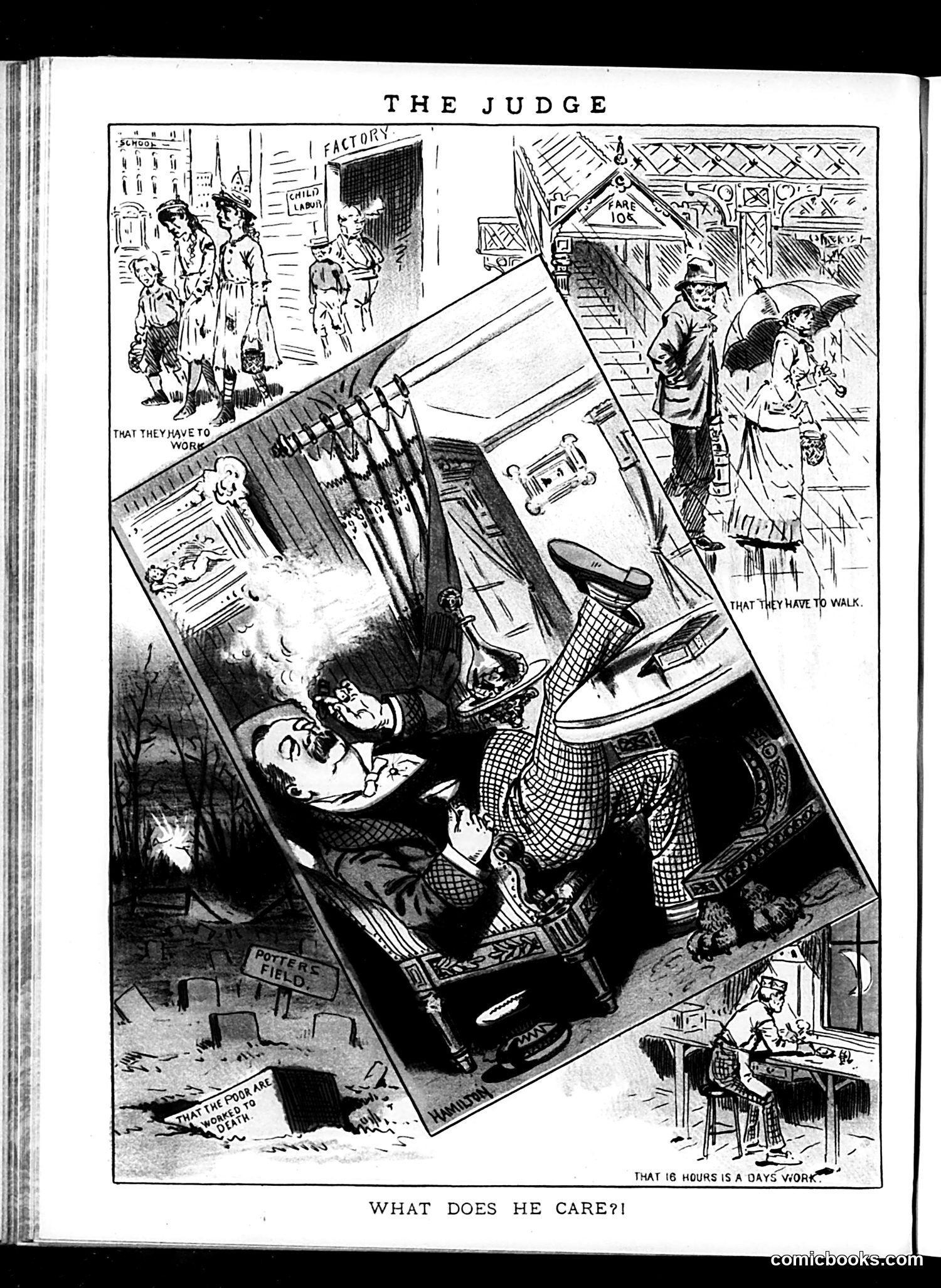
This political cartoon satirizes judicial indifference to child labor conditions. The central image depicts a rotund judge figure literally turned away from scenes of exploitation: children working in factories ("that they have to work"), walking barefoot on city streets ("that they have to walk"), and laboring sixteen-hour days ("that 16 hours is a day's work"). The judge sits comfortably in an ornate chair, apparently oblivious or dismissive of these hardships visible in the surrounding vignettes. A gravestone labeled "Potter's Field" (a burial ground for the poor) suggests deadly consequences of such conditions. The cartoon criticizes the judicial system's failure to address child labor abuses during the Progressive Era, when labor reform was a major social issue. The judge's turning away emblematizes institutional negligence toward vulnerable working children.