
A complete issue · 16 pages · 1884
Judge — June 21, 1884
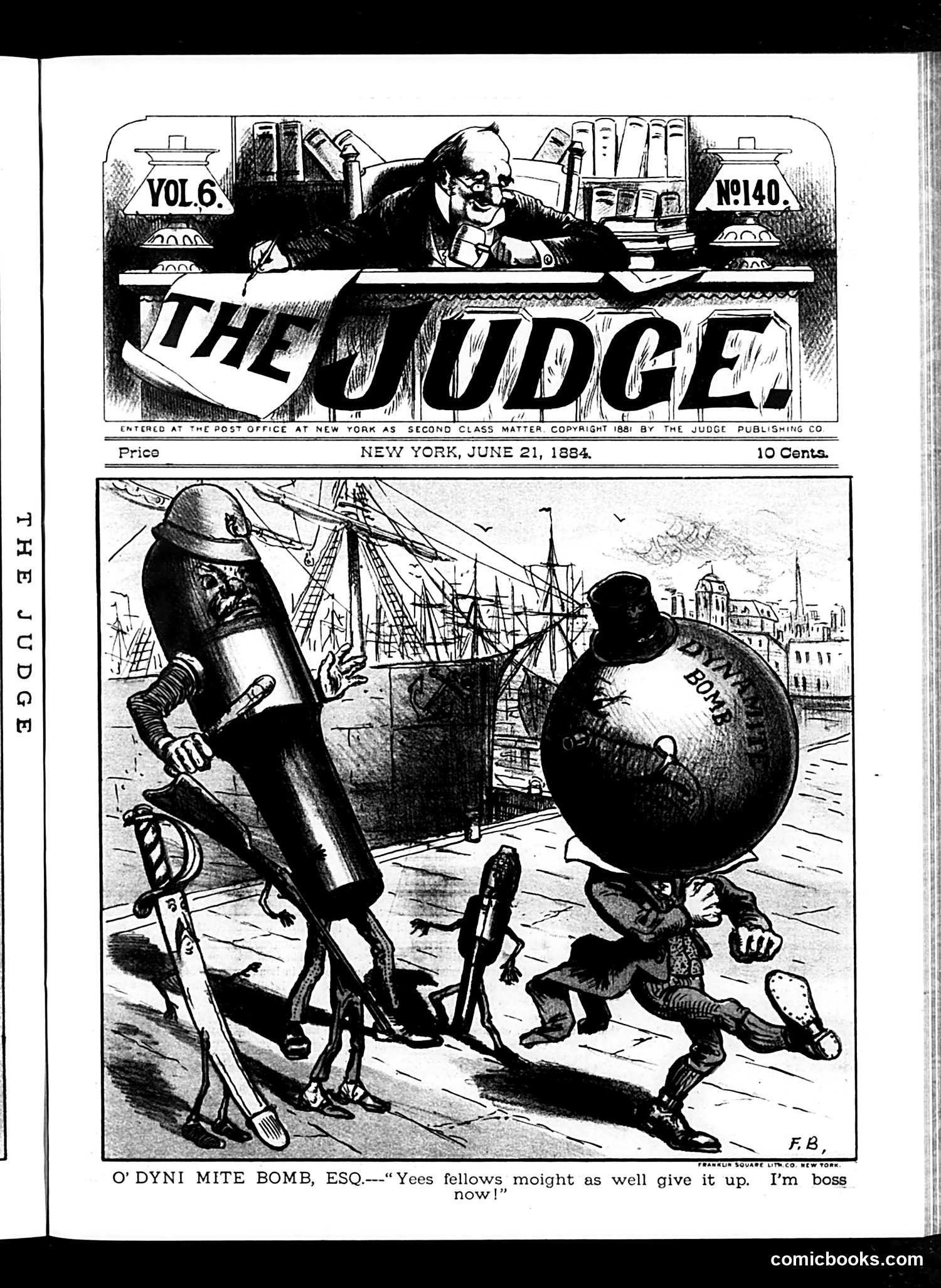
This cartoon, titled "O'Dyni Mite Bomb, Esq.," appears to reference Irish-American dynamite threats or anarchist activities of the 1880s. The figure on the left—a caricatured Irishman holding a large dynamite bomb labeled "BOMB"—declares "Yees fellows moight as well give it up. I'm boss now!" while confronting smaller figures at a dock setting. The satire likely mocks Irish immigrants or Irish-American political groups perceived as dangerous radicals. The exaggerated dialect and caricature reflect period anti-Irish prejudices. The "dynamite" reference suggests connection to actual dynamite campaigns by Irish nationalist groups during this era, which American publications often weaponized to portray Irish immigrants as inherent threats to social order and American institutions.
This editorial cartoon mocks Republican "Independents"—party members who opposed James G. Blaine's nomination at the 1884 Chicago Convention and initially refused to support the ticket. **The Satire:** Judge compares the Independents to sulky children refusing to play a game because they didn't get their way. The piece ridicules their posturing as principled dissent, arguing they're actually just spoiled, petulant malcontents. **Key Points:** - Blaine's nomination generated genuine popular enthusiasm ("shouts of acclaim") - The Independents are gradually returning to support Blaine despite their initial boycott - Judge suggests they lack the integrity to admit they were wrong; instead they pretend necessity forced their return - The comparison to "semi-imbecile old women" and spoiled children emphasizes Judge's contempt for their behavior **Political Context:** The 1884 Republican Convention revealed party factions. Judge—supporting the regular Republican ticket—uses mockery to delegitimize the Independents' dissent and celebrate Blaine's broad appeal as inevitable.
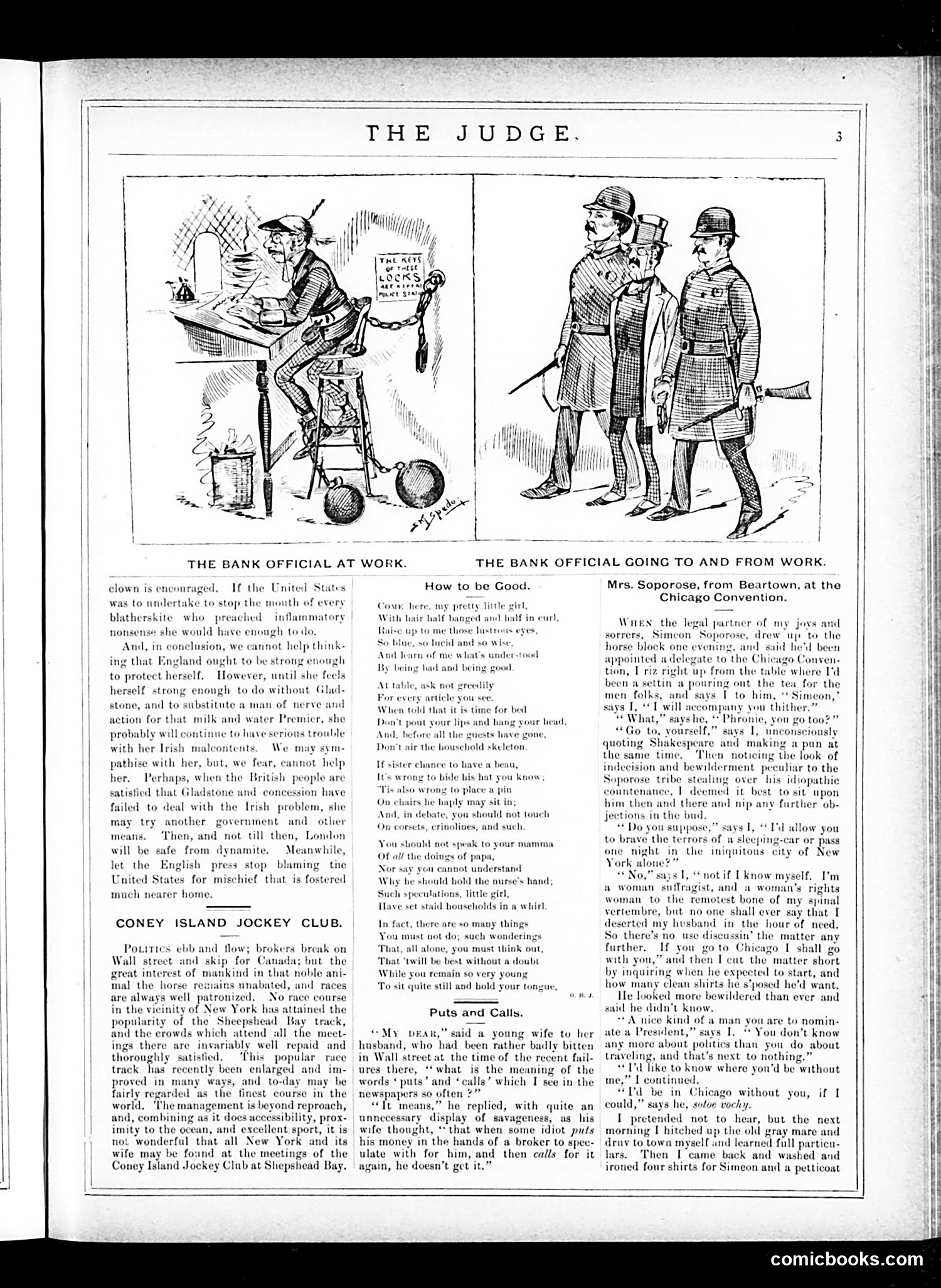
**"The Bank Official at Work" and "Going To and From Work"** (left cartoons): These contrasting panels satirize the double life of corrupt bank officials during the Gilded Age. The left shows an official at his desk, seemingly juggling accounts or hiding fraudulent activities (note the chains and balls), while the right depicts him dressed respectably in military-style attire, presenting a facade of respectability in public. The satire critiques how financial criminals maintained respectable appearances despite their dishonest dealings. **"How to Be Good"** (poem): This piece sardonically instructs young girls on restrictive Victorian behavior—silence, obedience, suppression of personality—mocking the era's oppressive gender expectations. **"Puts and Calls"** (dialogue): A husband bitterly explains stock market terminology to his wife, likely referencing the recent financial crisis mentioned (the "recent failures"), where ordinary people lost money to brokers' speculation. The husband's anger reflects real public resentment toward Wall Street gambling. **"Mrs. Soporose from Beartown"**: A woman humorously insists on accompanying her husband to the Chicago Convention, asserting women's rights and refusing domestic confinement—satirizing both women's emerging political consciousness and male resistance.
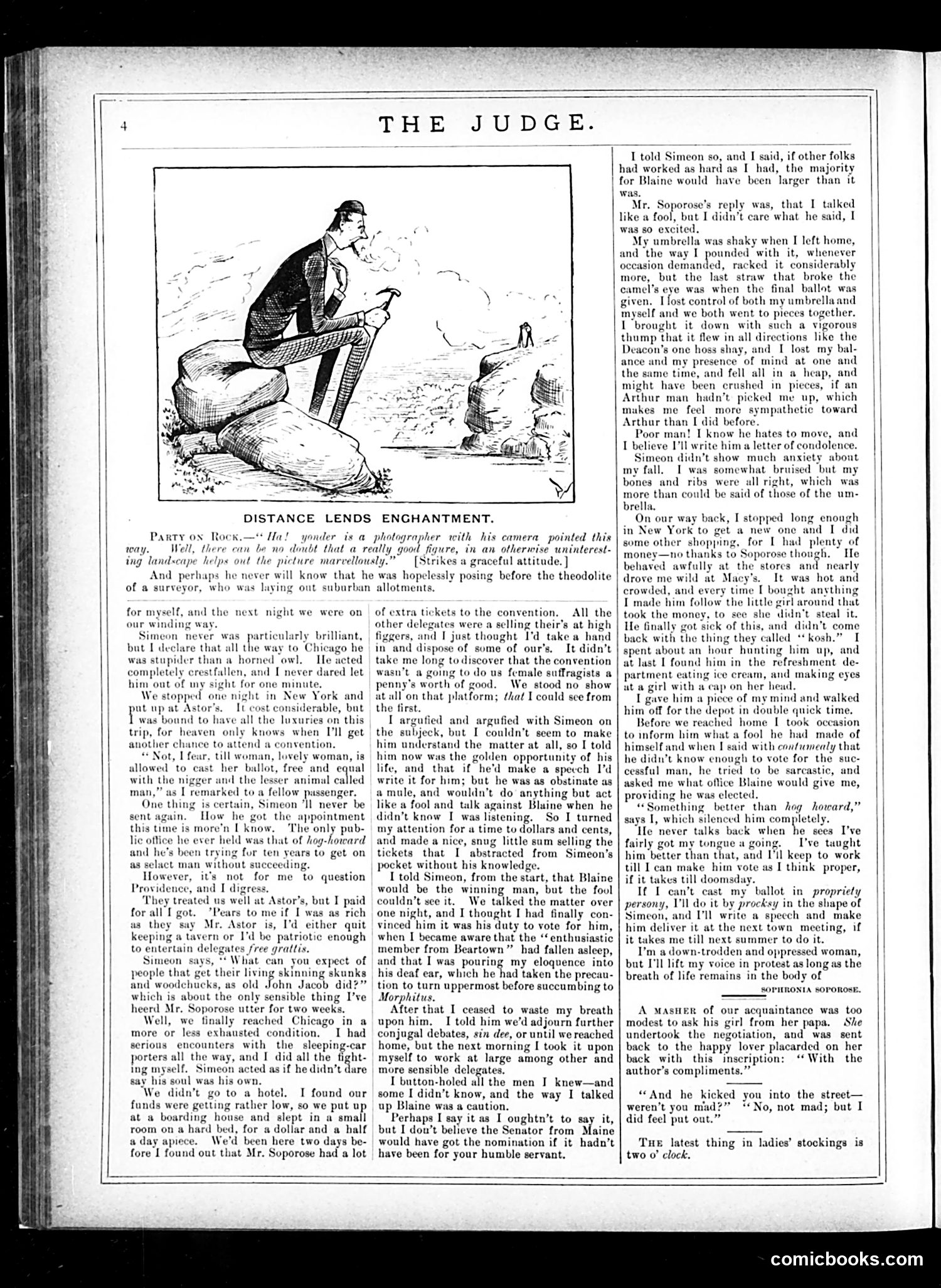
This page from *Judge* magazine satirizes political convention attendance and female suffrage activism in the Gilded Age (likely 1880s, given the Blaine reference). The cartoon "Distance Lends Enchantment" depicts a man awkwardly posing on rocks for a photographer—a visual joke about how perspective transforms reality. The accompanying text is a first-person account by a female delegate frustrated with her incompetent male traveling companion, Simeon, at what appears to be a Republican convention. The satire targets several things: Simeon's stupidity and passivity, the speaker's aggressive self-interest (she steals convention tickets to profit), and the futility of women's suffrage efforts at the convention. The humor relies on her frank admission that she prioritizes making money over political principle, and her exasperation that even when she tries to coach Simeon on voting strategy, he falls asleep. The joke is essentially: women seeking political equality are hampered by incompetent male allies and their own mercenary impulses.
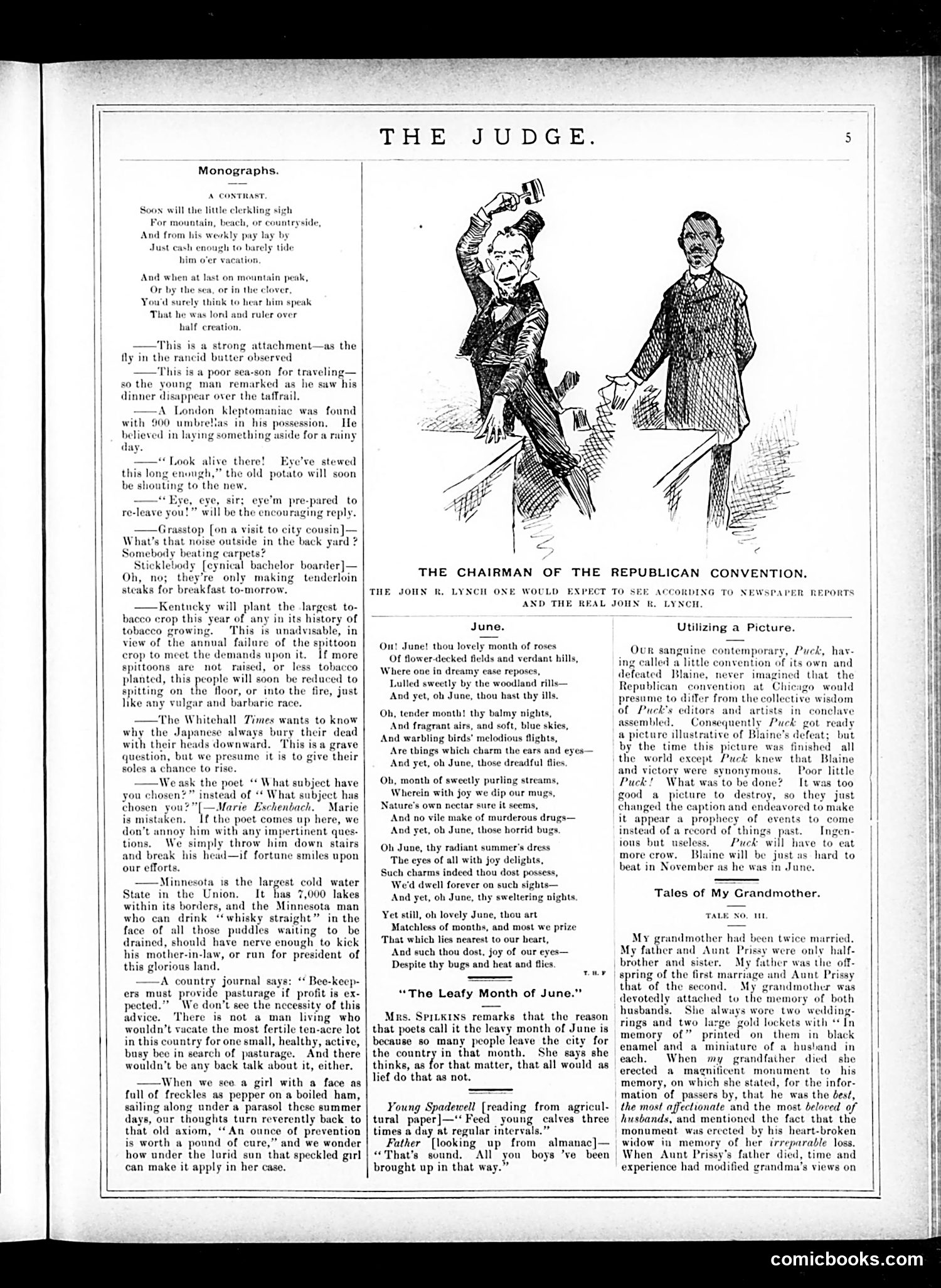
The main cartoon depicts **John R. Lynch**, identified in the caption as chairman of the Republican Convention. One figure (left) appears to be striking or attacking Lynch (right) with a weapon or tool. This likely references the **1884 Republican National Convention**. Lynch, a Black Republican from Mississippi, held a position of prominence in the party during Reconstruction and its aftermath. The violent imagery suggests satirical commentary on political conflict—possibly mocking either Lynch's authority or broader Republican Party divisions of that era. The accompanying text includes various unrelated satirical "monographs" (short jokes and observations) about American life, plus poetry about June. The page is primarily humorous commentary rather than hard-hitting political critique, typical of *Judge* magazine's lighter fare.
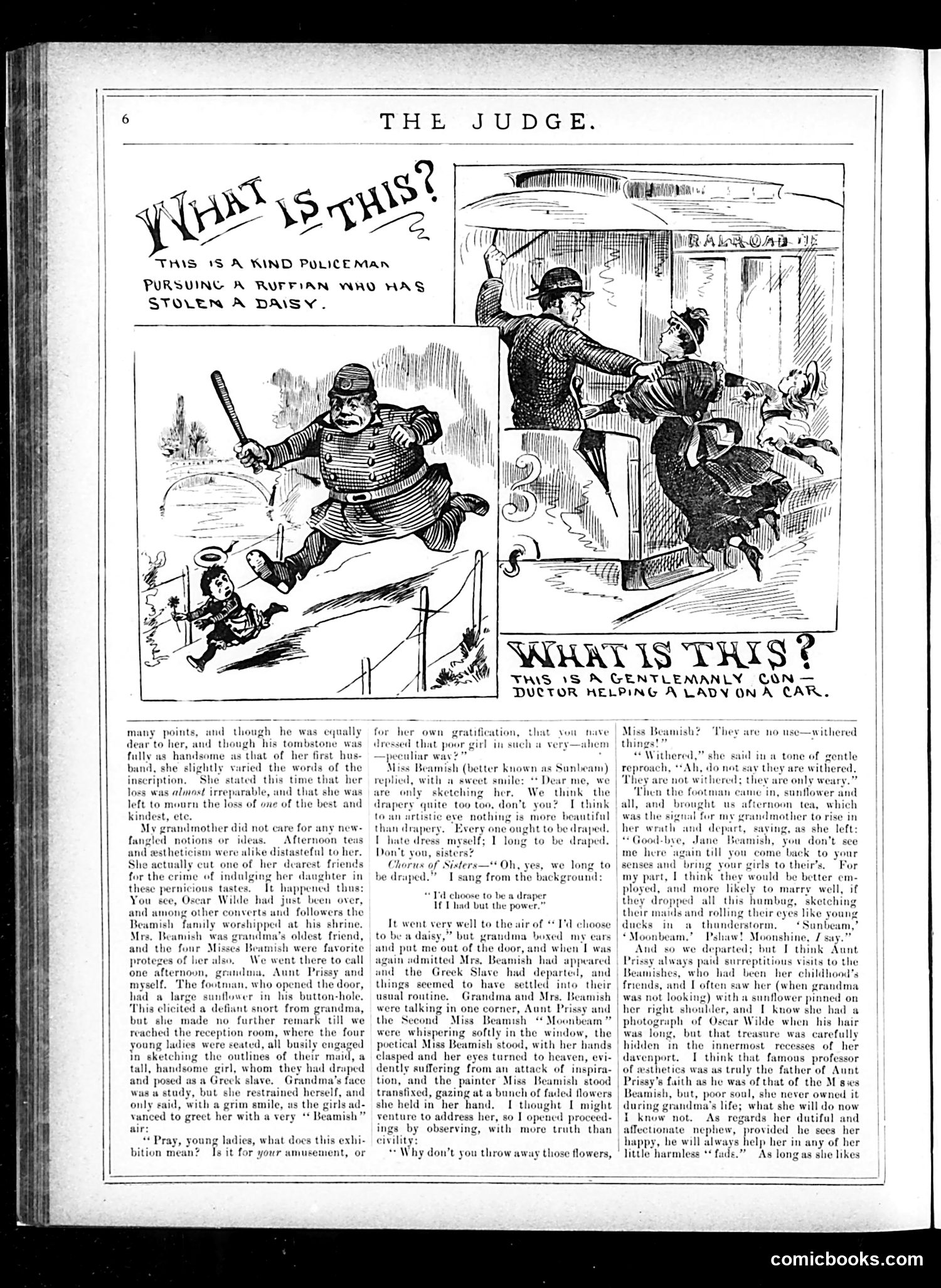
This page satirizes the Aesthetic Movement of the 1880s-90s, particularly Oscar Wilde's influence on American society. The two cartoons mock different responses to aestheticism: **Left cartoon**: A police officer chases a man for stealing a daisy—absurd because aesthetes valued flowers as decorative objects rather than living things, suggesting the movement's disconnection from practical reality. **Right cartoon**: A gentleman conductor helps a lady board a streetcar, labeled as "gentlemanly"—contrasting with the affected, impractical poses of aesthetic devotees shown in the accompanying story. The text satirizes the Beamish family's embrace of aestheticism: daughters sketch a maid as a "Greek slave," wear sunflowers, speak in affected language ("too, too"), and gaze heavenward dramatically. The grandmother character represents common-sense opposition, ultimately rejecting the family for their "humbug." The satire targets aestheticism as pretentious affectation disconnected from genuine morality or usefulness—a common conservative criticism of the movement.
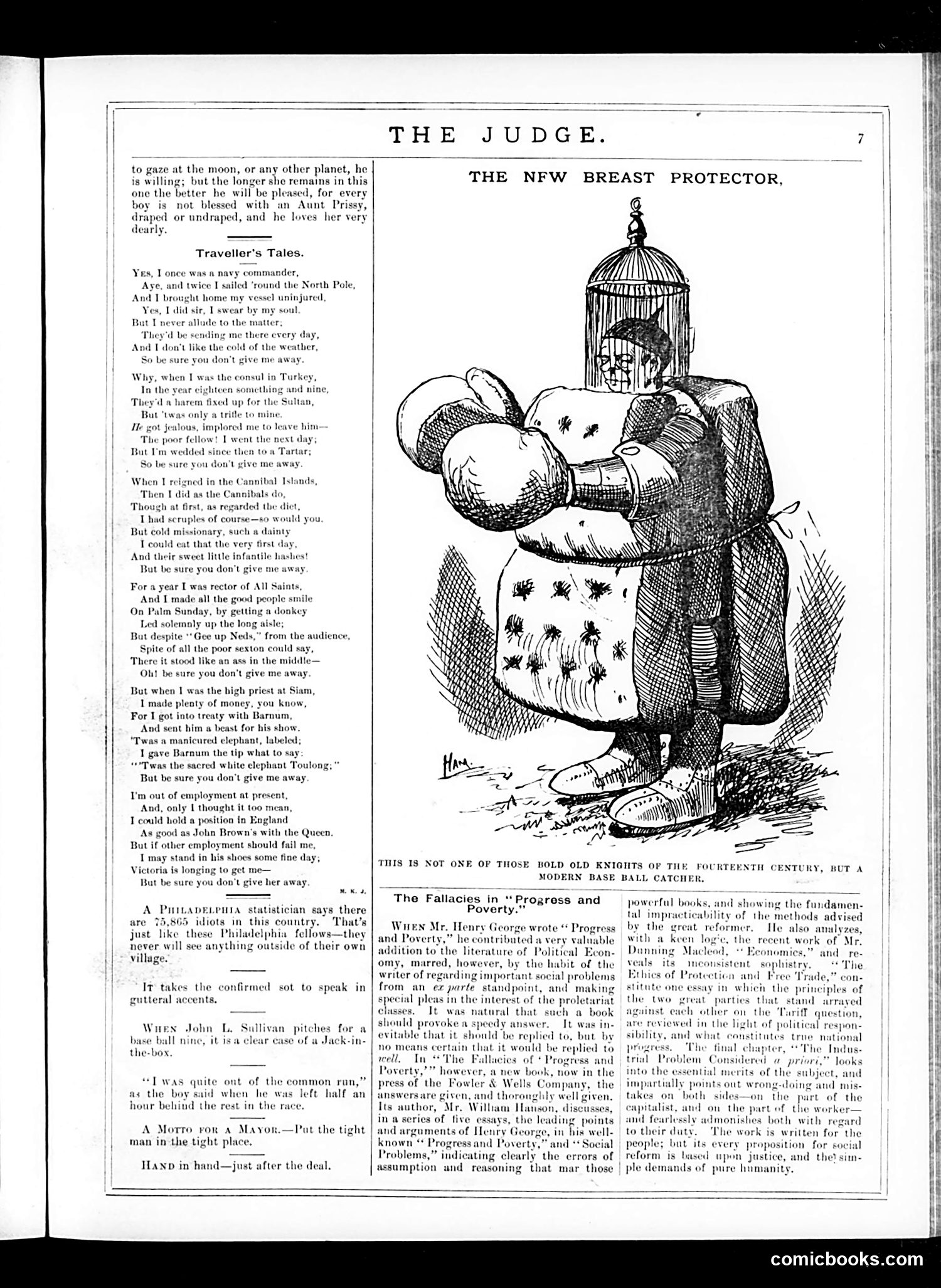
This page contains a humorous cartoon satirizing baseball safety equipment. The illustration shows a rotund catcher wearing an exaggerated protective chest piece resembling oversized breasts, complete with flies crawling on it. The caption claims this is "NOT one of those bold old knights of the fourteenth century, but a modern base ball catcher"—a joking comparison of the ridiculous protective gear to medieval armor. The crude joke plays on the catcher's position requiring chest protection, mocking both the awkward appearance of contemporary baseball equipment and, implicitly, masculine vanity about athletic gear. The satirical tone typical of Judge magazine suggests contemporary readers would recognize this as commentary on the developing sport of baseball and evolving protective equipment standards. The page also contains unrelated content: a poem titled "Traveller's Tales" featuring tall tales, and a literary review of "The Fallacies in Progress and Poverty."
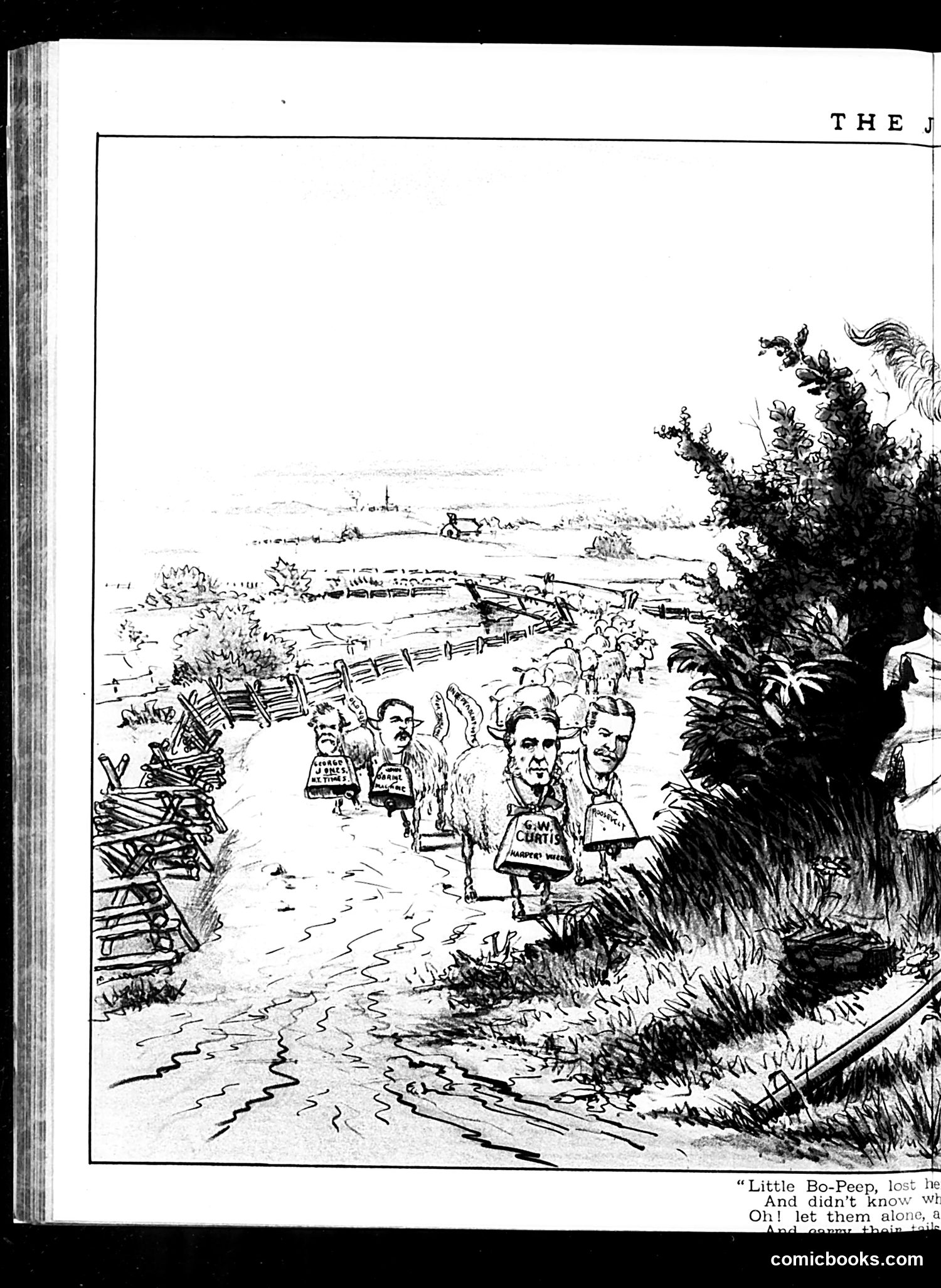
This appears to be a satirical adaptation of the nursery rhyme "Little Bo-Peep." The cartoon depicts caricatured political figures (whose specific identities are unclear from the image alone) being herded like sheep across a rural landscape, complete with fencing and pastoral scenery. The satire suggests these politicians are following the "Little Bo-Peep" approach—leaving problems unattended, hoping they'll resolve themselves ("let them alone"). This was likely critiquing political negligence or inaction on contemporary issues during Judge magazine's publication period. The figures wear what appear to be political badges or labels, though the specific text is difficult to read clearly. The cartoon mocks the subjects for passivity or abdication of political responsibility, a common Judge magazine theme.
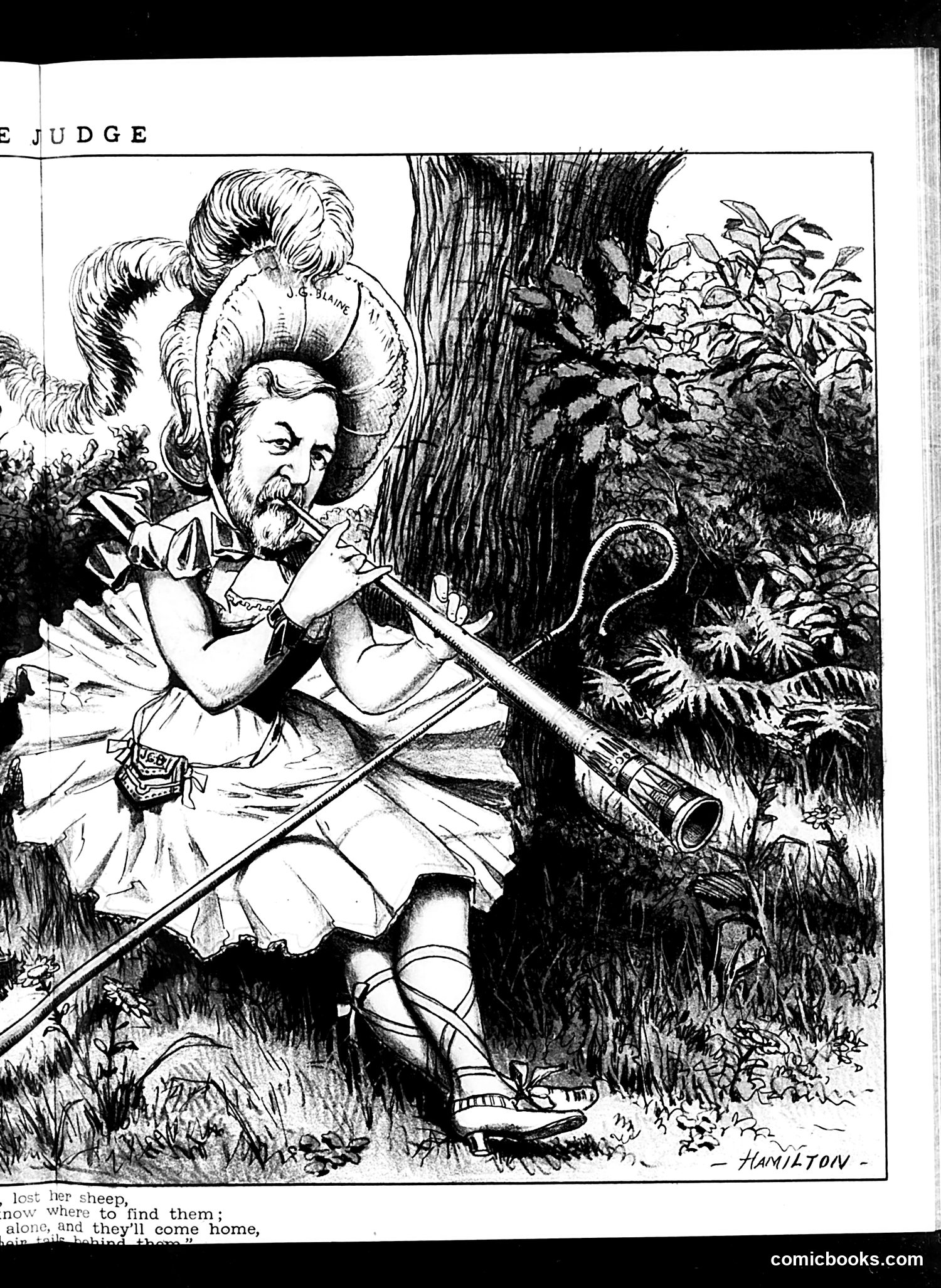
This illustration by Hamilton depicts a figure in elaborate Turkish or Ottoman dress—featuring a large turban, ornate robes, and a pipe—sitting beneath a tree. The character appears to be a personified representation, likely of an Ottoman ruler or Turkish authority figure based on the stereotypical orientalist styling common in late-19th/early-20th-century American satire. The visible text references lost sheep and finding them, suggesting an allegory about governance or control of a population. Without the complete caption and publication date, the specific political reference is unclear, but this type of cartoon typically mocked foreign leaders or satirized American foreign policy toward Ottoman territories during periods of imperial decline or conflict.
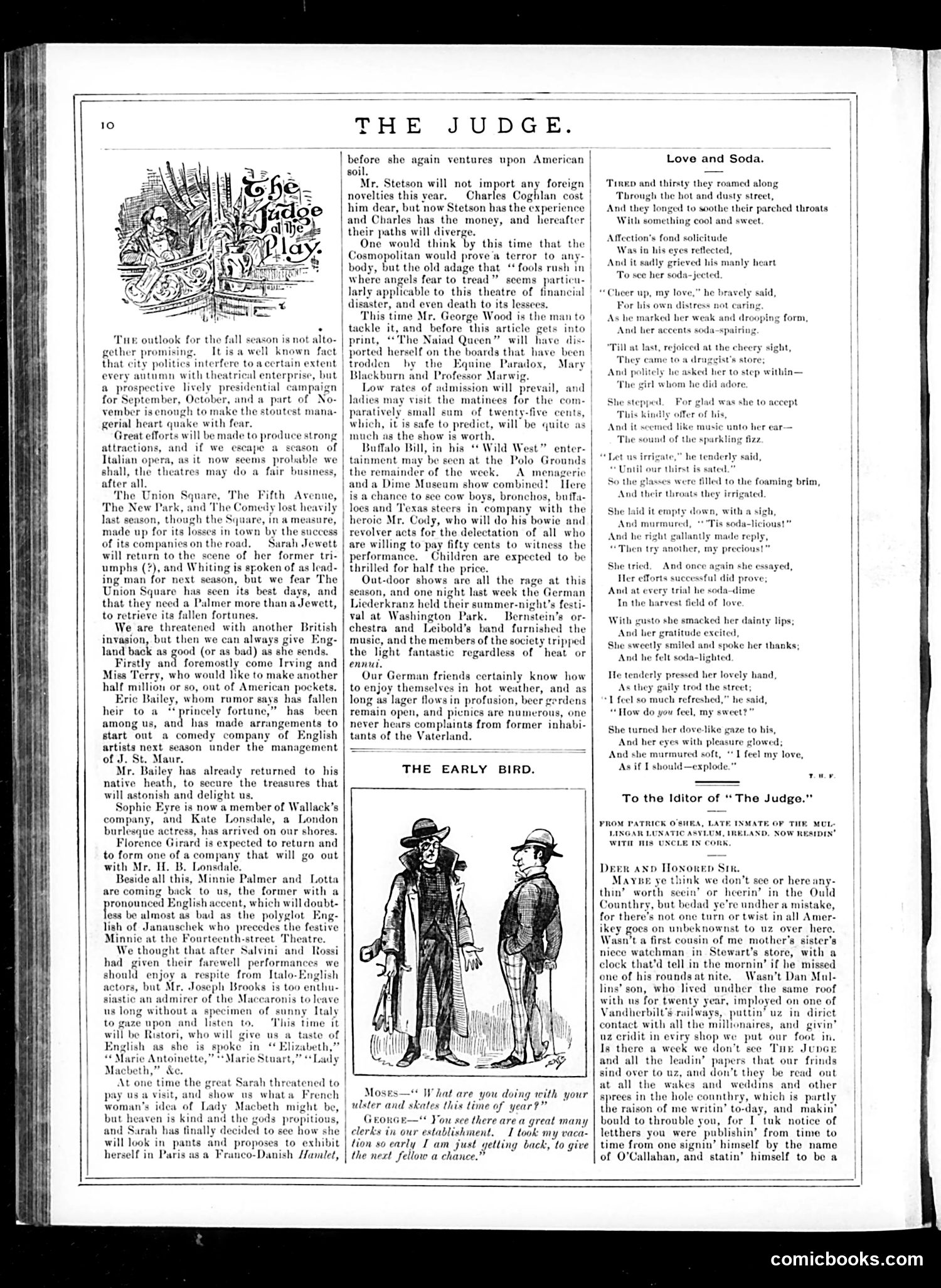
This page surveys the **1880 fall theatrical season** outlook in New York City. The main text discusses financial troubles at major theaters (Union Square, Fifth Avenue, New Park, Comedy) and anticipated attractions. **Key references:** - **Irving and Miss Terry**: The famous British acting duo expected to profit heavily from American audiences - **Sarah Bernhardt** ("the great Sarah"): French actress proposing to perform *Hamlet* in Paris dressed in pants—a scandalous idea for the era - **Ristori**: An Italian actress - **Theater politics**: The piece notes that presidential campaign season (fall 1880) disrupts theatrical business **The satire's point**: Theater managers constantly chase foreign talent and novelties (Irving, Bernhardt, Italian opera stars) while struggling financially. The underlying joke criticizes American theaters' dependency on European performers and gimmicks rather than developing native talent. **"The Early Bird" cartoon** (lower left) shows two men in period dress—context unclear from this page alone.
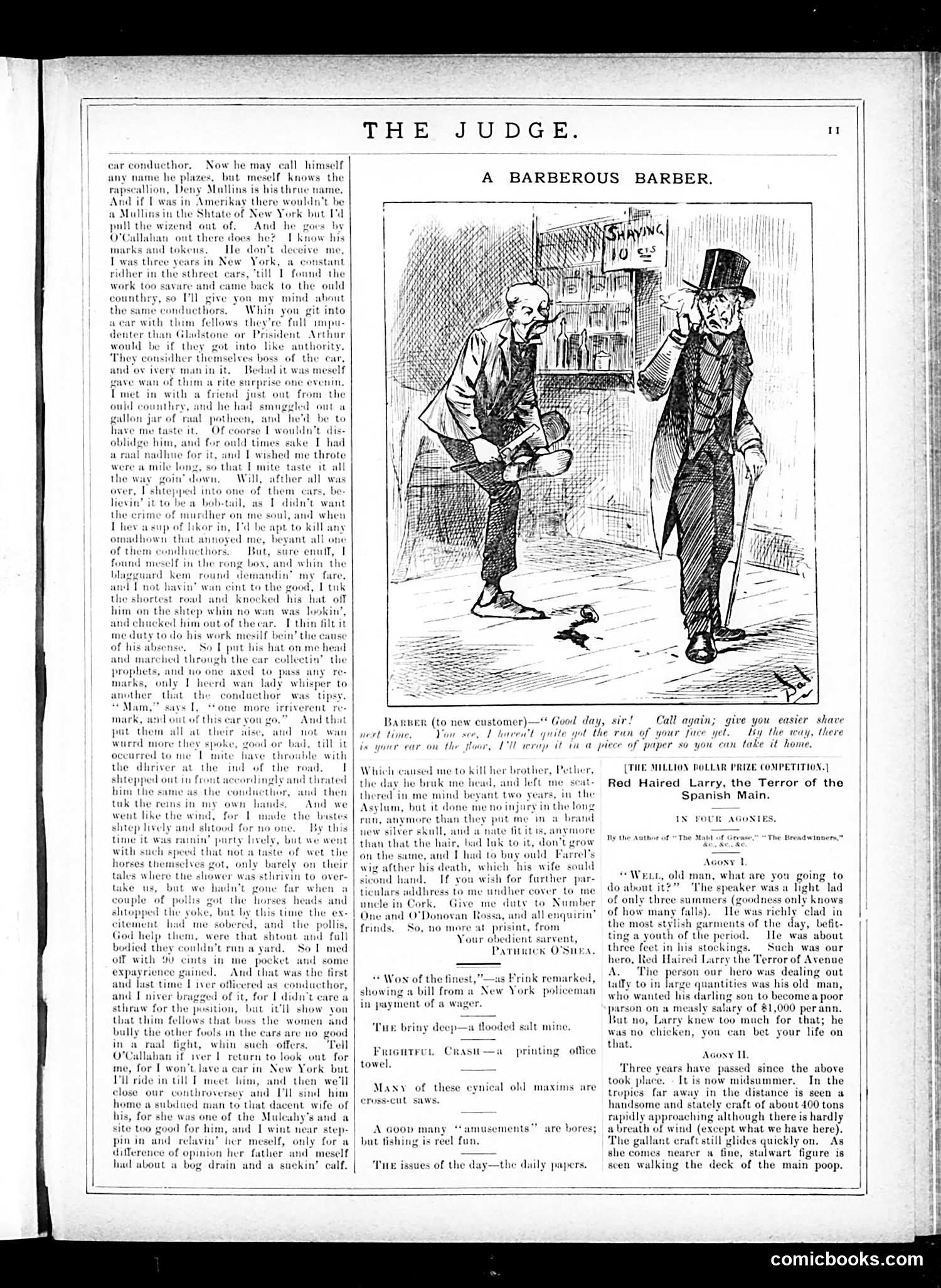
The cartoon depicts an Irish immigrant barber accosting a well-dressed customer outside his shop ("Shaving 10¢"). The barber, drawn with exaggerated Irish features, appears aggressive and confrontational while the gentleman recoils. The accompanying text is a first-person Irish-dialect monologue about a street-car conductor named "Deny Mullins" (or "O'Calihan"), recounting the narrator's violent revenge for perceived disrespect. The conductor allegedly cheated him and mistreated him; the narrator responds by assaulting the conductor, hijacking the trolley, and fleeing with 90 cents. **The satire targets**: Irish immigrant laborers, stereotyping them as volatile, quick-tempered, dishonest, and prone to violence over minor slights. The heavy dialect and crude grammar reinforce period stereotypes of Irish as uncultured. **The barber cartoon** likely illustrates this stereotype—an Irish tradesman behaving menacingly toward a customer, embodying the "dangerous immigrant" trope common in 1880s-90s American satire. Judge magazine frequently published such anti-Irish content reflecting nativist prejudices of the era.
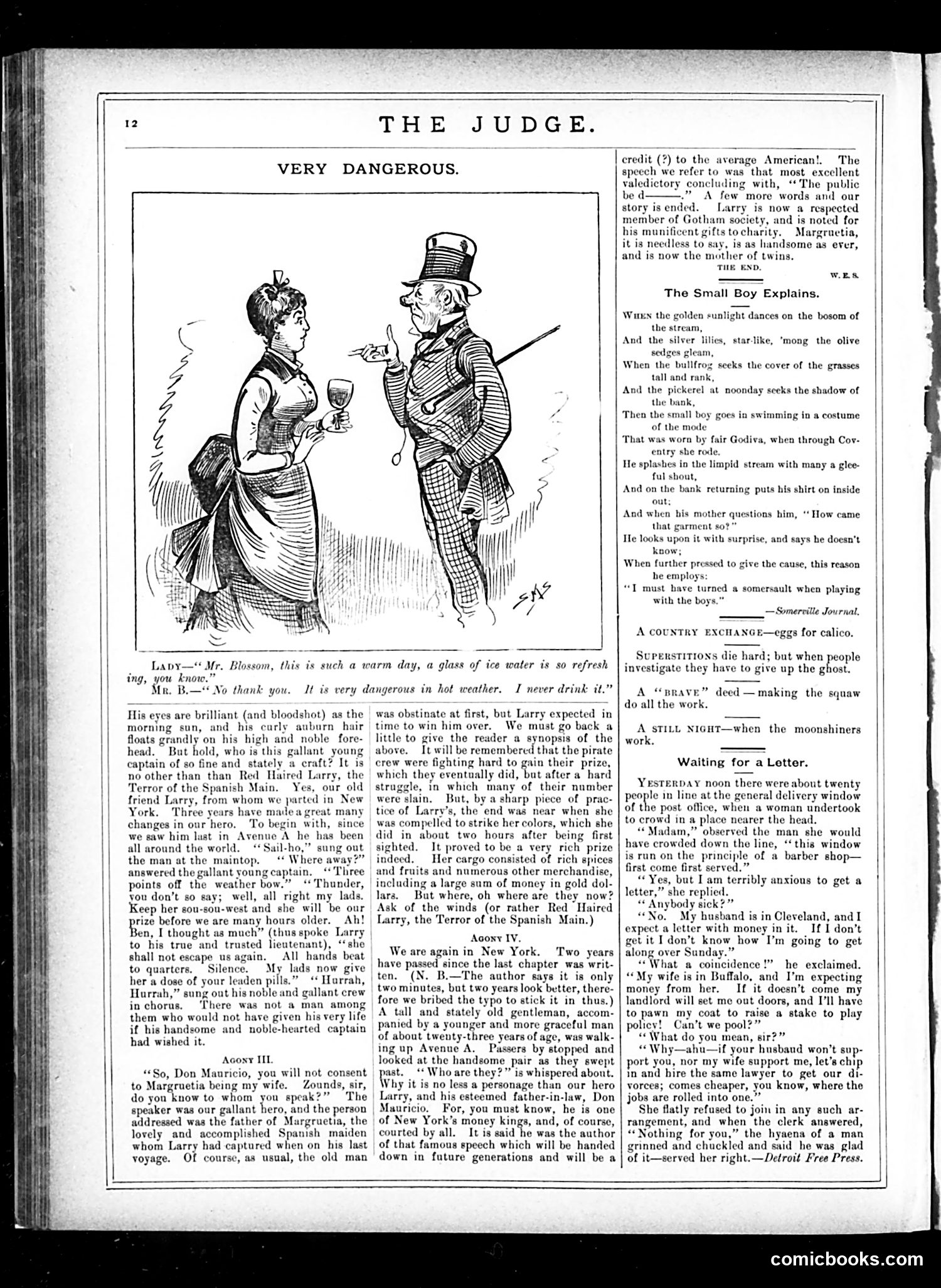
This page satirizes the Victorian-era serialized adventure story, specifically the melodramatic pirate narratives that were popular in the 1800s. The cartoon depicts a gentleman in a top hat addressing a woman, warning her that ice water is "very dangerous in hot weather"—a deliberately absurd and prissy concern that mocks upper-class affectation. The accompanying text parodies the overwrought style of adventure serials about "Red Haired Larry, the Terror of the Spanish Main," tracking his implausible transformation from Avenue A ruffian to respectable New York businessman and philanthropist married to a Spanish maiden. The humor lies in Judge's mockery of both the melodramatic plotting (pirates, captures, fortune) and the sentimental moralizing (reformed villain becomes pillar of society). The cartoon ridicules genteel pretension and the gap between working-class reality and upper-class anxieties about propriety.
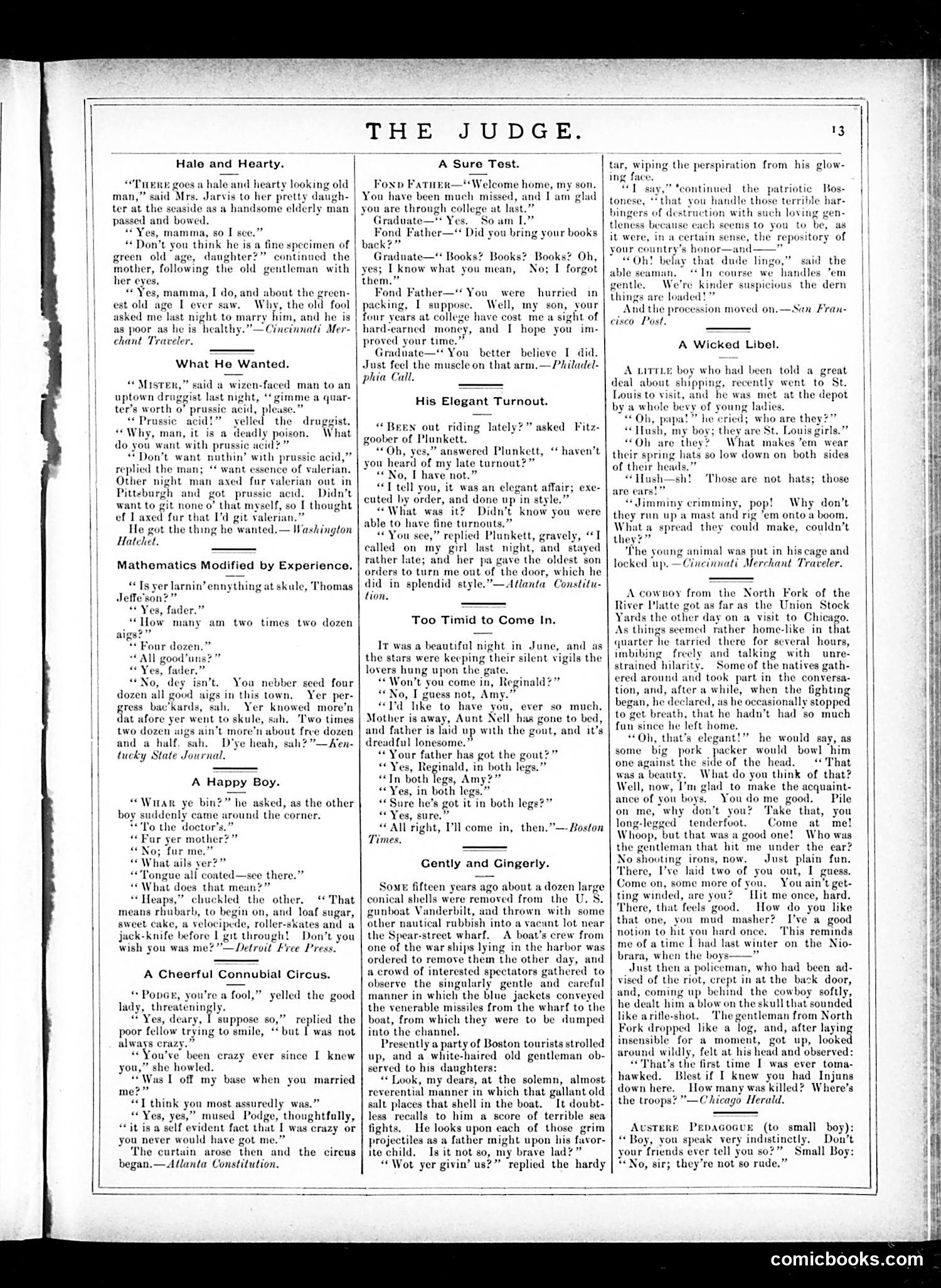
This page from *Judge* (a 19th-century American satirical weekly) contains multiple short humorous pieces rather than political cartoons. The content reflects period concerns and social humor: **Key pieces include:** - **"Hale and Hearty"**: Satirizes elderly men pursuing younger women for marriage despite poverty - **"What He Wanted"**: A dialect-heavy joke about a man deliberately asking for the wrong poison to receive valerian instead - **"Mathematics Modified by Experience"**: Uses African American dialect to joke about practical versus book learning (reflecting period racial stereotypes) - **"A Happy Boy"**: Humor about a child's anticipated treats (tongue coating, rhubarb, cake, roller-skates) - **"A Sure Test"**: A father tests his college-educated son's strength rather than knowledge - **"His Elegant Turnout"**: A pun—"turnout" means both carriage and being ejected from a house The dialect humor and character types reflect late 19th-century publishing conventions. Most jokes target social pretension, romantic folly, and generational differences.
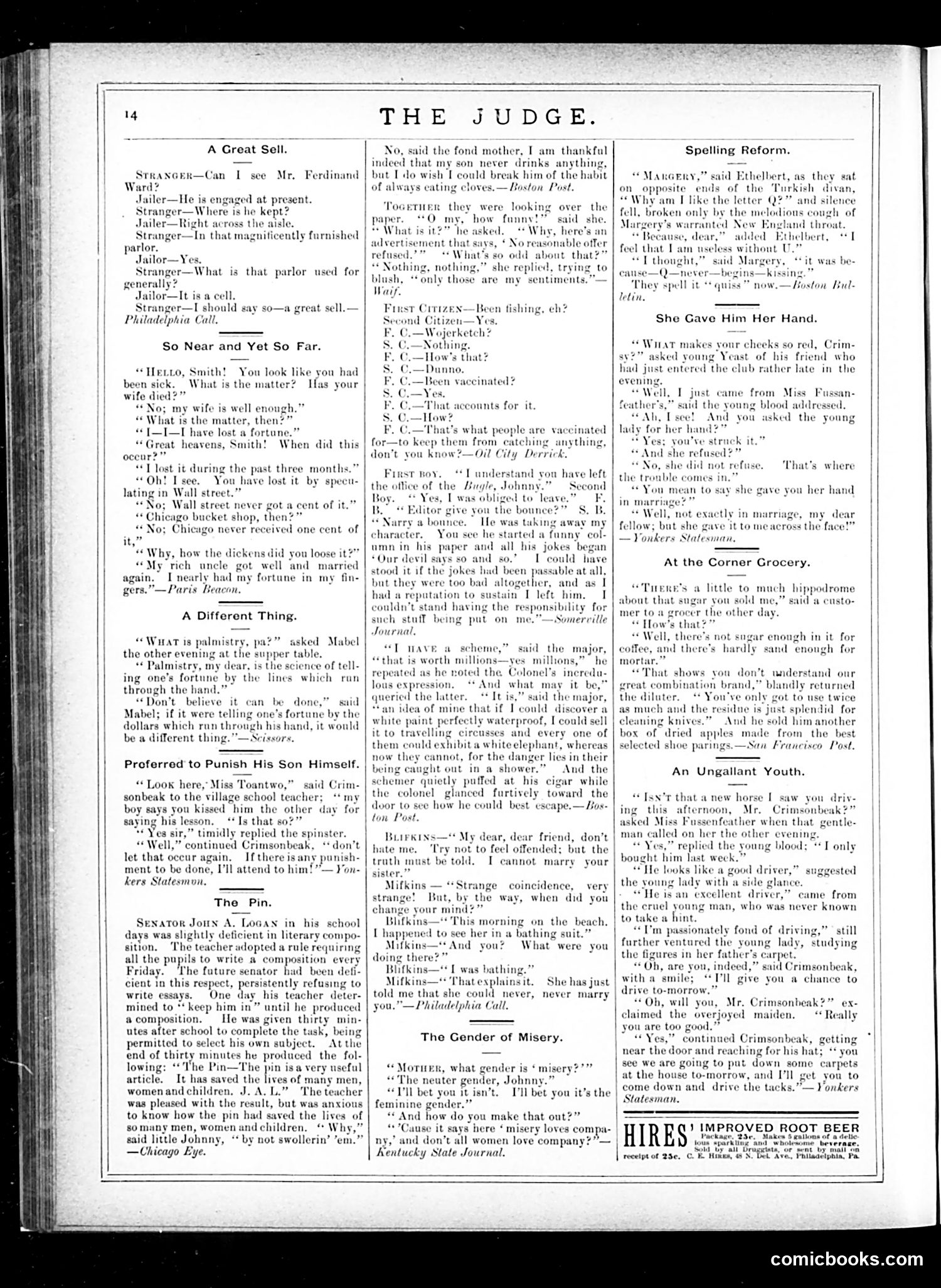
This page contains humorous short anecdotes and jokes typical of Judge magazine's satirical content. Key pieces include: **"A Great Sell"**: A prisoner asks a jailer about a parlor's purpose; the jailer calls it "a cell," punning on "sell" (deception). The humor plays on words. **"So Near and Yet So Far"**: A man lost his fortune through Wall Street speculation—commentary on the risks of financial markets and get-rich-quick schemes. **"Spelling Reform"**: Two characters, Ethelbert and Margery, discuss simplified spelling ("Margery" instead of "Margaret"), reflecting contemporary debates about language modernization. **"She Gave Him Her Hand"**: A young man asks a woman for her hand in marriage; she refuses but literally gives him her hand—by slapping his face. This plays on the phrase's double meaning. **"At the Corner Grocery"**: A grocer overcharges and adulterates goods, reflecting common consumer complaints about merchant dishonesty. The page satirizes contemporary concerns: financial speculation, linguistic debates, romance, and consumer fraud—all presented through brief, pun-heavy anecdotes characteristic of Victorian-era humor magazines.
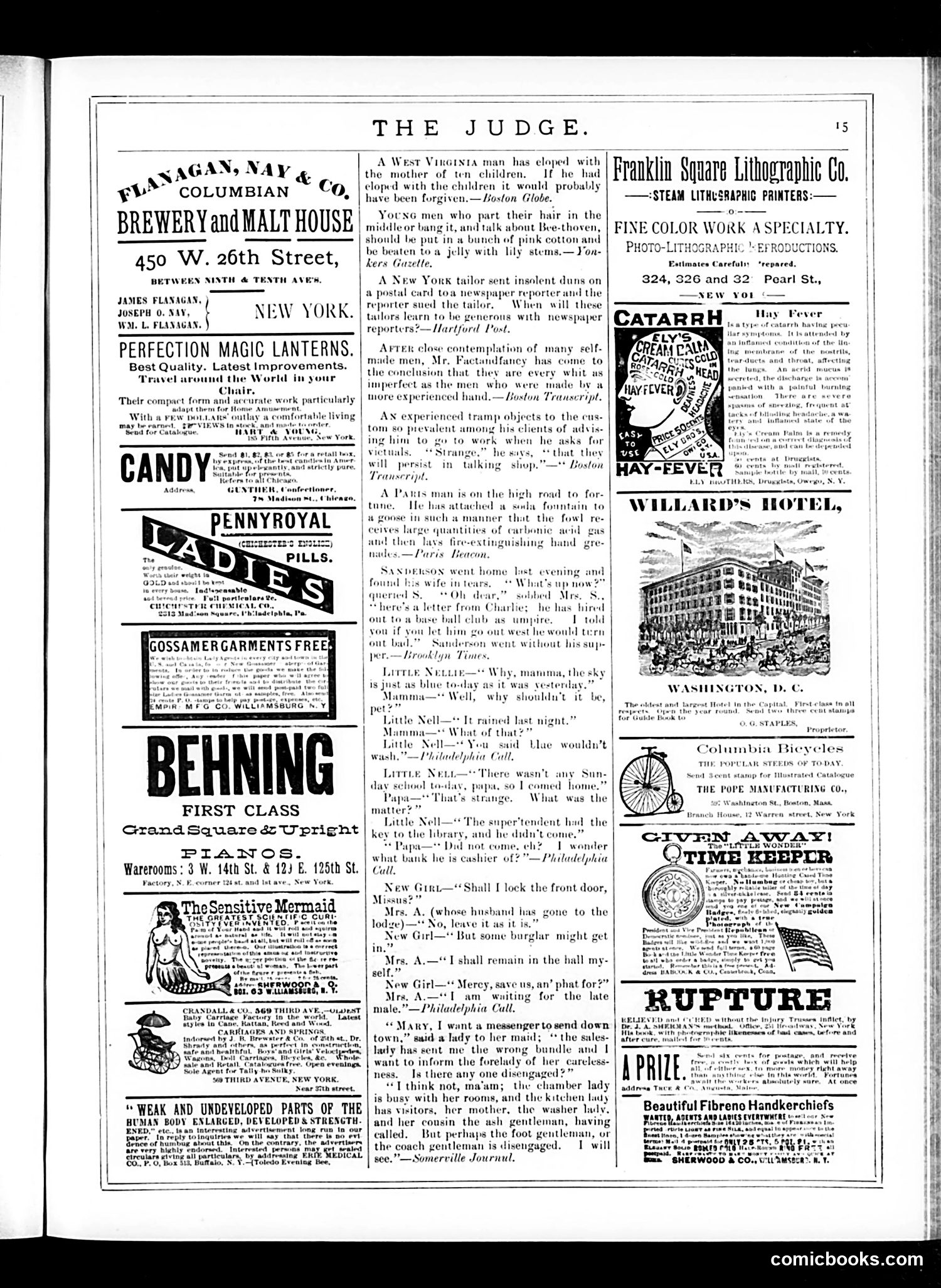
This page is primarily **advertising with humorous filler content**, typical of Judge magazine's format. The main satirical content consists of short, joke-format anecdotes scattered throughout—brief comedic observations about everyday life rather than political cartoons. Examples include: - A Boston Globe reference about a West Virginia man eloping with his children's mother (absurdist humor) - A story about a New York tailor sending "insolent duns" (bill collectors) to a newspaper reporter, suggesting satirical comment on working relationships - Domestic humor about wives questioning husbands ("What's up now?") - Workplace absurdism: a lady asking her maid to find someone "disengaged" to run an errand, only to learn everyone is busy—even "the foot gentleman" and "coach gentleman" The humor is **gentle social satire** mocking Victorian-era class structures, domestic dynamics, and the proliferation of servants with oddly specific titles. The "foot gentleman" and "coach gentleman" jokes appear to mock the pretentiousness of wealthy households maintaining unnecessary staff. The page is dominated by period advertisements for pianos, magic lanterns, brewery products, and patent medicines rather than substantive political commentary.
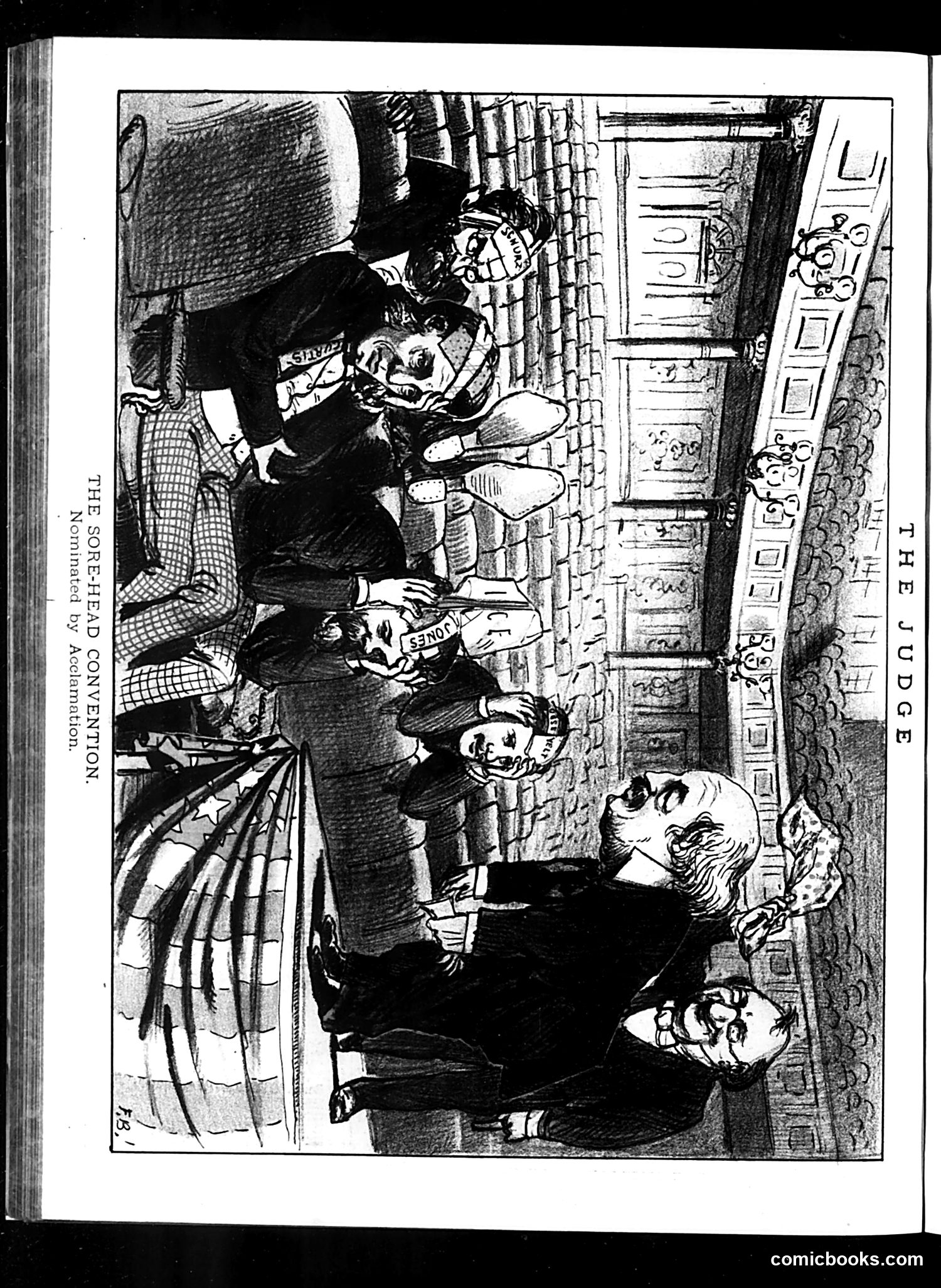
This page from *Judge* magazine appears to show a street scene with multiple figures interacting on a city sidewalk or street. The image is titled "The Sore-Head Convention" and is attributed to Adamson (per the OCR text). The cartoon likely satirizes a political gathering or faction characterized as disgruntled or angry ("sore-head"). The figures appear to be politicians or public figures of the era, though their specific identities aren't clearly legible in this image quality. Without clearer visibility of faces, labels, or date information, I cannot definitively identify which political event or controversy this references. The style suggests early-to-mid 20th century American political satire, typical of *Judge* magazine's approach to lampooning political discord.