
Judge, 1884-06-21 · page 13 of 16
Judge — June 21, 1884 — page 13: what you’re looking at
What you’re looking at
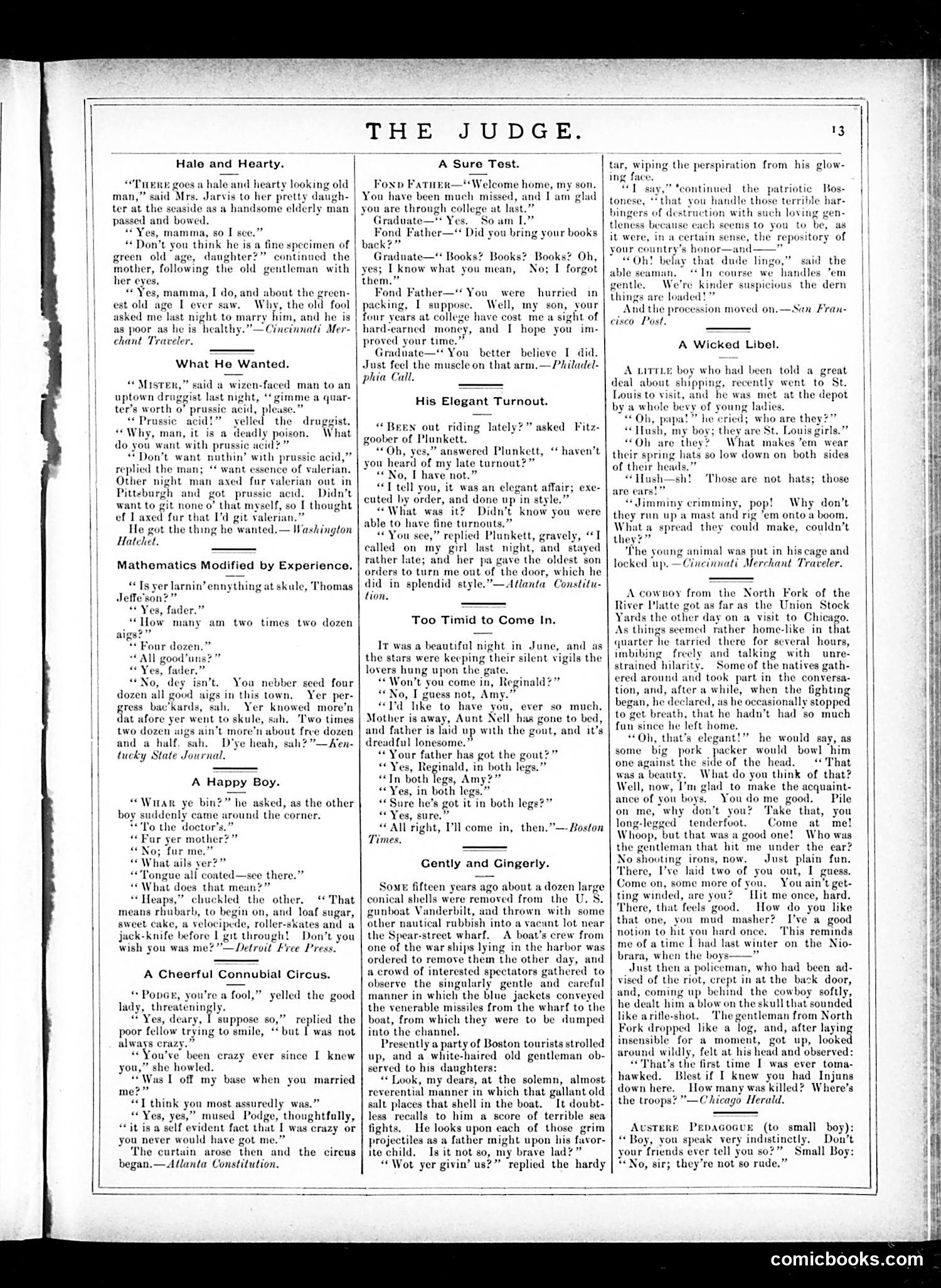
This page from *Judge* (a 19th-century American satirical weekly) contains multiple short humorous pieces rather than political cartoons. The content reflects period concerns and social humor: **Key pieces include:** - **"Hale and Hearty"**: Satirizes elderly men pursuing younger women for marriage despite poverty - **"What He Wanted"**: A dialect-heavy joke about a man deliberately asking for the wrong poison to receive valerian instead - **"Mathematics Modified by Experience"**: Uses African American dialect to joke about practical versus book learning (reflecting period racial stereotypes) - **"A Happy Boy"**: Humor about a child's anticipated treats (tongue coating, rhubarb, cake, roller-skates) - **"A Sure Test"**: A father tests his college-educated son's strength rather than knowledge - **"His Elegant Turnout"**: A pun—"turnout" means both carriage and being ejected from a house The dialect humor and character types reflect late 19th-century publishing conventions. Most jokes target social pretension, romantic folly, and generational differences.
📄 Transcribed text from this page (OCR, searchable)
Machine-transcribed from the original scan — historical spelling and the odd misread are preserved.
Hale and Hearty. hale and heart man,” said Mrs. Jarvis to her p ter at the seaside a nd bowed. 3, mamma, so I ses “Don’t you think he i fine specimen of | green old daughtel ontinued the | mother, following the old gentleman with her “Yes, mamma, I do, and about the green- est old age I ever saw. Why, the old fool asked me last night to marry him, and he is as poor as he is healthy.”—Cincinnati Mer- chant Travele etty daugh- a handsome elderly man What He Wanted. “Mister,” said a wizen-faced man to an uptown druggist last night, ‘gimme a quar- ter’s worth o° pru please.” “ Pru yelled the druggist. “Why, m deadly poison. W do you want with prussic “Don’t want nuthin’ replied the man; ‘ want essence of Other night man fur valerian out in Pitteburgh and got prussic acid. Didn't want to git none o’ that myself, so I thought ef I axed fur that I'd git valerian.” He got the thing he wanted.— Washington Hatchet. with prussic acid,” alerian. Mathematics Modified by Experience. «Ts yer larnin’ ennything at skule, Thomas ow many am two times two dozen ar dozen. \I1_good’un fader.” “No, dey isn’t. Yoa nebber seed four dozen all good aigs in this town, Yer per- gress bac’kards, sah. Yer knowed more’n dat afore yer went to skule, suh. ‘Two times two dozen i ain’t more’n about free dozen and a half. sah. D’ye heah, sah?"—A'en- tucky State Journal. A Happy Boy. sked pund the corner. “Witar ye bin? boy suddenly ¢ Po the ur yer mother?” No; fur me.” “ What ails yer “Tongue ali conted—se “What does that mean Heaps,” chuckled the other. 'That means rhubarb, to begin on, and loaf su sweet cake, a velocipede, roller-skat jack-knife before 1 git through! Don’t you wish you was me?”—Detroit Free Press. as the other A Cheerful Connubial Circus. * Pope fool,” lady, thr nteningly. “Yes, deary, 1 suppose so,” replied the poor fellow trying to smile, “but I was not always "wz, “You've been crazy ever since I knew you,” she howled. Was I off my base when you married * yelled the good I think you most assuredly was.” “Yes, yes,” mused Podge, thoughtfully, ‘it is a self evident fact that 1 was crazy or never would have got me he curtain arose then and the circus began.—Allanta Constitution. looking old | THE JUDGE. A Sure Tost. Fox Fatner—“Welcome home, my son, You have been much n | you are through colle, “Yes. ‘ather—‘ Did you bring your books Graduate—* Books? Books? yes; I know what you mean, them.” Fond Father—' packing, I suppe four years at college arned mon your tim te— You better believe I did. Just feel the muscle on that arm,— Philadel- phia Call. pecans Oh, No; I forgot were hurried in Well, my son, your ave cost me a sight of , and I hope you im- “You His Elegant Turnout. “Been out riding lately?” goober of Plunkett. swered Plunkett, rd of my late turnout?” “No, I have not.” “T tell you, it was an elegant affair; exe- cuted by order, and done up in s “What was it? Didn't know you were able to have fine turnouts.” “You sce,” replied Plunkett, gravely, “I called on my girl last night, and stayed rather late; and her pa gave the oldest son orders to turn me out of the door, which he did in splendid style.”—Adanta’ Constitu- tion, asked Fitz- “haven't Too Timid to Come In. Ir was a beautifal night in June, and as the stars were keeping their silent vigils the lovers hung upon the gate. **Won’t you come in, Reginald?” “No, I guess not, Amy.” “Td like to have you, ever so much. Mother is away, Aunt Nell has gone to bed, and father is laid up with the gout, and it’s dreadful lonesome. “Your father has got the gout?” “Yes, Reginald, in both leg “In both legs, Amy?" “Yes, in both le “Sure he’s got it in both lege?” “ Yes, sure.” “Allright, I'll come in, then Times. - Boston Gently and nd Gingerly. ‘ome fifteen years ago about a dozen large conical shells were removed from the U. 8. gunboat Vanderbilt, und thrown with some other nautical rubbish into a vacunt lot near the Spear-street wharf. A boat’s crew from one of the war ships lying in the harbor was ordered to remove them the other day, and a crowd of interested spectators gathered to observe the singularly gentle and careful manner in which the blue jackets convey the venerable missiles from the wharf to the boat, from which they were to be dumped into the channel. Presently a party of Boston tourists strolled up, and a white-haired old gentleman ob- served to his daughters: “Look, my dears, at the solemn, almost reverential manner in which that gallant old salt places that shell in the boat. It doubt- less recalls to him a score of terrible sea fights. He looks upon each of those grim yrojectiles as a father might upon his favor- ite child. Is it not so, my brave lad?” “Wot yer givin’ us?” replied the hardy 13 the perspiration from his glow- » wiping ing face. he ontinued the patriotic Bos- andle those terrible har- ction with such loving gen- ems to you to be, a8 it were, in a ¢ the r tory of your country’s honor—and “Oh! belay that dude lin able ‘In course we gentle, re kinder suspi thin, ded!” And the proce cisco Post. tor bingers of de tleness be the vem dern said andles jous the ion moved on.—San Fran- A Wicked Libel. A Littie boy who had been told a great deal about shipping, recently went to St. Louis to visit, and he was met at the depot by a whole bevy of young ladies. “Oh, papa!” he cried; who are the; “Hush, my boy; they are St. Louis girls.” “Oh are they at makes “em wear their spring hats so low down on both sides of their heads.” “TWush—sh! are ears!” Jimminy crimminy, pop! Why don’t they run up a mast and rig ’em onto a boom, What a spread they could make, couldn't they?” The young animal was put in his cage and locked up. —Cincinnati Merchant Traveler. ‘Those are not hats; those A cownoy from the River Platte got as far Yards the other on a visit to Chicago. As things seemed rather home-like in that quarter he tarried there for several hours, imbibing freely and talking with unre- strained hilarity. Some of the natives gath- ered around and took part in the conversa- tion, and, after a while, when the fighting began, he declared, as he occasionally stopped to get breath, that he hadn’t had ‘so much fun since he left home. “Oh, that’s el some big pork the North Fork of the s the Union Stock he would say er would bowl him de of the head. That What do you think of that? Well, now, I’m glad to inake the acquaint- ance of you boys. Youdo me good. Pile on me, why don’t you? that, you long-legged’ tenderfoot. Come at ime! Whoop, but that was a good one! Who was the gentleman that hit me under the ear? No shooting irons, now. Just plain fun, There, I’ve laid two of you out, I guess. Come on, some more of y You ain't get- ting winded, are you? “Hit me once, hard. There, that feels good. How do you like that one, you mud masher? I’ve a good notion to hit you hard once. This reminds me of atime | had last winter on the Nio- bra when the bo: Just then a policeman, who had been ad- vised of the riot, crept in at the back door, and, coming up behind the cowboy softly, he dealt him a blow on the skull that yanaded like arifle-shot. Thegentleman from North Fork dropped like a log, and, after laying insensible for a moment, got up, looked around wildly, felt at his head and observe «That's the first time I was ever toma- hawked. Blest if I knew you had Injuns down here. How many was killed? Where’s the troc "—Chicago Herald. a8 Austere Pepacocur (to small boy): ** Boy, you speak very indistinctly. Don’t your friends ever tell you so?” Small Boy “No, sir; they’re not so rude,” comicbooks.com