
A complete issue · 16 pages · 1884
Judge — May 31, 1884
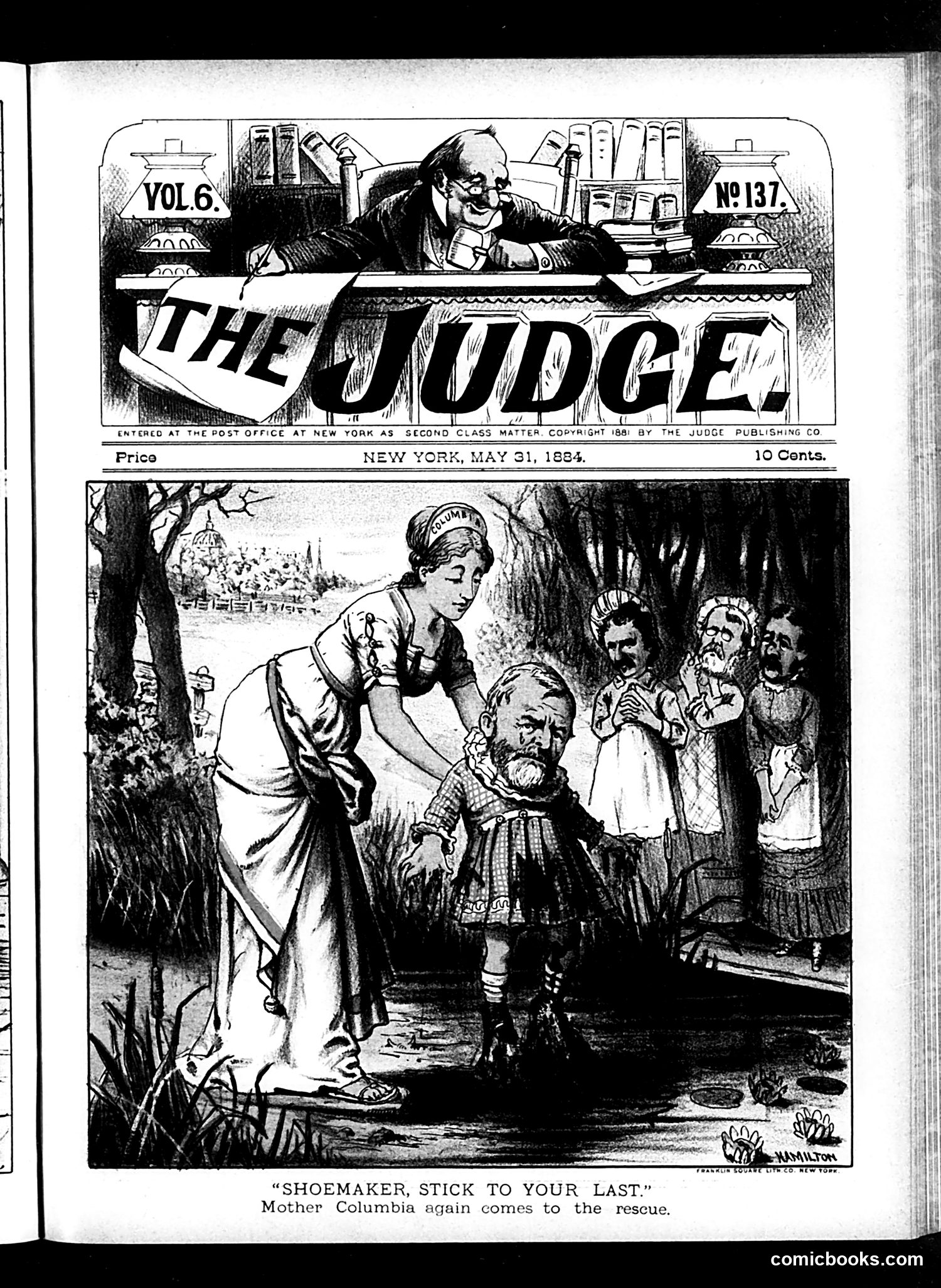
This cartoon titled "Shoemaker, Stick to Your Last" depicts **Mother Columbia** (the female personification of America) rescuing a small child from water. The caption suggests she's intervening in some crisis. The satire likely criticizes someone—possibly a politician or public figure—for overstepping their proper role or expertise. The proverb "shoemaker, stick to your last" means stay within your professional competence. The image suggests that despite bungling or incompetence, Mother Columbia (government/national stability) ultimately saves the day. Without more specific historical context from 1884, the exact target remains unclear, but the message appears to be about misplaced authority requiring correction by proper institutions.
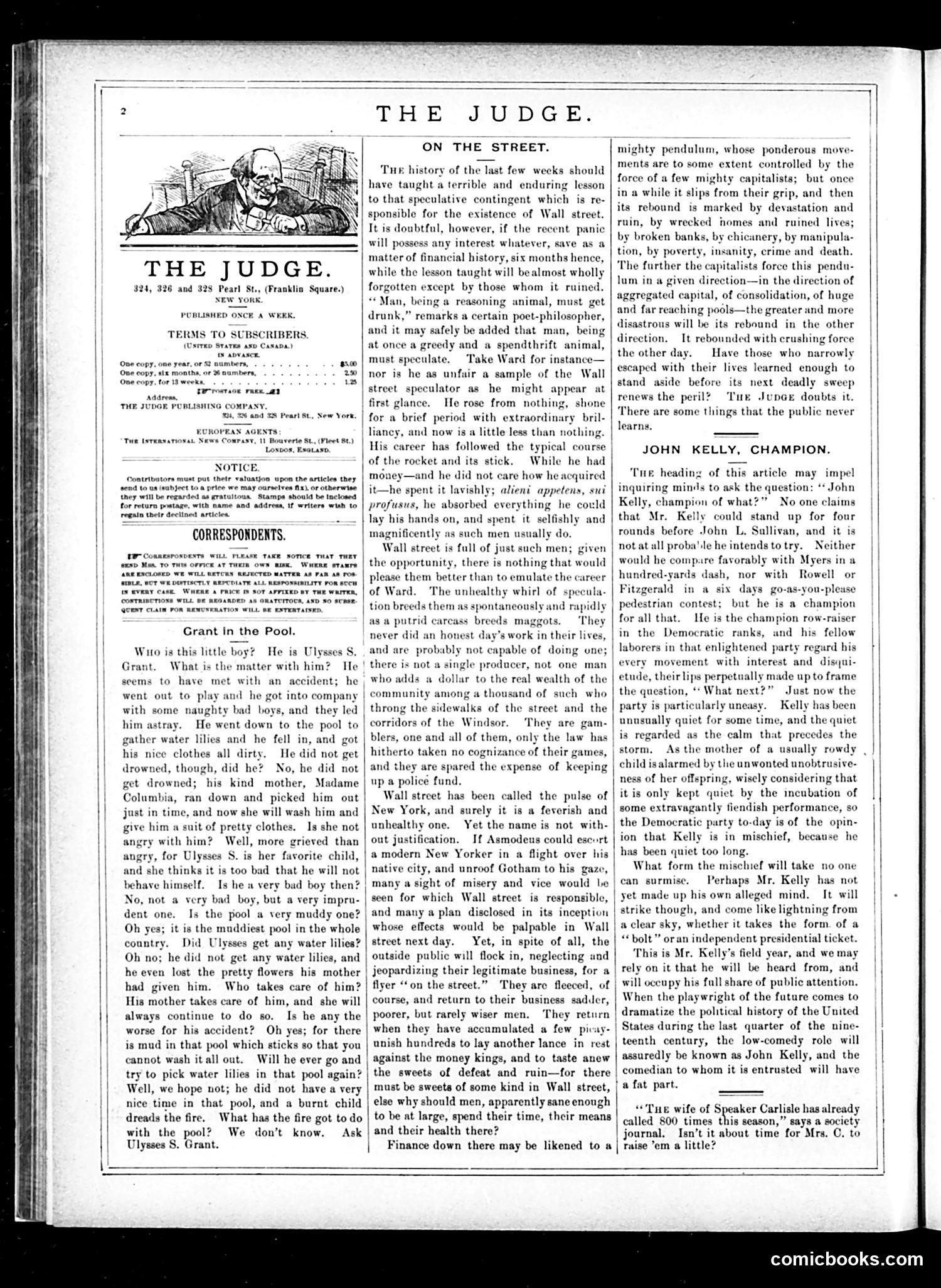
This page contains two satirical pieces about post-financial crisis themes, likely from the 1870s panic era. **"Grant in the Pool"** uses a children's-story-style allegory: young Ulysses S. Grant falls into mud while playing, gets rescued by "Madame Columbia" (the personified United States), and cannot be fully cleaned. The satire criticizes Grant's involvement in financial scandals—the mud that "sticks" represents corruption that cannot be washed away. It's gentle criticism wrapped in nursery-rhyme format. **"On the Street"** directly critiques Wall Street speculation. It references a "Ward" (likely General Daniel E. Sickles or a similar figure involved in recent financial disasters) who rose from nothing, spent lavishly, and collapsed. The piece argues speculators are inherently greedy and will repeat their mistakes despite the recent panic's lessons. Both pieces reflect Judge's role exposing financial corruption and cautioning against rampant speculation that harmed ordinary citizens.
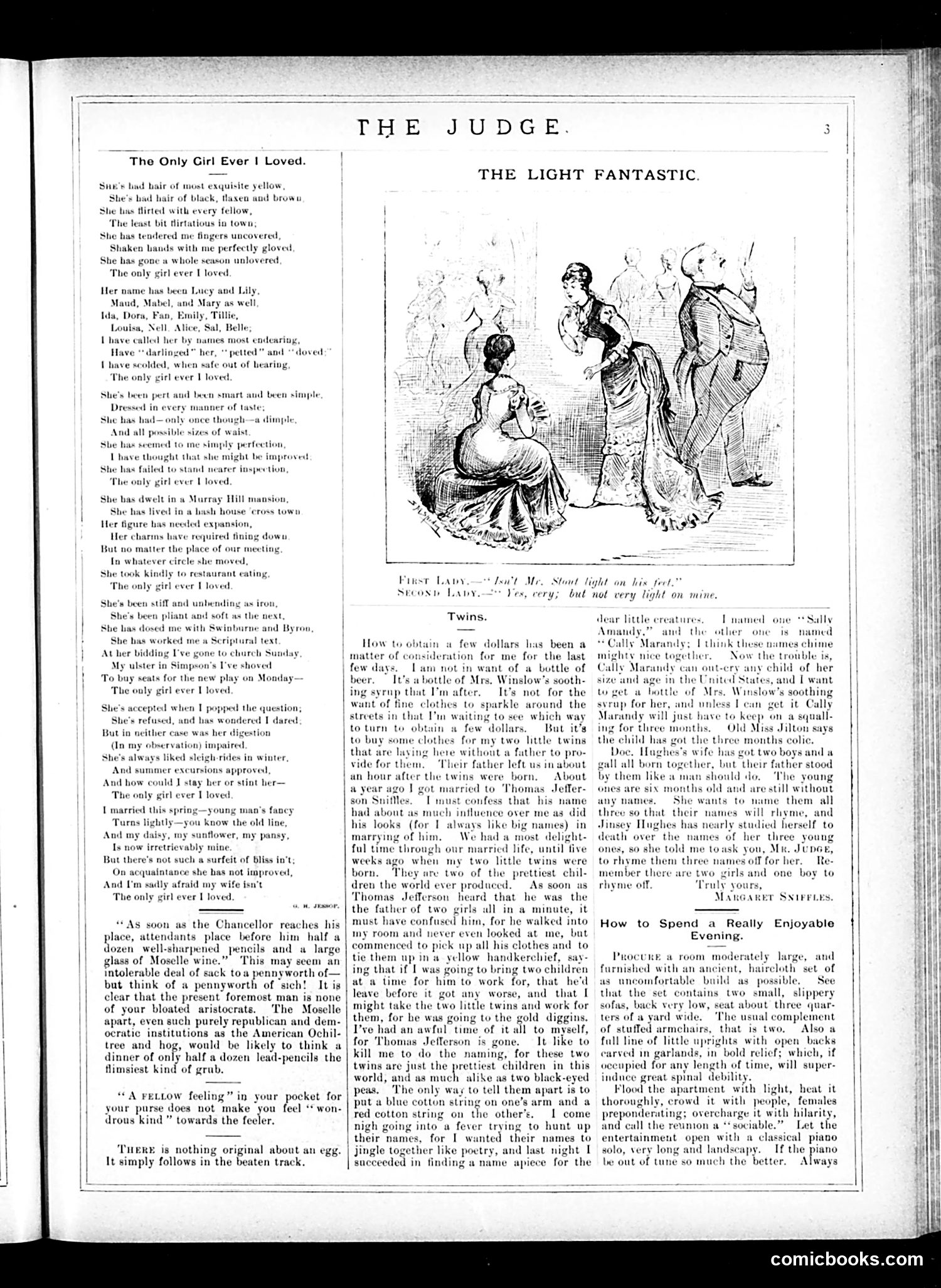
This page contains three distinct pieces of social commentary typical of late 19th-century American satire: **"The Only Girl Ever Loved"** (poem): A humorous lament about a man's inconsistency in romance. He's loved numerous women with different appearances and circumstances, married one, and now finds married life disappointing—she "has not improved" upon acquaintance. The satire targets male romantic idealization and the gap between courtship fantasy and marital reality. **"The Light Fantastic"** (illustration): Shows two elaborately dressed ladies encountering a working-class man, likely satirizing Victorian class distinctions and the performative nature of "proper" social interaction between classes. **"Twins"** and **"How to Spend a Really Enjoyable Evening"**: Humorous domestic sketches about working-class struggles—obtaining children's medicine and furnishing modest apartments on limited budgets—gently mocking lower-class aspiration and financial constraints. The overall tone is gentle satire of courtship, marriage, class relations, and domestic economics rather than sharp political critique.
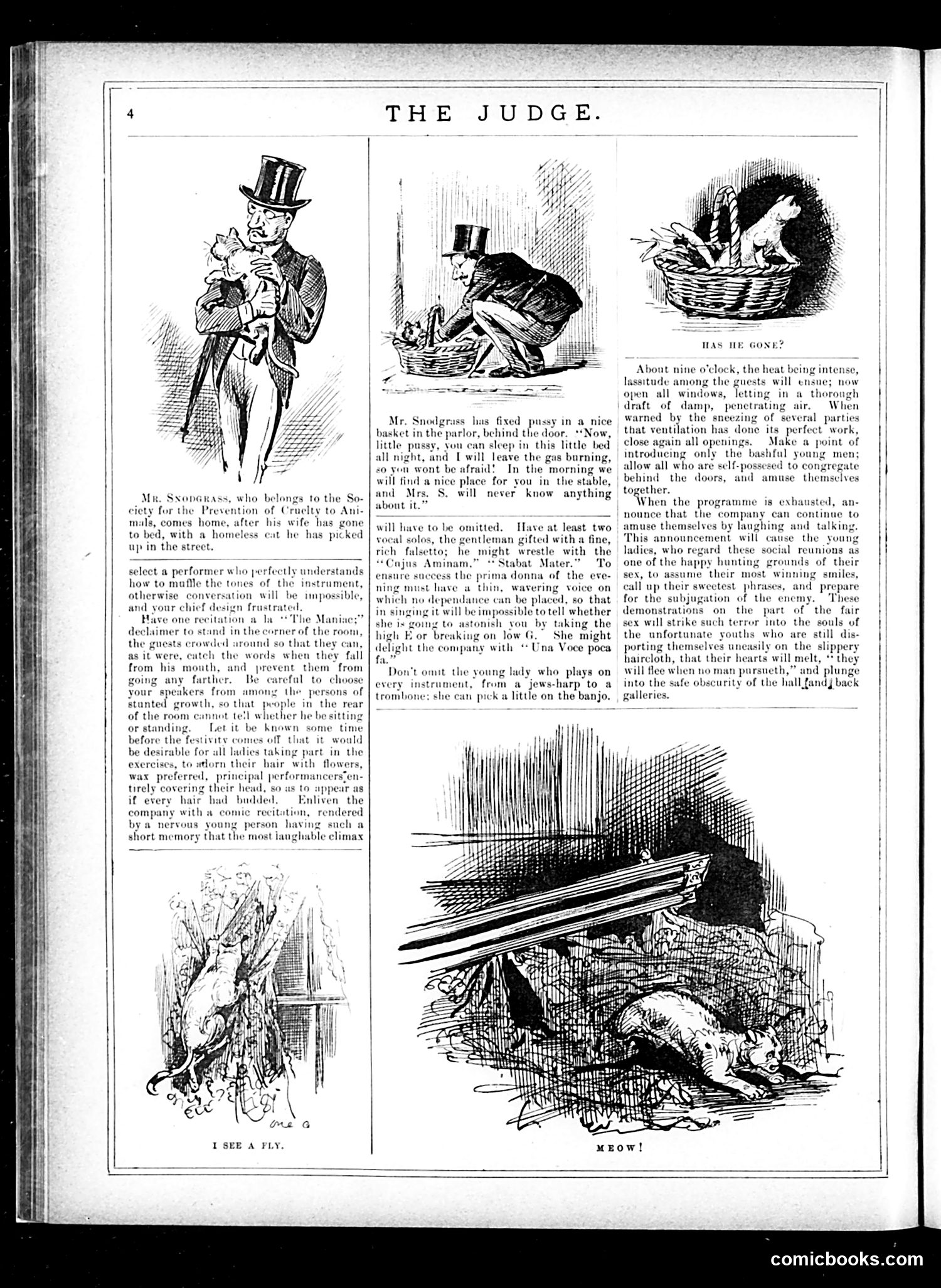
This page satirizes Victorian-era social gatherings and their awkward conventions. The left column presents absurd "advice" for hosting parlor entertainments—deliberately terrible suggestions masked as helpful tips. **Key satirical targets:** - **Mr. Snodgrass**: A member of the "Society for the Prevention of Cruelty to Animals" who casually abandons a cat in a basket with burning gas (dark humor about animal welfare hypocrisy) - **The "entertainment advice"**: Intentionally bad suggestions—selecting performers with wavering voices, placing reciters in corners so guests can't hear them, hiring those of "stunted growth," choosing nervous speakers who forget their lines. This mocks the tedious, poorly-executed musical performances common at Victorian social events. - **Ventilation bit**: Jokes about opening windows to allow "damp, penetrating air" then closing them again—absurd health concerns of the era. The accompanying illustrations show domestic chaos: a cat in a basket, a person bent over (likely the "stunted" performer), and a cat being kicked ("MEOW!"). **The satire**: ridicules both pretentious social gatherings and their typically dull, uncomfortable entertainment.
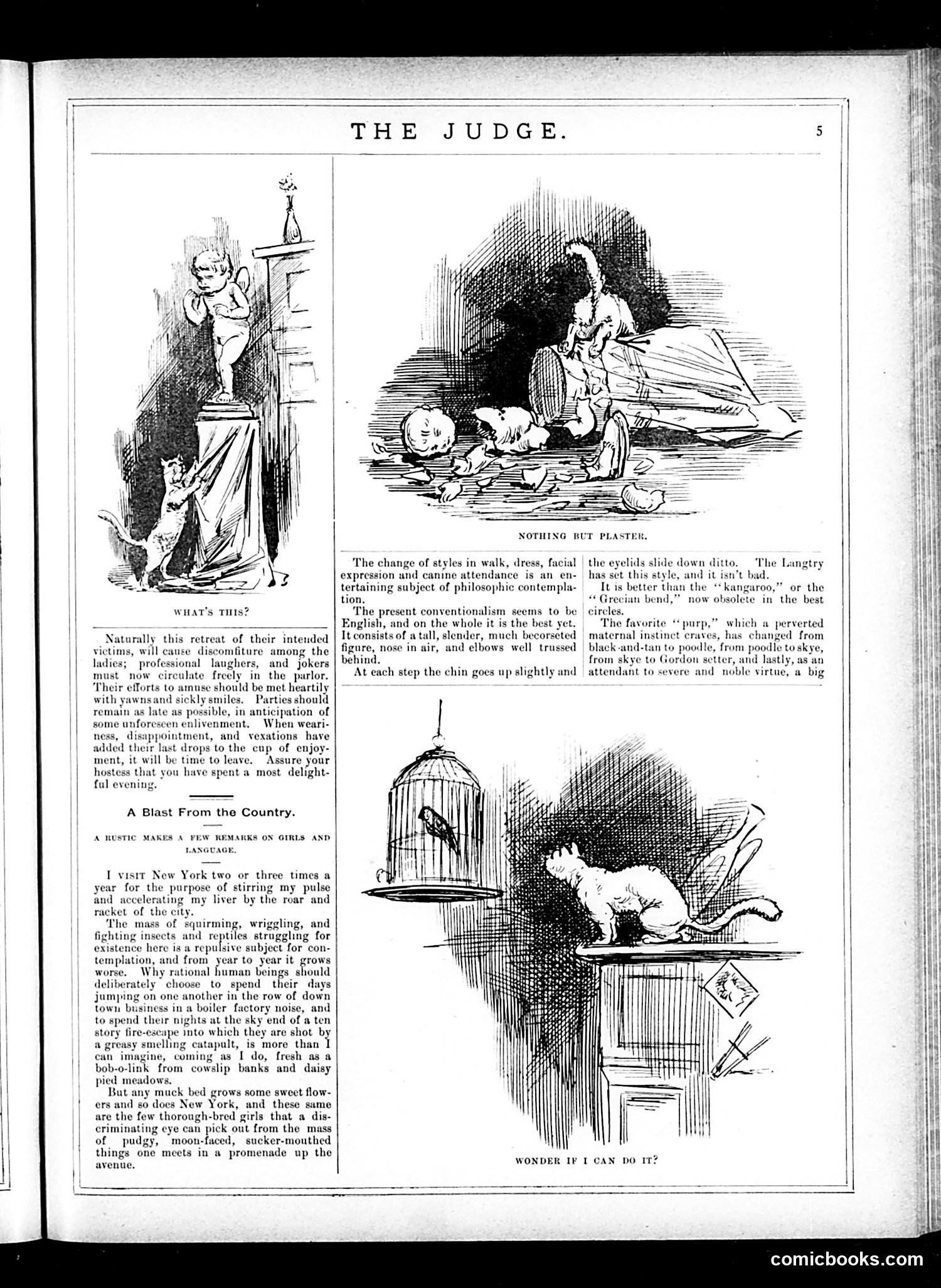
This page contains three distinct pieces of satirical social commentary: **"What's This?"** mocks social etiquette by advising guests to endure boring dinner parties—professionals entertainers have apparently left, so hosts must now suffer through awkward evenings. The satire targets rigid Victorian social conventions requiring polite attendance regardless of enjoyment. **"A Blast From the Country"** presents a rural visitor's scathing critique of New York City. He contrasts urban chaos—crowded, noisy, dirty—with rural beauty, lamenting that rational people choose city life. However, he admits New York does produce "thorough-bred girls" among the masses of unattractive women. The satire mocks both urban overcrowding and provincial snobbery. **The illustrated section on fashion and dogs** satirizes changing style conventions, particularly women's posture (chin up, eyelids lowered) and pet preferences shifting from one breed to another. It suggests fashionable society mindlessly follows trends without substance. Overall, the page satirizes American social pretension, urban excess, and the tyranny of fashion among the upper classes.
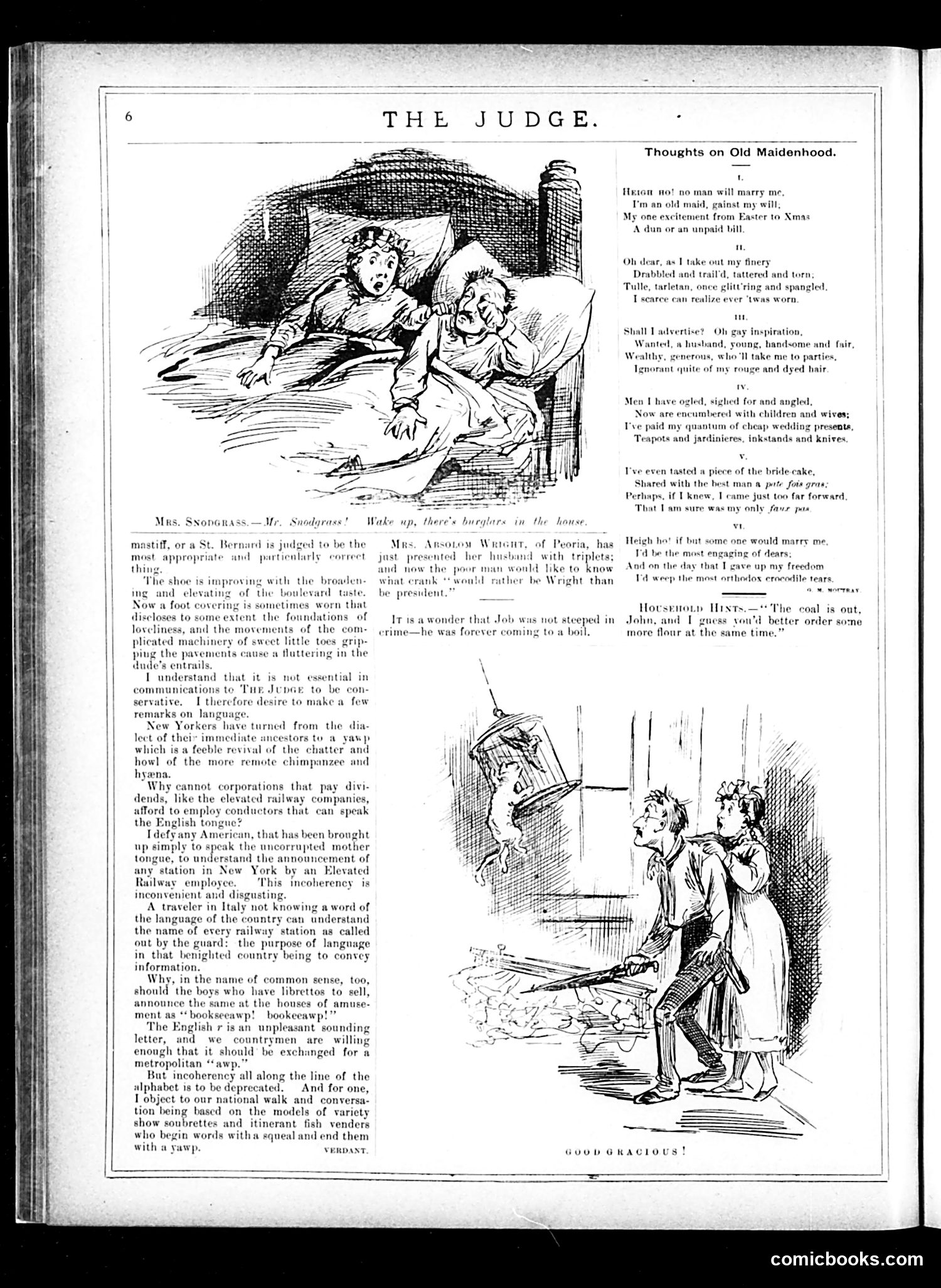
This page satirizes unmarried women through a series of connected sketches. The main poem presents a spinster's laments: she's aging, poor ("dun or unpaid bill"), desperately seeking a husband ("young, handsome and fair"), yet sabotaged by vanity (rouge and dyed hair). The bitter humor lies in her paradox—she wants marriage but has made herself unmarriageable through artifice and missed opportunities. The accompanying cartoons mock courtship conventions. One shows a couple in bed where the woman alerts her drowsy husband to burglars—suggesting marital disappointment. Another depicts two men discussing a woman, likely commenting on female desperation. The second article, signed "Verdant," attacks New York Elevated Railway conductors' poor diction, comparing their "yawp" to animal sounds. This reflects period-class anxieties: urban workers' crude speech supposedly debased English, contrasting unfavorably with European civility. Together, the page ridicules both unmarried women's desperation and working-class linguistic incompetence—common Judge targets.
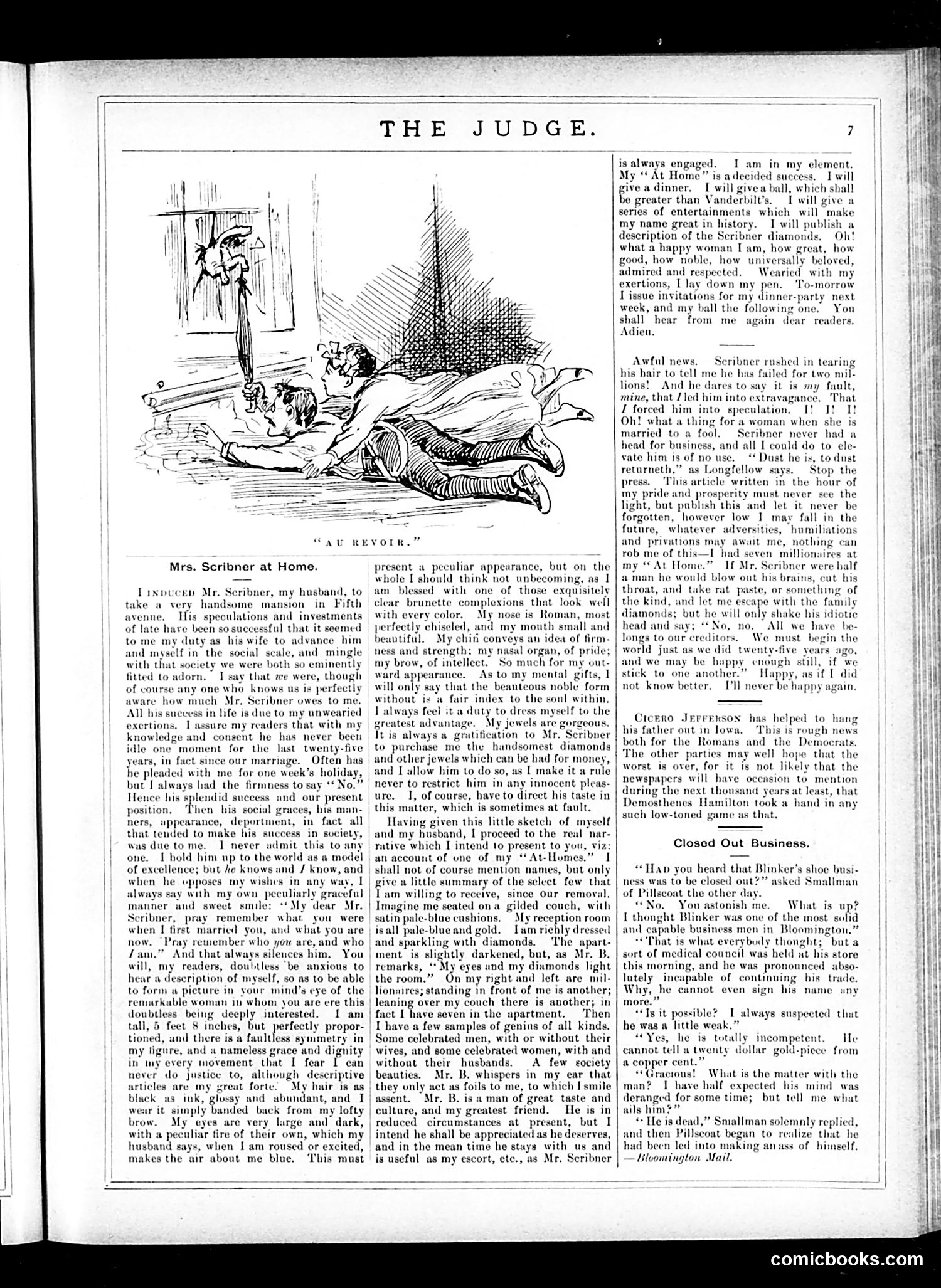
This satirical piece mocks an absurdly vain, self-aggrandizing society wife. Mrs. Scribner claims credit for her husband's entire business success while describing herself in laughably extravagant terms—her "Roman" nose, "lofty brow," eyes that make "the air about me blue" when excited. The accompanying cartoon shows a grotesquely exaggerated figure sprawled dramatically, matching the text's ridiculing tone. The satire targets wealthy Fifth Avenue society women of the Gilded Age who, despite contributing little, took undeserved credit for their husbands' achievements while obsessing over appearance, jewelry, and social status. The piece's title "*Au Revoir*" suggests this self-important matron is merely saying goodbye—a cutting final jab at her pretentious, French-inflected affectations. *Judge* uses her voice to expose the vanity and parasitic nature of certain elite society figures.
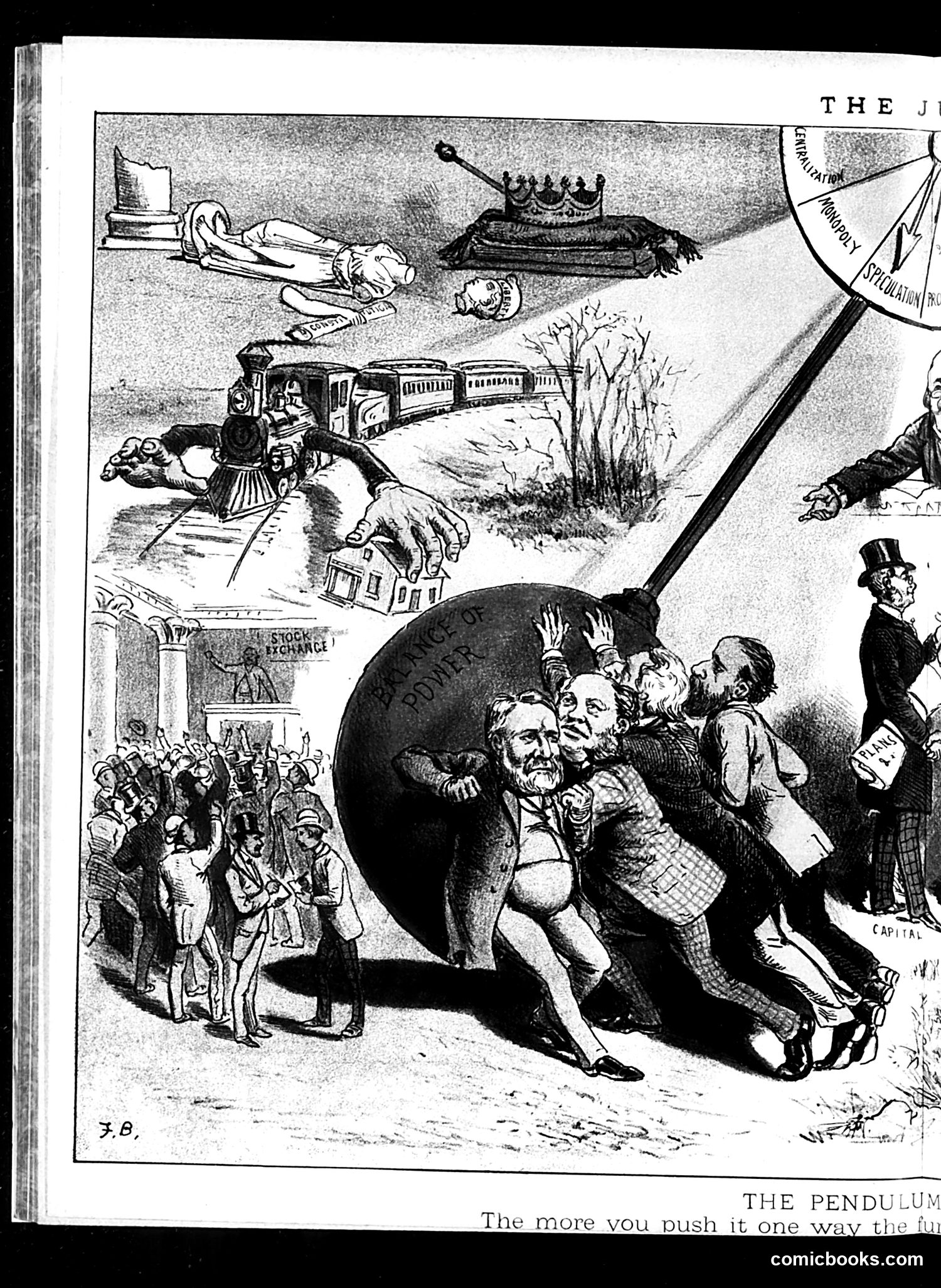
This political cartoon satirizes economic cycles and inequality. The central image shows a large pendulum labeled "DEBT" swinging over crowds of common people at a Stock Exchange building. Wealthy figures and politicians appear to control or ride the pendulum's movement. The incomplete caption—"The more you push it one way the fu[rther]"—suggests the cartoon critiques how those in power manipulate financial systems for personal gain while ordinary citizens bear the consequences of economic instability. The background vignettes depicting trains, crowns, and various scenes of commerce reinforce themes of industrial wealth and class disparity. This appears to be a Judge magazine critique of Gilded Age financial speculation and the boom-bust cycles that harmed working-class Americans.
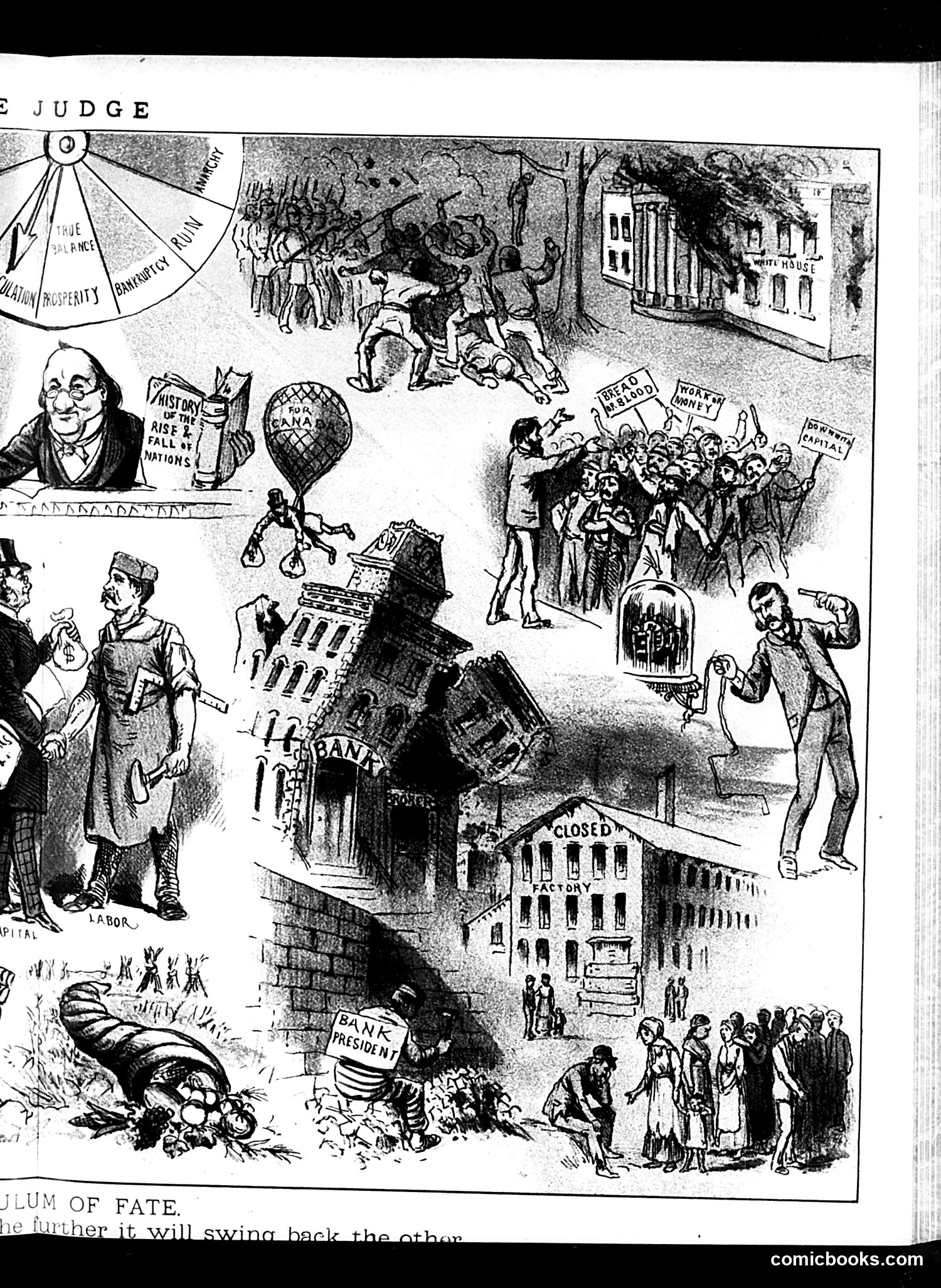
This appears to be a political cartoon titled "Pendulum of Fate" (text partially visible at bottom). The page uses a circular "Judge" wheel diagram at top-left showing ideological positions: "True Balance," "Ruin," "Bankruptcy," "Prosperity," and "Damnation." The main cartoon depicts social chaos and economic turmoil. Central imagery includes a collapsing bank building labeled "Bank" and "President," closed factories, crowds of distressed citizens, and what appears to be anarchist or labor agitation. A figure at bottom-left labeled "Labor" and "Capital" suggests class conflict commentary. The satirical point critiques economic mismanagement—suggesting policy swings between extremes will cause societal collapse like a swinging pendulum. This reflects late 19th/early 20th-century anxieties about labor unrest, financial crises, and political instability.
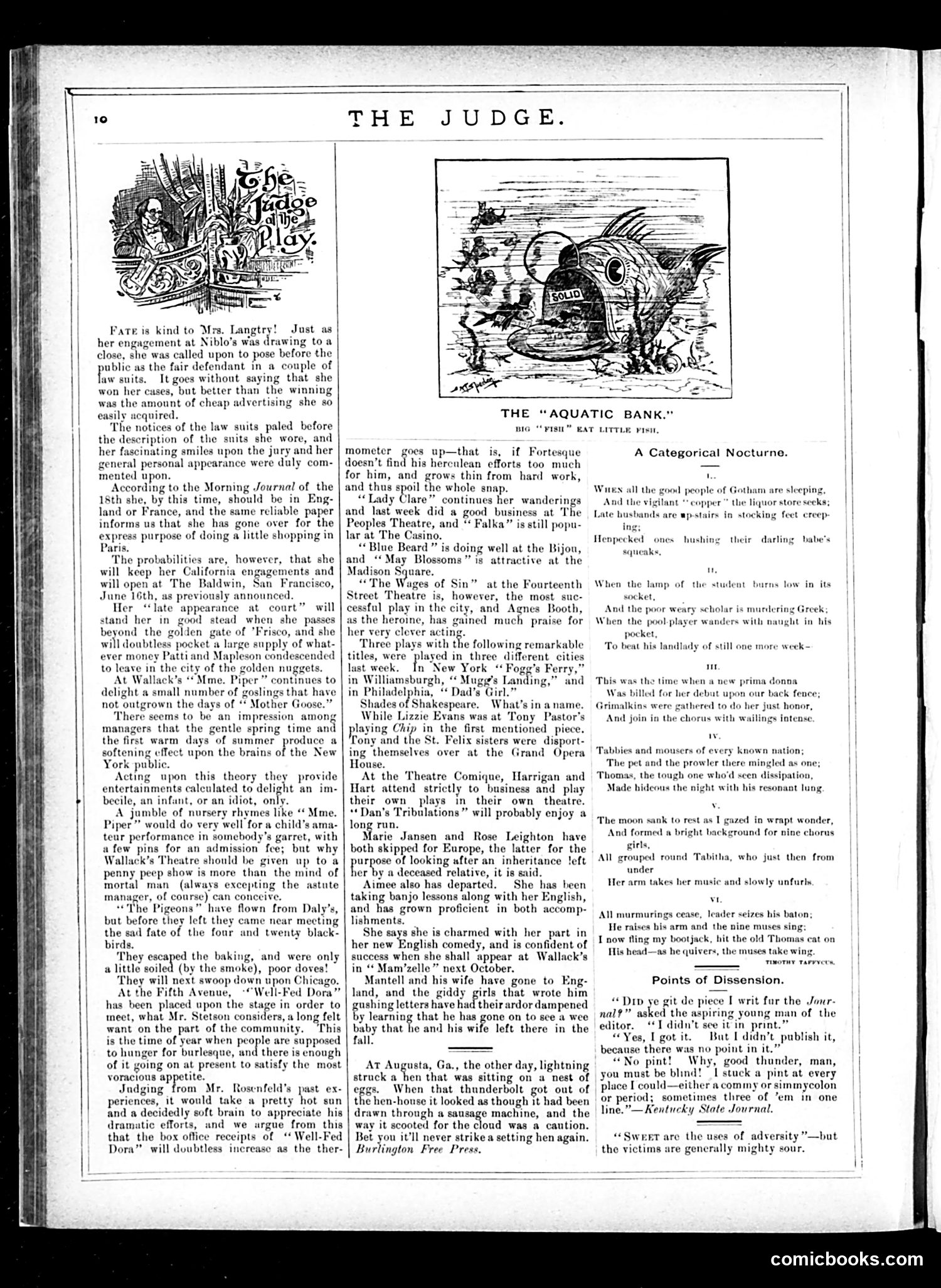
This page primarily contains **theatrical criticism and gossip**, not political cartoons. The small illustration labeled "The 'Aquatic Bank'" appears to be a humorous sketch about fish, unrelated to the main text. The substantive content concerns **Lillie Langtry**, a famous actress of the era. The critic sarcastically praises how her recent appearance as a defendant in lawsuits generated cheap publicity—newspapers focused more on her fashionable courtroom attire and charm than on the legal proceedings themselves. The piece mocks theater managers' apparent belief that summer audiences want mindless entertainment, criticizing productions like "Mme. Piper" at Wallack's Theatre as suitable only for children or "imbeciles." The page reviews various theatrical productions and their success or failure, with particular scorn directed at "Well-Fed Dora," deemed unworthy despite its likely commercial success. The final note humorously observes that three different plays with absurdly similar regional titles ("Fogg's Ferry," "Mugg's Landing," "Dad's Girl") opened simultaneously in different cities—a satire on theatrical mediocrity and repetitiveness.
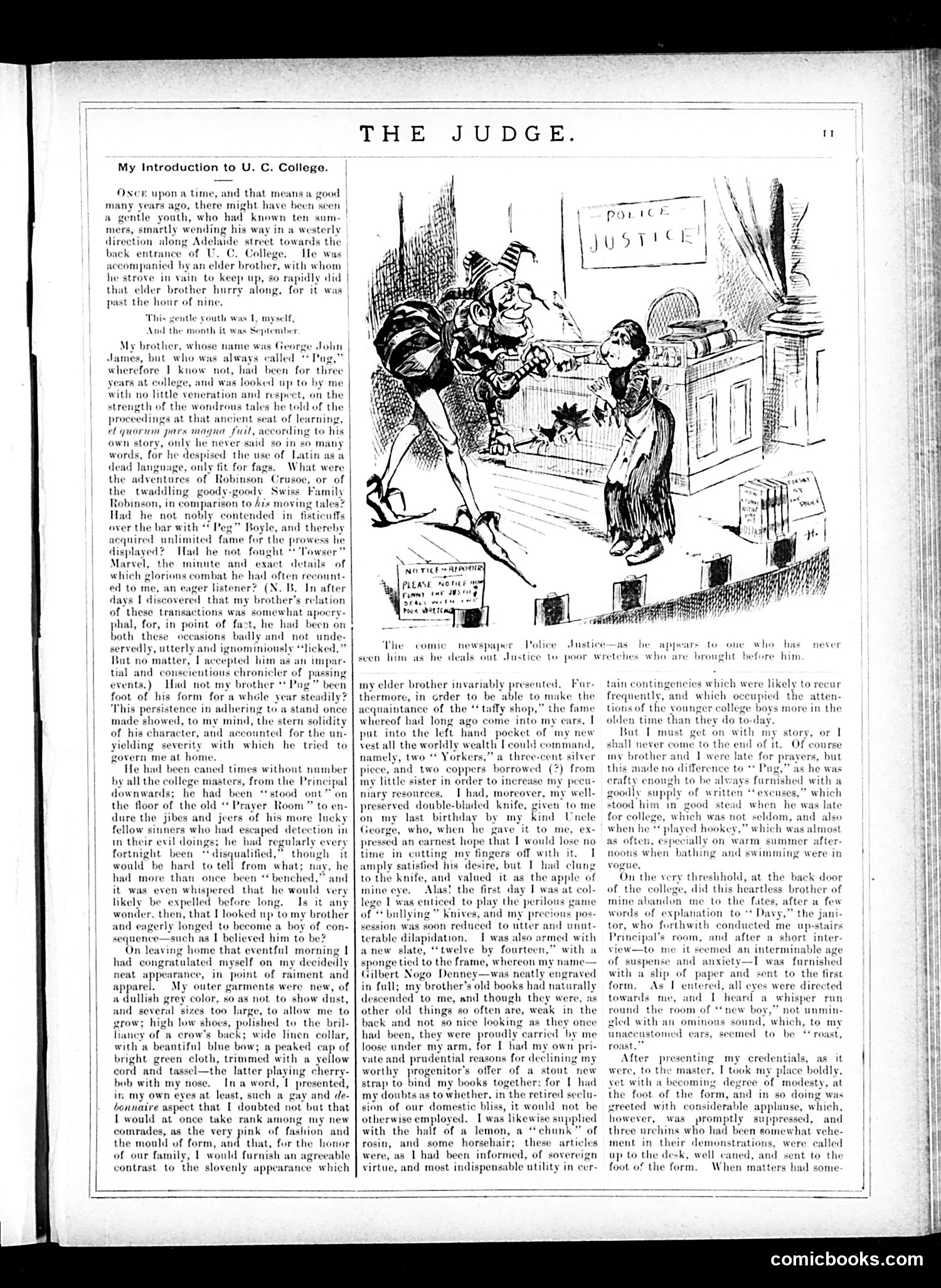
This page from Judge presents a satirical autobiographical narrative titled "My Introduction to U.C. College," illustrated with a cartoon depicting a disheveled older student being escorted to what appears to be a disciplinary office. The satire targets pretentious college boys and their fabricated reputations. The narrator describes his admiration for his elder brother "Page," who regales him with exaggerated tales of academic exploits—fighting rivals, athletic triumphs, and daring pranks. However, the text reveals the truth: the brother has actually been repeatedly caned, "disqualified," and nearly expelled for misconduct. The cartoon visualizes this hypocrisy: while the younger brother arrives at college dressed meticulously in new finery, convinced he'll impress his peers through association with his "legendary" brother, the reality—shown in the illustration—is far less glamorous. The joke mocks the gap between college boys' self-mythologizing and their actual behavior, and the younger generation's naive deference to dubious role models.
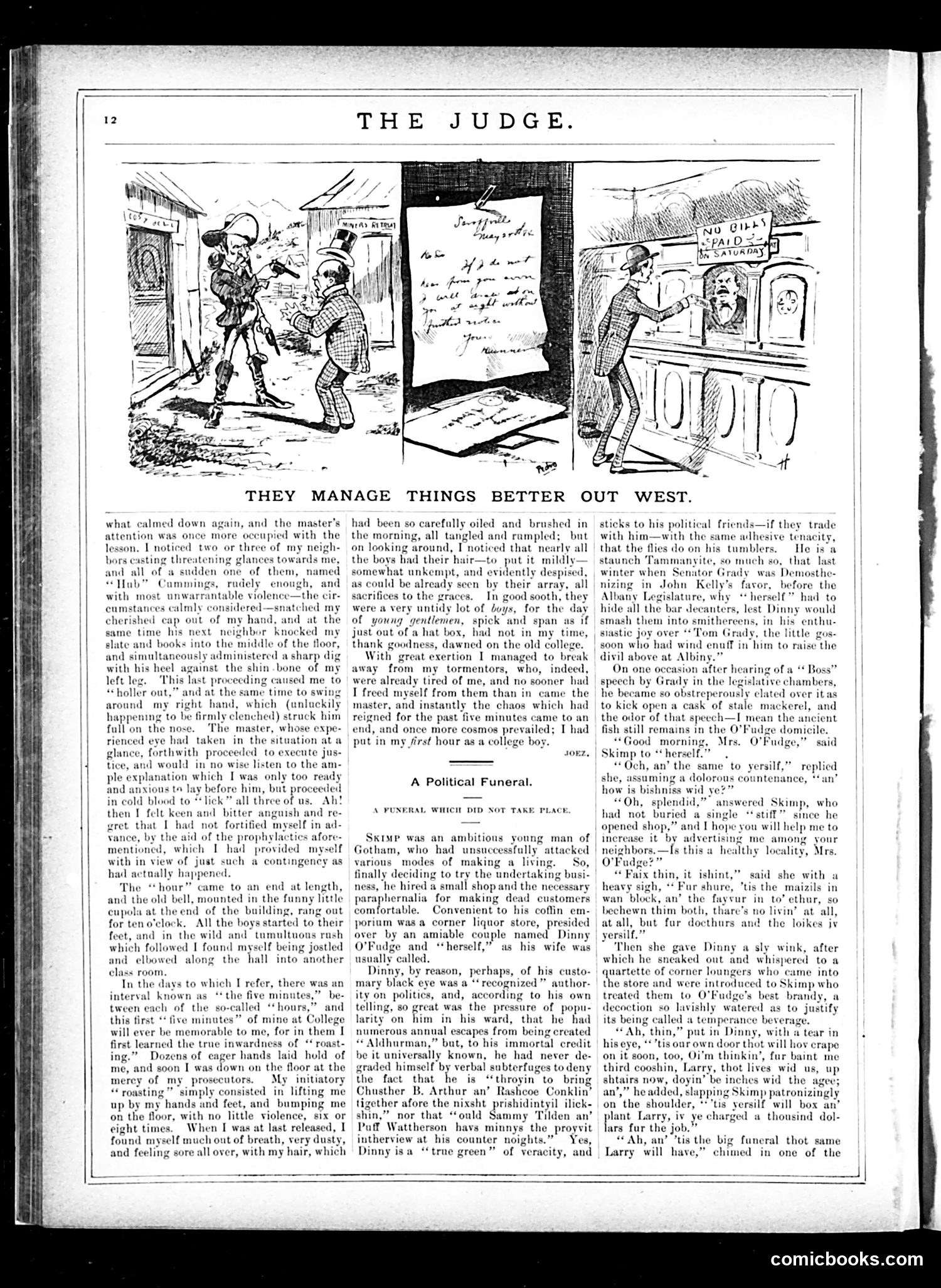
This three-panel cartoon satirizes Western frontier justice compared to Eastern civility. The left panel shows a violent street brawl with men fighting; the center panel displays a formal written complaint or legal document; the right panel depicts an orderly saloon bar scene with "No Girls Admitted Saturday" posted. The title's irony suggests that despite the West's reputation for roughness, Westerners actually "manage things better"—resolving disputes directly rather than through lengthy Eastern legal procedures. The accompanying text describes a college hazing incident ("roasting"), contrasting chaotic institutional bullying with the West's more straightforward (if brutal) conflict resolution. The satire targets Eastern hypocrisy: civilized institutions like colleges perpetuate violence under different names, while the "uncivilized" West at least operates honestly. The cartoon mocks Progressive Era assumptions about Eastern superiority and order.
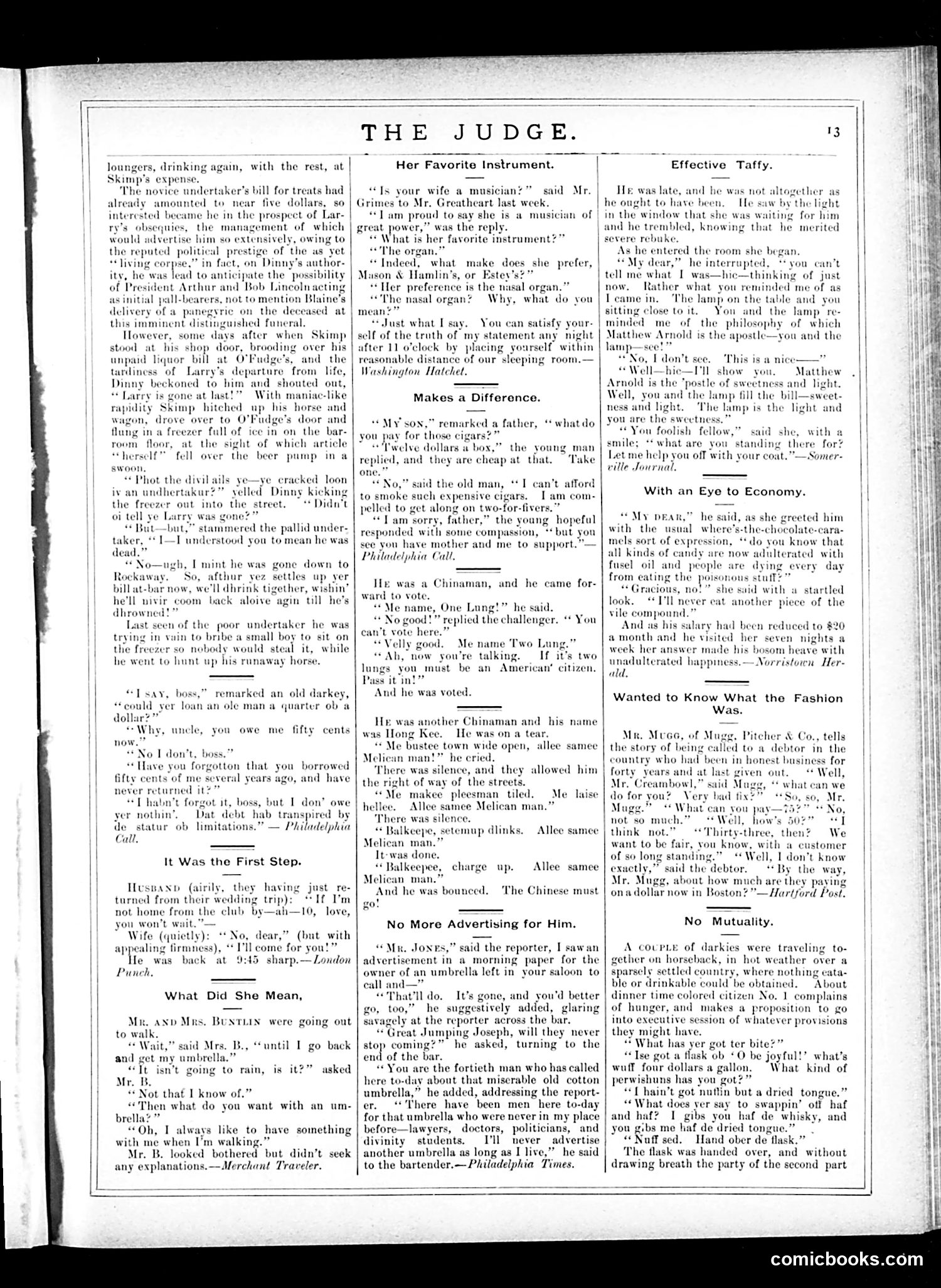
This page contains multiple short humorous anecdotes typical of Judge's satirical format. Key pieces: **"Her Favorite Instrument"**: A wife's preference for the nasal organ (nose) is a pun—she's musically talented but also implies she's nosy or interfering, poking fun at wives' stereotypical intrusiveness. **"Makes a Difference"**: Contrasts a father's disapproval of expensive cigars with tolerance for expensive beer, satirizing working-class priorities and hypocrisy about luxury spending. **"It Was the First Step"**: Appears to reference Chinese immigrants and voting rights (mentions "can't vote here"), likely satirizing exclusionary policies of the era against Chinese laborers. **"No More Advertising for Him"**: A bartender owner refuses to advertise for a lost umbrella because the owner was actually a lawyer—satire of anti-lawyer sentiment common in the period. The page reflects Judge's focus on class commentary, immigration attitudes, and marital humor typical of Gilded Age American satire.
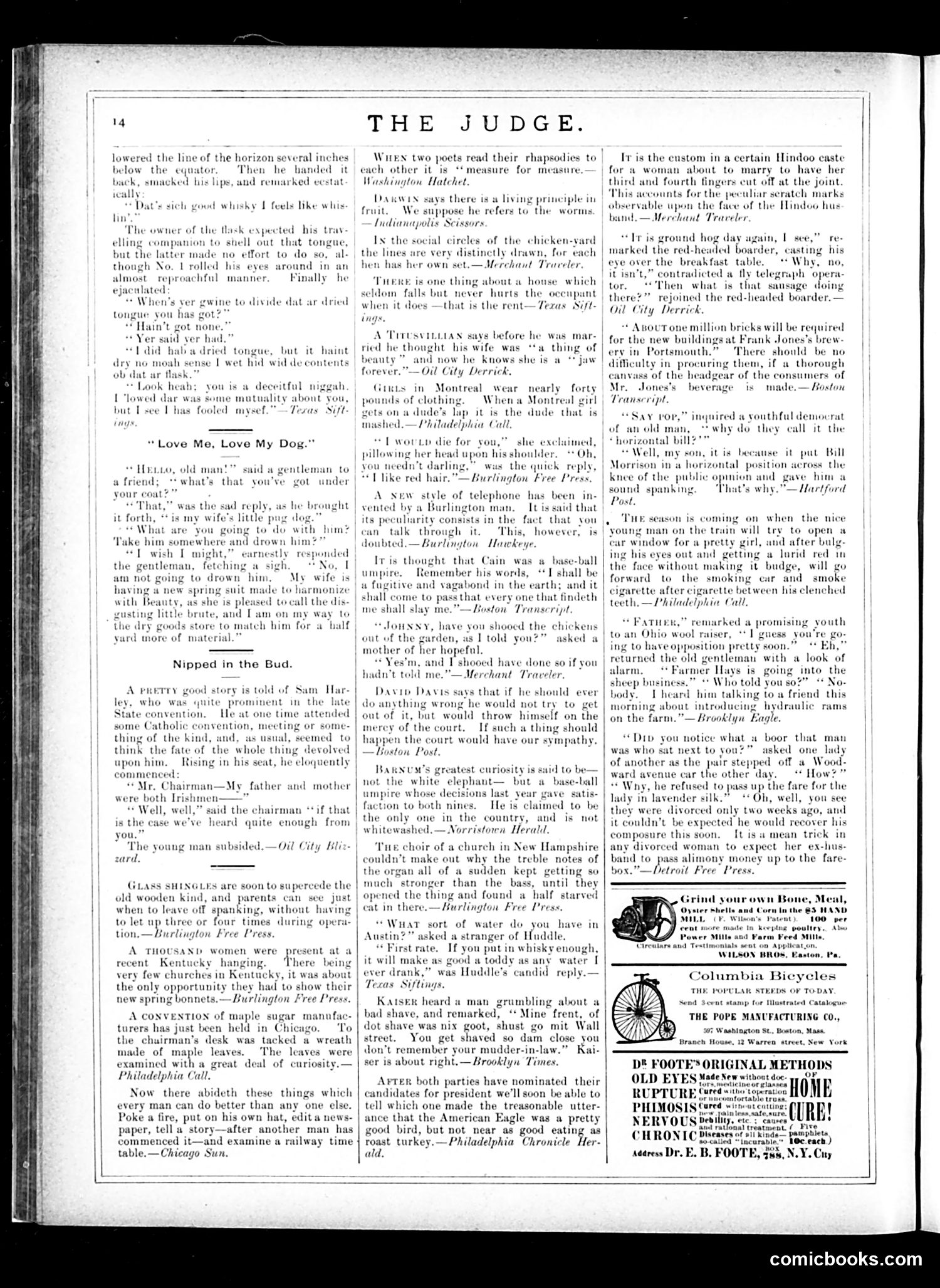
This page from **Judge** (a 19th-century American satirical weekly) contains primarily **short humorous anecdotes** rather than political cartoons. The satirical content targets everyday social absurdities and character types common to the era. Notable pieces include racist dialect humor ("Nipped in the Bud," featuring Black characters using dehumanizing language), religious mockery (a Catholic convention story), and social commentary on consumption and fashion (maple sugar manufacturers examining decorative leaves, women attending hangings to display spring bonnets). There's **one advertisement** visible—promoting Dr. E.B. Foote's medical treatments and Columbia bicycles. The humor reflects late 19th-century sensibilities: it mocks pretension, conjugal relations, and ethnic/religious groups through exaggerated anecdotes. The racist content is especially jarring to modern readers but was standard in such publications. No identified political figures appear; this page relies on generic character stereotypes rather than contemporary political satire.
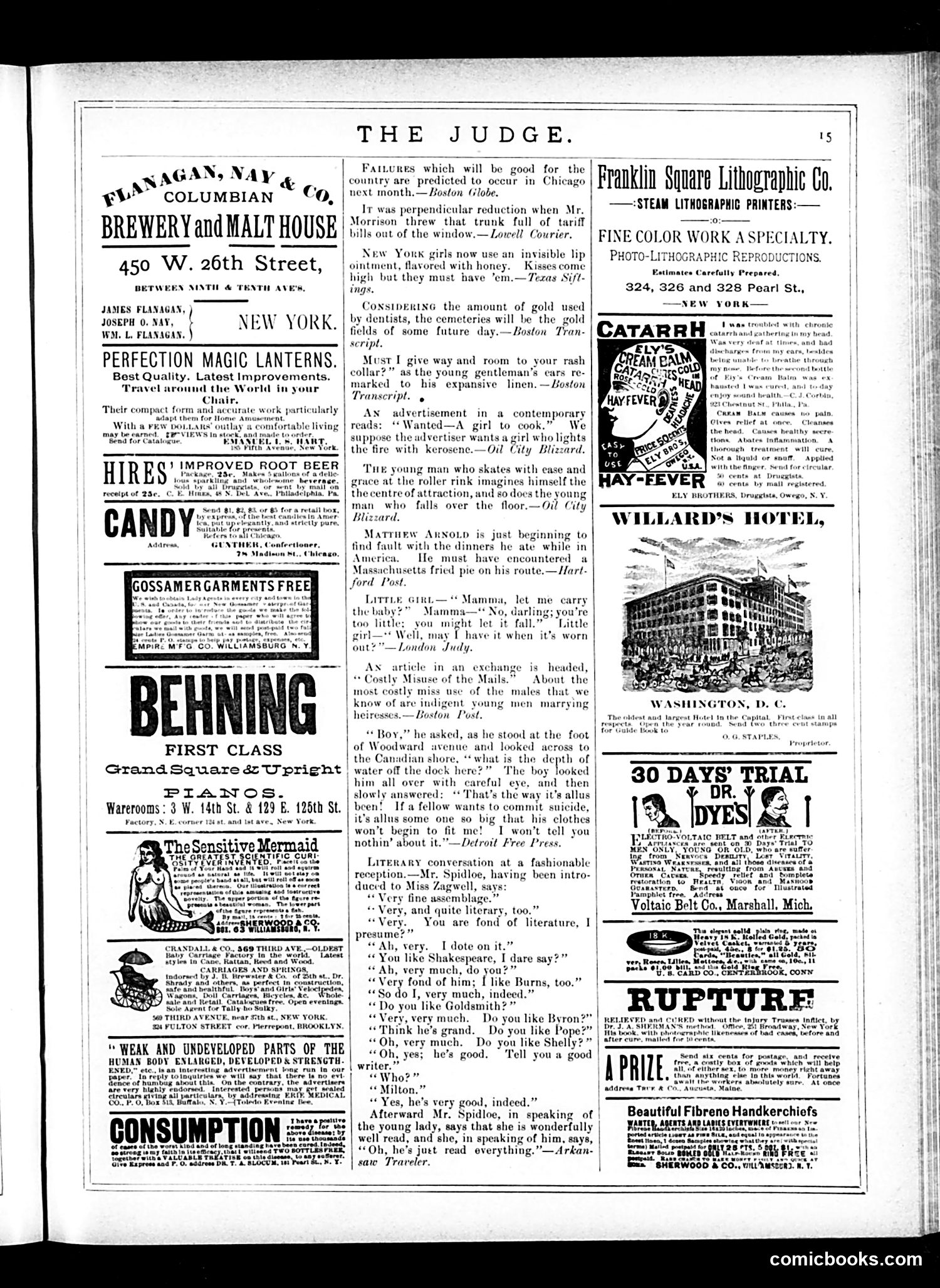
This page is primarily **advertisements and filler content** rather than political cartoons. Judge magazine, a satirical weekly, fills its pages with small humorous anecdotes and commercial ads. The brief text items mock contemporary social habits: failures predicted in Chicago, a man throwing tariff bills from a window, dentists using gold (leading to cemetery wealth), young skaters' vanity, Matthew Arnold's complaint about American food, and — most substantially — a **literary conversation** where two people claim to love famous writers (Shakespeare, Burns, Goldemith, Pope, Shelley) but one admits afterward he "just read everything," satirizing pretentious, superficial literary appreciation among fashionable society. The page contains typical period advertisements for pianos, root beer, magic lanterns, and medical treatments (including dubious ones like "weak parts enlarged").
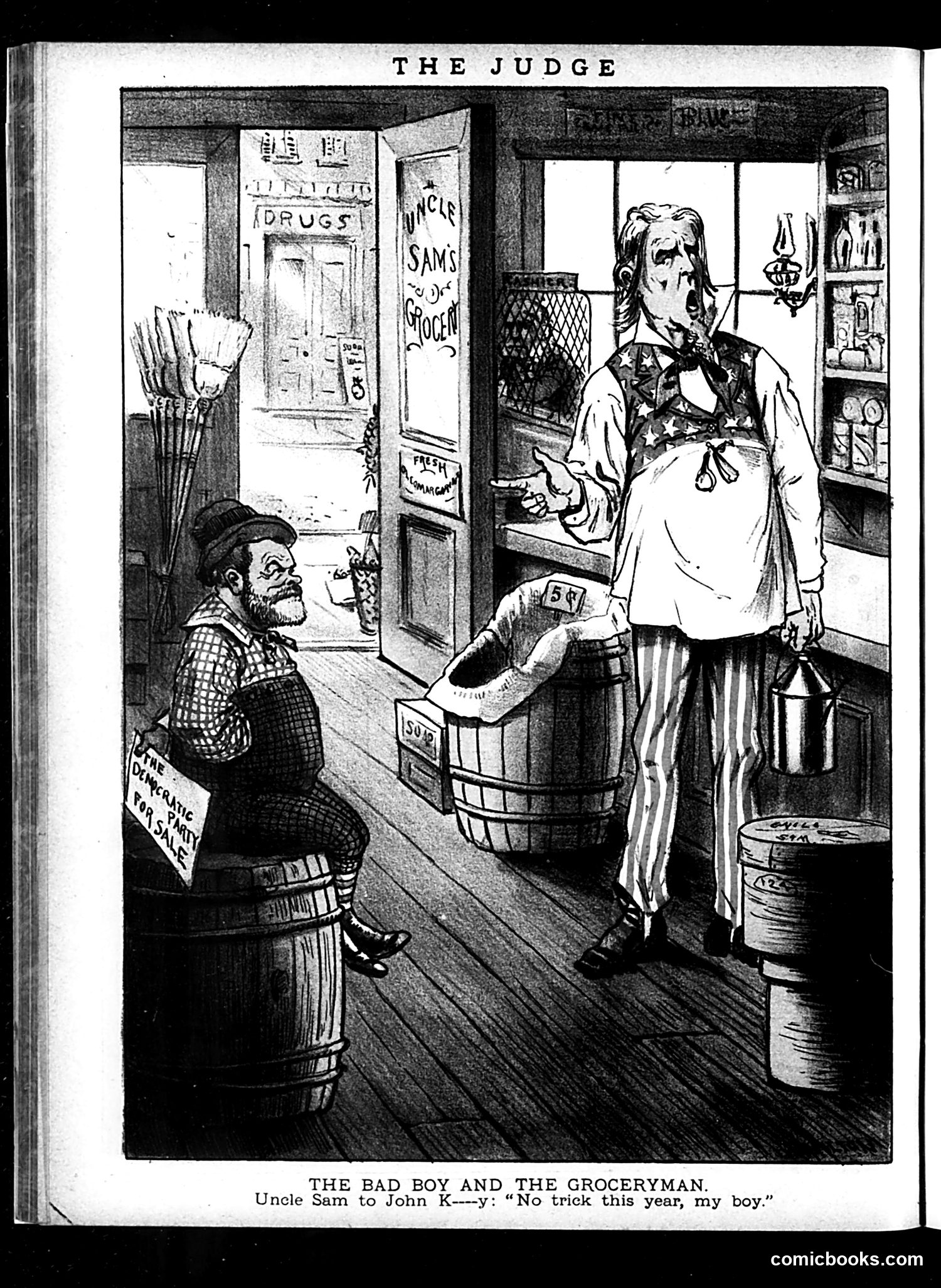
This political cartoon depicts Uncle Sam (representing America) scolding a figure identified as "John K----y" (the name is partially redacted, likely "Kennedy" or similar). The groceryman represents commercial/mercantile interests. The caption "No trick this year, my boy" suggests Uncle Sam is warning against deception or dishonest dealing in trade or business. The "bad boy" framing implies the targeted figure has previously engaged in fraudulent practices—possibly price gouging, adulterating goods, or similar commercial misconduct. The grocery store setting and various product boxes visible emphasize concerns about food safety and honest commercial practices, issues that were prominent during Progressive Era reforms (roughly 1890s-1920s). This appears to satirize a specific politician or businessman known for questionable business dealings, warning against continued malpractice.