
Judge, 1884-05-31 · page 2 of 16
Judge — May 31, 1884 — page 2: what you’re looking at
What you’re looking at
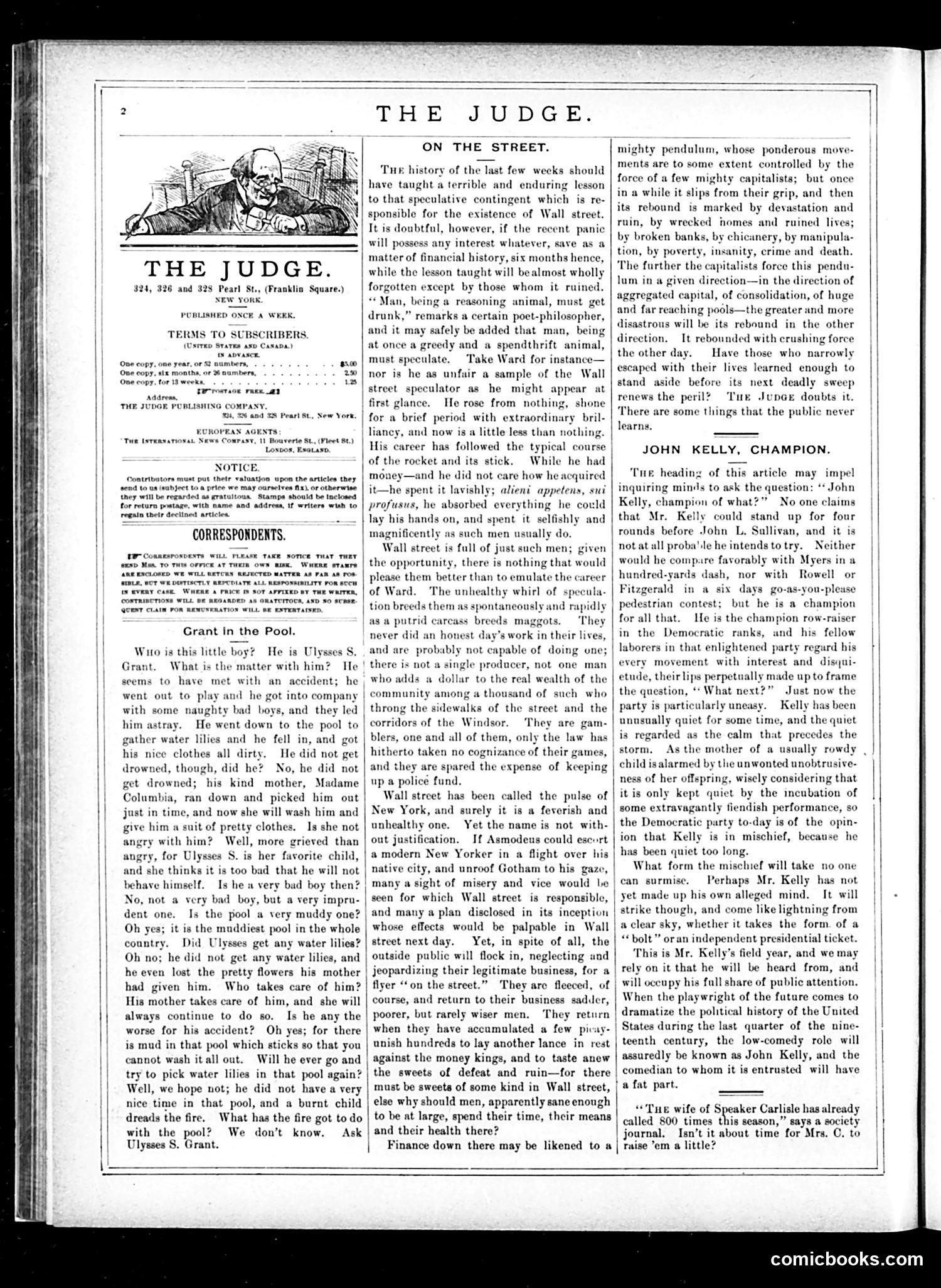
This page contains two satirical pieces about post-financial crisis themes, likely from the 1870s panic era. **"Grant in the Pool"** uses a children's-story-style allegory: young Ulysses S. Grant falls into mud while playing, gets rescued by "Madame Columbia" (the personified United States), and cannot be fully cleaned. The satire criticizes Grant's involvement in financial scandals—the mud that "sticks" represents corruption that cannot be washed away. It's gentle criticism wrapped in nursery-rhyme format. **"On the Street"** directly critiques Wall Street speculation. It references a "Ward" (likely General Daniel E. Sickles or a similar figure involved in recent financial disasters) who rose from nothing, spent lavishly, and collapsed. The piece argues speculators are inherently greedy and will repeat their mistakes despite the recent panic's lessons. Both pieces reflect Judge's role exposing financial corruption and cautioning against rampant speculation that harmed ordinary citizens.
📄 Transcribed text from this page (OCR, searchable)
Machine-transcribed from the original scan — historical spelling and the odd misread are preserved.
THE JUDGE. 324, 326 and 328 Pearl St., (Franklin Square.) PUBLISHE TERMS TO SUBSCRIBERS. (Usrreo Staves asp C 1 ADVASCE 7. one year, of @ numbers, six months of 8 numbers, iF 13 weeks, emcee EPrrosrace vane ad One cop: One cops One c Address, THE JUDGE PUBLISHING COMPANY, 4, LV and GN Pearl St, New York, EURO! Tue (srensanionat News RAN AGENTS PAST, I! Bouverte St.,(Pleet 8t.) | Loxvos, Rotax. NOTICE. tribators must put thelr valuation upon the artictes they lus (aabject to a price we may ourselves fix). or otherwise 1 be regarded as gratuitous Stamps should be tnclosed for return postage, with name and address, if writers wiah to regain thelr declined articles. CORRESPONDENTS. FU CORRESPONDENTS WiLL PLEASE TAKE sonICE THAT THEY fexp Mss To Tt OFFICE AT THEIR OWN MINK. WERE sTAMre SNCLOMED WE WILL RETCRS REJECTED MATTER AS FAR AM FOR LITT FOR SCCH tw EVERY CASE WHERE 4 PRICE (® SOT AFFIXED BY TuR WAITER, CONTRIBUTIONS WILL BE REQARDED A¥ ORATCITOCA, AND NO SCRE. QUENT CLAIN YOR REWUNERATION WHLL SE ENTERTAINED. Grant in the Pool. Wuo is this little boy? He is Ulysses S. Grant. What is the matter with him? He seems to have met with an accident; he went out to play and he got into company | with some naughty bad boys, and they led him astray. He went down to the pool to gather water lili nd he fell in, and got his nice clothes all dirty. He did not get drowned, though, did he? No, he did not get drowned; his kind mother, Madame | Columbia, ran down and picked him out | just in time, and now she will wash him and give him a suit of pretty clothes. Is she not angry with him? Well, more grieved than angry, for Ulysses S. is her favorite child, and she thinks it is too bad that he will not | behave himself, Is he a very bad boy then? | No, not a very boy, but a very impru- | dent one. Is the pool a very muddy one? Oh yes; it is the muddiest pool in the whole Did Ulysses get any water lilies? Oh no; he did not get any water lilies, and he even lost the pretty flowers his mother | had given him. Who takes care of him? His mother takes care of him, and she will always continue to do so. Is he any the worse for his accident? Oh yes; for there | is mud in that pool which sticks so that you cannot wash it all out. Will he ever go and try to pick water lilies in that pool again? Well, we hope not; he did not have a very nice time in that pool, and a burnt child dreads the fire. What has the fire got to do with the pool? We don’t know. Ask | Ulysses 8. Grant. | street speculator as he might THE JUDGE. ON THE STREET. Tue history of the last few weeks should have taugh lesson to that speculative contingent which is re- sponsible for the existence of Wall street. terrible and endurin: | It is doubtful, however, if the recent panic will possess any interest whatever, save as a matter of financial history, six months hence, while the lesson taught will be almost wholly forgotten except by those whom it ruined. “Man, being a reasoning animal, must get drunk,” remarks a certain poet-philosopher, and it may safely be added that man, being at once a greedy and a spendthrift animal, must speculate. Take Ward for instance— nor is he as unfair a sample of the Wall appear at He rose from nothing, shone for a brief period with extraordinary. bril- liancy, and now is a little less than nothing. His career has followed the typical course of the rocket and its stick. While he had money—and he did not care how he acquired it—he spent it lavishly; alieni appetens, sui profusus, he absorbed everything he could lay his hands on, and spent it selfishly and magnificently as such men usually do. Wall street is full of just such men; given first glance. | the opportunity, there is nothing that would ase them better than to emulate the career The unhealthy whirl of specula tion breeds them as spontaneously and rapidly asa putrid carcass breeds maggots. ‘They never did an honest day’s work in their live and are probably not capable of doing on le producer, not one man who adds a dollar to the real wealth of the there is not a sin community among a thousand of such who throng the sidewalks of the street and the corridors of the Windsor. ‘They are gam- blers, one and all of them, only the law has | hitherto taken no cognizance of their games, and they are spared the expense of keeping | up a policé fund. Wall street has been called the pulse of New York, and surely it is a feverish and unhealthy one. Yet the name is not with- out justification. If Asmodeus could escort | a modern New Yorker in a flight over his nto his gaze, | native city, and unroof Gotha many a sight of misery and vice would be seen for which Wall street is responsible, and many a plan disclosed in its inception whose effects would be palpable in Wall | street next day. Yet, in spite of all, the outside public will flock in, neglecting and jeopardizing their legitimate business, for a | flyer ‘on the street.” They arc fleeced, of course, and return to their business sadder, poorer, but rarely wiser men. They return when they have accumulated a few pivay- unish hundreds to lay another lance in rest against the money kings, and to taste anew the sweets of defeat and ruin—for there | | a fat part. must be sweets of some kind in Wall street, else why should men, apparently sane enough to be at large, spend their time, their means and their health there? Finance down there may be likened to a | in hty pendulum, whose ponderous move- ments are to some extent controlled by the force of afew mighty capitalists; but once in a while it slips from their grip, and then its rebound is marked by devastation and ruin, by wrecked homes and ruined lives; by broken banks, by chicanery, by manipula- tion, by poverty, insanity, crime and death. The further the capi ts force this pendu- lum in a given direction—in the direction of aggregated capital, of consolidation, of huge and far reaching pools—the greater and more disastrous will be its rebound in the other direction. It rebounded with crushing force the other day. Have those who narrowly escaped with their lives learned enough to stand aside before its next deadly sweep renews the peril? Tue Junge doubts it. ‘There are some things that the public never learns, JOHN KELLY, CHAMPION. ‘Te heading of this article may impel inquiring minds to ask the question: “John Kelly, champion of what?” No one claims that Mr. Kelly could stand up for four rounds before John L. Sullivan, and it is notatall proba'le he intends totry. Neither would he compare favorably with Myers in a hundred-yards dash, nor with Rowell or Fitzgerald in a six days go-as-you-please pedestrian contest; for all that. but he is a champion He is the champion row-raiser the Democratic ranks, and fellow laborers in that enlightened party regard his every movement with interest and disqui- etude, their lips perpetually made up to frame the question, ** What next?” Just now the party is particularly uneasy. Kelly has been unusually quiet for some time, and the quiet is regarded as the calm that precedes the storm, As the mother of a usually rowdy , child is alarmed by the unwonted unobtrusive- ness of her offspring, wisely considering that itis only kept quiet by the incubation of some extravagantly fiendish performance, so the Democratic party to-day is of the opin- ion that Kelly is in mischief, because he has been quiet too long. What form the mischief will take no one can surmise. Perhaps Mr. Kelly has not et made up his own alleged mind. It will strike though, and come like lightning from aclear sky, whether it takes the form. of a “bolt” oran independent presidential ticket. This is Mr. Kelly’s field year, and we may rely on it that he will be heard from, and will occupy his full share of public attention. When the playwright of the future comes to dramatize the political history of the United States during the last quarter of the nine- teenth century, the low-comedy role will assuredly be known as John Kelly, and the comedian to whom it is entrusted will have his “Tue wife of Speaker Carlisle has already called 800 times this season,” says a society journal. Isn’t it about time for Mrs. C. to raise ’em a little? comicbooks.com