
A complete issue · 16 pages · 1884
Judge — May 17, 1884
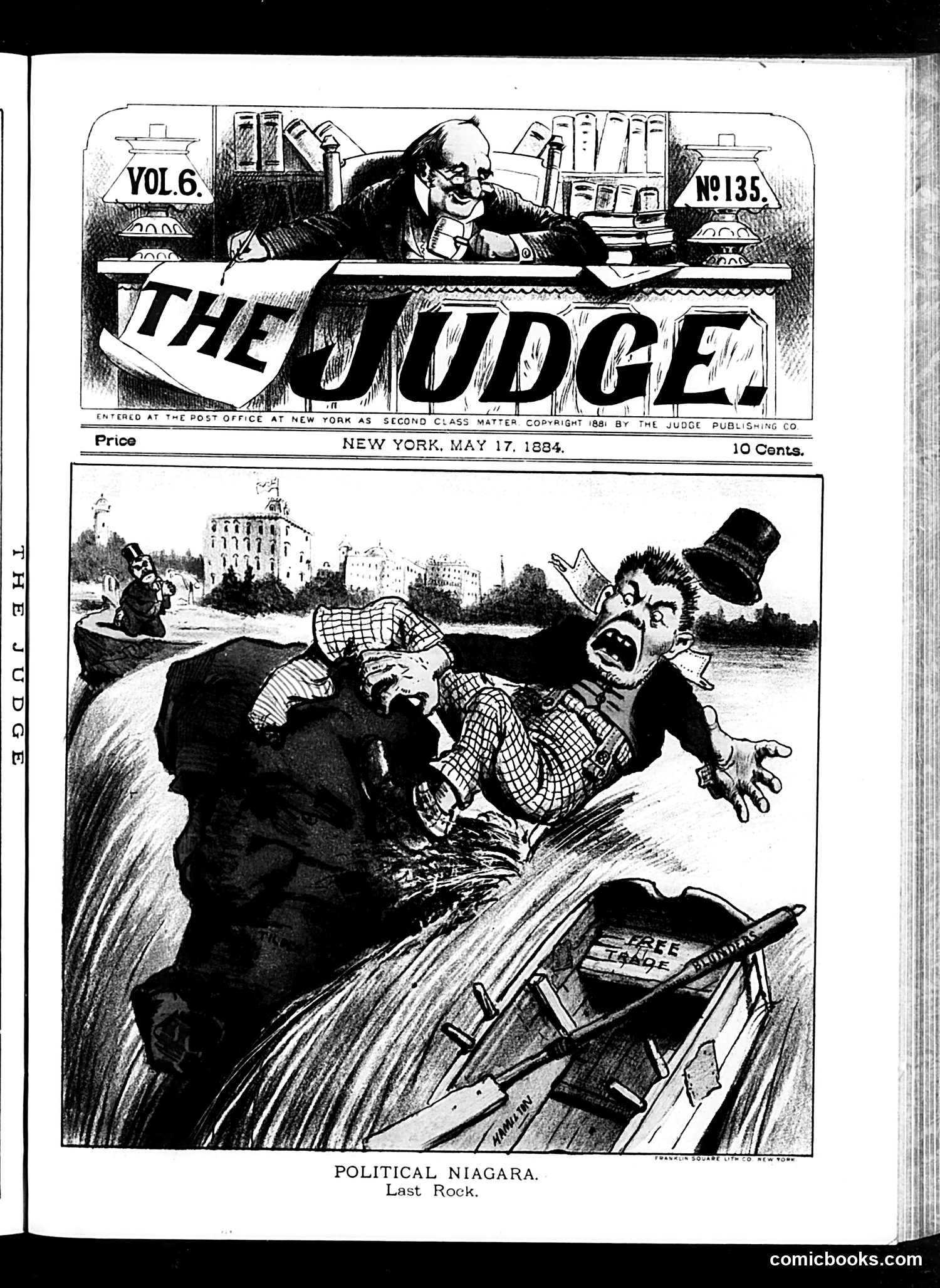
This cartoon from *Judge* magazine (May 17, 1884) uses the metaphor of Niagara Falls to satirize American politics. Two figures in a canoe approach the falls' edge—a precarious "last rock" before disaster. One wears a top hat (likely representing a political establishment figure or party leadership), while the other appears distressed. The title "Political Niagara" suggests the nation's political situation is careening toward inevitable catastrophe, with this final position representing the last chance to avoid ruin. The cartoon likely comments on a specific 1884 political crisis—possibly related to the presidential election that year or internal party conflict. The drowning/falling imagery conveys urgency: without intervention, political disaster is imminent. The satirical point: leadership has allowed the nation to drift dangerously close to the brink.
This page analyzes the emerging strength of **James G. Blaine** versus incumbent President **Chester Arthur** heading into the 1884 Republican Convention in Chicago. The article documents Blaine's commanding delegate lead across 18 states (203 electoral votes), predicting ~300 convention votes for Blaine versus ~50 for Arthur. Arthur's supporters counter that scattered votes from candidates like Edmunds and Sherman, plus Southern "bogus votes," could be consolidated to nominate Arthur against Republican states' will. The piece tracks the pivotal **40 Illinois Logan delegates**—currently uncommitted—as the deciding factor. These delegates, led by John Logan (an 8-year Cincinnati convention supporter), are expected to swing to Blaine, triggering cascading support from Ohio and western states. The satire mocks Arthur's prospects as miraculous and implausible, portraying Blaine's nomination as inevitable despite the political maneuvering.
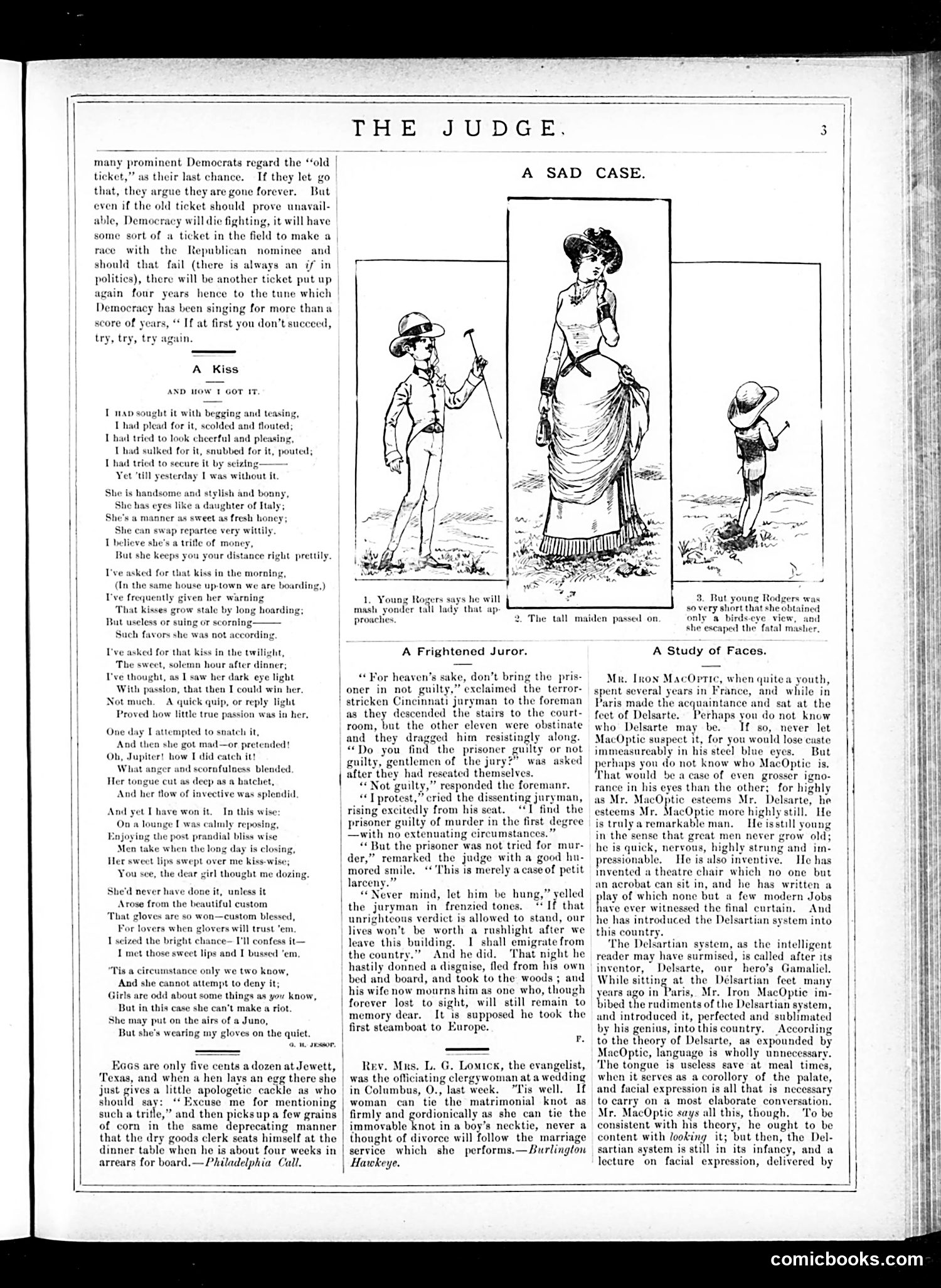
This page from the satirical magazine *Judge* contains several distinct pieces: **Political Content (top left):** A commentary on Democratic Party strategy, suggesting Democrats cling to their "old ticket" as a last hope. The satire mocks Democratic resilience—if their current nominee fails, they'll simply run another candidate in four years, repeating their mantra "If at first you don't succeed, try, try again." **"A Kiss" (center-left):** A humorous poem about a man's persistent but unsuccessful attempts to obtain a kiss from a woman, until he succeeds by catching her off-guard during a drowsy moment. The punchline reveals she allows it only because she's unconscious—yet paradoxically accepts his gloves as payment. **"A Sad Case" (right side):** A comic anecdote about a Cincinnati juror so terrified of the defendant that he insists on a guilty verdict *before* entering court. When the judge reveals the trial concerns only petit larceny (minor theft), not murder, the juror becomes so embarrassed he emigrates from the country. The humor relies on exaggeration and absurdist logic typical of late-19th-century satirical magazines.
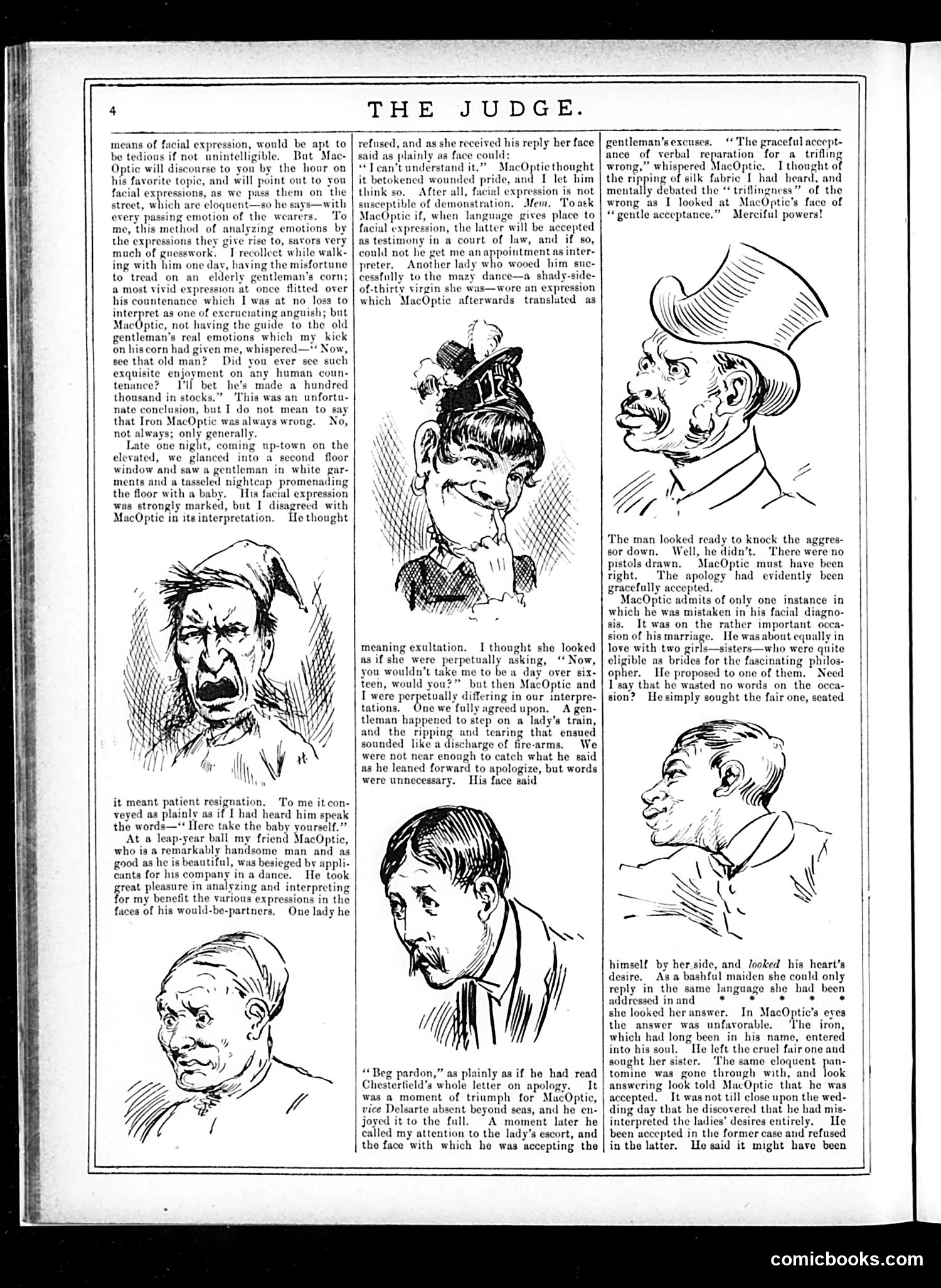
This page satirizes a character named "MacOptic" who claims expertise in reading human emotions through facial expressions alone. The author recounts several encounters where MacOptic's interpretations prove wildly inaccurate or absurd—claiming a man stepping on an elderly gentleman's foot made a fortune in stocks, or that a woman accepting a dance proposal expressed "exultation" when she likely meant something entirely different. The satire mocks pseudoscientific character-reading trends popular in the 19th century, particularly systems like Delsarte's method of gesture interpretation (referenced in text). MacOptic represents charlatans who claimed to divine inner truth from external signs. The humor lies in the gap between what MacOptic "reads" and reality—suggesting such systems are unreliable nonsense masquerading as science. The numerous facial expression sketches illustrate how subjective and misleading such readings truly are.
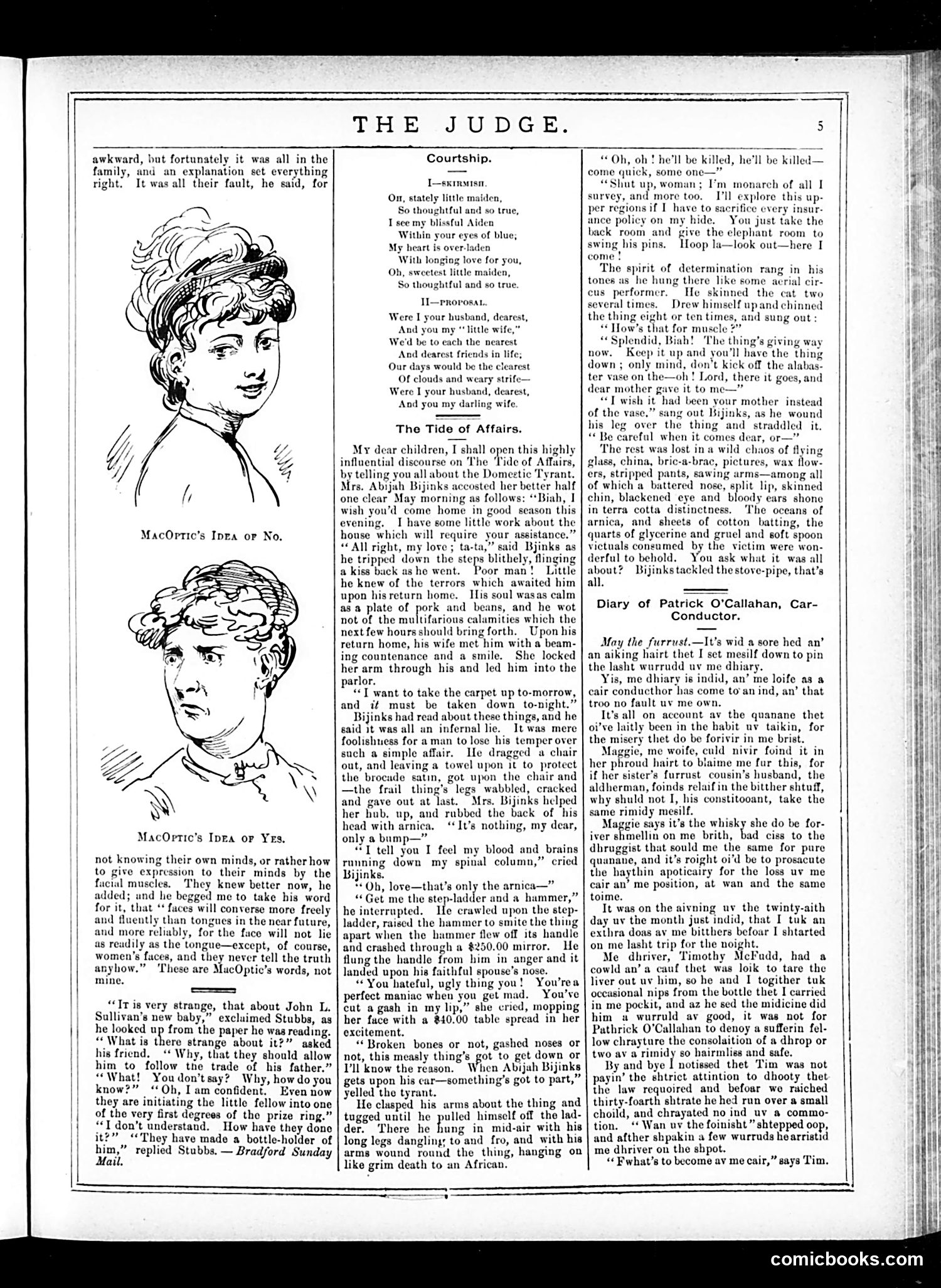
This page from the satirical magazine *Judge* contains three unrelated pieces of social satire typical of late 19th-century American humor: 1. **"MacOptie's Idea"**: Two portrait sketches illustrating a character's claim that faces communicate better than words—with ironic commentary that women's faces are inherently dishonest. This mocks pseudoscientific physiognomy theories popular at the time. 2. **Sullivan's Baby Joke**: A brief quip about boxer John L. Sullivan's infant, sarcastically suggesting the baby is being "initiated" into prizefighting by being made a "bottle-holder"—a reference to someone who assists fighters. The joke plays on Sullivan's fame and working-class boxing culture. 3. **"The Tide of Affairs"**: A domestic comedy about Mr. and Mrs. Bijinks. The husband reluctantly helps remove a carpet, breaks a chair, destroys a mirror with a hammer, and strikes his wife's nose with the handle—escalating chaos presented as humorous marital discord. It satirizes the friction of domestic life and masculine incompetence with household tasks.
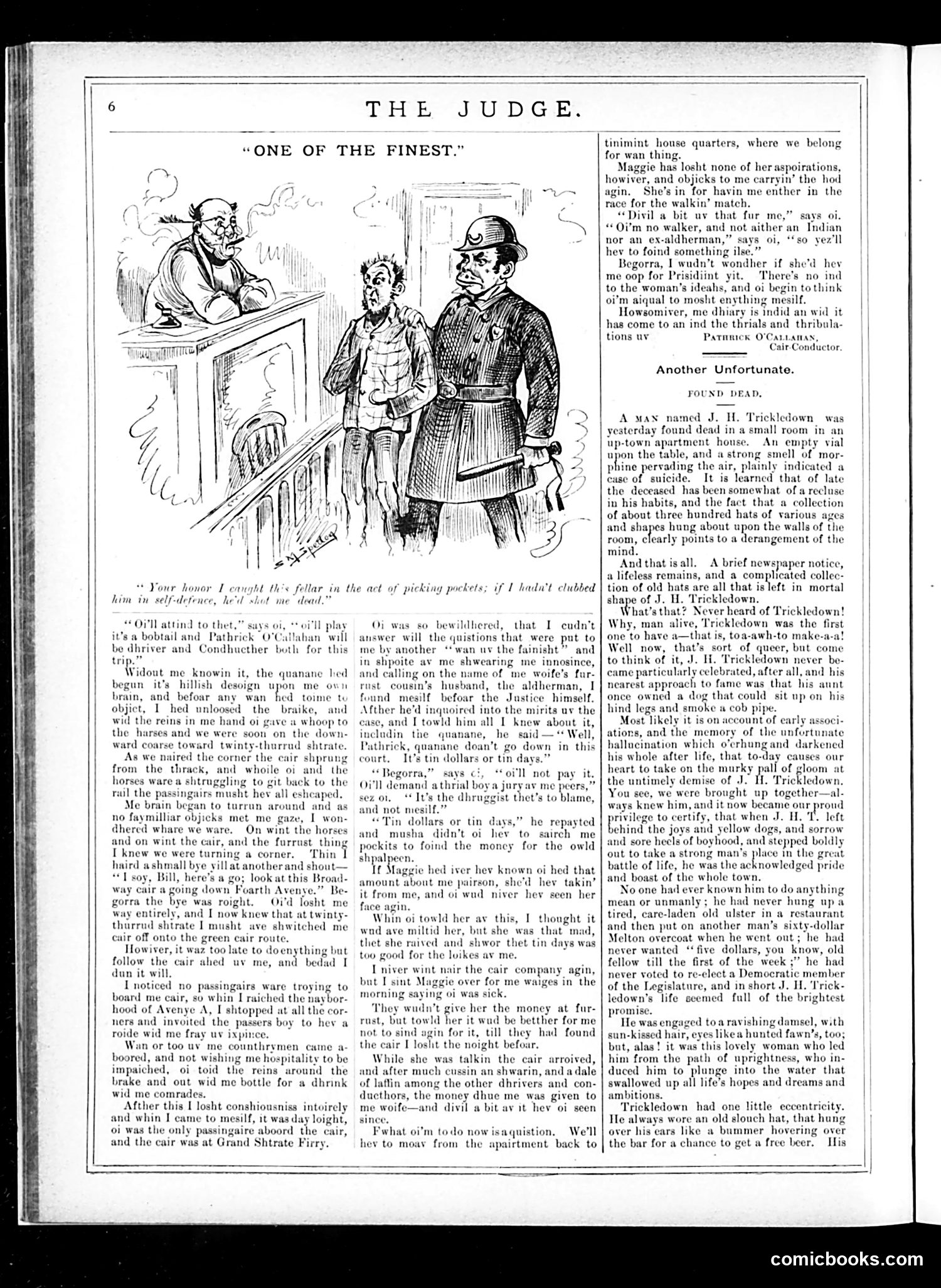
This page satirizes Irish immigrant experience and urban bureaucracy in late-19th-century America. The cartoon depicts a police officer presenting an arrested man (identified by dialect as Irish) to a judge. The satire operates on multiple levels: The title "One of the Finest" ironically refers to police officers as "New York's Finest," while the arrestee's heavy Irish brogue—rendered in exaggerated phonetic spelling—marks him as a working-class immigrant. The accompanying text, a first-person narrative in thick Irish dialect, recounts how the narrator accidentally took a streetcar off its rails while drunk, was arrested for picking pockets he didn't commit, fined ten dollars, and now faces eviction from his tenement. The humor targets both the character's gullibility and the casual injustice of the system: he's punished despite being innocent, treated with condescension by authorities, and his wages unfairly distributed. The satire critiques how immigrants faced arbitrary legal consequences and economic exploitation in urban America.
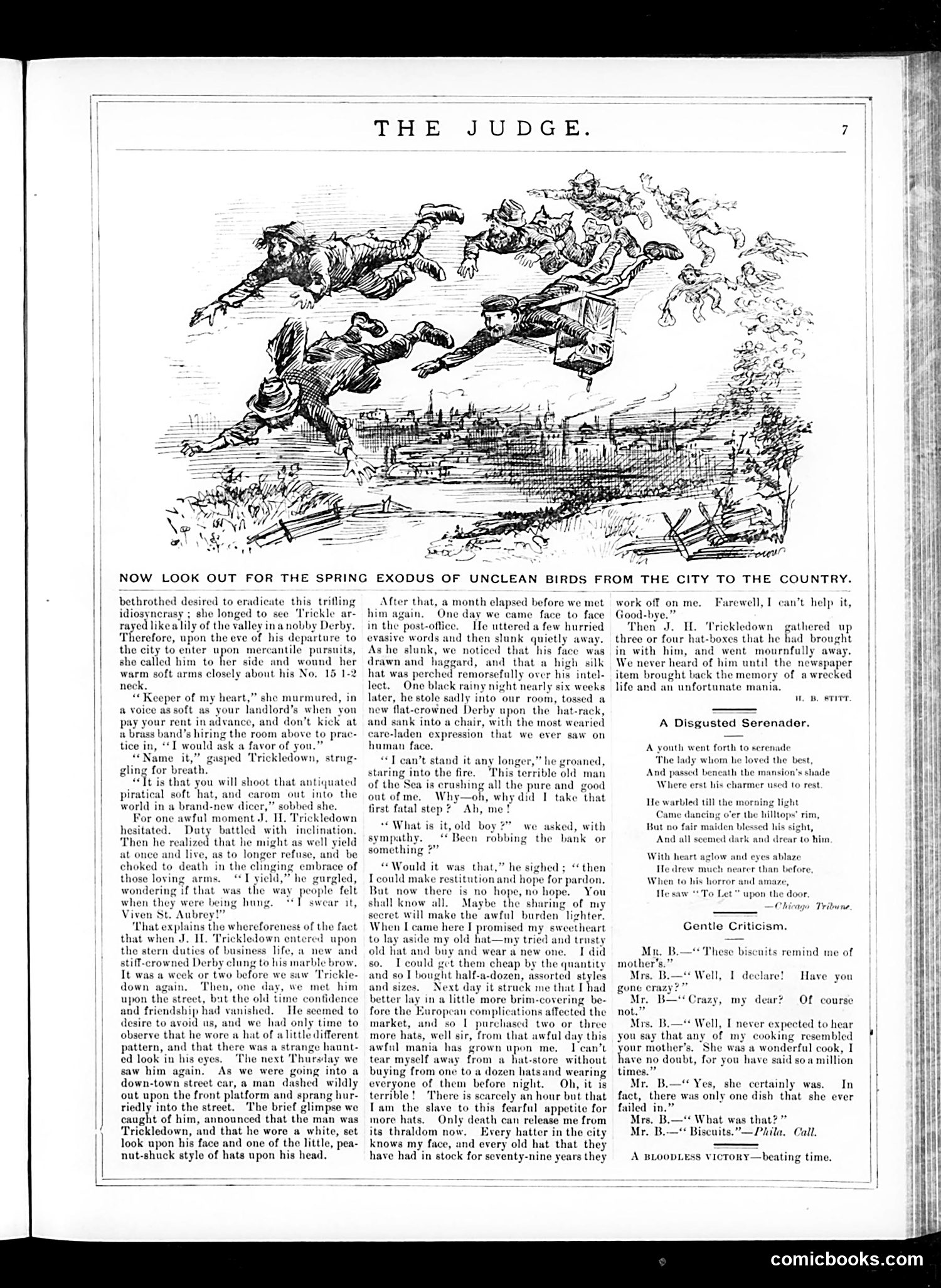
This Judge page satirizes compulsive consumer behavior through the story of J. H. Trickledown, a young man whose sweetheart pressures him to replace his shabby old hat with a fashionable new one before entering business life. The joke unfolds as dark comedy: after buying one new hat, Trickledown becomes addicted to purchasing hats obsessively—dozens at a time—unable to stop himself. The cartoon illustrates figures flying chaotically above a cityscape, visualizing his spiraling madness. The satire targets late-19th-century materialism and consumer culture, mocking how minor acts of consumption spiral into psychological compulsion. The girlfriend's seemingly innocent request triggers ruinous behavior, suggesting anxieties about both feminine influence and the newly commercialized economy's power to enslave men through shopping habits. The tragic-comic tone suggests addiction to consumer goods as a modern affliction—a remarkably prescient critique of consumer capitalism's psychological grip.
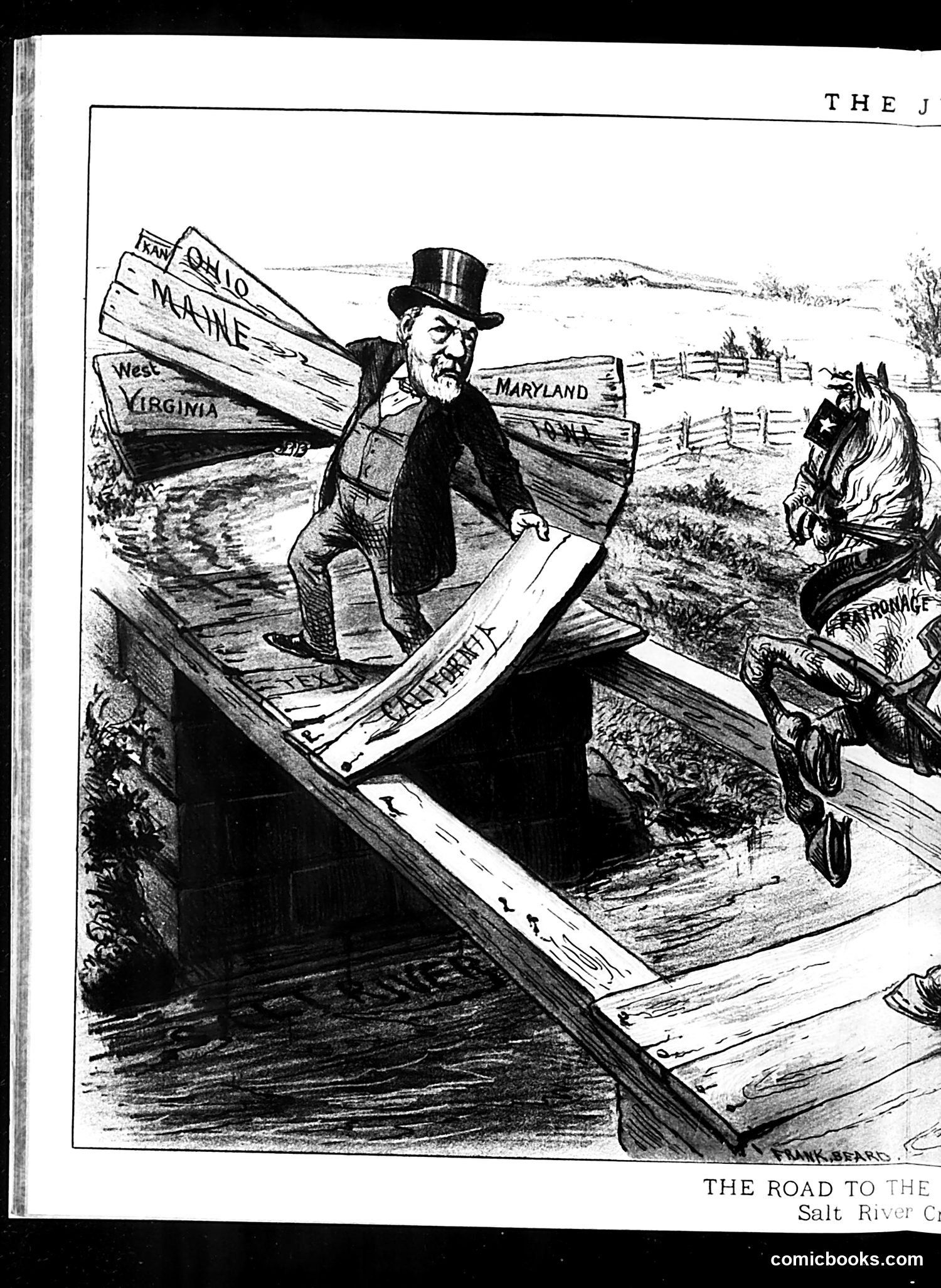
This Judge magazine cartoon depicts a well-dressed man in a top hat navigating wooden planks labeled with state names (Ohio, Maine, West Virginia, Maryland) and marked "CELEBRITY" and "PATRONAGE." He appears to be carefully balancing or choosing his path, while a horse waits nearby. The cartoon satirizes political maneuvering during the Gilded Age, likely criticizing how politicians navigated between different states and regional interests to secure patronage appointments and celebrity status. The precarious wooden planks suggest the unstable, shifting nature of such political calculations. The title "Road to the Salt River" references a period political phrase meaning electoral defeat or political ruin, implying this path leads to failure despite the figure's careful positioning.
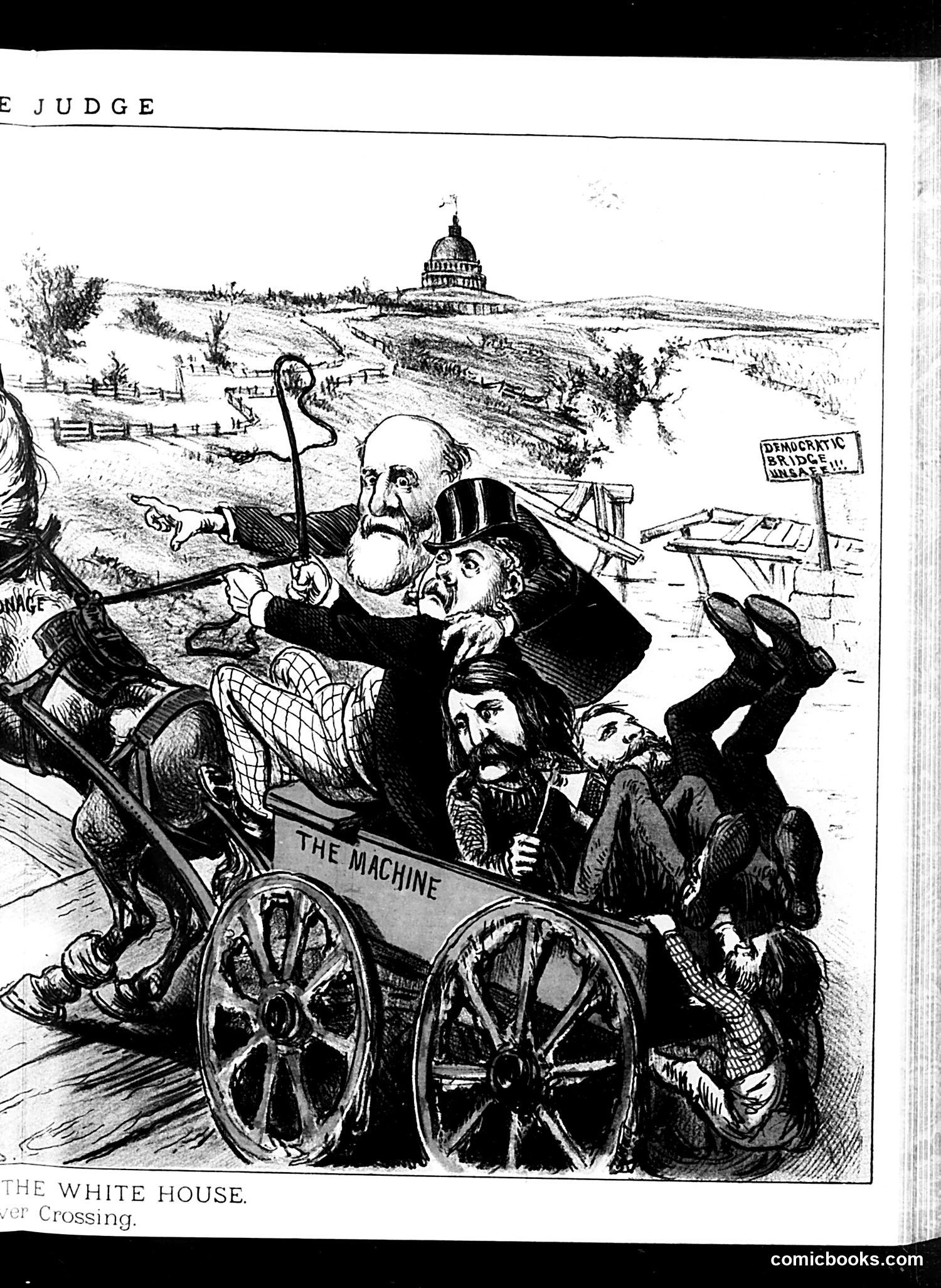
This Judge magazine cartoon depicts a donkey—the symbol of the Democratic Party—pulling a cart labeled "THE MACHINE" carrying several bearded men. The sign reads "DEMOCRATIC MACHINE" and the Capitol building appears in the background. The satire criticizes Democratic political machinery and corruption, suggesting party leadership is being driven by donkey labor (implying foolishness or stubbornness). The bearded figures likely represent Democratic politicians or party operatives of the era. The cartoon's title references Washington, D.C., suggesting the critique targets Democratic control of federal government and its bureaucratic operations. The overall message warns against the Democratic Party operating as an unthinking, mechanical political apparatus serving its operators rather than the public interest. Without a visible date, the specific historical context remains unclear.
This page from **Judge** magazine contains theater reviews and gossip, not political cartoons. The small illustration at top-left appears decorative rather than satirical. The content discusses New York theater closures and productions circa the 1880s. Key points: - **Rankin** (theater manager) lost money operating the Third Avenue Theatre, forcing closure of "The Two Orphans" at Union Square Theatre - **Wallack's Theatre** is ending its season; reviewer criticizes supporting actresses Louise Moody and Miss Russell as inadequate - **Rose Coghlan's absence** from a production is regretted - Positive notices for **Mrs. Langtry** in "Galatea" and various musical performances - Mentions of specific plays ("Hazel Kirke," "Dan's Tribulations," various musical comedies) running at various venues The tone is gossipy insider commentary on theater management failures, casting choices, and performance quality—typical of Judge's theatrical coverage. No significant political satire is evident on this particular page.
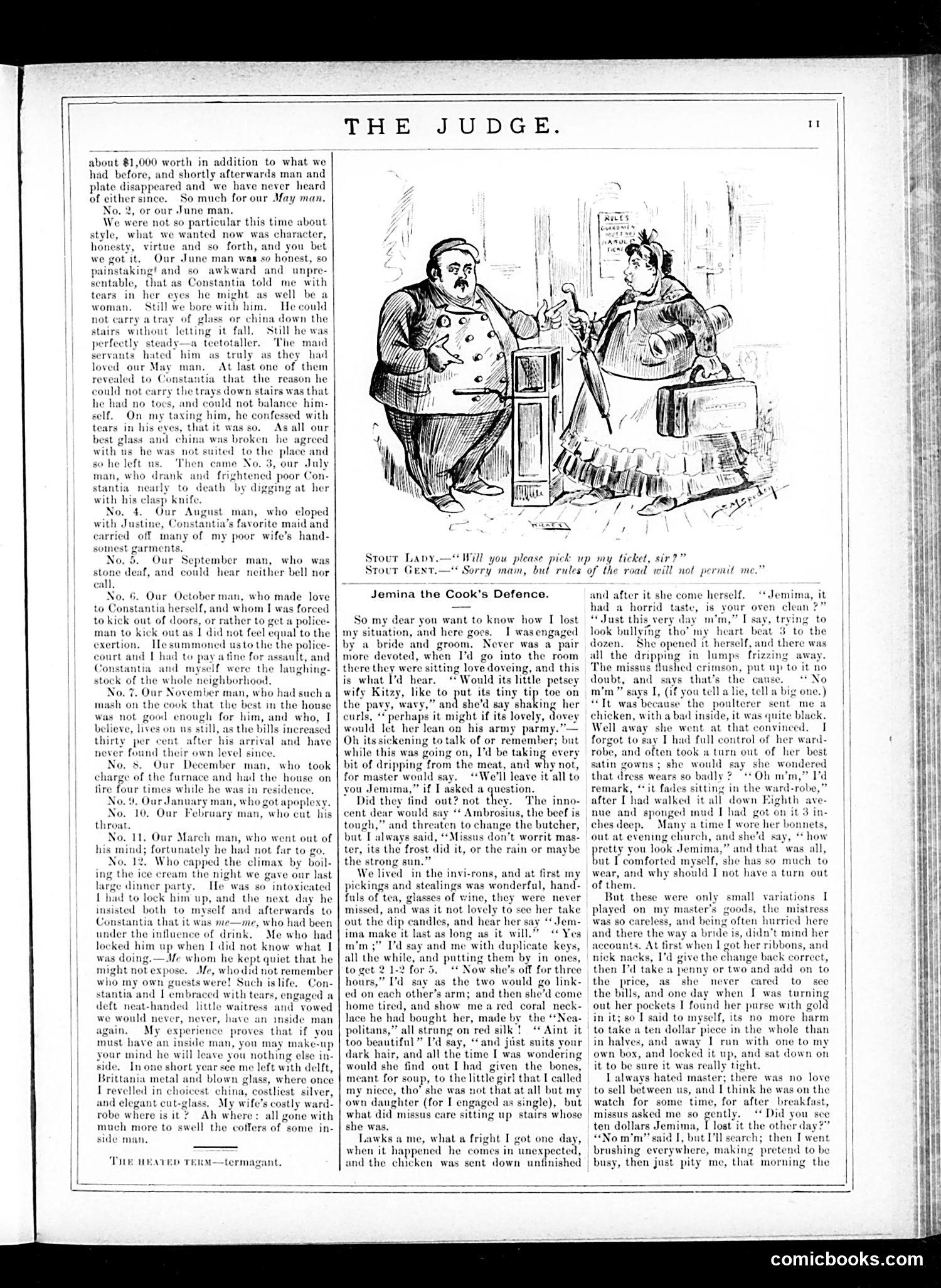
This page presents a serialized complaint by an employer about a succession of twelve domestic servants, each with progressively worse failings—from theft and drunkenness to mental illness and property damage. The accompanying illustration shows a stout gentleman complaining to a woman about household staff problems. The adjacent piece, "Jemina the Cook's Defence," presents the cook's rebuttal, suggesting the employer's complaints are unfair. She describes working for a newlywed couple so sentimental ("love doveing") that she finds their behavior absurd. The satire targets both sides: the employer's unreasonable expectations and bitter recounting of servant misfortunes, and the servant's defensive perspective. This reflects late-19th-century class tensions around domestic labor, mocking both employers who blame staff for every household mishap and servants who excuse poor performance through circumstance or employer ridiculousness. The humor exploits the era's anxieties about the servant problem and household management.
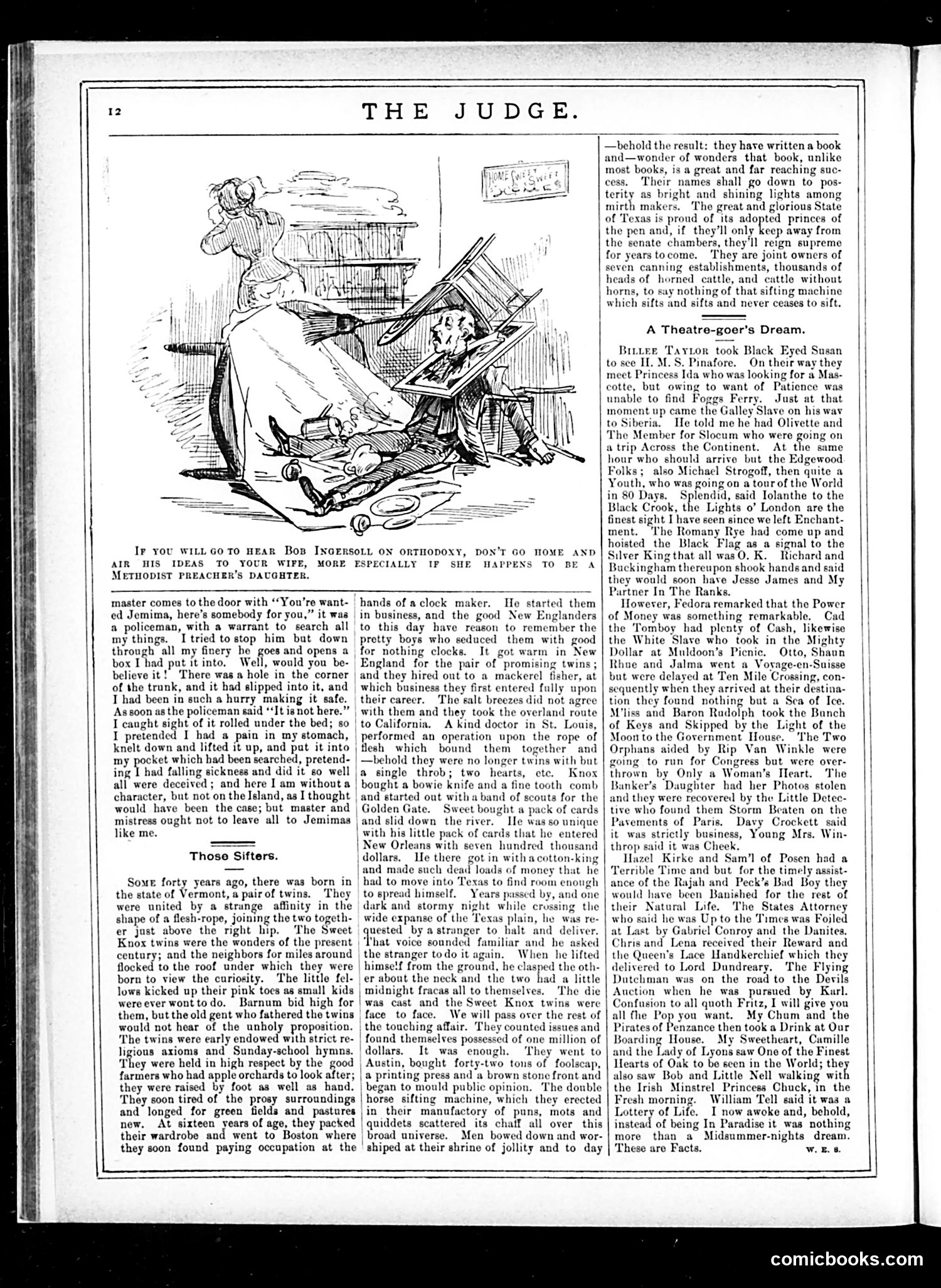
This Judge magazine page contains two distinct pieces of satirical content: **Top Cartoon:** A warning to Methodist families against hearing Robert Ingersoll speak on orthodoxy (religious doctrine). The joke implies that Ingersoll's arguments against religious dogma are so persuasive that even a Methodist preacher's daughter—from a religiously strict family—might be corrupted by his ideas. The cartoon depicts this social anxiety humorously. **"Those Sifters" Story:** A tall tale about the "Sweet Knox twins," conjoined brothers joined at the hip who separate and go their different ways. One becomes a riverboat gambler accumulating wealth in Texas; the other becomes a bandit. They eventually meet as robber and victim on the Texas plains—a comedic twist ending. This appears to be absurdist humor playing on the novelty of actual conjoined twins as public curiosities of that era, while satirizing Western frontier tales and get-rich-quick schemes. Both pieces reflect 19th-century concerns about religious authority, rapid social change, and American mythology.
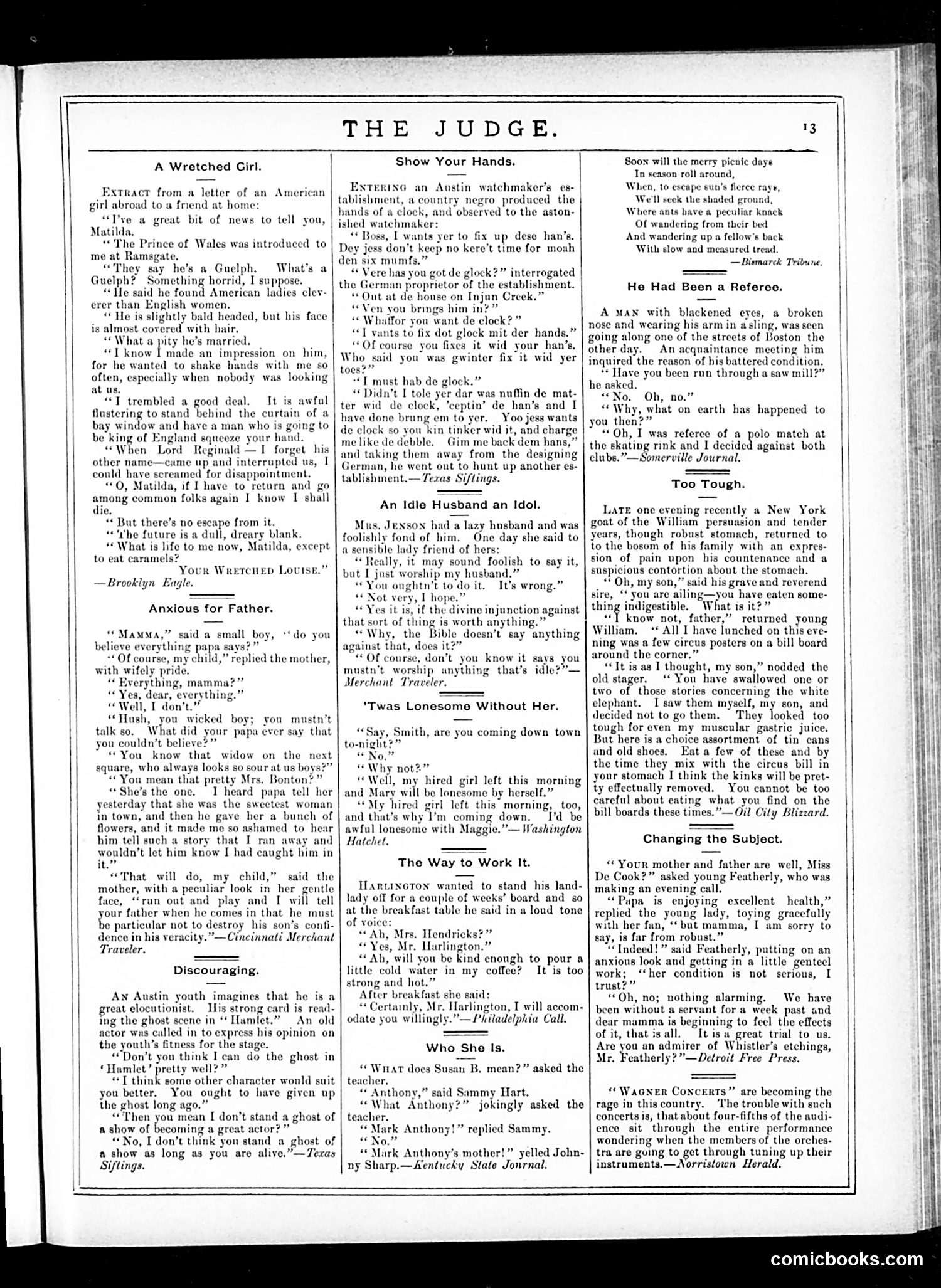
This page from Judge magazine contains several short humorous pieces typical of 19th-century American satire: **"A Wretched Girl"** mocks an American woman abroad who becomes absurdly starstruck meeting a minor British royal ("Prince of Wales"), misidentifying him as a "Guelph" and obsessing over his attention while he's married. **"Show Your Hands"** satirizes a rural Black character who arrives at a German watchmaker's shop with only clock hands, insisting on repair without the clock itself—depicting him as either deliberately obtuse or suspicious the craftsman will overcharge. **"Anxious for Father"** humorously depicts a child catching his father flattering a widow, undermining parental authority through innocent logic. **"Discouraging"** features an aspiring actor being told he has "no show" at performance—wordplay on "ghost" and theatrical failure. The page reflects period attitudes: class anxiety about foreigners, racial stereotyping in dialect humor, and domestic comedy. The satire targets human folly across social strata rather than specific political events.
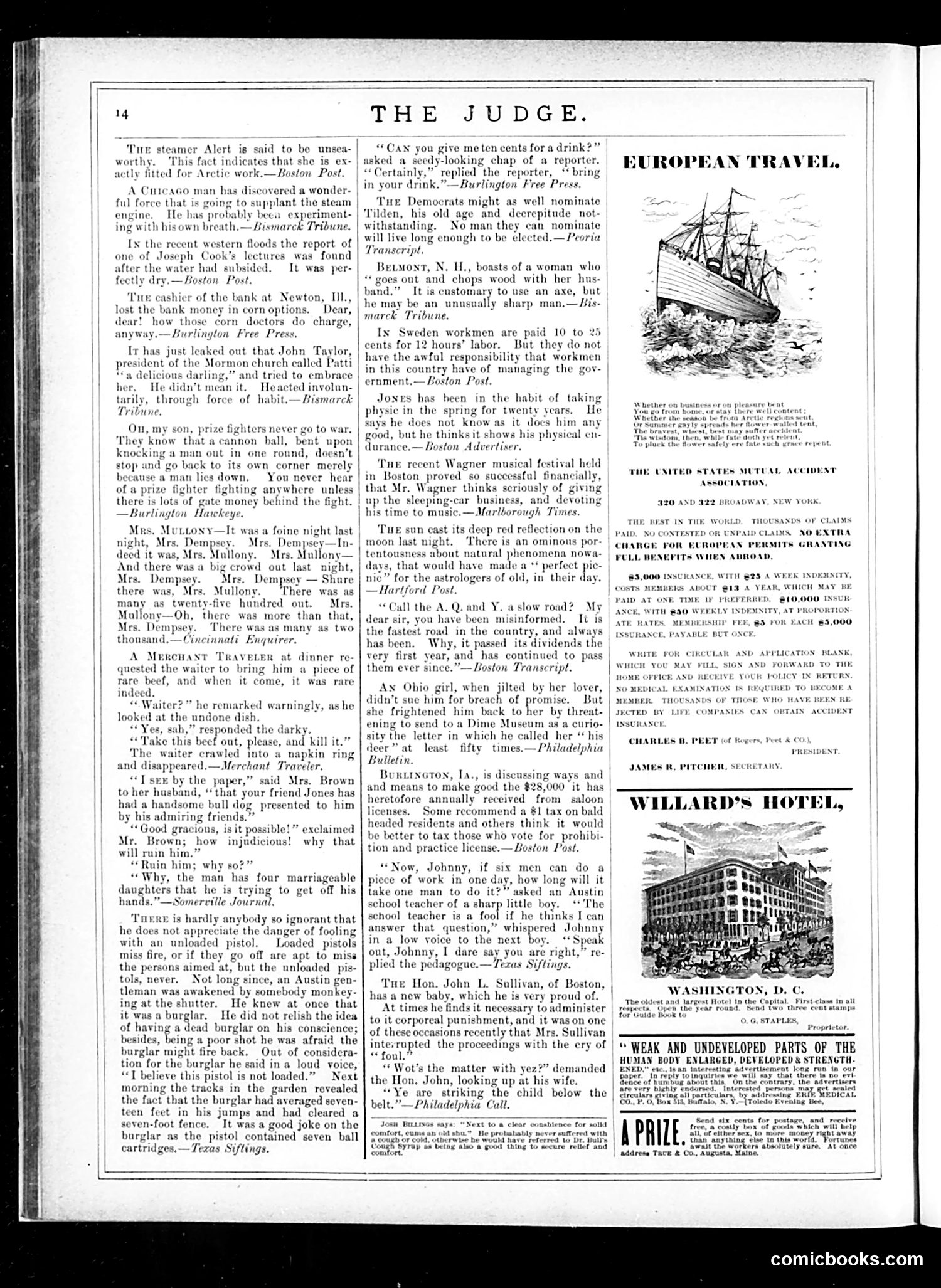
This page from **Judge** magazine (a leading American satirical publication) contains primarily short humorous anecdotes and advertisements rather than political cartoons. The visible content includes: **Notable items:** 1. **"European Travel"** - An illustration of a sailing ship, accompanying travel advertisements. 2. **"Willard's Hotel"** - A hotel advertisement featuring the building's image in Washington, D.C. 3. **Short satirical pieces** mocking various subjects: a reporter asking for drink money, Democratic presidential prospects (referencing Samuel Tilden), Swedish labor practices, and prize fighting. The humor is largely gentle social commentary rather than sharp political critique. 4. **"The Judge" section** - Contains brief jokes and observations about contemporary life, from corn speculation to unloaded pistols. The page reflects late 19th-century American humor: punning, class observations, and domestic comedy. Without clearer political cartoon imagery, most satire here targets social absurdities rather than specific political figures or major events.
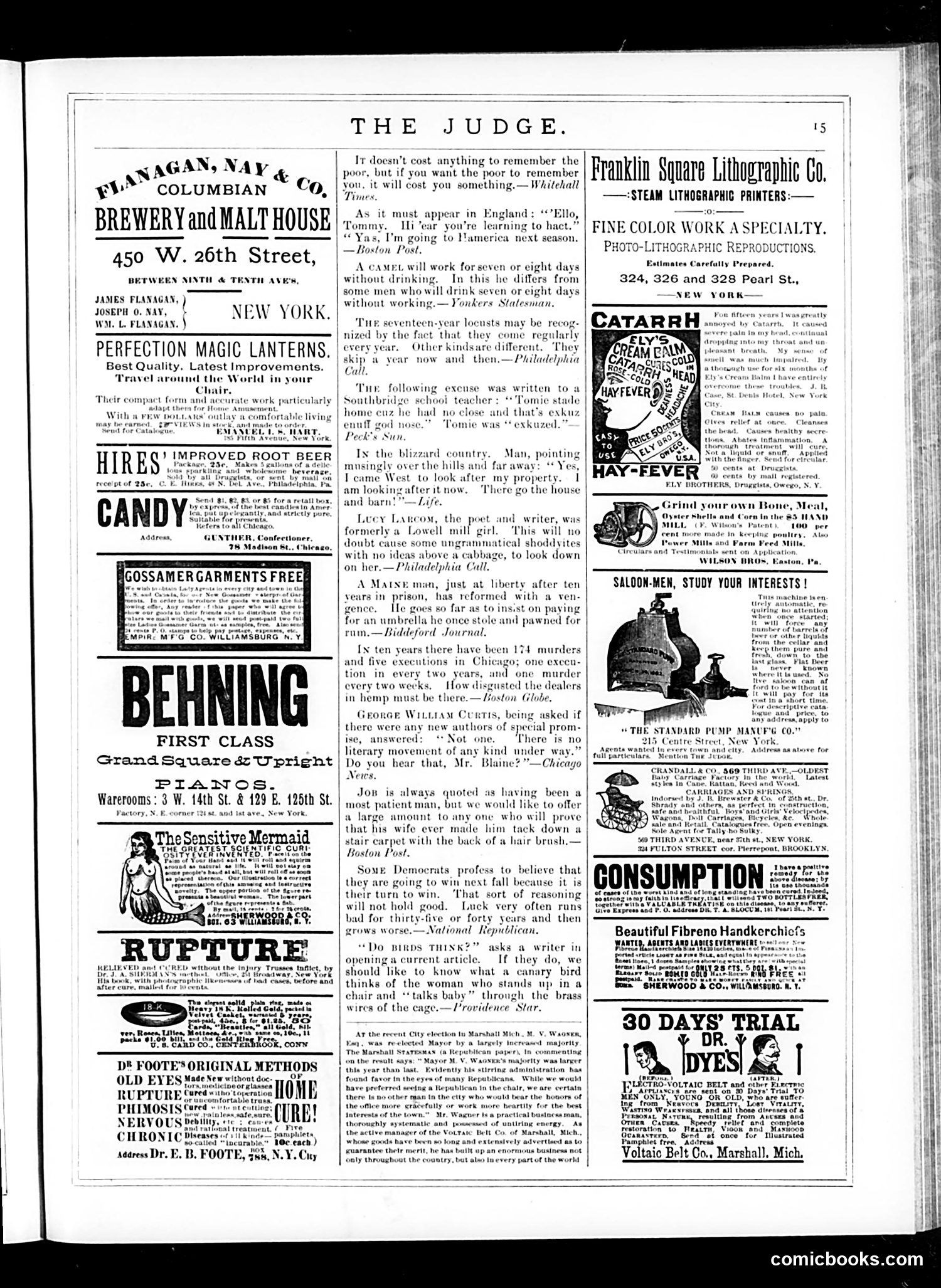
This is primarily an **advertising page** with minimal editorial content. The page consists almost entirely of classified advertisements and commercial notices typical of late 19th-century American magazines. The small editorial content visible includes brief **humorous quips and observations** extracted from various newspapers, touching on: - Poverty and charity (Whitehall Times) - Animal behavior vs. human work ethic (Yonkers Statesman) - Political commentary on Democratic electoral strategy (National Republican) - Social satire about mill girls becoming writers (Philadelphia Call) These are **filler jokes**—typical of Judge's format—rather than sustained political cartoons. The quips mock working-class behavior, poke fun at Democratic optimism about elections, and offer genteel social criticism. The page's primary purpose is **revenue generation** through advertisements for pianos, breweries, magic lanterns, medical devices (the "Dr. Dyes" voltaic belt), and lithographic services—standard fare for a commercial satirical weekly of the era.
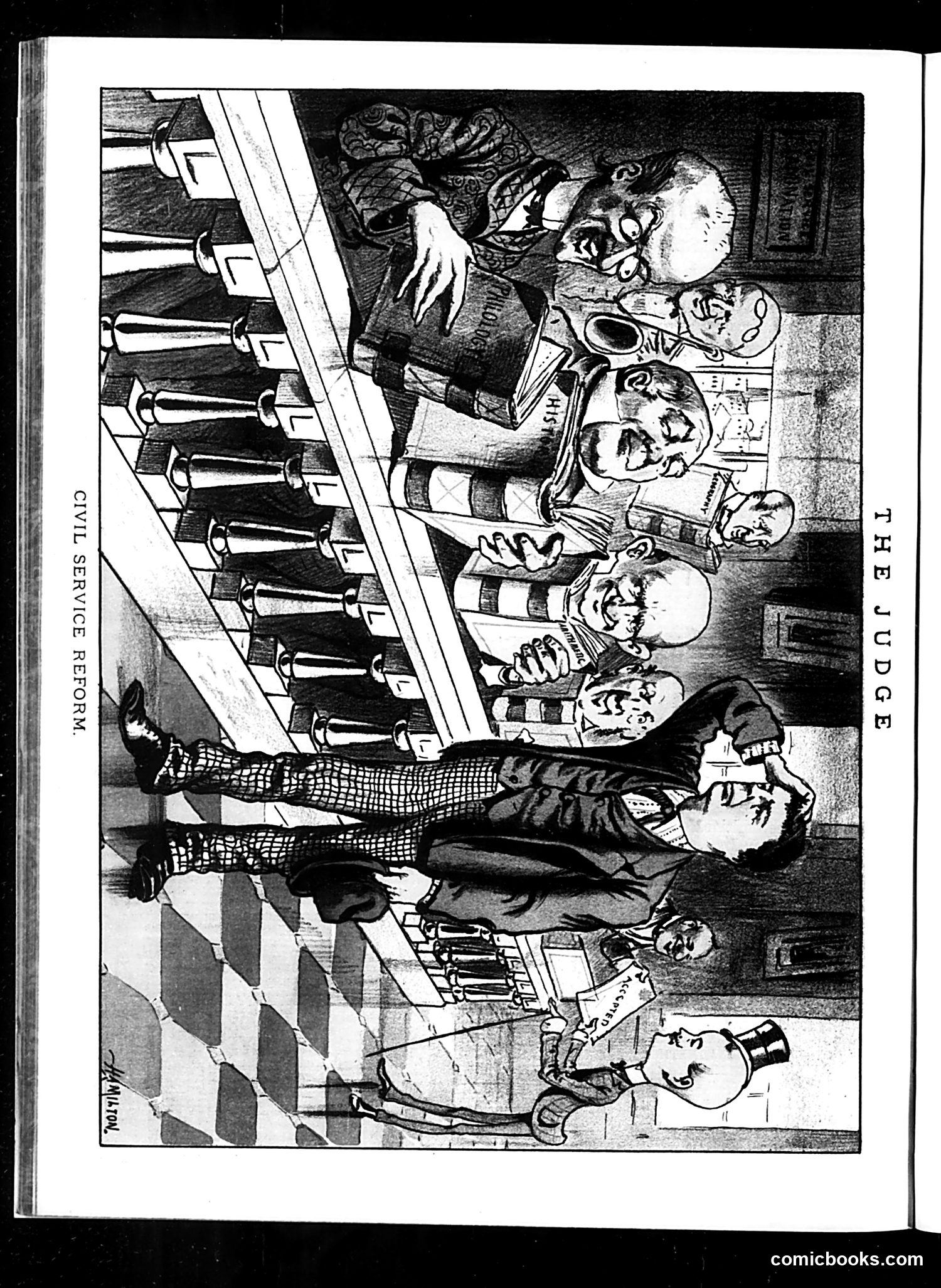
This political cartoon satirizes civil service reform debates, a major issue in late 19th-century American politics. The image shows a figure in formal dress examining what appears to be a government office or bureaucratic structure, with multiple officials or employees visible in the background. The cartoon critiques the spoils system—where political patronage determined government hiring—versus merit-based civil service. The figure's inspection suggests scrutiny of whether government positions were filled by qualified candidates or merely party loyalists. Civil service reform was championed by progressive reformers who opposed corruption and inefficiency in government. The satire likely mocks either the inadequacy of reform efforts or the resistance from politicians defending patronage networks. Without a visible date, the cartoon's exact context remains unclear, but the theme dominated American politics from the 1870s onward.