
A complete issue · 16 pages · 1884
Judge — March 15, 1884
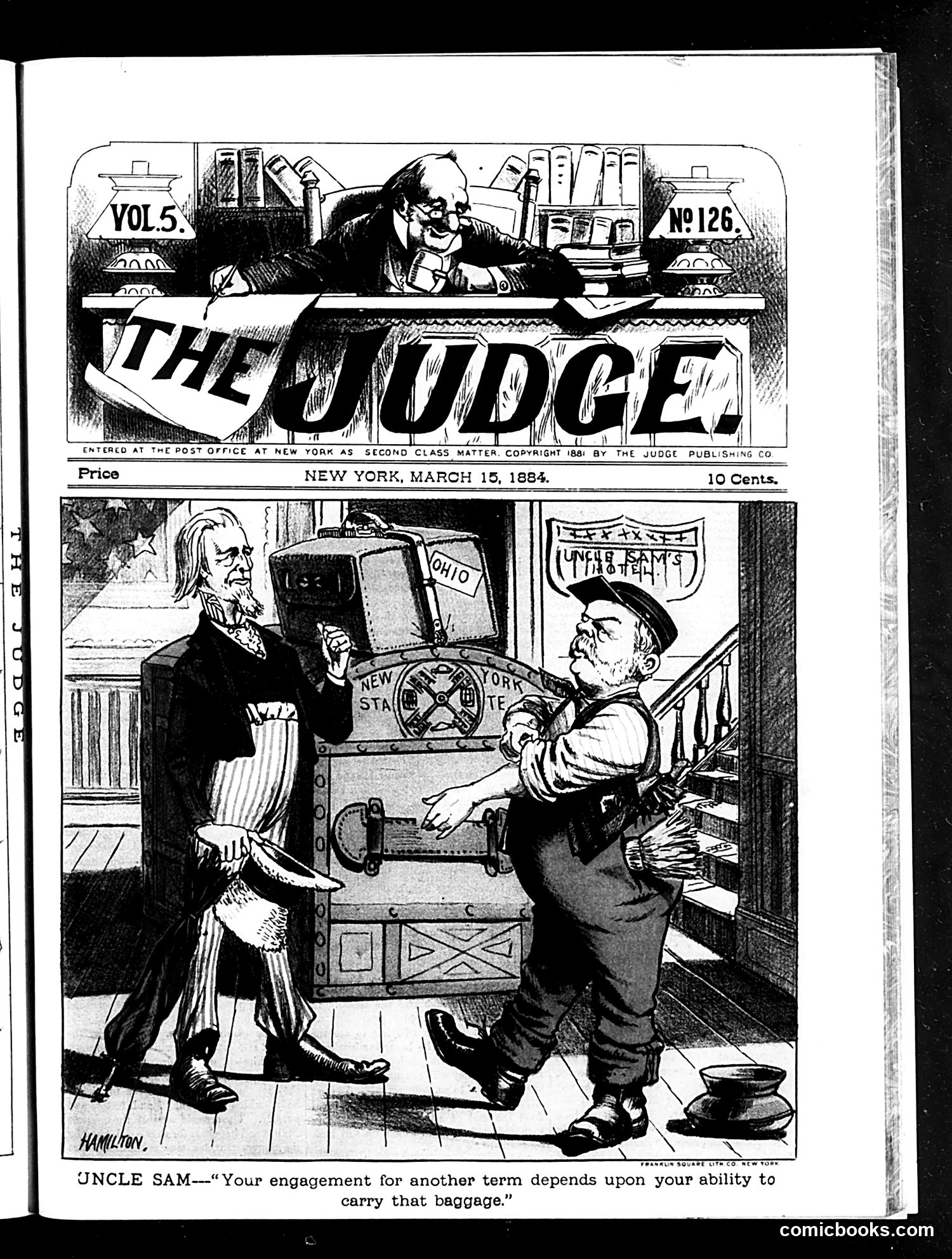
The cartoon depicts Uncle Sam (identifiable by his characteristic tall hat and striped trousers) confronting a man labeled as representing Ohio or a state official. Uncle Sam holds a large trunk labeled "NEW YORK STATE" while the other figure carries baggage. The caption reads: "Your engagement for another term depends upon your ability to carry that baggage." This appears to be political commentary about electoral politics in 1884, likely regarding a candidate's prospects for re-election. The "baggage" metaphor suggests the candidate must bear responsibility for controversial policies or scandals associated with their previous term. The specific reference to New York State indicates this concerns state-level politics during that era.
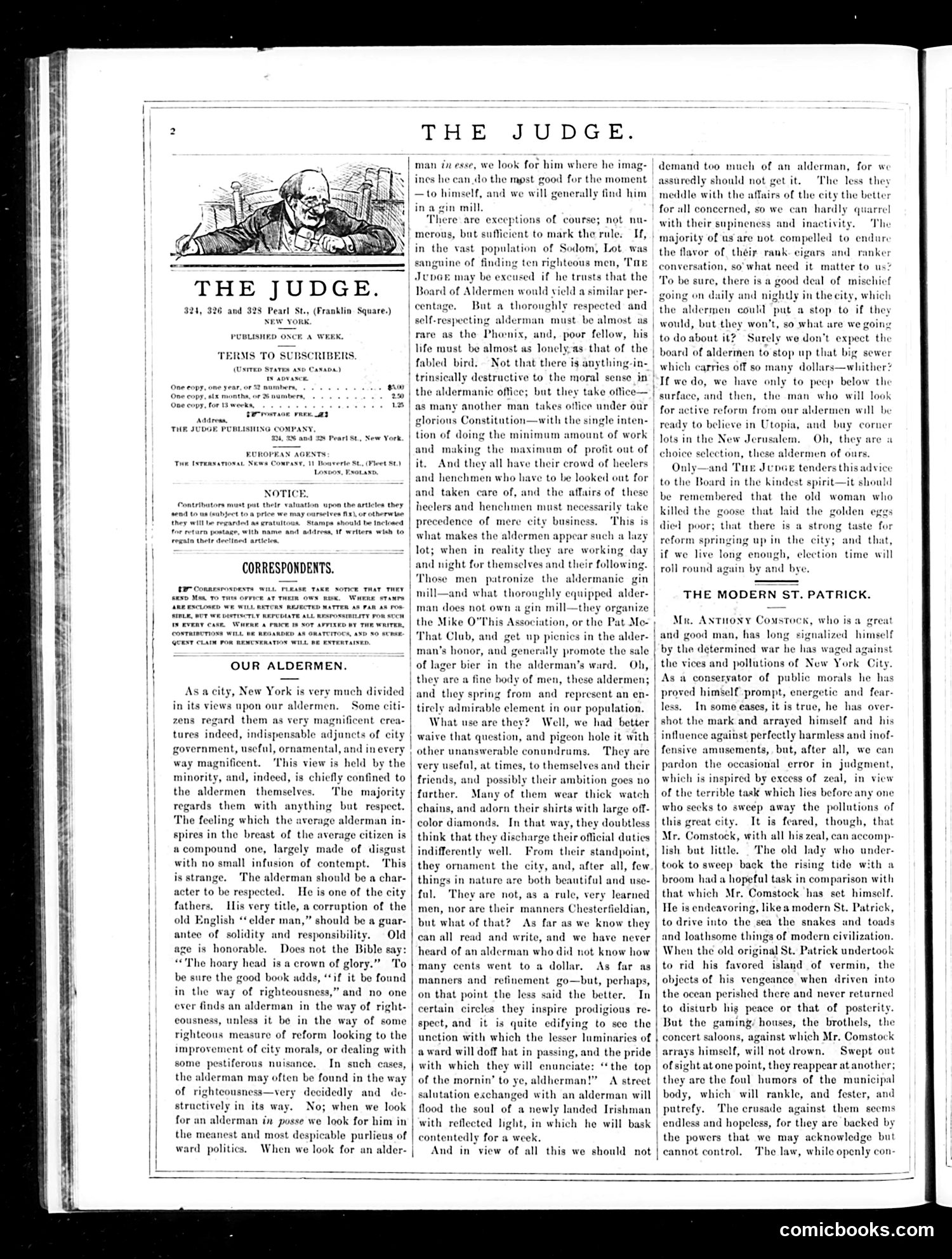
This editorial page attacks New York City aldermen as corrupt and self-serving. The text sarcastically contrasts the honorable etymology of "alderman" (from "elder man") with their actual behavior—depicted as motivated solely by personal profit and ward politics patronage. The author argues aldermen use their office minimally while extracting maximum personal gain, surrounding themselves with "heelers" (political operatives) who must be financially supported. The piece mocks their façade of community service through organizations like the "Mike O'This Association" or social clubs, which primarily promote alcohol sales benefiting their constituents' financial interests. The piece suggests corruption is systemic: aldermen frequent gin mills and operate within networks of mutual obligation to ward operatives rather than serving genuine city interests. The comparison to Biblical Sodom implies moral degeneracy is nearly universal among them.
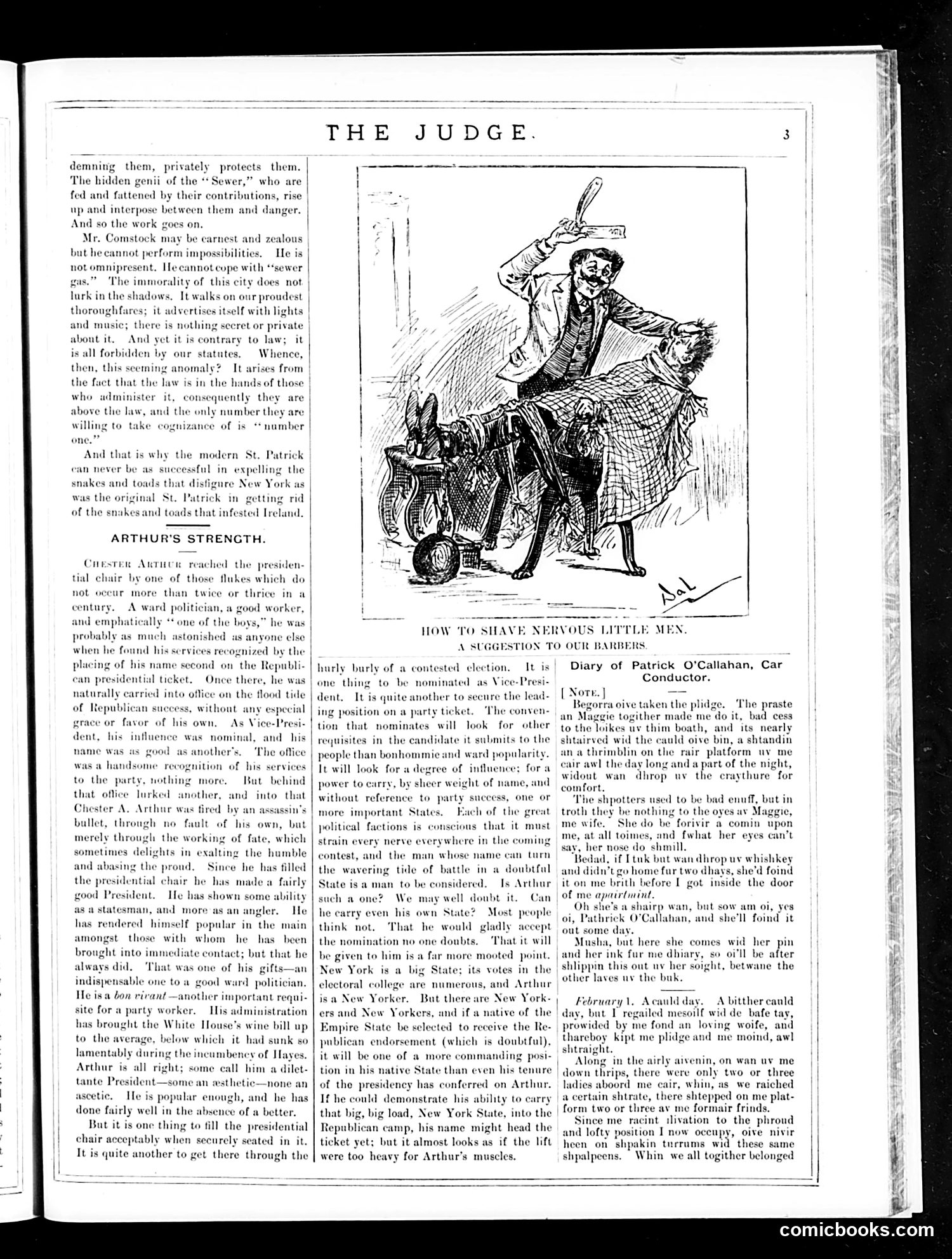
This page critiques **Anthony Comstock**, the famous anti-obscenity crusader (referenced as "Mr. Comstock"), arguing his efforts to clean up New York are futile because immorality is openly visible everywhere—not hidden. The satire suggests Comstock cannot succeed because those enforcing laws place themselves above the law ("number one"). The cartoon's title "How to Shave Nervous Little Men" appears to mock barbers or political figures, though the exact reference is unclear. The second article, "Arthur's Strength," discusses **Chester Arthur's** presidential viability. It praises his character and popularity but questions whether he possesses the political influence needed to lead the Republican ticket in an election. The piece suggests Arthur is competent as president but may lack the clout to win nomination or carry important states like New York in a contested election. Both pieces reflect late-19th-century political concerns about competence, corruption, and electoral strategy.
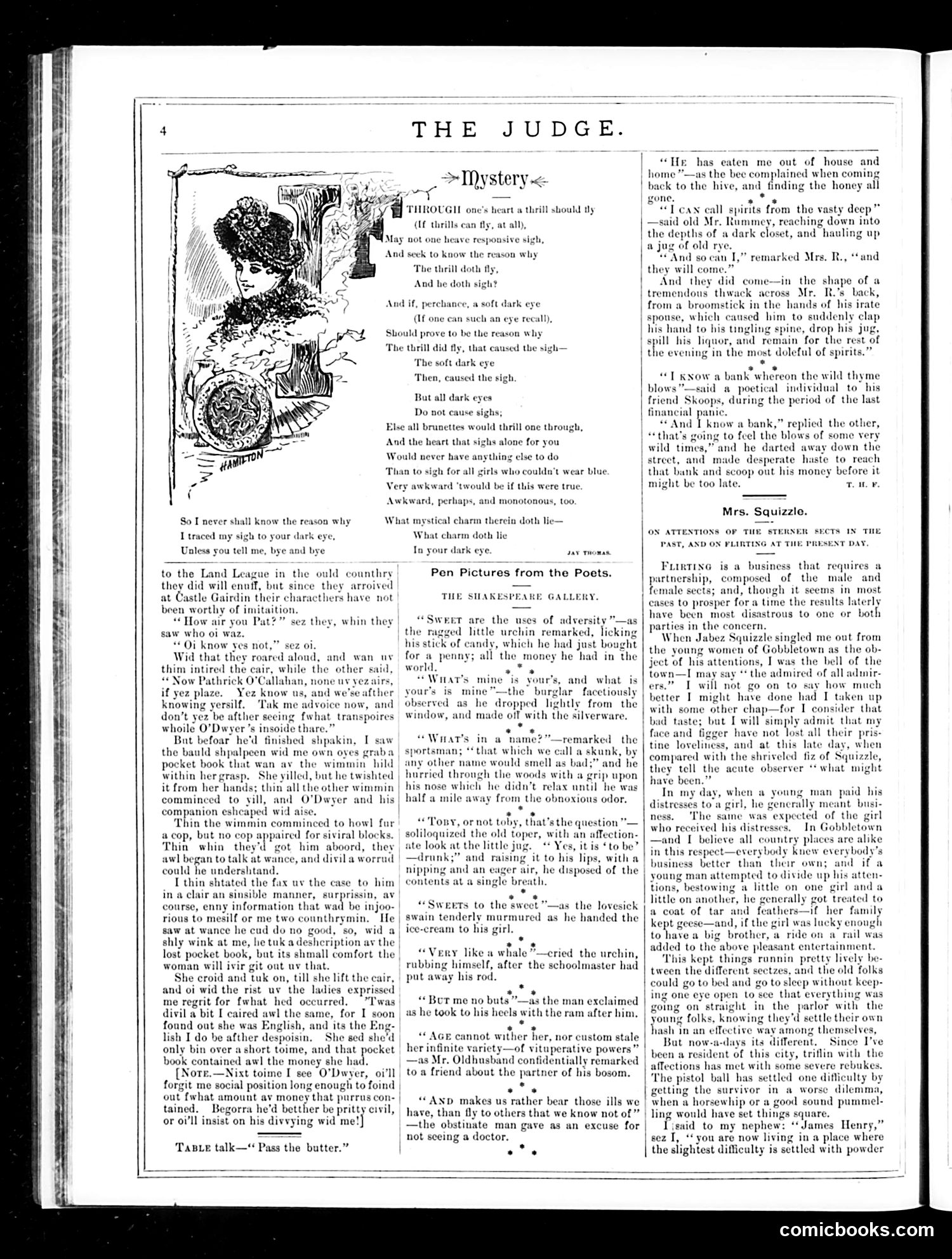
This page contains **literary humor** rather than political satire. The main content includes: **"Pen Pictures from the Poets"** — A comedic section parodying famous Shakespeare quotations by applying them to mundane or absurd situations. Examples include: - "Sweet are the uses of adversity" applied to a street urchin - "What's in a name?" used by a burglar stealing silverware - "To be or not to be?" spoken by a drunk deciding whether to finish his drink **"Mystery" poem** (upper left) — A romantic verse about a man trying to understand why a woman with dark eyes captivates him. **"Mrs. Squizzle"** column — Social commentary about flirting as a business requiring male-female partnerships, with anecdotes about theatrical performances. **"Table talk"** — An Irish-dialect story about Land League members and a stolen pocket book, apparently satirizing Irish political activists' behavior. The page represents typical late-19th-century American humor: literary parody, romantic whimsy, and ethnic comedy (Irish dialect humor).
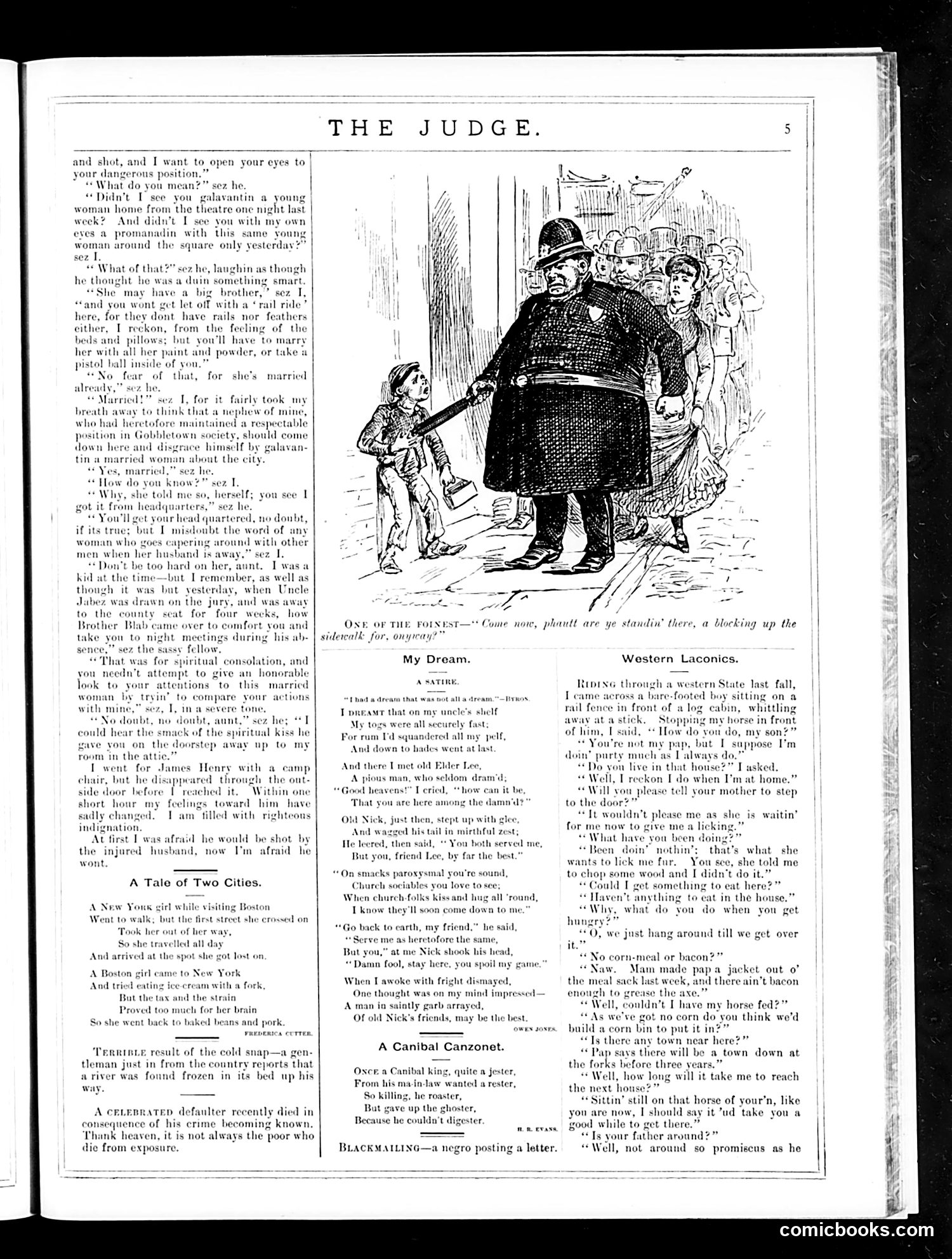
This page contains several satirical pieces typical of Judge's social commentary: **Main Cartoon**: "One of the Finest" depicts a confrontation between a man in a bowler hat and a young boy on a city street, with police or officials in the background. The caption suggests street harassment or improper conduct—likely satirizing urban vice or police indifference to misconduct by prominent citizens. **Text Stories**: Multiple pieces mock social pretensions and moral hypocrisy: - "A Tale of Two Cities" ridicules a Boston girl's inability to adapt to New York sophistication - "My Dream" is a satirical poem about hypocrisy—church officials and sinners meeting in the afterlife - "Western Laconics" humorously depicts rural American dialect and parental discipline - "A Cannibal Canzonet" is absurdist verse **Overall Theme**: The page targets Victorian-era urban vice, religious hypocrisy, class pretensions, and generational conflict—common Judge targets of moral criticism disguised as humor.
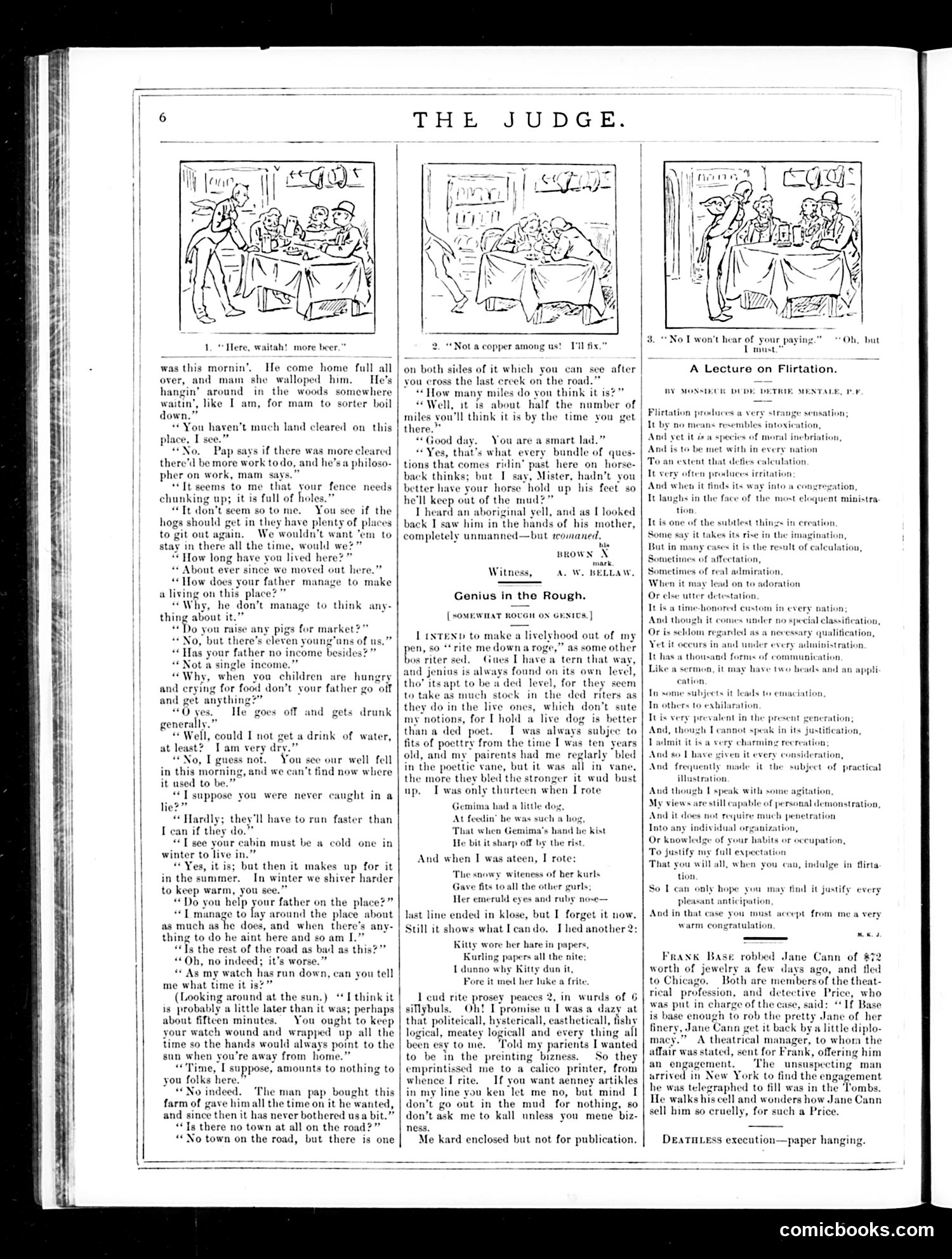
This page contains three separate humorous sketches satirizing rural American life and attitudes circa the late 19th century. **The three cartoon panels** depict conversations between a traveling gentleman and rural farmers, mocking their ignorance, poverty, and crude manners. The jokes center on the farmers' lack of education (confusing time-telling with sun position), primitive living conditions (collapsed wells, mud roads), and indifference to basic civilization. The implicit satire targets rural backwardness and the stark divide between urban sophistication and agrarian ignorance. **"Genius in the Rough"** is a comic narrative poem about an aspiring writer of humble origins whose poetic attempts are hilariously bad. The humor derives from misspellings ("rite," "poct," "ded") and overwrought, clumsy verse, satirizing pretentious amateur poets and the romantic notions of "natural talent" transcending education. Both sections mock rural/working-class Americans with the condescension typical of Judge's educated, urban readership.
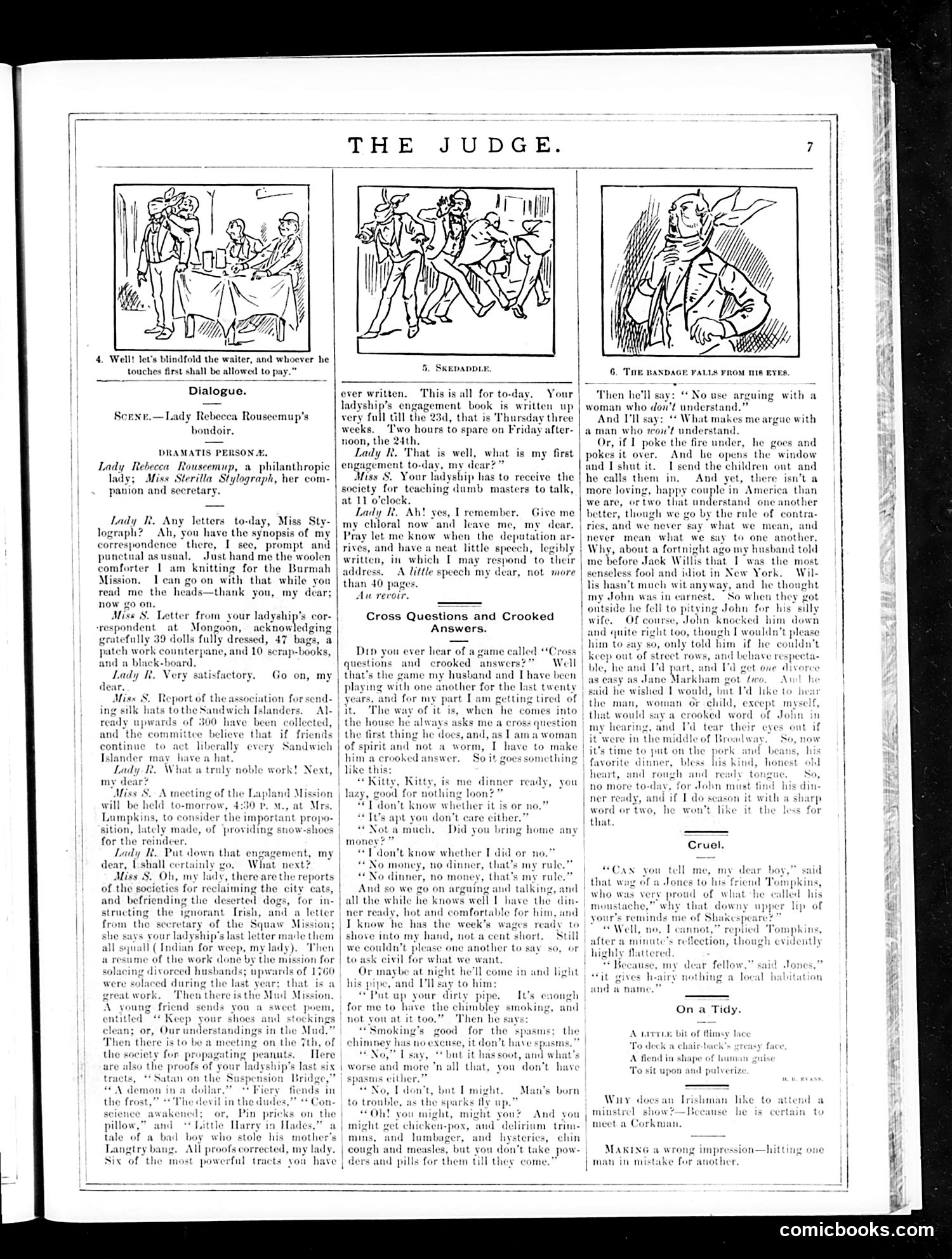
This page from *Judge* magazine contains three satirical pieces mocking Victorian philanthropic excess and domestic discord. **Cartoons 4-6** ridicule upper-class charity obsession through "Lady Rebecca Rouseemup," a wealthy philanthropist so consumed with charitable causes (helping Burmese missionaries, clothing Pacific Islanders, providing reindeer for the needy) that she has almost no free time. The satire suggests such charitable work was performative and excessive—a status symbol rather than genuine compassion. **"Cross Questions and Crooked Answers"** depicts a working-class couple's combative marriage, where the husband constantly baits his wife with hostile questions ("Kitty, is dinner ready, you lazy loon?") and she responds with deliberately evasive answers. The piece mocks both spouses' passive-aggressive communication and mutual resentment disguised as game-playing. The overall message: whether wealthy do-gooders or poor couples, Victorian society features dishonest, self-serving behavior masked by propriety.
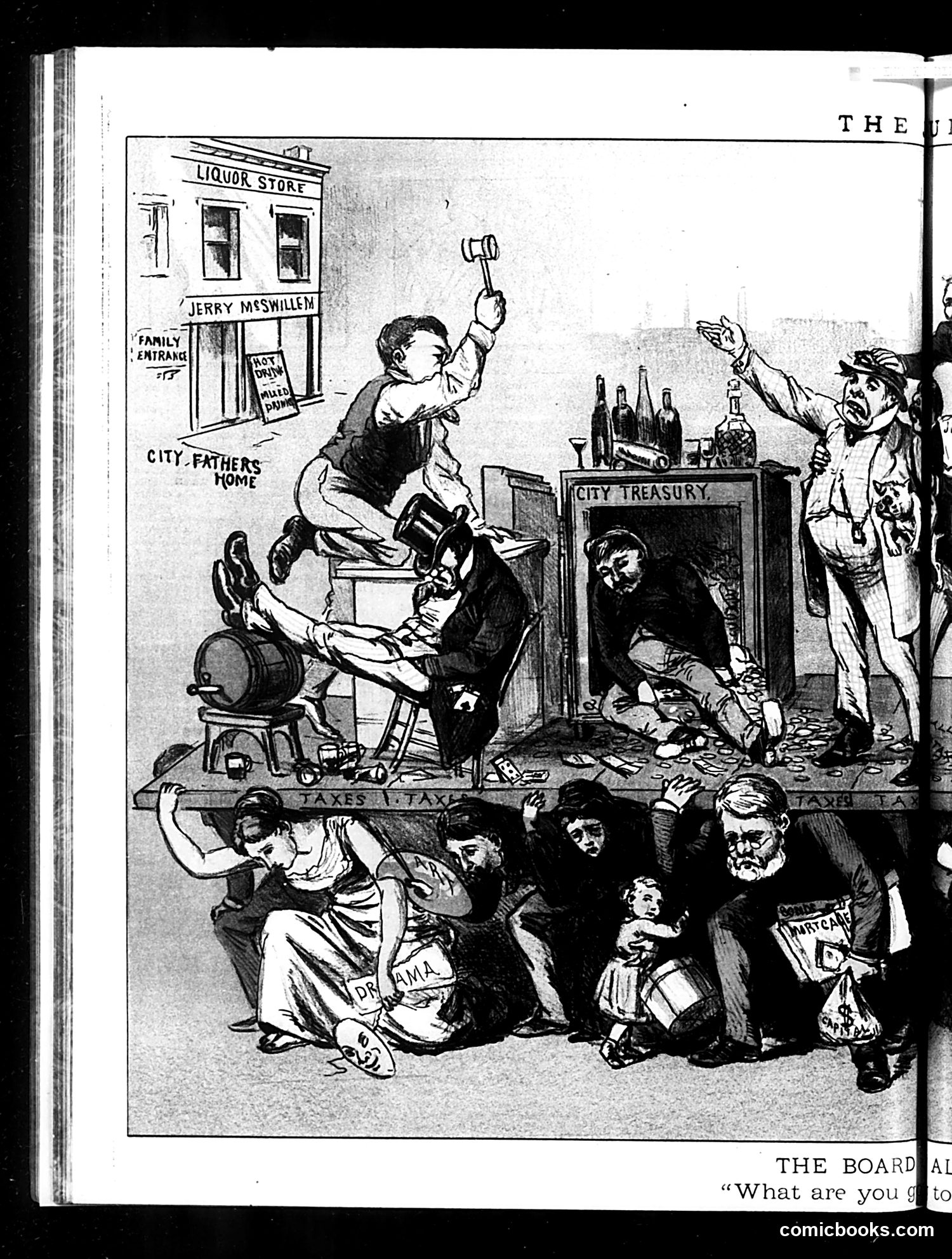
This satirical illustration depicts corruption in municipal government, specifically targeting misuse of public funds. The central scene shows: **Key Elements:** - A "City Treasury" building with bottles (suggesting drinking/vice) visible inside - A figure using a hammer labeled "TAXES" on what appears to be a seesaw or lever - "City Fathers Home" liquor store referenced on the left - Poor/working-class figures (bottom) bearing the weight, literally crushed beneath the apparatus - Well-dressed officials (right) appearing to control the system **The Satire:** The cartoon criticizes how city officials use taxpayer money for personal enrichment and corruption rather than public benefit. The working poor bear the actual burden of taxation while city leaders profit. The lever mechanism suggests systemic exploitation—the tax burden functions as a tool enriching corrupt officials. The visible alcohol references suggest both graft and moral degeneracy among city government.
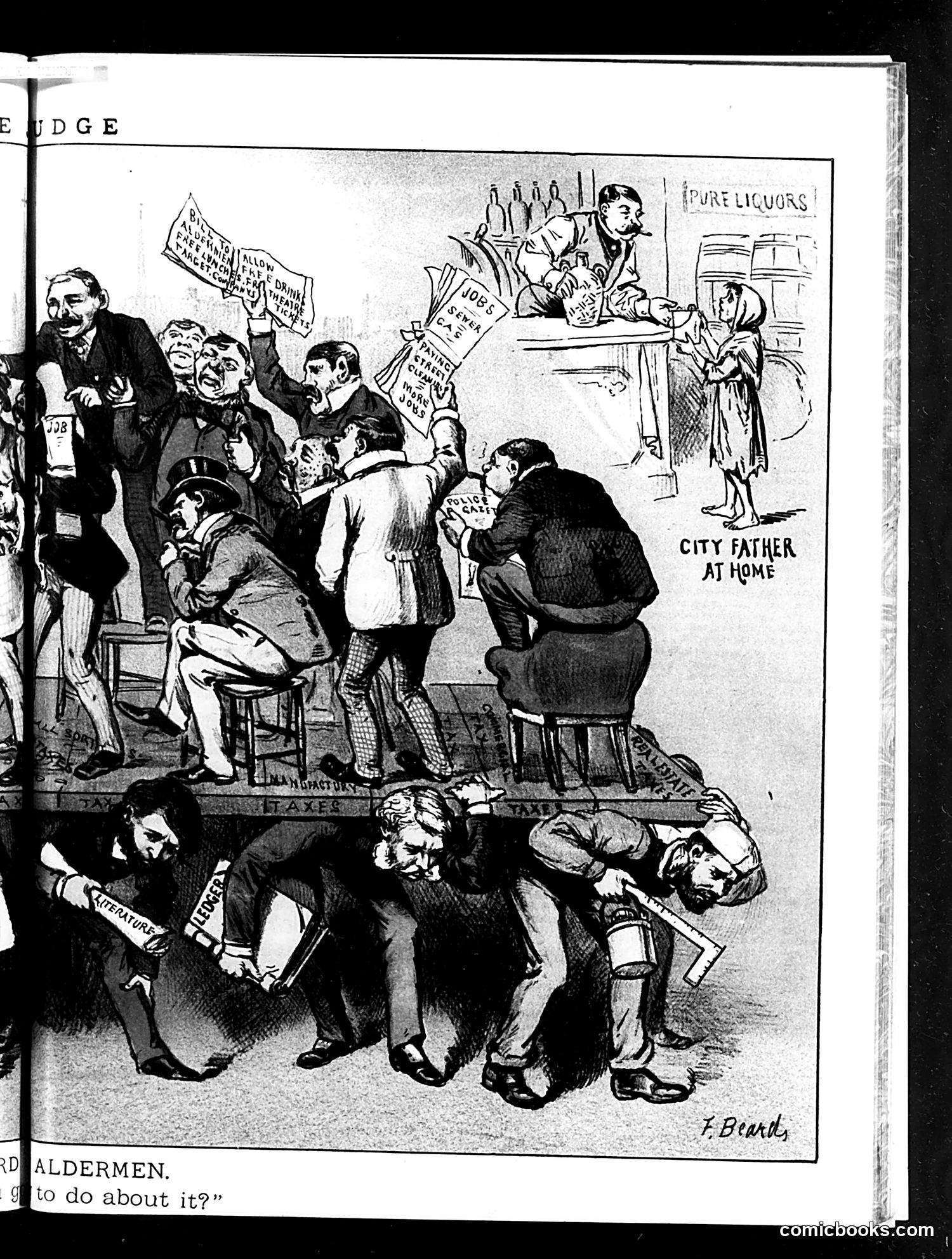
This political cartoon satirizes the hypocrisy of municipal officials ("aldermen") regarding alcohol regulation. The upper scene shows a "city father" at home, comfortably serving "pure liquors" to guests, while shelves of bottles line his wall. The lower scene depicts the same officials presumably debating what "to do about it"—apparently referring to public drinking or alcohol sales they publicly condemn. The satire targets the double standard: city leaders privately enjoy alcohol while publicly deciding policy (likely Prohibition-era regulation). Signs visible in the gathering reference liquor commerce. The contrast between the respectable home setting and their official stances exposes moral inconsistency—a classic Judge magazine critique of municipal corruption and elite hypocrisy during debates over alcohol control.
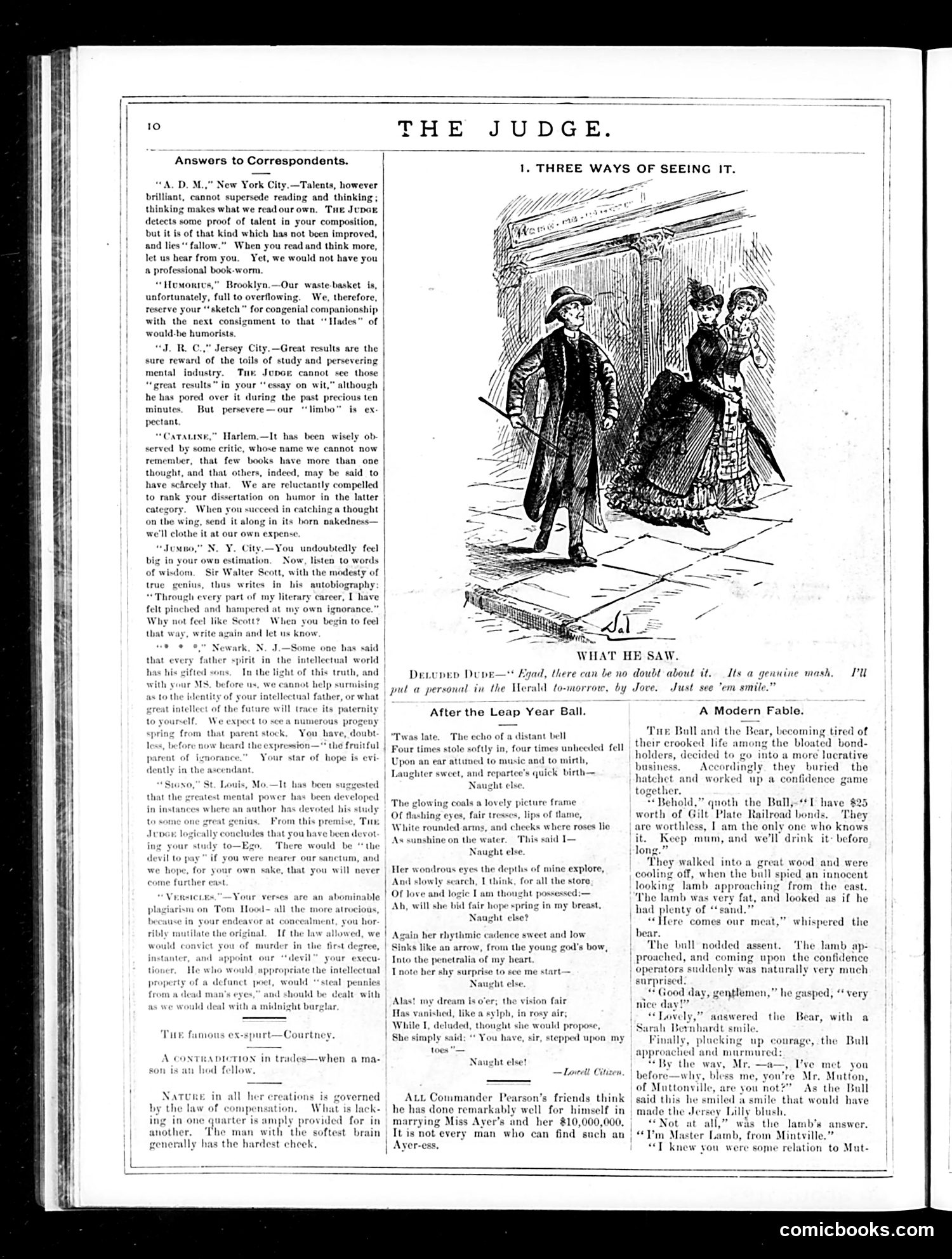
This page from *Judge* magazine contains two main elements: **"Three Ways of Seeing It" (top cartoon):** The illustration shows two men examining something from different angles or perspectives—likely a satirical commentary on how observation or interpretation varies based on viewpoint. The specific subject they're observing isn't entirely clear from the image alone, but the title suggests the cartoon's point: the same object or situation can appear different depending on one's perspective. **"Answers to Correspondents" (left column):** This section mocks aspiring writers and poets who submitted work to the magazine. *Judge* editorial voice dismisses their submissions as mediocre or derivative, offering patronizing advice to improve. References to a "waste basket" and "Hades of would-be humorists" suggest widespread rejection of amateur contributions. **Literary content (right side):** Poetry and prose pieces fill remaining space, including "After the Leap Year Ball" (romantic verse) and "A Modern Fable" (a brief story about a bull and bear). The page exemplifies *Judge's* satirical editorial stance toward amateur creativity while maintaining its mix of humor, social commentary, and literary content.
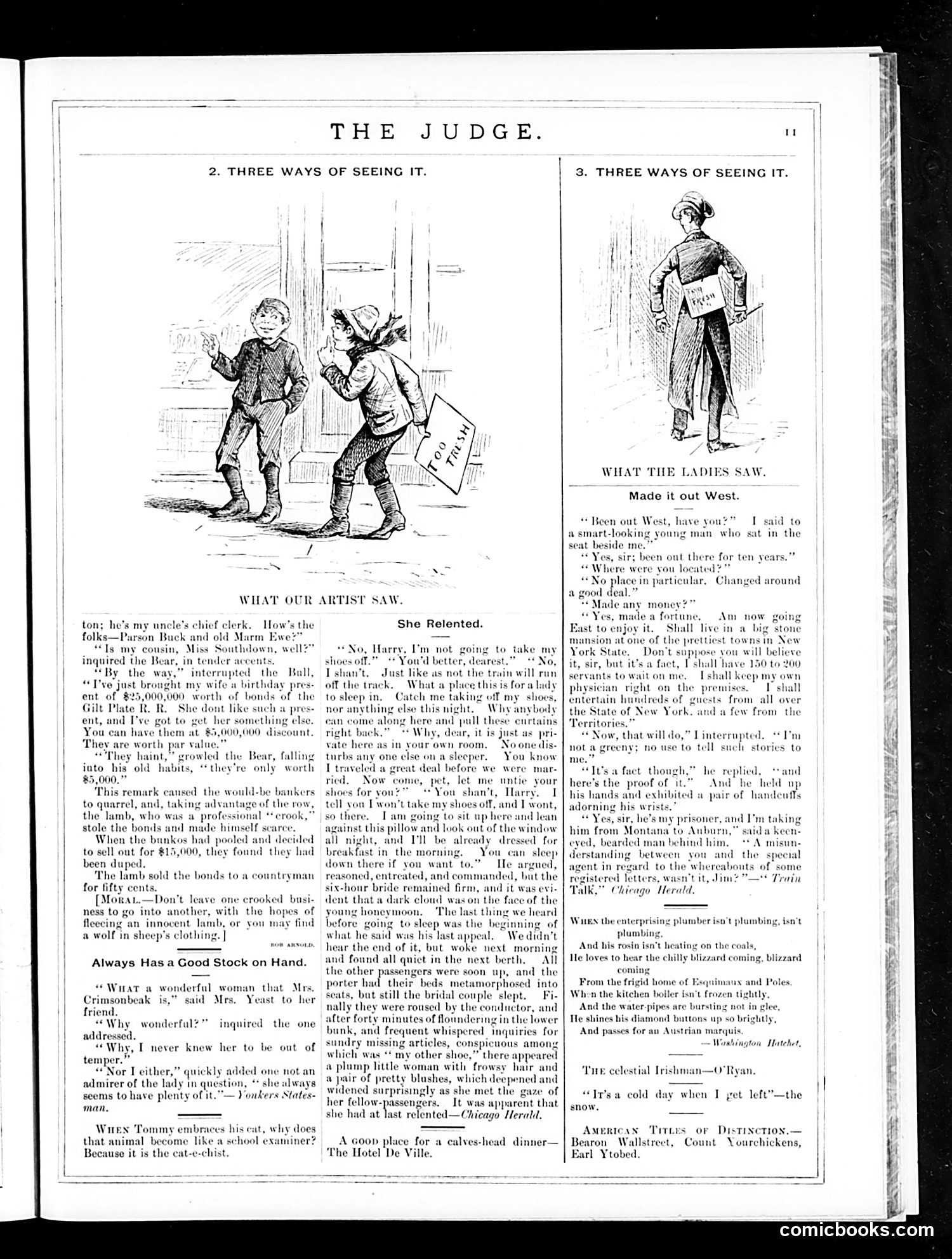
This page presents three separate satirical sketches about deception and perspective. **Section 2 ("What Our Artist Saw")** depicts a financial swindle: a bull and bear discuss bonds; a lamb becomes involved in a scheme to defraud him. The moral—don't abandon honest work hoping to fleece the innocent, or you'll meet a "wolf in sheep's clothing"—warns against get-rich-quick schemes common in the Gilded Age. **Section 3 ("What the Ladies Saw")** shows a woman who claims to have "made it out West" living luxuriously. The twist: she's actually a prisoner being escorted by a guard, revealing her entire prosperous story is fiction. The joke exposes both unreliable Western success narratives and women's gullibility. The page's title suggests how the same events appear differently depending on who observes them—a commentary on deception, credibility, and the gap between appearance and reality in late-19th-century American life.
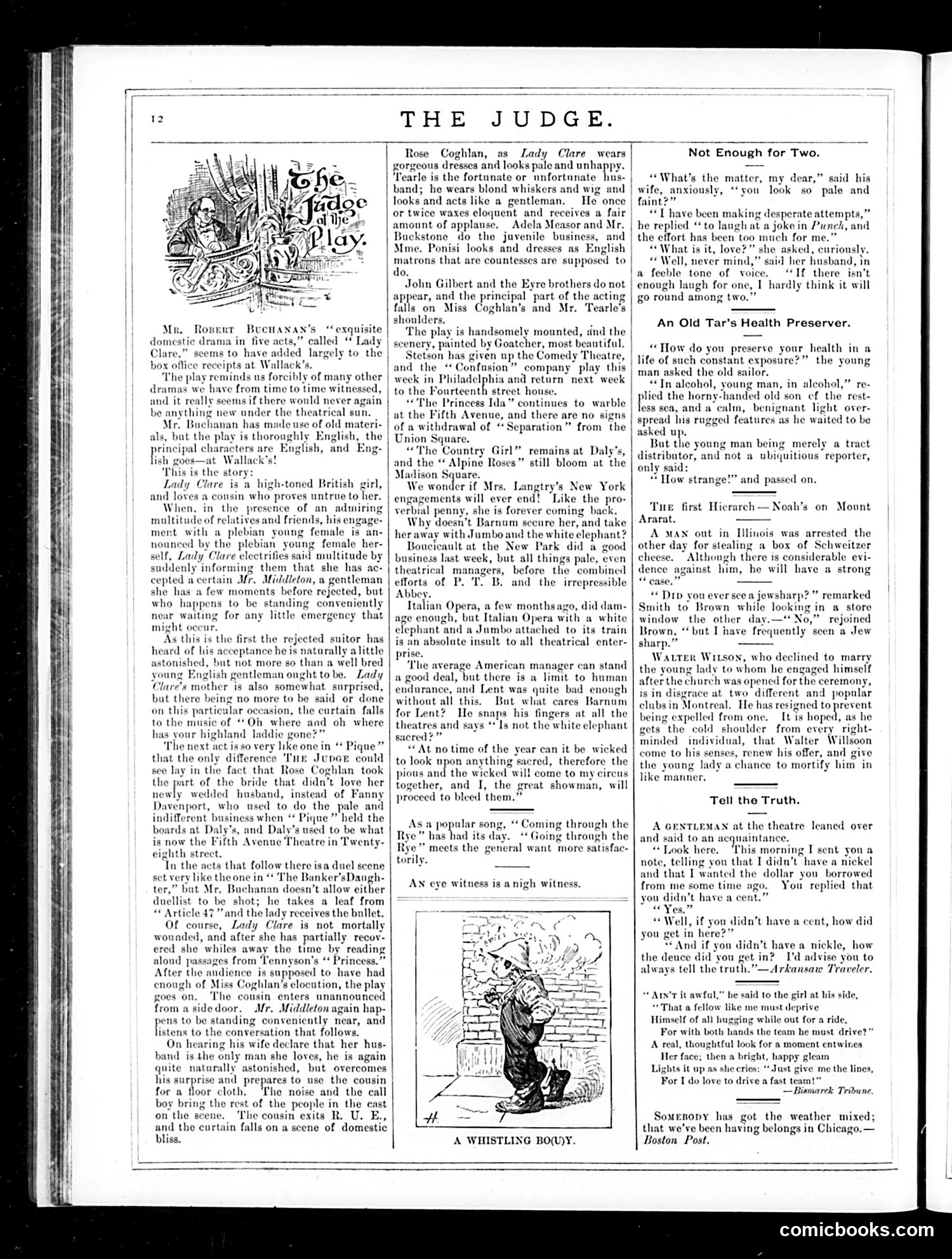
This page from *Judge* magazine primarily reviews theatrical productions rather than presenting political satire. The main content discusses Robert Buchanan's play "Lady Clare" at Wallack's Theatre—a domestic drama about a British aristocrat who impulsively accepts a gentleman's marriage proposal after her cousin proves unfaithful. The reviewer critiques the play as derivative, comparing it unfavorably to earlier works like "Pique" and "The Banker's Daughter." The plot follows a predictable Victorian formula: Lady Clare marries Middleton, complications arise, and domestic bliss is restored after a duel. The page includes one cartoon titled "A Whistling Boudy" (bottom), which appears to illustrate an anecdote about a man whistling, though the specific joke is unclear without additional context. The remaining content consists of brief theatrical notices and humorous miscellaneous items unrelated to the main review—typical filler content for entertainment magazines of this era.
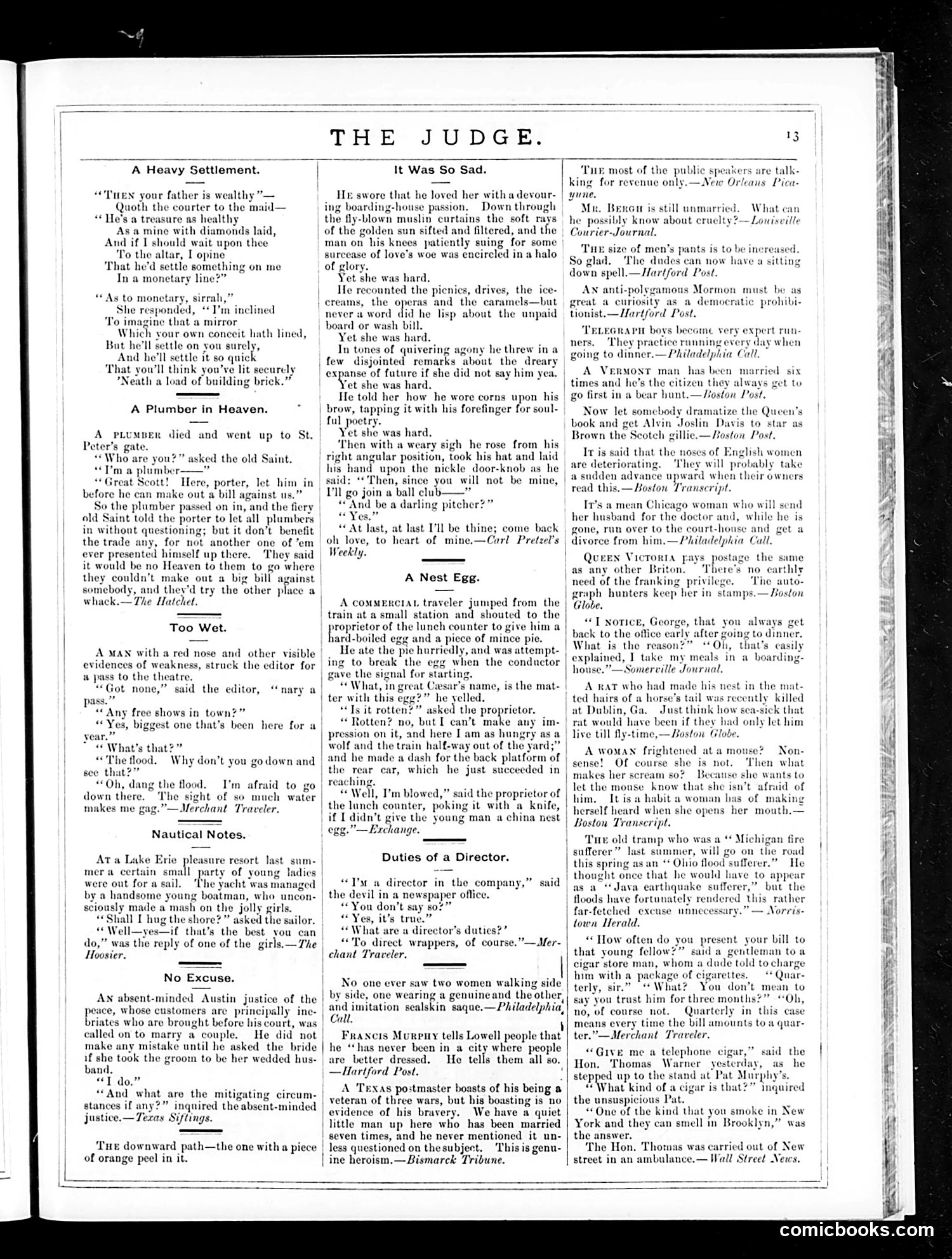
This page from **Judge** magazine (a 19th-century American satirical publication) contains multiple brief humorous sketches mocking contemporary social types: **"A Plumber in Heaven"** jokes that plumbers are so devoted to billing customers that even paradise would disappoint them—they'd refuse entry to avoid losing their primary pleasure of charging inflated fees. The satire targets the plumbing trade's reputation for overcharging. **"Too Wet"** mocks a flood victim seeking free theater tickets, and an editor's dismissive response that watching the actual disaster is better entertainment. **"A Heavy Settlement"** presents a fortune-hunter asking a wealthy father for a monetary dowry, receiving a sharp rebuke about "settling" in bricks instead. Other sketches satirize various professions and behaviors: an absentminded judge, a boatman's romantic clichés, and a traveler unable to crack a hard-boiled egg. The overarching theme: mockery of lower-class ambition, professional greed, and the gap between romantic pretense and harsh reality. These represent typical Judge humor—cynical, class-conscious social commentary.
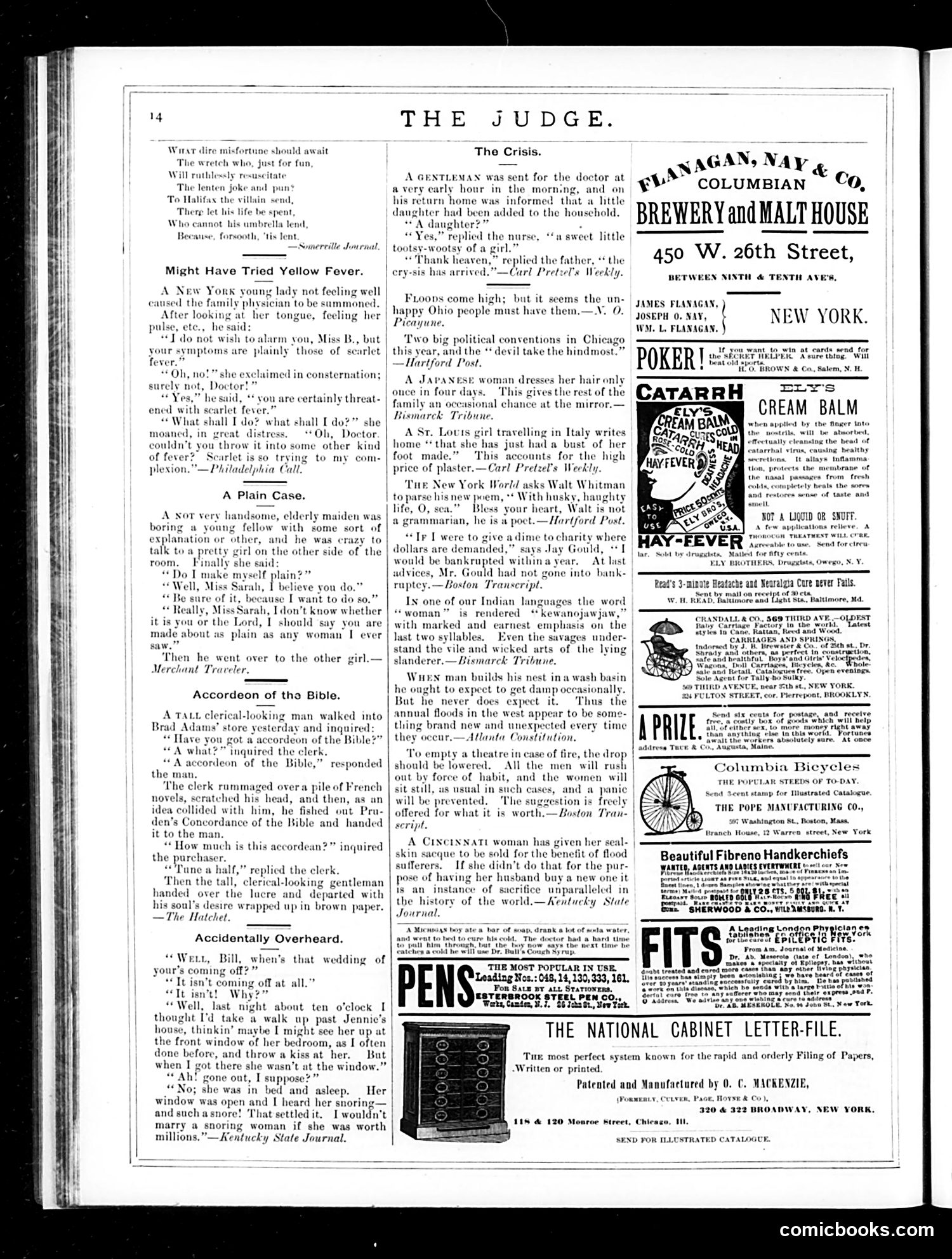
This is primarily a **humor and satire page** from Judge magazine, featuring short jokes and quips rather than political cartoons. The content reflects late 19th-century American sensibilities: **Notable Items:** - **"Might Have Tried Yellow Fever"**: A young woman with scarlet fever asks the doctor to give her a different fever instead because scarlet fever is "trying to my complexion"—satirizing vanity and the triviality of wealthy women's concerns. - **"A Plain Case"**: A play on words where an elderly maiden's plainness (unattractive appearance) is compared to being "plain" (clear/obvious), mocking her lack of romantic prospects. - **"Accordeon of the Bible"**: A verbal mix-up between "accordion" (musical instrument) and "concordance" (biblical index)—a clergymen's confusion joke. - **"Accidentally Overheard"**: Dark humor about a man abandoning wedding plans after hearing his fiancée snore. The page is largely **filler content with advertisements**—typical for 1890s magazines. The humor relies on wordplay, social observation, and gentle mockery of human vanity rather than explicit political commentary.
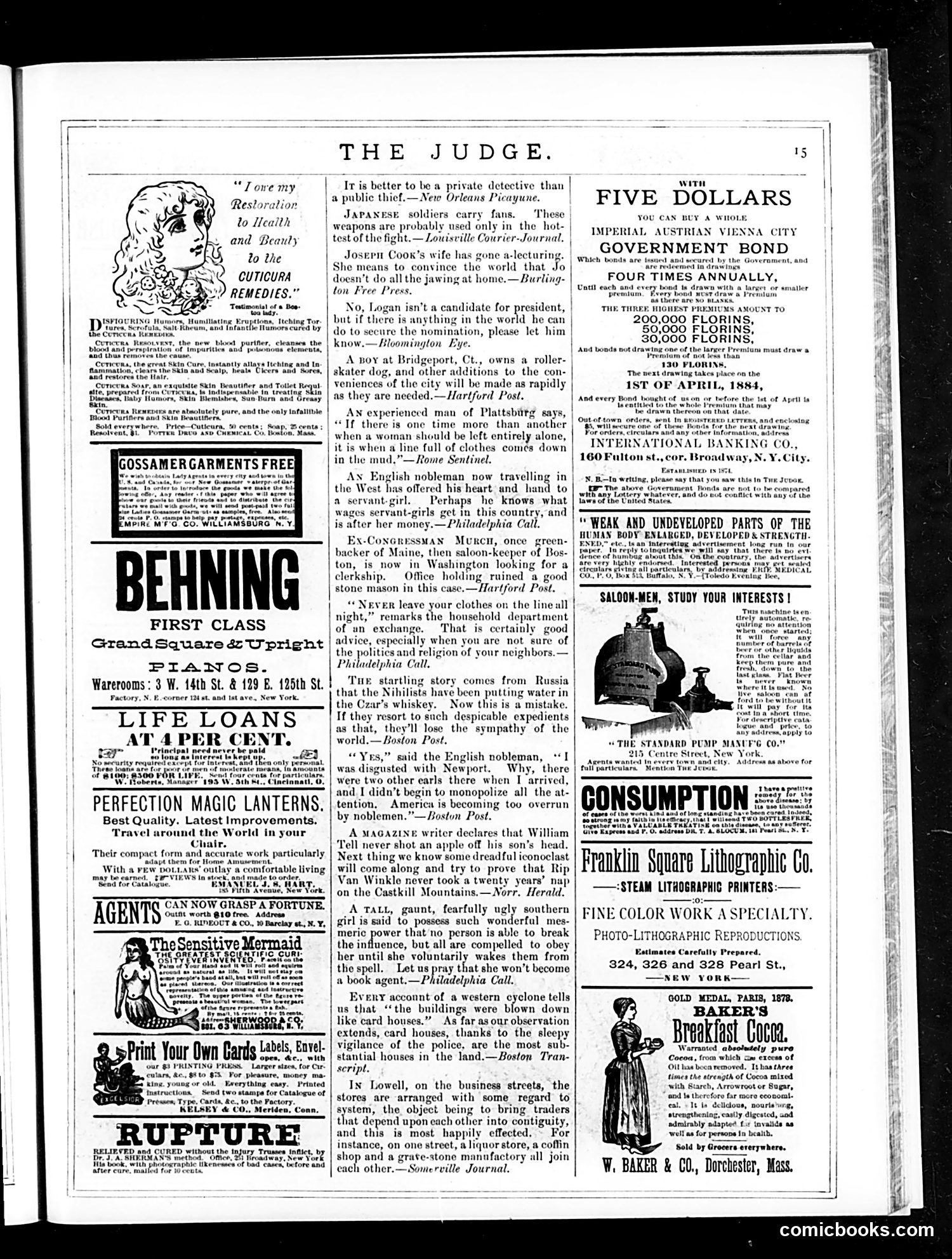
This is primarily an **advertising page** from Judge magazine, with brief satirical comment sections interspersed. The main content consists of period advertisements (Cuticura remedies, Behning pianos, life loans, magic lanterns). The satirical remarks are short, topical quips typical of Judge's format: - Jokes about **Joseph Cook's wife lecturing** (domestic nagging humor) - A candidate refusing nomination (unclear who "Lo" is) - A roller-skating dog in Bridgeport (absurdist humor) - Domestic advice about clotheslines (women's humor) - A **visiting English nobleman** seeking romance with servant girls—mocking both European aristocratic pretension and American social climbing - **Congressman Mutch**, apparently a former mason turned politician, implying office corrupts working men - Skepticism about Russian whiskey quality and European nobility flooding America - A "southern girl with mesmerism" who shouldn't become a book agent These are light, disconnected satirical observations rather than sustained political cartoons—typical filler humor reflecting period anxieties about immigration, social climbing, and gender roles.
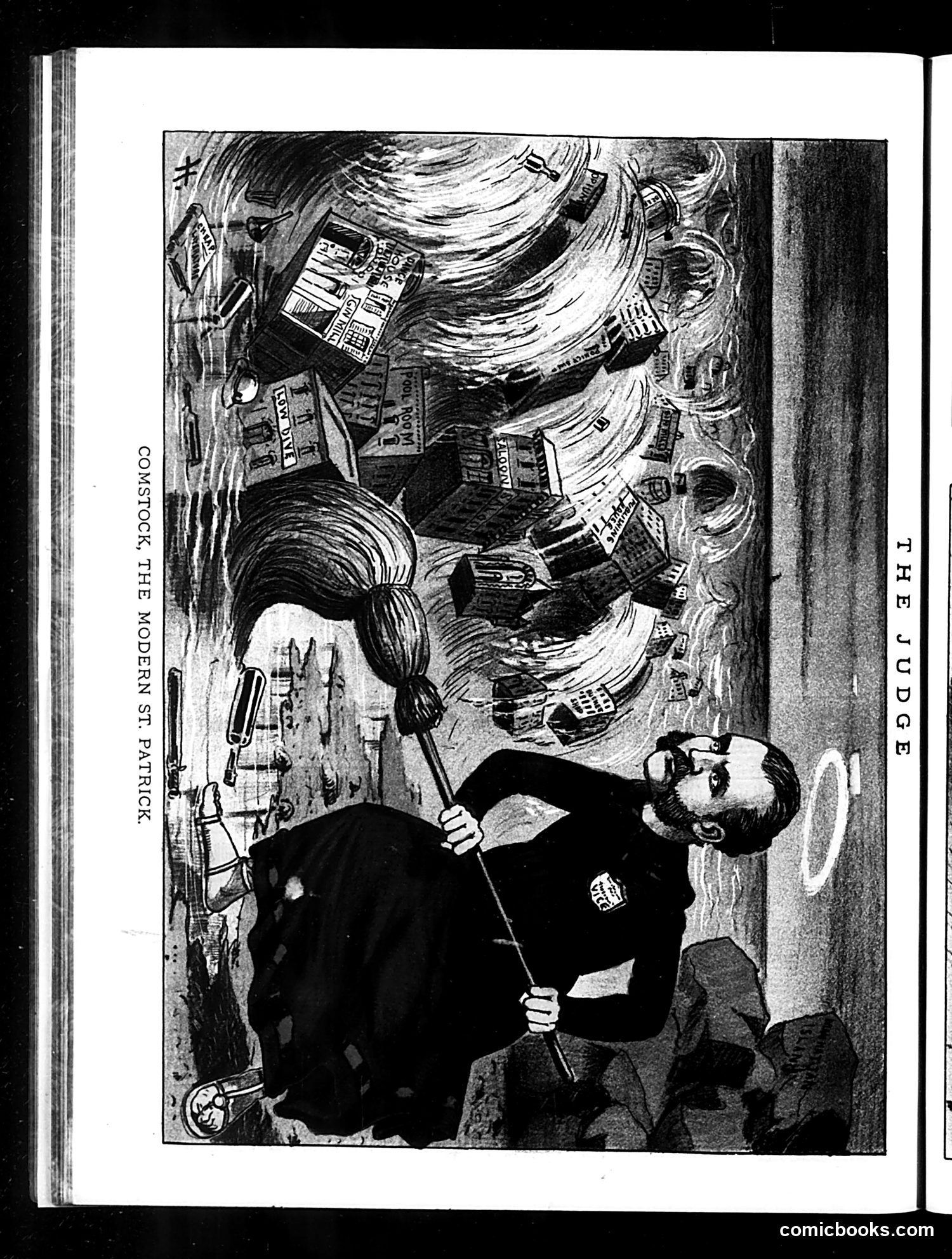
This political cartoon satirizes Anthony Comstock, the anti-vice activist who led the New York Society for the Suppression of Vice. The image depicts him as "St. Patrick" driving out snakes—but here the "snakes" are actually books, publications, and other materials he sought to censor or ban. The cartoon mocks Comstock's aggressive censorship campaigns by comparing his crusade to the legendary saint's expulsion of serpents from Ireland. The artist suggests Comstock viewed himself as a moral purifier, while critics saw him as an overzealous censor who banned legitimate literature and art. This reflects contemporary debate over Comstock's broad interpretation of obscenity laws, which many felt suppressed free speech and cultural expression beyond genuinely harmful material.