
Judge, 1884-03-15 · page 12 of 16
Judge — March 15, 1884 — page 12: what you’re looking at
What you’re looking at
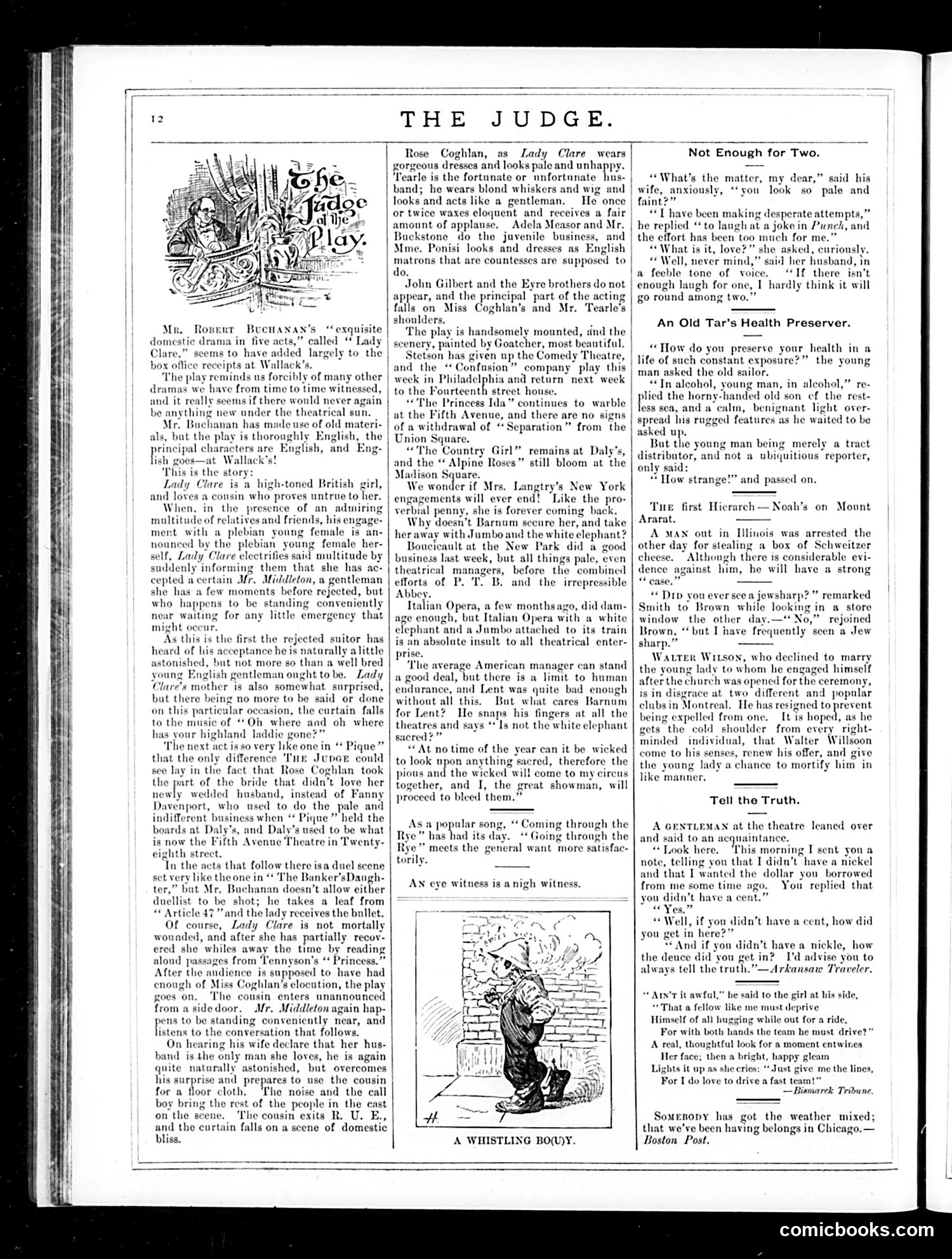
This page from *Judge* magazine primarily reviews theatrical productions rather than presenting political satire. The main content discusses Robert Buchanan's play "Lady Clare" at Wallack's Theatre—a domestic drama about a British aristocrat who impulsively accepts a gentleman's marriage proposal after her cousin proves unfaithful. The reviewer critiques the play as derivative, comparing it unfavorably to earlier works like "Pique" and "The Banker's Daughter." The plot follows a predictable Victorian formula: Lady Clare marries Middleton, complications arise, and domestic bliss is restored after a duel. The page includes one cartoon titled "A Whistling Boudy" (bottom), which appears to illustrate an anecdote about a man whistling, though the specific joke is unclear without additional context. The remaining content consists of brief theatrical notices and humorous miscellaneous items unrelated to the main review—typical filler content for entertainment magazines of this era.
📄 Transcribed text from this page (OCR, searchable)
Machine-transcribed from the original scan — historical spelling and the odd misread are preserved.
THE JUDGE. BUCHANAN’S “exquisite domestic drama in five acts,” called “ Lady Clare,” seems to have box ollice receipts at Wallack’s. ‘The play reminds us forcibly of many other dramas we have from time to time witnessed, und it really seems if there would never again be anything new under the theatrical sun. Mr. Buchanan has made use of old materi- als, but the play is thoroughly English, the principal characters are English, and —at Wallack’: ‘This is the story Lady Clare is a high-toned British girl, and loves a cousin who proves untrue to her, When, in the presence of an admiring multitude of relatives and friends, his engage- ment with a plebian young female is an- nounced by the plebian young female hei self, Lady Clare electrities said multitude by suddenly informing them that she has ac- cepted ertain Mr. Middleton, a gentleman she has a few moments before rejected, but who happens to be standing conveniently near waiting for any little emergency that might occur. As this is the first the rejected suitor has heard of his acceptance he is naturally alittle stonished, but not more so than a well bred vung English gentleman ought tobe. Lady Clare's mother is also somewhat. surprised, but there being no more to be said or done on this particular occasion, the curtain falls to the music of ‘Oh where and oh where your highland laddie gone?” The next act is so very like one in “ Pique” that the only differen Jupee could the part of the bride that didn’t love her newly wedded husband, instead of Fanny Davenport, who used to do the pale and indifferent business when ‘ Pique ” held the boards at Daly's, and Daly’s used to be what is now the Fifth Avenue Theatre in Twenty- eighth str In the acts that follow there is set very like the one in “ The Bank ter,” but Mr, Buchanan doesn’t duellist to be she “ Article 47”and the Of course, Lad wounded, and ered she whiles a aloud pa es from ‘Tennyson's ‘ Princess, After the audience is supposed to have had enough of Miss Coghlan’s elocution, the play goes on. ‘The cousin enters unannounced from a sidedoor. Mr. Middleton i pens to be standing conveniently ne: listens to the conversation that follows. duel scene ’sDaugh- Mow either leaf from receives the bullet. the time by reading On hearing his wife declare that her hus- | band is the on! man she loves, he is again quite naturally stonished, but overcomes hiis surprise and prepares to uso the cousin | for a floor cloth. ‘The noise and the call boy bring the rest of the people in the cast on the scene. ‘The cousin exits R. U. E., and the curtain falls on a scene of domestic bliss. dided largely to the | | | | Mme. Pi Rose Coghlan, as Lady Clare wears ‘ous dresses and looks pale and unhappy. ‘Tearle is the fortunate or unfortunate hus- band; he wears blond whiskers and wig looks and acts like a gentleman. He once or twice waxes eloquent and receives a fair amount of appla Adela Measor and Mr. Buckstone do the juvenile i nisi looks and dre: matrons that are count do. John Gilbert and the Eyre brother appear, and the prince’ part of the falls on Miss Coghlan’s and Mr. 1 shoulde: The play is handsomely mounted scenery, painted by Goatcher, most t Stetson has given up the Comed nd the “Confusion” company” play week in Philadelphia and return’ next’ week to the Fourteenth street house, “The Princess Ida” continues to warble ut the Fifth Avenue, and there are no signs of a withdrawal of “Separation” from the Union Square. “The Country Girl” remains at Daly’s, and the ‘ Alpine Roses” still bloom at the Madison Square. We wonder if Mrs. Langtry’s New York engagements will ever end! “Like the pro- verbial penny, she is forever coming back Why doesn’t Barnum secure her, and tak her away with Jumbo and the white elephant? Boucicault at the New Park did a good business last week, but all things pale, even before the combined B. and the irrepressible theatrical managers, efforts of P. T. n Opera, a few monthsago, did dam- age enough, but Italian Opera with a white pphant and a Jumbo attached to its train in absolute insult to all theatrical enter- prise. ‘The average American manager can stand a good deal, but there 1 limit to human endurance, and Lent was quite bad enough without all this. But what cares Barnum for Lent? He snaps his fingers all the theatres and says “Is not the white elephant sacred?” “At no time of the year can it be wicked to look npon anything sacred, therefore the pious and the wicked wil! come to my cireus together, and I, the great showms will proceed to bleed them.” ning through the ping through the ant more satisfa Asi popular song Rye” has had it Rye” meets the | torily. A WHISTLING BO(U)Y. sare supposed to | Not Enough for Two. “What's the matter, my dear,” said his and | wife, anxiously, ‘yon look so” pale and faint?” “T have been making desperate attempts,” he replied “to laugh at a joke in Punch, and the effort has been te h for me.” What is it, love? ked, curiously. “Well, never mind 1 her husband, in a feeble tone of voi “If there isn’t enough laugh for one, I hardly think it will go round among two.” An Old Tar’s Health Preserver. “Tow do you preserve your health in a life of such constant exposire?” the young man asked the old sailor. **In alcohol, young man, in alcohol,” re- plied the horny-handed old son cf the rest- jess sea, and a calm, benignant light over- spread his rugged features as he waited to be | asked up. But the young man being mere| distributor, and not a ubiquitio only said: “ How strang nd a tract reporter, don. first Hicrarch —Noah’s on Mount Ararat. A MAN out in Illinois was arrested the other day for stealing a box of Schweitzer cheese. “Although there is considerable evi- dence against him, he will have a strong Dip you ever see a jewsharp? ” remarked Smith to Brown while looking in a store window the other day.—‘ No,” rejoined Brown, “but Ihave frequently ‘seen a Jew sharp.” Waren Witso, who declined to marry the young lady to whom he engaged himself after the church was opened for the ceremony, is in disgrace at two different and popular clubs in Montreal. He ned to prevent being expelled from one. It is oped ae he gets the cold shoulder from every right- minded individual, that Walter Willsoon come to his senses, renew his offer, and give the young lady a chance to mortify him in Tell the Truth. NTLEMAN at the theatre leaned over and said to quaintanct “Look here. ‘This morning I sent you a note, telling you that I didn’t have a nickel and that I wanted the dollar you borrowed from me some time You replied that you didn’t have ac “Yer “Well, if you didn’t have a cent, how did you get in here?” 1y’r it awful,” he said to the girl at his side, That a fellow like me must deprive Himself of all hugging while out for a ride, For with both hands the team he must drive?” A real, thoughtful look for a moment entwines Her face; then a bright, happy gleam Lights Just give me the lines, For I do love to drive a fast team!” — Bismarck Tribune. up as she cries: Somenopy has got the weather mixed; that we've been having belongs in Chicago.— Boston Post. comicbooks.com