
Judge, 1884-03-15 · page 2 of 16
Judge — March 15, 1884 — page 2: what you’re looking at
What you’re looking at
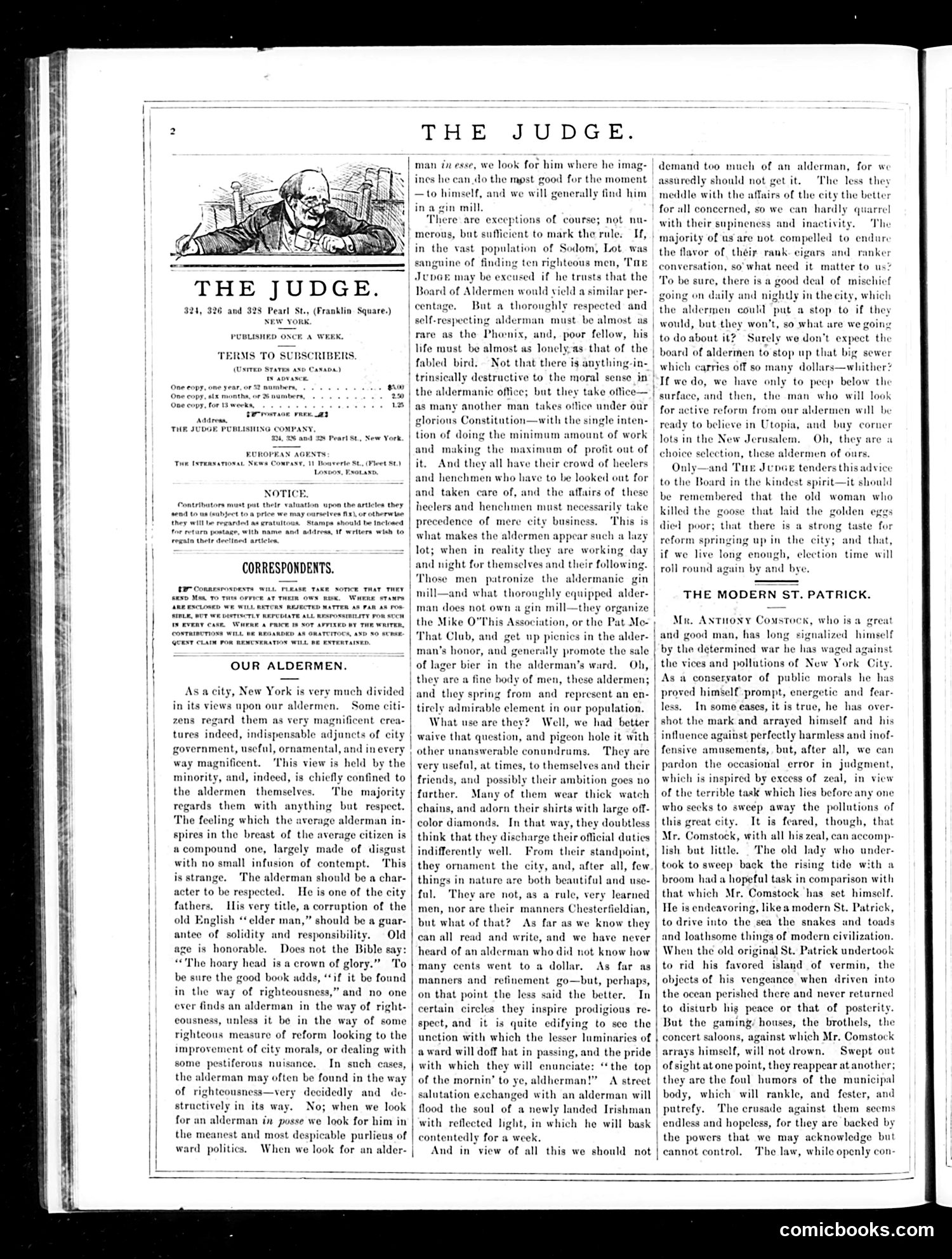
This editorial page attacks New York City aldermen as corrupt and self-serving. The text sarcastically contrasts the honorable etymology of "alderman" (from "elder man") with their actual behavior—depicted as motivated solely by personal profit and ward politics patronage. The author argues aldermen use their office minimally while extracting maximum personal gain, surrounding themselves with "heelers" (political operatives) who must be financially supported. The piece mocks their façade of community service through organizations like the "Mike O'This Association" or social clubs, which primarily promote alcohol sales benefiting their constituents' financial interests. The piece suggests corruption is systemic: aldermen frequent gin mills and operate within networks of mutual obligation to ward operatives rather than serving genuine city interests. The comparison to Biblical Sodom implies moral degeneracy is nearly universal among them.
📄 Transcribed text from this page (OCR, searchable)
Machine-transcribed from the original scan — historical spelling and the odd misread are preserved.
THE JUDGE. — 324, 326 and $28 Pearl St., (Franklin Square.) NEW YORK, PUBLISHED ONCE A WEEK. MS TO SUBS (strep Staves RIBERS. 1S ADVASCE, numbers, for Sweeky gerrosral reread Addrens, TUR JUDGE, PUBLISHING COMPANY A, KB and ZN Peart St, New York. OVEAN AGENTS Tue Eereasarioss a4, 11 Hoaverte St. (Pleet St.) NOTIC st put thetr valuation upon the articles they 8 price we may ourselves fi, of otherwise Stampa ahould be Incloaed Af writers wish Contributors send to they will regain the CORRESPONDENTS. FP-ConnesrospesTs with PLEASE TAKE XonICE THAT esp Max ro Tatts w Ln, WOT Wwe DE t RVERY Case. APYIXED RY THE WRITER, quest c1 FOR REMUNERATION WILL RE ENTERT OUR ALDERMEN. Asa city, New York is very much divided in its views upon our aldermen. Some citi- rd them as very magnificent crea tures indeed, indispensable adjuncts of city government, useful, ornamental, and in eve way magnificent. ‘This view is held by the minority, and, indeed, is chiefly confined to the aldermen themselves. ‘The majority regards them with anything but respect. The feeling which the average alderman in- spires in the breast of the average citizen is acompound one, largely made of disgust with no small infusion of contempt. This is strange. The alderman should be a char- acter to be respected. He is one of the city fathers, His very title, a corruption of the old English “elder man,” should be a guar- antee of solidity and responsibility. Old age is honorable. Does not the Bible say: The hoary head is a crown of glory.” To be sure the good book adds, ‘if it be found in the way of righteousness,” and no one ever finds an alderman in the way of right- eousness, unless it be in the way of some righteous measure of reform looking to the improvement of city morals, or dealing with some pestiferous nuisance. the alderman may often be found in the of righteousness—very decidedly and de- structively in its way. No; when we look for an alderman in posse we look for him in the meanest and most despicable purlieus of ward politics. When we look for an alder: In such cases, THE JUDGE. man inesse, we look for him where he imag- ines he can.do the mpst good for the moment —to himself, and we will generally find him ina gin mill. There are exceptions of course; not nu- merous, but sufficient to mark the rule. If, in the vast population of Sodom, Lot was nguine of finding ten righteous men, Ta Jupor may be dif he trusts that the Board of Aldermen would vield a similar per- centage. But a thoroughly respected and self-respecting alderman must. be almost as. rare as the Phonix, and, poor fellow, his life must be almost as lonclyas that of the fa bird. Not that there is anything-in- trinsically destructive to the moral sense in the aldermanic office; but they take office— as many another man takes otfice under our glorious Constitution—with the single inten- | tion of doing the minimum amount of work and making the maximum of profit out of it. And they all have their crowd of heelers and henchmen who have to be looked out for and taken care of, and the affairs of these heelers and henchmen must necessarily take precedence of mere city business, ‘This is what makes the aldermen appear such y lot; when in reality they are working day and night for themselves and their following. mill—and what thorough man does not own a gin mill—they org the Mike O’This Association, or the Pat Me- ‘That Club, and get up picnics in the alder- man’s honor, and generally promote the sale of lager bier in the alderman’s ward. Oh, they are a fine body of men, these aldermen; and they tirely admirable element in our population. What use are they? Well, we had better waive that question, and pigeon hole it with other unanswerable conundrums. ‘They are very useful, at times, to themselves and their | friends, and possibly their ambition goes no further. Many of them wear thick watch chains, and adorn their shirts with large off- | color diamonds, In that way, they doubtless equipped alder- nize | | | | indifferently well. From their standpoint, they ornament the city, and, after all, few things in nature are both beautiful and use- ful. They are not, as a rule, very learned men, nor are their manners Chesterfieldian, but what of that? As far as we know they heard of an alderman who did not know how many cents went to a dollar, As far as manners and refinement go—but, perhaps, on that point the less said the better. In certain circles they inspire prodigious re- spect, and it is quite edifying to sce the unction with which the lesser luminaries of award will doff hat in passing, and the pride with which they will cnunciate: ‘the top of the mornin’ to ye, aldherman!” A street salutation exchanged with an alderman will flood the soul of a | with reflected light, in which he will bask contentedly for a week. And in view of all this we should not pring from and represent an en- | | think that they discharge their official duties | can all read and write, and we have never | | would, but they won't, so what hf we do, we |‘Those men patronize the aldermanic gin | | by the determined war he has w newly landed Irishman | demand too much of an alderman, for we assuredly should not get it. The less they meddle with the affairs of the city the better for all concerned, so we can hardly quarrel with their supineness and inactivity. ‘The majority of us are not compelled to endure the flavor of their rank. eigars and ranker o' what need it matter to us? ure, there is a good deal of mischief on daily and nightly in the city, which the aldermen could put a stop to if they conversation, ‘To be goin 2 we goine to do about it? Surely we don't expect the board of aldermen to stop up that big sewer which carries off so many dollars—whither? ¢ only to peep below the surface, and then, the man who will look for uctive reform from our ready to believe in lots in the New Jerusalem. Idermen will be and buy corner Oh, they choice selection, these aldermen of ours. Only—and Tue Junge tenders this advice to the Board in the kindest s] that the old that laid the g there is a stron opia it—it should be remembered killed the ge woman who Iden e; taste for up in the city; and that if we live long enough, election time will reform sprin roll round again by and bye. THE MODERN ST. PATRICK. Mu. AxtiHoxy Comstock, who is a gre: nd good man, has long eignalized himself ged against the vices and pollutions of New York City. As a conseryator of public proved himself prompt, energetic and fear- less. In some eases, it is true, he has over- shot the mark and arrayed himself and his wainst perfectly harmless and inof- fensive amusements, but, after all, we can pardon the occasional error in jud which is inspired by excess of zeal, in view of the terrible task which lies before any one sto sweep away the pollutions of this great city. It is feared, though, that Mr. Comstock, with all his zeal, can accomp- lish but little. The old lady who under- took to sweep back the rising tide with a broom had a hopeful task in comparison with that which Mr, Comstock has set himself. He is endeavoring, likea modern St. Patrick, to drive into the sea the snakes und toads and loathsome things of modern civilization. When the old original St. Patrick undertook to rid his favored island of vermin, the objects of his vengeance when driven into the ocean perished there and never returned to disturb hig peace or that of posterity. But the gaming: houses, the brothels, the concert saloons, against which Mr. Comstock arrays himeclf, will not drown, Swept out ofsight at one point, they reappear at another; they are the foul humors of the municipal body, which will rankle, and fester, and putrefy. The crusade against them seems endless and hopeless, for they are backed by morals he h influence gment, who see! | the powers that we may acknowledge but | cannot control. The law, while openly con- comicbooks.com