
A complete issue · 16 pages · 1884
Judge — January 16, 1884
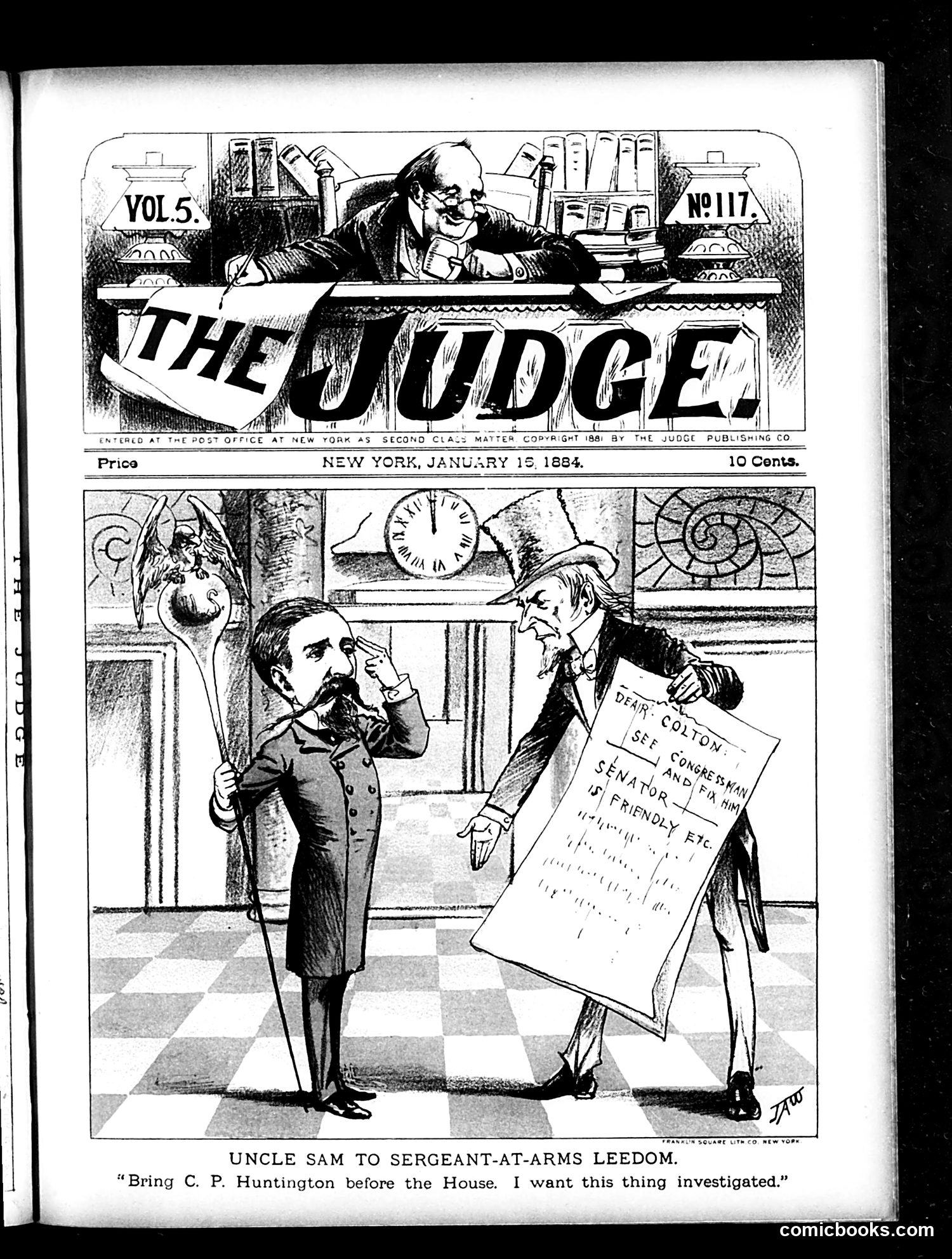
This 1884 Judge cartoon satirizes alleged corruption involving C.P. Huntington, a powerful railroad magnate. Uncle Sam (representing the nation) directs the Sergeant-at-Arms to investigate Huntington before Congress. The cartoon depicts a figure holding a list labeled "DEAR BOLTON / SEE CONGRESSMAN / SENATOR / & FRIENDLY / ETC"—suggesting a network of corrupt political connections and bribery. The implication is that Huntington has purchased influence with multiple politicians through payments or favors. The satire mocks how wealthy industrialists wielded political power in the Gilded Age, buying congressional support. The "friendly" politicians listed appear to be Huntington's accomplices in corruption, making this a critique of the wealthy businessman's brazen manipulation of government.
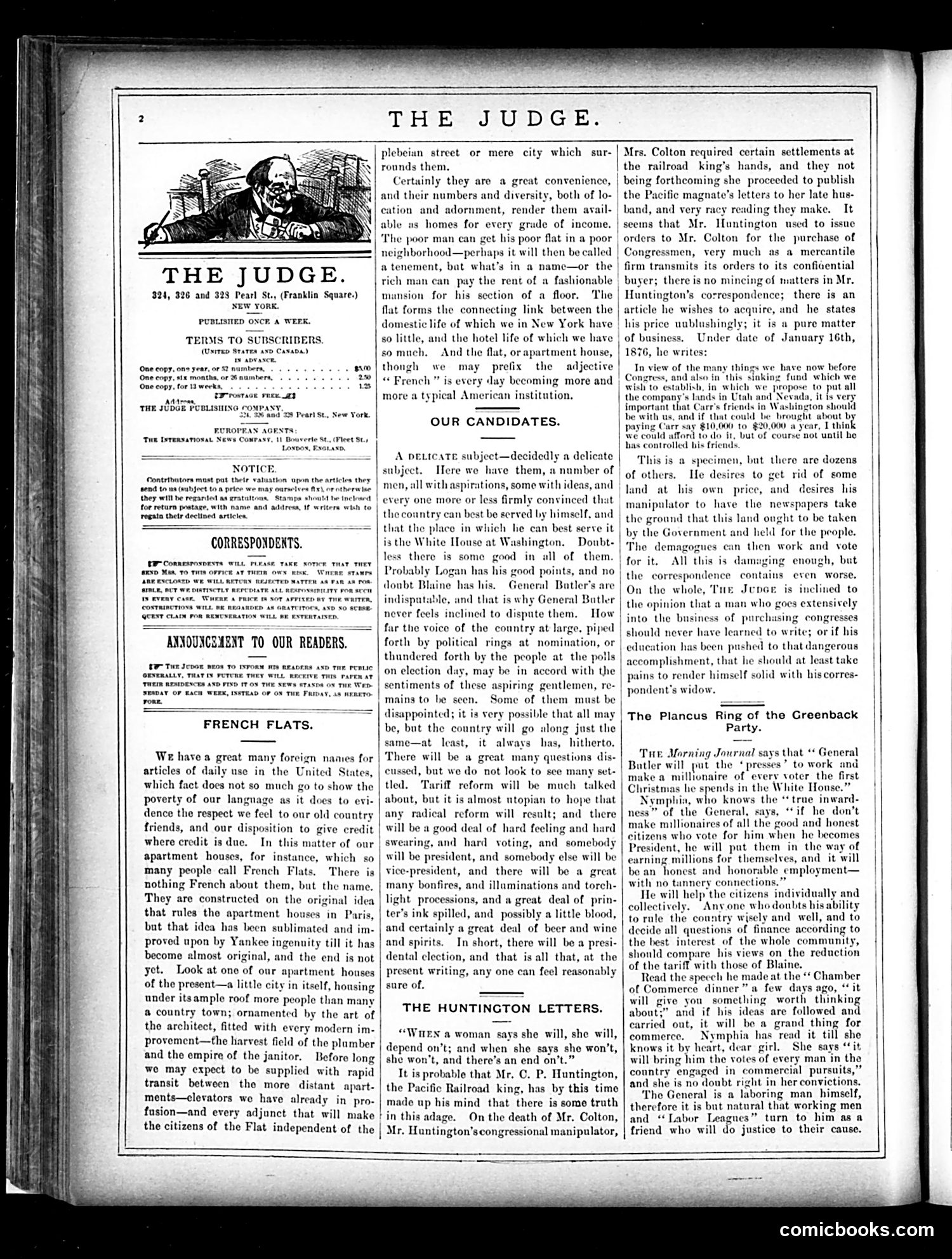
This page from *Judge* magazine contains editorial commentary and announcements rather than political cartoons. The small woodcut illustration at the top depicts a generic caricatured face, likely used as the magazine's masthead. The substantive content includes two main articles: 1. **"French Flats"** — A satirical discussion of apartment buildings, which the author notes are called "French" but are actually American innovations. The piece mocks how Americans adopt foreign names while improving upon the original concept. 2. **"Our Candidates"** — Commentary on presidential candidates (the text mentions Logan, Blaine, and General Butler by name), satirizing their aspirations and self-confidence that each believes themselves best suited for the White House. The author suggests political machines manipulate nominations while claiming to represent popular will. The overall tone is skeptical of both American pretensions to European sophistication and the earnestness of political candidates pursuing office.
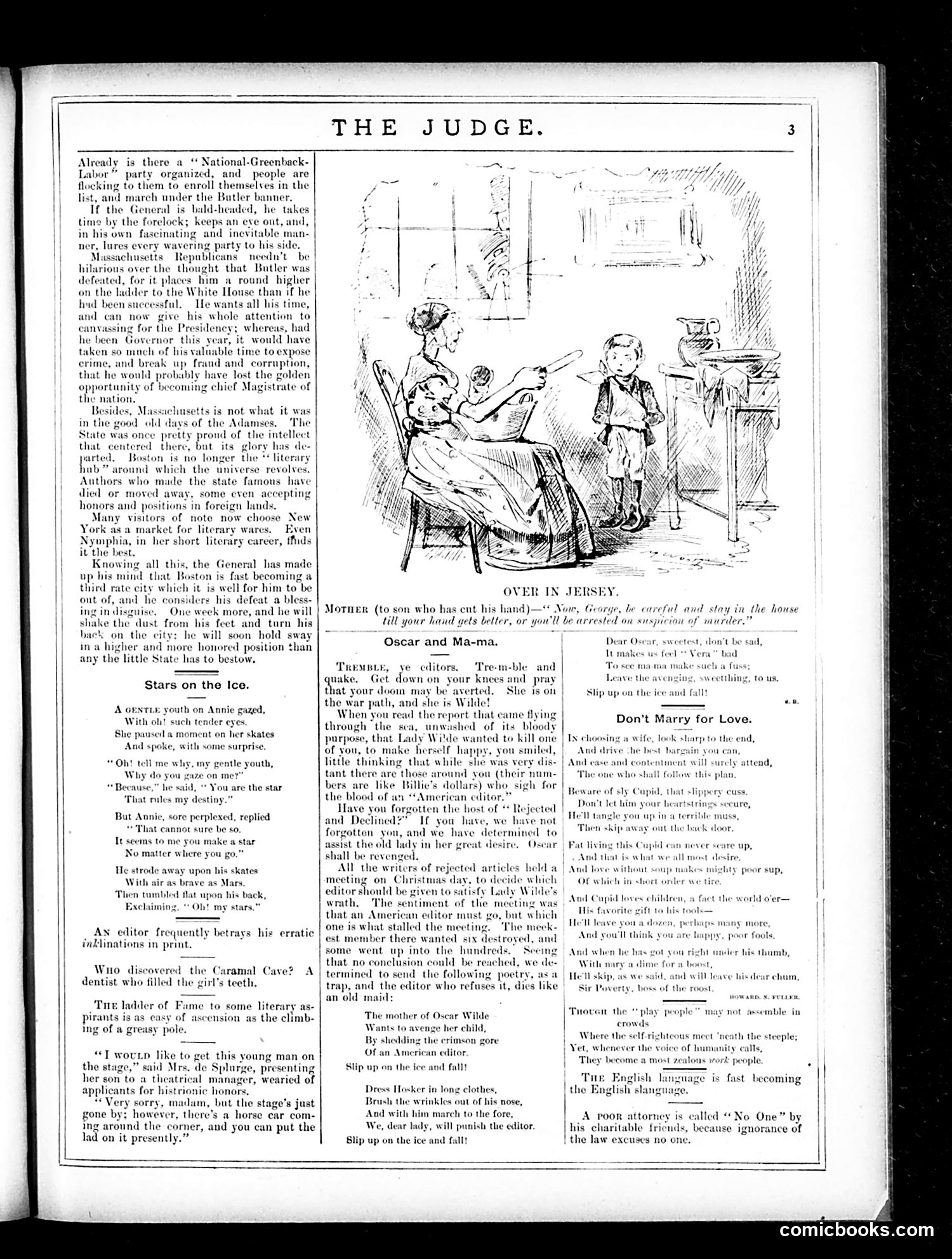
This page from the satirical magazine *Judge* contains several distinct pieces: **"Stars on the Ice"** — A humorous poem mocking a young man's romantic pretensions. He claims Annie is "the star that rules [his] destiny," but immediately falls flat on ice skates, deflating his romantic grandiosity. **Political commentary on General Butler** — The text discusses General Benjamin Butler's defeat in a Massachusetts gubernatorial race. The satire suggests Butler actually benefits from losing because it frees him to pursue the presidency without gubernatorial duties distracting him. The piece mocks Massachusetts's declining intellectual status, implying Butler's ambitions suit the state's reduced importance. **"Oscar and Ma-ma"** — A cartoon captioned with Mother warning her son about getting arrested for murder, likely referencing Oscar Wilde's mother's (Lady Wilde's) reputation. The accompanying text is a mock-serious warning to editors that Lady Wilde allegedly wanted to kill one of them, and editors should beware rejected and declined writers who might share similar murderous impulses—satirizing both literary rejection and editors' anxieties. The page blends political satire with lighter social humor typical of *Judge*'s irreverent style.
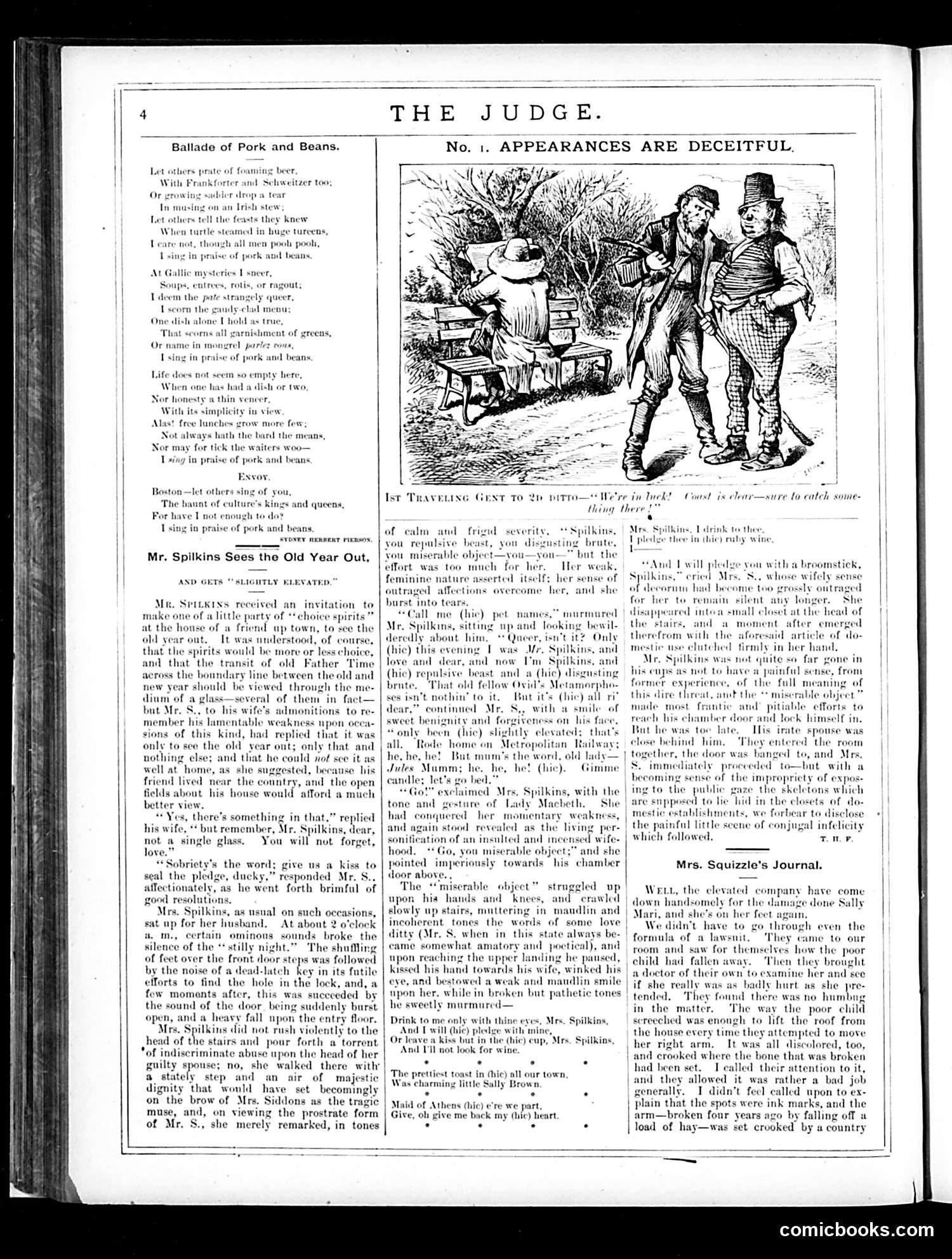
This page contains two distinct pieces: **"Ballade of Pork and Beans"** (left): A humorous poem praising humble pork and beans as superior to fancy French cuisine—a jab at pretentious dining and immigrant food snobbery common in Gilded Age America. **"Mr. Spilkins Sees the Old Year Out"** (right): A comic story about a drunk husband. Mr. Spilkins attends a New Year's Eve party promising his wife he'll stay sober, then returns home extremely intoxicated around 2 a.m., stumbling through the front door. His wife maintains dignified composure while he babbles excuses about champagne ("Jules Mumm"), compares his behavior to Ovid's *Metamorphoses*, and crawls upstairs singing love songs. The satire ridicules male drunkenness, broken promises, and the gap between genteel pretense and reality—typical Judge humor targeting middle-class hypocrisy.
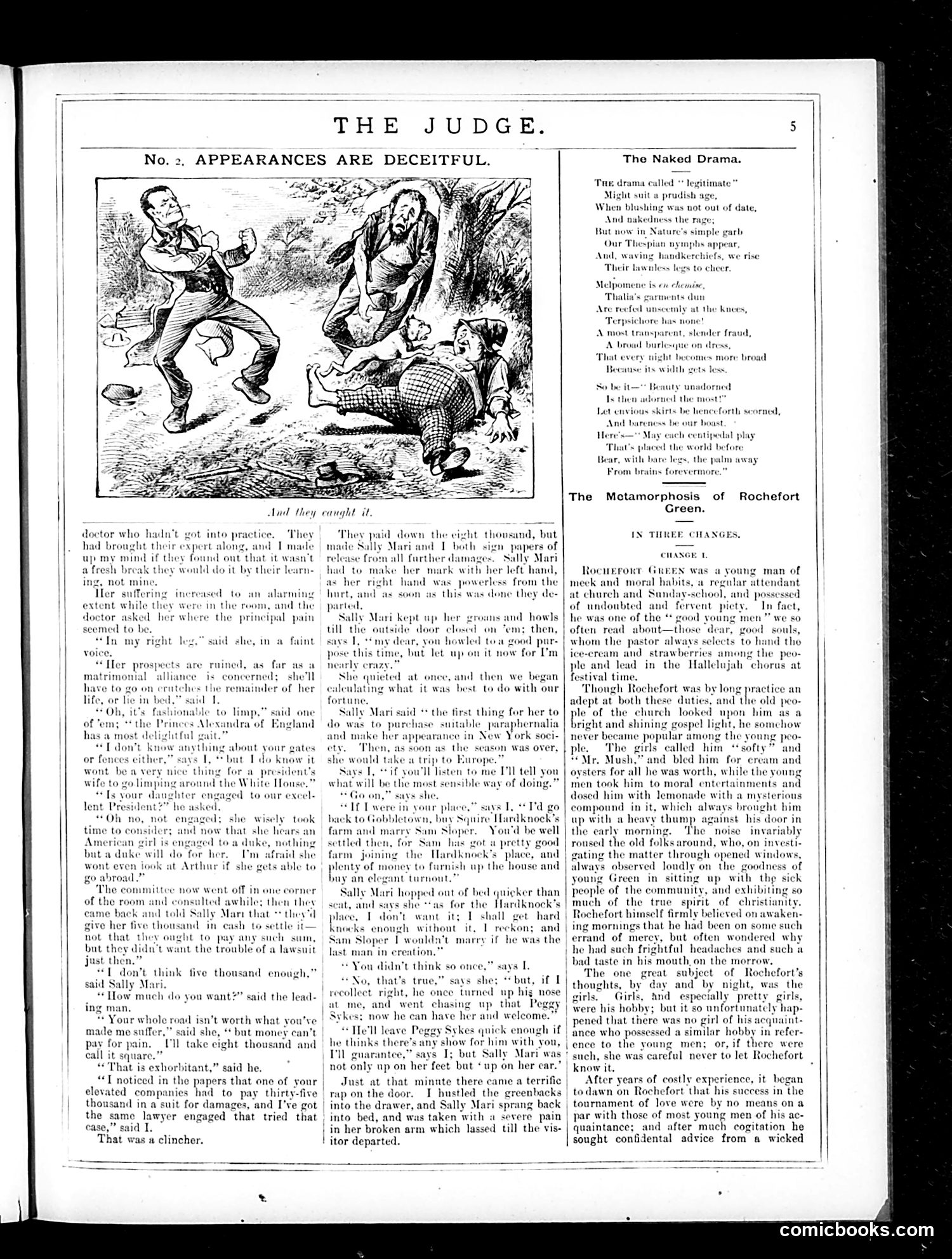
This cartoon satirizes insurance fraud and matrimonial schemes among the working/lower classes. The narrative depicts a woman (Sally Mari) who feigns injury to extort money from what appears to be a streetcar or transit company, working with a male accomplice. The humor lies in exposing the deception: though she claims grievous harm requiring cash settlement, she quickly recovers once paid. The dialogue reveals their cynical scheme—they plan to use the eight thousand dollars gained through fraud to purchase respectability via fashionable clothes and European travel. The satire targets both the fraudsters' transparent dishonesty and the legal system's vulnerability to such schemes. "Appearances Are Deceitful" is the moral: despite Sally Mari's performance of injury and suffering, her rapid recovery exposes the con. The cartoon mocks how easily working-class schemers manipulated gilded-age institutions for social advancement.
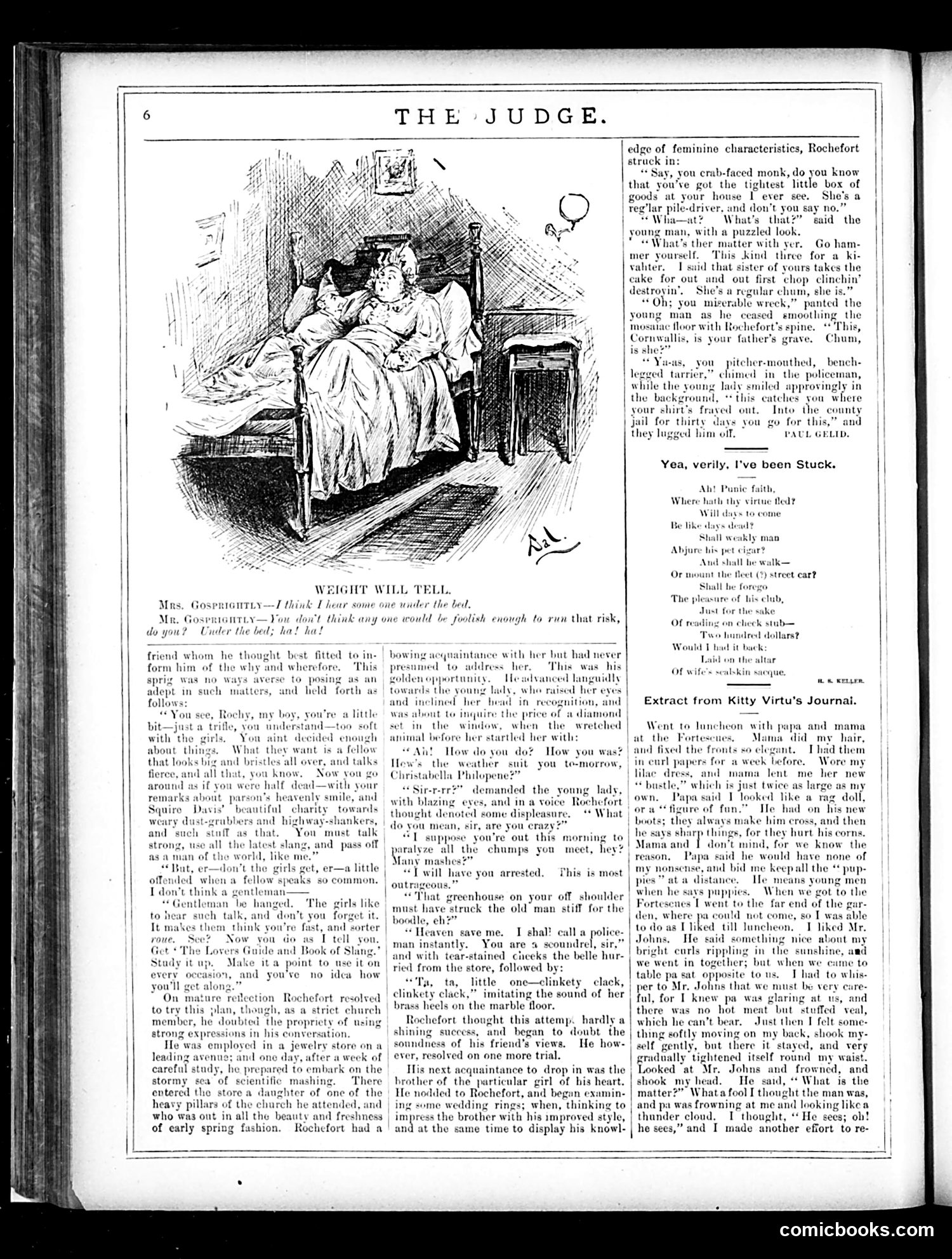
This page contains two satirical pieces about courtship and social pretense in late 19th-century America. **Main Cartoon ("Weight Will Tell"):** A young man named Rochefort attempts to court a respectable young lady by adopting crude, vulgar slang and aggressive behavior—believing this is what women find attractive. When he insults her family and uses coarse language, she reports him to police. The satire mocks both Rochefort's misguided strategy and the false masculine ideals he believes will impress women. **"Extract from Kitty Virtu's Journal":** A young woman chronicles her social activities, including flirtations and visits to jewelry shops with her father. The humor derives from the contrast between her seemingly innocent activities and her coy, calculated behavior designed to attract wealthy suitors. Both pieces satirize courtship rituals and the performative nature of Victorian social interaction—characters adopting false personas to achieve romantic or financial goals. The satire targets both masculine crudeness and feminine calculation in the marriage market.
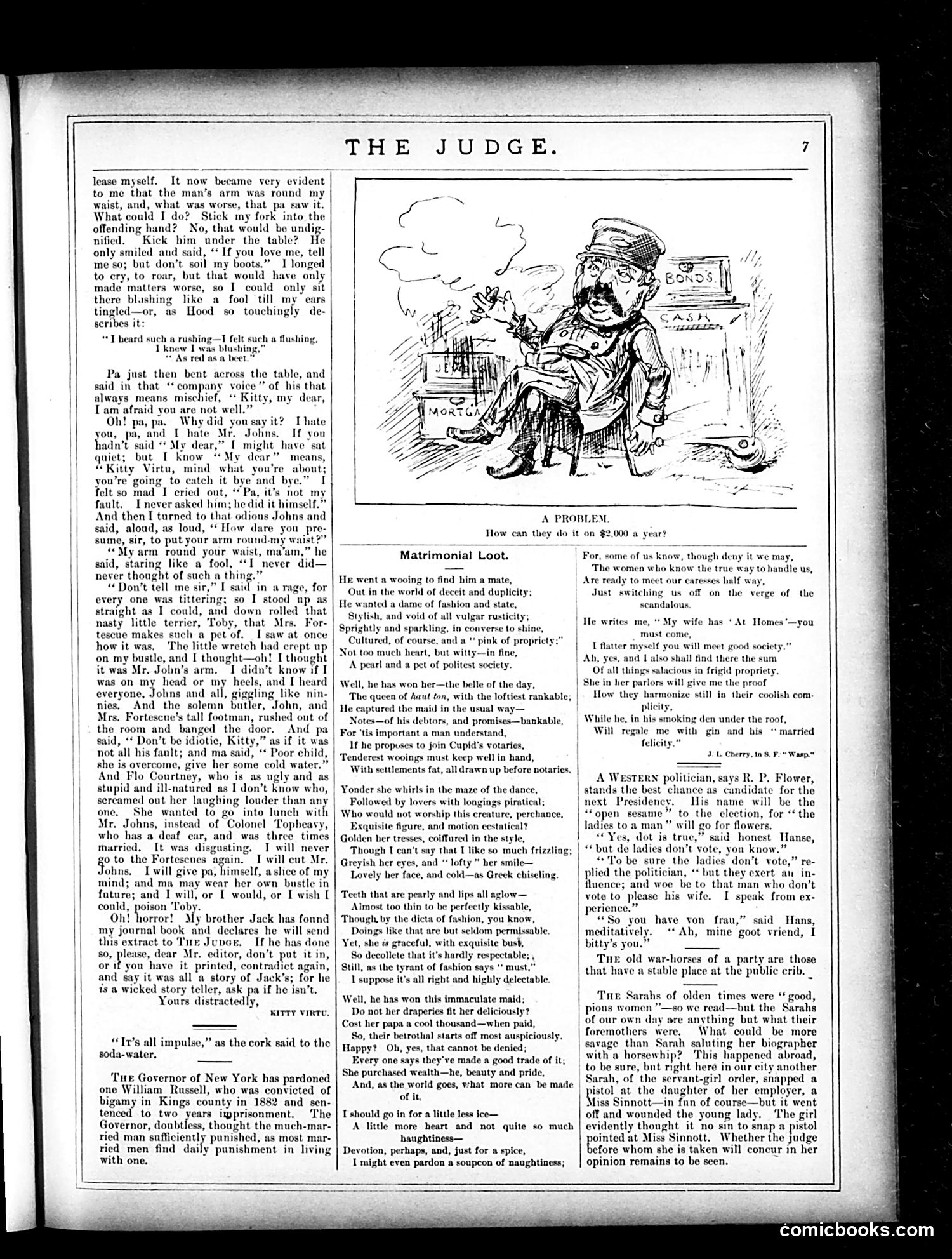
This page contains two separate pieces of satirical content: **Main Cartoon ("A Problem"):** The sketch depicts a man overwhelmed by stacks of boxes labeled with expensive items (bonds, cash, mortgages). The satire addresses the financial burden of marrying a wealthy, fashionable woman. The accompanying poem describes courting a woman of "fashion and state"—cultured and socially prominent—then questions how one can afford her "at $2,000 a year," implying the ruinous expense of maintaining such a wife's lifestyle and expectations. **"Matrimonial Loot" Poem:** This elaborates the satire, contrasting the husband's desires (a witty, cultured woman without "too much heart") against the financial reality: his new bride's expensive tastes have bankrupted him despite his wealth. **Context:** This reflects late-19th-century anxieties about marriage, class, and conspicuous consumption—particularly women's materialism and the financial trap of marrying into or maintaining upper-class status. The humor targets both husband's naïveté and wife's mercenary nature.
This page shows **"The Judge"** as a title/header in the left margin. The image depicts a satirical scene with multiple figures arranged in what appears to be a courtroom or judicial setting, shown from an unusual angle (rotated perspective). Without clearer details of specific caricatured faces or readable labels identifying the figures, I cannot definitively name the individuals being satirized. However, the composition suggests commentary on a legal proceeding or judgment, likely critiquing specific contemporary politicians or public figures through their exaggerated features. The overall composition—with figures stacked or arranged dramatically—suggests social or political commentary typical of *Judge* magazine's style. More legible text or clearer facial identifications would be needed to specify the exact satirical target.
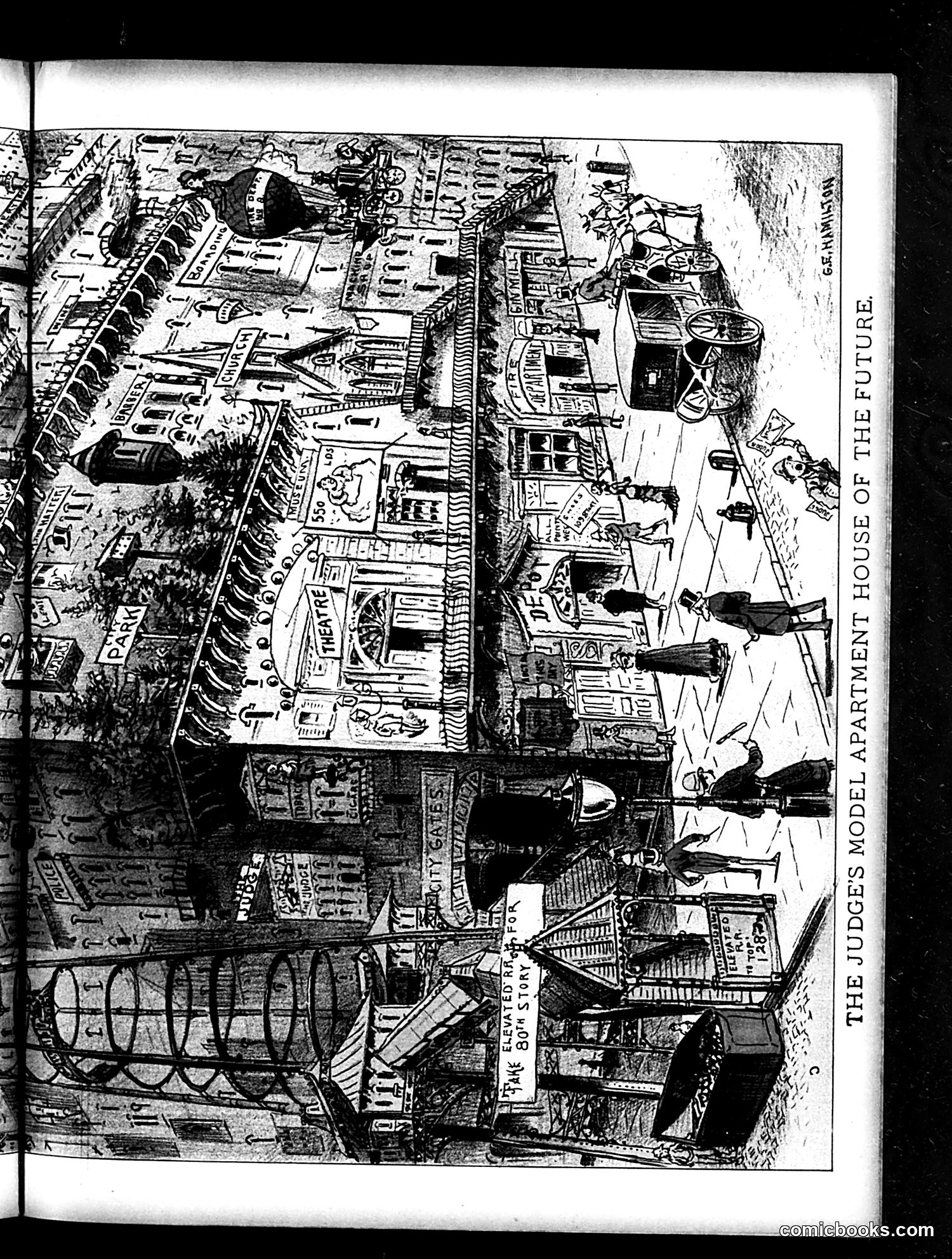
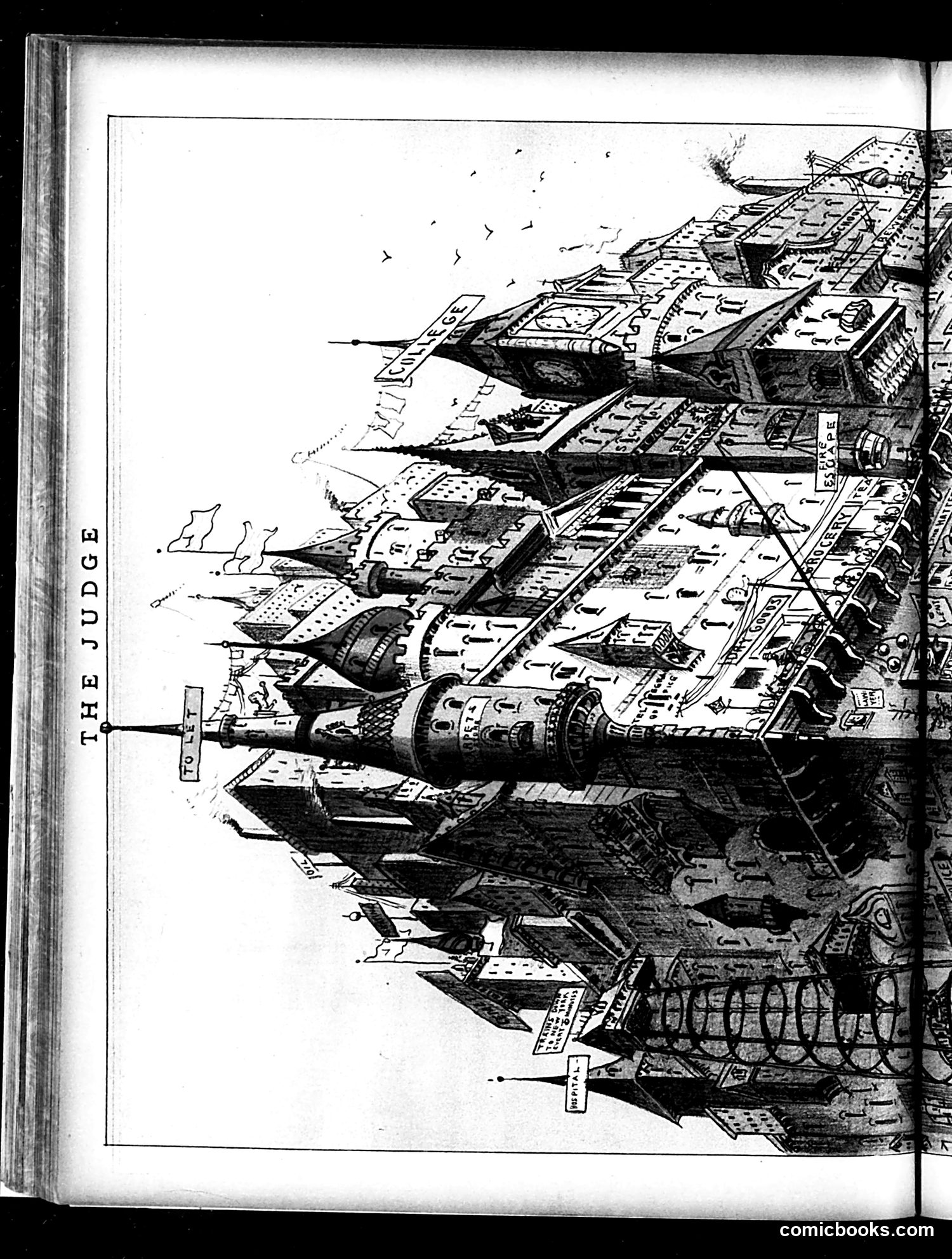
This appears to be an architectural satire or futuristic vision illustration rather than a traditional political cartoon. The image shows a detailed cross-section of an apartment building with multiple floors and rooms, presented as a speculative design. The OCR text is largely corrupted/illegible, making it difficult to identify specific satirical targets. However, the caption "The Judges Model Apartment House of the Future" suggests *Judge* magazine is critiquing or satirizing contemporary architectural design, urban planning, or real estate development trends. Without readable accompanying text, the specific satirical point—whether it mocks overcrowding, modern design pretensions, or housing practices—remains unclear. The illustration's minute detail suggests the satire lies in depicting absurdities of future housing that the modern viewer would recognize as flawed or ridiculous.
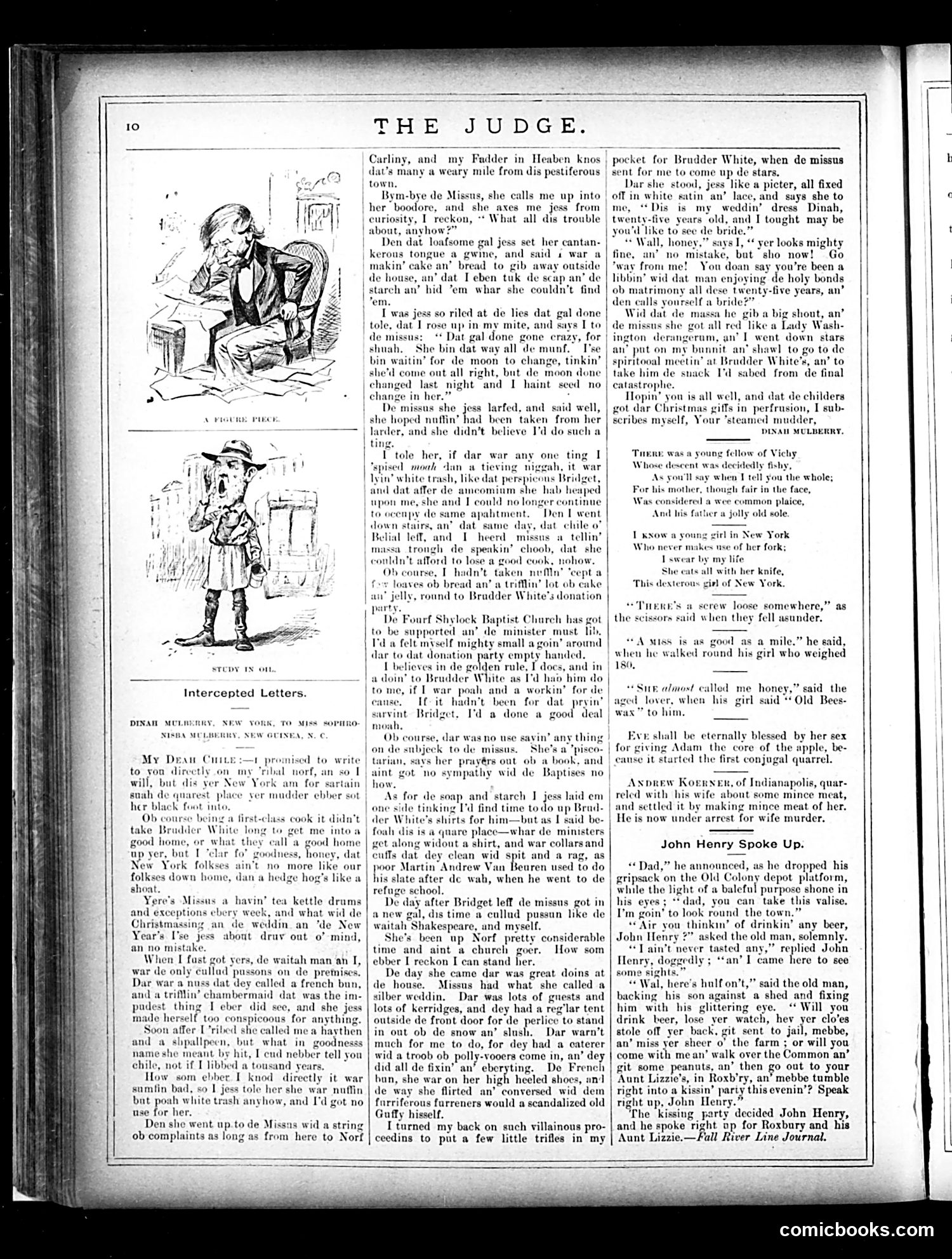
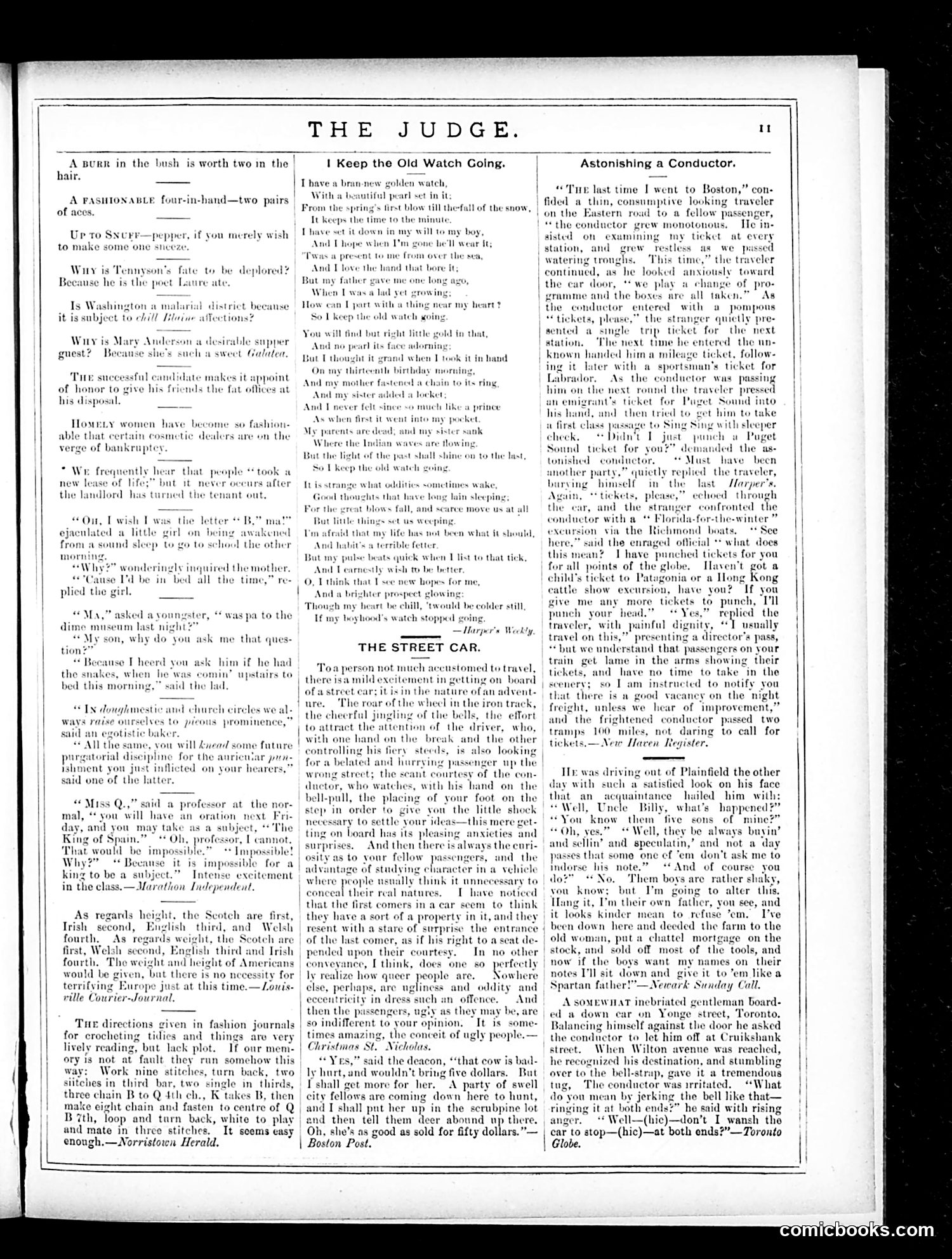
This page from the satirical magazine *Judge* contains three separate humorous pieces rather than unified cartoons: 1. **"I Keep the Old Watch Going"** - A sentimental poem about a man's inherited pocket watch, passed down from his father. The joke is the contrast between the watch's deep emotional significance and its practical function—he keeps it running as a sentimental keepsake. 2. **"The Street Car"** - A social commentary piece mocking the awkwardness and absurdities of public transit. It satirizes both passenger behavior (their oddness and lack of courtesy) and conductor attitudes. The humor targets how people act strangely in confined public spaces, and how transit workers treat passengers dismissively. The page also includes brief jokes and observations about fashion, social etiquette, and human nature—typical of *Judge*'s satirical format. The overall tone mocks Victorian-era social conventions and everyday absurdities rather than targeting specific political figures.
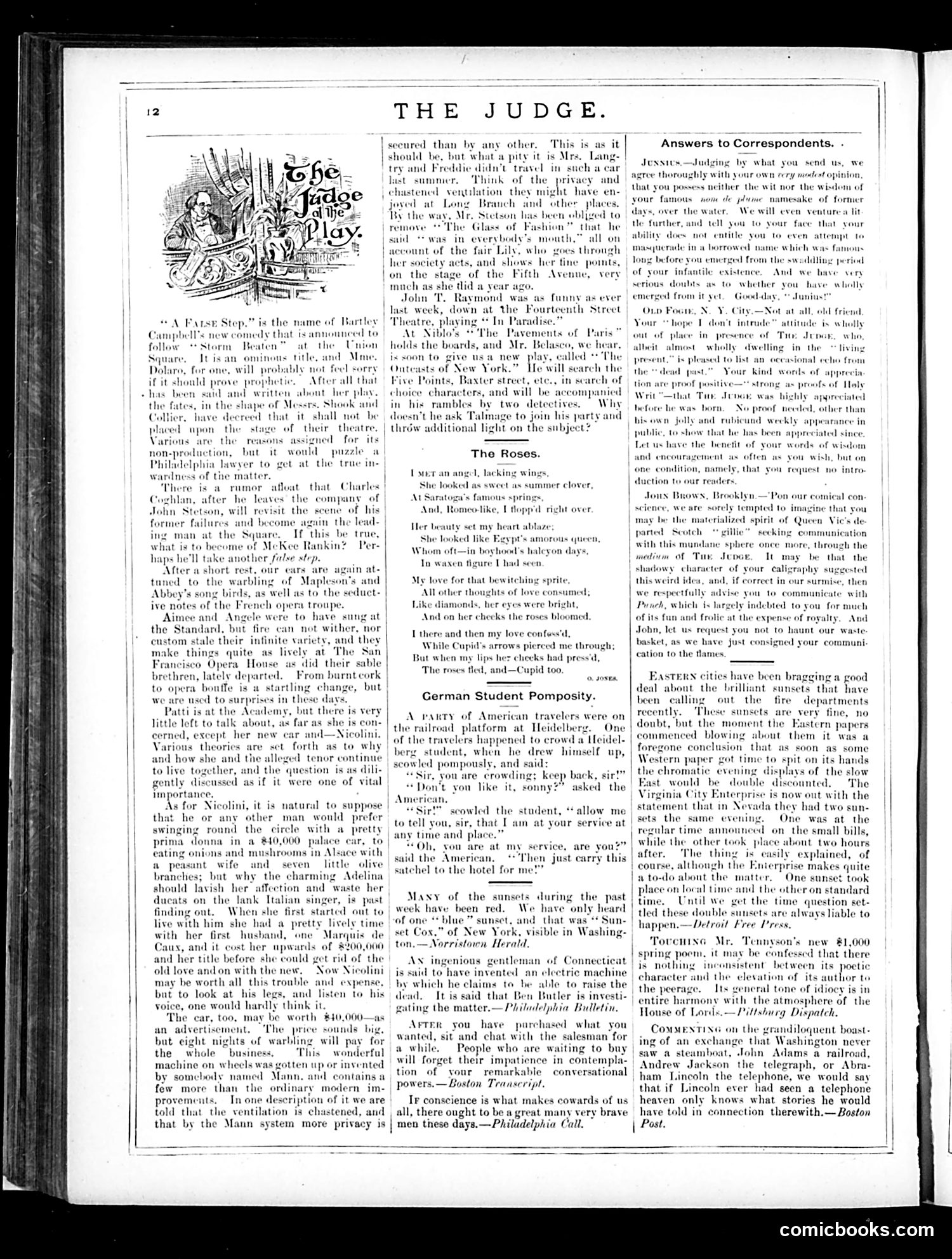
This page from Judge magazine contains theater gossip, poetry, and satirical commentary typical of 1880s entertainment journalism. **Main Content:** The left column discusses Broadway productions and performers—notably actresses like Mrs. Langtry and Adelina Patti, and theaters like the Standard and Fifth Avenue Theatre. The satire mocks theatrical pretension: why would Adelina Patti lavish affection on "the lank Italian singer" Nicolini when she could enjoy luxury? The piece ridicules both celebrity excess and the logic of romantic choices among the wealthy. **"The Roses"** is a sentimental poem about romantic disappointment—a lover idealizes a woman until kissing reveals reality ("the roses fled"). **"German Student Pomposity"** satirizes a German university student at Heidelberg who, when crowded on a train platform by an American, responds with exaggerated formality and indignation. The joke targets Germanic pretentiousness and rigidity when confronted by casual American informality. The page reflects Judge's focus on lampooning theatrical vanity, romantic foolishness, and European affectations—standard targets of Gilded Age American satire.
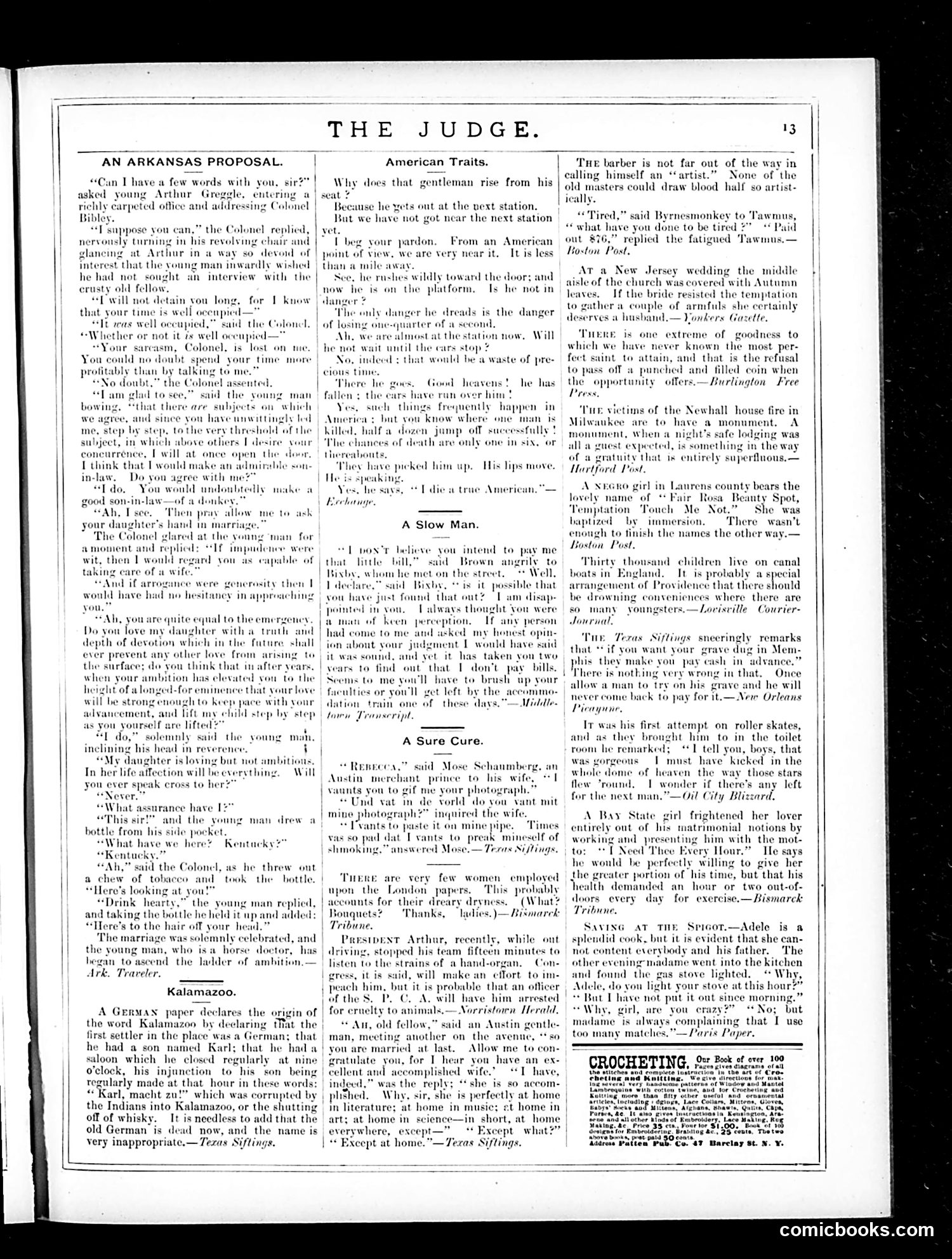
This page from *Judge* contains several brief humorous sketches satirizing American character types and social behaviors: **"An Arkansas Proposal"** depicts a young man's courtship of a Colonel's daughter. The satire mocks both rural Southern formality and the suitor's obsequious flattery—he absurdly praises the Colonel's "keen perception" and "sound judgment" while clearly being a simpleton. The Colonel's relentless questioning about devotion and ambition satirizes Victorian courtship pretense. **"American Traits"** ridicules Americans' obsession with punctuality and efficiency, showing a passenger frantically jumping from a train to avoid losing mere seconds—a caricature of American impatience and materialism. **"A Slow Man"** mocks a chronic debtor's deliberate evasion, using his slowness to perceive reality as an excuse for not paying bills. **"A Sure Cure"** satirizes German immigrants' drinking habits, presenting a remedy of tobacco and whiskey as folk medicine—a common ethnic stereotype of the era. The humor relies on exaggeration of regional, ethnic, and class characteristics typical of late-19th-century American satire.
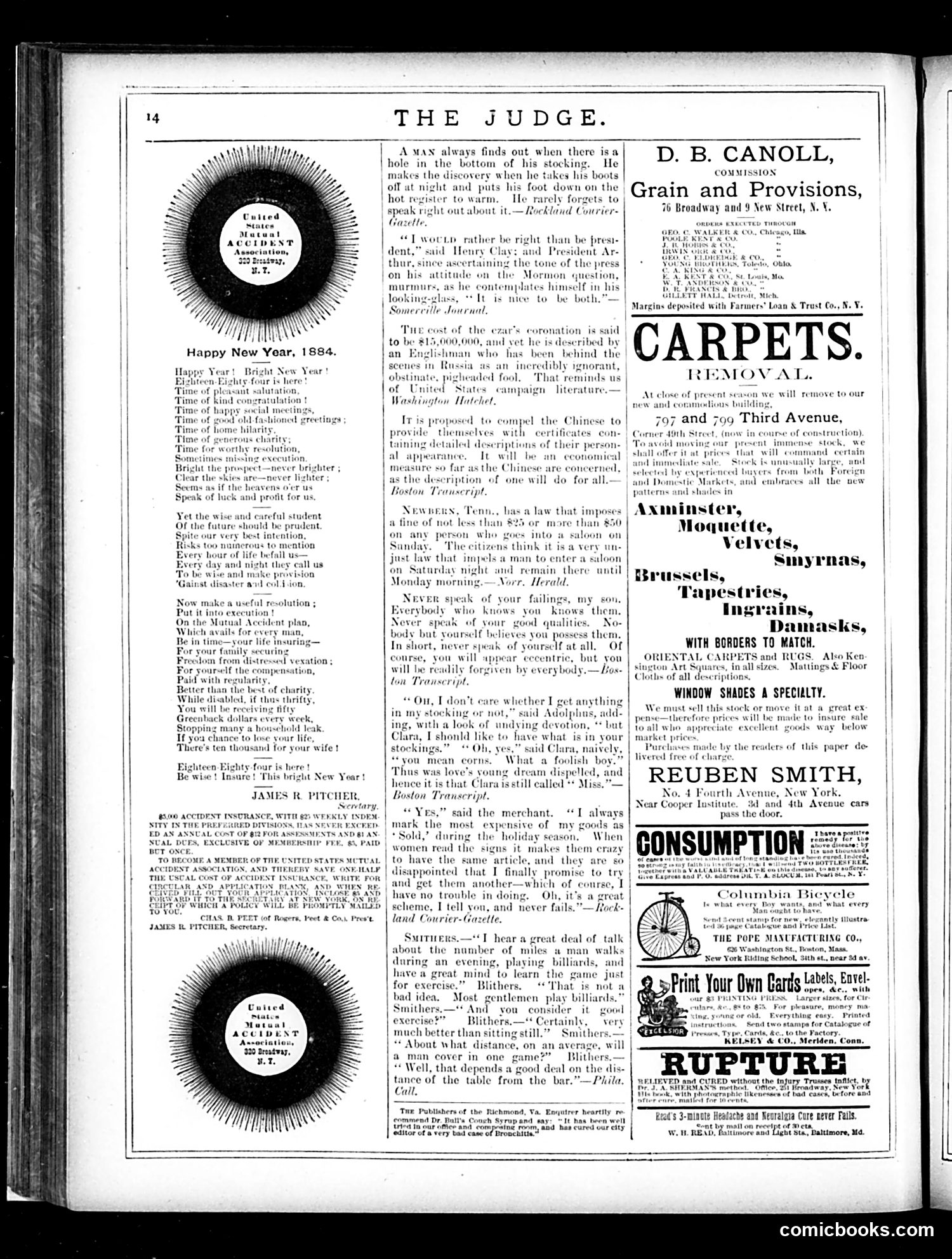
This page is primarily **advertisements and filler content** rather than political satire. The two circular emblems at top and bottom are logos for the **United States Mutual Accident Association**, an insurance company. The short humorous "items" scattered throughout are typical **period humor snippets**—brief, disconnected jokes about everyday life. Notable examples include: - A joke about discovering holes in socks by stepping on hot registers - A reference to President Arthur's awkward position on the Mormon question (likely referring to federal conflict with polygamist Mormons in Utah territories) - Jokes about saloon laws in Tennessee - Domestic humor about a woman's corns The page demonstrates how **19th-century satirical magazines mixed editorial cartoons with advertising and miscellaneous humor**. The content is topical but lighthearted rather than deeply political. Most references assume contemporary reader familiarity with current events that are now obscure without additional historical context.
This page is primarily **advertisements and brief satirical notices** rather than political cartoons. The content consists of: **Satirical Snippets:** Short, humorous observations from various newspapers about mundane topics—Senate etiquette, a 117-year-old Connecticut woman making pumpkin pies, Oscar Wilde (unfavorably compared to Samson), dolls that cry, and wedding etiquette. These are mild social satire typical of the era, poking fun at American manners and contemporary figures. **Key References:** - Oscar Wilde appears as a cultural reference point for mediocrity - George Washington statue mentioned sarcastically - References to modern technology (telegraphed poems, cable readings) **Advertisements** dominate: Cuticura remedies, Behning pianos, Wilson sewers, fire extinguishers, magic lanterns, and various other products. The page lacks significant political commentary or identifiable caricatures. It represents Judge's typical format of combining light social humor with commercial advertising rather than hard-hitting political satire.
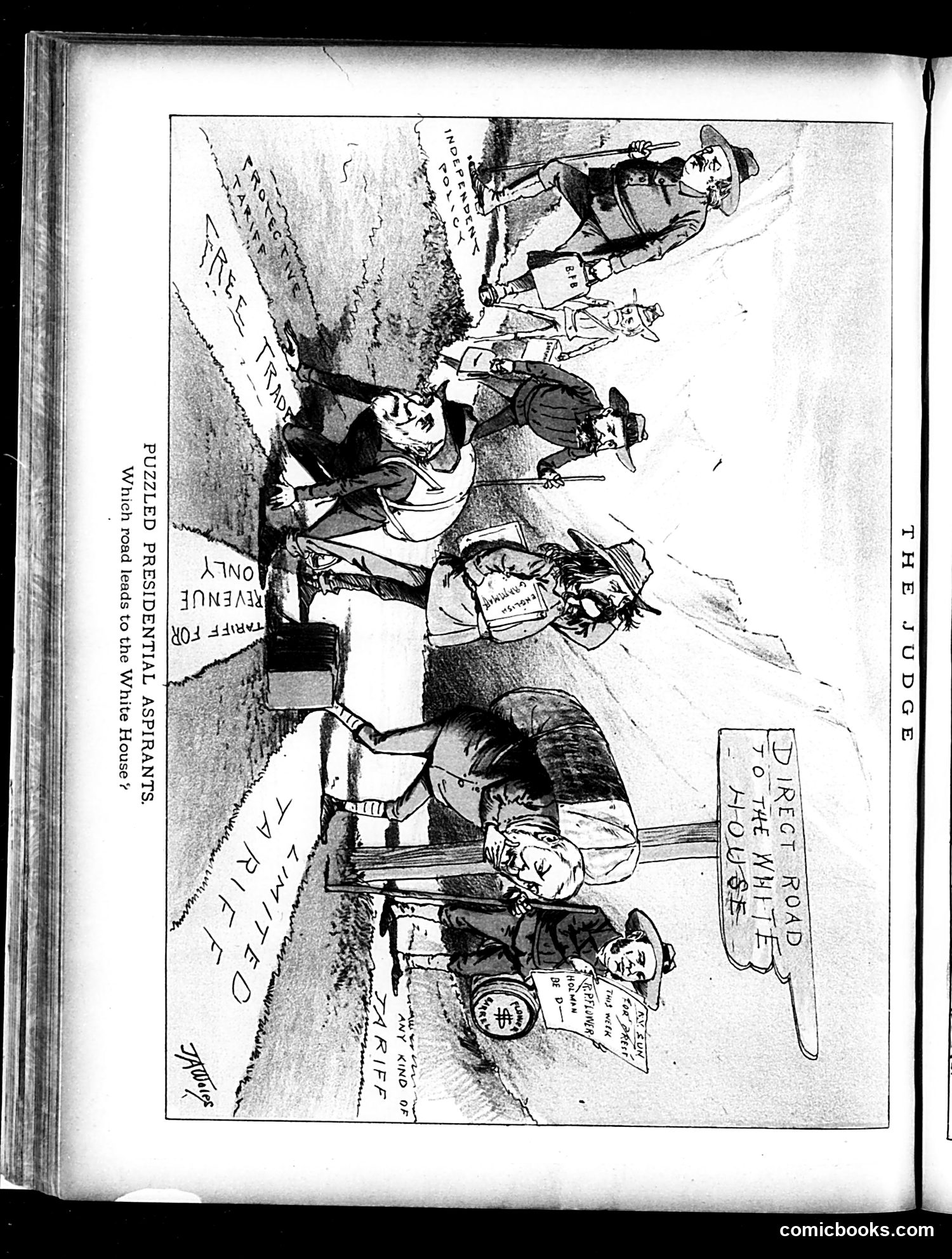
This cartoon satirizes multiple candidates uncertain about the path to the presidency. The image shows several figures at a crossroads labeled "Direct Road to the White House," appearing confused about which route to take. The title "Puzzled Presidential Aspirants" suggests this addresses a crowded field of political hopefuls—likely from a specific election cycle—who face competing strategies and unclear advantages. The multiple paths represent different political approaches or platforms available to candidates. Without a visible date or clearer identification of specific figures, the exact election and candidates remain unclear, but the cartoon's point is straightforward: numerous would-be presidents are uncertain which strategy will succeed, making the election itself a puzzle for ambition-driven politicians seeking the White House.