
Judge, 1884-01-16 · page 2 of 16
Judge — January 16, 1884 — page 2: what you’re looking at
What you’re looking at
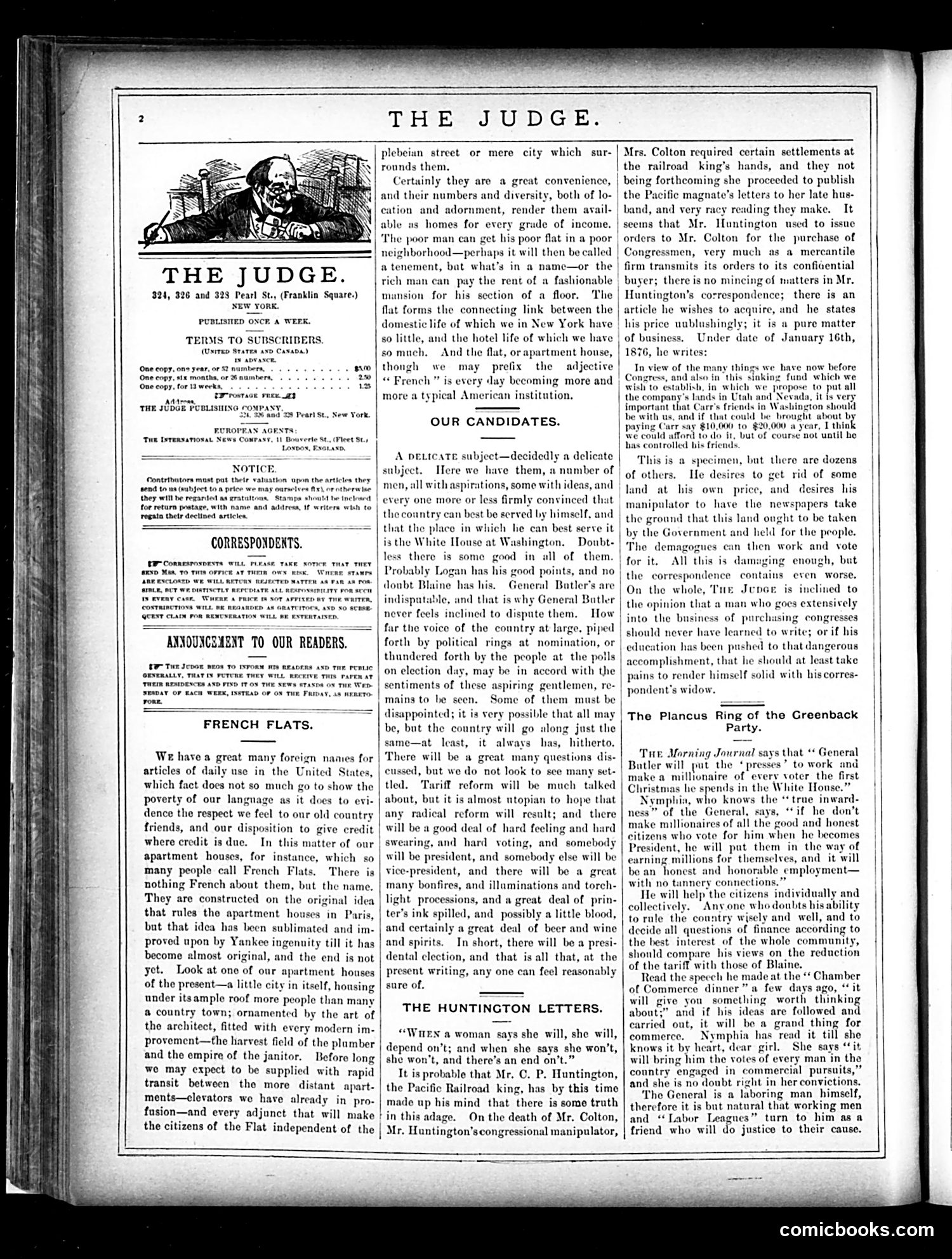
This page from *Judge* magazine contains editorial commentary and announcements rather than political cartoons. The small woodcut illustration at the top depicts a generic caricatured face, likely used as the magazine's masthead. The substantive content includes two main articles: 1. **"French Flats"** — A satirical discussion of apartment buildings, which the author notes are called "French" but are actually American innovations. The piece mocks how Americans adopt foreign names while improving upon the original concept. 2. **"Our Candidates"** — Commentary on presidential candidates (the text mentions Logan, Blaine, and General Butler by name), satirizing their aspirations and self-confidence that each believes themselves best suited for the White House. The author suggests political machines manipulate nominations while claiming to represent popular will. The overall tone is skeptical of both American pretensions to European sophistication and the earnestness of political candidates pursuing office.
📄 Transcribed text from this page (OCR, searchable)
Machine-transcribed from the original scan — historical spelling and the odd misread are preserved.
THE JUDGE. THE JUDGE. 324, 326 and 328 Pearl St., (Franklin Square.) NEW YORK. PUBLISIIED ONC. A WERK. TERMS TO SUBSCRIBERS. (Usrrep States avo Cava) FUROT ‘Tue Ixrensariowat News Comrase, 11 Bh NOTICE. Contrfoutors must pat tele valuation upon the articles thes | tend to ua (aubject to a price we may ourselves fix). or otherwise they will he regardest as gratultous Stampa should be ineloeed for return prstage, with name and address, If writers wish to regaia thelr declined articien. CORRESPONDENTS. HU-ConnesrospENTs WILL PLEASE TAKE xOTCR THAT THEY axxo Mat to Tite oFnicR AT x AIMLE, CT WR DIRTISCTLY REFEDIATR Att, REAFOS A TRICR 18 NOT AFFIKED RE THE w OR REMUNERATION WILL ME ESTERTAINED, ANNOUNCEMENT 70 OUR READERS. E97 Tie Jcooe wens To IXPORM WHY READERS AxD THE FERLIC ORSERALLY, THAT IY FUTCRE THEY WILL RECEIVE THIS PAFER AT | THEIR RESIDESCES AND FIND FT 08 THE NEWS STASDS ON THE WED | SEADAY OF EACH WEEK, INSTEAD OF O¥ THE FRIDAY, AS HERETO. yore. FRENCH FLATS. We have a great many foreign names for | articles of daily use in the United States, | which fact does not so much go to show th poverty of our lan eas it does to dence the respect we feel to our old country friends, and our disposition to give credit where credit is due. In this matter of our apartment houses, for in: ce, which so many people call French F There is nothing French about them, but the name. They are constructed on the original id that rules tho apartment houses in Paris, | but that idea nd im- proved upon by Yankee ingenuity till it has become almost original, and the end is not yet. Look at ono of our apartment houses of the present—a little city in itself, housing under itsample roof more people than many a country town; ornamented by the art of the architect, fitted with every modern im- provement—the harvest field of the plumber and the empire of the janitor. Before long we may expect to be supplied with rapid transit between tho more distant apart- ments—clevators we have already in pro- fusion—and every adjunct that will make the citizens of the Flat independent of the | plebeian street or mere city which sur- rounds them, Certainly they are a great convenience, | and their numbers and diversity, both of lo- cation and adornment, render them avail- able as homes for every grade of income. | ‘The poor man can get his poor flat in a poor »g it will then be called | neighborhood—per atenement, bat what’s in a name—or the rich man can pay the rent of a fashionable mansion for his section of a floor. The flat forms the connecting link between the domestic life of which we in New York have so little, and the hotel life of which we have somnch, And the flat, or apartment house, though we may prefix the adjective “ French ” more a typical Ame becoming more and ‘an institution, OUR CANDIDATES. A peutcate subject—decidedly a delicate subject. Here we have them, a number of men, all with aspirations, some with ideas, and every one more or less firmly convinced that the country can best be served by himself, and that the place in which he can best serve it is the White House at Washington. Doubt. less there is some good in all of them. Probably Logan has his good points, and no doubt Blaine has his. General Butler's are | indisputable, and that is why General Butler never feels inclined to dispute them. How far the voice of the country at large, piped forth by political rings at nomination, or thundered forth by the people at the polls on election day, may be in accord with the sentiments of these aspiring gentlemen, re- mains to be seen. Some of them must be disappointed; it is very possible that all m be, but the country will go along just the same—at least, it always has, hitherto. There will be a great many questions di cussed, but we do not look to see many 5 tled. Tariff reform will be much talked about, but it is almost utopian to hope that ‘adical reform will result; and there 1 be a good deal of hard feeling and hard sweari and hard voting, and somebody will be president, and somebody else will be vice-president, and there will be a great | many bonfires, and illaminations and torch- light. processions, and a great deal of prin- ter’s ink spilled, and possibly a little blood, and certainly a great deal of beer and wine and spirits, In short, there will be a presi- | dental clection, and that is all that, at the present writing, any one can feel reasonably sure of. THE HUNTINGTON LETTERS. “WHEN a woman says she will, she will, depend on’t; and when she says she won't, she won't, and there’s an end on’t.” It is probable that Mr. C. P. Huntington, the Pacific Railroad king, has by this time made up his mind that there is some truth in this adage. On the death of Mr. Colton, Mr. Huntington’scongressional manipulator, Mrs. Colton required certain settlements at the railroad king’s hands, and they not being forthcoming she proceeded to publish the Pacific magnate’s letters to her late hus- band, and very racy reading they make, It seems that Mr. Huntington used to issue orders to Mr. Colton for the purchase of Congressmen, very much as a mercantile firm transmits its orders to its confidential buyer; there isno mincing of mutters in Mr. | Huntington’s correspondence; there is an article he wishes to acquire, and he states his price uublushingl is 4 pure matter of business. Under date of January 16th, 1876, he writes: ¢ fund which we wish to esi to put all | the company’s lands in U important that Carr's friends in Wash be with nd if that could be bros | pa Carr say $10,000 to $20,000 | we could afford to do it, but of course not’ until he | has controlled his friends. This is of others. Ife desires to get rid of some land at his own price, and desires his manipulator to have the newspapers take the ground that this land onght to be taken by the Government and held for the people. | The demagogues can then work and vote | for it. All this is damaging enough, but | the correspondence contains even worse, | On the whole, Tie JupGe is inclined to the opinion that a man who goes extensively | into the business of pure! congresses should never have learned to write; or if his | education has been pushed to that dangerous accomplishment, that he should at least take pains to render himself solid with his corres- pondent’s widow, specimen, but there are dozens Y | The Plancus Ring of the Greenback Party. Tue Morning Journal says that ‘ General Butler will put the ‘presses’ to work and ea millionaire of every voter the first istmas he spends in the White House.” Nymphia, who knows the “true inward- ” of the General, says, ‘if he don’t ke millionaires of all the good and honest zens who vote for him when he becomes President, he will put them in the way of earning millions for themselves, and it will be an honest and honorable employment— with no tannery connections He will help the citizens individually and collectively. Anyone who doubts bis ability to rule the country wisely and well, and to decide all questions of finance according to the best interest of the whole communi | should compare his views on the reduction of the tariff with those of Blaine. Read the specch he made at the “ Chamber of Commerce dinner” a few days ago, “ it will give you something worth thinking about;” and if his id are followed and carried out, it will be a grand thing for commerce. Nymphia has read it till she knows it by heart, dear girl. She says ‘it will bring him the votes of every man in the country engaged in ¢ and she is no doubt right in her convictions. The General is a laboring man_ himself, therefore it is but natural that working men and ‘Labor Leagues” turn to him as a friend who will do justice to their cause. comicbooks.com