
A complete issue · 16 pages · 1884
Judge — January 5, 1884
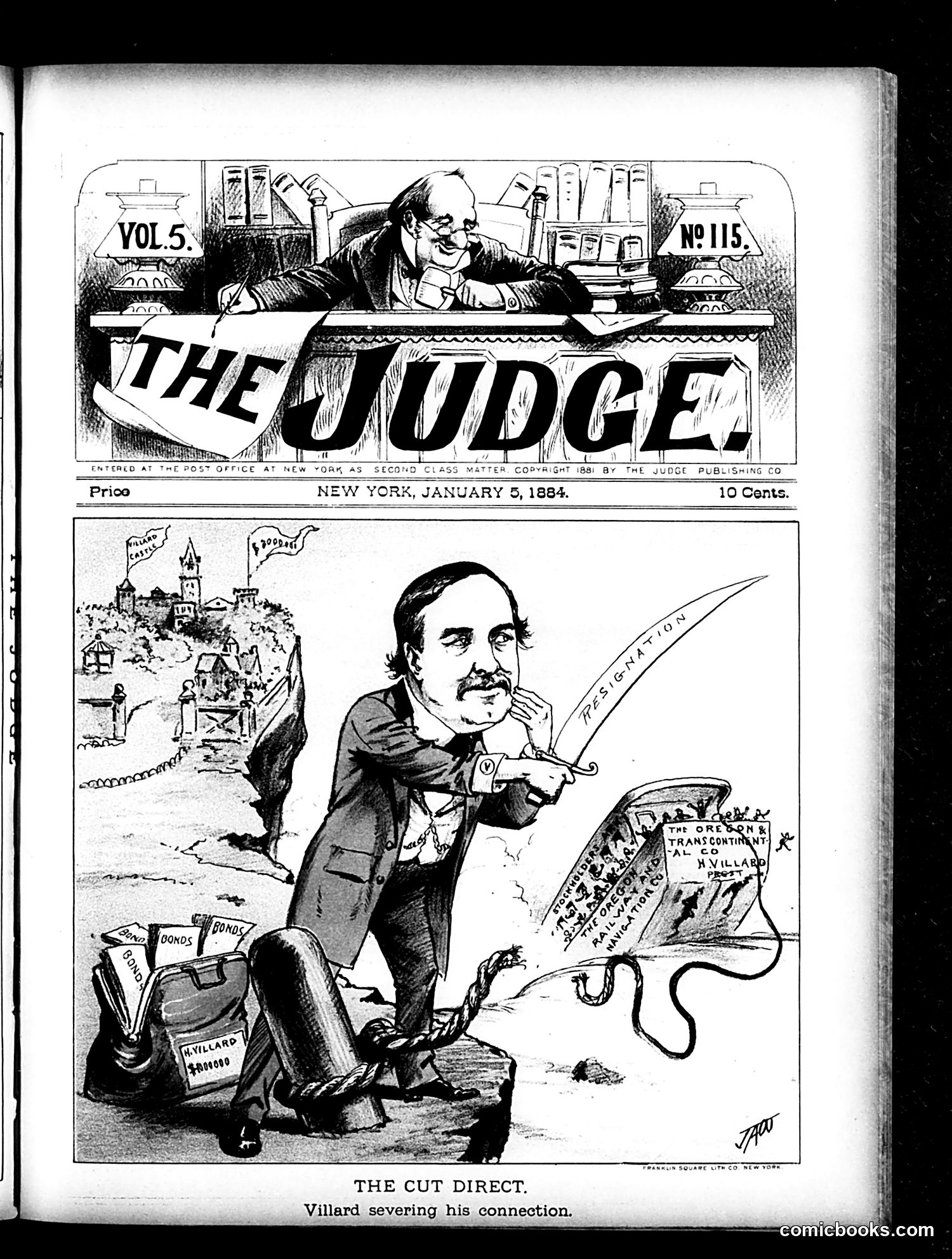
This cartoon from January 5, 1884 satirizes Henry Villard, a railroad magnate, severing ties with the Oregon Transcontinental Railroad. The caricatured figure holds a sword labeled "Designation," cutting a rope connected to his business portfolio (marked with bonds and railroad documents). The background shows a castle, likely representing railroad wealth and power. The cartoon mocks Villard's sudden withdrawal from the venture, presenting it as a dramatic but ultimately hollow gesture—he's wielding his "designation" (position/authority) as the weapon, yet appears to be disconnecting from substantial financial interests. This reflects late-19th-century skepticism toward railroad tycoons and their often unstable business dealings during the era of rapid rail expansion and financial speculation.
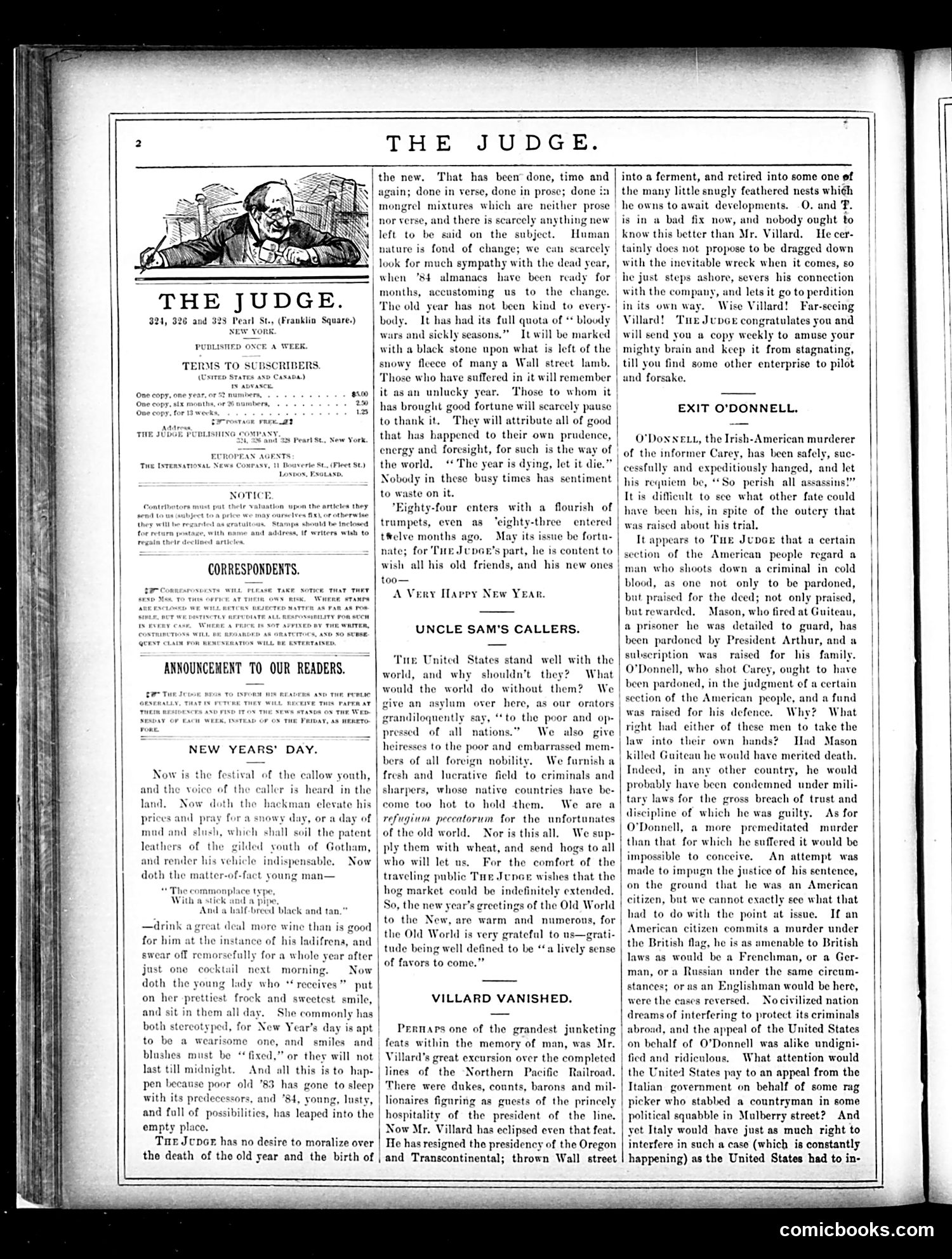
The page contains several satirical pieces mocking American social pretensions and hypocrisy circa 1884-1885. **The main cartoon** (top left) depicts a grotesque figure—likely representing greedy capitalism or Wall Street excess—surveying the year ahead. The accompanying "New Year's Day" essay satirizes how New Yorkers ritualize the new year while ignoring substantive moral reflection. **"Uncle Sam's Callers"** mocks American self-righteousness: the U.S. boasts of sheltering the world's poor and oppressed, yet simultaneously profits from them—supplying wheat, exporting pork, and apparently attracting criminals and con artists ("refugium peccatorum"). The satire suggests America's charitable reputation masks mercenary motives. **"Villard Vanished"** references railroad magnate Henry Villard's famous 1883 Northern Pacific excursion featuring European nobility. The piece ironically notes that despite this grand junket, Villard later "vanished," likely alluding to his subsequent business failures—a commentary on the hollowness of gilded-age prosperity built on speculation rather than substance.
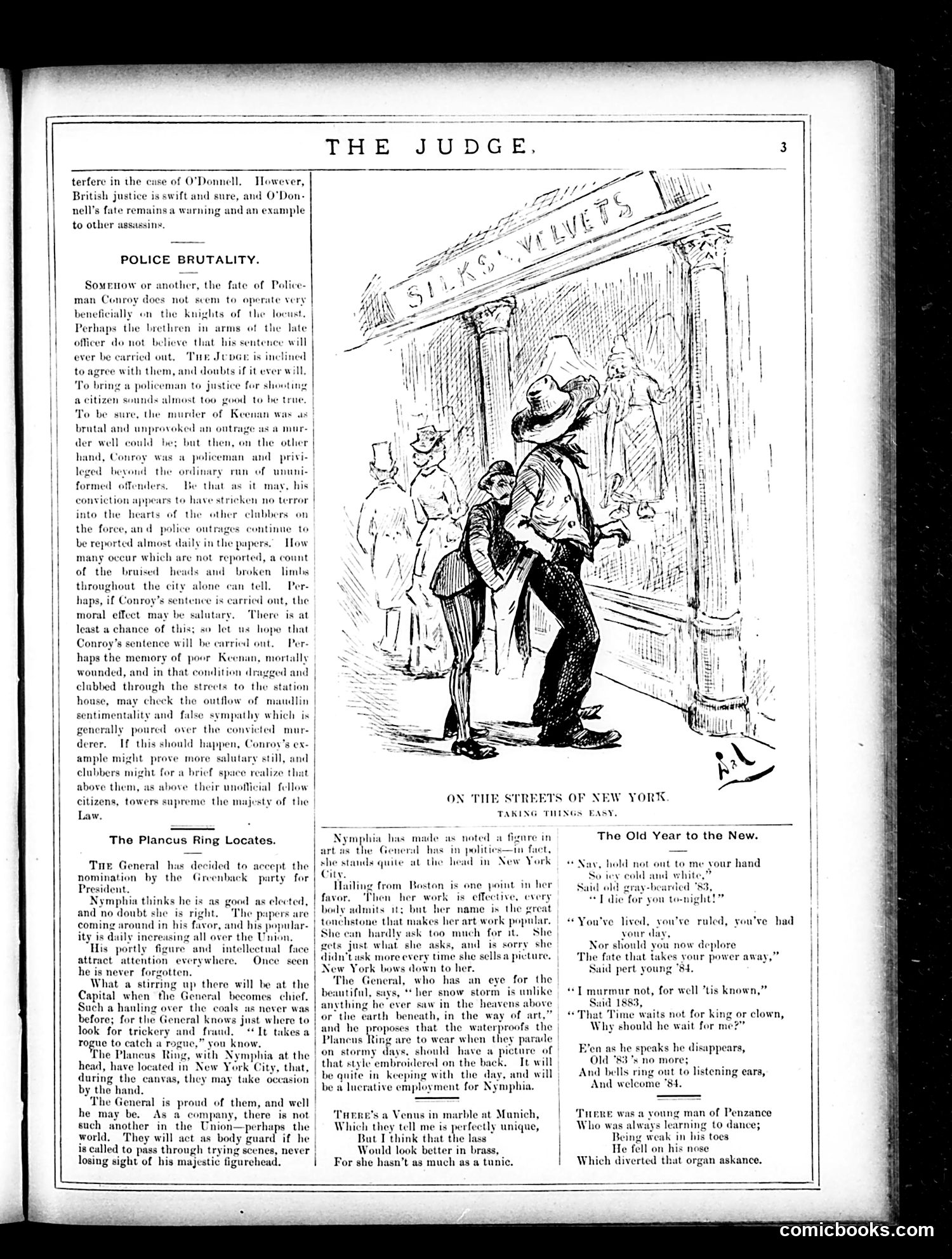
This *Judge* page contains two distinct satirical pieces: **"Police Brutality"** critiques the conviction of Policeman Conroy (apparently for murdering a citizen named Kerrigan). The author ironically doubts Conroy's sentence will be carried out, suggesting the police brotherhood shields its own from justice despite the brutality being obvious. The cartoon (right) depicts a confrontation on New York streets, illustrating such abuse. The satire attacks both police impunity and public sentiment that protects corrupt officers. **"The Plancus Ring"** satirizes a political operative (General Plancus) nominated by the Greenback Party, along with his associate "Nymphia," an artist. The piece mocks their arrival in New York and suggests they'll "haul over the coals" political enemies. It's unclear which specific election or figure this references, though it appears to ridicule opportunistic political machinery. Both pieces exemplify *Judge's* muckraking approach to contemporary corruption.
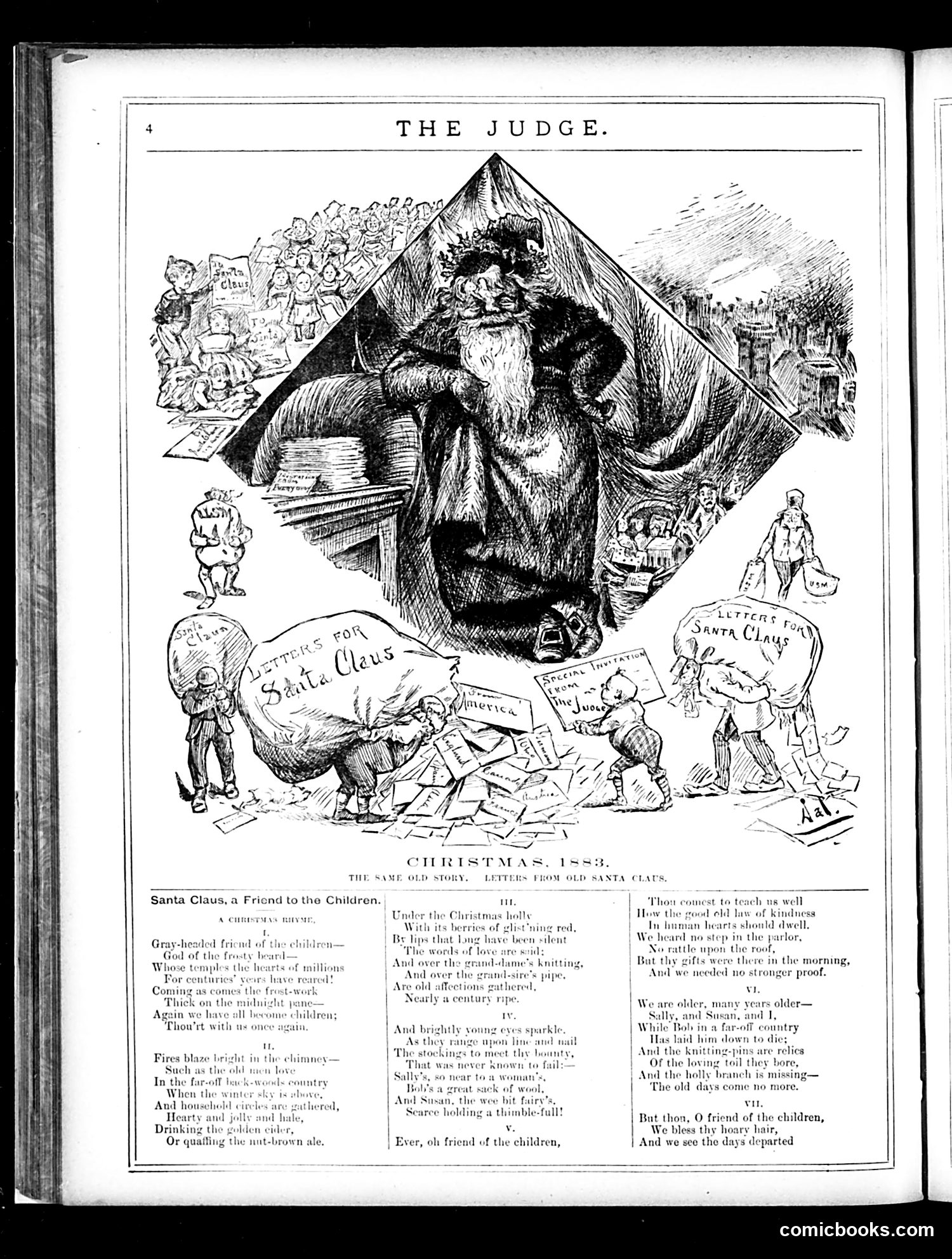
This is a sentimental Christmas poem and illustration, not political satire. The large central image depicts Santa Claus as a benevolent, grandfatherly figure presiding over a domestic scene of children and families celebrating Christmas—with letters addressed to "Santa Claus" scattered below. The accompanying poem, divided into seven numbered sections, celebrates Santa as a symbol of childhood wonder and moral instruction. It emphasizes traditional Christmas values: generosity, family gatherings by the fire, and the teaching of "kindness" to children. The verse repeatedly references "the old days" and portrays Santa as a steadfast, reassuring presence across generations. This appears to be purely festive editorial content rather than political commentary—typical of how 19th-century magazines included seasonal, family-oriented material alongside their satirical cartoons.
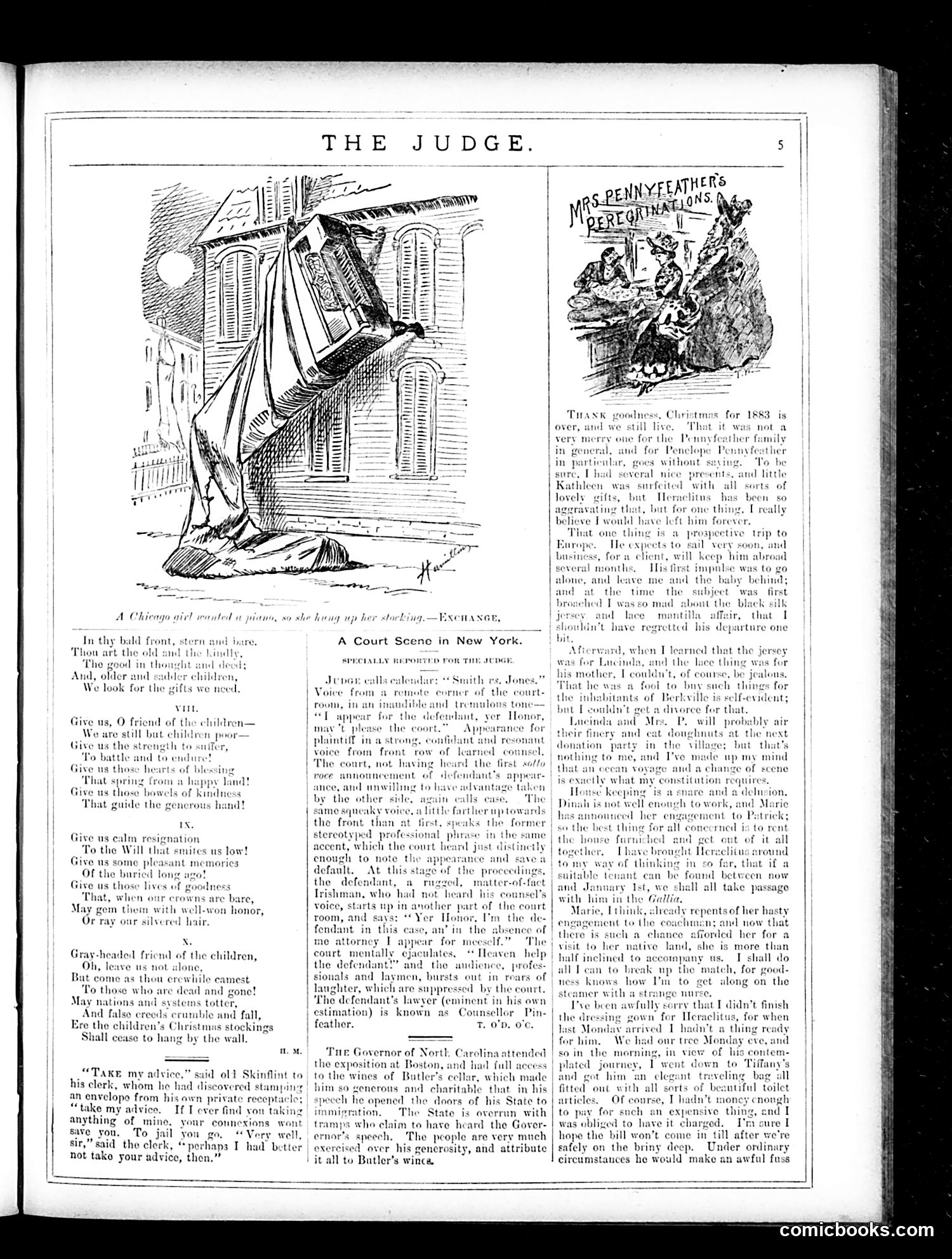
This page contains multiple satirical pieces typical of Judge's 1880s content: **Main Cartoon (left):** "A Chicago girl wanted a piano" depicts a woman in elaborate dress climbing outside a building facade, illustrated as absurdly dangerous behavior to obtain a luxury item—mocking wealthy pretension and materialism. **"Court Scene in New York":** Satirizes courtroom proceedings where a working-class Irish defendant ("Irishman") suddenly stands up and shouts his case passionately in broken English, disrupting formal legal decorum. The humor targets both Irish immigrant speech patterns and the contrast between dignified court procedures and crude reality. **"Mrs. Pennyfeather's Perambulations":** A domestic narrative mocking upper-class women's concerns—Christmas gifts, European travel plans, marital complications, servant problems—presented as simultaneously trivial and fraught with anxiety. Overall, the page ridicules American social classes: the wealthy for frivolous materialism, immigrants for cultural incompatibility, and society women for self-absorbed concerns, using exaggerated character types and dialect humor common to 1880s satirical magazines.
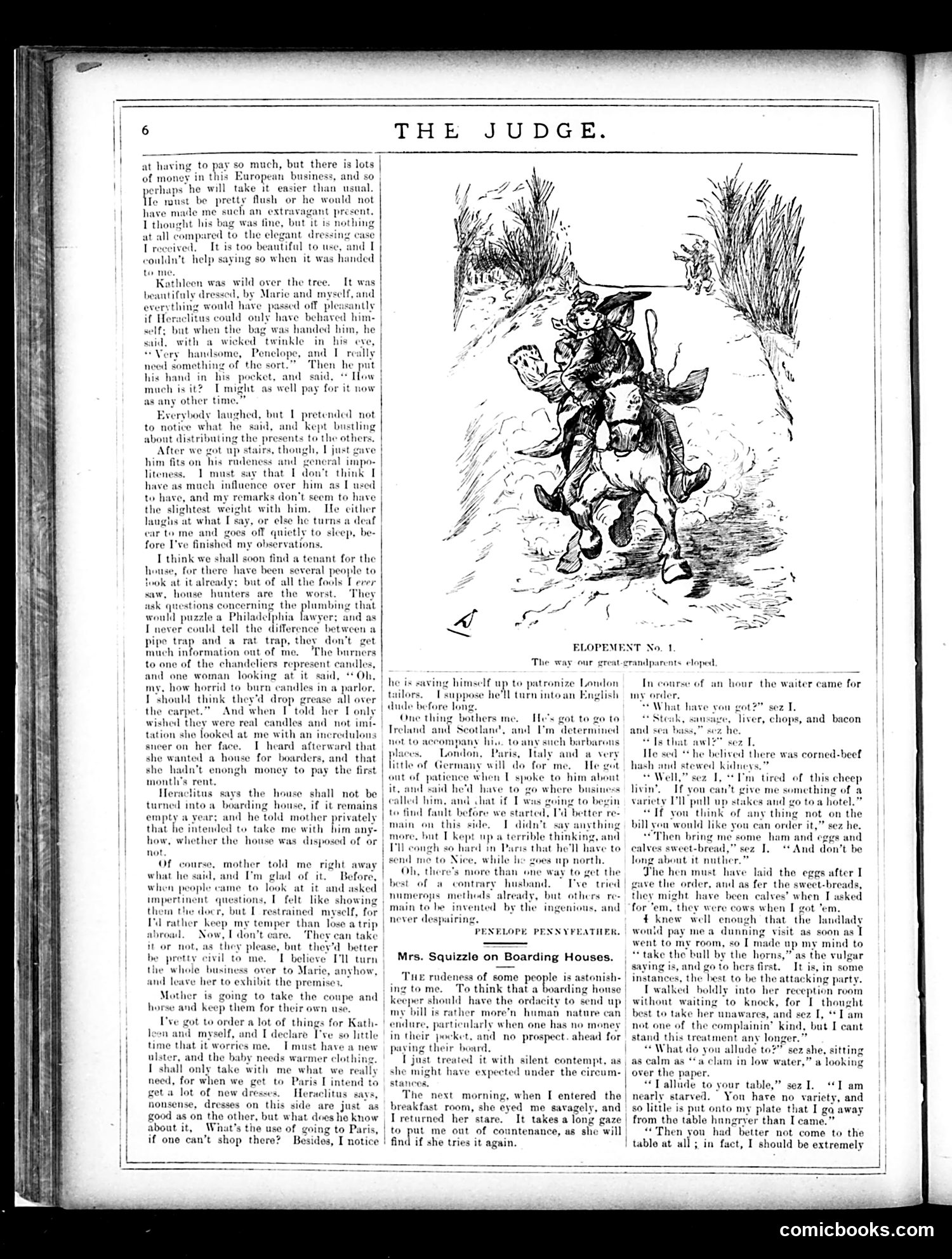
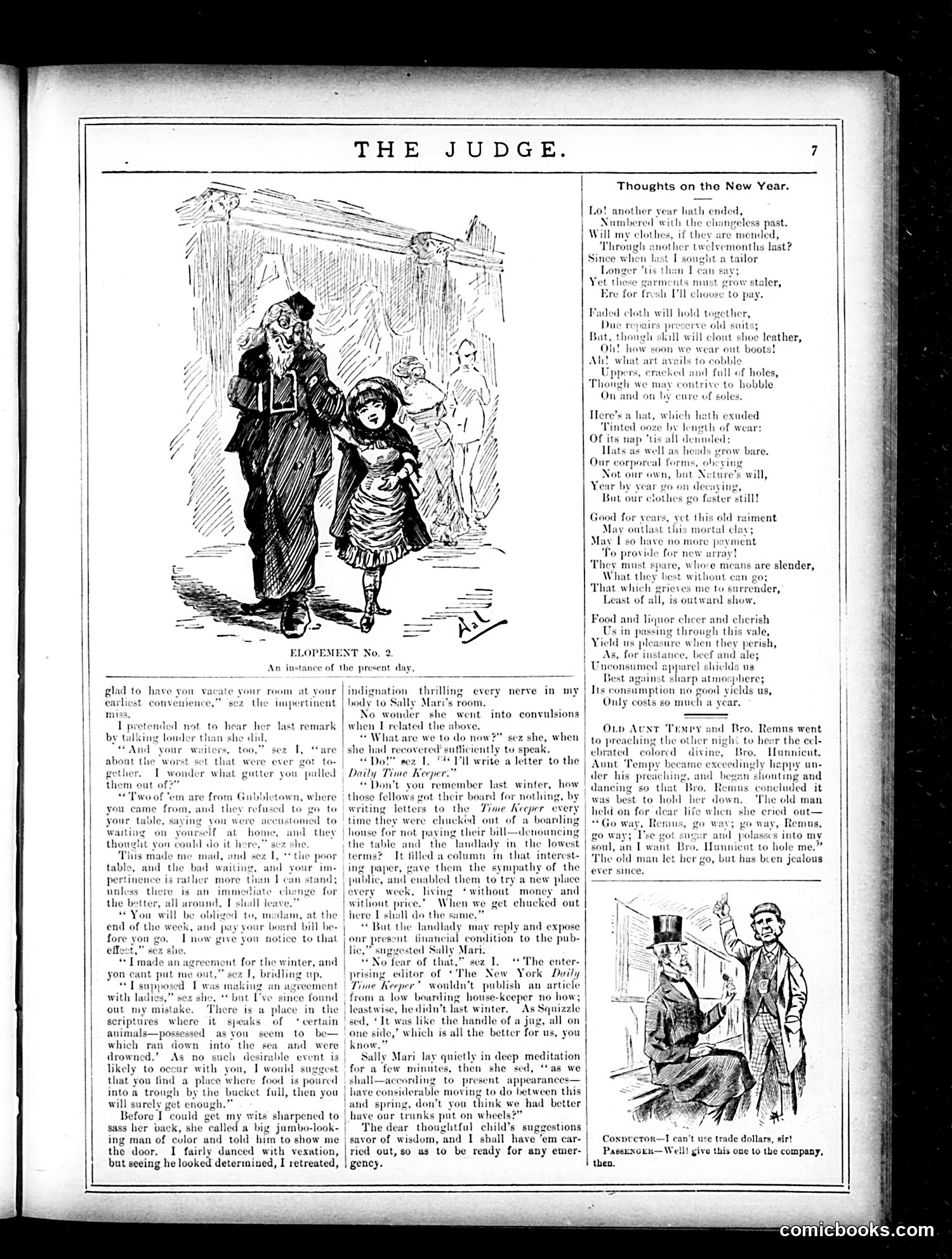
This page satirizes the precarious lives of poor boarding-house residents in late 19th-century America. The main cartoon depicts a confrontation between a deadbeat tenant and a landlady demanding payment or eviction. The satire's point: The tenant and his friend Sally Mari discuss evading the landlady by writing complaint letters to newspapers (like the *New York Daily Time Keeper*) to generate public sympathy, then moving to a new boarding house under false pretenses. The scheme relies on exploiting journalistic interest in "human interest" stories about the poor. The accompanying poem, "Thoughts on the New Year," reinforces the economic desperation theme—mending old clothes repeatedly, cobbling worn shoes, and stretching meager resources through another year. The final anecdote about "Old Aunt Tempy" adds domestic comedy to the economic hardship narrative. Together, these pieces mock both the resourcefulness of the impoverished and the gullibility of sentimental newspaper editors.
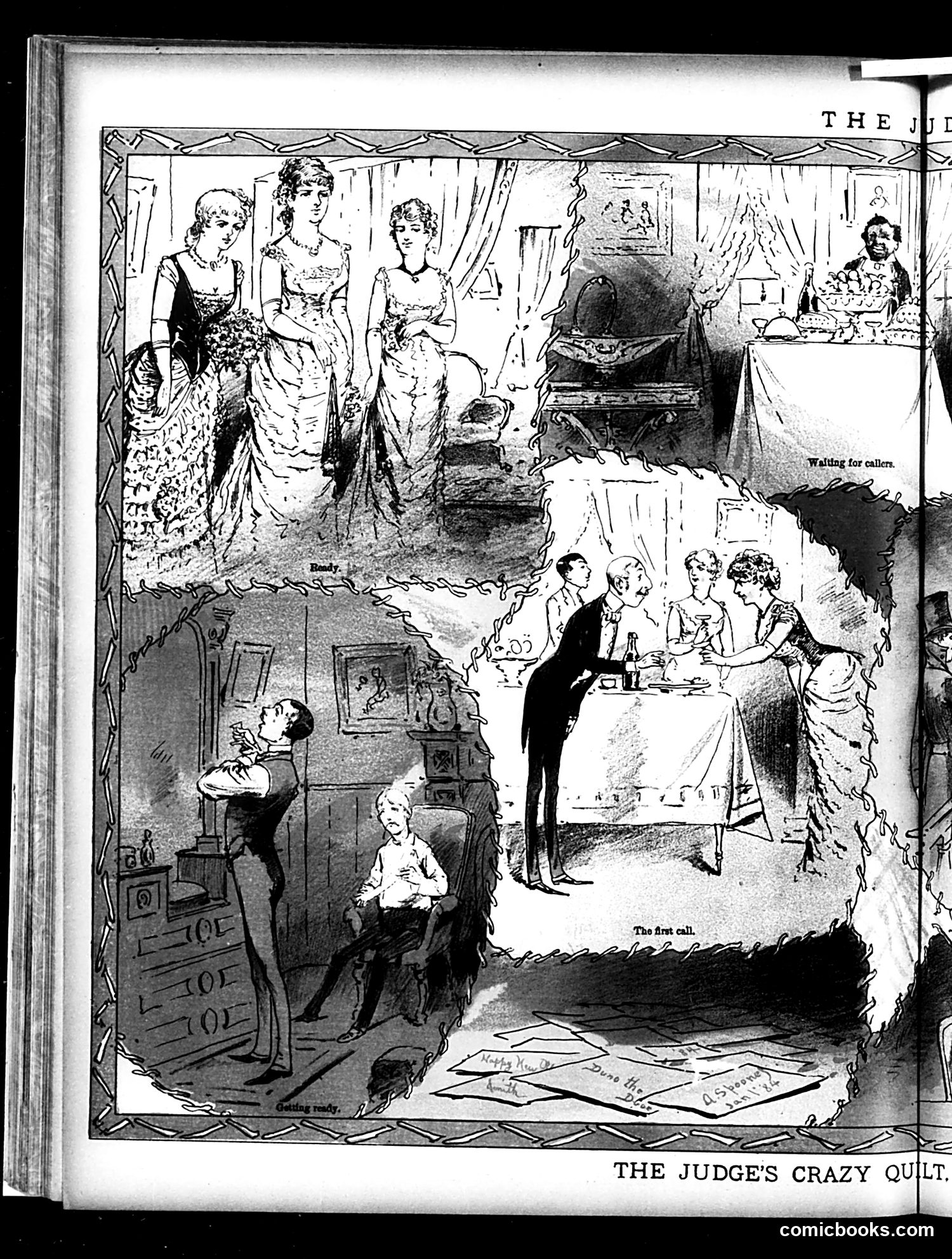
This appears to be a multi-panel satirical comic from *Judge* magazine depicting scenes of courtship and social calling. The title "Crazy Quilt" references the patchwork nature of the vignettes shown. The panels illustrate social rituals of the era: young men calling on women ("Waiting for callers," "Getting ready"), women preparing for visits in elaborate dress, and a formal dinner scene labeled "The first call." The humor targets Victorian courtship conventions—the anxious waiting, elaborate preparations, and stilted formality of gentleman callers visiting eligible women. The detailed interior furnishings and fashionable dress suggest this satirizes upper-class or middle-class social pretensions. Without clear political figures or specific dated references visible, this appears to be general social satire about courtship customs rather than political commentary.
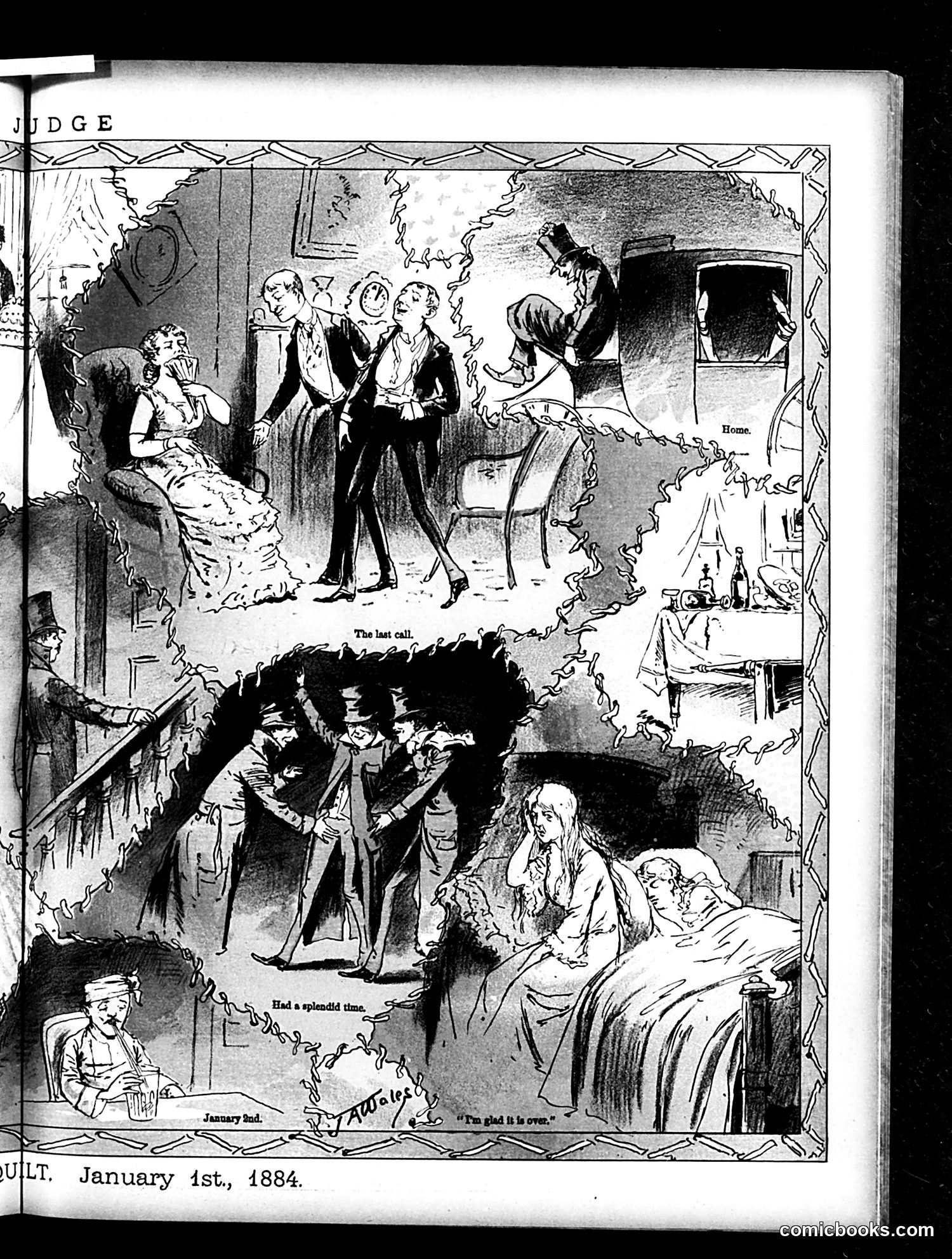
This multi-panel satirical cartoon appears to depict scenes of New Year's revelry and its consequences. The page shows contrasting scenes: the upper panels depict elegant social gatherings with well-dressed figures, while lower panels show darker, more chaotic scenes labeled "The last call" and "Had a splendid time," culminating in what appears to be a deathbed scene with the caption "I'm glad it is over." The satire critiques excessive New Year's celebration and drinking culture, contrasting the glamorous facade of holiday festivities with their actual destructive consequences—poverty, illness, and death. The "January Bed" reference and final scene suggest commentary on how New Year's indulgence leads to regret and suffering for revelers, particularly among lower classes.
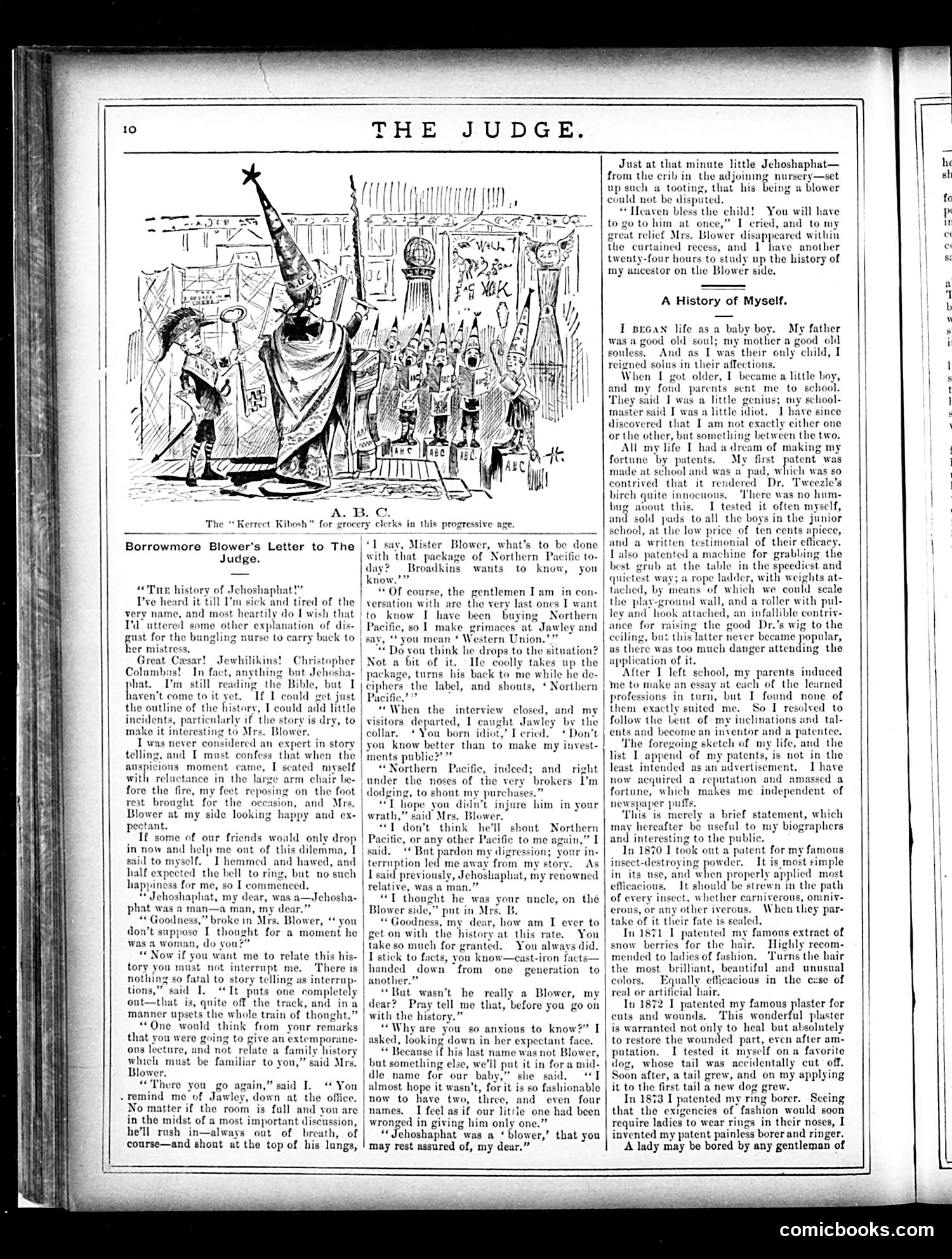
This page from *Judge* magazine satirizes verbose storytelling and domestic interruption. The main cartoon (top left) shows "The 'Kerrect Kibosh' for Grocery Clerks in this Progressive Age"—a humorous illustration of proper behavior. The lengthy letter below mocks a husband's tedious attempt to tell his wife the biblical history of Jehoshaphat. The satire targets: 1. **Nagging wives**: Mrs. Blower constantly interrupts with questions, derailing his narrative 2. **Workplace gossip**: He digresses about an annoying coworker (Jawley) who interrupts business conversations 3. **Pretentious genealogy**: The wife wants to use obscure names for their baby, caring more about fashionable ancestry than accuracy The humor derives from the husband's pompous insistence on "cast-iron facts" while being utterly unable to deliver a simple story without lengthy digressions. It's domestic comedy targeting both marital communication failures and period obsessions with genealogy and "progressive age" propriety.
This page contains **autobiographical humor** from a character named Nozias Huckaback, who catalogs his absurd patent inventions. The satire targets the era's obsession with labor-saving gadgets and mechanical "improvements." Key inventions lampooned include: an ottoman for couples (to test compatibility), a self-adjusting servant's bed, special honeymoon lines, a mechanical Banbury horse toy, a galvanic device to control sulking horses, and a weighted "protective club" to keep husbands home from smoking establishments. The humor climaxes with Huckaback's admission he invented a "recipe for cooking missionaries" during travels to Fiji—a darkly comic jab at 19th-century colonial attitudes and the absurdity of treating human problems as mechanical puzzles. The lower sections contain **lighthearted children's anecdotes** ("Smart Little Ones") and a sentimental poem ("The Sun and Moon"), typical filler content for satirical magazines of this period. The page ridicules Victorian-era inventor culture and mechanical solutions to complex social problems.
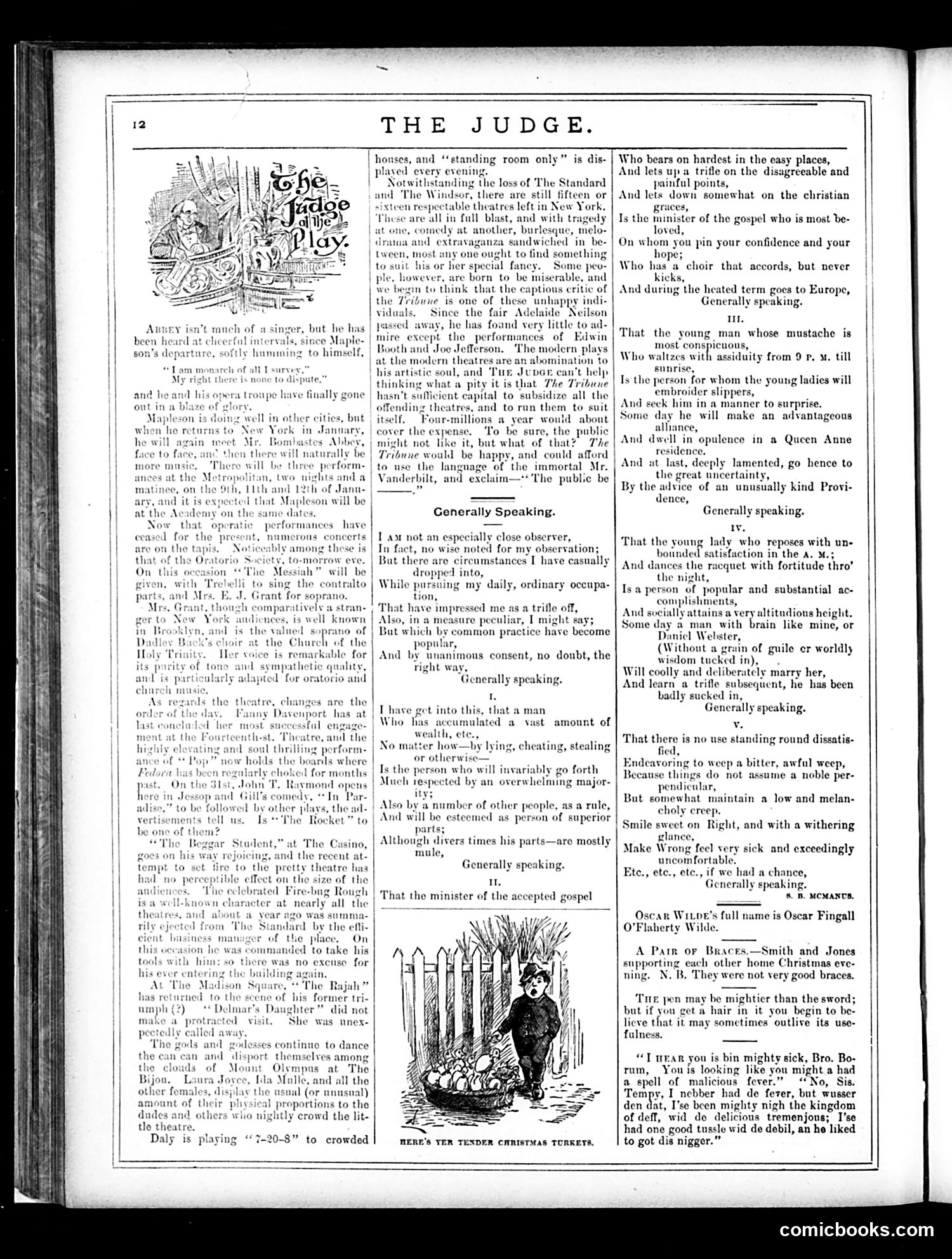
This page contains theatrical criticism and social commentary typical of Judge's satirical voice. The main cartoon depicts a street vendor selling Christmas turkeys, captioned "There's Yer Tender Christmas Turkeys" — likely a joke about the quality or toughness of affordable holiday poultry. The text mocks New York's theatrical scene, criticizing a Tribune critic for being perpetually dissatisfied despite having fifteen theaters operating. It sarcastically suggests the critic should subsidize theaters according to his own tastes, a jab at unrealistic aesthetic demands. The "Generally Speaking" sections contain broader social satire: they mock wealthy men—regardless of how they accumulated their fortunes through "lying, cheating, stealing"—who receive undeserved social respect. The final section satirizes hypocritical ministers who are beloved because they maintain pleasant choirs, avoid controversy, and conveniently vacation during hot summers. The satire targets elites who gain unearned status through wealth or religious position rather than genuine merit.
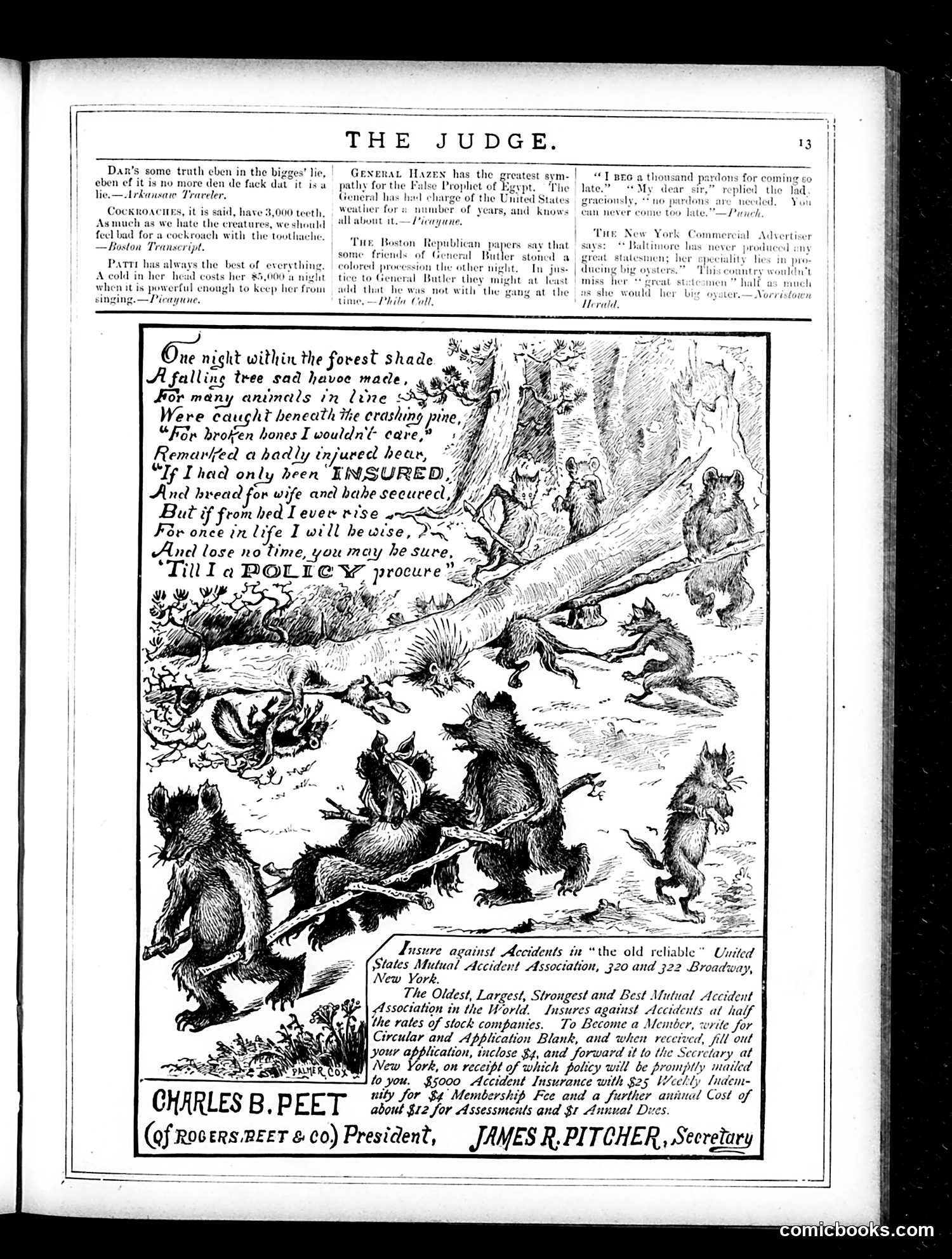
This page is primarily **advertising disguised as editorial content**. The main feature is a cautionary fable illustrated with animals trapped under a fallen tree. A injured bear remarks that while he wouldn't worry about broken bones, he *will* become wise and purchase insurance—specifically accident insurance—if he survives. The satire is straightforward: the cartoon mocks how people only learn prudent lessons (like buying insurance) after disaster strikes. The bear's delayed wisdom reflects human nature—we ignore risks until experiencing harm. The advertisement promotes the **United States Mutual Accident Association**, emphasizing it as "the old reliable" insurer offering accident coverage at half the rates of stock companies. The company's leaders (Charles B. Peet and James R. Pitcher) are named at bottom. The page includes brief quoted quips at top from various newspapers, a common Judge feature providing social commentary filler. This represents Judge's characteristic blend: **satirical humor serving commercial interests**.
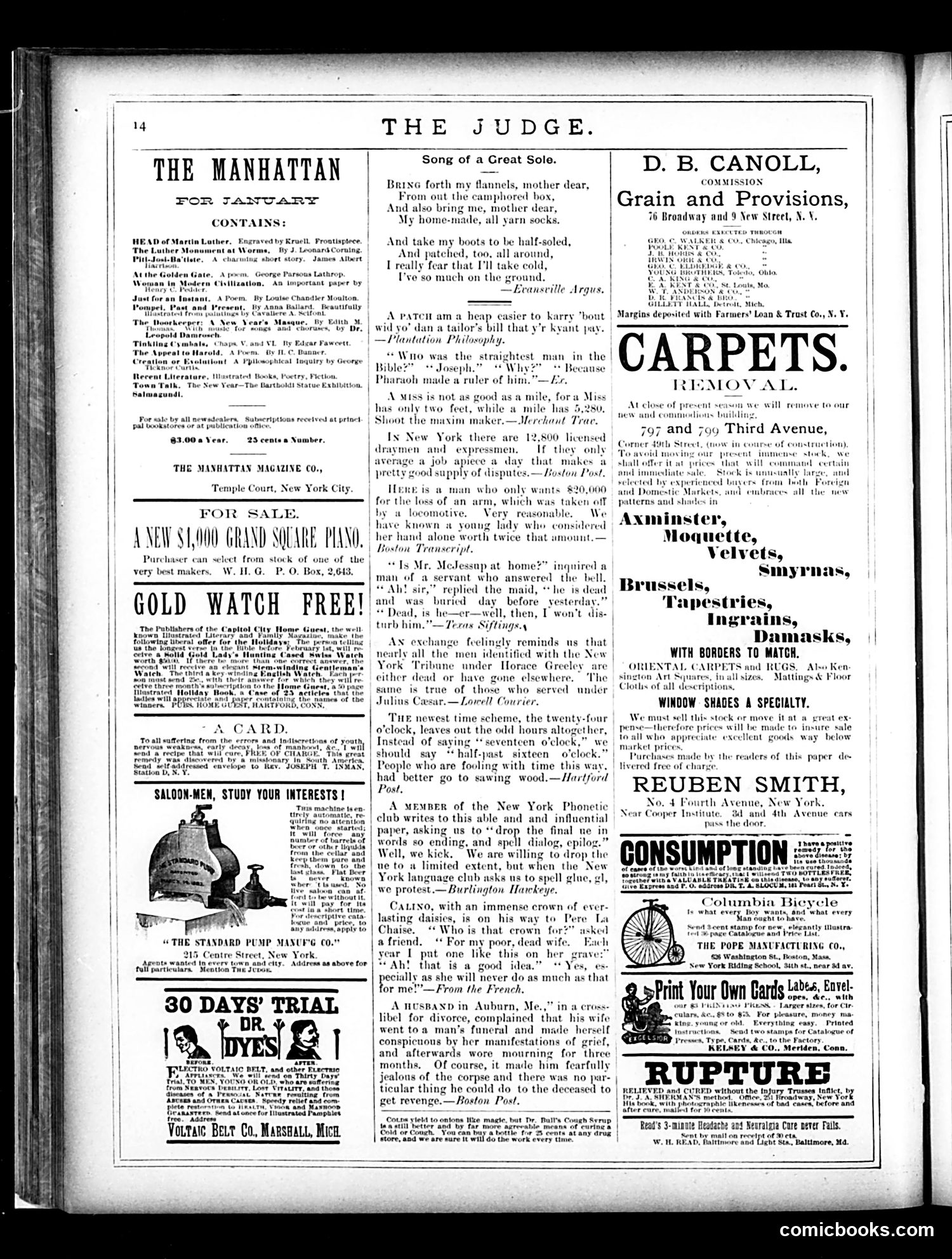
This page is primarily **advertisements and filler content** rather than political satire. The main items are: **Advertisements:** Piano sales, watches, carpets, bicycles, printing services, and various patent medicines dominate the page. The "Voltaic Belt" ad promises cures for "weakness," a common dubious health claim of the 1880s-90s. **Humorous Filler:** Short satirical quips appear scattered throughout—jokes about shoeshining, marriage, time-keeping, and newspaper rivalries. One mocks a woman mourning a stranger at a funeral, implying jealousy. Another references Horace Greeley and Julius Caesar as dead/departed figures associated with the *New York Tribune*. **Social Commentary:** A "Plantation Philosophy" piece uses dialect to joke about patents versus debts—this reflects the magazine's approach to humor, though the racial language would be considered offensive today. **Context:** *Judge* was a humor/satire magazine, so these scattered jokes represent its editorial content between paid advertising. Most jokes target upper-class anxieties, marital discord, and contemporary absurdities rather than specific political figures.
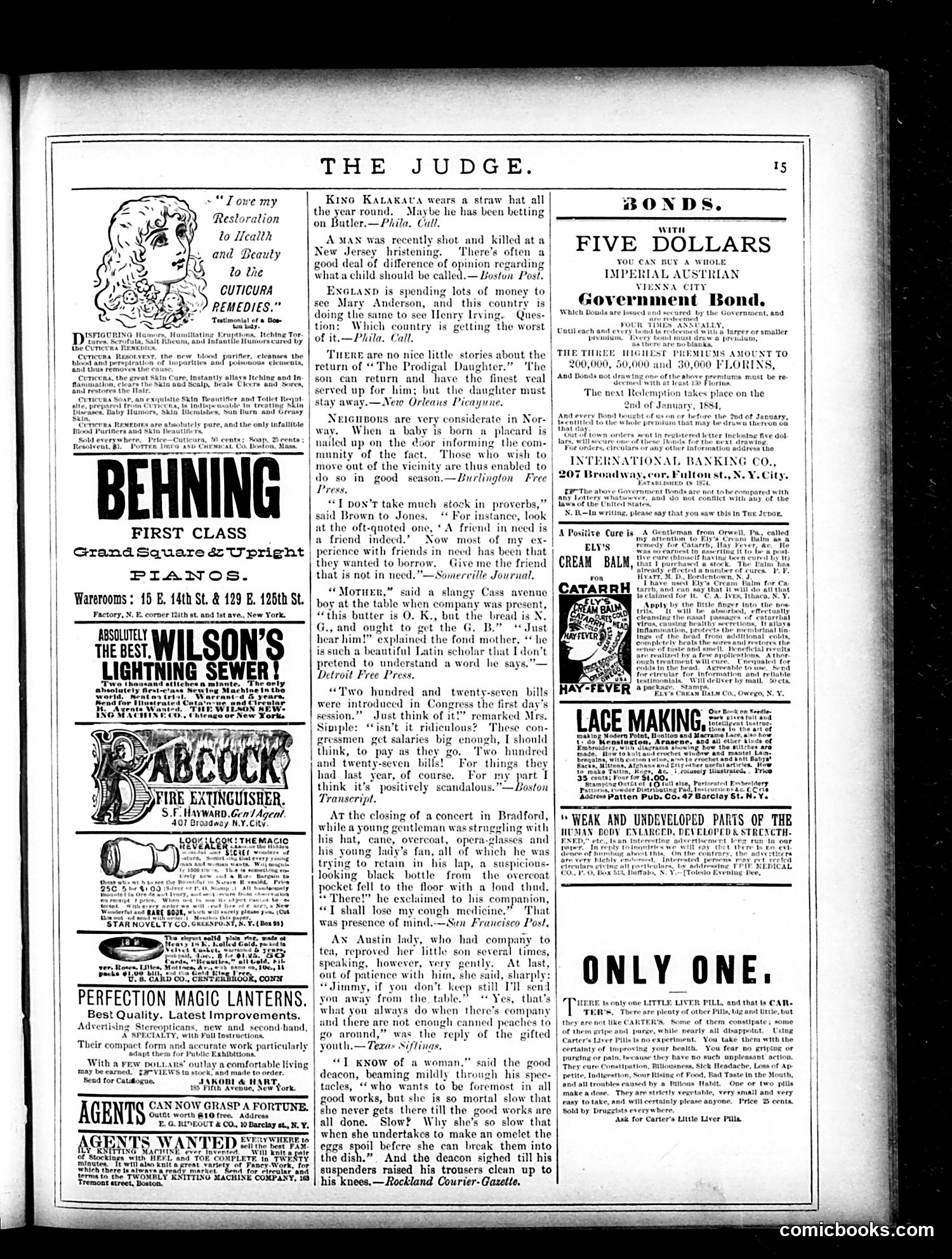
This page is primarily **advertisements and miscellaneous humor**, not political cartooning. The layout is typical of Judge magazine's mixed format combining ads with jokes. The brief satirical items are mild social observations: - **King Kalakaua** (Hawaiian monarch) wearing a straw hat year-round—possibly joking he's been betting heavily on General Benjamin Butler (unclear what specific bet is referenced). - A quip about naming disputes at christenings. - Humor about England sending money to see Henry Irving perform—sarcastically asking which country loses in the deal. - Various other short jokes about proverbs, congressional bills, social etiquette, and slow women—typical late-19th-century domestic humor that doesn't require specific political knowledge to understand. There are no identifiable political cartoons on this page—instead, it's filled with product advertisements for pianos, beauty treatments, lanterns, and other goods, interspersed with brief comic anecdotes typical of Judge's content.
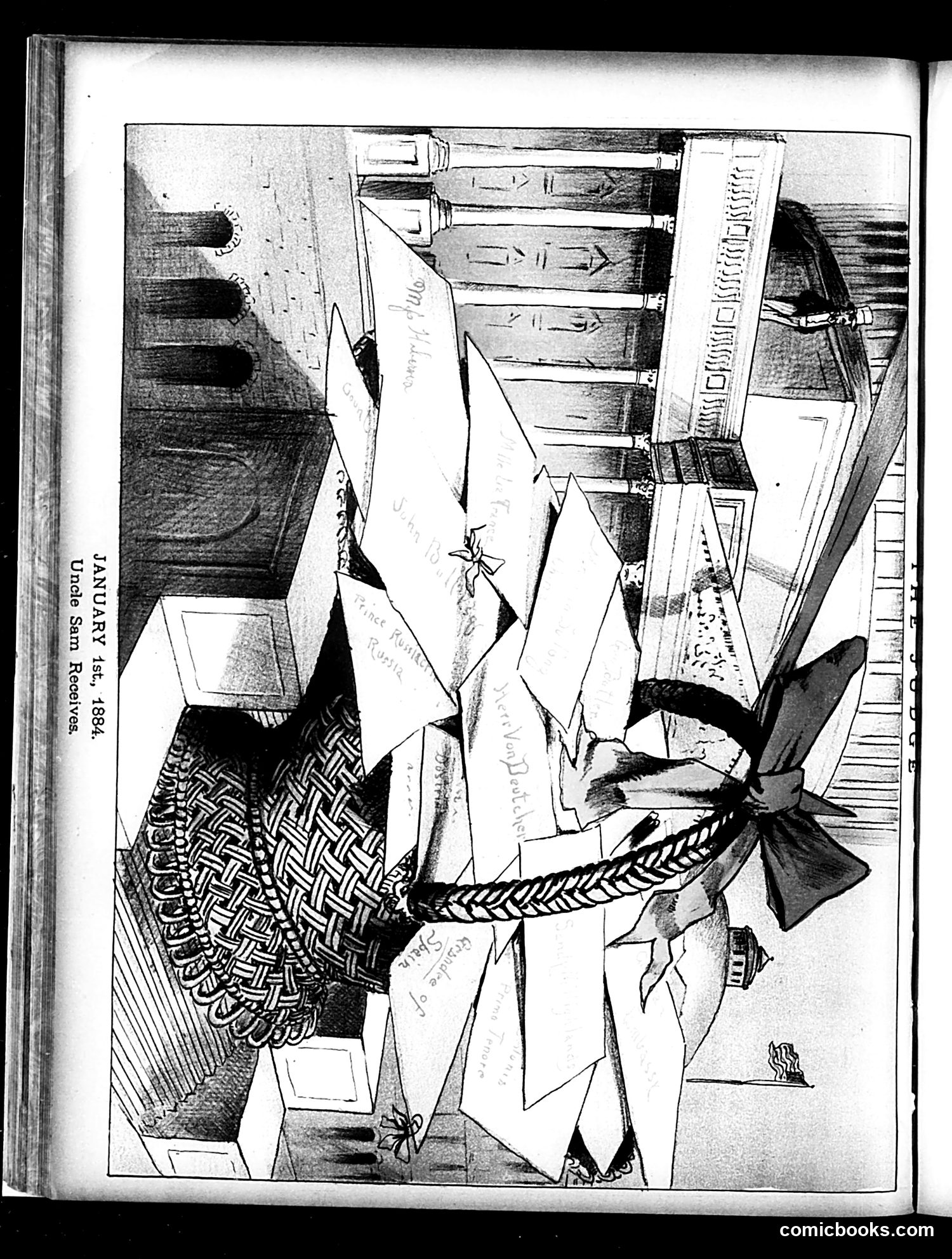
This page is printed upside-down, making analysis difficult. The visible text references appear corrupted in OCR. From the image, I can discern this is from **Judge magazine** (visible in the spine marking), a satirical publication known for political and social commentary. The illustration shows what appears to be a formal indoor scene with multiple figures in period dress, though the inverted orientation prevents confident identification of specific individuals or the cartoon's precise subject matter. There are architectural elements, furniture, and what appears to be formal attire suggesting a political or social gathering of importance. Without legible text or correct orientation, I cannot reliably identify which political figures or events are being satirized. The image quality and inversion prevent accurate historical interpretation.