
Judge, 1884-01-05 · page 2 of 16
Judge — January 5, 1884 — page 2: what you’re looking at
What you’re looking at
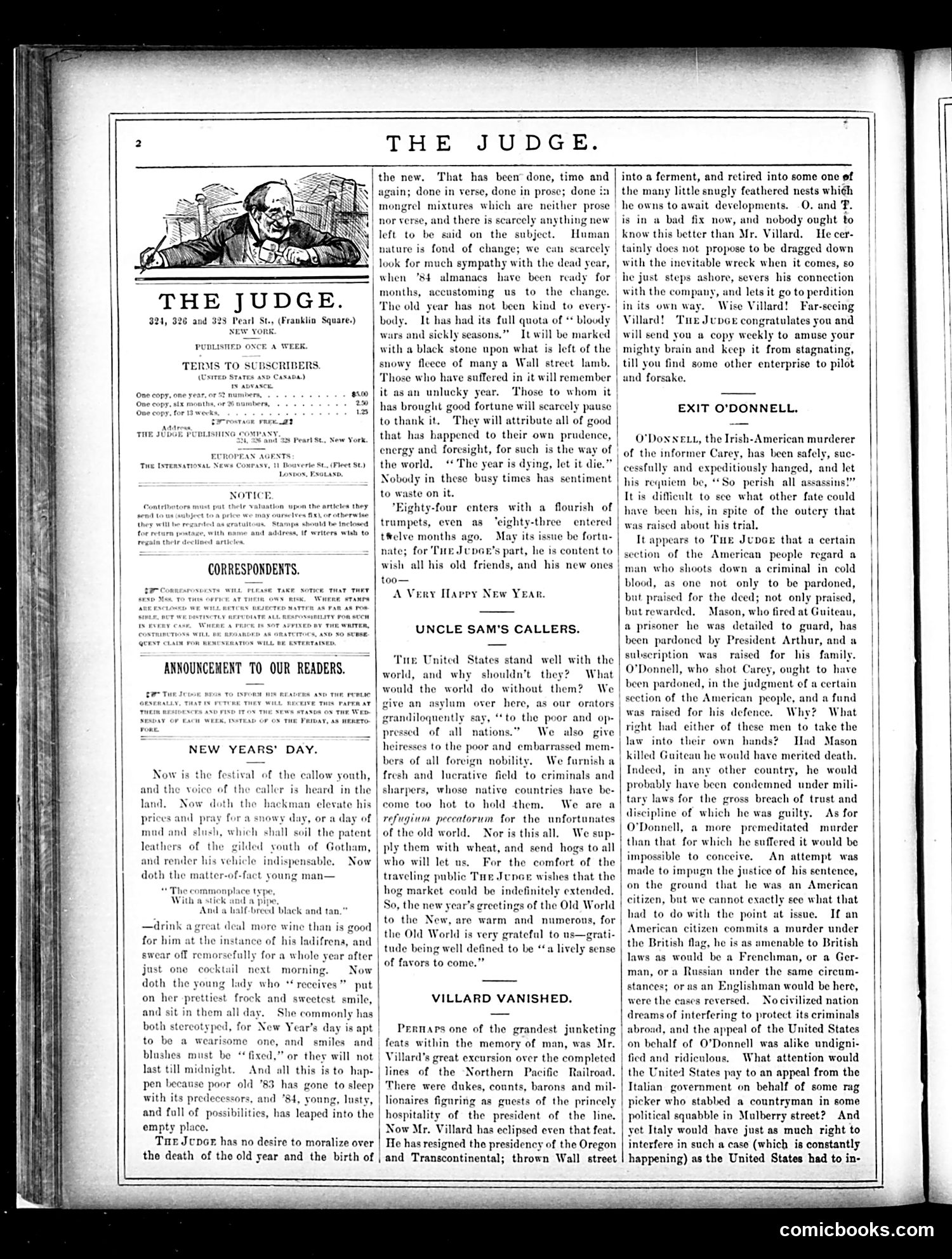
The page contains several satirical pieces mocking American social pretensions and hypocrisy circa 1884-1885. **The main cartoon** (top left) depicts a grotesque figure—likely representing greedy capitalism or Wall Street excess—surveying the year ahead. The accompanying "New Year's Day" essay satirizes how New Yorkers ritualize the new year while ignoring substantive moral reflection. **"Uncle Sam's Callers"** mocks American self-righteousness: the U.S. boasts of sheltering the world's poor and oppressed, yet simultaneously profits from them—supplying wheat, exporting pork, and apparently attracting criminals and con artists ("refugium peccatorum"). The satire suggests America's charitable reputation masks mercenary motives. **"Villard Vanished"** references railroad magnate Henry Villard's famous 1883 Northern Pacific excursion featuring European nobility. The piece ironically notes that despite this grand junket, Villard later "vanished," likely alluding to his subsequent business failures—a commentary on the hollowness of gilded-age prosperity built on speculation rather than substance.
📄 Transcribed text from this page (OCR, searchable)
Machine-transcribed from the original scan — historical spelling and the odd misread are preserved.
THE JUDGE. THE JUDGE. 324, 326 and 323 Pearl S Franklin Square.) ECROPEAN AGENTS Tue terensariovat Neves Conrasy, It Bouverte St. (Piet $t) CORRESPONDENTS. ON THE SWS KTASDS 8 THE Weep. OF EACH WEEK, INSTEAD OF ON THE FRIDAY, A8 HERETO: NEW YEARS’ DAY. Now and the v the festival of the callow youth, ce of the caller is heard in the land. Now doth the hackman elevate his prices and pray fora snowy day, or a day of lush, which shall soil the patent gilded youth of Gotham, Now mad and leathers of the and render his vehicle indispensable. doth the matter-of. commonplace ty a stick and a pipe. And a half-breed black and tan.” Ww —drink agreat deal more wine than is for him at the instance of his Iadifrena, swear off remorsefully for a whole 3 just one cocktail next mornir doth the young lady who * on her ‘prettiest frock and sit in them all d both stereotyped, for receives and sweetest smile, She ¢ ew Y ay is apt one, and and fixed,” or they will not last midn And all this is to hap- pen because poor old '83 h with its predecessors, and 84, and full of possibilities, empty place, Tue Jcpor has no desire to moralize over | the death of the old year and the birth of | mmonly has | rs to be a wearisome blushes must be “ smiles gone to sleep young, lusty, | has leaped into the | when | grandiloquently | pressed of all nat the new. That has been done, timo and again; done in verse, done in prose; done i: mongrel mixtures which are neither prose nor verse, and there is scarcely anything new left to be said on the subject. Human nature is fond of change; we can sea look for much sympathy with the dead year, ’84 almanacs have been ready months, accustoming us to the ch; ld year has not been kind to ever It has had its full quota of ** bloody and sickly seasons.” It will be marked with a black stone upon what is left of the snowy fleece of many a Wall strect lamb. Those who have suffered in it will remember it asan unlucky year. Those to whom it has brought good fortune will s to thank it. They will attribute all of good that has happened to their own prudence, energy and foresight, for such is the way of the world. ‘* The Nobody in these busy times has sentiment to waste on it. *Eighty-four trumpets, even as tfelve months ago. nate; for Tur Jun rely pause enters with a flourish of *eighty-three May its issue be fortu- rt, he is content to wish all his old friends, and his new ones | too— A Very [Harpy New Year. UNCLE SAM'S CALLERS. Tue world, United States stand well with the and why shouldn't. they What would the world do without them? We give an asylum over here, as our orators “to the poor and op- ions.” We heiresses to the poor and embarr bers of all foreign nobility. fresh and lucrative field to criminals and sharpers, whose native countries have be- come too hot to hold them. We are a refugium peceatorum for the unfortunates of the old world. Nor is this all. We sup- ply them with wheat, and send hogs to all who will let us. or the comfort of the traveling public Toe JunGe wishes that the hog market could be indefinitely extended. So, the new year’s greetings of the Old World to the e warm and numerous, for | the Old World is very grateful to us—grati- also give tude being well defined to be ‘a lively sense | of favors to come. VILLARD VANISHED. Pernars one of the grandest junketing feats within the memory of man, was Mr. Villard’s great excursion over the completed lines of the Northern Pacific Railroad. | There were dukes, counts, barons and mil- lionaires figuring as guests of the princely hospitality of the president of the line. Now Mr. Villard has eclipsed even that feat. He has resigned the presidency of the Oregon and Transcontinental; thrown Wall street ar is dying, let it die.” | entered | ed mem- | > furnish a | into a ferment, and retired into some one ef the many little snugly feathered nests whigh he owns to await developments. O. and P. is in a bad fix now, and nobody ought to know this better than Mr. Villard. He cer- tainly does not propose to be dragged down with the inevitable wreck when it comes, so he just steps ashore, severs his connection with the company, and lets it go to perdition | in its own way. Wise Villard! Far-secing Villard! Tue JupGe congratulates you and will send you a copy weekly to amuse your mighty brain and keep it from stagnating, till you find some other enterprise to pilot | and forsake. EXIT O'DONNELL, O'Don SELL, the Irish-. | of the informer Care: American murderer has been safely, suc- cessfully and expeditiously hanged, and let So perish all assassins!” It is difficult to sce what other fate could have been his, in spite of the outery that was raised about his trial. It appears to Tue JupGE that a certain ection of the American people regard a man who shoots down a criminal in cold blood, not only to be pardoned, d for the deed; not only praised, Mason, who fired at Guiteau, a prisoner he was detailed to guard, has been pardoned by President Arthur, and a subscription was raised for his family. O'Donnell, who shot Carey, ought to have his requiem be as one section of the American people, | was raised for his defence. Why t had either of these men to take the into their own hands? Had Mason killed Guiteau he would have merited death, Indeed, in any other country, he would probably have been condemned under mili- tary laws for the gross breach of trust and | discipline of which he was guilty, As for O'Donnell, a more premeditated murder than that for which he suffered it would be impossible to conceive. An attempt was made to impugn the justice of his sentence, on the ground that he was an American | citizen, but we cannot exactly see what that had to do with the point at issue. If an | American citizen commits a murder under | the British flag, he is as amenable to British ja as would be a Frenchman, or a Ger- man, ora Russian under the same circum- stances; or as an Englishman would be here, were the cases reversed. No civilized nation dreams of interfering to protect its criminals | abroad, and the appeal of the United States on behalf of O'Donnell was alike undigni- fied and ridiculous, What attention would the United States pay to an appeal from the Italian government on behalf of some rag | picker who stabbed a countryman in some political squabble in Mulberry street? And yet Italy would have just as much right to interfere in such a case (which is constantly happening) as the United States had to in- law | comicbooks.com