
A complete issue · 16 pages · 1883
Judge — October 6, 1883
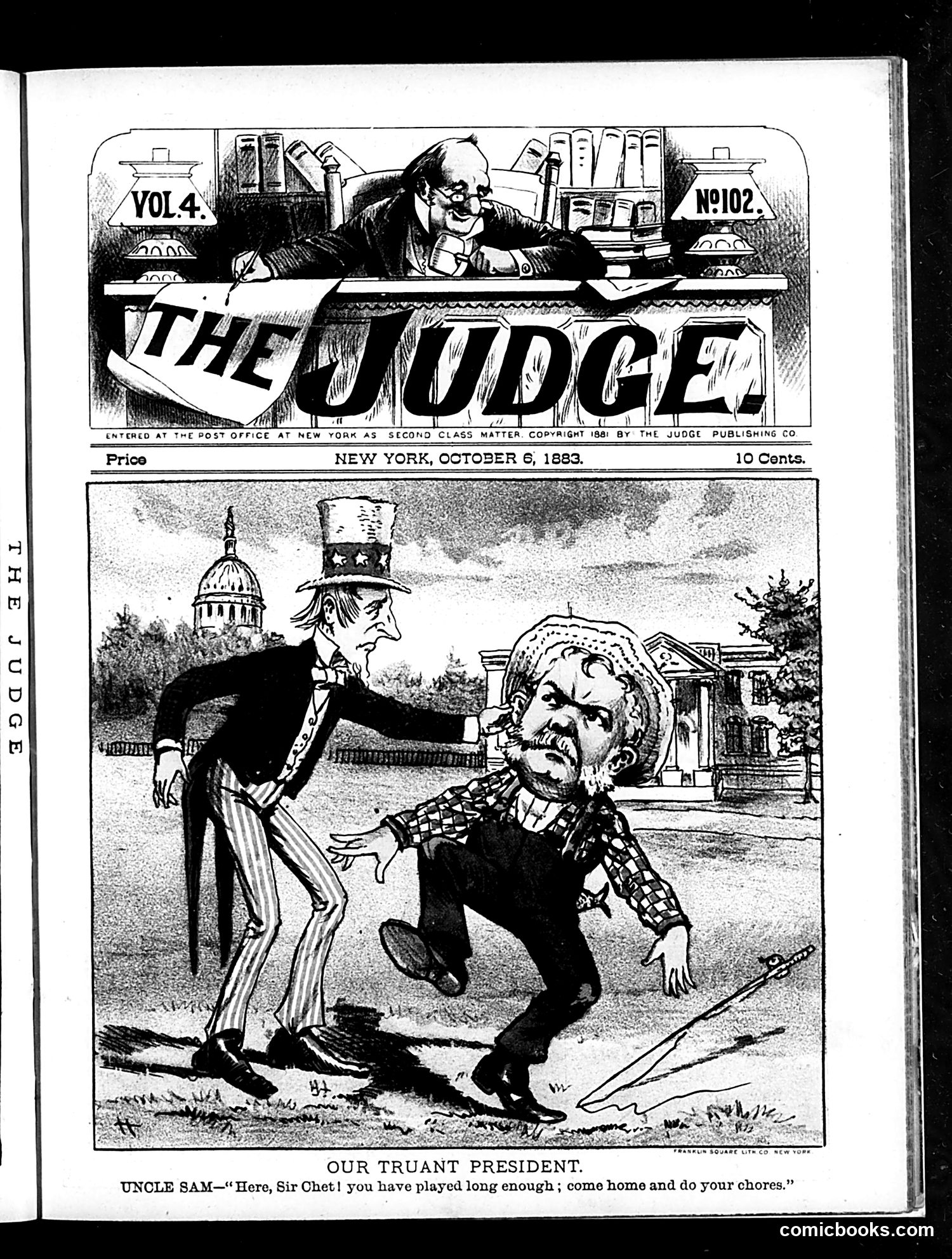
This political cartoon titled "Our Truant President" depicts Uncle Sam (the tall figure in striped pants and top hat) scolding a smaller caricatured figure labeled as a "truant president." The caption has Uncle Sam saying: "Here, Sir Chet! you have played long enough; come home and do your chores." The satire criticizes a sitting U.S. president for neglecting duties—the "chores" represent presidential responsibilities. The "truant" metaphor suggests the president has been absent or shirking work. The Capitol building visible in the background reinforces the political setting. Without additional context, the specific president and incident referenced are unclear, though the date (1883) and tone suggest criticism of executive performance during that period.
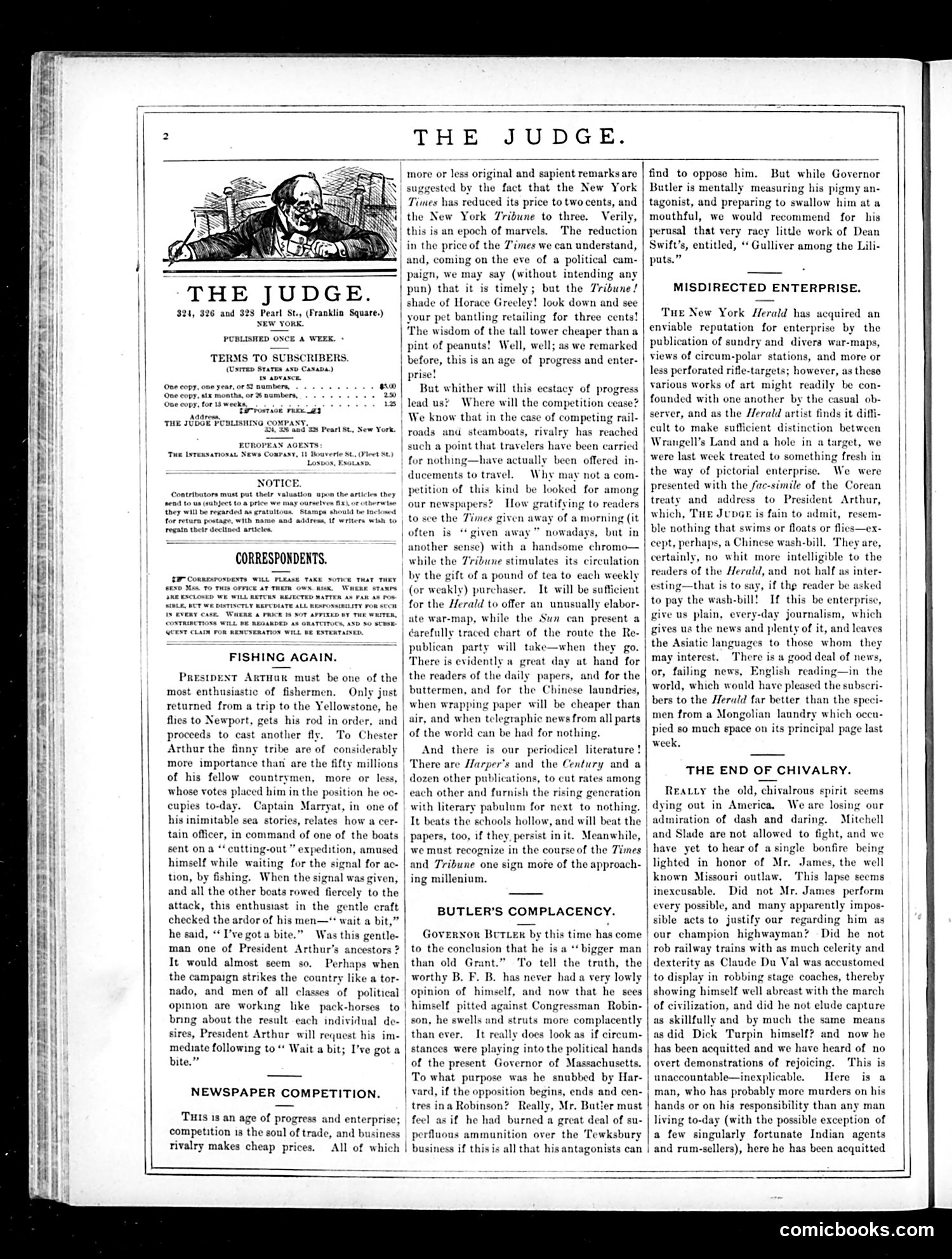
## "Fishing Again" This satirizes President Chester Arthur's perceived priorities. The piece criticizes Arthur for fishing trips to Yellowstone and Newport when he should be campaigning. The joke compares him to a naval officer who delayed battle to land a fish—suggesting Arthur cares more about sport fishing than governing 50 million citizens. The implicit criticism: Arthur is neglecting his presidential duties during an important political campaign season. ## "Newspaper Competition" This section mocks the price war between major New York newspapers. The *Times* cut to two cents and the *Tribune* to three cents. Judge sarcastically praises this "progress," then absurdly extrapolates: if competition continues, papers will soon *pay* readers to take them, offering chromos, tea, and elaborate maps. The satire criticizes newspapers' desperate competition driving down prices and quality in pursuit of circulation—a concern about sensationalism over substance.
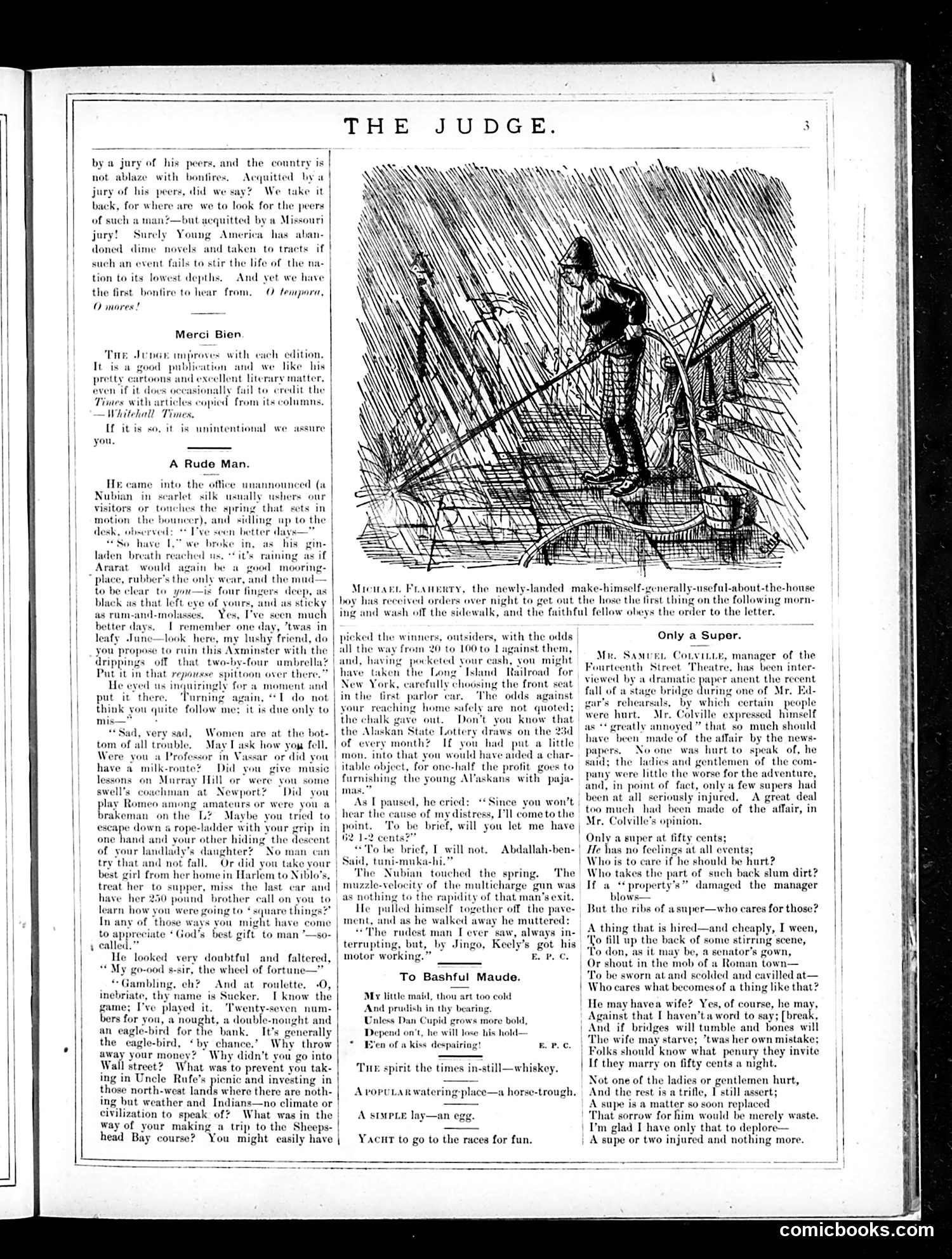
This page contains several satirical pieces mocking contemporary American society circa the 1880s-90s: **Main Cartoon (top right):** Shows a figure at a ship's helm in stormy seas—likely representing the U.S. government navigating troubled waters, a common political metaphor. **"A Rude Man":** Satirizes an uncouth visitor who enters a newspaper office dripping wet, then launches into crass questioning about the editor's personal life (failed romances, gambling, financial schemes). The satire mocks both the visitor's rudeness and implicitly critiques wasteful American behaviors—gambling, speculation, frivolous spending. **"To Bashful Maude":** A brief poem teasing a prudish young woman for being overly reserved. **Opening text:** References acquittal by a "Missouri jury" (unclear which case), sarcastically questioning whether peers exist for such a person—commenting on perceived jury incompetence or regional justice failures. The page reflects Judge's focus on social commentary through humor, targeting bad manners, financial excess, and judicial failures in Gilded Age America.
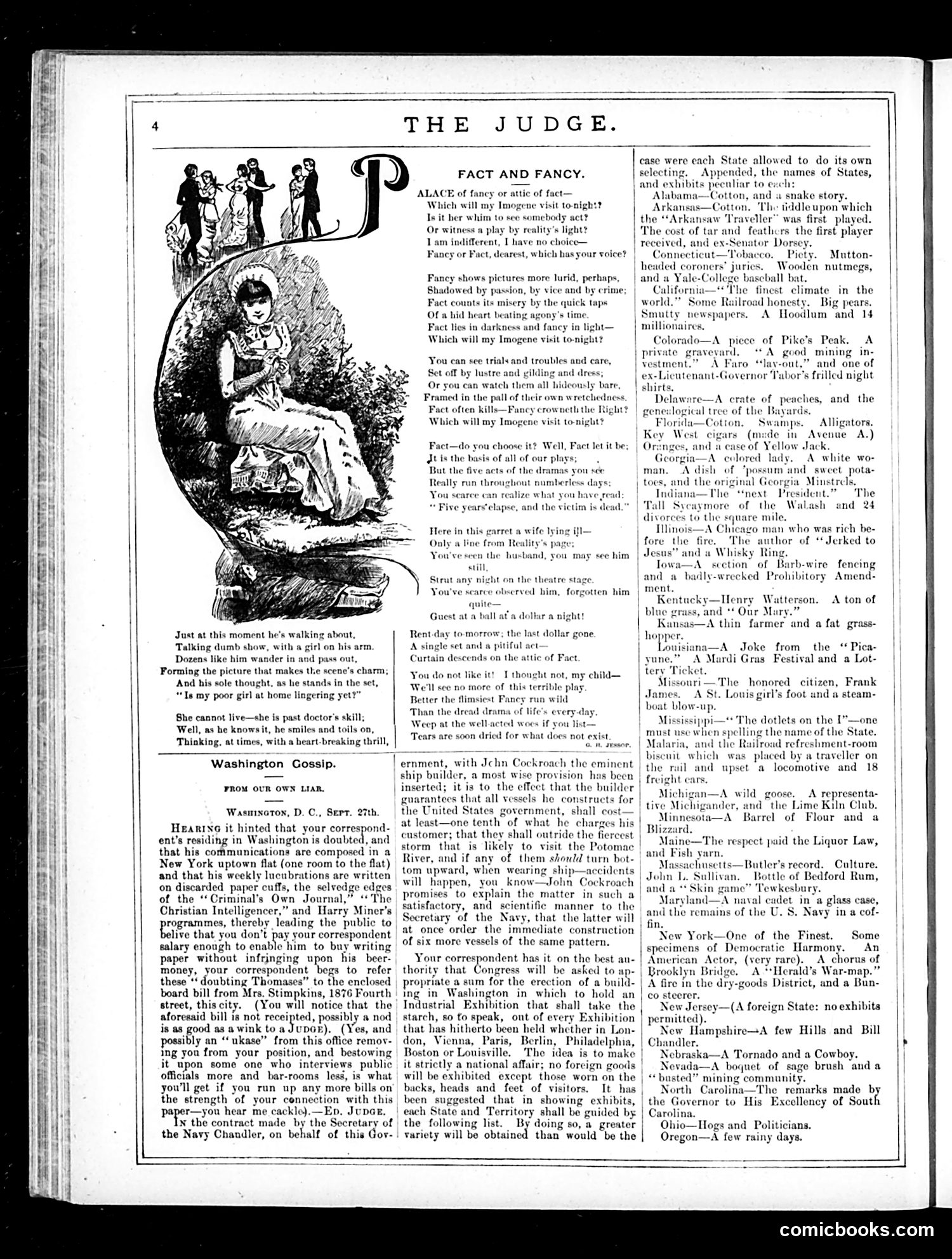
This page contains two distinct satirical pieces: ## "Fact and Fancy" (Main Illustration) A poetic meditation on theatrical escapism versus harsh reality. The illustrated narrative contrasts a theater patron's romantic evening with his dying wife waiting at home. The satire critiques middle-class aspirations and the theater's role as an escape from genuine suffering—suggesting audiences prefer comfortable fiction to confronting life's tragedies. ## "Washington Gossip" (Bottom Section) A mock-serious column where the correspondent defends himself against accusations that he doesn't actually work in Washington. The humor lies in his "evidence"—an unpaid boarding house bill from a Mrs. Stimpkins. The editor's caustic response (in brackets) mocks his expense-running and implies threats of dismissal. This satirizes Washington correspondents' questionable practices and editorial frustrations with freelance writers. Both pieces exemplify Judge's characteristic blend of social criticism and workplace humor targeting contemporary American life and institutions.
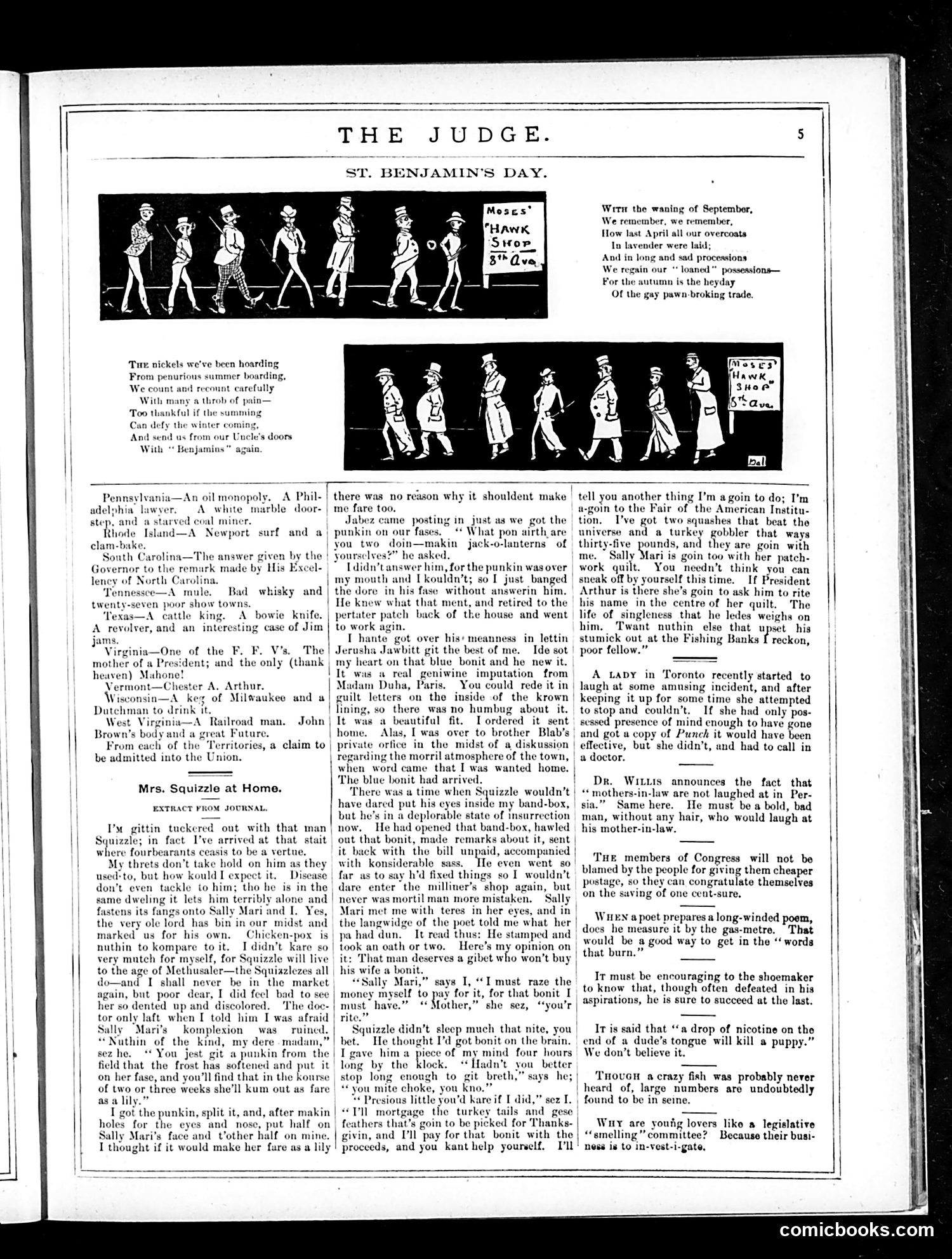
This page satirizes American materialism and regional stereotypes circa the 1870s-80s. The two cartoon strips depict figures in processions labeled "Moses' Hawk Shop" (a pawnbroker), mocking Americans' financial desperation—particularly the annual autumn cycle of reclaiming winter coats from pawnbrokers (the "heyday of the gay pawn-broking trade"). The accompanying text lists crude regional caricatures: Pennsylvania as oil monopolies, Tennessee as mules and whiskey, West Virginia as railroad workers. These mock each state's defining characteristics or scandals. "Mrs. Squizzle at Home" is a humorous domestic sketch (in phonetic dialect) depicting a frustrated wife dealing with her careless husband's behavior—he destroys her prized bonnet from Paris without paying the bill, exemplifying male insensitivity and financial irresponsibility. The overall message ridicules American greed, regional vulgarity, and marital discord as defining national traits.
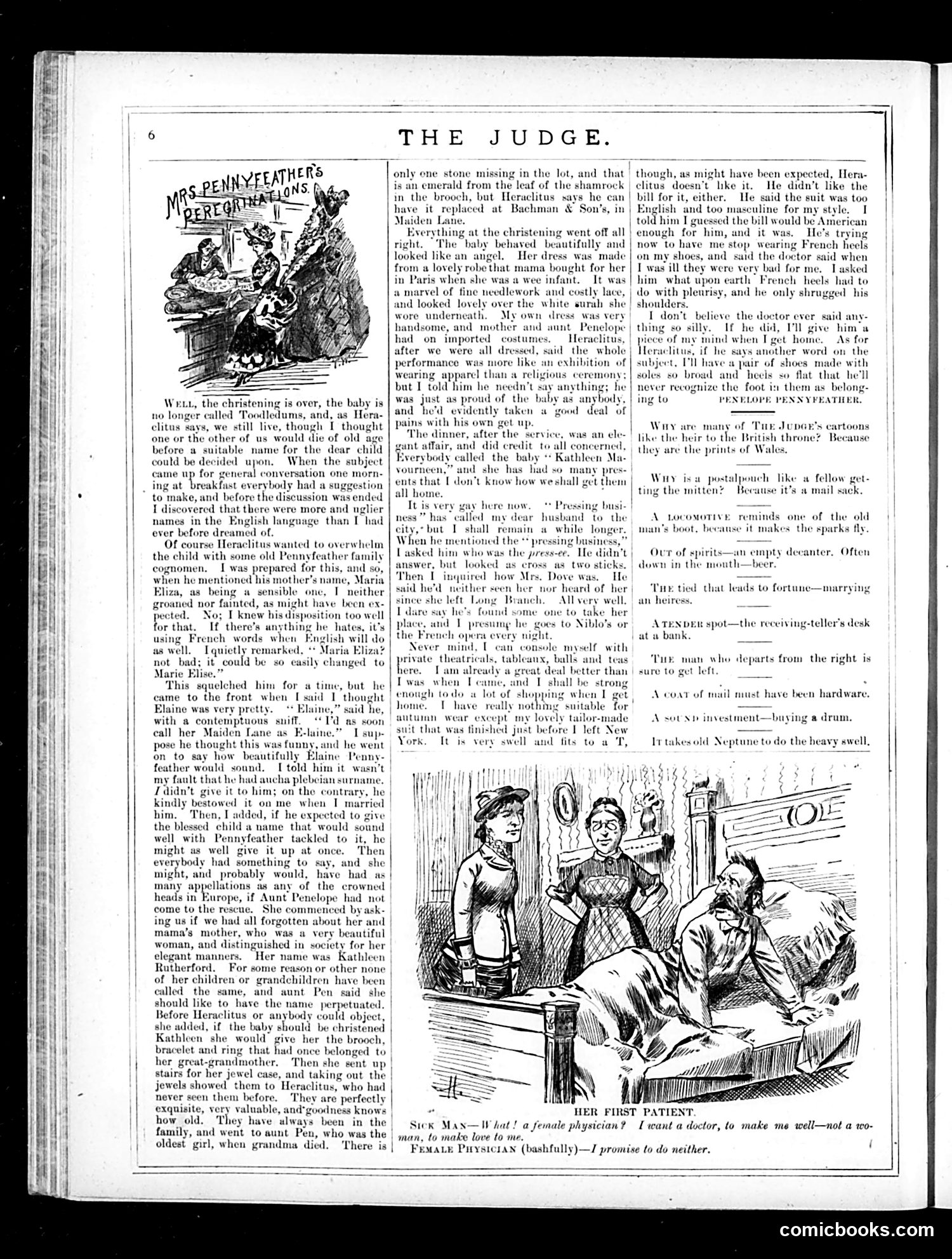
This page from *Judge* magazine contains a lengthy narrative essay titled "Mrs. Pennyfeather's Peregrinations" about naming a newborn baby, accompanied by a single cartoon captioned "Her First Patient." The main article humorously chronicles a family debate over christening a child "Kathleen," eventually persuaded by the promise of inherited jewelry. It's domestic satire reflecting Victorian-era social conventions—the fussiness over naming, the importance of inherited goods, and family negotiations. The cartoon shows a woman (appearing to be a newly licensed female physician) with her first patient—a sick man in bed. The dialogue reveals contemporary skepticism about women doctors: the male patient asks for "a doctor, to make me well—not a woman," while the female physician promises compliance. This satirizes the era's resistance to women entering medicine, mocking both male prejudice and suggesting women physicians were uncommon enough to provoke surprise.
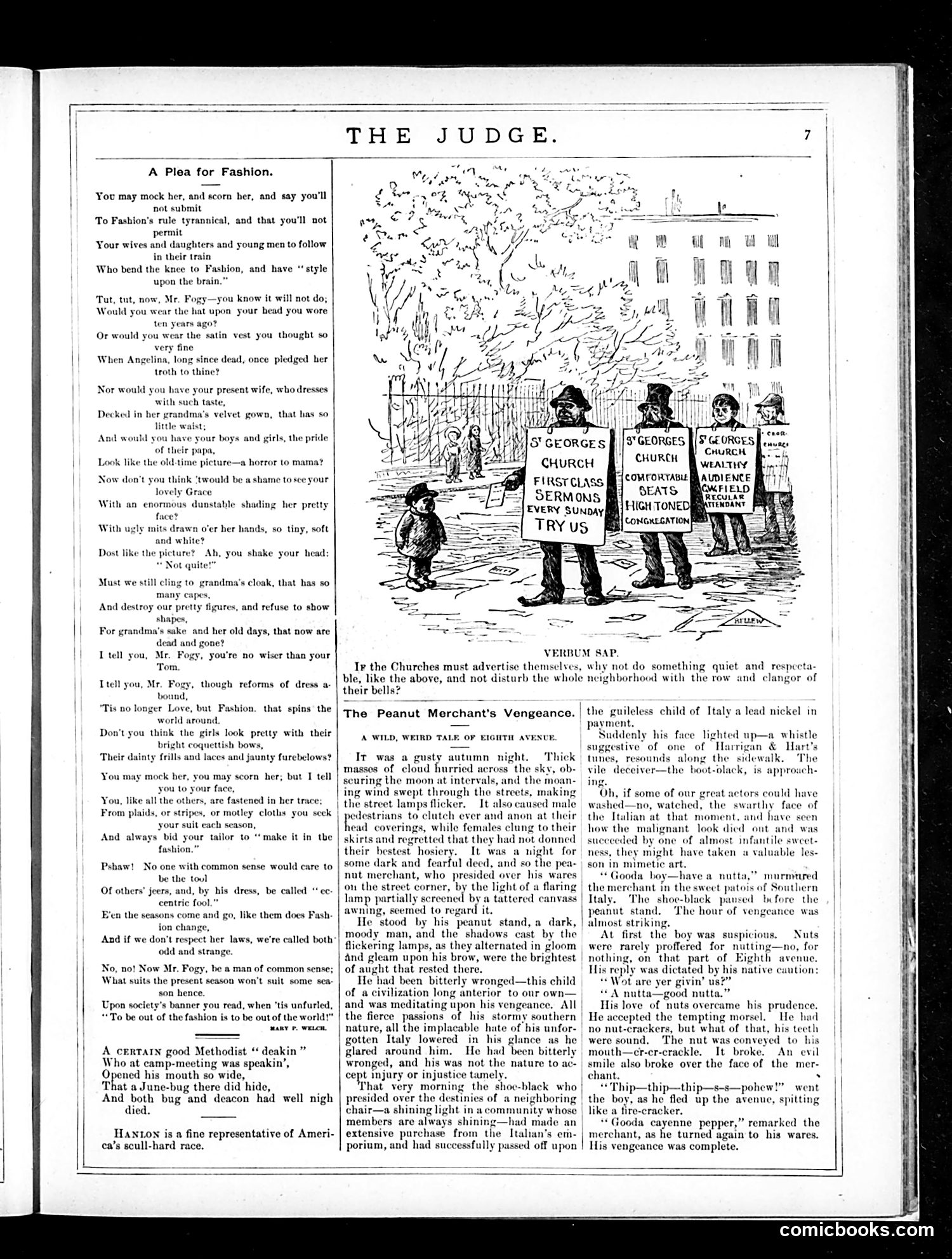
This page satirizes anti-fashion sentiment through a lengthy poem defending fashionable dress. The poem mocks the "Mr. Fogy" (old-fashioned person) who scorns fashion, arguing that style evolves naturally—men wouldn't wear decade-old hats, women deserve modern clothes that flatter their figures rather than grandmother's shapeless garments. The satirist's point: fashion criticism is hypocritical since everyone follows fashion regardless. The cartoon "Verbum Sap" depicts church signs competing like businesses ("First Class Sermons," "Wealthy Audience," "High-Toned Congregation"), mocking churches that resort to undignified advertising rather than quiet respectability—a jab at religious institutions adopting aggressive commercial tactics. The page also contains unrelated content: a joke about a Methodist deacon at camp meeting, a reference to Hanlon (likely an athlete), and the beginning of a melodramatic story, "The Peanut Merchant's Vengeance."
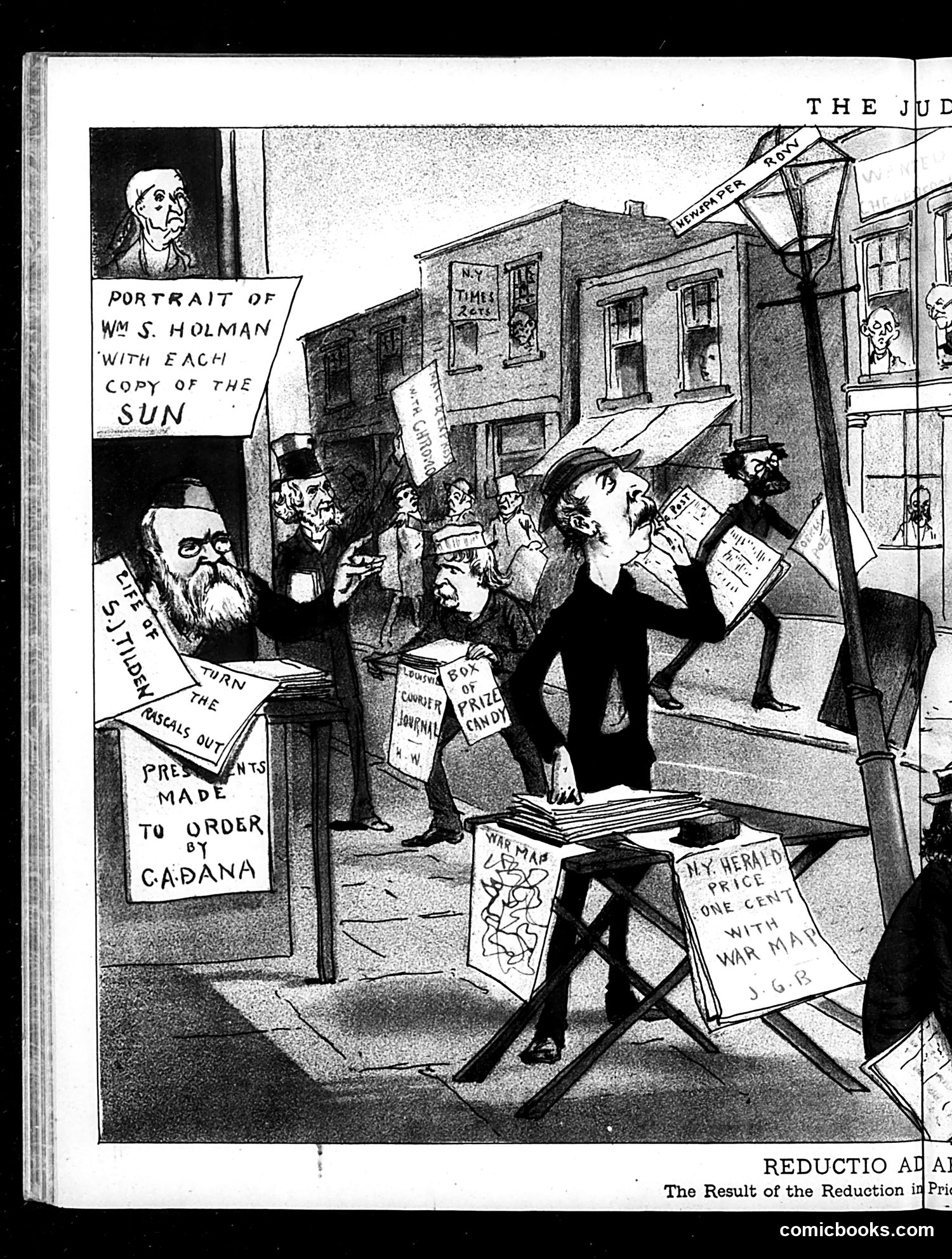
This political cartoon satirizes William S. Holman, an American politician (likely Congressman from Indiana, active late 1800s). The cartoon shows street vendors hawking newspapers and printed materials outside storefronts, with Holman's portrait prominently displayed as if he were a cheap commodity being sold "with each copy of the Sun." The satire appears to mock Holman's perceived insignificance or commodification in political discourse—suggesting he's no more valuable than a promotional giveaway bundled with newspaper purchases. References to "presents made to order by Cadana" and other vendor materials reinforce the joke that Holman has become a disposable, mass-produced political figure rather than a significant statesman. The cartoon reflects Judge magazine's characteristic irreverent treatment of contemporary politicians.
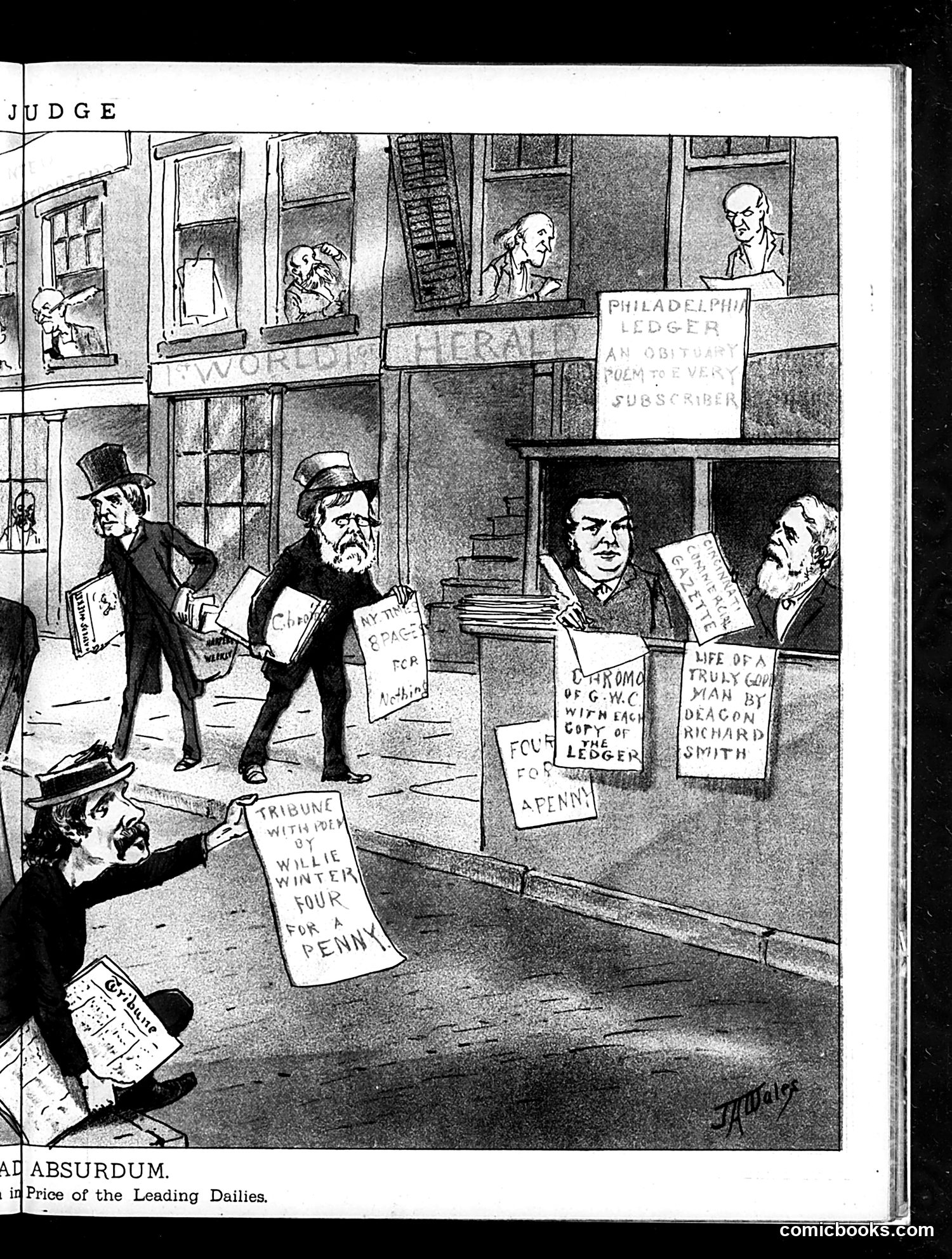
This cartoon satirizes newspaper pricing during what appears to be an early period of American journalism. The scene shows men on a street hawking newspapers with increasingly absurd prices and titles displayed on signs. A small figure (possibly a child or poor person) sits examining papers while well-dressed gentlemen carry newspapers with signs reading things like "Tribune with Wee Willie Winter Four for a Penny" and references to various publications like the Philadelphia Lodge and World Herald. The satire appears to mock either: - The proliferation and competition among newspapers - Rising newspaper prices becoming ridiculous - Publishers making false or exaggerated claims about content The title "Ad Absurdum" (to absurdity) reinforces this critique of the newspaper industry's seemingly irrational pricing and marketing practices.
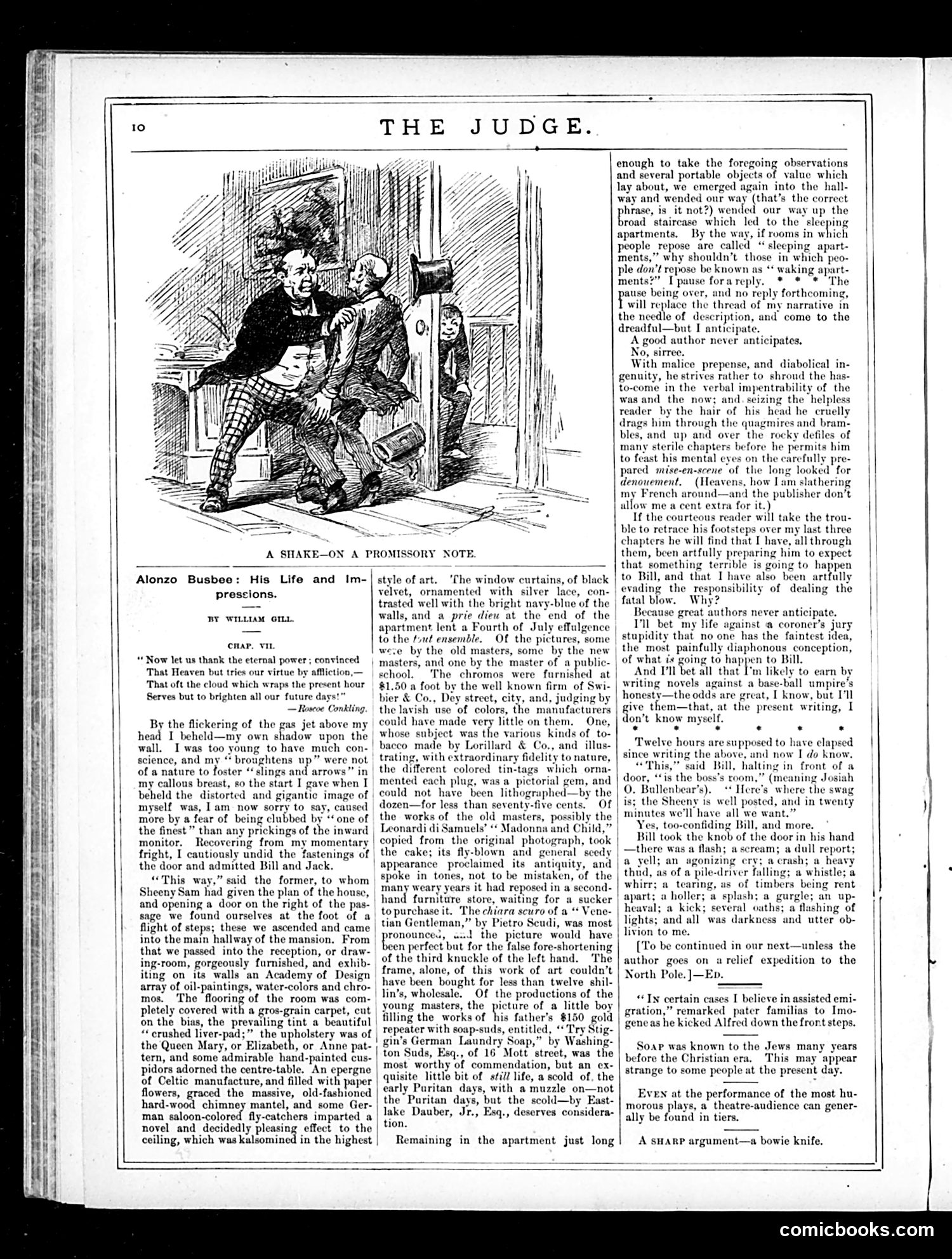
This is the opening chapter of a serialized story about "Alonzo Busbee: His Life and Impressions" by William Gill. The illustration shows what appears to be a burglary in progress—men entering a wealthy home through a door, with one figure visible in shadow. The narrative voice describes breaking into an ornately decorated mansion filled with ostentatious furnishings and art. The satire targets nouveau-riche excess: the narrator mockingly catalogs overwrought décor—"crushed liver-pad" carpets, gaudy chromos (cheap color prints), and absurdly detailed bad paintings. One painting advertises German laundry soap; another depicts a child ruining an expensive watch with soap-suds—obvious advertisements masquerading as art. The humor lies in the detailed, deadpan description of tasteless wealth and the implicit criticism of both the rich homeowner's garish decoration and commercial culture infiltrating high art. The epigraph from Roscoe Conkling about virtue through affliction suggests ironic commentary on crime and morality.
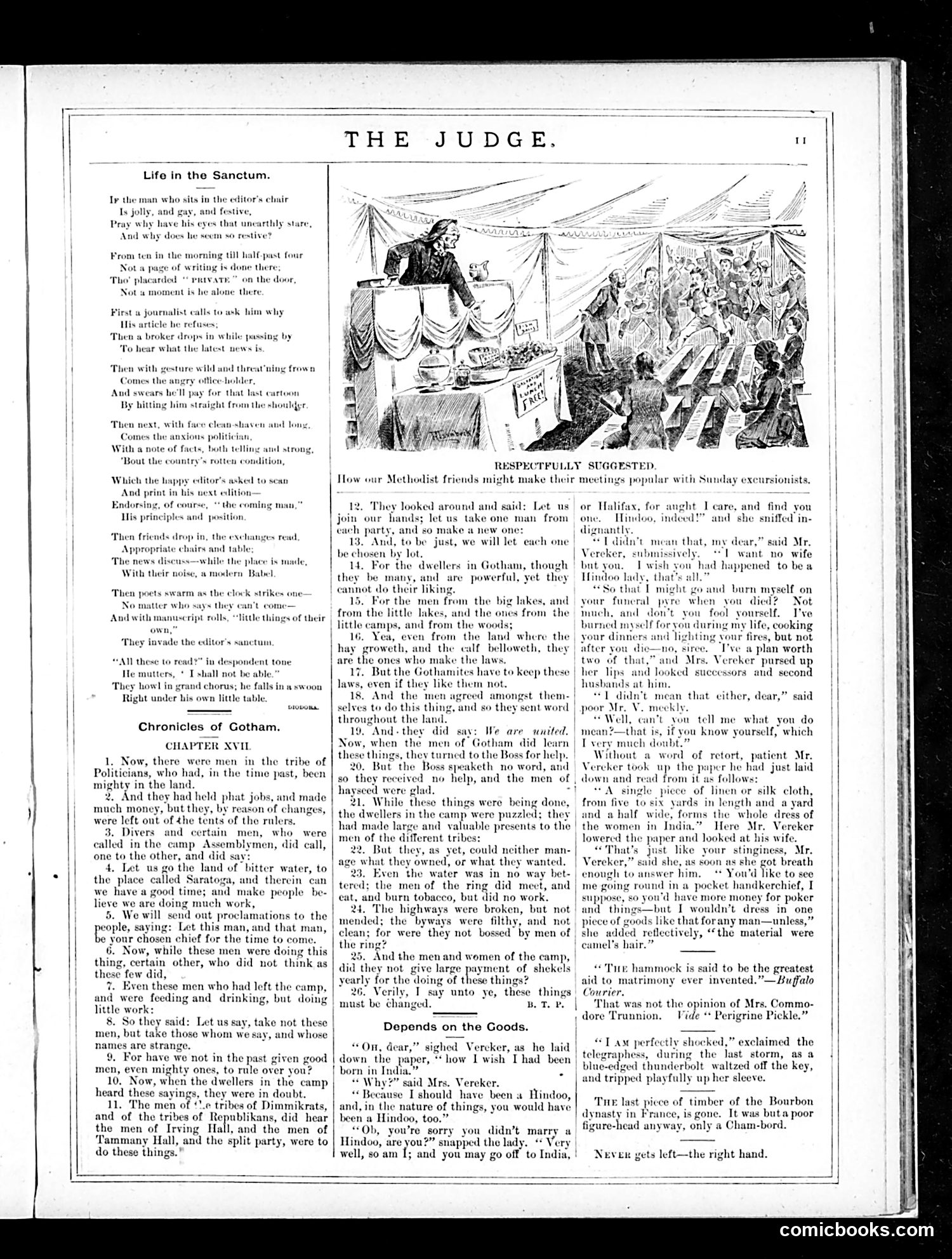
This page contains two distinct pieces of political satire from an American magazine (Judge): **"Life in the Sanctum"** (top): A humorous poem mocking an editor's chaotic workday. The accompanying illustration shows an overwhelmed editor besieged by demanding visitors—journalists demanding explanations, brokers seeking news tips, angry politicians threatening retaliation over editorial coverage, friends discussing current events, and poets forcing their manuscripts upon him. The satire targets the editor's impossible position: bombarded by special interests, politicians, and supplicants all seeking favorable coverage or access. **"Chronicles of Gotham"** (bottom): A biblical-parody narrative about New York City politics, written in pseudo-King James language. It appears to mock political factionalism and machine politics, referencing competing political groups ("Dimmikrats," "Publikans," "Irving Hall," "Tammany Hall") and their maneuvering for power. The satirical tone suggests infighting among political establishments vying for control. Both pieces target institutional dysfunction—editorial pressures and political corruption—common Judge subjects critiquing American governance and media.
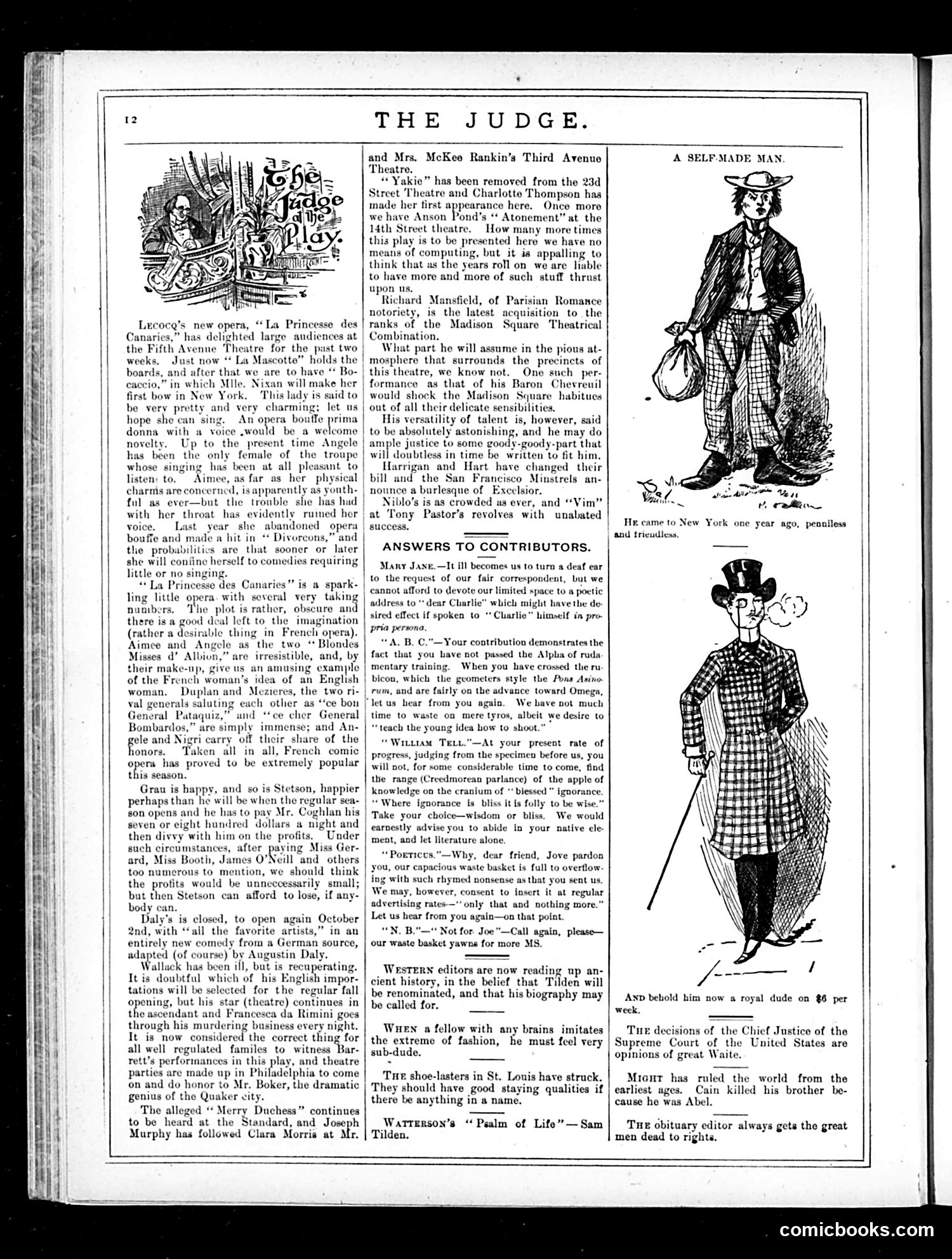
This page contains theater reviews and gossip rather than political cartoons. The main content discusses New York theatrical productions from the 1880s, including operas like "La Princesse des Canaries" at the Fifth Avenue Theatre and various plays at different venues. The three illustrated figures on the right are character types rather than political figures: "Kobe Judge" (the magazine's mascot), "A Self-Made Man" (a well-dressed gentleman), and what appears to be another character in working-class attire labeled as earning "$6 per week." The "Answers to Contributors" section contains brief editorial responses to reader letters about theater and literary topics, including critiques of stagecraft and playwriting. Rather than satire targeting specific politicians or events, this page represents **entertainment journalism and cultural commentary**—Judge magazine functioning as a society publication covering theater, fashion, and popular culture of the era.
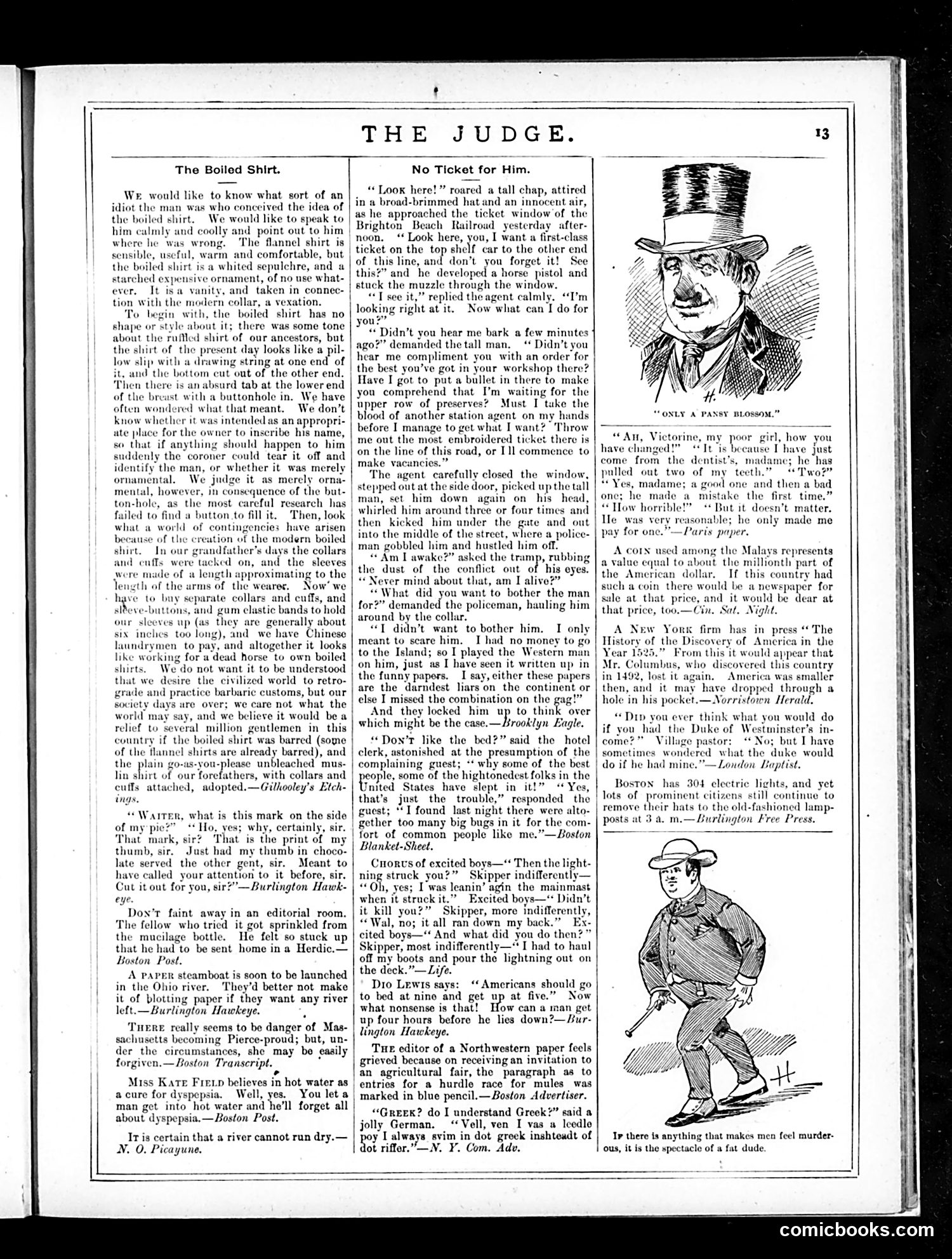
This page from Judge magazine contains satirical commentary on contemporary annoyances. The main article, "The Boiled Shirt," attacks the formal starched dress shirt as impractical and ridiculous—a symbol of pretentious civility that requires separate collars, cuffs, and elastic bands, plus expensive laundry service. The author argues it's inferior to flannel shirts and represents misguided "civilization." The accompanying brief anecdotes mock various subjects: a waiter's muddy thumbprint on a plate, a faint editorial employee, a steamboat named after blotting paper, and Massachusetts's pride in President Franklin Pierce. These are typical 19th-century Judge humor—quick jabs at modern inconveniences, bureaucratic absurdities, and regional foibles. The cartoon illustration (right) depicts a man in Western attire, likely related to the "No Ticket for Him" story about a rough character at a train window.
This page is **primarily advertising** with some satirical content typical of the era. The main text piece, "A Year Ago," appears to be romantic poetry reflecting on past letters and lost love—a sentimental piece common to Judge's mix of humor and pathos. **"A Bald Sea Story"** is a tall tale about a man surviving inside a whale's body, a humorous adventure narrative in the style of exaggerated seafaring yarns popular in 19th-century magazines. The page contains numerous **period advertisements** for pianos, jewelry, cocoa, pens, and notably a **"Cancer Institute"**—reflecting the era's patent medicine and dubious medical claims. An ad for **"Opium"** appears unremarkable for this period, before drug regulation. One brief joke references a woman choosing cheaper excursion tickets over spending time with someone she dislikes—mild social satire on materialism. The **Cuticura Remedies** ad with its emphatic claims exemplifies the unregulated medical advertising Judge accepted, typical of publications from this era.
This page is primarily **advertisements and light humor pieces**, not political satire. The content includes: **Main Elements:** - Cosmetic and personal care product ads (nail powder, face cream, lip treatments) - Medical device advertisements (Ely's Cream Balm for hay fever; Voltaic Belt for male vitality issues) - Humorous short pieces with titles like "My Age," "What She Said," and "Man's Inalienable Right" **The Humor:** The comic pieces are domestic/social rather than political—a child arguing with a nurse about going outside, observations about marriage inequality, anecdotes about lovers and poetry pricing. These represent typical late 19th-century magazine filler: light, sentimental, or gently satirical takes on everyday life and relationships. **Context for Modern Readers:** The medical advertisements reveal period attitudes (male sexual dysfunction treatments were marketed openly; hay fever cures were heavily promoted). The humor is genteel and moralistic rather than sharp political commentary. This appears to be a typical issue of *Judge*'s advertising/miscellaneous content pages rather than its main satirical editorial content.
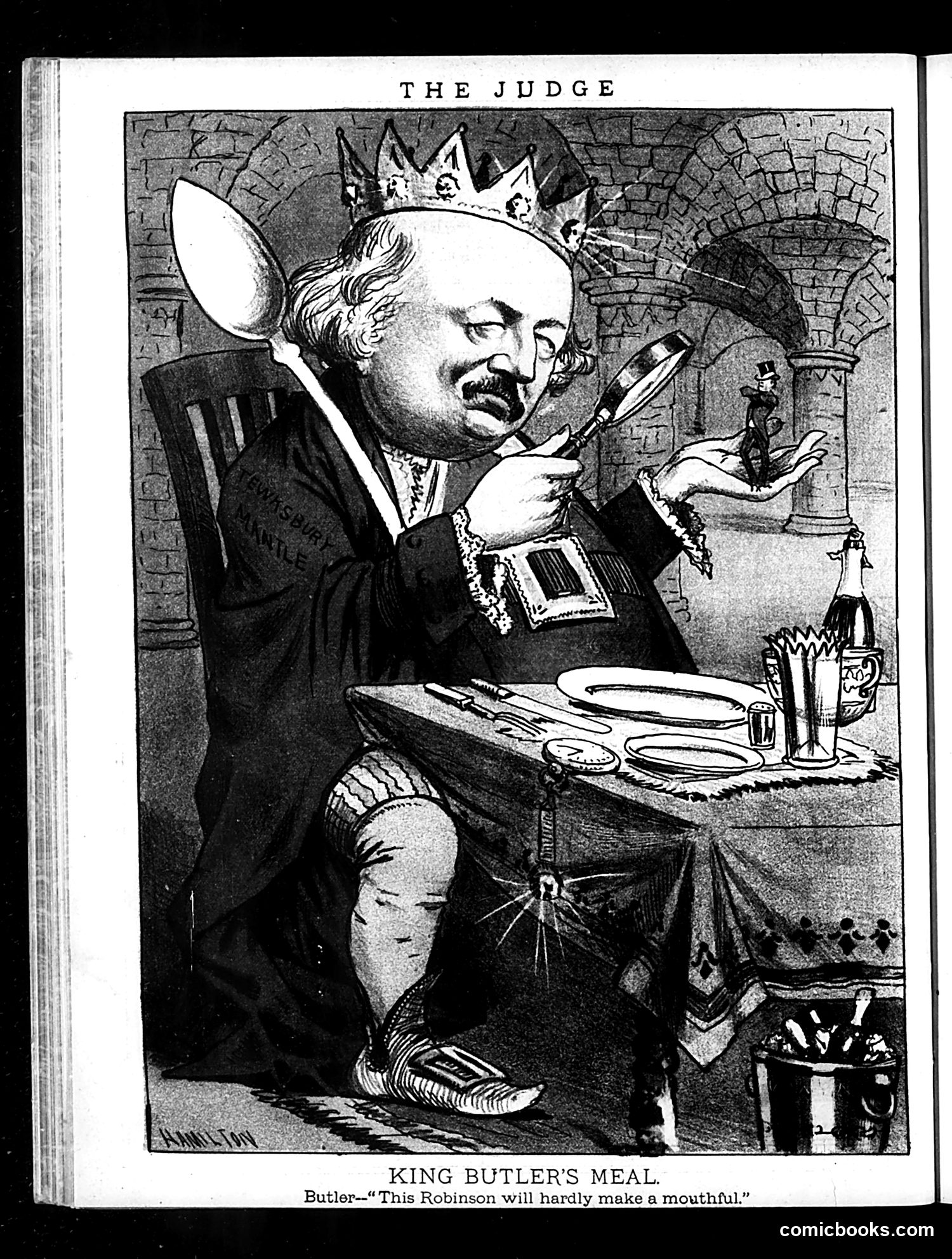
This cartoon satirizes a wealthy, crowned figure labeled "King Butler" dining in a castle setting. The caption quotes Butler declaring "This Robinson will hardly make a mouthful," suggesting he views someone named Robinson as insignificantly small—suitable only as a bite of food. The satire likely mocks Butler's arrogance and appetite for power or consumption, treating a person (Robinson) as disposable prey. The royal imagery and feasting setup emphasize Butler's presumed superiority and contempt. Without additional historical context, the specific identity of Butler and Robinson remains unclear, though this appears to reference American political or business figures contemporary to Judge magazine's publication. The cartoon criticizes exploitative attitudes toward those considered beneath one's station.