
Judge, 1883-10-06 · page 2 of 16
Judge — October 6, 1883 — page 2: what you’re looking at
What you’re looking at
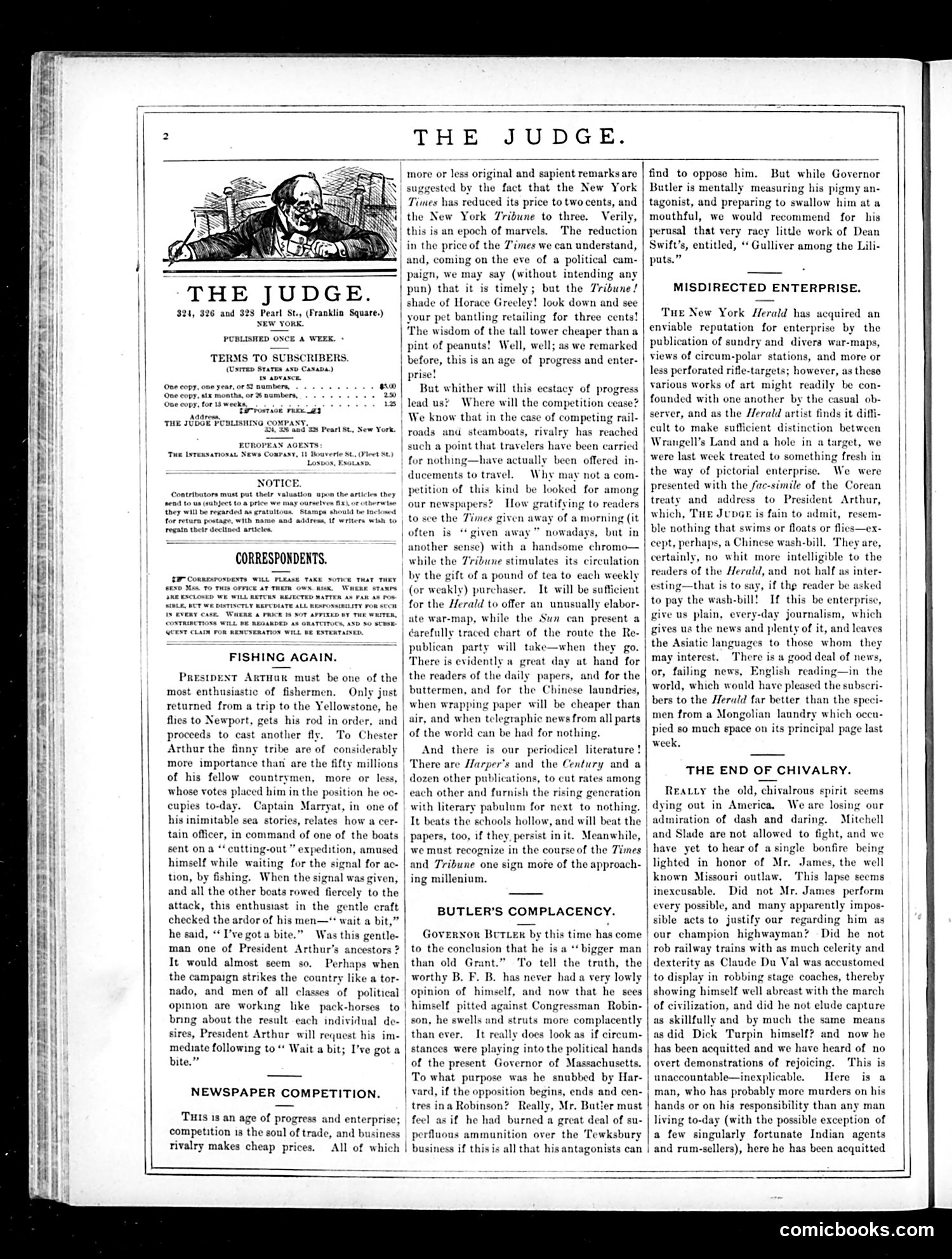
## "Fishing Again" This satirizes President Chester Arthur's perceived priorities. The piece criticizes Arthur for fishing trips to Yellowstone and Newport when he should be campaigning. The joke compares him to a naval officer who delayed battle to land a fish—suggesting Arthur cares more about sport fishing than governing 50 million citizens. The implicit criticism: Arthur is neglecting his presidential duties during an important political campaign season. ## "Newspaper Competition" This section mocks the price war between major New York newspapers. The *Times* cut to two cents and the *Tribune* to three cents. Judge sarcastically praises this "progress," then absurdly extrapolates: if competition continues, papers will soon *pay* readers to take them, offering chromos, tea, and elaborate maps. The satire criticizes newspapers' desperate competition driving down prices and quality in pursuit of circulation—a concern about sensationalism over substance.
📄 Transcribed text from this page (OCR, searchable)
Machine-transcribed from the original scan — historical spelling and the odd misread are preserved.
THE JUDGE. $24, 326 and 328 Pearl St., (Franklin Square.) YORK. PUBLISHED ONCE A WEEK. + TERMS TO SUBSCRIBERS. (Usrrep Staves axp Casapa) 18 ADVANCE. no 20 res) "EW abd'EM Pearl St, New York. EAN AGENTS ‘Tue IsrexsanionaL News Comrast, I! ouverte St., (Fleet St.) Loxpos, ESotasp, NOTICE. CORRESPONDENTS. S97 CORRESPONDENTS WILL FLEASE TAKE yoTICE THAT THEY eexp Mes. To THIS OFFICE AY THETE OWN RISK. WHERE STAMPS ARE ESCLOSED WE WILL RETCRY REJECTED MATTER sre, ae INCTLY REFUDIATE ALL REAP Iv EVERY CASE WHERE A PRICE 19 NOT AFYITED BY THE WRITER, CONTRIBUTIONS WILE, BE REDAMDED A8 ORATCITOCK, ASD SO SURGE QUEST CLAIN FOR RENCNERATION WILL RE ESTIERTA: FISHING AGAIN. PrestpENT ArTHUR must be one of the most enthusiastic of fishermen. Only just returned from a trip to the Yellowstone, he flies to Newport, gets his rod in order, und proceeds to cast another fly. To Chester Arthur the finny tribe are of considerably more importance than are the fifty millions of his fellow countrymen, more or le whose votes placed him in the position he oc cupies to-day. Captain Marryat, in one of his inimitable sea stories, relates how a cer- tain officer, in command of one of the boats sent ona “‘cutting-out ” expedition, amused himself while waiting for the signal for ac- tion, by fishing. When the signal was given, and all the other boats rowed fiercely to the attack, this enthusiast in the gentle craft checked the ardor of his men—* wait a bit,” he said, ‘I’ve got a bite.” Was this gentl man one of President Arthur’s ancesto It would almost seem so. Perhaps when the campaign strikes the country like a tor- nado, and men of all classes of political opmion are working like pac bring about the result each individual de- sires, President Arthur will request his im- mediate following to ‘* Wait a bit; I’ve gota bite.” horses to NEWSPAPER COMPETITION. Tuts is an age of progress and enterprise; competition 18 the soul of trade, and busin rivalry makes cheap prices. THE JUDGE. more or less original and sapient remarks are gested by the fact that the New York Times has reduced its price to two cents, and the New York Tribune to three, Verily, this is an epoch of marv The reduction in the price of the 7'imes we can understand, and, coming on the eve of a political cam- | paign, we may say (without intending any | pun) that it is timely; but the Tribune! | shade of Horace Greeley! look down and see | your pet bantling retailing for three cents! The wisdom of the tall tower cheaper than a | pint of peanuts! Well, well; as we remarked | before, this is an age of progress and enter- pris But whither will this ecstacy of progress lead us? Where will the competition cease? We know that in the case of competing rail- roads and steamboats, rivalry has reached such a point that travelers have been carried for nothing—have actually been offered in- ducements to travel. Why may not a com- petition of this kind be looked for among our newspap su rs? How gratifying to readers to see the Times given away of a morning (it | often i ven away” nowadays, bat in another sense) with a handsome chromo— | while the 7ridune stimulates its circulation by the gift of a pound of tea to each weekly (or weakly) purchaser. It will be sufficient for the Herald to offer an unusually elabor- ate war-map, while the Sun can present a éarefully traced chart of the route the Re- publican party will tuke—when they go. There is evidently a great day at hand for the readers of the daily p: and for the buttermen, and for the Chinese | laundries, | when wrapping paper will be cheaper than air, and when telegraphic news from all parts of the world can be had for nothing. And there is our period) literature ! here are Harper's and the Century and a dozen other publications, to cut rates among ach other and furnish the rising generation with literary ulum for next to nothing. It beats the schools hollow, and will beat the papers, too, if they, persist init. Meanwhile, we must recognize in the course of the Times and Tribune one sign more of the approach- | ing millenium. | | BUTLER’S COMPLACENCY. | Goveryor Better by this time has come | to the conclusion that he is a *‘ bigger man than old ant.” To tell the truth, the worthy B. F. B. has never had a very lowly | opinion of himself, and now that he sees | himself pitted against Congressman Robin- son, he swells und struts more complacently than ever. It really does look as if circum: | stances were playing into the political hands of the present Governor of Massachusetts. ; | To what purpose was he snubbed by Har- | vard, if the opposition begins, ends and cen- tres ina Robinson? Really, Mr. Butler must feel as if he had burned a great deal of su- perfluous ammunition over the Tewksbury find to oppose him. But while Governor Butler is mentally measuring his pigmy an- tagonist, and preparing to swallow him at a mouthful, we would recommend for his perusal that very racy little work of Dean Swift's, entitled, ‘‘ Gulliver among the Lili- puts.” MISDIRECTED ENTERPRISE. Tue New York Herald has acquired an enviable reputation for enterprise by the publication of sundry and divera war-maps, views of circum-polar stations, and more or perforated rifle-targets; however, as these various works of art might readily be con- founded with one another by the casual ob- server, and as the Herald artist finds it diffi- cult to make sufficient distinction between Wrangell’s Land and a hole in a target | were last week treated to something fresh in the way of pictorial enterprise. We were presented with the fac-simile of the Corean treaty and address to President Arthur, which, THe Junge is fain to admit, r ble nothing that swims or floats or fli cept, perhaps, a Chinese wash-bill. 1 certainly, no whit more intelligible to the readers of the Herald, and not half as inter- esting—that is to s if the reader be asked to pay the wash-bill! If this be enterprise, give us plain, every-day journalism, which gives us the news and plenty of it, and leaves the A nguages to those whom they may interest. There good deal of news, or, failing news, English reading—in the world, which would have pleased the subseri- bers to the Herald far better than the speci- men from a Mongolian laundry which occu- pied so much gpace on its principal page last week, m= —e THE END OF CHIVALRY. Reatry the old, chivalrous spirit seems dying out in America, We are losing our admiration of dash and daring. Mitchell nd Slade are not allowed to fight, and we have yet to hear of asingle bonfire being lighted in honor of Mr. James, the well known Missouri outlaw. ‘This lapse seems inexcusable. Did not Mr. James perform every possible, and many apparently impos- sible acts to justify our regarding him as our champion highwayman? Did he not | rob railway trains with as much celerity and dexterity as Claude Du Val was accustomed to display in robbing stage coaches, thereby showing himself well abreast with the march of civilization, and did he not elude s skillfully and by much the same means }asdid Dick Turpin himself? and now he | has been acquitted and we have heard of no | overt demonstrations of rejoicing. ‘Th unaccountable—inexplicable. Here is man, who has probably more murders on his hands or on his responsibility than any man living to-day (with the possible exception of a few singularly fortunate Indian agents capture a All of which | business if this is all that his antagonists can | and rum-sellers), here he has been acquitted comicbooks.com