
Judge, 1883-10-06 · page 7 of 16
Judge — October 6, 1883 — page 7: what you’re looking at
What you’re looking at
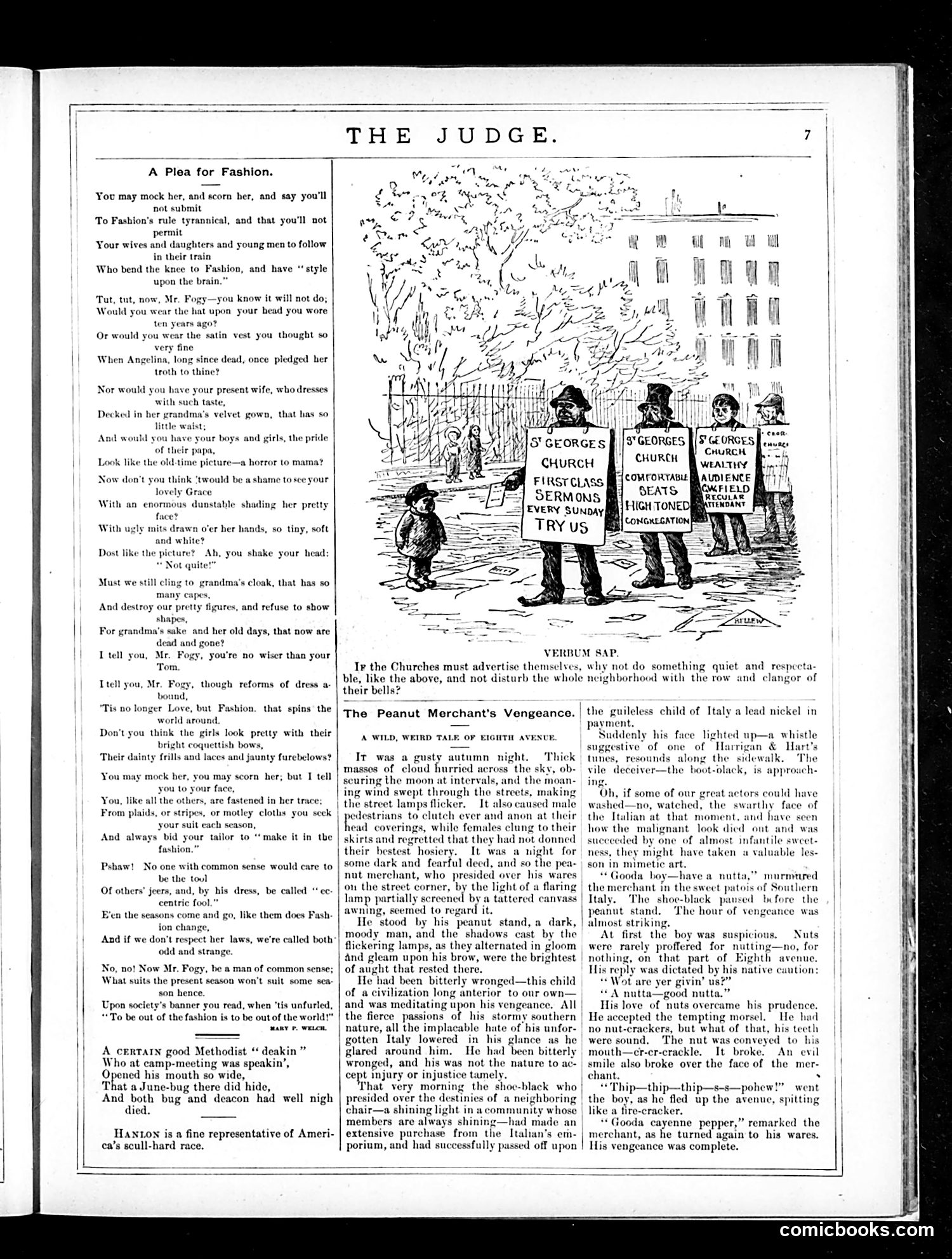
This page satirizes anti-fashion sentiment through a lengthy poem defending fashionable dress. The poem mocks the "Mr. Fogy" (old-fashioned person) who scorns fashion, arguing that style evolves naturally—men wouldn't wear decade-old hats, women deserve modern clothes that flatter their figures rather than grandmother's shapeless garments. The satirist's point: fashion criticism is hypocritical since everyone follows fashion regardless. The cartoon "Verbum Sap" depicts church signs competing like businesses ("First Class Sermons," "Wealthy Audience," "High-Toned Congregation"), mocking churches that resort to undignified advertising rather than quiet respectability—a jab at religious institutions adopting aggressive commercial tactics. The page also contains unrelated content: a joke about a Methodist deacon at camp meeting, a reference to Hanlon (likely an athlete), and the beginning of a melodramatic story, "The Peanut Merchant's Vengeance."
📄 Transcribed text from this page (OCR, searchable)
Machine-transcribed from the original scan — historical spelling and the odd misread are preserved.
A Plea for Fashion. You may mock her, and scorn her, and say you'll not submit To Fashion's rule tyrannical, and that you'll not permit Your wives and daughters and young men to follow in their train Who bend the knee to Fashion, and have ‘style upon the brain.” ‘Tut, tut, now, Mr. Fogy—you know it will not do; Would you wear the hat upon your head you wore ten years ago? Or would you wear the satin vest you thought so very fine When Angelina, long since dead, once pledged ber troth to thine? Nor would you have your present wife, who dresses with such taste, Decked in her grandma's velvet gown, that has so little waist; And would you have your boys and girls, the pride of their papa, Look like the old-time picture—a horror to mamat Now don't you think ‘twould be a shame to sce your lovely Grace us dunstable shading her pretty facet With ugly mits drawn o'er her hands, so tiny, soft and whit Dost like the picture? * Not quite Ab, you shake your head: Must we still cling to grandma's cloak, that has so many capes, And destroy our pretty figures, and refuse to show shapes, For grandma's suke and her old days, that now arc dead and gone? I tell you, Mr. Fogy, you're no wiser than your ‘Tom. Itell you, Mr. Fe bound, ‘Tis no longer Love, but Fashion. that spins’ the world around. Don't you think the girls look pretty with their bright coquettish bows, Their dainty frills and laces and jaunty furebelows? though reforms of dress a- You may mock her, you m: you to your II the others, are fastened in her trace; , of stripes, or motley cloths you seck your suit each season, And always bid your tailor to “make it in the fashion.” scorn her; but I tell From pla Pshaw! No one with common sense would care to ve the toul Of others’ jeers, and, by his dress, be called "ec: centric fool n the seasons come and go, like them does Fash- ion change, And if we don’t respect her laws, we're called both. odd and strange. No, no! Now Mr. Fogy, be a man of common sense; What suits the present season won't suit some sca- son henc Upon society’s bannes “To be out of the fash you read, when ‘tis unfurled, n is to be out of the world!" many wanes, A CERTAIN good Methodist “ deakin ” Who at camp-meeting was speakin’, Opened his mouth so wide, That a June-bug there did hide, And both bug and deacon had well nigh died. HANLon is a fine representative of Ameri- ca’s scull-hard race. | | S' GEORGES CHURCH S'GEORGES | CrhuRCH WEALTHY, FIRSTCLASS SERMONS, HIGH TONED CONGREGATION! VERBUM SAP. Ir the Churches must advertise themselves, why not do something quiet and_ respec ble, like the above, and not disturb the whole ne their bells? The Peanut Merchant's Vengeance. | A WILD, WEIRD TALE OF EIGHTH AVENUE. Ir was a gusty autumn night. Th masses of cloud hurried across the sky, ob- scuring the moon at intervals, and the moan- ing wind swept through tho streets, makin, the street lamps flic It also caused m pedestrians to cluteh ever and anon at their head coverings, while females clung to their skirts and regretted that they had not donned their bestest hosie: night for some dark and fearful deed, and so the 7 nut merchant, who presided over on the street corner, by the light of lamp partially awning, seemed to regard He stood by his p man, and the shadows cast by the ing lamps, as they alternated in m upon his brow, were the brightest of aught that rested there. He had been bitterly wronged—this child of a civilization long anterior to our own— and was meditating upon his vengeance. All the fierce passions of his stormy southern nature, all the implacable hate of his unfor- gotten Italy lowered in his glance as he glared around him. He had been bitterly wronged, and his was not the nature to ac- cept injury or injustice tamel That very morning the shoe k who presided over the destinies of a neighboring chair—a shining light in acommunity whose members are always shining—had made an extensive purchase from the Italan’s em- porium, and had successfully passed off upon Ares, flaring screened bya tattered cany it. anut stand, a dark, | hborhood with the row and clangor of the guileless child of Italy a lead nickel in payment, Suddenly his face lighted up—a whistl suggestive’ of one of Harrigan & Hart tun resounds along the sidewalk. The vile deceiver—the boot-olack, is approuch- ing. Oh, if some of our great actors could have washed—no, watched, the swarthy face of the Italian that moment, and have seen how the malignant look died ont and w succeeded by one of almost infantile sweet ness, they might have taken a valuable les- son in mimetic art. *Gooda boy—have a nutta,” murmured the merchant in the sweet patois of Southern Italy. The shoe-black pan tufore the peanut stand. ‘The hour of vengeance was almost striking. At first the boy was suspicious, Nuts were rarely proffered for nutting—no, for nothing, on that part of Eighth avenue. His reply was dictated by his native caution: “Wot are yer givin’ us?” “A nutta—good nutta.” His love of nuts overcame his prudence. He accepted the tempting morsel. He h no nut-erackers, but what of that, his teeth were sound, The nut was conveyed to his mouth—cr-cr-crackle. It broke. An evil smile also broke over the face of the mer- chant. . “Thip—thip—thip—s-s—pohew!” went the boy, as he fled up the avenue, spitting like a tire-cracker. *Gooda cayenne pepper,” remarked the merchant, as he turned again to his wares. Ilis vengeance was complete. comicbooks.com