
Judge, 1883-10-06 · page 10 of 16
Judge — October 6, 1883 — page 10: what you’re looking at
What you’re looking at
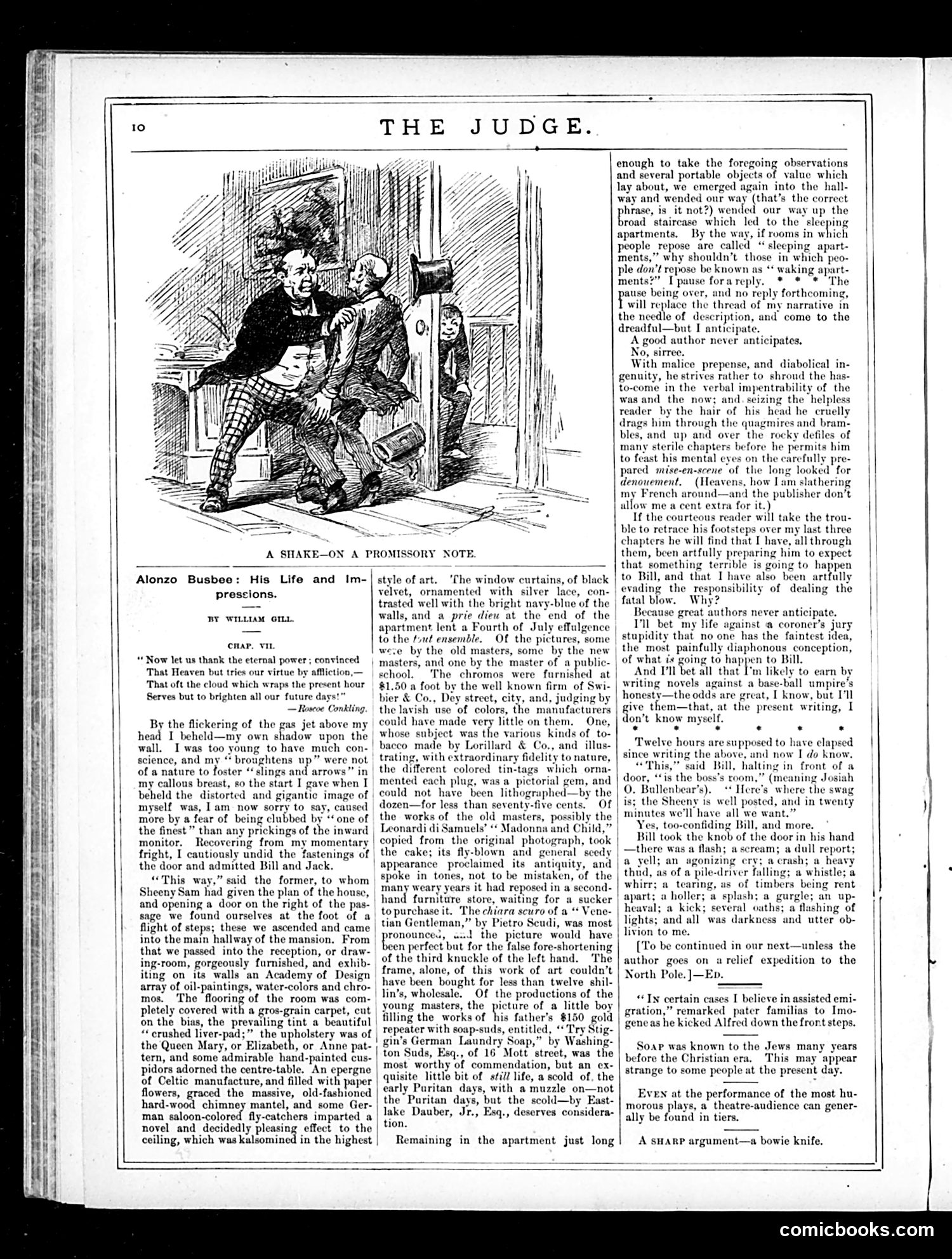
This is the opening chapter of a serialized story about "Alonzo Busbee: His Life and Impressions" by William Gill. The illustration shows what appears to be a burglary in progress—men entering a wealthy home through a door, with one figure visible in shadow. The narrative voice describes breaking into an ornately decorated mansion filled with ostentatious furnishings and art. The satire targets nouveau-riche excess: the narrator mockingly catalogs overwrought décor—"crushed liver-pad" carpets, gaudy chromos (cheap color prints), and absurdly detailed bad paintings. One painting advertises German laundry soap; another depicts a child ruining an expensive watch with soap-suds—obvious advertisements masquerading as art. The humor lies in the detailed, deadpan description of tasteless wealth and the implicit criticism of both the rich homeowner's garish decoration and commercial culture infiltrating high art. The epigraph from Roscoe Conkling about virtue through affliction suggests ironic commentary on crime and morality.
📄 Transcribed text from this page (OCR, searchable)
Machine-transcribed from the original scan — historical spelling and the odd misread are preserved.
THE JUDGE. A SHAKE—ON A Alonzo Busbe: His Life and Im- pressions. BY WILLIAM GILL. cnar, vit jow let us thank the eternal power ; convinced ‘That Heaven but tries our virtue by affliction, — That oft the cloud which wraps the present hour Serves but to brighten all our future days!” — Roscoe Conkling. By the flickering of the gas jet above my head I beheld—my own shadow upon the wall. I was too young to have much con- science, and my “ broughtens up” were not of a nature to foster “slings and arrows” in my callous breast, so the start I gave when I beheld the distorted and gigantic image of myself was, | am now sorry to say, caused more by a fear of being clubbed by ‘one of the finest ” than any prickings of the inward monitor. Recovering from my momentary fright, I cautiously undid the fastenings of the door and admitted Bill and Jack. “This way,” said the former, to whom Sheeny Sam had given the plan of the house, and opening a door on the right of the pas sage we found ourselves at the foot of flight of steps; th we ascended and came into the main hallway of the mansion, From that we passed into the reception, or draw- ing-room, gorgeously furnished, and exhib- iting on its walls an Academy of Design array of oil-paintings, water-colors and chro- mos. The flooring of the room was com- pletely covered with a gros-grain carpet, cut on the bias, the prevailing tint a beautiful “crushed liver-pad;” the upholstery was of the Queen Mary, or Elizabeth, or Anne pat- tern, and some admirable hand-painted cus- pidors adorned the centre-table. An epergne of Celtic manufacture, and filled with paper flowers, graced the massive, old-fashioned hard-wood chimney mantel, and some Ger- man saloon-colored fly-catchers imparted a novel and decidedly pleasing effect to the ceiling, which was kalsomined in the highest a PROMISSORY NOTE. style of art. ‘The window cl velvet, ornamented with r lace, con- trasted well with the b -blue of the walls, and a prie dieu at the end of the apartment lent a Fourth of July efful to the fut ensemble. Of the pictures, wese by the old masters, some by the ne | ‘ters, and one by the master of a public- school. The chromos were furnished at | $1.50 a foot by the well known firm of Swi- bier & Co., Dey street, city, and, judging by | the lavish use of colors, the manufacturers | could have made very little on them. One, whose subject was the various kinds of to- acco made by Lorill and illus- ing, with extraordi to nature, the different colored tin’ mented each plug, was a p could not have been lithog dozen—for less than sevent. the works of the old masters, possibly Leonardi di Samuels’ ** Madonna and Child,” copied from the original photograph, took the cake; its fly-blown 1 seedy | | appearance proclaimed its antiquity, and spoke in tones, not to be mistaken, of the many weary years it had reposed in a second- hand furniture store, waiting for a sucker to purchase it. The chiara scuro of a“ Ven tian Gentleman,” by Pietro Scudi, was most pronounces wad the picture would have been perfect but for the false fore-shortening of the third knuckle of the left hand. The frame, alone, of this work of art couldn’t have been bought for less than twelve shil- lin’s, wholesale. Of the productions of the young masters, the picture of a little boy filling the works of Vis father’s $150 gold repeater with soap-suds, entitled, ‘Try Stig- | gin’s German Laundry Soap,” by Washing- ton Suds, Esq., of 16° Mott street, was the most worthy of commendation, but an ex- quisite little bit of still life, a scold of, the | early Puritan days, with a muzzle on—not the Puritan days, but the scold—by E: | lake Dauber, Jr., Esq., deserves co | tion. | Remaining in the apartment just long enough to take the foregoing observations and several portable objec value which lay about, we emerged again into the hall- and wended our way (that’s the correct phrase, is it not?) wended our way up the brcan staircase which le apartments, the way, if rooms in which people repose are called “sleeping apart- ments,” why shouldn't those in which peo- ple don’ » be known as * wakin ments forareply. * * d no reply forthcoming, Pevill replace the th: 1 of my narrative in the needle of description, and come to the dreadful—but I anticipat A good author never anticipates, No, sirree. With malice prepense, and diabolical in- genuity, he strives rather to shroud the to-come in the verbal impentrubility of the was and the now; and. seizing the helpless reader by the hair of his head he cruelly gs him through the quagmires and bram- and up and over the rocky defiles of ny sterile chapters before he permits him to feast his mental eyes on the carefully pre- pared mise-en-scene of the long looked for denouement. (Heavens, how I hering my French around—and the publisher don’t allow me a cent extra for it.) If the courteous reader will take the trou- ble to retrace his footsteps over my last three chapters he will find that I have, all through them, been artfully preparing him to expect that something terrible is going to happen to Bill, and that I have also been artfully evading the responsibility of dealing the al blow. Why? use gi uthors never anticipate. Il bet my life against @ coroner's j stupidity that no one has the faint the most painfully diaphonous conception, of what is going to happen to Bill. And I'll bet all t z y to earn by iting novels against a base-ball umpi sty—the odds are great, I know, but I'll give them—that, at the present writing, I don’t know myself. . . Twelve hours are supposed to have elapsed writing the above, and now I do know, * said Bill, halting in front of a is the bos: "(m ing Josiah ). ‘Here's where the swag eny is well posted, and in twenty we'll have all we want.” too-confiding Bill, and more. ‘ook the knob of the door in hi: a flash 1 agonizing of a pile-driver 1 tearing, as of timbe holler; a splash; a gurgle; an up- kic everal ouths; a flashing of and all was darkness and utter ob- livion to me. (‘To be continued in our next—unless the author goes on arelief expedition to the North Pole.]—Ep. oom! Yes, Bill t a yell thud, “Ty certain cases I believe in assisted emi- gration,” remarked pater familias to Imo- geneas he kicked Alfred down the front steps. Soap was known to the Jews many years before the Christian era. This may appear strange to some people at the present day. EVEN at the performance of the most hu- morous plays, a theatre-audience can gener- ally be found in tiers. A SHARP argument—a bowie knife. comicbooks.com