
Judge, 1883-10-06 · page 3 of 16
Judge — October 6, 1883 — page 3: what you’re looking at
What you’re looking at
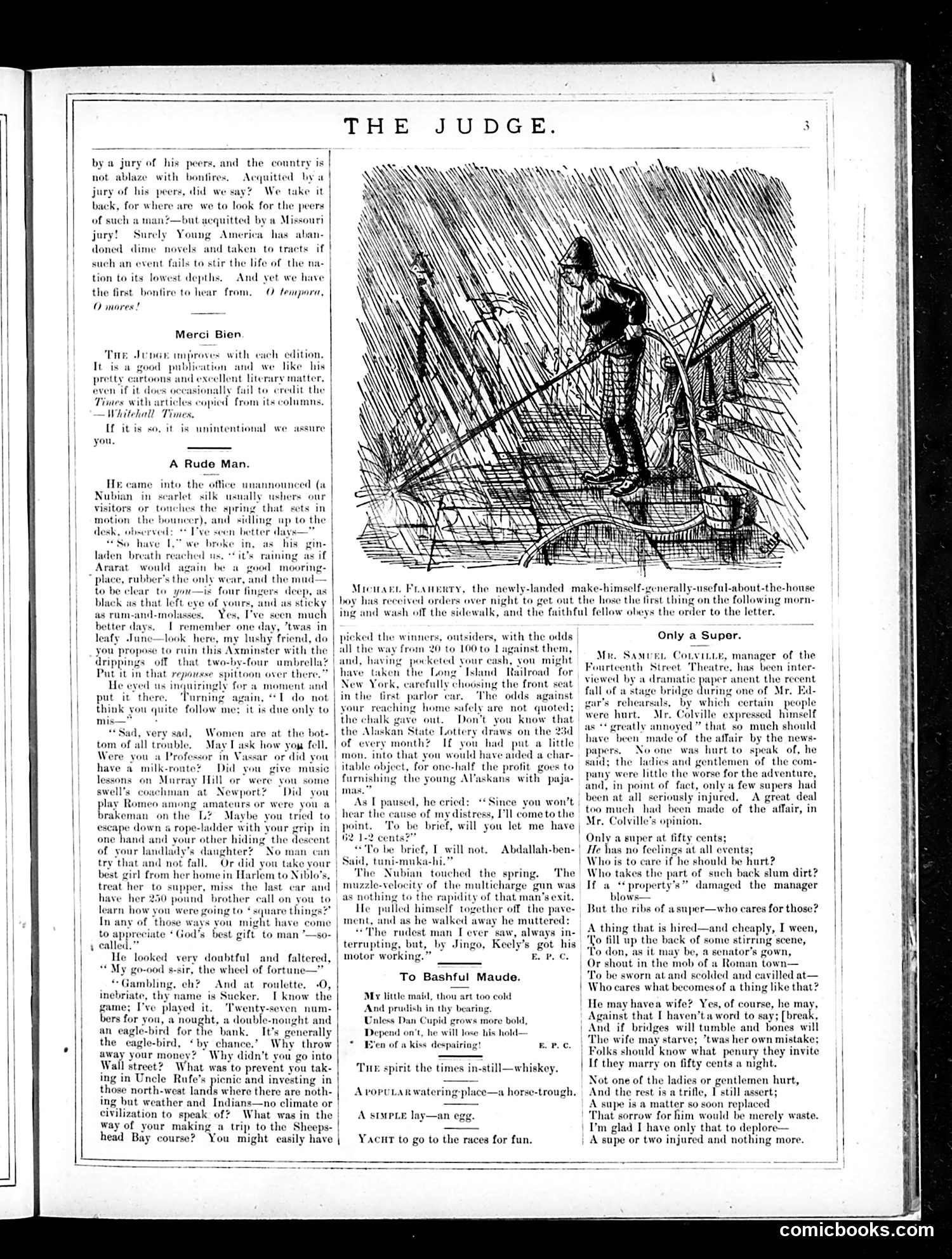
This page contains several satirical pieces mocking contemporary American society circa the 1880s-90s: **Main Cartoon (top right):** Shows a figure at a ship's helm in stormy seas—likely representing the U.S. government navigating troubled waters, a common political metaphor. **"A Rude Man":** Satirizes an uncouth visitor who enters a newspaper office dripping wet, then launches into crass questioning about the editor's personal life (failed romances, gambling, financial schemes). The satire mocks both the visitor's rudeness and implicitly critiques wasteful American behaviors—gambling, speculation, frivolous spending. **"To Bashful Maude":** A brief poem teasing a prudish young woman for being overly reserved. **Opening text:** References acquittal by a "Missouri jury" (unclear which case), sarcastically questioning whether peers exist for such a person—commenting on perceived jury incompetence or regional justice failures. The page reflects Judge's focus on social commentary through humor, targeting bad manners, financial excess, and judicial failures in Gilded Age America.
📄 Transcribed text from this page (OCR, searchable)
Machine-transcribed from the original scan — historical spelling and the odd misread are preserved.
by a jury of his peers not ablaze and the country is Acquitted by a We take it re we to look for the peers of such a man?—but acquitted by a Missouri jury! Surely doned dime with bontir jury of his peers, did we say? back, for where Young America has aban- nd taken tracts if tir the life of the na- tion to its lowest depths. And yet we | the first bent o hear from, novels such an event fails ve O tempora, O mores Merci Bien The June vex with each edition, It is a good publication and we like his pretty cartoons and excellent literary matter, even if it does occasionally fail to credit the Times with articles copied from its columns. —Whitehall Times. If itis so, it is unintentional we you, sure A Rude Man. ame into the office unannounced (i | sually ushers our | ¢ spring that «ets in dling up to the | 1 better days— broke in, as his gin- fits raining as if "a good moor visito: r m the b observe have | laden breath re place, rubber’s the toh black us that left e: , “twas in leafy June—look here, my lushy friend, do you propose to ruin this Axminster with t drippings off that two-by-four umbrell Put it in that repousse spittoon over the He eyed tts inquiringly for put it there, ‘Turning think you quite follow me: mi 1 moment and *L do not | is due only to d, very sad, tom of all trouble. Were you a Prof have a milk-route Women are at the bot- May Task how you fell. or in “did you Did you music Hill or” © you some at Newport? “Did you | play Romeo among amateurs or were you a akeman on the Maybe you tried to pe down & rope-ladder with your grip in nd and your other hiding laughter? try that and not fall. Or did you ta! best girl from her home in Harlem to Niblo’s, | treat her to supper, last car and have her 250 pound. ti all on you to learn how you were going to ‘square thi In any e ways vou might have come to appr iod’s best gift to man ’—so- calle He looked very doubtful and faltered, a ls-sir, the wheel of fortune—” umbling, eh? And at roulette. -O, inebriate, thy name is Sucker. [ know the game; I’ve played it. Twenty-seven num- a nought, a double-nought and ird for the bank. It’s generally le-bird, ‘by chance.” Why throw away your money? © Why didn’t you go i Wall street? What was to prevent you tak- ing in Uncle Rufe’s picnic and investing in those north-west lands where there are noth- ing but weather and Indians—no climate or civilization to speak of? What was in the way of your making a trip to the Sheeps- | head Bay course? You might easily have | | ment, Micewarn Franerty, the boy has received orders over night te newly-landed_ make-himself- y t out the hose the first thing on the fol ing and wash off the sidewalk, and the faithful fellow obeys the order to the letter. picked the winners, outsiders, with the odds against them, nu might Railroad for the front seat odds against not quoted; Long. Ish New York, carefully choosir nthe first mon. into that y itable object, for one-half the profit goes to furnishing the young AVaskans with paja- As I paused, he cried: ‘Since you won't se of my distress, I'll come to the To be brief, will you let me have To be brie aid, tuni-mu s The Nubian touched the spring. ‘The muzzle-velocity of the multicharge gun was pidity of that man’s exit. f together off the pave- nd as he walked away he mutte: he rudest man [ever saw, always terrupting, but, by Jin ecly’s got his motor working.” EP. C. I will not. Abdallah-ben- ni, To Bashful Maude. My little maid, thou art too cold And prudish in thy Unless Dan Cupid grows more bold, Depend on't, he will Ie hold— ‘en of a kiss despairi Tite: spirit the time ng-place—a horse-trough, in-still—whiskey. AvoruLarwate A stMpLe lay—an egg. Yacut to go to the races for fun. Only a Super. AMUEL CoLy it manager of the nth Street Theat has been inter- umatic paper anent the recent bridge ining one of Mr. Ed by which’ certain people . Colville expressed. himself inoyed” that. so much should by the news- ne was hurt speak of, he ies and gentlemen of the com- pany little the worse for the adventure, and, in point of fact, only a fev been at all seriously injured. too much had t made of the Mr. Colville’s opinion. Only a super at fifty cents; He has no feelings at all events; Who is to care if he should be hurt? Who takes the part of such back slum dirt? If a property «” damaged the manager were hurt. as ** greatly have been ma papers. No said; the A thing that is hired—and cheaply, I ween, ‘Lo fill up the back of some stirring scene, To don, as it ator’s gown, Or shout in th ‘To be sworn a Who cares wh: a thing like that? He may havea wife? Yes, of course, he may, Against that I haven’ta word to say; [break, And if bridges will tumble and bones will The wife starve; ‘twas her own mist Folks should know what penury they If they marry on fifty cents a night. Not one of the ladies or gentlemen hurt, And the rest is a trifle, T still assert; A supe is a matter so soon replaced ‘That sorrow for him would be merely waste. I'm glad I have only that to deplore— A supe or two injured and nothing more. comicbooks.com