
A complete issue · 16 pages · 1883
Judge — September 29, 1883
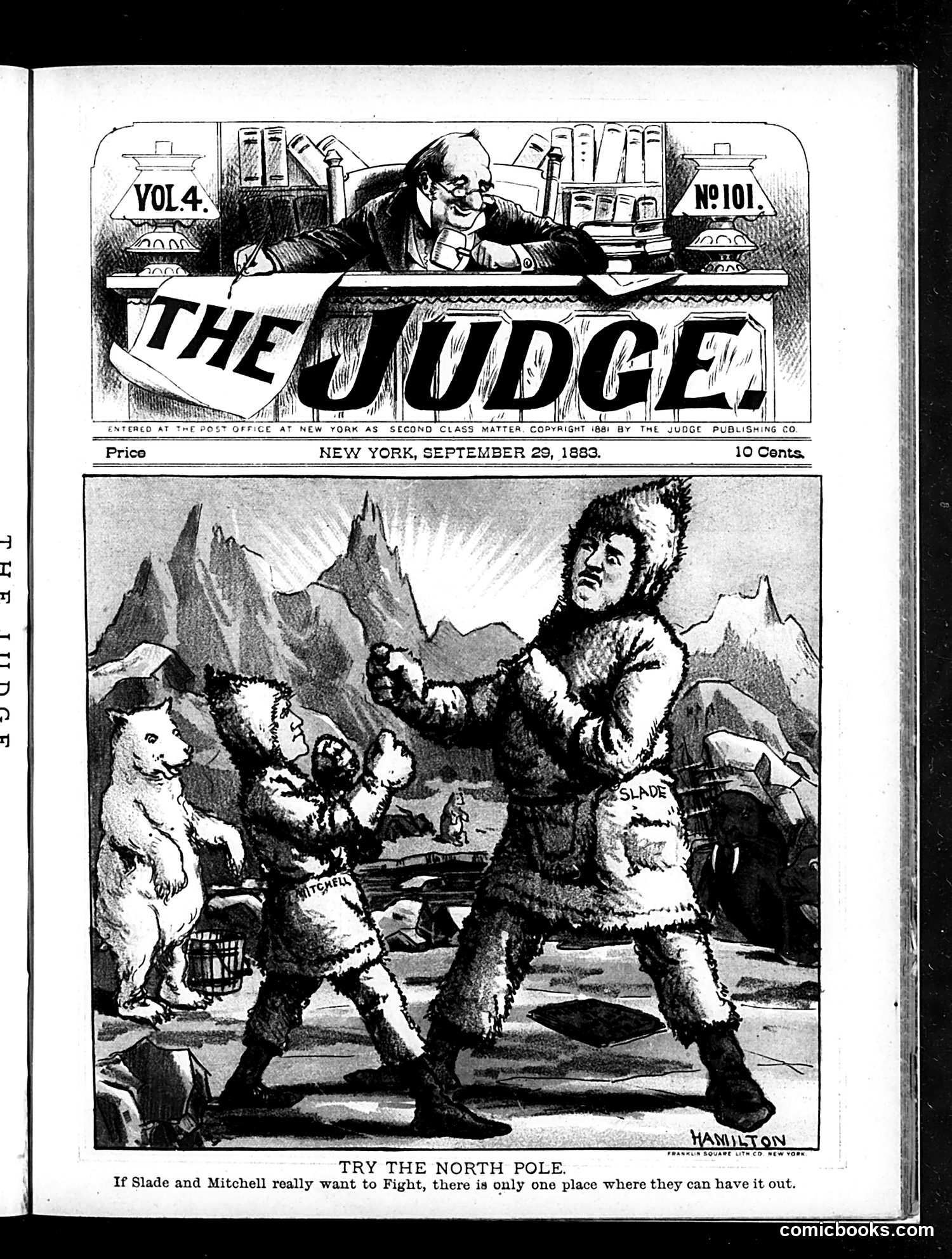
This political cartoon satirizes a proposed fight between two boxers named Shade and Mitchell. The caption suggests the North Pole as the only suitable location for their bout, likely implying the fight was so controversial or problematic that it needed to happen in an isolated, uninhabited place. The cartoon depicts a giant figure (presumably one of the fighters) towering over smaller characters in a mountainous arctic setting, with bears present. The exaggerated scale and harsh landscape emphasize the absurdity of the proposed match. Without additional context about Shade and Mitchell's specific identities or the contemporary boxing controversy referenced, the exact nature of the dispute remains unclear, but Judge's editors clearly viewed their rivalry as requiring extreme measures or removal from civilization.
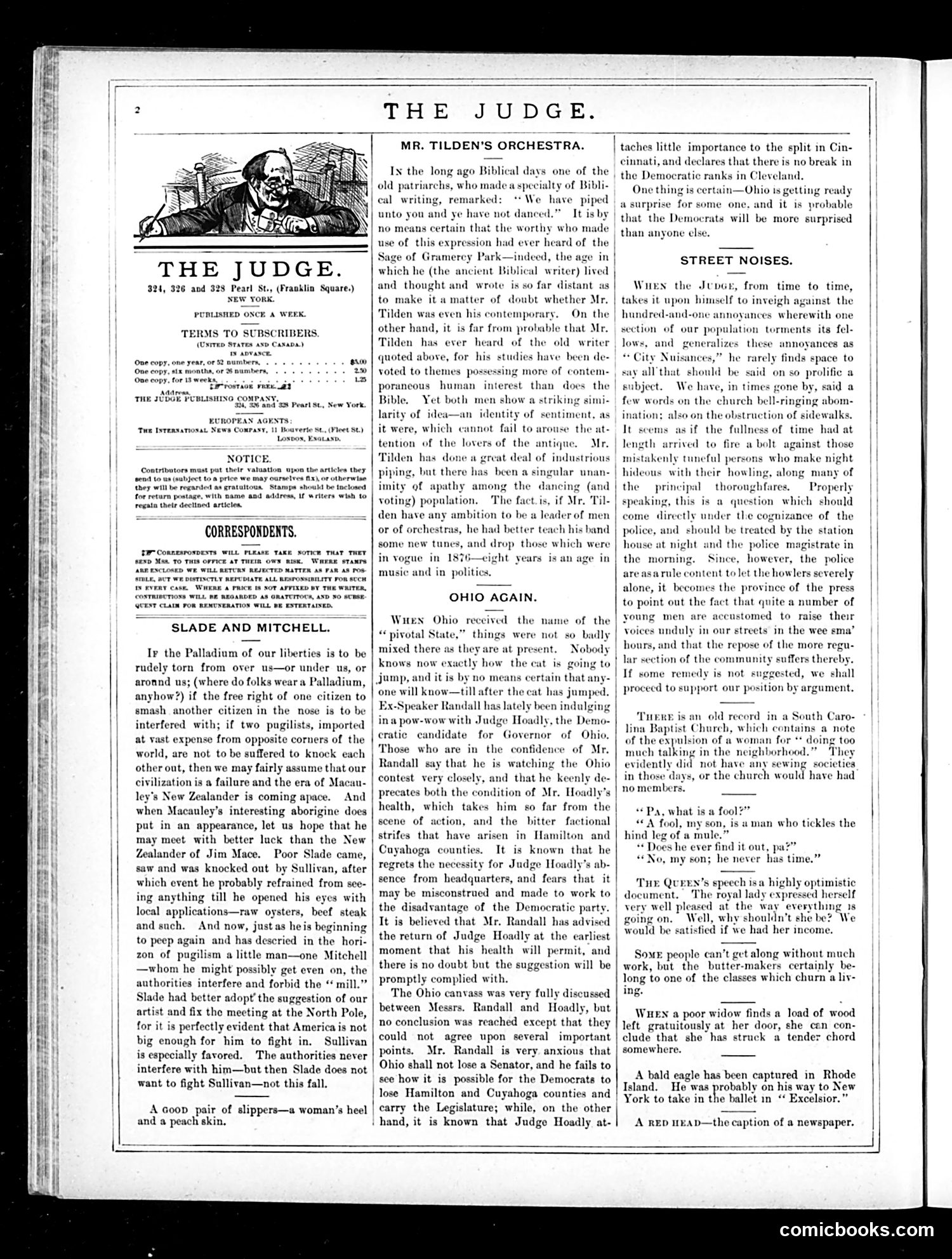
This page from *Judge* magazine contains two main political pieces: **"Slade and Mitchell"**: Satirizes American authorities for preventing a prizefight between boxers Slade and Mitchell while allowing John L. Sullivan (a favored boxer) to fight freely. The author mocks this selective enforcement, suggesting authorities favor Sullivan. The piece critiques the hypocrisy of permitting boxing while selectively suppressing matches. **"Mr. Tilden's Orchestra"**: A satirical commentary on Samuel J. Tilden (the 1876 Democratic presidential candidate and "Sage of Gramercy Park"). The author compares Tilden to a Biblical patriarch who "piped unto you" but got no dancing response. The satire suggests Tilden's political messaging is outdated—stuck in 1876 tunes—and failing to energize Democratic voters. It's political criticism disguised as musical metaphor, mocking Tilden's inability to inspire party enthusiasm.
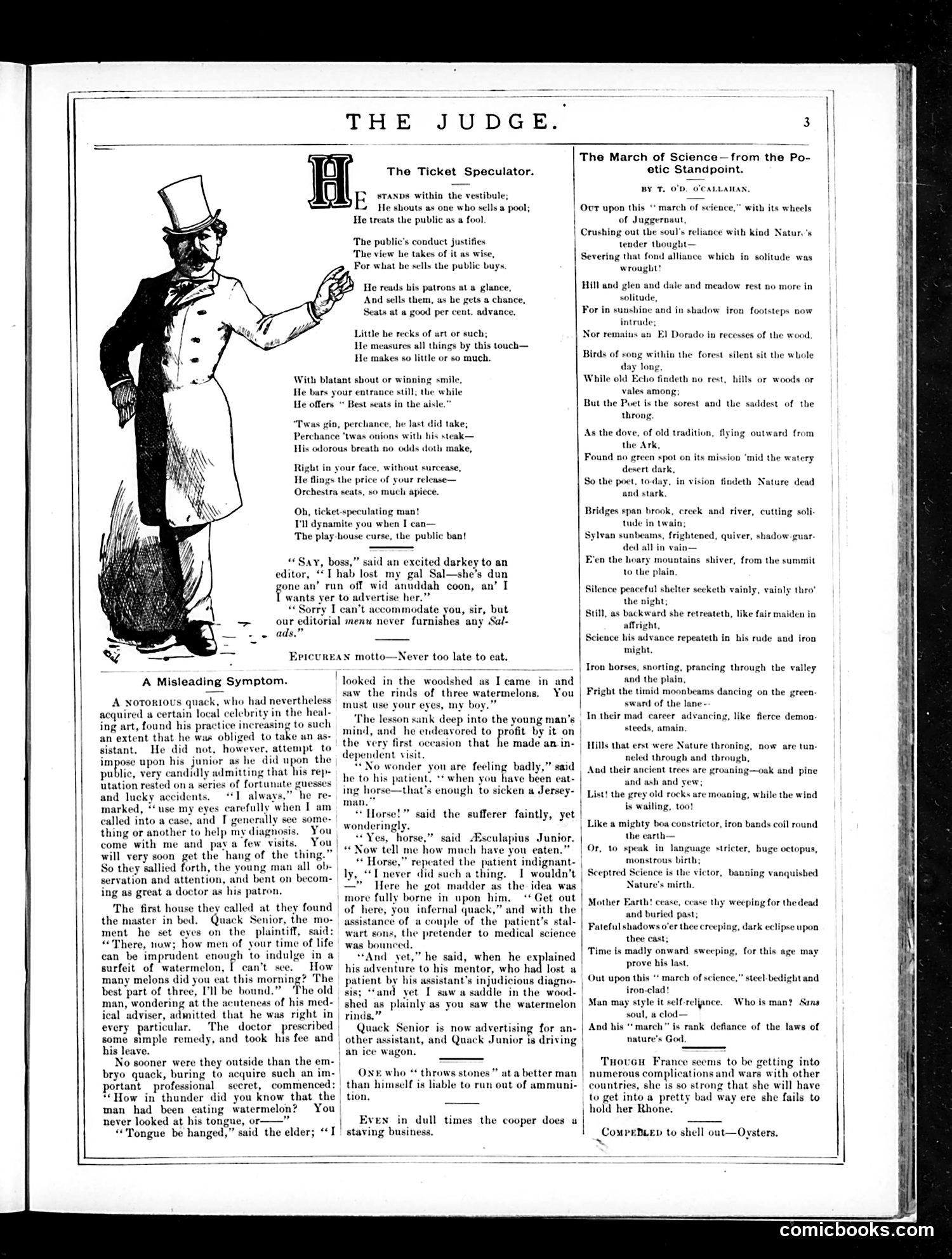
The cartoon depicts a well-dressed con artist in top hat and tails—the "ticket speculator"—selling theater seats at inflated prices to the public. The accompanying poem satirizes his predatory business model: he exploits patrons' desperation for good seats, charges exorbitant markups ("a good per cent, advance"), and treats customers as fools to be manipulated. The accompanying anecdote, "A Misleading Symptom," illustrates the same theme through a fraudulent doctor. The quack gains reputation through lucky accidents and misdirected observation—he assumes a patient ate watermelon after seeing rinds in a shed, then carelessly diagnoses another patient as eating horse meat (a ridiculous assumption). When challenged, his pretense collapses. Both pieces target **social parasites who exploit public gullibility**—whether ticket scalpers or medical charlatans. The satire suggests such swindlers flourish because the public enables them through naive trust and desperation.
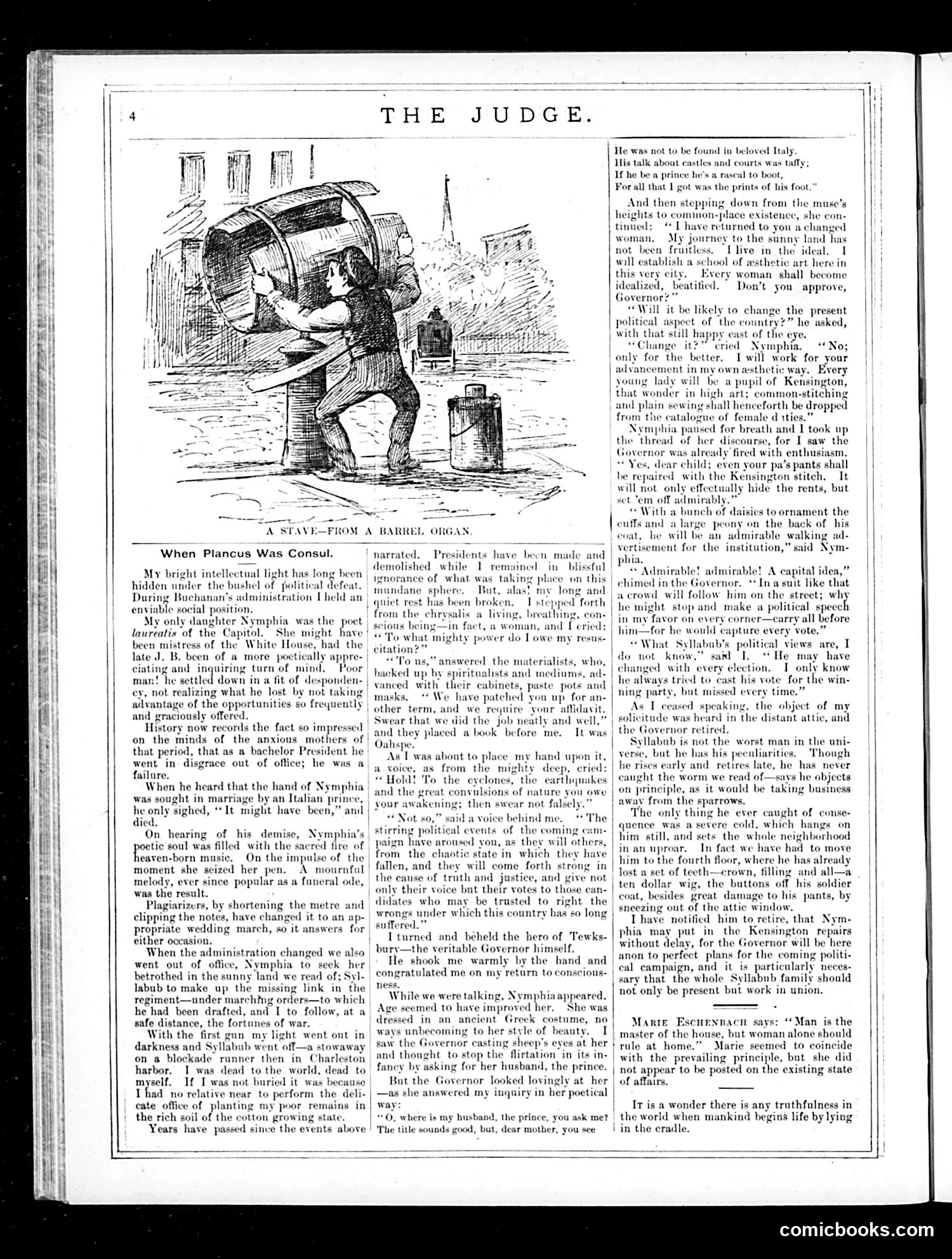
This page satirizes **James Buchanan's failed presidency** and the chaos of American politics during his administration (1857-1861). The narrator, a woman named Syllabub, recounts how her daughter Nymphia rejected the opportunity to marry Buchanan when he was a bachelor president. After he leaves office "in disgrace" as "a failure," Nymphia marries an Italian prince instead. Years later, awakened by the political upheaval of an upcoming election campaign, Syllabub encounters the "Governor" (likely representing post-Buchanan political leadership attempting reform). The satire mocks Buchanan's incompetence and the nation's need for stronger leadership. The cartoon illustration depicts Syllabub emerging from a barrel or vessel—symbolizing her awakening from political sleep during turbulent times. The piece criticizes both Buchanan's administrative failures and suggests hope that new political figures will restore "truth and justice" to the country, which has "suffered" under previous misrule.
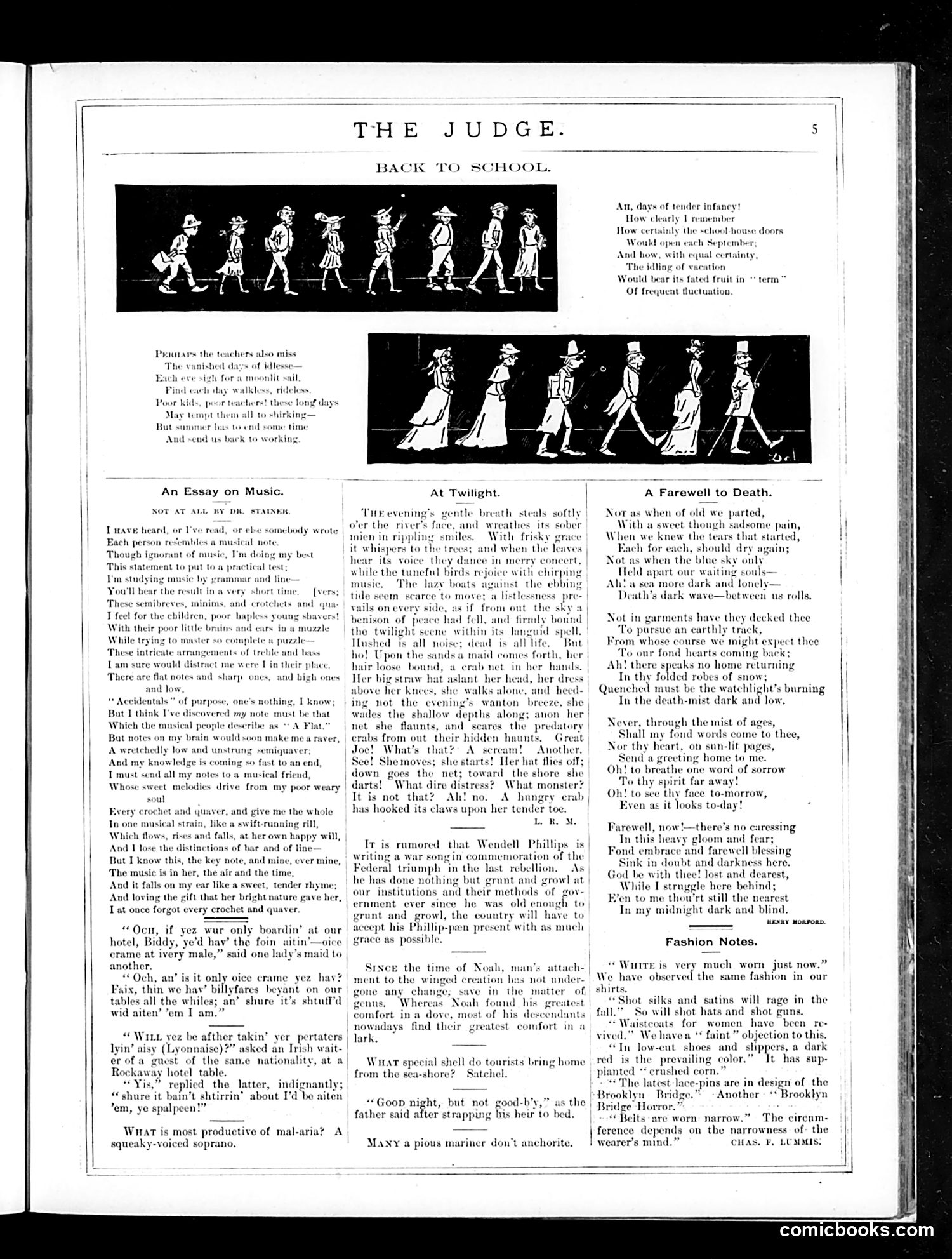
This page from Judge satirizes end-of-summer nostalgia and the return to school. The top cartoons depict children trudging back to school—a familiar American experience. The accompanying verse humorously captures both children's and teachers' mixed feelings about vacation ending: teachers miss the "vanished days of idlesse," while students dread losing freedom. The page includes several satirical pieces: an absurdist "Essay on Music" mocking pretentious music criticism; romantic poetry about twilight ("At Twilight"); and a humorous poem about death ("A Farewell to Death"). Notable is a brief jab at abolitionist **Wendell Phillips**, suggesting he's finally writing a war song—presumably mocking his persistent criticism of government while contributing little constructively. The piece implies his perpetual complaints ("grunt and growl") make even a positive contribution suspect. The "Fashion Notes" section offers lighter social commentary on contemporary dress trends. Overall, the page blends gentle social satire with literary content typical of Judge's middlebrow humor.
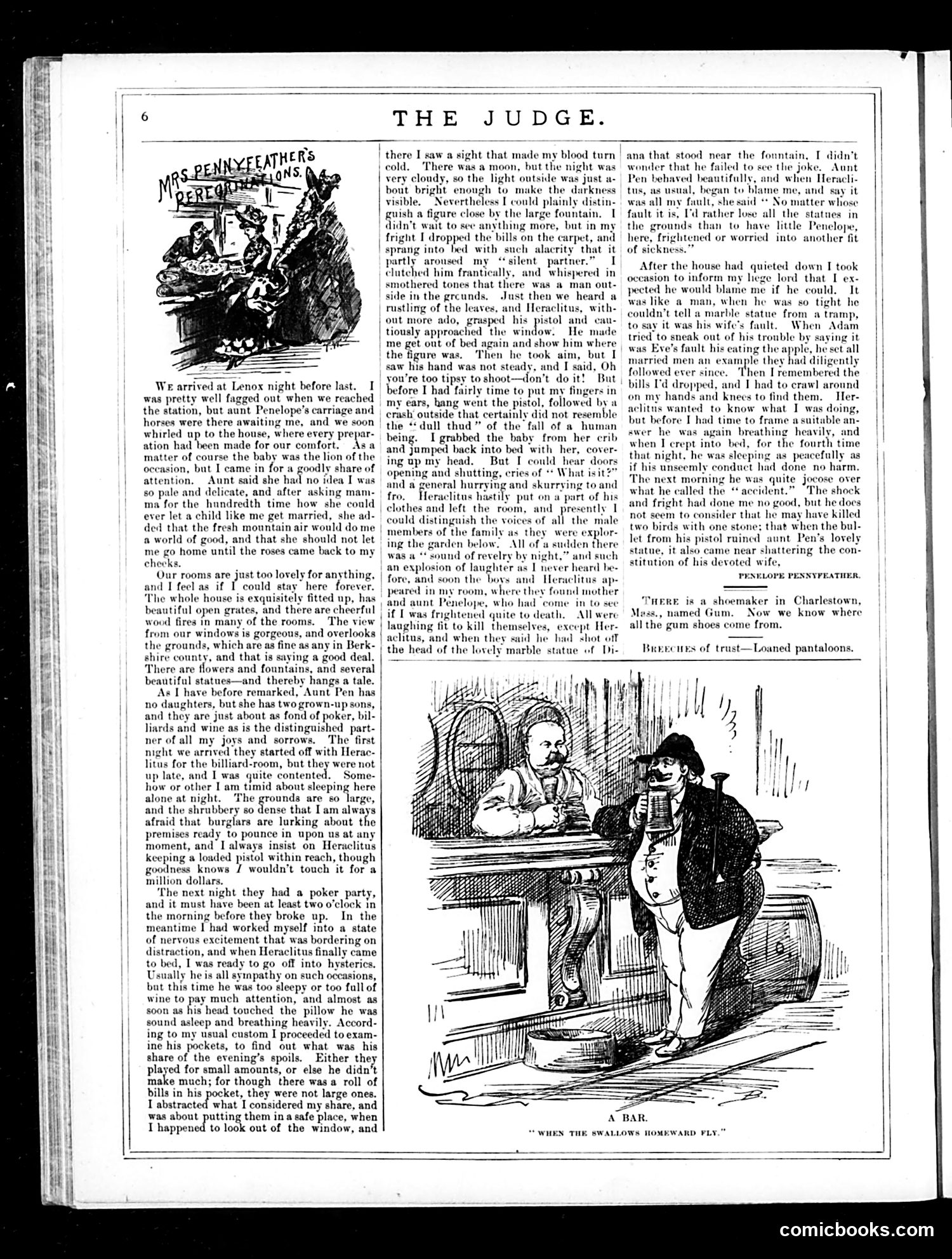
This page from *Judge* contains a serialized domestic story (left column) and a single cartoon (bottom right). The cartoon depicts a man at a bar counter speaking to a bartender. The caption "When the Swallows Homeward Fly" appears to be a humorous reference to the sentimental song, suggesting ironic contrast—likely the man is making an excuse about returning home or drinking away from home during migration season. The accompanying text snippet references "a shoemaker in Charlestown" and discusses where gun shoes come from, suggesting the cartoon may involve wordplay or a pun, though the precise satirical target is unclear from this excerpt alone. The main narrative on the left is a woman's account of visiting relatives in Lenox (Massachusetts) with her husband Heraclitus, focusing on social anxieties and marital dynamics rather than political satire.
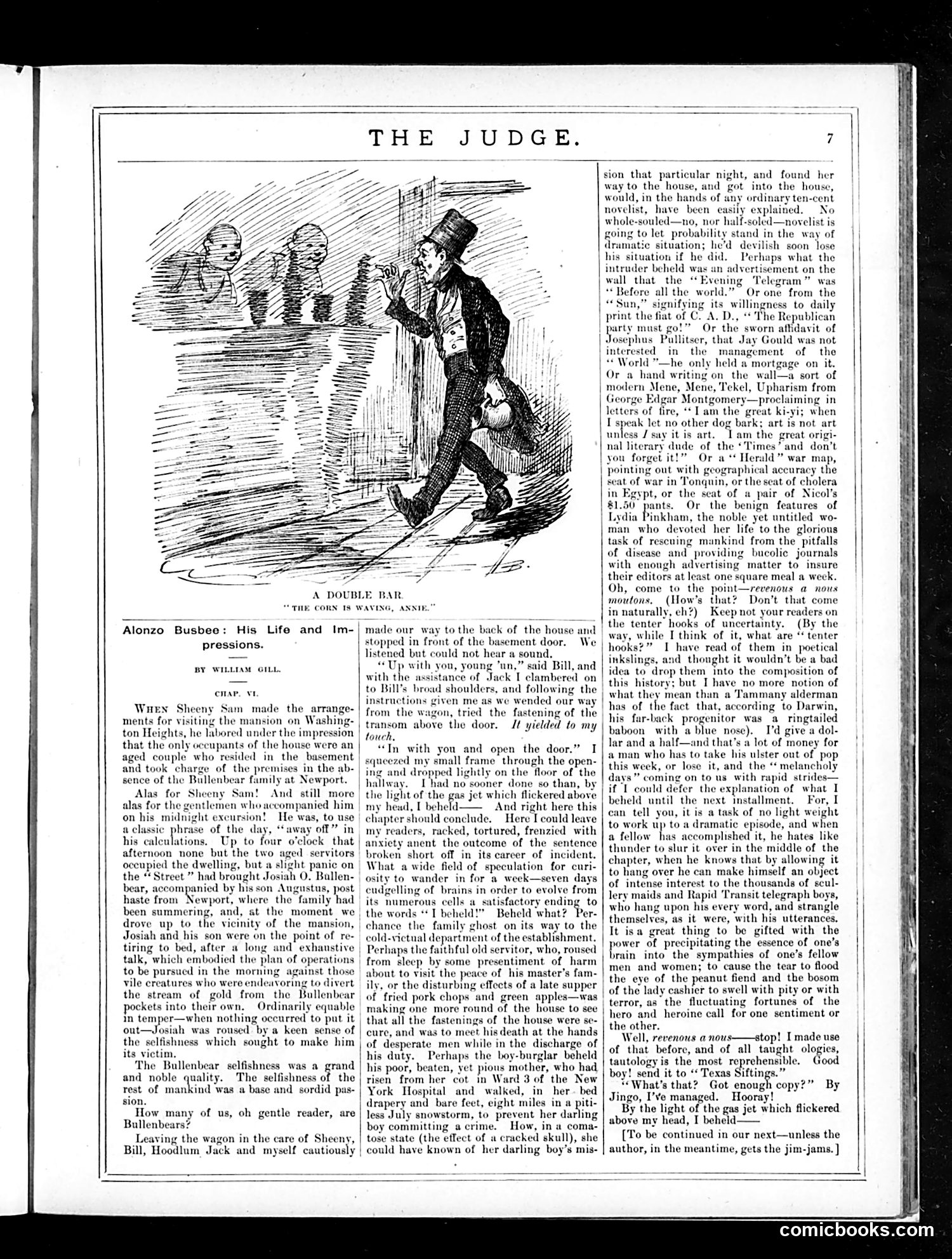
This page from *Judge* magazine contains a serialized story titled "Alonzo Busbeo: His Life and Impressions" by William Hill, alongside a cartoon labeled "A Double Bar" (subtitle: "The Corn is Waving, Annie"). **The Cartoon:** depicts what appears to be a burglary in progress—a man in formal dress (top hat) confronting two figures near water or a cellar. The caption's meaning is unclear without more context. **The Story:** is a humorous narrative about a bungled burglary of a wealthy family's mansion on Washington Heights. The narrator, part of a criminal gang led by "Sheeny Sam," infiltrates the Bullenbear family home expecting only elderly servants—but the wealthy patriarch Josiah O. Bullenbear has unexpectedly returned from Newport due to a financial panic on Wall Street. The story satirizes both the criminals' incompetence and the wealthy family's self-righteous hypocrisy. The narrative deliberately breaks off mid-sentence ("I beheld...") to build suspense, while the author mockingly speculates about what could be revealed next.
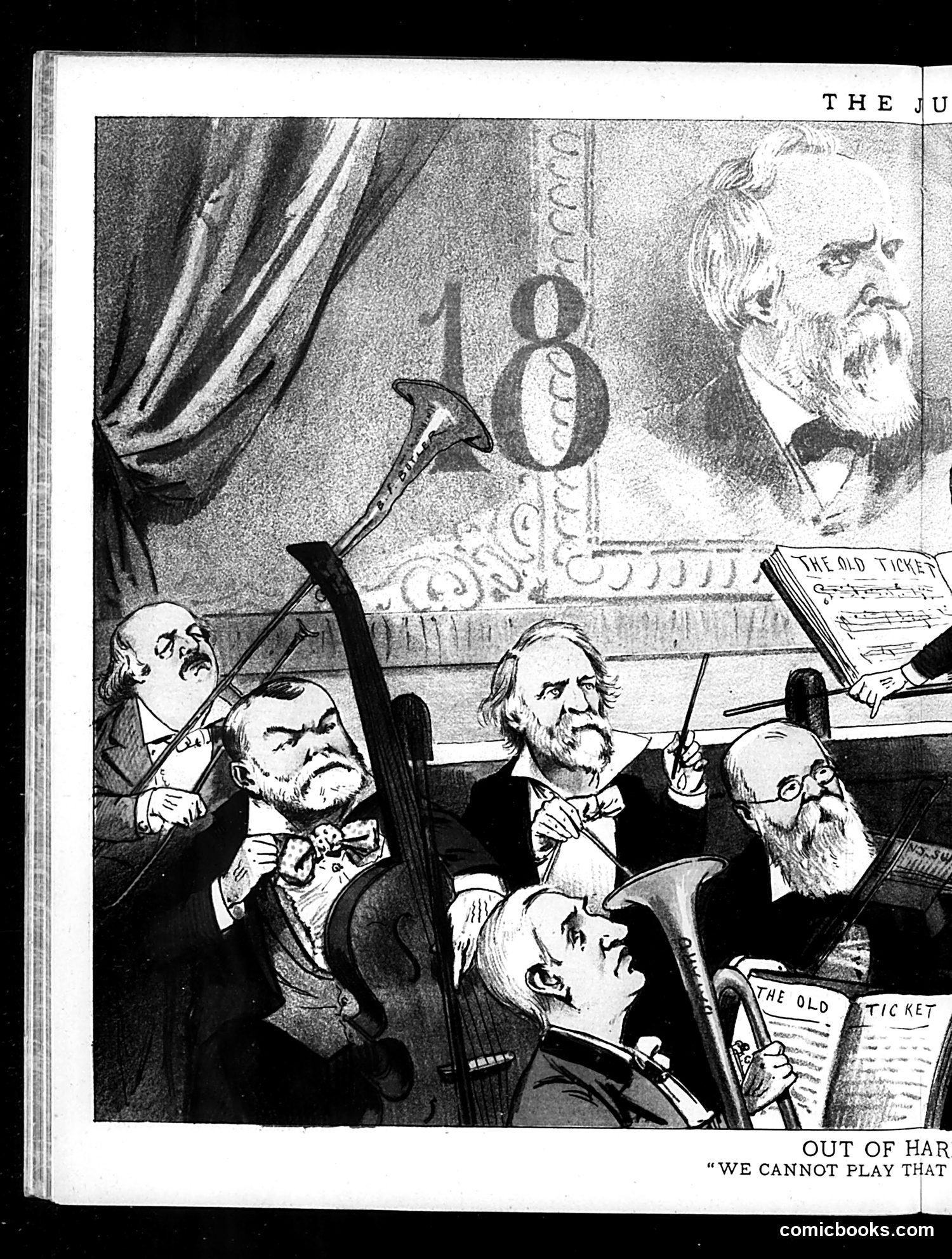
This appears to be a satirical cartoon from *Judge* magazine depicting a musical ensemble or orchestra. Five bearded men in formal attire are shown with instruments, looking at sheet music labeled "THE OLD TICKET." The caption reads "OUT OF HARMONY—'WE CANNOT PLAY THAT.'" The cartoon likely satirizes political discord within a party or political faction—the musicians unable to harmonize represent politicians who cannot agree on a shared platform or policy (represented by "the old ticket"). The specific identities of the figures remain unclear without additional context, but the satire centers on political division and the inability of party members to work together toward common goals.
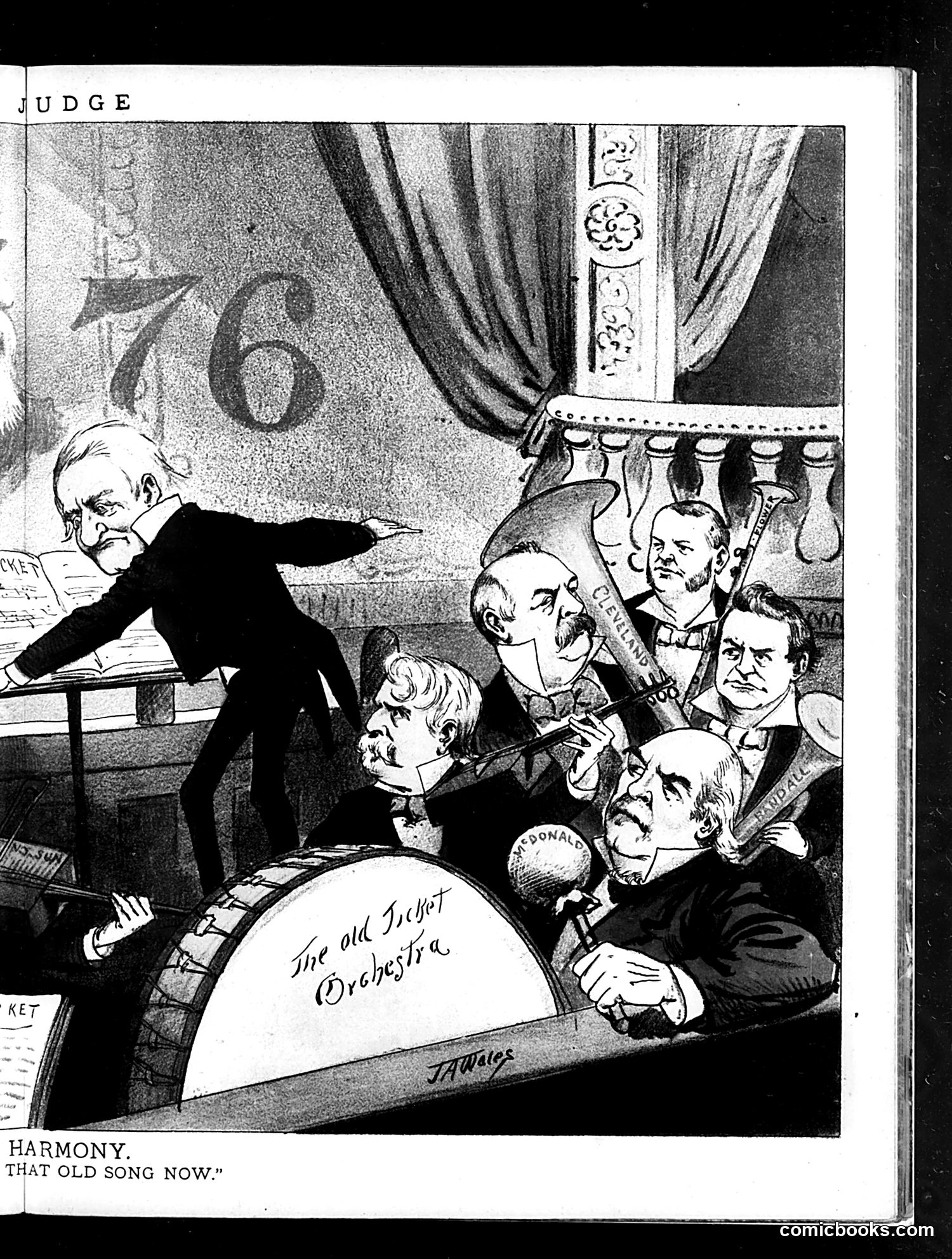
This political cartoon depicts "The Old Tricot Orchestra" — a group of men in formal dress seated together like orchestra members. A conductor on the left gestures expressively, apparently leading them. The drum reads "The old Tricot Orchestra," suggesting these figures represent political or social leaders being orchestrated to perform in "harmony." The satire appears to mock forced unity or coordination among political figures who would not naturally agree. The "old song" reference suggests they're being made to repeat tired, outdated rhetoric or policies. The caricatured faces and exaggerated features emphasize the ridicule. Without the publication date visible, the specific political context remains unclear, but the cartoon critiques orchestrated political conformity or propaganda among establishment figures.
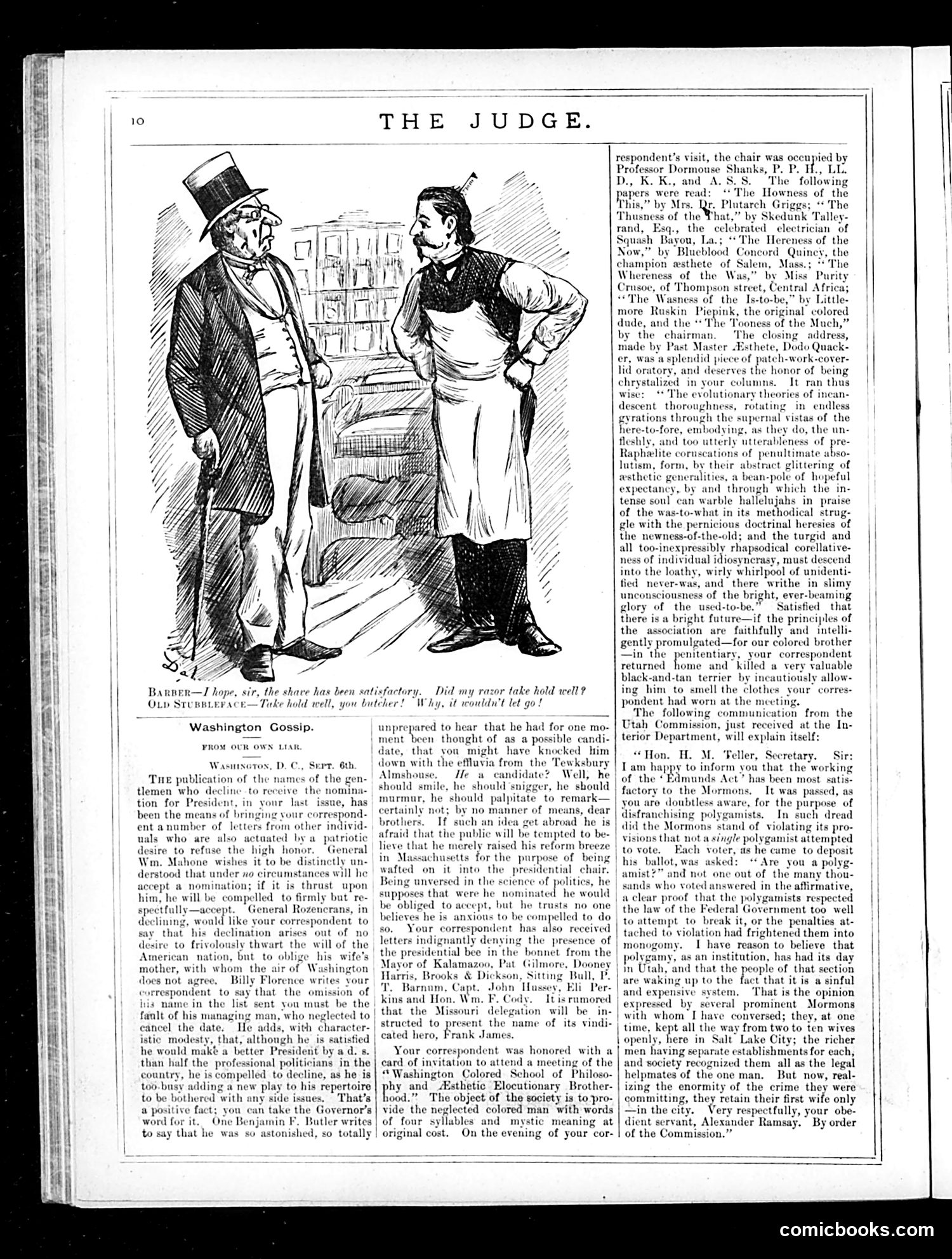
The top cartoon depicts a barber and customer in a crude visual pun: the barber's razor supposedly "held" so well it "wouldn't let go"—satirizing politicians who, when offered the presidency, claim they cannot refuse despite protestations otherwise. The main text, "Washington Gossip," mocks prominent figures supposedly declining presidential nomination. General William Mahone and General Rosecrans are portrayed as insisting they'll refuse if nominated, while the correspondent sarcastically notes their transparent lack of genuine reluctance. Billy Florence and Benjamin Butler similarly claim they're "astonished" at being considered. The piece concludes by ridiculing a "Washington Colored School of Philosophy and Aesthetic Elocutionary Brotherhood," which allegedly educates Black men using four-syllable words of "mystic meaning." The satirists mock speakers with absurdist titles like "The Hereness of the Now" and "The Wasness of the Is-to-be"—mocking both pretentious language and, appears likely, contemporary Black intellectual advancement itself.
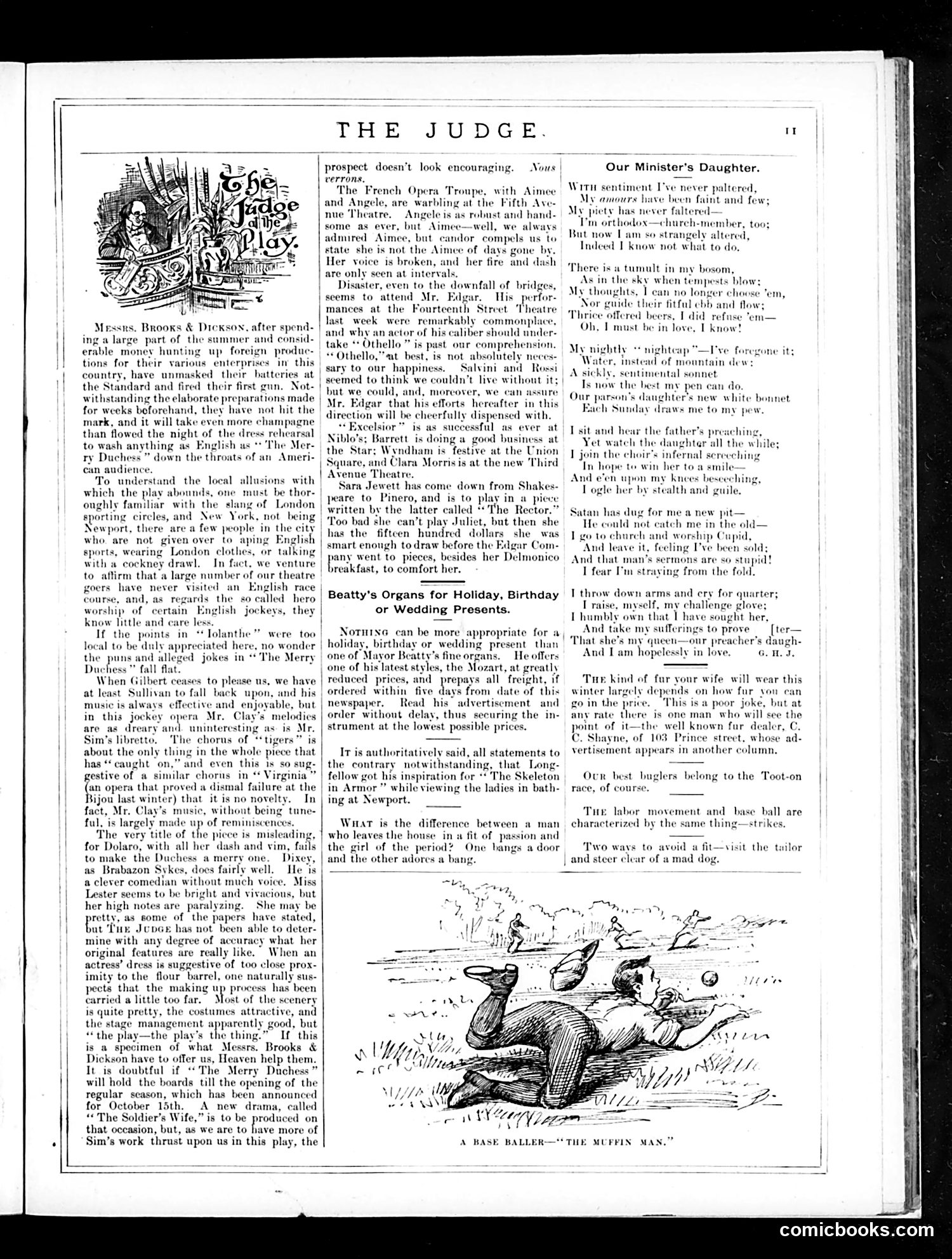
This page from *Judge* magazine contains theater reviews and criticism typical of the publication's satirical approach to New York culture. **The Main Review:** The lengthy critique discusses "The Merry Duchess," a theatrical production that the reviewer finds disappointing. The critic complains that the play relies too heavily on London sporting slang and references unfamiliar to American audiences, making it inaccessible. The music by Mr. Clay is dismissed as unoriginal and derivative. **Social Context:** The satire targets theater-goers who pretend sophistication by adopting English mannerisms—wearing London clothes, speaking with cockney accents, and worshipping English jockeys. This mocks a particular class of wealthy New Yorkers aping British fashion and culture. **Additional Reviews:** Brief mentions of other performances, including French opera singer Aimee (past her prime) and actor Edgar's lackluster *Othello*. **The Cartoon:** "A Base Baller—'The Muffin Man'" appears at bottom, likely satirizing baseball culture, though context is unclear from this excerpt.
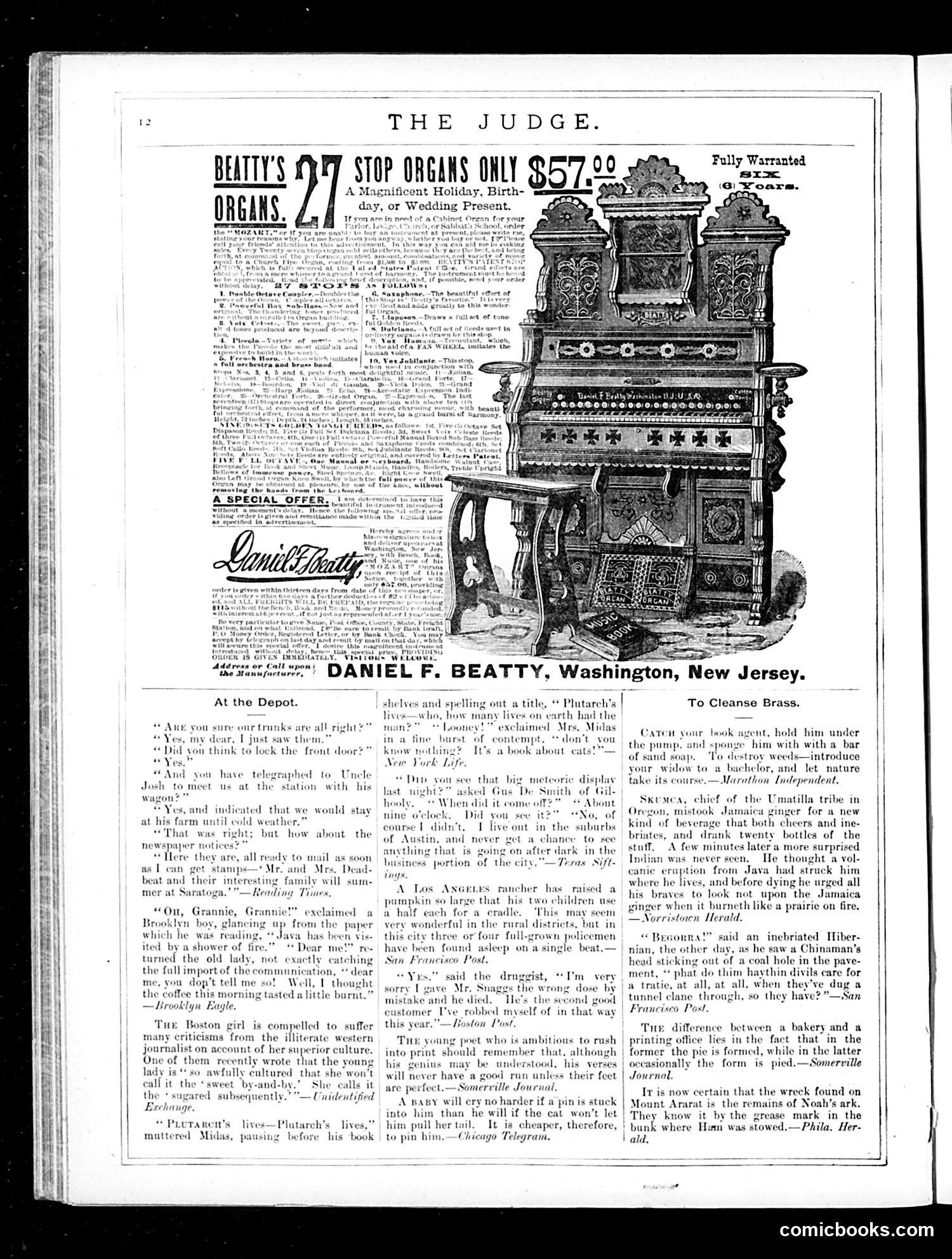
This is primarily an **advertisement page** for Beatty's 27-Stop Organs ($57.00), manufactured in Washington, New Jersey—the dominant visual element being an ornate parlor organ illustration. The surrounding content consists of brief **humorous anecdotes and jokes** typical of Judge's satirical style: - **"At the Depot"**: Comic dialogue about travelers and telegrams - **"Plutarch's Lives" references**: Wordplay jokes about literary titles - **Social humor**: Anecdotes about a Los Angeles rancher's enormous pumpkin, Irish laborers, and cultural pretensions - **Newspaper office satire**: Comments on Western journalists' poor grammar and the difference between bakeries and printing offices **No major political cartoons appear here.** The content reflects late-19th-century American humor: immigrant stereotypes (Irish dialect humor), rural exaggeration tales, and gentle mockery of social climbers and literary affectation. The page demonstrates how Judge mixed advertising with brief comedic filler rather than sustained political commentary.
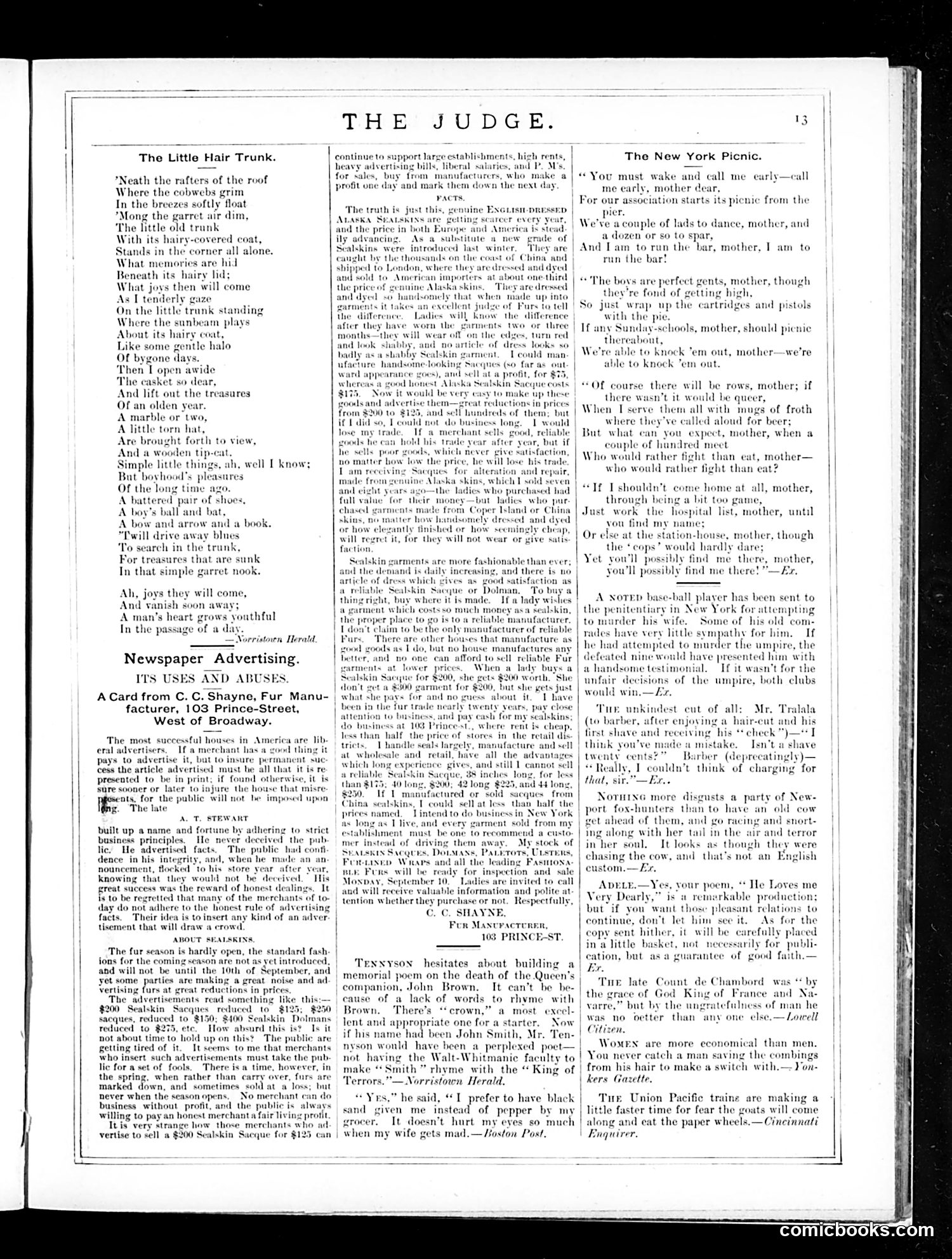
This appears to be a humorous dialogue between a young man and his mother on the eve of a New York picnic organized by "our association." The son promises to behave—dancing, sparring, and running the bar—but his assurances become increasingly dubious. He acknowledges fights will likely break out ("there will be rows"), admits the attendees will get drunk ("mugs of froth"), and finally confesses he might not come home at all, asking his mother to check hospital lists for his name. The satire mocks youthful male bravado and the gap between respectable intentions and raucous reality. The "picnic" is clearly a drinking and fighting expedition that the son tries to present decorously to his mother. It's social commentary on working or middle-class urban recreation in this era.
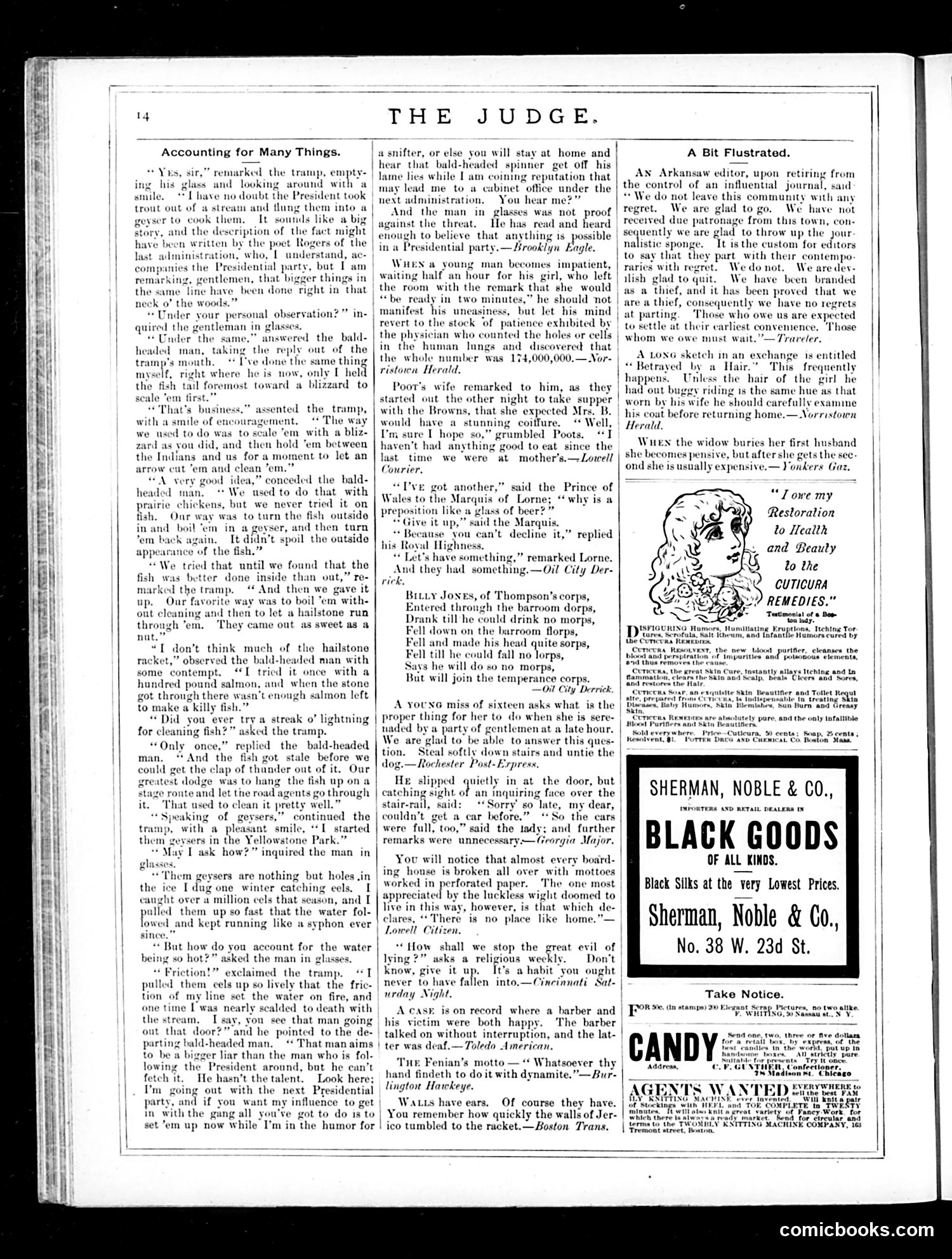
This page features a tall tale dialogue mocking President Theodore Roosevelt's famous hunting and naturalist expeditions. A tramp and bald-headed man exchange increasingly absurd stories about cooking fish in geysers and using hailstones and lightning for cleaning—clearly exaggerated elaborations on Roosevelt's actual Yellowstone Park adventures. The satire targets both Roosevelt's well-publicized outdoor exploits and the hyperbolic newspaper accounts that accompanied them. The tramp's boasts about accompanying "the next Presidential party" and his threat to share inflated stories with the press satirizes how Roosevelt's expeditions generated sensational press coverage. The joke is that tall tales and impossibly exaggerated accounts have become indistinguishable from legitimate news reporting about the President's activities—a critique of both Rooseveltian self-promotion and credulous journalism. The text references "the poet Rogers of the administration," likely alluding to actual Roosevelt propagandists.
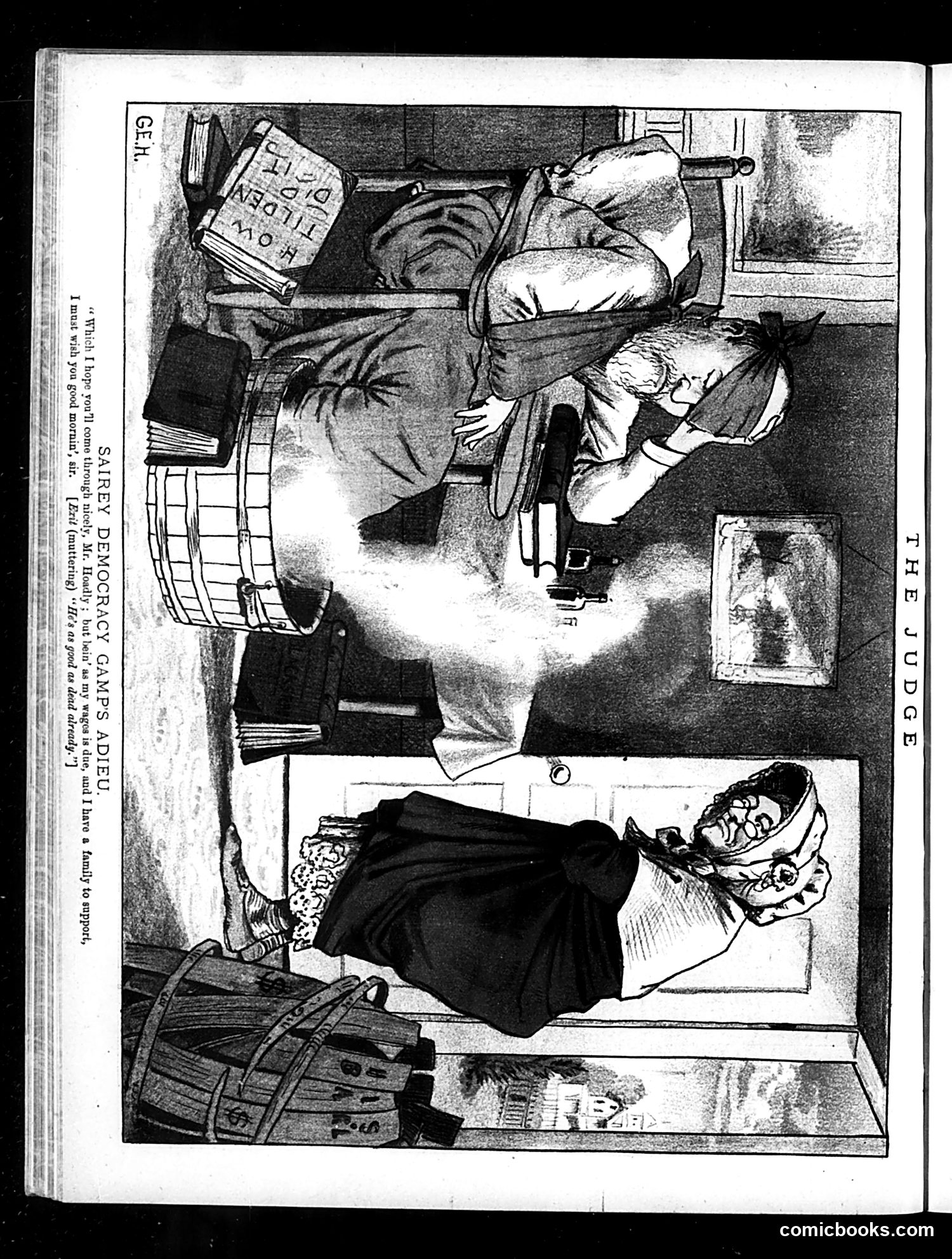
This cartoon satirizes "Sairey Gamp," a famous character from Dickens's *Martin Chuzzlewit*—a disreputable nurse known for drinking and dishonesty. The cartoon uses her as a symbol for Democracy itself, bidding farewell to someone named Hoadly (likely a political figure of the era). The satire suggests Democracy is abandoning the political situation like Sairey abandoning a dying patient. Her callous muttering—"He's as good as dead already"—implies the cartoon's creator believed Democracy (or democratic principles) was being destroyed or abandoned during whatever political crisis this addressed. The barrel and crude furnishings reinforce the character's disreputable nature, equating flawed Democracy with Dickens's notorious, unreliable character.