
Judge, 1883-09-29 · page 3 of 16
Judge — September 29, 1883 — page 3: what you’re looking at
What you’re looking at
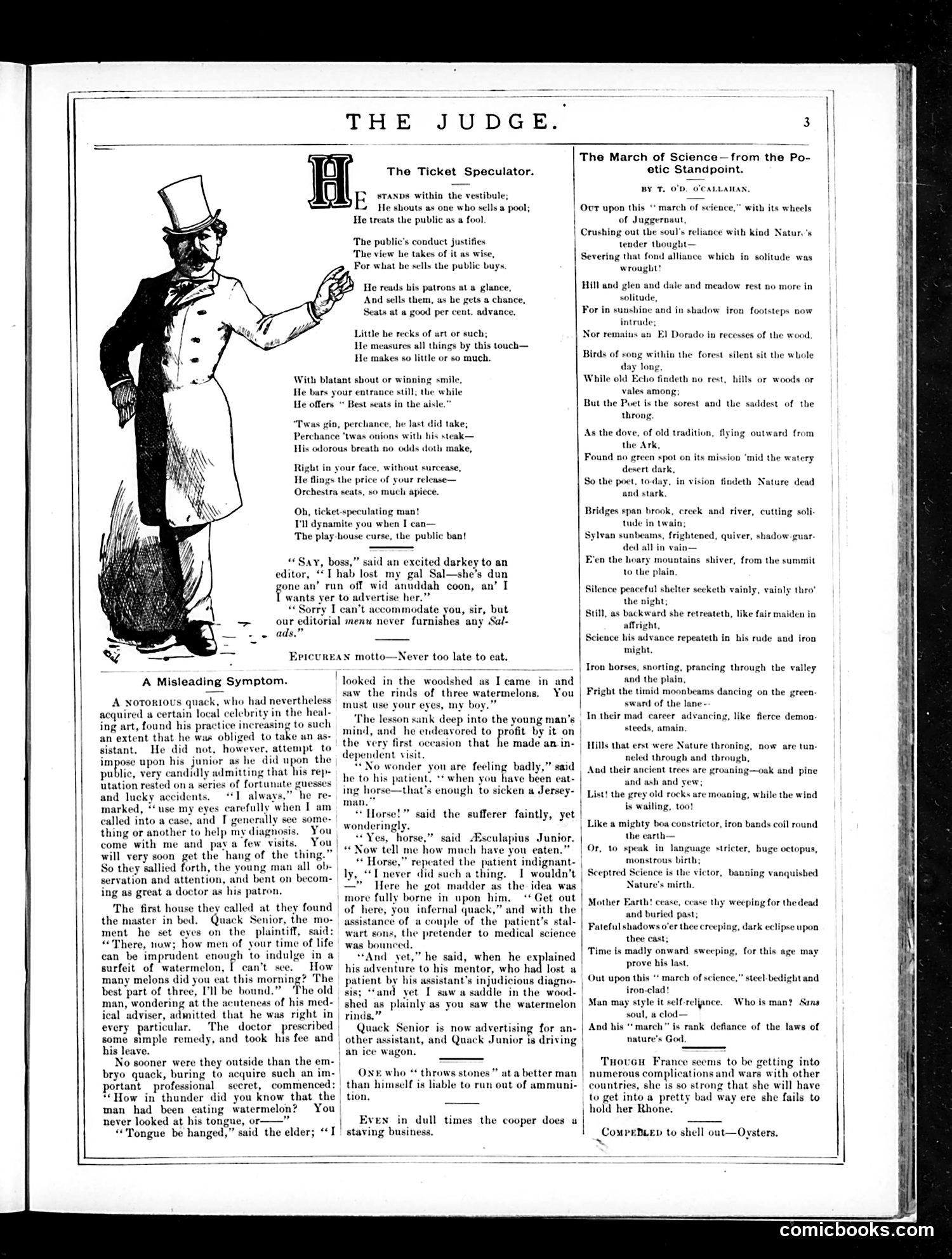
The cartoon depicts a well-dressed con artist in top hat and tails—the "ticket speculator"—selling theater seats at inflated prices to the public. The accompanying poem satirizes his predatory business model: he exploits patrons' desperation for good seats, charges exorbitant markups ("a good per cent, advance"), and treats customers as fools to be manipulated. The accompanying anecdote, "A Misleading Symptom," illustrates the same theme through a fraudulent doctor. The quack gains reputation through lucky accidents and misdirected observation—he assumes a patient ate watermelon after seeing rinds in a shed, then carelessly diagnoses another patient as eating horse meat (a ridiculous assumption). When challenged, his pretense collapses. Both pieces target **social parasites who exploit public gullibility**—whether ticket scalpers or medical charlatans. The satire suggests such swindlers flourish because the public enables them through naive trust and desperation.
📄 Transcribed text from this page (OCR, searchable)
Machine-transcribed from the original scan — historical spelling and the odd misread are preserved.
THE JUDGE. With bl He bars He offers“ Best seats in the aisle. “Twas gl Perchan His odorous breath no odds Right in your f He fling Orchest Oh, ti T'll dynamite ‘The play-house curse, the public ban! “Say, boss,” editor, “T ben nor wants ye Sorry our editori ads.” EPICUREAN motto: A Misleading Symptom. A Notorious quack, who had nevertheless acquired a certain local celebrity in the heal- ing art, found his practice increasing to such an extent that he was obliged to take un as- sistant. He did not, however, attempt to impose upon his junior as he did upon the public, very candidly admitting that his re utation rested on a series of fortunate and lucky accidents. ‘1 always,” he re- marked, * use my eyes carefully when Iam called into a case, and T generally see some- thing or another to help my diagnosis. You come with me and pay a few visits. You will very soon get the hang of the thing.” So they sallied forth, the young man all ob- servation and attention, and bent on becom- ing as great a doctor as his patron, The first house they called at they found the master in bed. Quack Senior, the mo- ment he set eyes on the plaintiff, said “There, nuw; how men of your time of life can be imprudent enough to indulge in a surfeit of watermelon, I can’t see. How many melons did you eat this morning? The best part of three, I'll be bound.” The old man, wondering at the acuteneas of his med- ical adviser, admitted that he was right in every particular. ‘The doctor prescribed some simple remedy, and took his fee and his leave. No sooner were they outside than the em- bryo quack, buring to acquire such an im- portant professional secret, commenced: **How in thunder did you know that the man had been eating watermelon? You never looked at his tongue, or- 7 “Tongue be hanged,” said the elder; “I The Ticket Speculator. E STANDS within the vestibule; 4 He shouts as one who sells a pool; He treats the public as a fool ‘The public’s conduct justifies ‘The view he takes of it as wis For what be sells the public buys, He reads his patrons ata glance, And sells them, as he gets a chance, Seats at a good per cent, advance, Little he recks of urt or such; He measures all things by this touch— He makes so little or so much. Jatant shout or winning smill your entrance still; the wh perchance, he last did take; ‘twas onions with his steak— oth make, 1c, without surcease, the price of your release: ra seats, so much apiece. et-speculating man! pu when I can— aid an excited darkey to an hab lost. my gal Sal—she’s dun un off wid anuddah coon, an’ I r to advertise her.” T can’t ommodate you, sir, but jal menu never furnishes any Sal- Never too late to eat. { . looked in the woodshed as I came in and saw the rinds of three watermelons, You must use your eyes, my boy.” ‘The lesson sank deep into the young man’s mind, and he endeavored to profit by it on the very first occasion that he made an in- dependent visit. No wonder you are feeling badly,” said he to his patient, ** when you have been eat- ing horse—that’s enough to sicken a Jersey- man. * Horse!” wonderingly “Yes, horse,” said Esculapius Junior. | “ Now tell me how much have you eaten “Horse,” repeated the patient indignant- ly, “I never did such a thing. I wouldn't Here he got madder as the idea was | more fully borne in upon him. ‘Get out | of here, you infernal quack,” and with the | assistance of a couple of the patient’s stal- | art sons, the pretender to medical science was bounced. And yet,” he said, when he explained his adventure to his mentor, who had lost a patient by his assistant’s injudicious diagno- sis; ‘‘and yet I saw a saddle in the wood- shed as plainly as you saw the watermelon rinds,” | Quack Senior is now advertising for an- | other assistant, and Quack Junior is driving an ice wagon. said the sufferer faintly, yet One who “ throws stones ” ata better man than himself is liable to ran out of ammuni- tion. | Even in dull times the cooper does a staving business. The March of Science—from the Po- etic Standpoint. BY T. O'D, O'CALLAMAN. Oct upon this ** march of science,” with its wheels Crushing out the soul's reliance with kind Natur’s tender thought— Severing that fond alliance which in solitude was wrought! Hill and glen and dale and meadow rest no more in solitude For in sunshine and in shadow iron footsteps now Nor remains an El Dorado in recesses of the wood. Birds of song withi day long. the forest silent sit the whole While old Echo findeth no rest, hills or woods or vales among: But the Poet is the sorest and the saddest of the throng, As the dove, of old tradition, flying outward from Ark, green xpot on its mission ‘mid the watery desert dark, So the poet, today, and stark Found vision findeth Nature dead Bridges span brook, in tw nbeams, frightened, quiver, shadow-guar. Hall in creek and river, cutting soli in; ain— E'en the hoary mountains shiver, from the summit the pla Silence peaceful shelter seeketh vainly, va the night; Still, as backward she retreateth, like fair maide affright, Science his advance repeateth in his rude and iron might, ly thro! in Iron horses, snorting, prancing through the valley and the plain, Fright the timid moonbeams dancing on the green- sward of the lane- In their mad career advancing, like fierce demon. steeds, amain. Hills that erst were Nature throning, neled through and through, now are tun- And their ancient trees are groaning—oak and pine and ash and yew; List! the grey old rocks are mouning, while the wind is wailing, toc Like a mighty boa constrictor, iron bands coil round the earth— Or, to speak in language stricter, huge octopus, Sceptred Science is the victor, banning vanquished Nature's mirth ther Earth! cease, cease thy weeping for the dead and buried past; Fateful shadows o'er thee creeping, dark eclipse upon thee cast; Time is madly onward swe prove his last ping, for this age may Out upon this “* march of science,” steel-bedight and iron-clad! Man may style it self-reliance, soul, a clod— And his “march” is rank defiance of the laws of nature's God. Who is man? Sins Tuovcn France seems to be getting into numerous compli nd wars with other countries, she is so strong that she will have to get into a pretty bad way ere she fails to hold her Rhone. Cometur to shell out—Oysters. soe comicbooks.com