
A complete issue · 16 pages · 1883
Judge — March 31, 1883
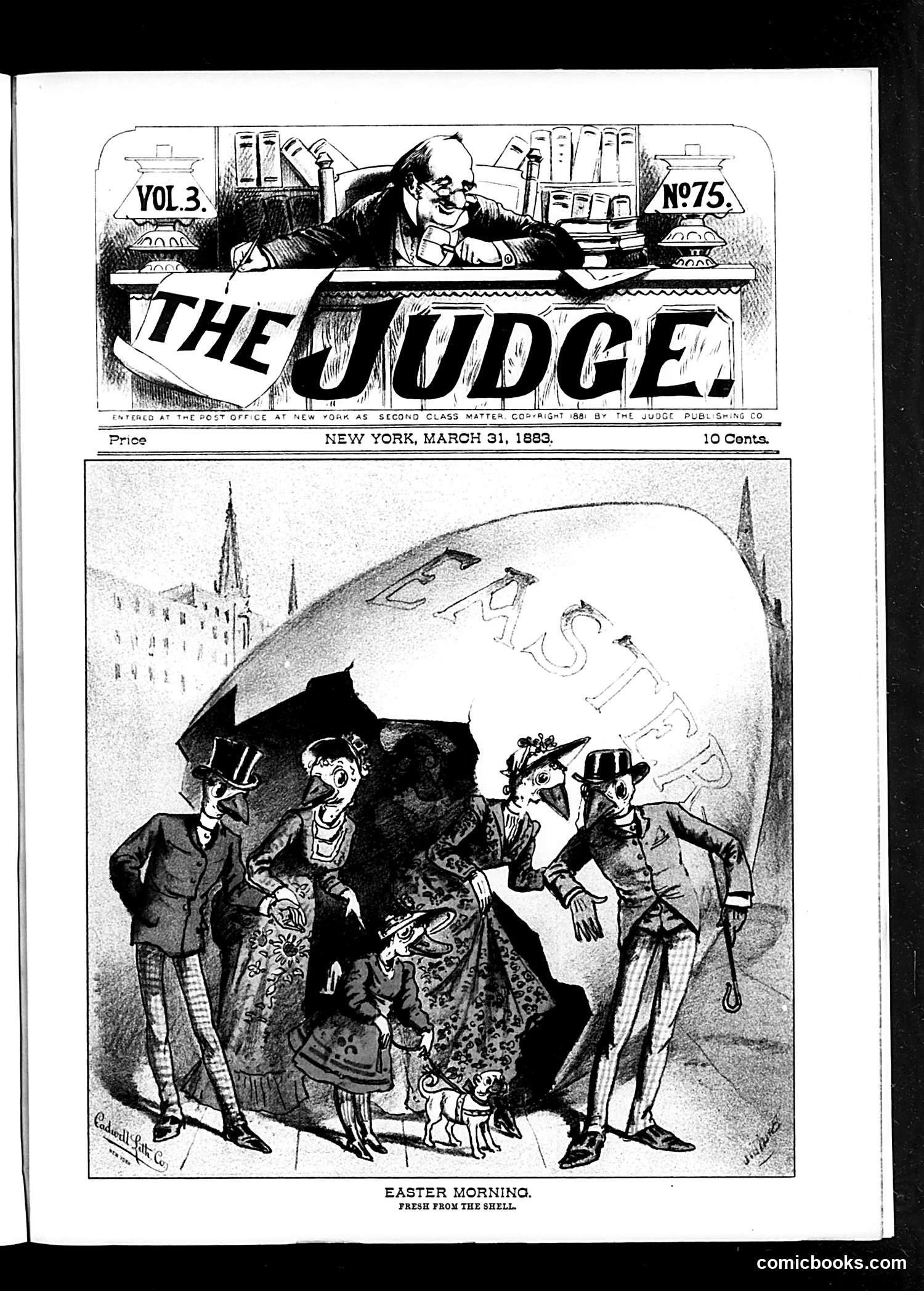
This cartoon satirizes Easter fashion ostentation among wealthy New Yorkers. The illustration shows well-dressed men and women sheltering under a large umbrella during rain, with the caption "Easter Morning—Fresh from the Shell." The satire targets the elaborate, expensive Easter clothing displays—particularly the women's ornate bonnets and dresses—which were cultural status symbols. The "fresh from the shell" reference appears to mock how people emerge in their new finery, like chicks hatching from eggs. The storefront setting with books suggests urban shopping districts where New Yorkers purchased these expensive garments. The cartoon ridicules the vanity and class consciousness surrounding Easter dress, a major social event in Gilded Age America where displaying wealth through fashion was paramount.
This page satirizes O'Donovan Rossa and Irish dynamite attacks on Britain. The main editorial, "Destroying Their Goddess," argues that violent Irish nationalist tactics—specifically dynamite bombings targeting London—ultimately harm Ireland's cause and freedom movement rather than help it. Judge criticizes both Rossa's extremist followers and naive sympathizers in America and Britain who excuse such violence. The piece references the 1882 Phoenix Park murders (Burkean Cavendish killings) and recent Parliament Street bombing, warning that dynamite terrorism alienates international support and undermines legitimate Irish independence advocates like Parnell and Sullivan. The secondary item, "Poor Oakey Hall," briefly notes the former New York City official who served under Tammany Hall corruption, suggesting his theatrical career is a comedown from political power. The satire targets both radical Irish nationalism and American tolerance for it.
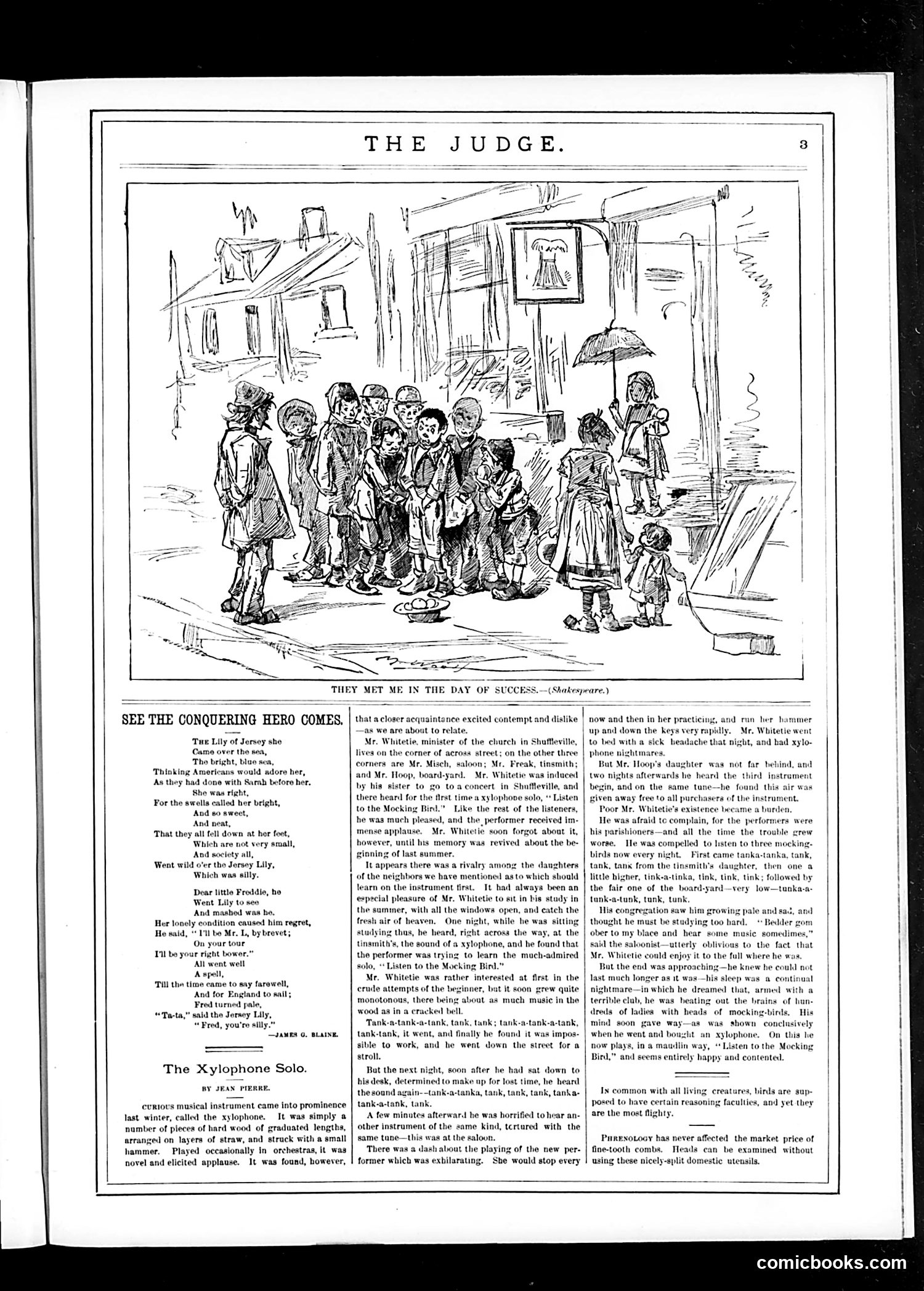
This page contains two satirical pieces from the late 19th century: **"See the Conquering Hero Comes"** mocks the "Jersey Lily" (likely referring to Lillie Langtry, a famous British actress who toured America and became a social sensation). The poem satirizes how American "swells" (wealthy society men) fawned over her, with a character named "Freddie" (possibly Prince Frederick of Prussia, a rumored suitor) falling for her before she returned to England. The satire targets American social pretension and obsession with foreign celebrities. **"The Xylophone Solo"** humorously describes a minister's escalating torment as his neighbors learn the same xylophone piece ("Listen to the Mocking Bird"), each practicing it repeatedly. Three women—daughters of a saloon owner, tinsmith, and lumberyard operator—all acquire xylophones, creating competing cacophonies that drive the pious Mr. Whitetie to despair. The satire mocks both the xylophone's trendy popularity and the annoying persistence of amateur musicians.
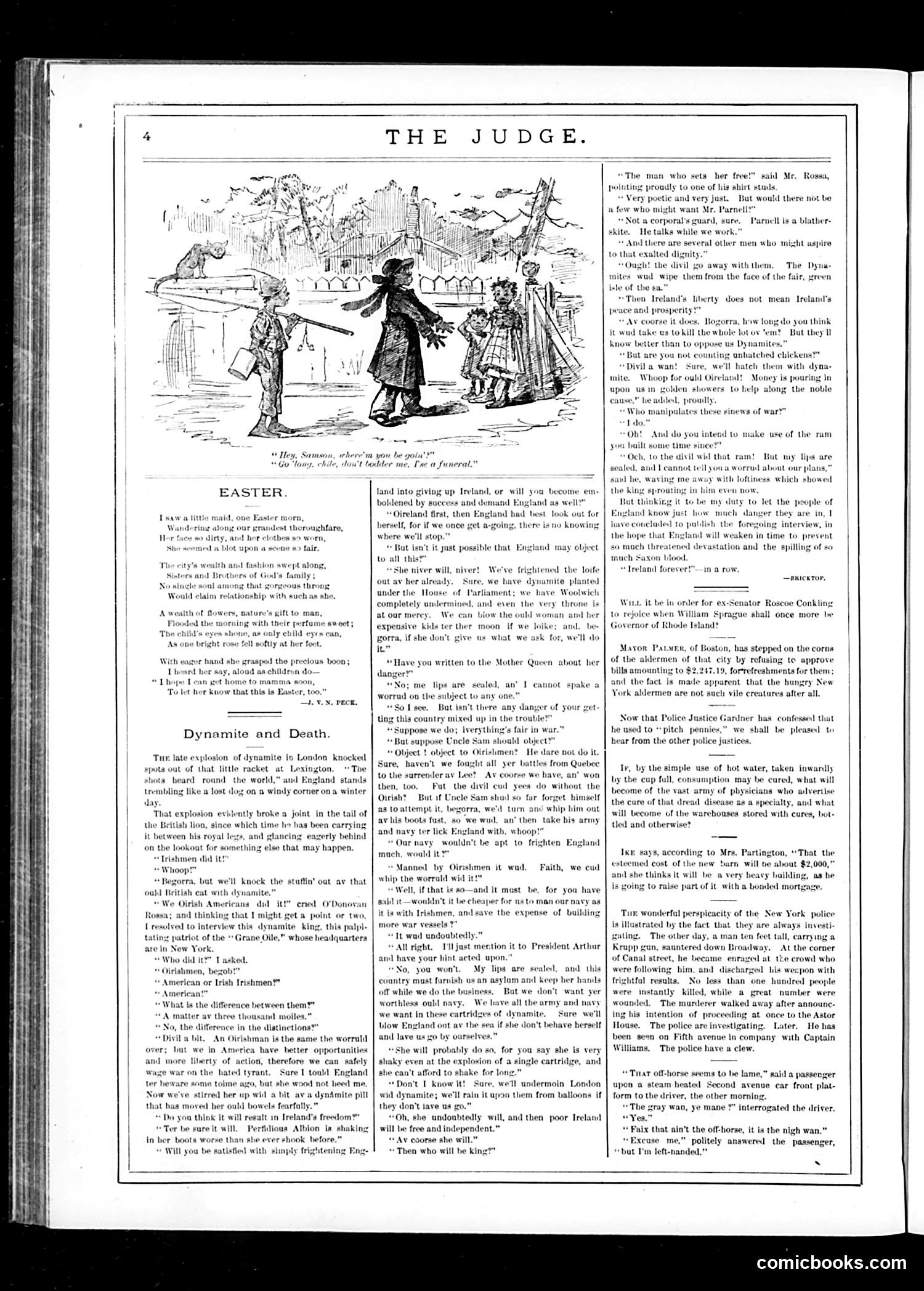
This page contains two distinct pieces of political satire from 1889: **"Easter"** (poem with illustration): A sentimental poem contrasting a poor child admiring Easter flowers with the wealthy indifference of the city. The illustration shows a ragged girl being directed away by well-dressed pedestrians—criticizing class inequality and callousness toward the poor. **"Dynamite and Death"** (dialogue): A satirical interview mocking Irish-American dynamiters. The piece ridicules an Irish immigrant's justifications for dynamite attacks on England, presenting him as boastful yet contradictory—claiming dynamite will force Irish independence while fantasizing about conquering England entirely. The satire targets both Irish-American nationalism and their perceived violent methods (referencing actual Fenian dynamite campaigns of the 1880s). The joke hinges on exposing the interviewee's absurd reasoning and exaggerated ambitions, portraying Irish-American political activism as simultaneously impotent and dangerously fanatical. It reflects contemporary American anxiety about immigrant radicalism.
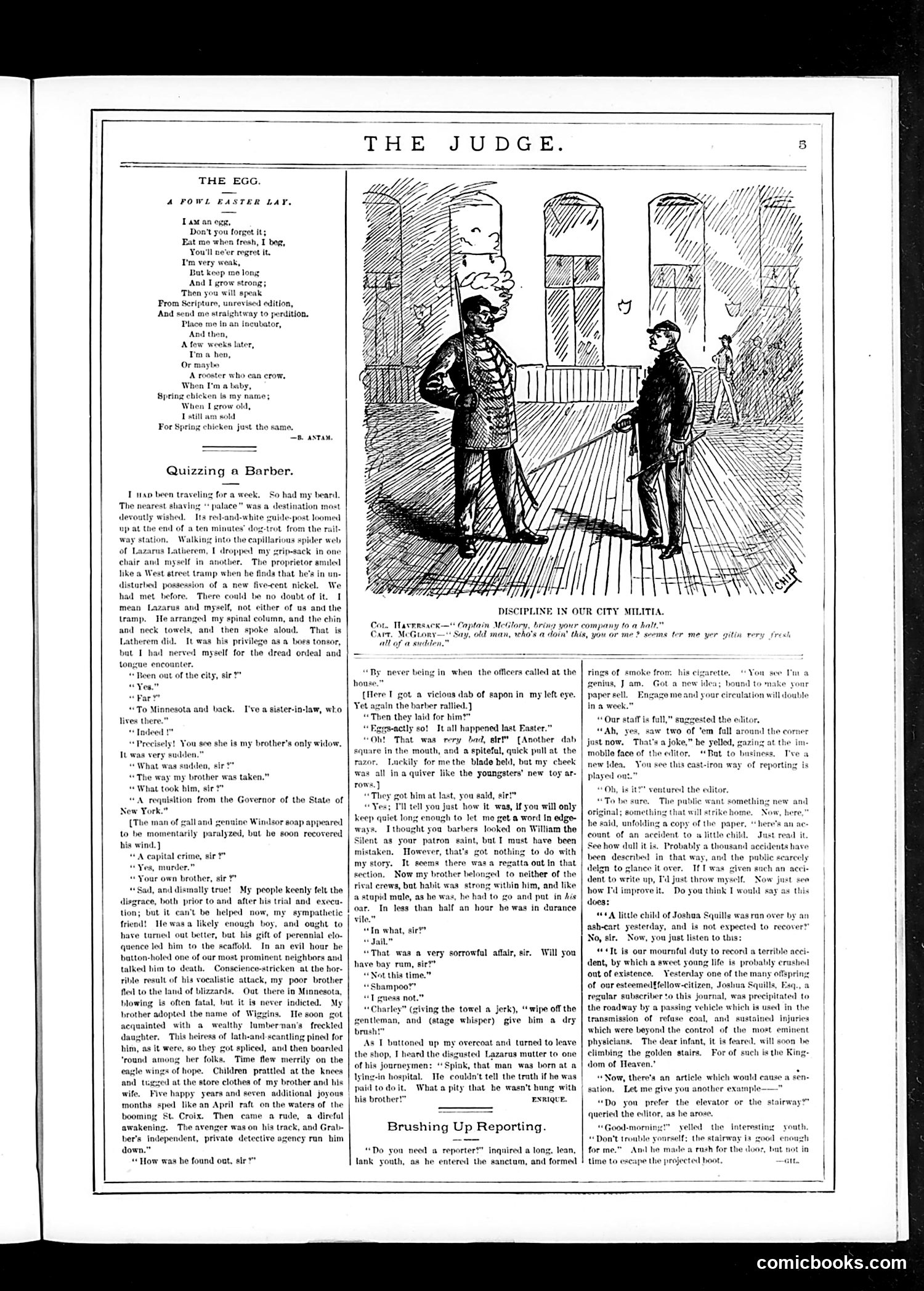
This page contains satirical content typical of Judge magazine's humor. The main cartoon, "Discipline in Our City Militia," depicts a military officer (Captain McGlory) addressing a subordinate (Captain McGuiggin) on a parade ground. The satire appears to mock military discipline and command structure—possibly commenting on incompetence or absurdity within militia organizations of the era. The accompanying text "Quizzing a Barber" is a humorous monologue where a barber customer reveals increasingly outlandish personal stories (a brother executed for murder, adoption, hidden identity) while the nervous barber keeps accidentally cutting or splashing him with soap. The joke satirizes both the customer's tendency to inflict tragic life details on service workers and the barber's clumsy reactions. The page's opening poem "The Egg: A Fowl Easter Lay" is lighthearted verse about eggs and chickens, unrelated to the political content.
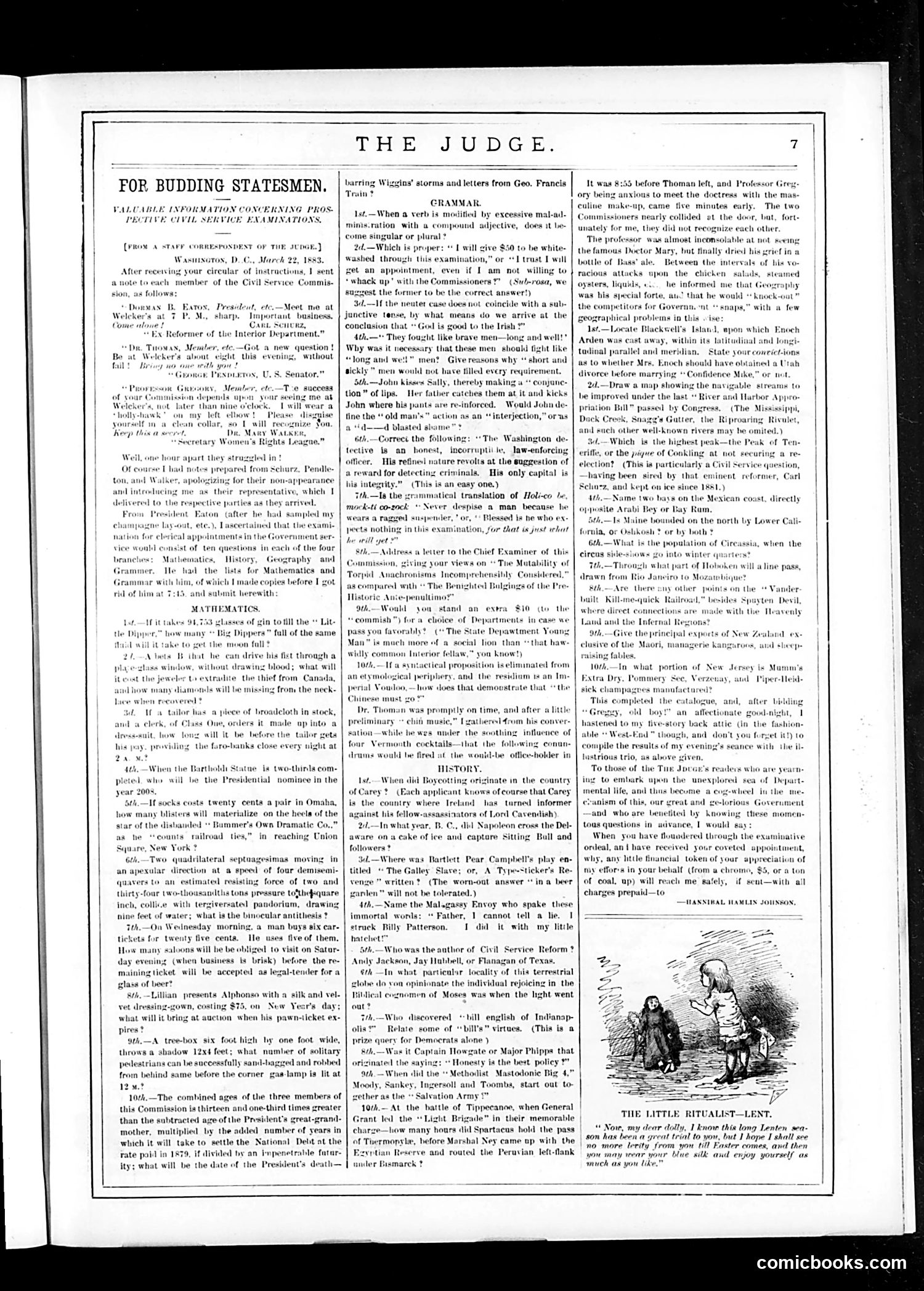
This is a satirical mock "examination" for Civil Service Commission positions, likely from the 1880s-90s when civil service reform was a major political issue. **The Joke:** The "exam questions" are absurdly nonsensical—mixing ridiculous math problems (how many "Big Dippers" fit in a "Little Dipper"?), corrupt scenarios (sand-bagging pedestrians, bribing officials with "whack up"), and impossible grammatical puzzles. **The Target:** The satire attacks the widespread belief that Civil Service Commission examinations were fraudulent theater designed to favor connected insiders rather than test actual qualifications. The introduction mentions studying "Welcker's" (likely a reference book), attending specific parties, and wearing the right clothes—implying patronage trumped merit. **The Point:** Judge ridicules both the pretense that examinations were legitimate and the corruption they supposedly masked. The incomprehensible questions symbolize how meaningless these "reformed" appointments actually were.
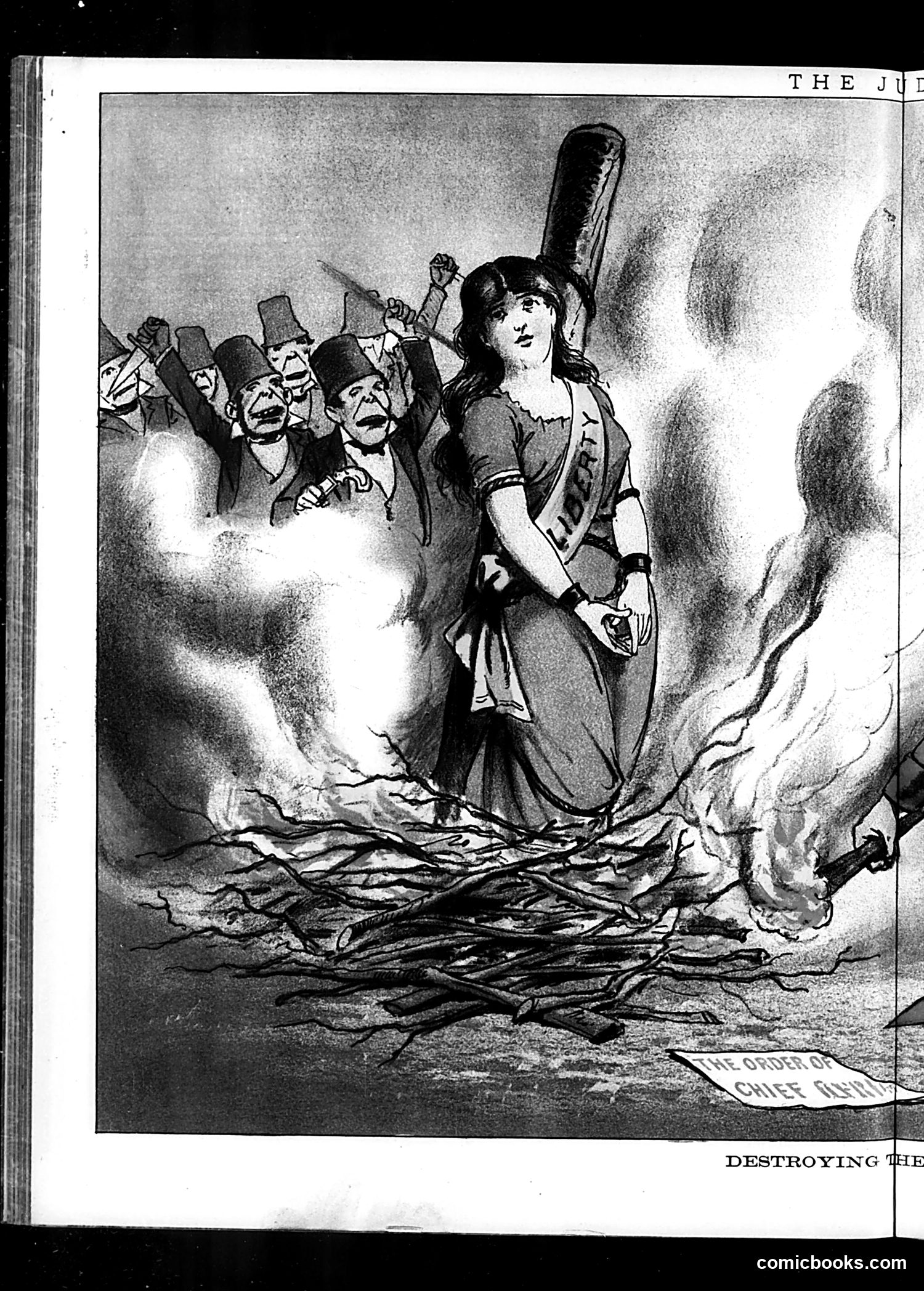
This is a political cartoon from *Judge* magazine showing a woman in classical dress (appearing to represent justice, liberty, or virtue) wielding a large club or bat, standing amid flames and burning branches. Behind her stand several men wearing top hats with exaggerated, menacing facial features, wielding weapons. The incomplete caption reads "DESTROYING THE..." suggesting the image critiques destruction of something—possibly institutions, rights, or order. The classical female figure appears heroic or defiant against the top-hatted figures behind her. Without the full caption or publication date visible, the specific political target remains unclear. This likely satirizes either destructive social movements, political corruption, or threats to established institutions, but the exact historical reference cannot be determined from the visible text alone.
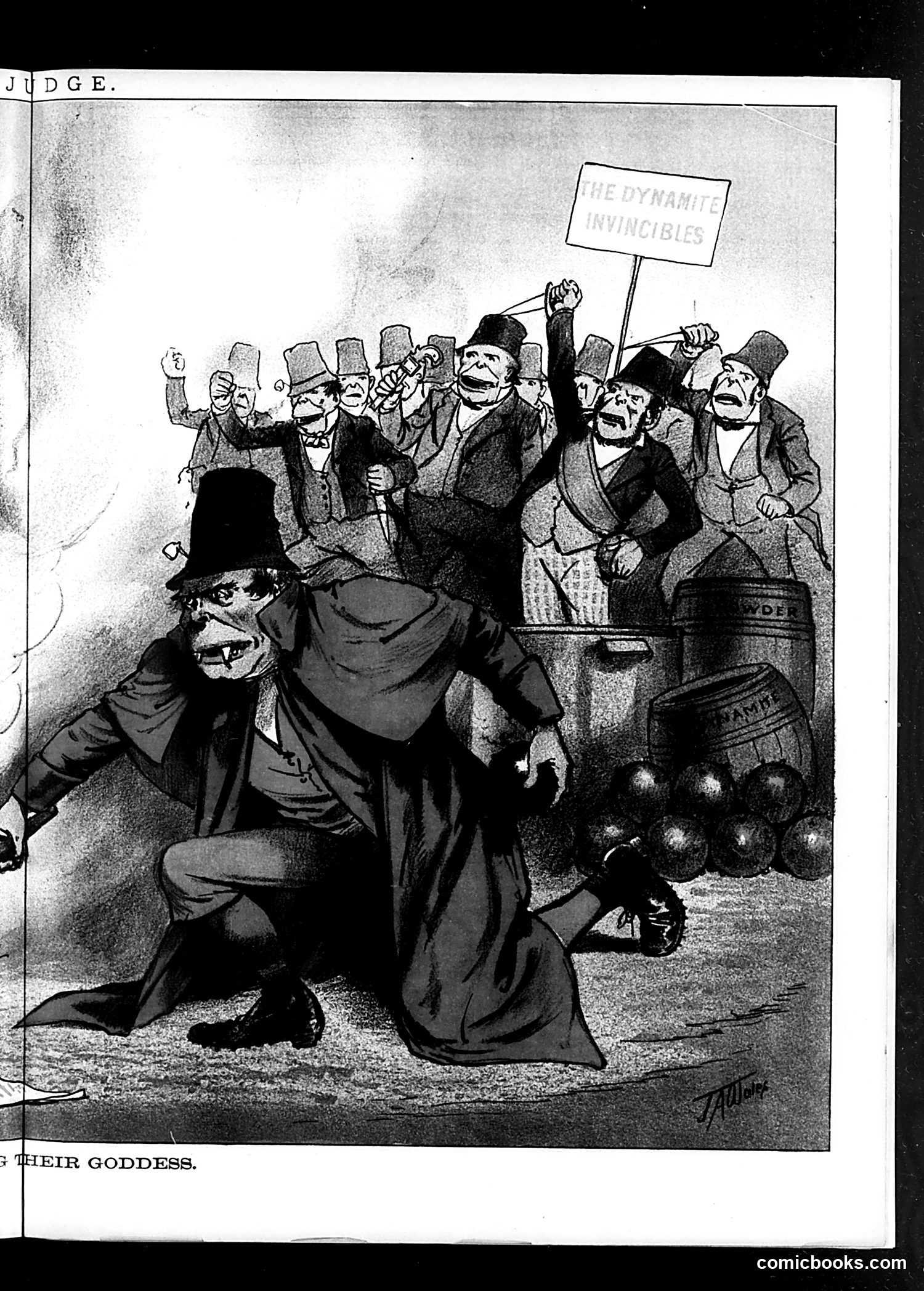
This political cartoon depicts a monstrous, demonic figure labeled "The Dynamic Invincibles" being worshipped by a crowd of caricatured men in formal dress. The beast appears grotesque and threatening, while the followers raise their arms in reverence or alarm. The satire likely targets a political movement or ideology that the cartoonist viewed as dangerous despite its supporters' claims of invincibility. The contrast between the horrifying creature and the devoted followers suggests the cartoonist believed these adherents were either deluded or deliberately supporting something monstrous. Without additional context about Judge's publication date, the specific identity of "The Dynamic Invincibles" remains unclear, though this appears to critique a contemporary political or social movement that had prominent advocates.
This page contains two separate stories from Judge magazine: **"The Self-Sacrificing Miner"** is a mock-heroic Western tale satirizing sentimentality and gullibility. A noble miner stops a stagecoach robbery to "save" passengers, appearing selfless—but the twist reveals he was actually the robber's accomplice. The moral warns readers not to trust seemingly heroic characters and to guard their valuables. The satire mocks both the melodramatic "Western hero" narrative and the naive sympathy readers might extend to rogues. **"The Government Expert on Whisky"** (partially visible) appears to satirize government officials and their claims of expertise, likely criticizing bureaucratic pretension or regulatory overreach regarding alcohol. Both pieces use narrative irony and reveal to mock contemporary attitudes: gullibility toward false heroism and deference to government authority. The satire targets both the subjects depicted and the readers' own potential foolishness.
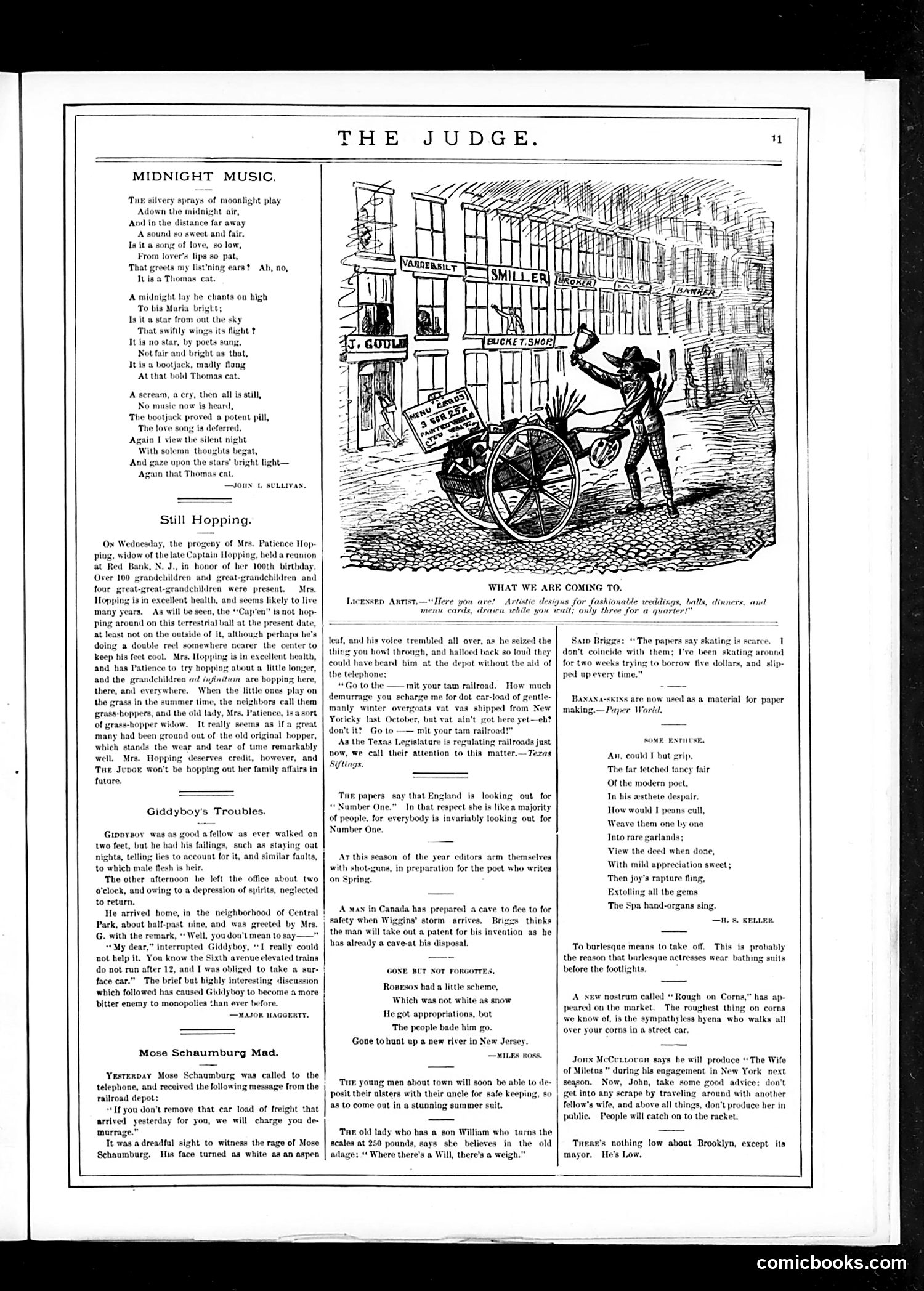
This page contains three main satirical pieces from *Judge* magazine: **"Midnight Music"** (poem): A humorous complaint about a tomcat's nocturnal caterwauling being mistaken for romantic serenading, ending when someone throws a bootjack at the offending animal. **"Still Hopping"**: A lighthearted feature celebrating Mrs. Patience Hopping's 100th birthday and her 100+ descendants, playing on her surname with puns about "hopping" around. **"What We Are Coming To"** (cartoon): Depicts a street scene where an artist advertises quick custom designs for social events. The dialogue satirizes the era's rapid commercialization and casualness—the artist produces work "while you wait" for minimal cost, while a customer complains about borrowing money. It mocks both cheap mass-production and financial desperation in modern urban life. The page also includes brief editorial quips about railroad regulations and spring poetry submissions, typical of *Judge's* gossipy, topical humor.
This is primarily a **theater criticism column**, not a political cartoon page. The main content reviews several Broadway productions during Holy Week (when many theaters traditionally closed). Key reviews discussed: - **"H.M.S. Pinafore"** revival - criticized as poorly executed, with weak performances and bad choreography - **"Julius Caesar"** at the Thalia, featuring German actor Herr Barnay - the critic confesses incomprehension, comparing himself to Mark Twain witnessing German opera - **"The Long Strike"** at the Cosmopolitan - praised as well-constructed melodrama - **"The Boomerang"** at Daly's - a successful farce featuring James Lewis and Ada Rehan, noted for bright dialogue and physical comedy The page also includes advertisements (Behning Pianos, Zola's works, and musical instruments) and a "Whiffs with Correspondents" letters section. This appears to be a standard theater/entertainment issue rather than satirical political commentary.
This page is primarily **advertising**, not editorial content or political cartoons. It consists of circa-1880s commercial advertisements for patent medicines, self-improvement courses, and services typical of the era. Notable ads include: - **Hale's Honey and Horehound & Tar** (cough remedy) - **Babcock Fire Extinguisher** - **Crown Collar** (clothing) - **Pike's Toothache Drops** - **Hill's Hair and Whisker Dye** - **James E. Walker's Book Binding** service The scattered editorial text fragments discuss minor social items (Sarah Bernhardt's play, cock-fighting in Troy, election contests), typical of Judge's satirical commentary on contemporary events. **For modern readers:** This page illustrates how 19th-century magazines subsidized editorial content through extensive patent medicine advertising—many products making dubious health claims now recognized as ineffective or dangerous.
This appears to be a satirical advertisement or editorial spread from *Judge* magazine promoting domestic labor-saving products and ideas. The main headline—"A STARTLING DOMESTIC REVOLUTION"—frames the content as commentary on women's household work. The page features multiple sections with illustrated hands gesturing toward text blocks, likely advertising various cleaning products, kitchen devices, or domestic innovations (the OCR is too corrupted to read clearly). The repeated phrase "FOR LADIES TO READ" and "FOR MEN TO READ" suggests satirical commentary on gender roles and domestic responsibilities during what appears to be the early 20th century. The satire likely mocks both overly-enthusiastic marketing of labor-saving devices and contemporary debates about women's domestic burden. By separating messages "for ladies" versus "for men," the magazine was probably ironically highlighting how advertising—and society—divided domestic concerns along gender lines, even as new technologies promised to revolutionize housework.
This page is primarily **advertising**, not political satire. It promotes "Frank Siddalls Soap," a cleaning product marketed as a revolutionary household solution for washing clothes, removing grease stains, and personal hygiene. The advertisement uses common early-20th-century marketing tactics: testimonials claiming superiority ("No Intelligent Woman" would refuse to try it), promises of multiple uses, and emphasis on gentility and refinement. A small illustration shows a woman demonstrating the soap's use. The OCR text is heavily corrupted, making precise details difficult to extract, but the core message is clear: this is a commercial pitch positioning the product as essential for refined, modern housewives. The "Judge" magazine format lent credibility by appearing alongside satirical content, a common advertising strategy of the era. **No political cartoons or social satire are visible on this page.**
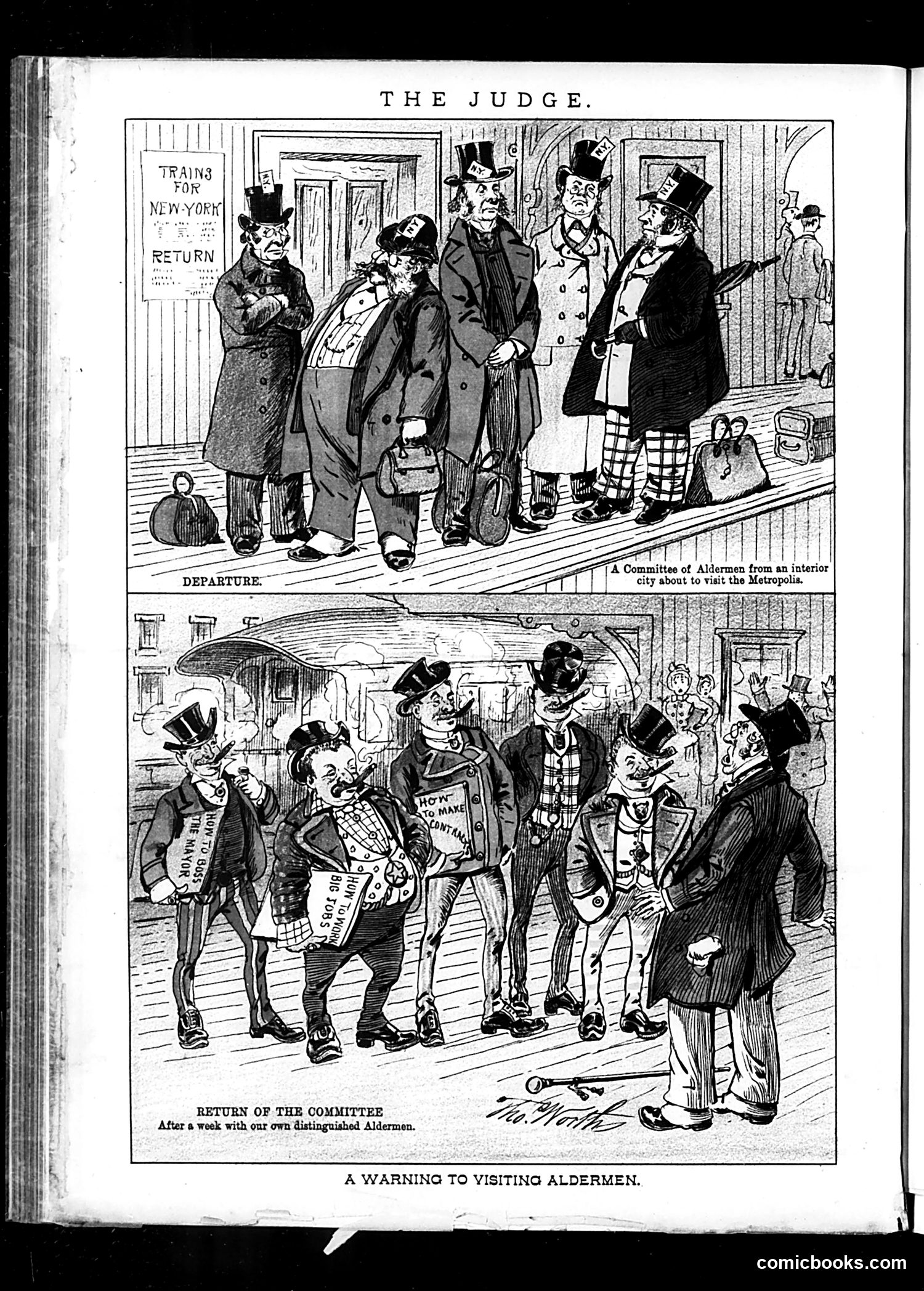
This two-panel satirical cartoon mocks the corruption of New York City aldermen. The top panel shows visiting aldermen from an interior city arriving at the train station, appearing respectable and orderly. The bottom panel depicts their "return" after a week—they've been transformed into disheveled, intoxicated caricatures, looking thoroughly debauched and corrupted by New York's aldermen. The joke warns out-of-town politicians that New York's aldermen are such bad influences they'll lead visitors astray through drinking, gambling, or other vices. The "distinguished Aldermen" caption is clearly sarcastic, suggesting these officials are known for moral corruption rather than civic virtue. This reflects widespread Progressive Era criticism of urban machine politics and municipal corruption.