
A complete issue · 16 pages · 1883
Judge — February 3, 1883
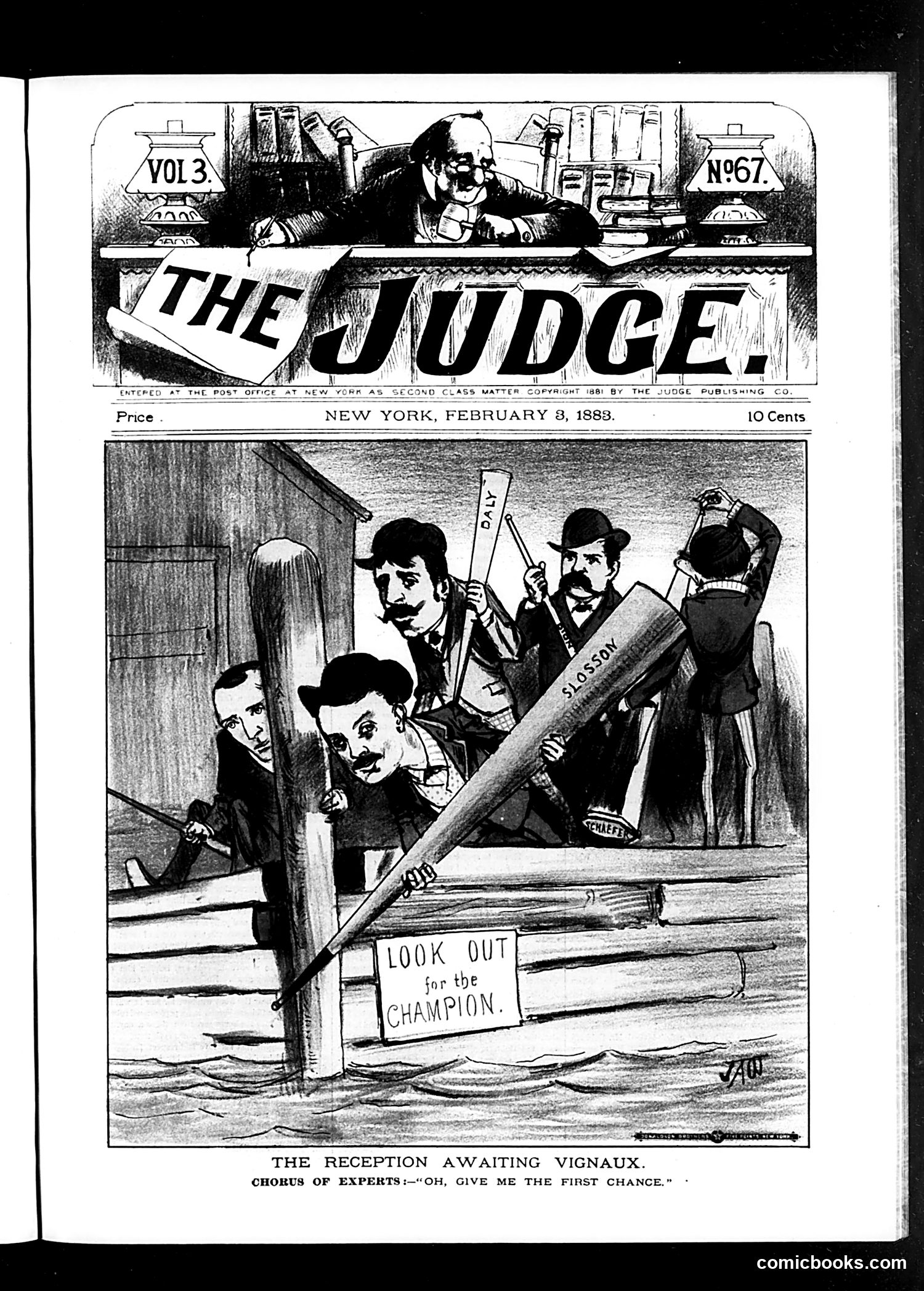
This cartoon satirizes the anticipated reception for **Vignaux**, a boxer preparing to challenge for a championship title. The image shows men armed with large clubs and other weapons, with a sign reading "LOOK OUT for the CHAMPION," suggesting they're preparing a violent "reception." The satire mocks both the boxing establishment and public excitement around the match. The "chorus of experts" crying "OH, GIVE ME THE FIRST CHANCE" represents various parties eager to attack or undermine Vignaux—whether rival boxers, promoters, or skeptics doubting his abilities. The cartoon plays on period anxieties about prize-fighting's brutality and the rough characters it attracted. Rather than a sporting competition, the scene depicts organized mob violence, critiquing boxing culture itself.
This page satirizes the conduct of prominent figures in the 1870s-80s American social scene. The main targets are: **Vignaux the Frenchman**: A celebrated billiard player whose arrival in New York sparked competitive disputes among American players (Slosson, Sexton, Schaefer) eager to challenge him. The satire mocks the obsessive attention given to this sporting rivalry. **Langtry and Gebhard**: The primary satirical focus. Mrs. Langtry (likely the actress Lillie Langtry) was involved in a scandal with Mr. Gebhard. When Gebhard believed a Confederate colonel had insulted her in print, he challenged the man to a duel—then refused the duel on grounds the "colonel" was socially unworthy. The satire ridicules Southern claims of "chivalry" as hypocritical: Southerners invoke honor codes selectively, insulting women in writing while refusing duels with social inferiors. Judge uses this incident to mock the pretense of Southern gentility post-Civil War.
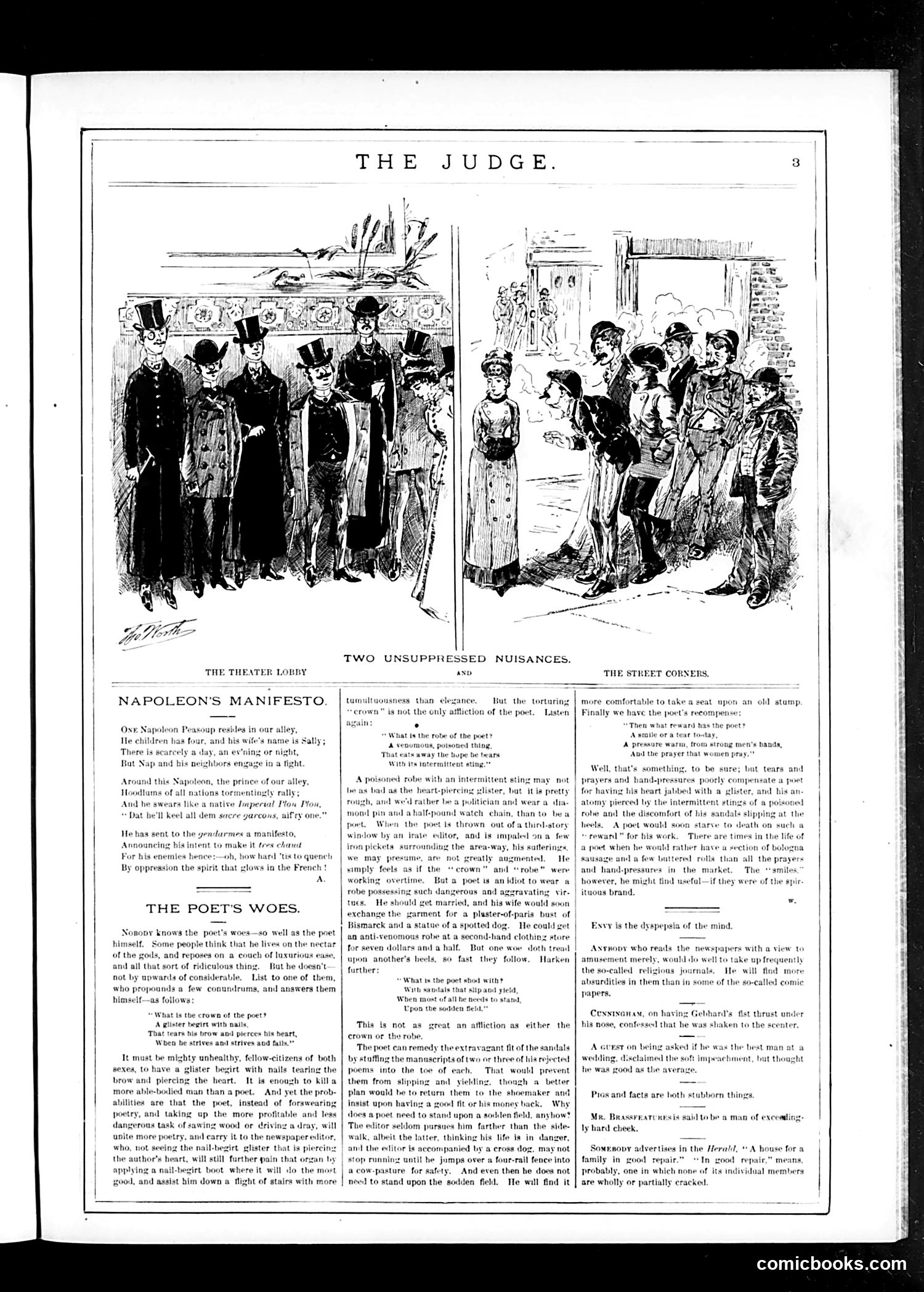
This page contains two distinct satirical pieces from Judge magazine: **"Two Unsuppressed Nuisances"** (two illustrations): The left cartoon depicts "The Theater Lobby" with well-dressed gentlemen in top hats, likely mocking theatrical society or a specific contemporary figure ("Napoleon Peasoup" mentioned in text). The right shows "The Street Corners" with a different social scene. The satire targets urban social gatherings as public nuisances. **"The Poet's Woes"** (text-heavy section): This mock-serious piece ridicules the Romantic notion of the suffering poet. It sarcastically catalogs the "crown" (thorns), "robe" (poisoned), and other supposed afflictions of poetic life, suggesting poets' complaints are self-indulgent and ridiculous. The satire deflates pretensions about artistic suffering, arguing poets would be better off in practical professions. This targets both Romantic literary conventions and possibly specific contemporary poets or their affectations. Both pieces use Judge's characteristic approach: exaggerating claims to absurdity to expose vanity and pretension in contemporary society.
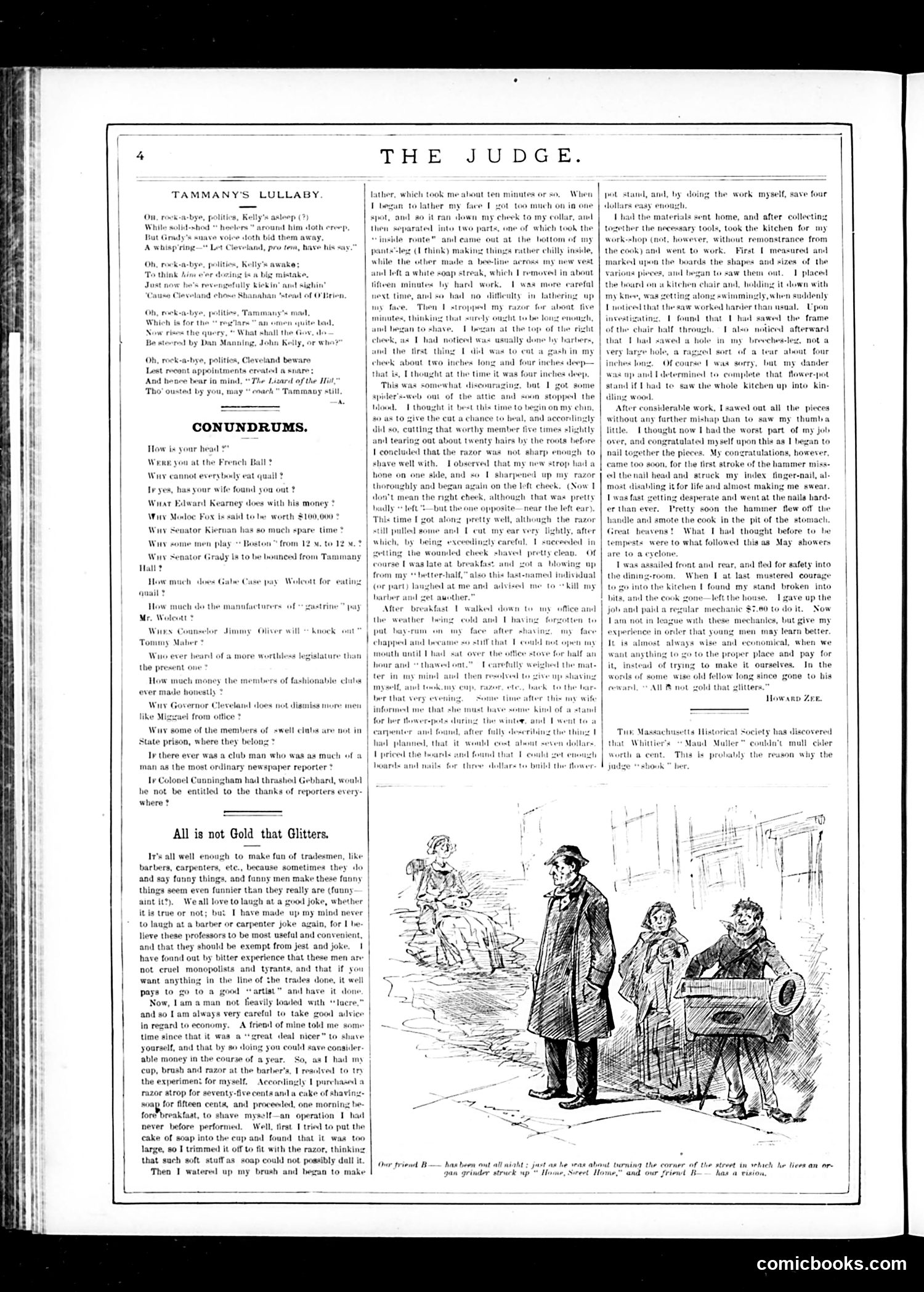
This page from *Judge* satirizes **Tammany Hall**, the corrupt Democratic political machine that controlled New York City politics. The "lullaby" mockingly suggests Tammany politicians (including **Kelly** and references to **Cleveland**) are asleep or negligent, with the machine continuing to operate through backroom dealings ("Shanahan"). The **"Conundrums"** section poses rhetorical questions about wealthy or powerful Tammany-connected figures, exposing their corruption or undeserved prosperity—a common *Judge* tactic for naming graft-enriched politicians. The main cartoon (bottom) appears unrelated: it illustrates a humorous domestic mishap involving home repair work, likely a standalone comedic piece rather than political satire. The overall message: Tammany Hall thrives through corruption while public figures profit mysteriously, presented with *Judge*'s characteristic biting humor targeting urban Democratic machine politics.
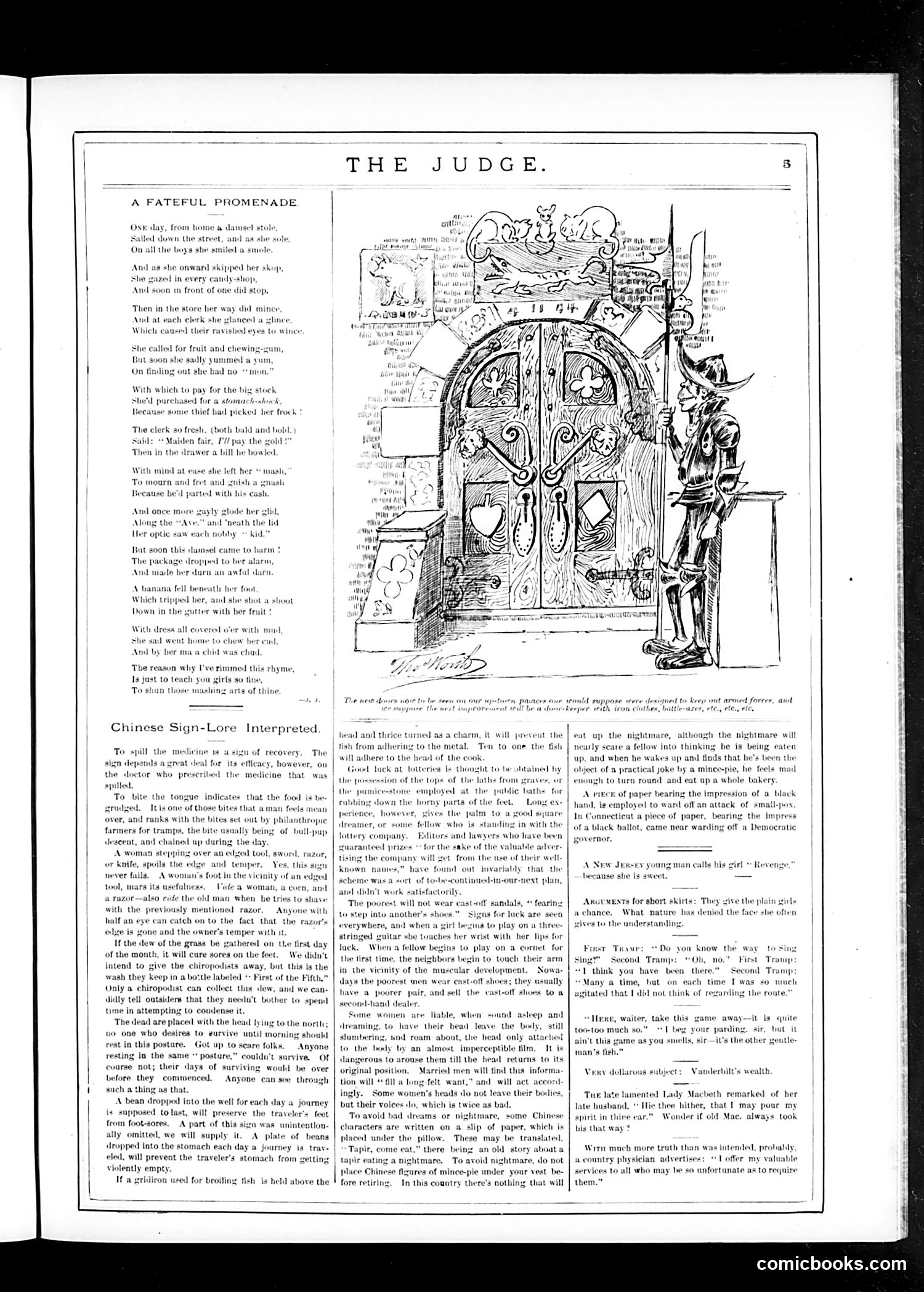
This page contains a cautionary verse-narrative illustrated with an ornate doorway illustration. The poem tells of a young girl who window-shops for candy, enters a store, purchases sweets without money, and the clerk gives her credit. Walking home distracted by fashionable young men ("nobby kids"), she trips over a banana peel, falls into a gutter, and is struck by an oncoming vehicle. **The satire's point:** The moral lesson warns girls against vanity, frivolity, and flirtation—suggesting these character flaws lead to literal disaster. This reflects late-19th/early-20th-century attitudes moralizing female behavior and consuming desires as socially dangerous. The accompanying "Chinese Sign-Lore Interpreted" appears to be mock-ethnographic humor, treating Chinese superstitions as quaint folk remedies (bananas preventing travel accidents, dew curing foot sores, etc.). This reflects period attitudes toward non-Western cultures as sources of comedic exoticism.
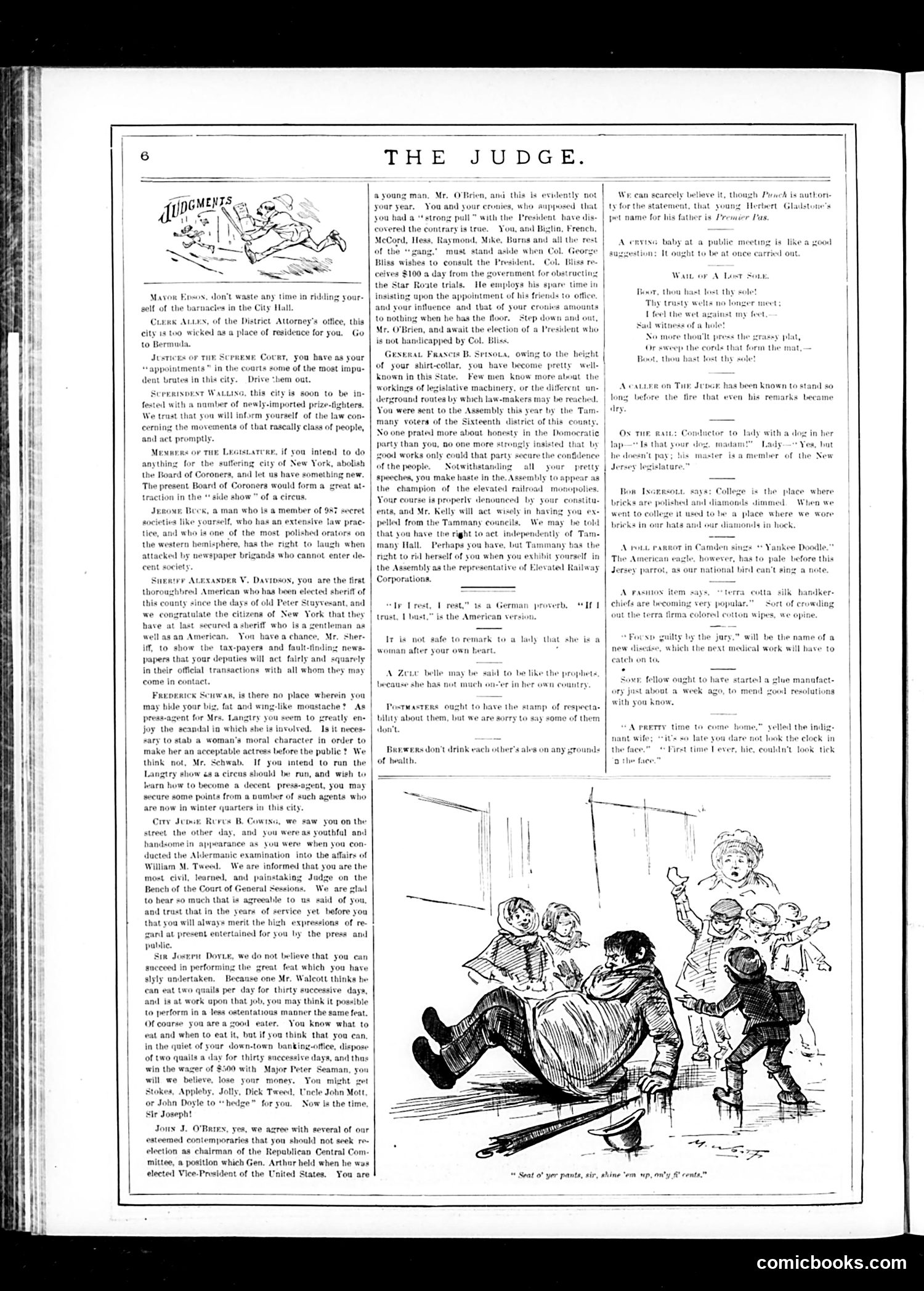
This page from *Judge* contains several political satirical commentaries aimed at New York City officials, circa the 1880s-1890s. **Main Targets:** - **Col. Bliss**: A government figure receiving $100/day to obstruct Star Route trials (a major corruption scandal) - **General Francis B. Spinola**: Criticized for championing elevated railroad monopolies despite promising Democratic reform - **Jerome Beck**: A prizefighter whose residence is questioned - **City officials generally**: Accused of corruption and moral compromise **The Cartoon**: Shows an obese man (likely a corrupt politician) surrounded by children, illustrating how municipal corruption affects the vulnerable. The caption suggests moral hypocrisy. **Core Satire**: *Judge* attacks Tammany Hall-affiliated politicians for abandoning reform principles once elected, prioritizing special interests (railroads, patronage) over constituents. The magazine advocates for ethical government and transparency in judicial/legislative proceedings. The commentary reflects Gilded Age urban corruption concerns and Progressive Era reform sentiment.
This page contains two separate pieces of satirical humor typical of 1880s-90s Judge magazine: **"The Pants of Love"** (top): A humorous poem about Augustus, who leaps a fence to court Anetta but is chased away by a vicious dog that tears off his pants. The joke relies on physical comedy and the embarrassment of losing one's clothing—standard Victorian-era farce humor. **"The Man With The Funny Story"** (main article): Satirizes the convention of the "funny man" who insists on telling an amusing anecdote. The piece mocks how such storytellers become so consumed by their own humor—laughing uncontrollably—that they can barely deliver the punchline. The editor and staff wait impatiently as the visitor repeatedly breaks into fits of laughter. The satire targets social pretension and the tedium of forced joviality in polite company. Both pieces use exaggerated language and slapstick situations typical of Judge's comedic style, which blended literary satire with crude physical humor for middle-class American audiences.
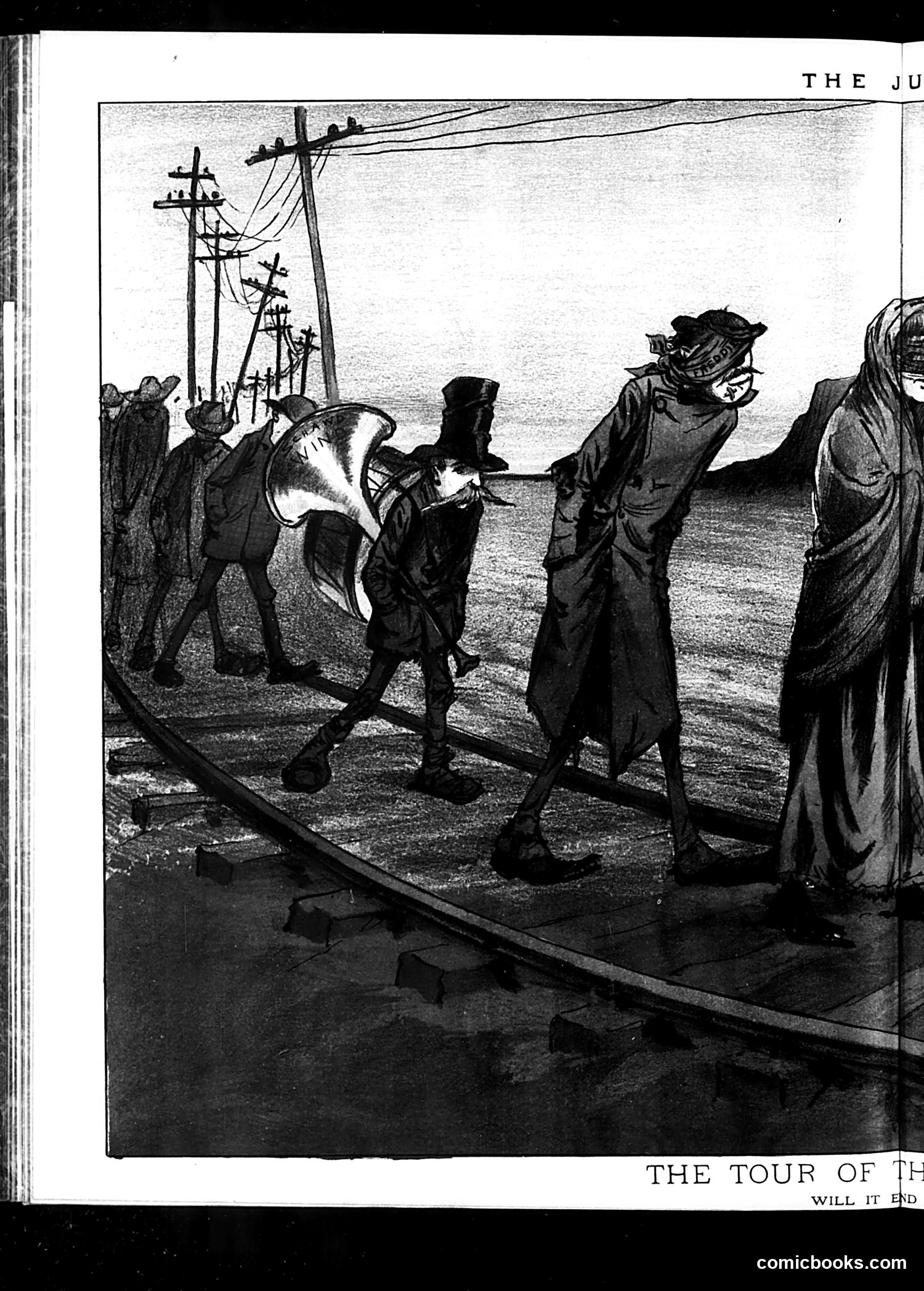
This appears to be a page from *Judge* magazine showing a political cartoon titled "The Tour of the..." (title cut off). The image depicts several figures in formal attire and coats gathered near utility poles and power lines, with what appears to be a body of water in the background. The OCR text is largely illegible, making it difficult to identify the specific political figures or event being satirized. Without clear captions or readable text, I cannot reliably determine which politicians or public figures are being caricatured, what tour is referenced, or what satirical point is being made. To properly explain this cartoon's meaning to a modern reader, I would need clearer source text or additional context about the publication date and issue.
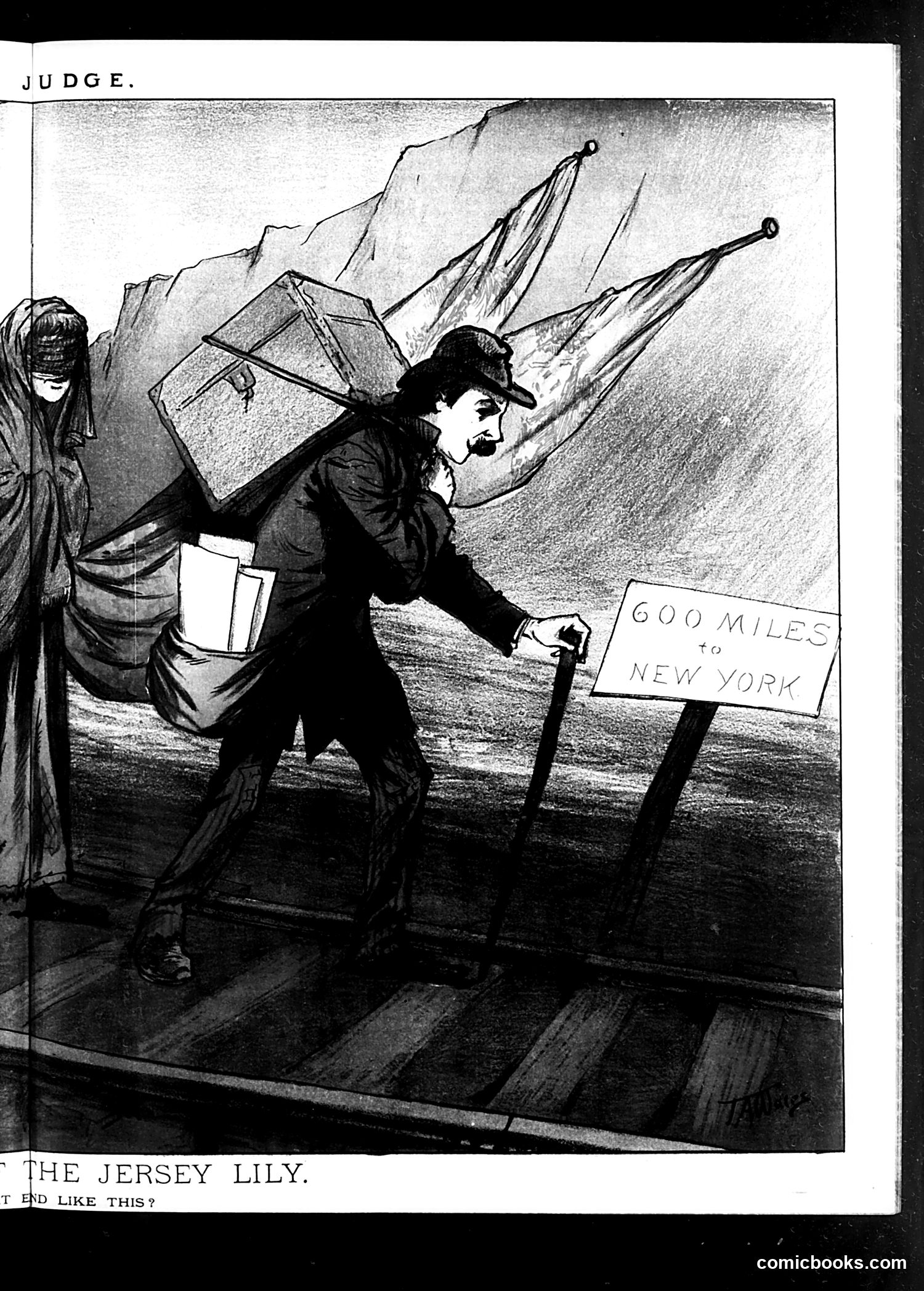
This cartoon depicts a man in working clothes carrying a large box labeled "600 MILES TO NEW YORK," with a ghostly female figure beside him. The title "The Jersey Lily" and question "And like this?" suggest commentary on a specific person or situation. The "Jersey Lily" likely refers to Lillie Langtry, a famous actress and courtesan of the era known by that nickname. The image appears to satirize either her travels, her romantic entanglements, or perhaps the burden she represented to someone (suggested by the heavy box). The 600-mile distance to New York may reference her theatrical circuits or a specific scandal involving travel. Without additional context about Judge magazine's publication date, the precise satirical target remains unclear, though it mocks a figure associated with scandal or romantic controversy.
This sentimental poem satirizes wealth and social mobility. It depicts two childhood friends who once scavenged cinders (coal residue) together on the docks. One has become wealthy—now riding in fine carriages with expensive horses, living in a fashionable mansion—while the narrator remains poor. The satire cuts both ways: it mocks the wealthy man's apparent indifference to his humble origins (he won't acknowledge his old friend), but also suggests the narrator's resentment of his former peer's success. The repeated refrain emphasizes lost innocence and the class divide that has replaced childhood equality. The accompanying farce "Our Church Fairs" satirizes church fundraising schemes, particularly raffles presented as charitable activities but which are essentially gambling—a hypocrisy Judge's readers would recognize.
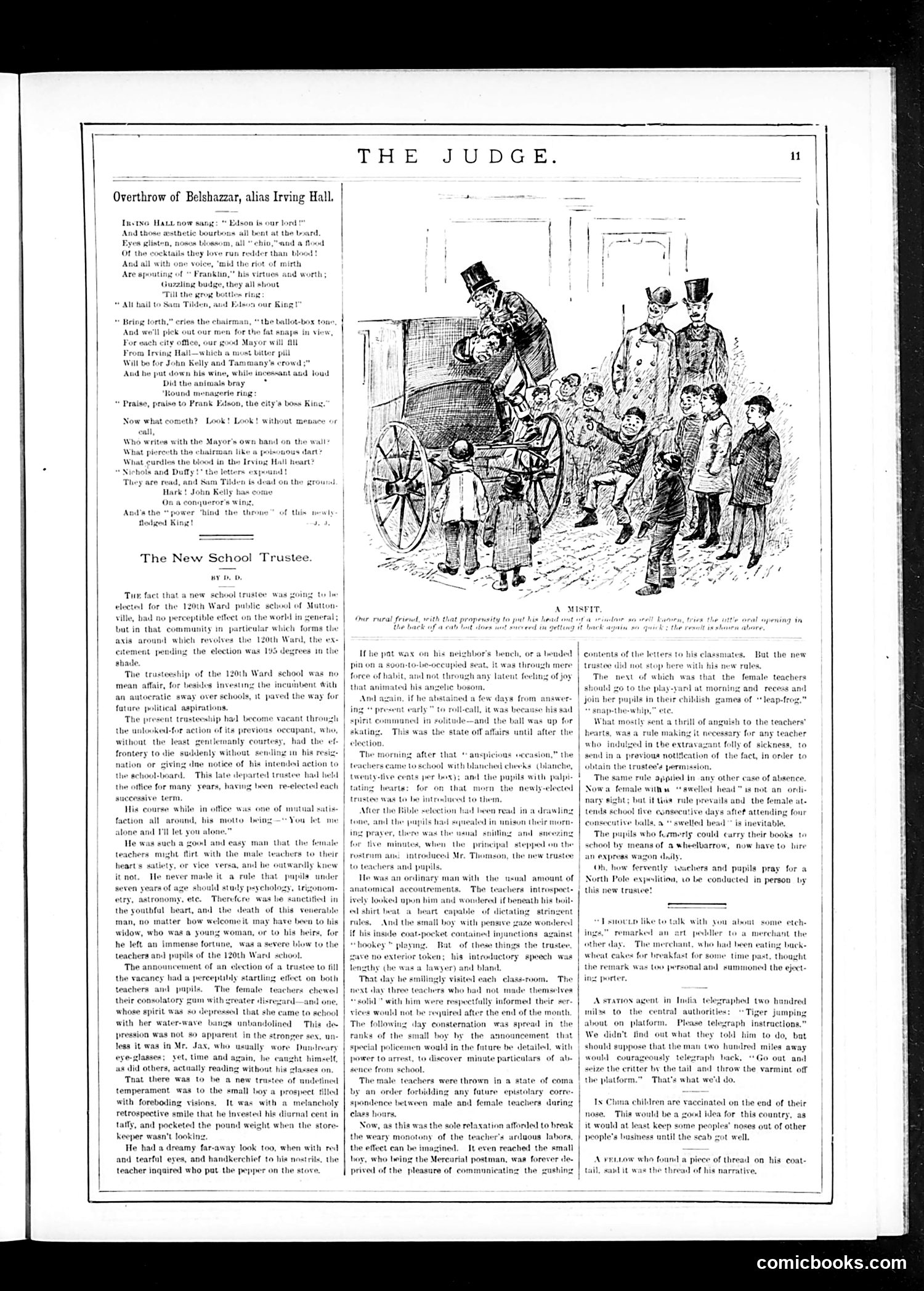
This page contains two distinct pieces of satirical commentary: **"Overthrow of Belshazzar, alias Irving Hall"** (top): A political poem mocking Irving Hall, a Democratic political venue in New York City. The satire uses the biblical story of Belshazzar's fall as metaphor for the collapse of Democratic/Tammany Hall political power. References to "Mayor," "John Kelly," and "Sam Tilden" indicate this concerns NYC Democratic machine politics of the 1870s-80s. The "writing on the wall" biblical allusion suggests inevitable political defeat. **"The New School Trustee"** (bottom): Social satire about a new school trustee elected for the 120th Ward public school. The story depicts the trustee's character through anecdotes—his apathy toward students, his absent-minded enabling of their mischief (wax on benches, pepper on stoves), and his general ineffectiveness. The satire critiques how political patronage produces incompetent administrators who neglect educational responsibilities. Both pieces target institutional corruption and incompetence in Gilded Age New York governance.
This page from Judge magazine contains theater reviews and social commentary typical of the publication's satirical approach to New York cultural life. **Theater References:** The text discusses current Broadway productions including performances by actors like Mary Anderson and Richard Mansfield. It critiques both the performances and the behavior of theater-goers, commenting on the quality of various shows at venues like the Thalia, Booth's, and Daly's theatres. **Social Satire:** The column includes joking observations about New York society—notably mocking the "East Side slums" and their "rows." A satirical comment about a horse "tipping" (being bribed) suggests commentary on urban corruption. References to Mayor Beatty's offer appear to reference contemporary municipal issues. **Magazine Format:** The page is primarily text-heavy with advertisements interspersed, typical of Judge's format. The content reflects the publication's focus on entertainment, society gossip, and topical satire aimed at educated urban readers familiar with New York's theater scene and civic affairs.
This is primarily an **advertising page** from Judge magazine (circa 1880-1883), with minimal editorial content or satire. The page showcases endorsements from **prominent opera singers and performers** of the era—including Christine Nilsson, Adelina Patti, and Ole Bull—who publicly backed the **Haines piano** as "absolutely the best Upright Pianoforte in the world." This was a common marketing tactic: celebrity endorsements lending credibility to luxury goods. The remaining advertisements cover typical patent medicines (catarrh cures, hair dyes, honey remedies) and financial products (Austrian government bonds promising quarterly lottery prizes). These reflect 1880s consumer culture and the era's unregulated marketing of dubious remedies. There is **no visible political cartoon or satire** on this page—it functions as a commercial section rather than editorial content, common in 19th-century magazines that relied heavily on advertising revenue.
This is primarily an **advertising page** from Judge magazine, not a satirical cartoon section. The page features commercial advertisements for various products and services typical of the late 19th century. The main content includes: - **Knox hats** (top):Advertises "world renowned" hats sold nationwide - **Enoch Morgan's Sons soap** (left): Household cleaning product - **Beatty's Parlor Organs** (center, largest ad): A $59 organ with extensive promotional copy and coupon - **Columbia Bicycle** (right): Bicycle manufacturer advertisement - **"Health is Wealth"** patent medicine ad (right): Appears to be a medical treatment advertisement - Various smaller ads for candy, fire extinguishers, shorthand instruction, and card games The only satirical content appears to be a brief anecdote about a cow that swallowed various objects (tacks, hairpin), with a joke about "the hairpin part of the story." This page demonstrates Judge's primary revenue model: selling advertising space alongside editorial content. Modern readers should note these ads reflect period consumer goods and the era's patent medicine culture.
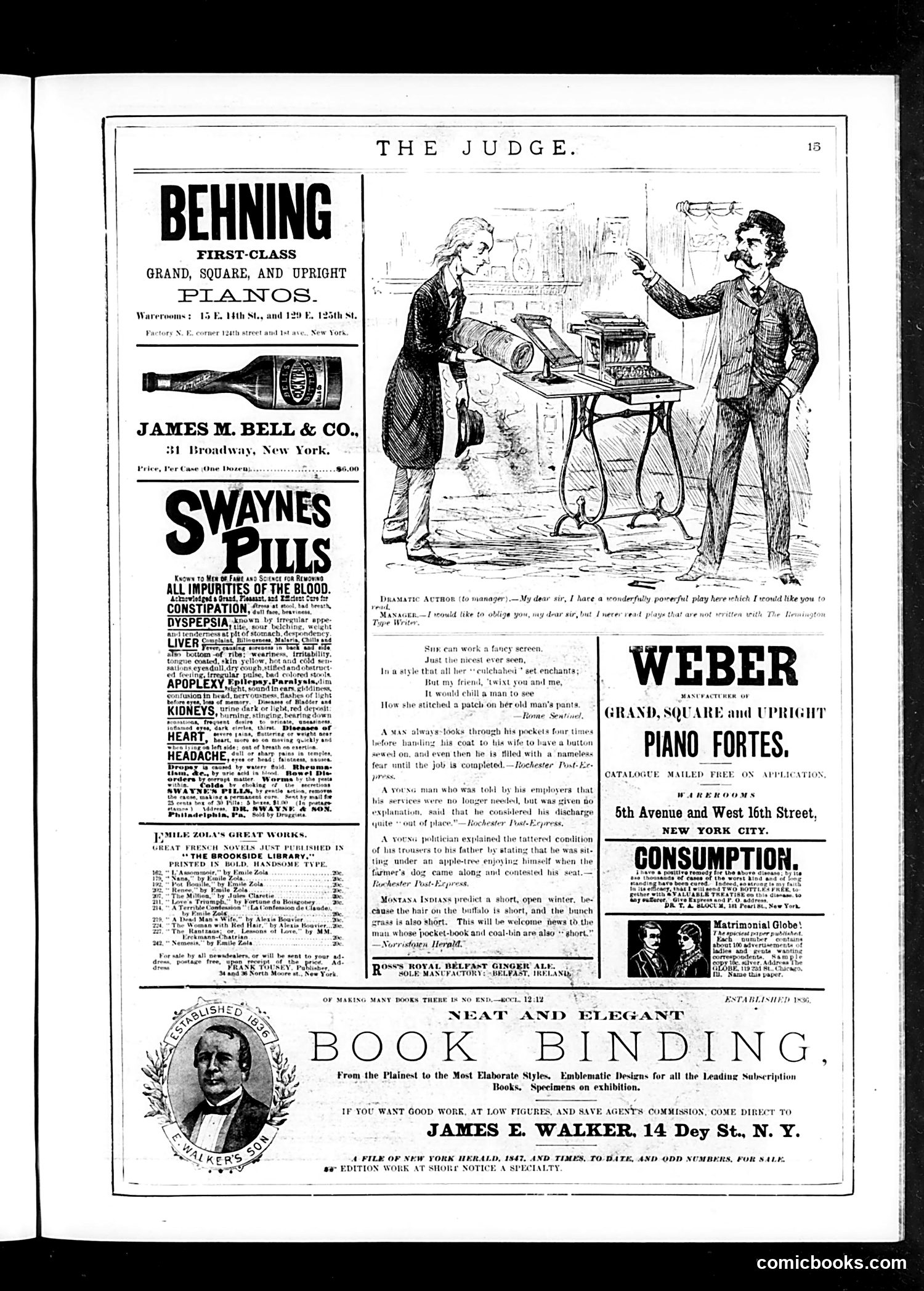
This page is primarily **advertisements with one small editorial cartoon**. The cartoon shows a dramatic author pitching a play to a theater manager, offering what he claims is "a wonderfully powerful play." The manager's dismissive body language—turning away while holding up a hand—suggests rejection or indifference, satirizing the pretentious aspirations of struggling writers and the gatekeepers who dismiss their work. The surrounding text includes humorous anecdotes (about a woman patching pants, short winter grass) typical of *Judge* magazine's satirical content. The page is dominated by period advertisements for pianos, patent medicines (Swaynes Pills), wine, book binding, and other services—representative of how 19th-century magazines sustained themselves through advertising revenue. No specific political figures or events are referenced here; this represents general social satire about artistic ambition and commercial culture.
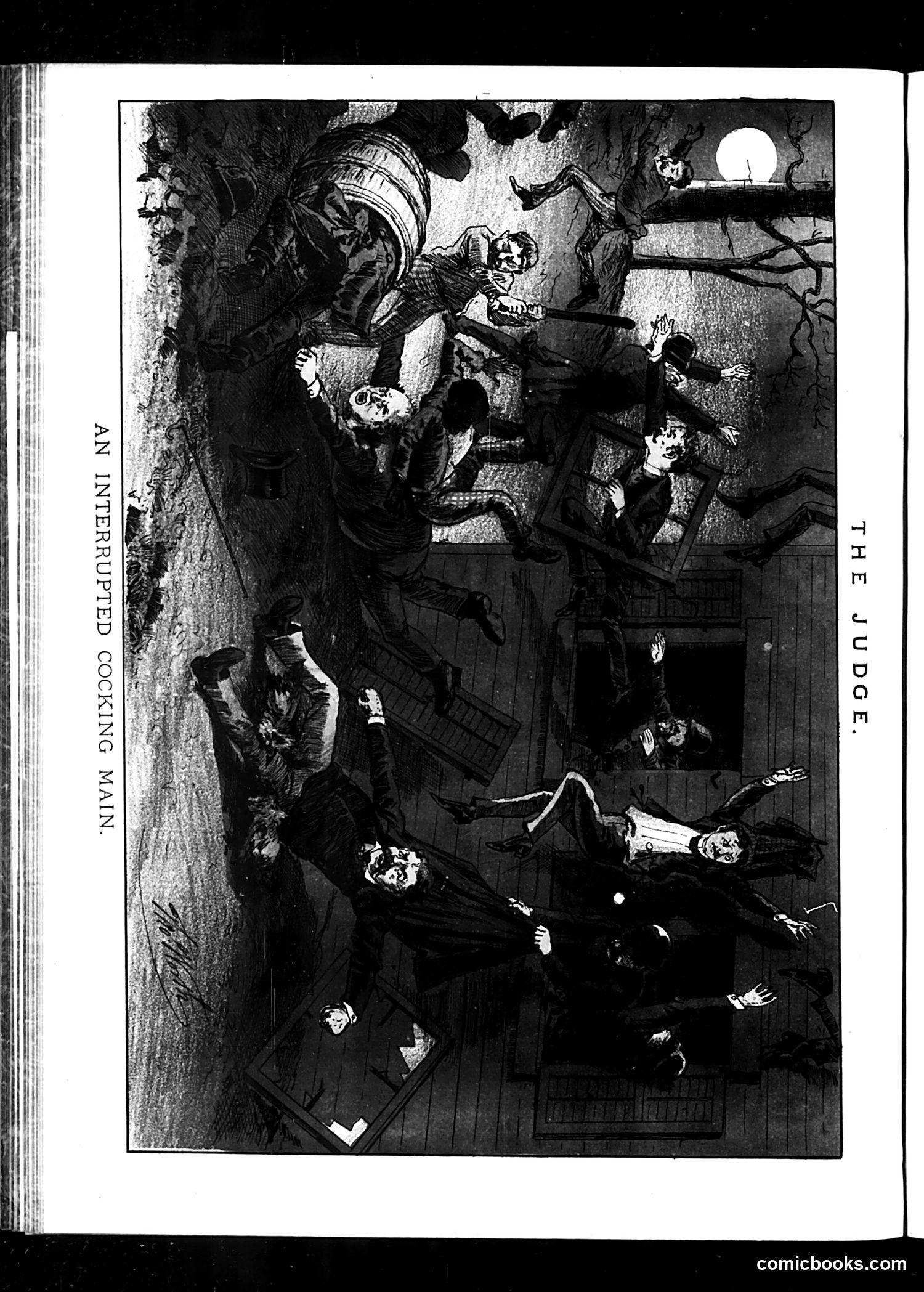
This satirical illustration depicts what appears to be an illegal cockfighting operation being raided or interrupted. The image shows men in formal attire gathered in what looks like a basement or underground venue, with dramatic lighting from above suggesting discovery or intrusion. The title "AN INTERRUPTED COCKFIGHTING MAIN" indicates this is mocking the underground practice of cockfighting—then illegal in many jurisdictions but practiced by those willing to break the law. The satire likely critiques either: 1. The persistence of this "barbaric" sport among supposedly civilized gentlemen 2. Law enforcement's efforts to shut down such operations 3. The hypocrisy of respectable citizens engaging in illegal blood sports The formal dress of participants underscores the social irony—wealthy, well-dressed men engaged in brutish gambling and animal cruelty.