
Judge, 1883-02-03 · page 3 of 16
Judge — February 3, 1883 — page 3: what you’re looking at
What you’re looking at
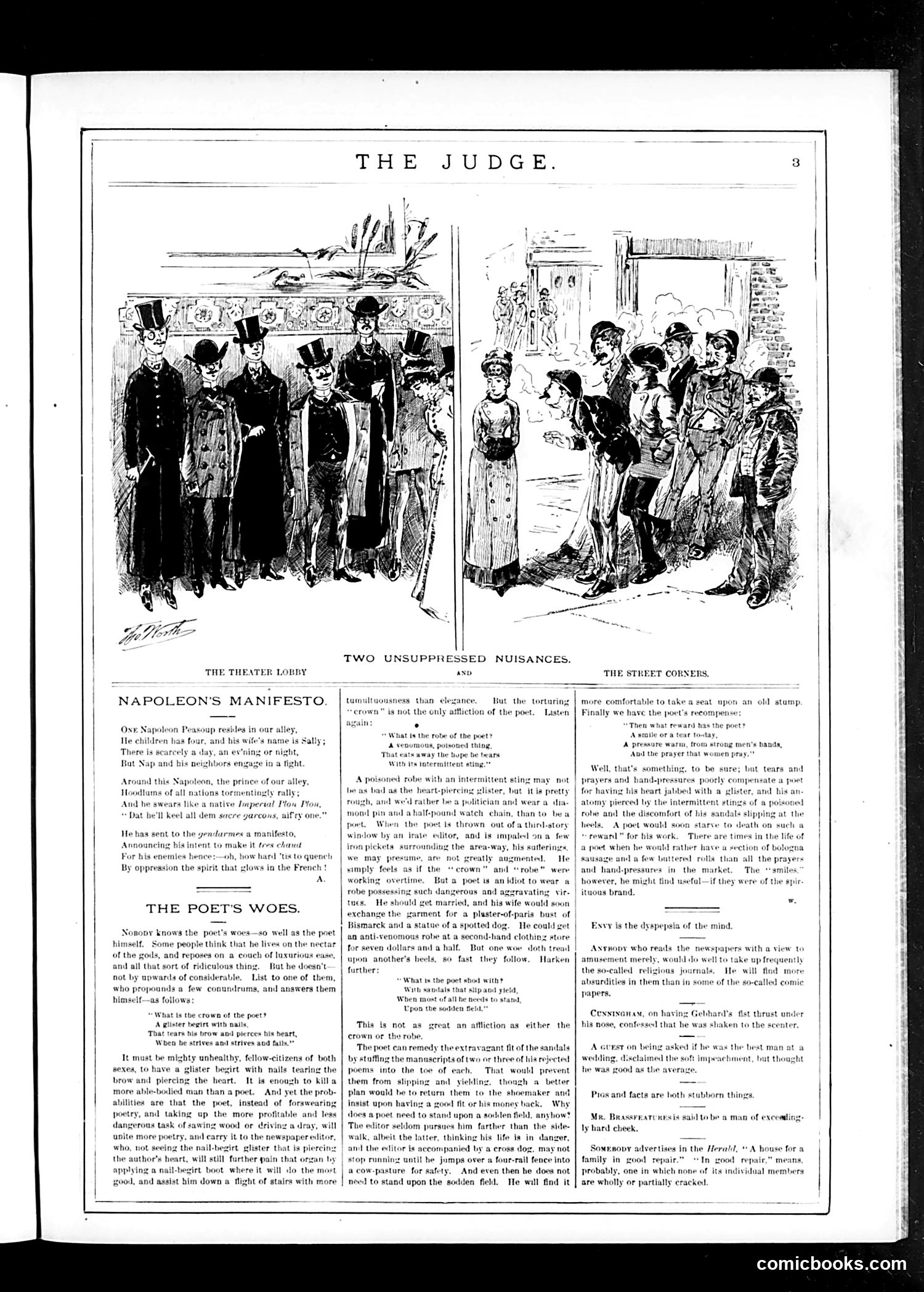
This page contains two distinct satirical pieces from Judge magazine: **"Two Unsuppressed Nuisances"** (two illustrations): The left cartoon depicts "The Theater Lobby" with well-dressed gentlemen in top hats, likely mocking theatrical society or a specific contemporary figure ("Napoleon Peasoup" mentioned in text). The right shows "The Street Corners" with a different social scene. The satire targets urban social gatherings as public nuisances. **"The Poet's Woes"** (text-heavy section): This mock-serious piece ridicules the Romantic notion of the suffering poet. It sarcastically catalogs the "crown" (thorns), "robe" (poisoned), and other supposed afflictions of poetic life, suggesting poets' complaints are self-indulgent and ridiculous. The satire deflates pretensions about artistic suffering, arguing poets would be better off in practical professions. This targets both Romantic literary conventions and possibly specific contemporary poets or their affectations. Both pieces use Judge's characteristic approach: exaggerating claims to absurdity to expose vanity and pretension in contemporary society.
📄 Transcribed text from this page (OCR, searchable)
Machine-transcribed from the original scan — historical spelling and the odd misread are preserved.
THE THEATER LOBBY Ose. Napoleon Peasoup re our all He children t There is seal and his wife's ni Around this Nap Hoodlains of all n And he swears like a native hapertal Pon Plon * Dat he'll keel all dem sacre garcons, aifry one.” Me has sent to the Announcing yendarmes a manifesto, pis in it tres chant For his enemies hence By oppression the spirit that oh, how hard "Us to quench, lows in the French ! A THE POET'S WOES. Nonopy k himself of the gous, and all that sort of ridicu not by upwards of consider: who himself—as follows: on the nectar uch of luxurious ease us thing, Ie, List drums, But he doesn’t one of them, pounds «1 answers them “What ts tbe crown of the poet? A glister begirt with nails ‘That tears his brow api pierces bis heart, When he strives and strives abd fails It must be mighty unhealthy, fellow-citizens of both sexes, toh ister bexirt with nails t brow and piercing the heart. It is eng -bodied man than a poet. And yet t that the poet, instead of forswearing etry, and taking up the dan wood of driving ad un who, not the author's he hegirt boot wh af ve a more al abilities a more profitable and 1 more po y it to the newspaper etitor, glister tha t him do THE JUDGE. TWO UNSUPPRESSED NUISANCES. ax tumultuousness than ele But the torturing crown” is not the only afftiction of the poet. Listen aguin . What Is the robe of the poet? A venomous, potsoned thing. A poisoned robe with an intermittent sting may not be as bad as the he rough, and we'd rather be a po alf-pound w Hand wear a dia- mond pin anda When the is thrown out of a third-sto window by an irate editor, and is impaled ona fe iron pickets h chain, than tobe poet rrounding the ai , his satteri we may presume, ans n simply feels as if the working overtime. Bi crown a poet is robe po ng such dangerous and a He should exchange t Bismarck a tues married, and his wife would soon garment for a plaster-of-paris bust of 1a statue of a spotted dog. He coul omous robe at a second-hand clothing «tore nl a hall, 80 fast But one woe doth tread they follow. Harken “What ts the poet abod with? Wirt sapiats that sipaod yh When most of all be needs t Upon the sodien fet.” This is not crown or t The poet nt fit of the sandals by staffing the manuscripts of two or three of his rejected poems into the toe of e would prevent them from. slipping gh abe plan would be to return th ker Insist upon having a good fit or his money back. does a poet need to stand upon a sodden field. The im farther than the walk, albeit the latter, thinking his life is in di anit the editor is accomp: as great an affliction as either the an remedy the extray and yi shoe Why nyhow? editor seldom pursues ed by a cross dog. m: stop running until he jumps over a four-rail fen a cow-pasture for safety, And even then he does not newd to stand upon the sodden field, He will find it more comfortable to take a Finally we an old stamp. © the poet's reeomy what feward has the poet? tay sure warty, from strong men’s b the prayer that women pray.” that's somethi sand hand. a poet having his heart jabbed with a glister, and his an- ed by the intermittent stings of ¢ discomfort of his sand: atomy pi robe and t “reward” for bis work. Tl 4 when he would rather have a section of bol sausage and a few buttersl rolls than all the pra sures in the market. Th ht tind usefal—if they wen poisoned tthe Lit re are times in the and hand-pr *amile however, he ituous brand. of the spir Envy is the dyspepsia of the mind Axvnopy who reads amusement merely, would called reli absurdities in them tha the s in son Cryst his nose, confessed th aw, on having Gi th yhard’s fist thrust under was shaken to the scenter, A avest on being asked if he was the best n . wedding, disclaimed the soft impeachment, bi good as the aver: thought he w Pros and facts are hoth stubborn things. Mr, Brassrratenesis said tobe a man of exceating ly hard cheek. Sowrnopy advertises in the Heralil, A hous family in good Tn Probably, one in which none of are wholly or partially cracked for a ood repair,” individual members comicbooks.com