
A complete issue · 16 pages · 1882
Judge — December 16, 1882
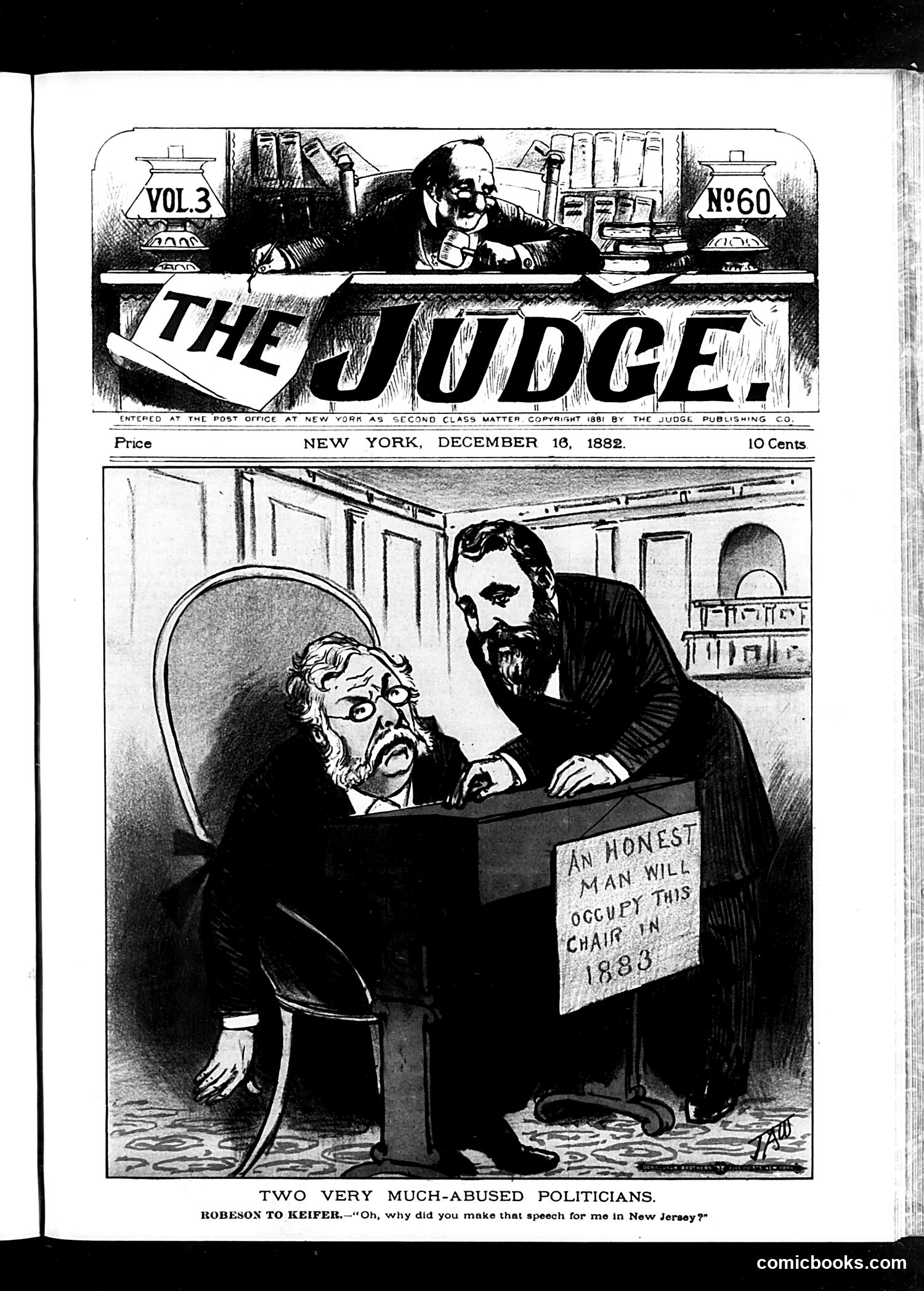
This political cartoon mocks two 19th-century politicians: **Robeson** and **Keifer**. The caption shows Robeson confronting Keifer about making a speech on Robeson's behalf in New Jersey. The sign reading "An honest man will occupy this chair in 1883" suggests this relates to upcoming elections and questions about political integrity. The cartoon satirizes the politicians as "very much-abused," likely meaning they were controversial or disreputable figures of their era. The humor appears to rest on the absurdity of one politician ghostwriting speeches for another, while they both claim questionable character—hence the ironic commentary about "honest men." Without additional context about these specific politicians' scandals or the New Jersey situation referenced, the precise grievance remains unclear, but the cartoon attacks their credibility and ethical standards.
This page contains three satirical pieces: **"Two Very Much-abused Politicians"** mocks Representatives Keifer (Ohio) and Robeson (New Jersey). The satire suggests these congressmen were mutually blamed for unpopular speeches—apparently each claimed the other wrote his remarks. Judge ridicules them for escaping accountability by shifting blame, while noting voters will likely punish Keifer by removing him from office next session. **"A Harmless Ghost"** eulogizes the recently deceased Thurlow Weed, a prominent 19th-century political operative. Judge sardonically suggests Weed—known for ruthless maneuvering—promised deathbed revelations that never materialized. The "harmless ghost" joke implies his legacy proved less scandalous than anticipated, disappointing those seeking posthumous exposés of political corruption. **"The Working of the New Sunday Code"** (partially visible) appears to discuss proposed Sunday legislation, likely mocking religious reformers' attempts to restrict weekend activities. The magazine combines political mockery with commentary on contemporary governance debates.
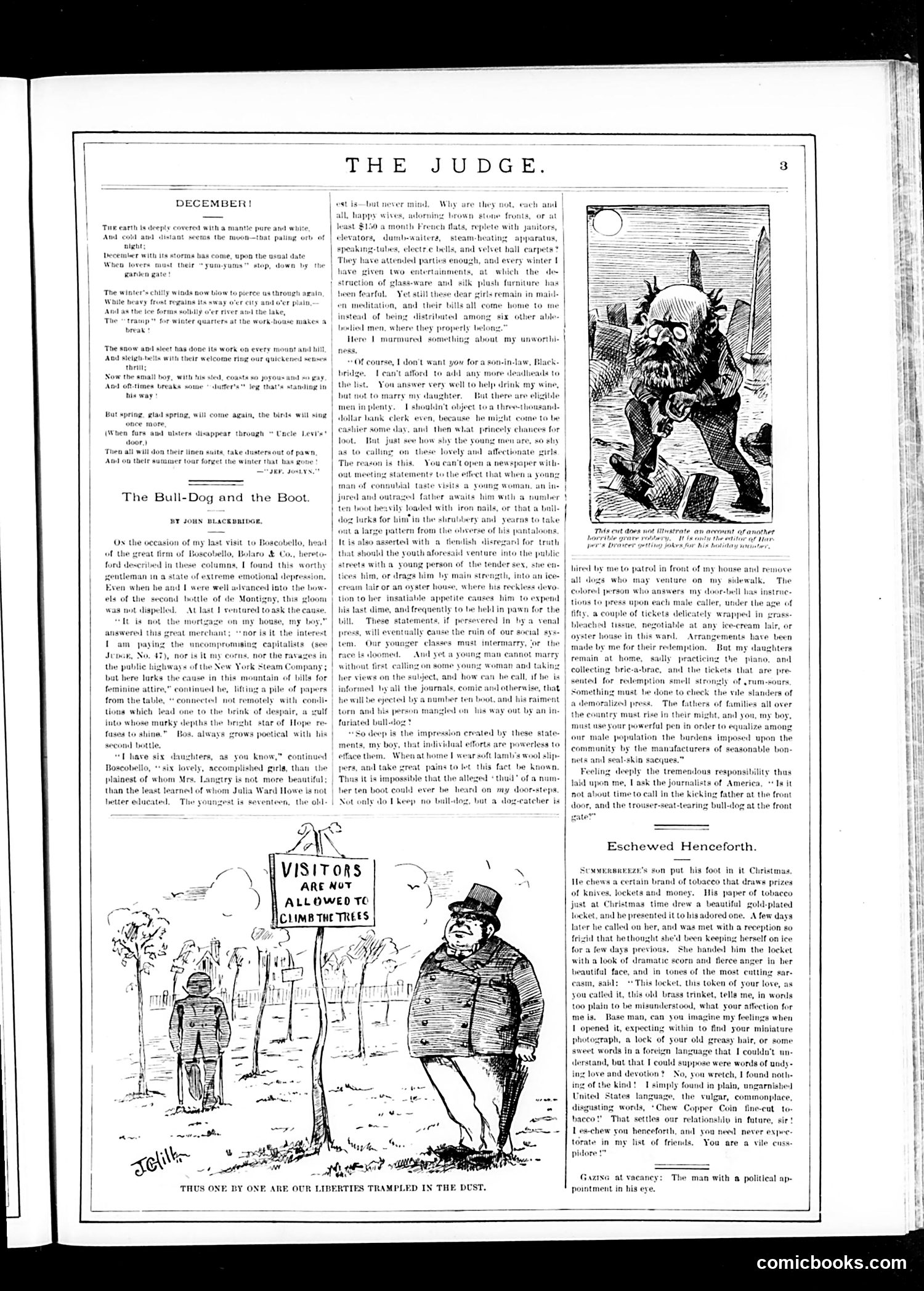
This page contains two distinct pieces of social satire: **"The Bull-Dog and the Boot"** mocks a wealthy merchant named Boscobello who has six unmarried daughters. The narrator, a suitor, visits seeking marriage but is literally kicked out by a fierce bulldog wearing a boot laden with iron nails—a physical metaphor for the father's aggressive protection of his daughters and rejection of suitors. The satire targets both the father's unrealistic expectations (wanting wealthy, well-educated husbands) and the absurd barriers he erects to potential matches. The accompanying cartoon depicts visitors barred from climbing a tree, captioned "Visitors Are Not Allowed To Climb The Trees"—likely a separate commentary on property restrictions and class divisions in the Gilded Age. **"Eschewed Henceforth"** describes a sentimental Christmas encounter where a man receives a locket from his estranged love, only to be coldly rejected when he attempts reconnection—satirizing romantic sentimentality and social pretense. Both pieces critique upper-class marriage dynamics, parental control, and the gap between romantic ideals and practical social constraints.
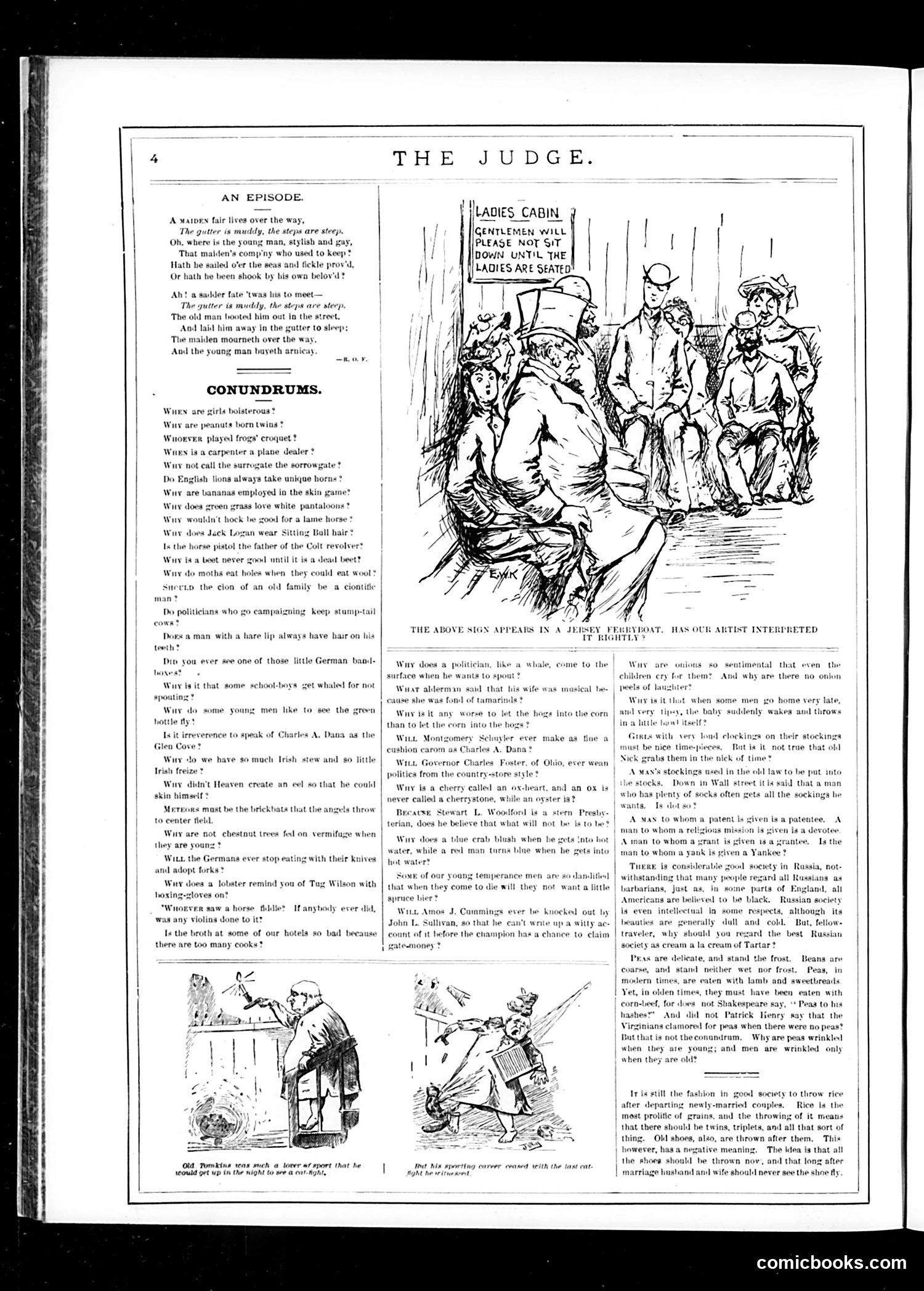
This page from *Judge* magazine contains multiple satirical elements typical of 19th-century American humor: **Main Cartoon**: The upper illustration depicts a "Ladies Cabin" sign enforcing that gentlemen not sit until ladies are seated—a social convention the artist appears to mock by showing overcrowded, chaotic conditions on what seems to be a Jersey ferry. The caption suggests the rule is impractical or absurdly applied. **Conundrums Section**: The bulk of the page consists of riddles mixing wordplay, puns, and social commentary. Examples include jabs at politicians ("Why do politicians who go campaigning keep stump-tail cows?"), ethnic stereotypes (references to German bands and Irish people), and absurdist humor. **Social Commentary**: The content reflects period concerns about etiquette, gender relations, politics, and class distinctions while relying heavily on puns that were fashionable in 19th-century humor but feel opaque today. The overall tone is lighthearted mockery of Victorian social conventions and contemporary figures, though many specific references and individuals referenced are now obscure.
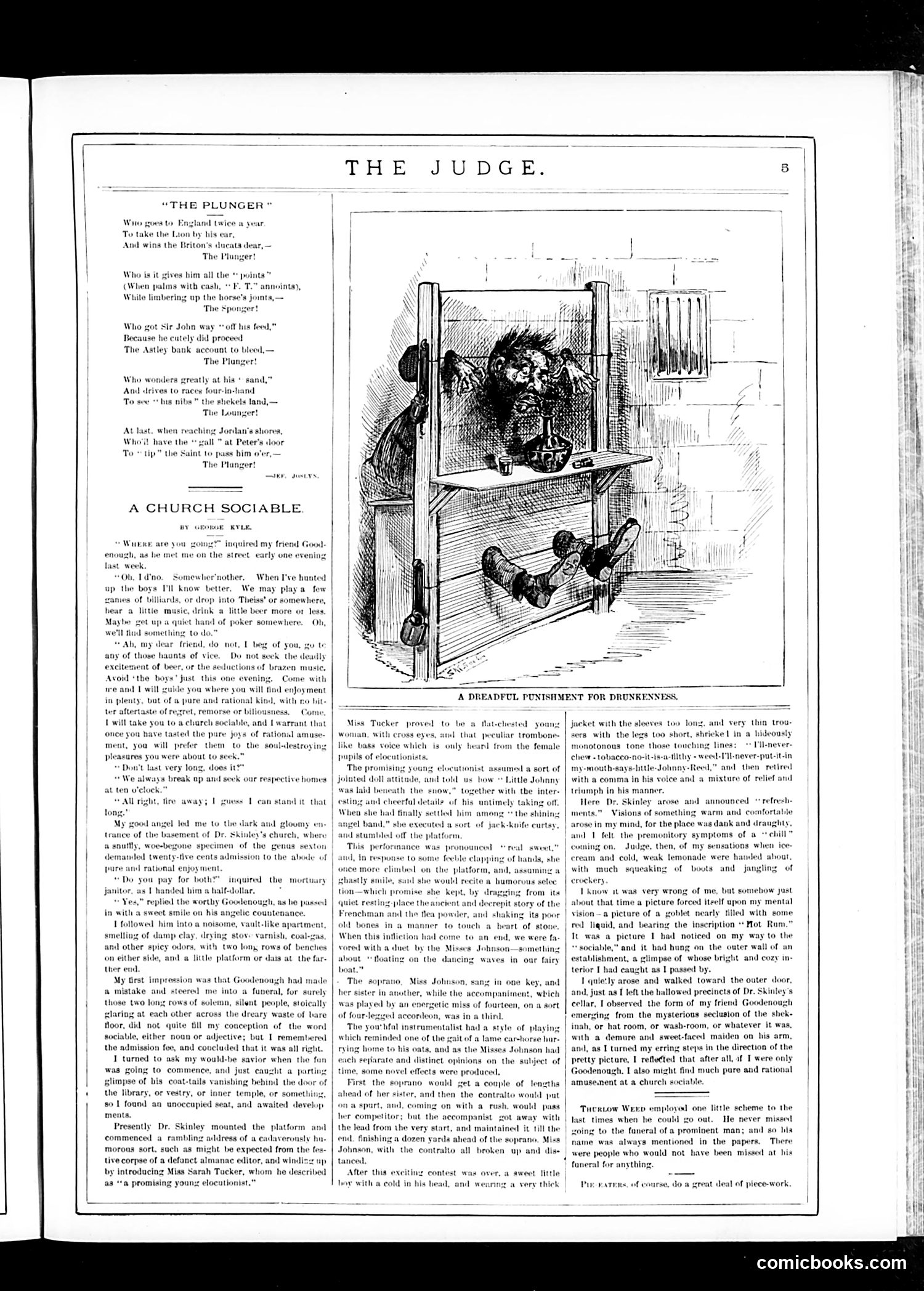
This page contains two satirical pieces from *Judge* magazine mocking social pretension and uncomfortable middle-class entertainments. **"The Plunger"** (top) is a poem ridiculing a wealthy man who squanders his fortune on reckless gambling and racing, eventually facing financial ruin. The caricatured figure appears to be a stereotypical wealthy "sport" or gambler of the era. **"A Church Sociable"** (bottom) satirizes a tedious church fundraising event. The narrator attends expecting rational entertainment but encounters a cramped, uncomfortable room with rows of chairs facing each other across a narrow space—creating an awkward, prison-like atmosphere. A particularly dreadful soprano performance and weak refreshments add to the misery. The cartoon illustrates this claustrophobic scene, with the performer on a makeshift platform and audience members trapped in uncomfortable proximity. Both pieces mock Victorian-era social institutions—reckless wealth and pious religiosity—revealing the author's cynical view of upper-middle-class life.
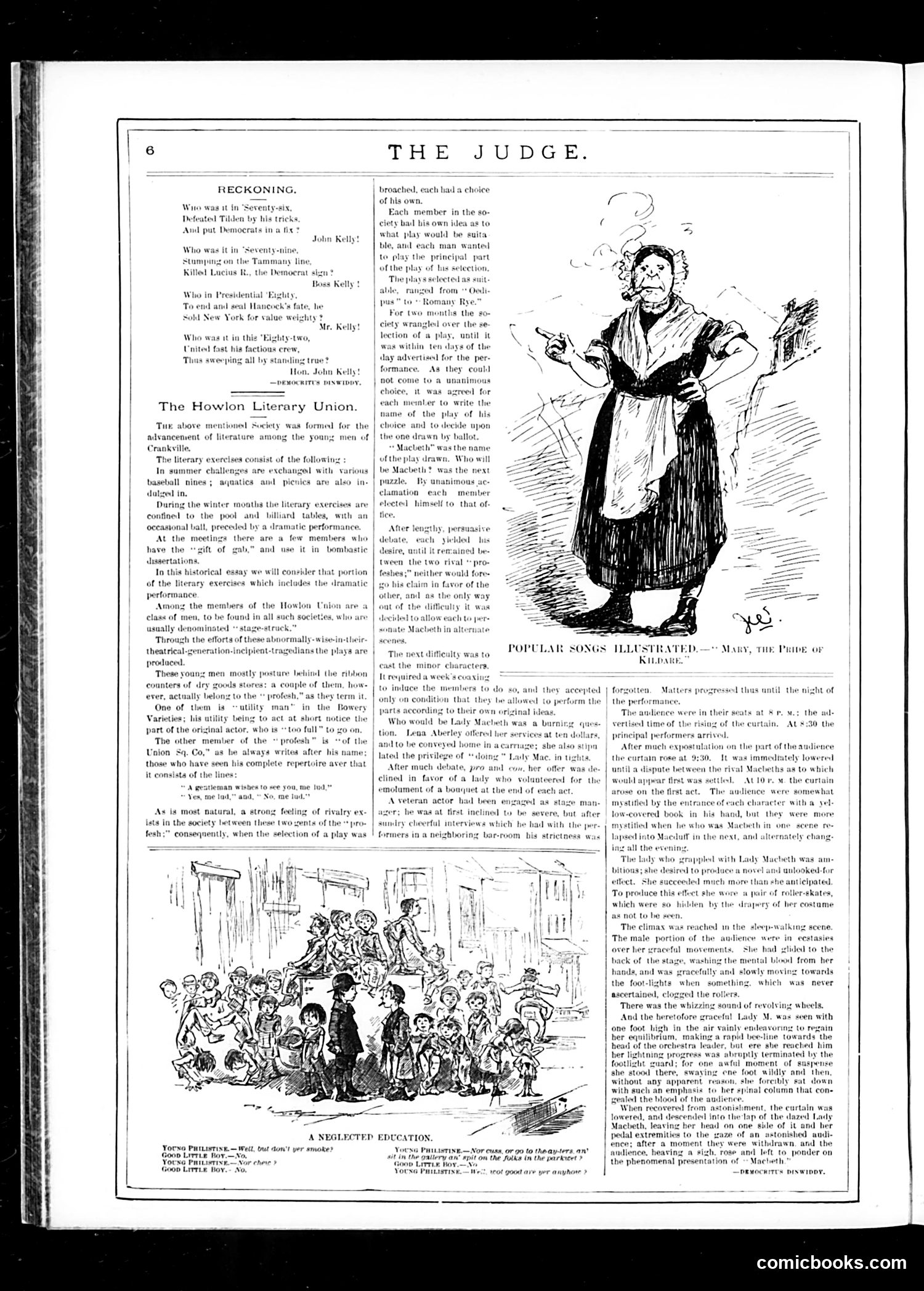
This page from *Judge* satirizes **New York Democratic politics**, specifically targeting **"Boss" John Kelly**, the powerful Tammany Hall leader of the 1870s-80s. The poem "Reckoning" uses repetitive questions to mock Kelly's influence: he allegedly manipulated the 1876 presidential election (helping Tilden), controlled the Tammany machine, and dominated New York politics through 1882. The rhetorical device hammers home Kelly's pervasive corruption. The lower sections describe the "Howlon Literary Union"—an amateur theatrical group—and their chaotic attempt to stage *Macbeth*. This appears as a **metaphorical critique**: the society's internal rivalries, petty disputes, and inability to organize reflect the dysfunction of Democratic factionalism under Kelly's boss rule. The amateur players' incompetence and ego-driven conflicts mirror real political infighting. The satire suggests that Kelly's dominance, while appearing all-powerful, actually produces chaos and mediocrity—much like the theatrical society's fumbled production.
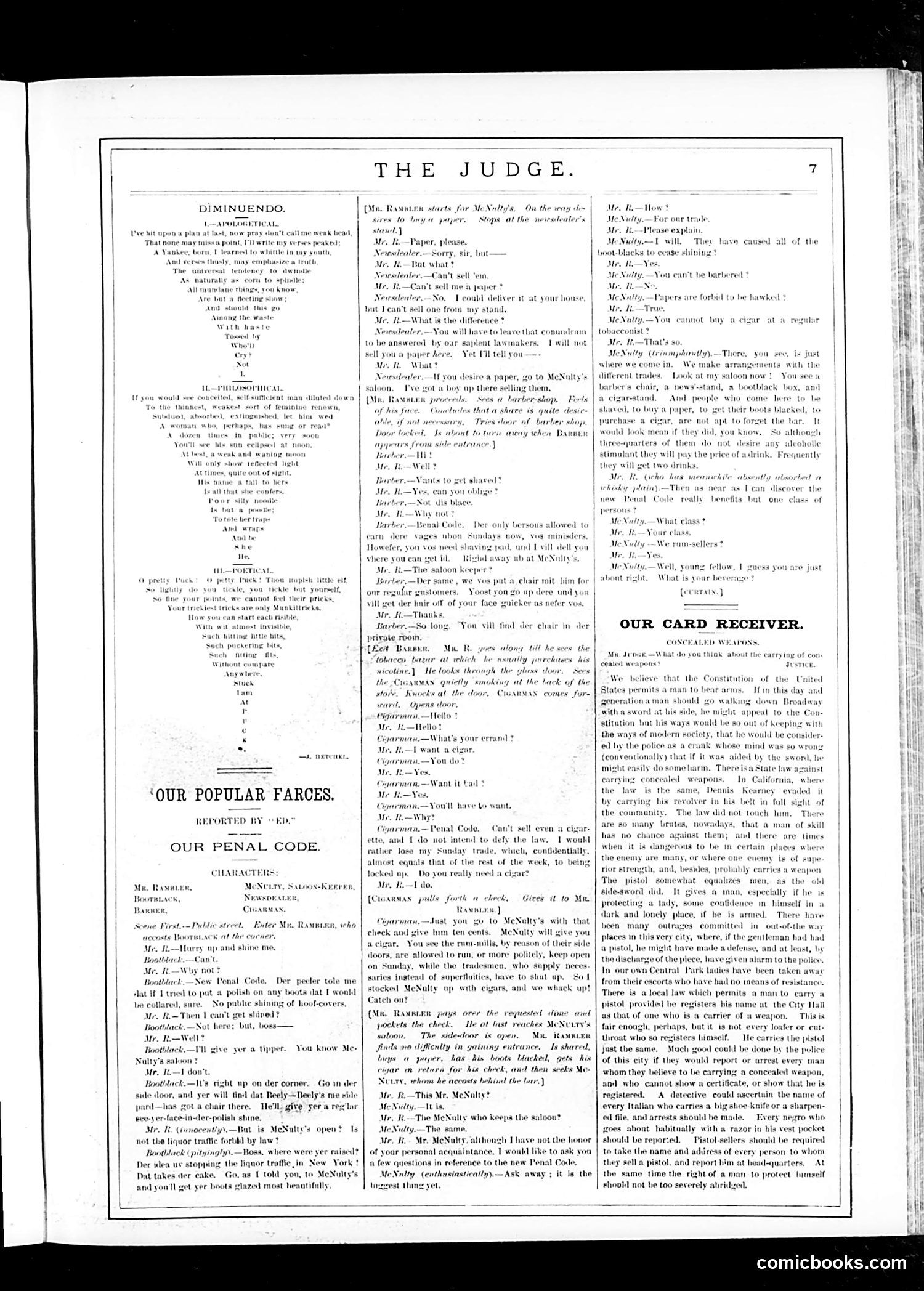
This page satirizes the absurdity of New York's Penal Code regarding Sunday liquor sales. The sketch depicts a man (Mr. Rambler) attempting to purchase a newspaper, shave, and cigar on Sunday—all denied him directly by shopkeepers citing legal prohibition. However, he discovers he can obtain *everything* at McNulty's saloon by purchasing a drink first, exploiting a loophole: saloons could operate on Sundays while legitimate businesses couldn't. The satire targets the law's obvious ineffectiveness and hypocrisy—it doesn't prevent Sunday commerce, merely redirects it through bars. The dialogue emphasizes how this creates perverse incentives: respectable businesses lose trade while saloons thrive as de facto general stores. The joke exposes how poorly-drafted legislation, meant to enforce moral standards, instead encourages exactly the behavior it supposedly prevents.
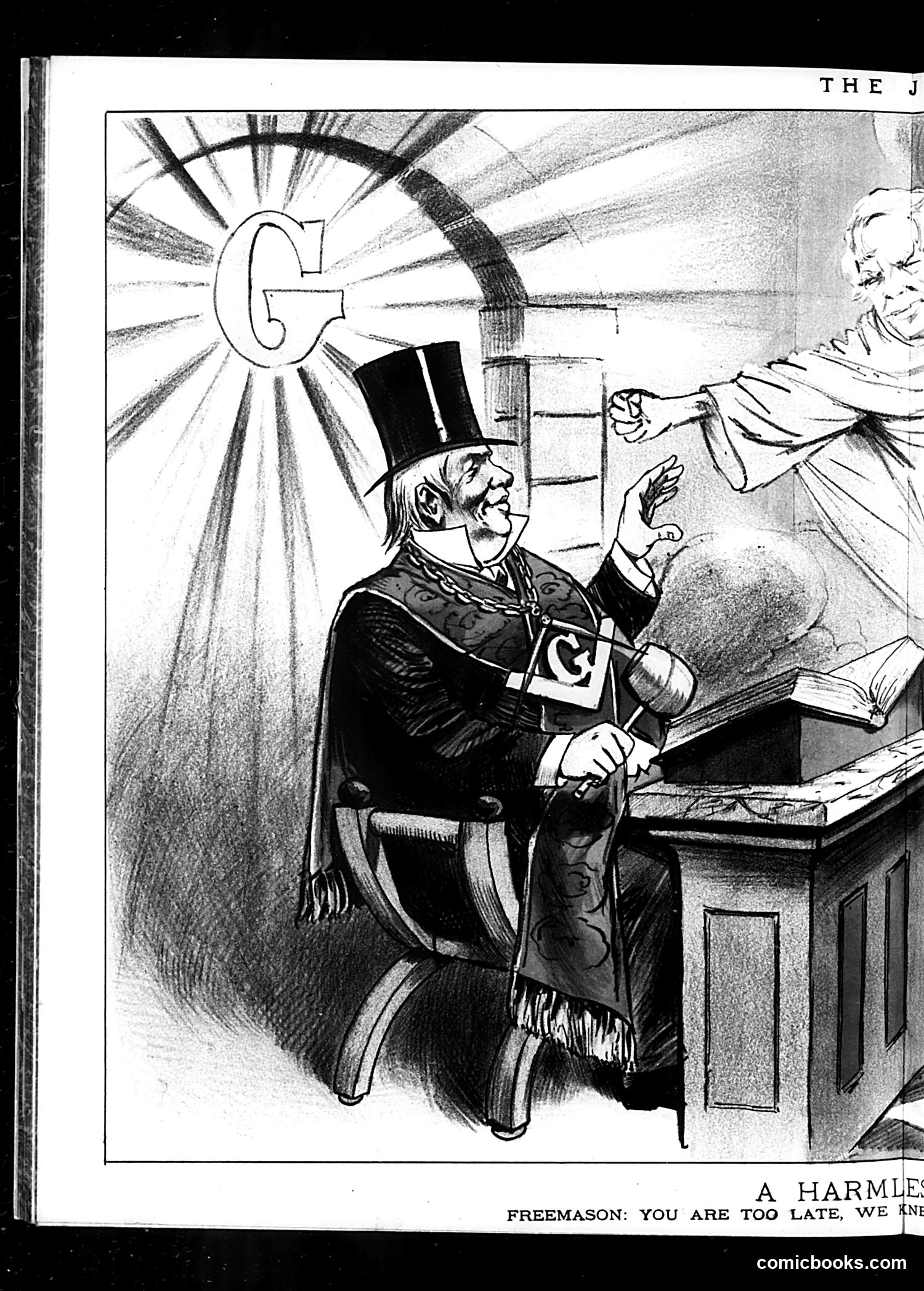
This appears to be a satirical cartoon from *Judge* magazine depicting a confrontation between a Freemason (identifiable by his top hat and Masonic insignia on his chest) and another figure. The Freemason is shown seated at a desk with papers and documents, suggesting an official or authoritative position. The caption "FREEMASON: YOU ARE TOO LATE, WE ARE..." (text cut off) suggests the cartoon critiques Freemasonry's influence or secretive power in institutions. The large glowing "G" symbol dominates the background, emphasizing Masonic symbolism. Without the complete caption and publication date, the specific political event referenced remains unclear. However, the image reflects historical American anxieties about Freemasonry's perceived hidden influence in government and civic institutions—a common satirical theme in 19th and early 20th-century publications.
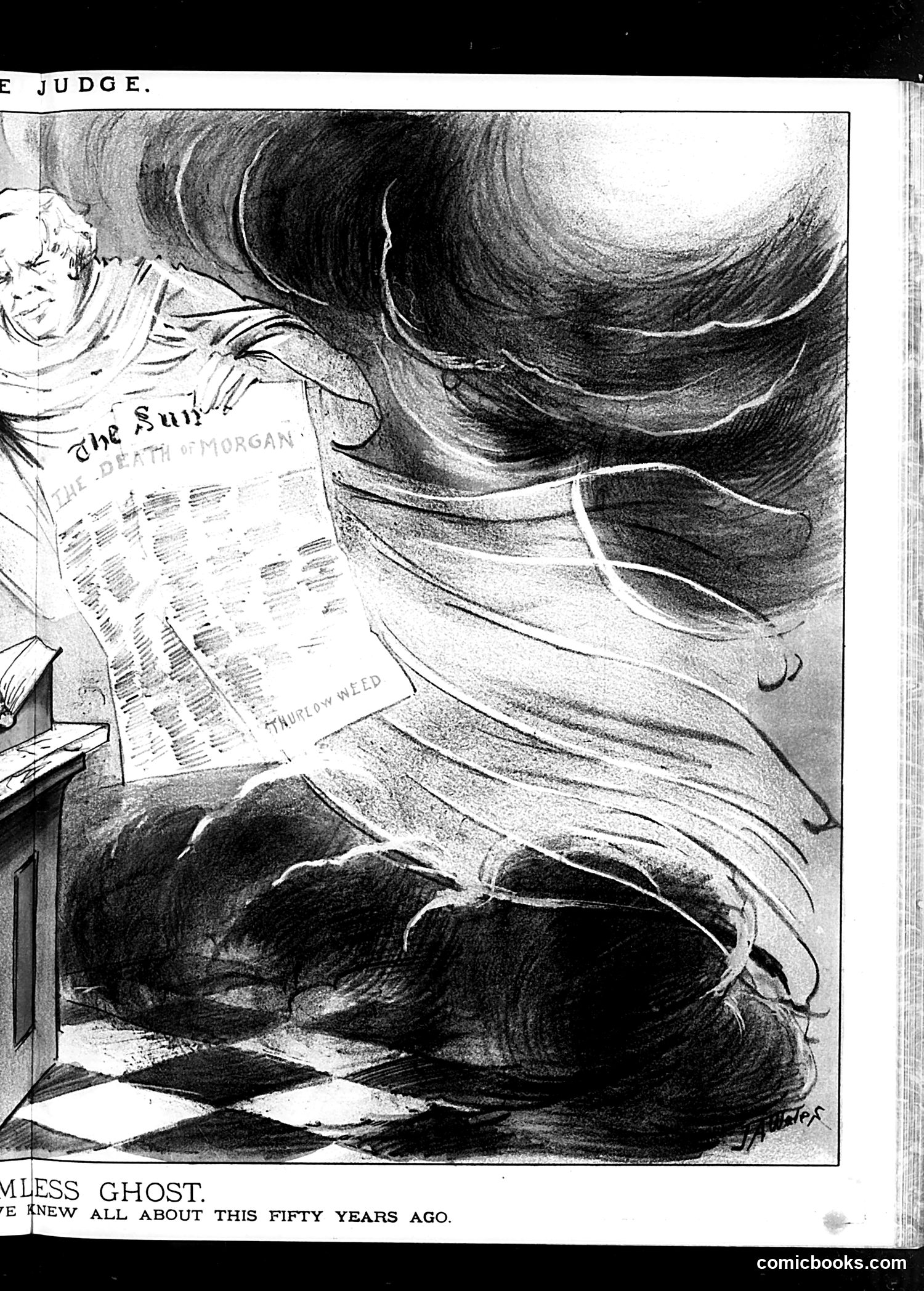
This appears to be a satirical cartoon titled "THE JUDGE" (visible at top). The image shows a woman with flowing dark hair reading newspapers that include visible headlines like "THE DEATH OF MORGAN," "THE SUN," and "TAINTED WEED." The bottom text reads: "LESS GHOST. WE KNEW ALL ABOUT THIS FIFTY YEARS AGO." The cartoon likely satirizes contemporary scandals or financial crimes—possibly referencing J.P. Morgan's death or related financial controversies. The woman appears to be a personification of justice or the public, reviewing old news. The caption's reference to "fifty years ago" suggests the cartoon criticizes repetitive patterns of corruption or wrongdoing in American business and politics, implying such scandals are not new despite public shock. The exact historical reference remains unclear without additional context.
This is a humorous piece of social satire about class expectations and urban vs. rural living standards in the late 19th century. The narrator, a country person, rented a room to a city bank-teller boarder who complained constantly about the food—particularly the lack of porter-house steak at breakfast. The boarder boasted that New York boardinghouses served better meals and accused the narrator of stinginess. Later, the narrator visits New York and discovers the truth: the bank-teller himself ate at fine restaurants only occasionally and typically had modest meals at his own eight-dollar-a-week boardinghouse. The city boarder had been pretending to a higher standard of living than he actually maintained. The satire mocks the pretentiousness of urban workers who affect superiority over rural people while living relatively modestly themselves, and their hypocrisy in criticizing country hospitality while unable to afford better in the city.
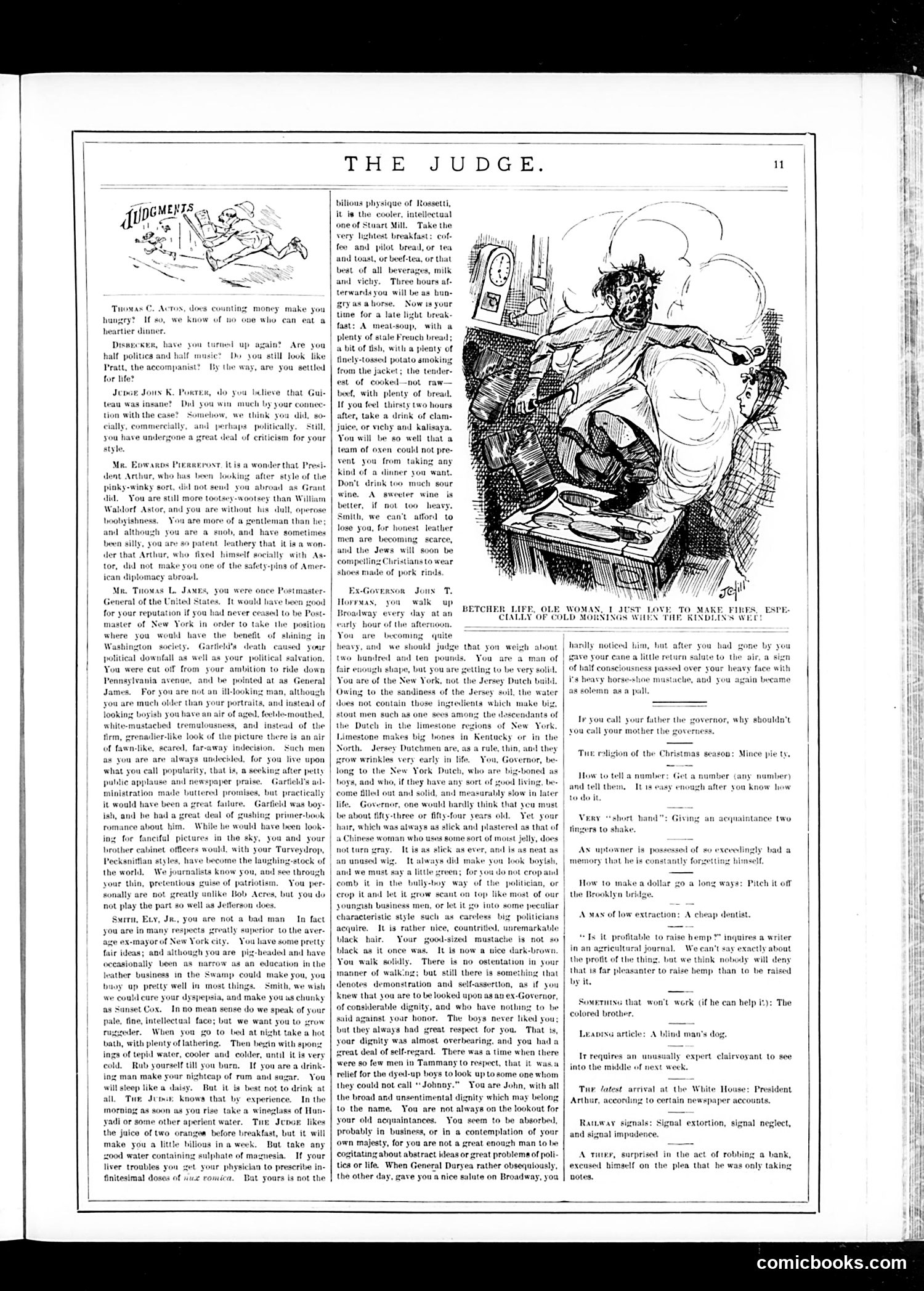
This page contains **satirical "advice" columns** addressing prominent New York political figures, likely from the Gilded Age (early 1880s based on references to Garfield's death and Arthur's presidency). The main targets appear to be: - **Thomas L. James** (Postmaster General): Criticized for abandoning his position as New York Postmaster to pursue Washington society status, called vain and pretentious - **Alonzo B. Cornell** and other local politicians: Mocked for their ambitions and character flaws The satire employs **mock medical advice** as its vehicle—suggesting these men need various remedies (liver tonics, baths, light diets) for their moral and political "ailments." This was a common Judge format: diagnosis of character through pseudo-medical language. The **large illustration** (right) appears to show a bloated, overstuffed political figure, reinforcing themes of corruption and excess. The overall message: these ambitious New York politicians are ethically bankrupt social climbers whose vanity and self-serving behavior mask fundamental incompetence. Their "cure" requires radical moral reform.
This page contains theater criticism rather than political cartooning. The main target is **Lillie Langtry** ("The Jersey Lily"), a famous British actress of the era who performed in America. The critic savagely attacks Langtry's theatrical abilities, calling her dramatically incompetent and a "morhid curiosity" whose popularity reflects poor public taste. Judge celebrates her departure from New York, contrasting her unfavorably with genuinely talented performers like "Miss Pattison." The page also reviews other theatrical productions, particularly criticizing American theaters' reliance on inferior imported English plays. The critique of "The Queen's Shilling" suggests American managers are foolishly paying high prices for mediocre foreign dramatic works rather than developing original American theater. The underlying satire targets celebrity culture and theatrical snobbery—Judge defends artistic merit against star power and foreign imports, while mocking both audiences and producers for their poor judgment.
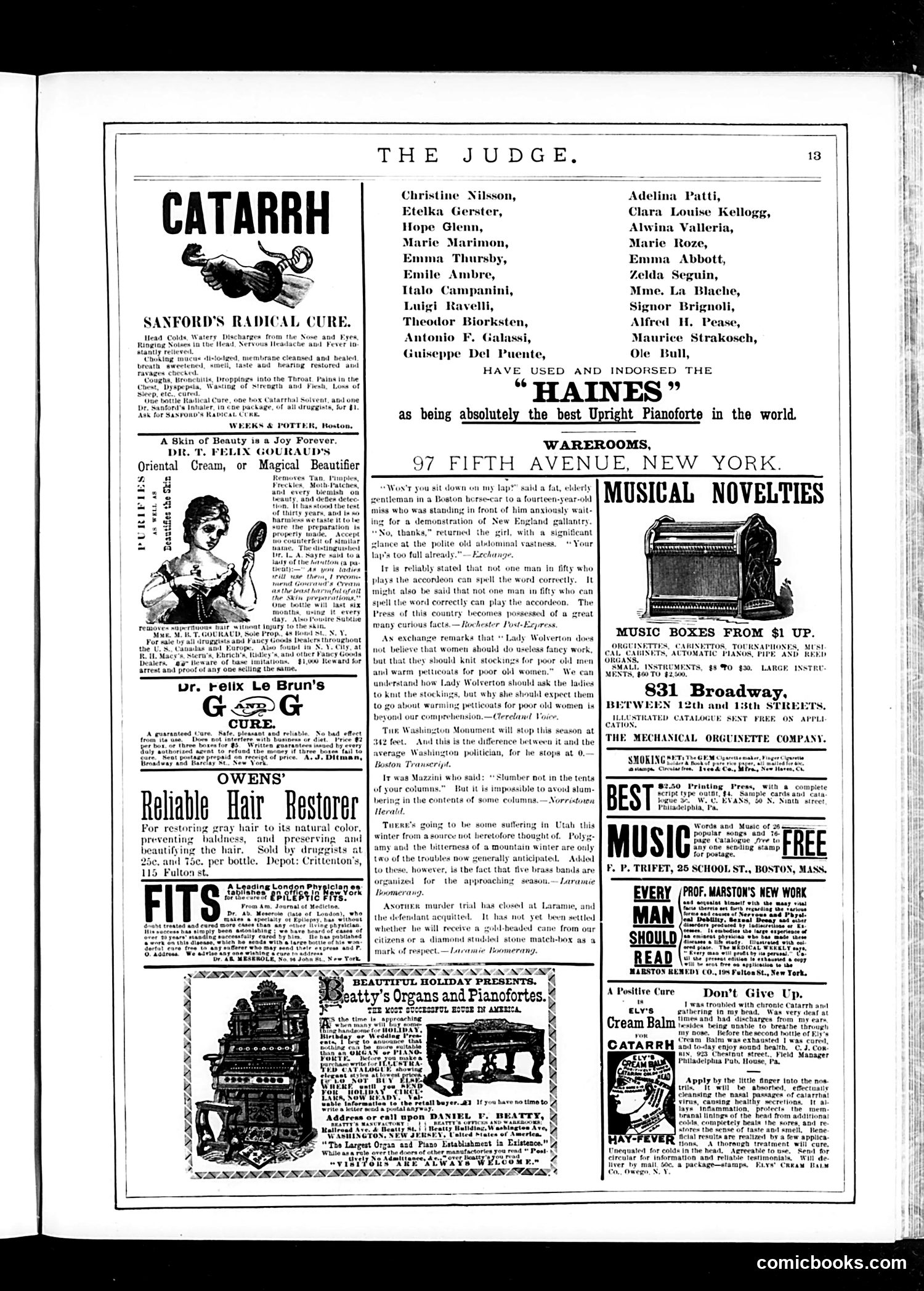
This is primarily an **advertising page**, not a satirical content page. It's page 13 from *Judge* magazine, dominated by commercial advertisements. Notable elements: **Advertisements include:** Sanford's Radical Cure (patent medicine for catarrh/head colds), Felix Gouraud's Oriental Cream (skin beautifier), Owens' Reliable Hair Restorer, and various music boxes and pianos (from Beatty's and The Mechanical Orinette Company at 831 Broadway). **Upper section** lists famous singers and musicians (Christine Nilsson, Clara Louise Kellogg, Adelina Patti, etc.) who allegedly endorsed **Haines pianos** as "the best Upright Pianoforte in the world." This was a common advertising strategy—celebrity endorsements. **Small text snippets** appear to contain brief humorous anecdotes about women, stockings, and an accordion player—typical *Judge* humor filler, but these are secondary to the advertising content. The page reflects late-19th-century consumer culture and demonstrates how satirical magazines supported themselves through extensive patent medicine and musical instrument advertising.
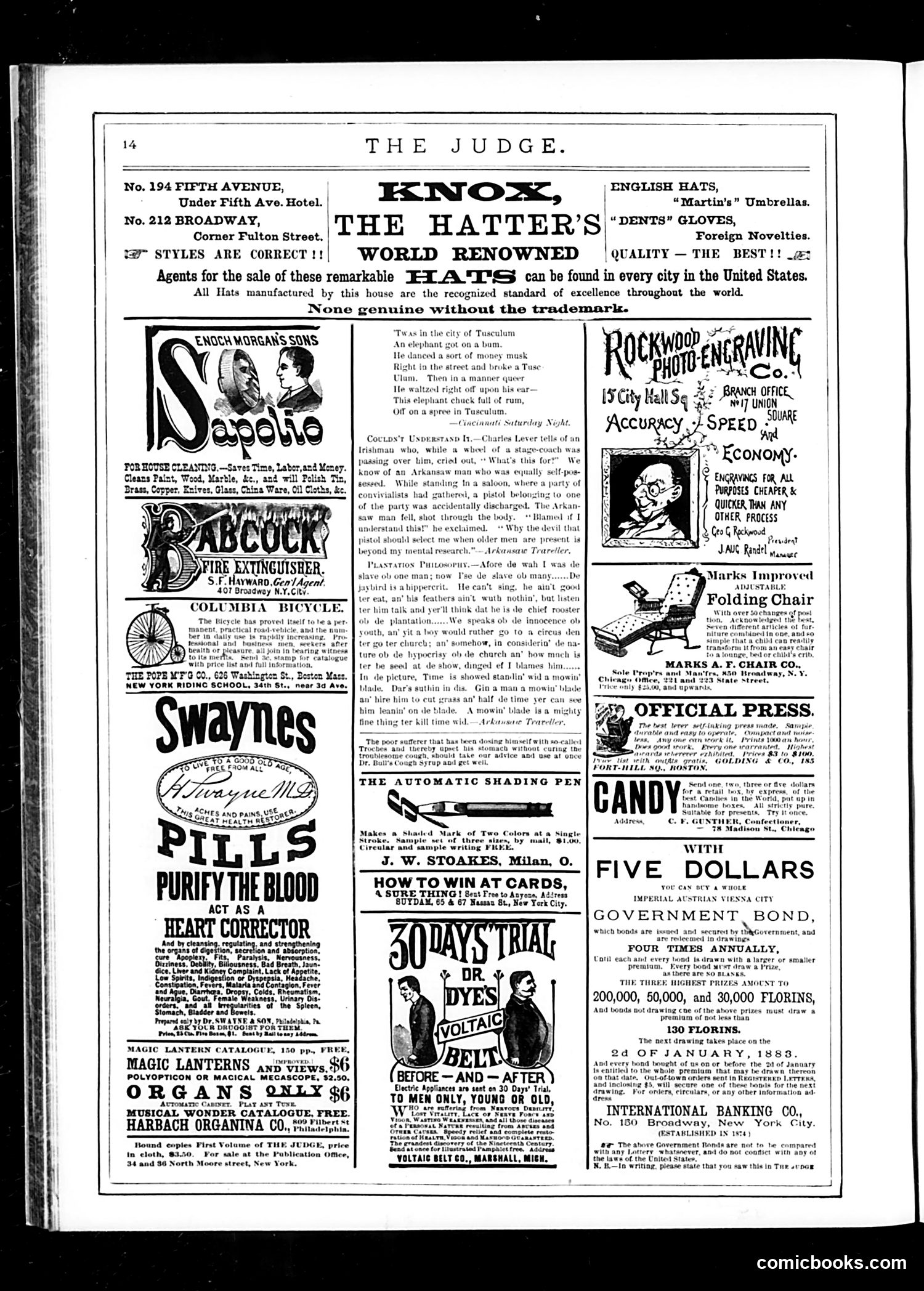
This is primarily an **advertising page** from Judge magazine, not a satirical cartoon. The page showcases commercial advertisements typical of late 19th-century America, including: **Notable ads:** - **Knox Hats**: A prestigious hatmaker claiming world-renowned status - **Swaynes Pills**: A patent medicine promising blood purification and heart health (typical snake-oil marketing of the era) - **Magic Lanterns and Organs**: Entertainment devices - **Austrian Government Bond lottery**: Promising large cash prizes—a speculative investment scheme **The satirical content** is minimal—mostly brief humorous anecdotes embedded between ads, including one about an elephant and references to plantation life and card-winning schemes. **For modern context**: This reflects the era's unregulated advertising, patent medicines with dubious claims, and aggressive financial schemes targeting readers. The page demonstrates how Judge mixed humor with commercial promotion to fund publication.
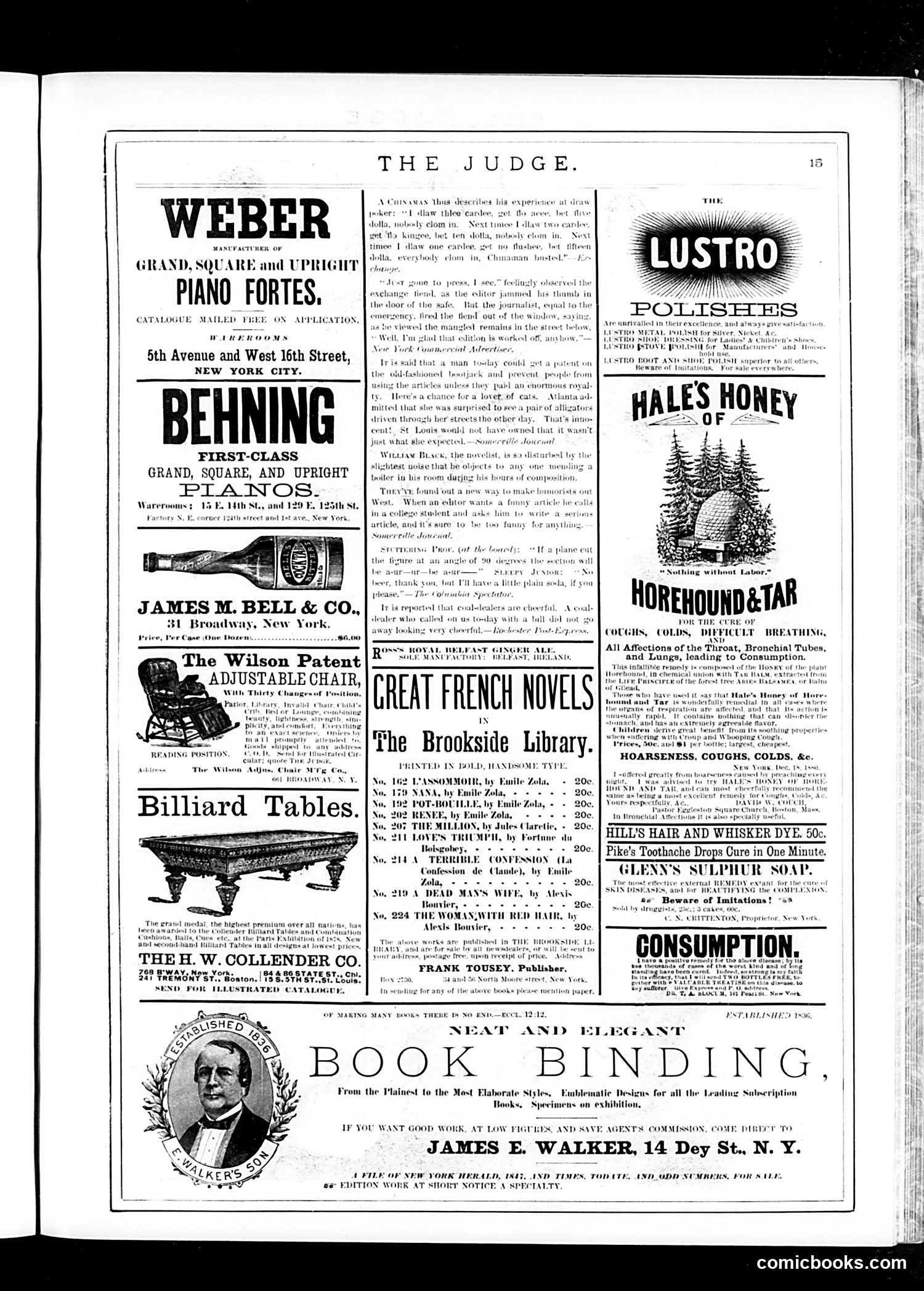
This page is primarily **advertisements and notices**, not a political cartoon. The visible content consists of: **Main Advertisements:** - Piano manufacturers (Weber, Behning, James M. Bell & Co.) - Billiard tables - The Wilson Patent adjustable chair - Books and novels from the Brookside Library - Patent medicines (Hale's Honey, Morehound & Tar, Pike's Toothache Drops) - Hair dye and soap - Book binding services **Small Anecdotes/Humor:** The page includes brief humorous snippets, including one about a "Chinaman" and gambling/card games—reflecting period stereotypes and casual ethnic humor typical of 1880s American magazines. **Publication Details:** The masthead indicates this is from Judge magazine, established 1881. James E. Walker handles book binding; Frank Tousey publishes novels. This appears to be a typical **ads-heavy page from a 19th-century periodical** rather than featuring significant political satire or cartoons worth analyzing for modern readers.
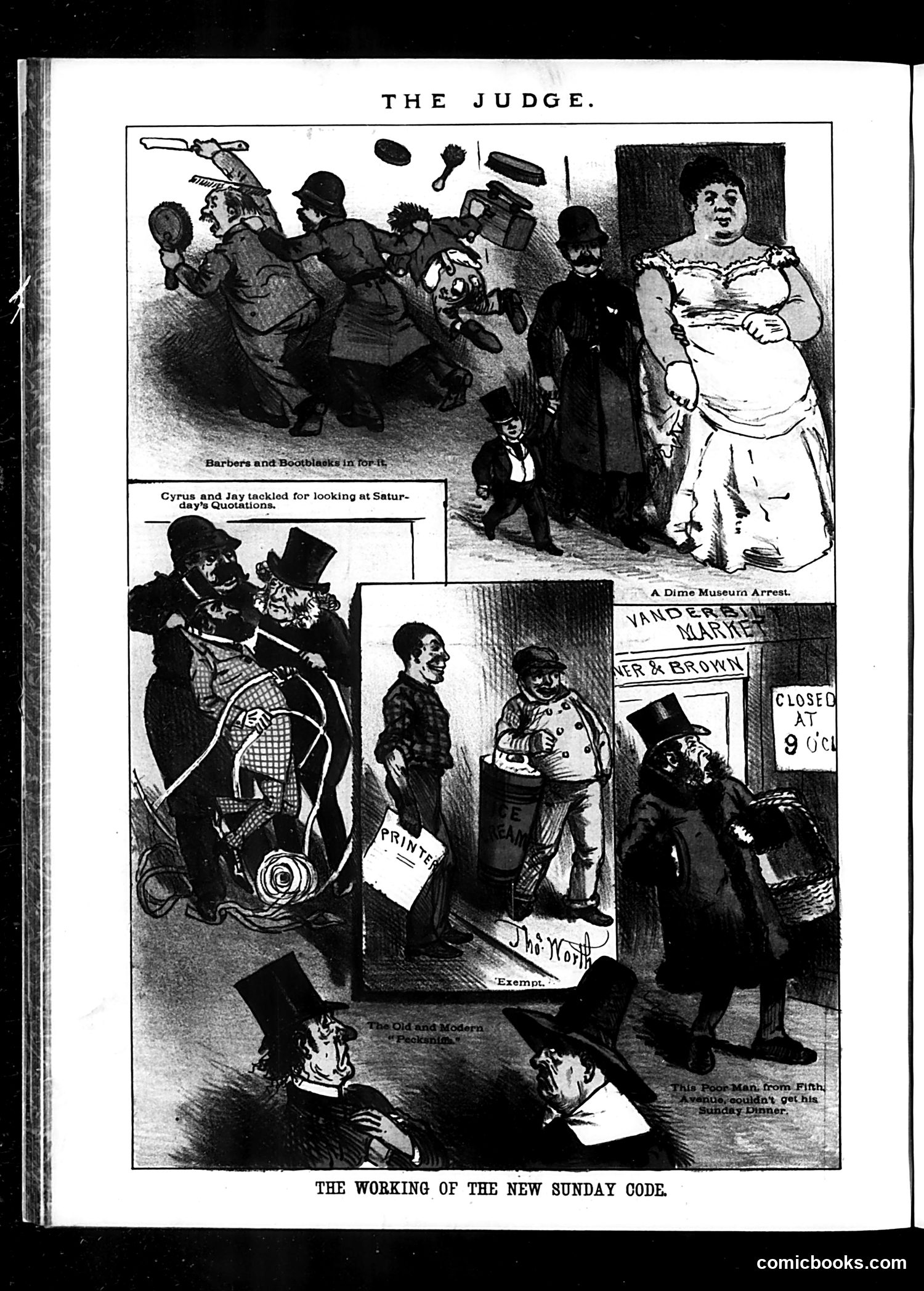
This Judge cartoon satirizes a new Sunday closing law, likely from the 1880s-90s. The page mocks enforcement of stricter Sabbath regulations through multiple vignettes: The top panel shows "Barbers and Bootblacks in for it"—working-class tradesmen arrested for Sunday labor. "Cyrus and Jay" (likely prominent businessmen) are "tackled for looking at Saturday's Quotations" (stock market reports). Lower panels depict the law's absurd consequences: a "Dime Museum Arrest," a "Poor Man from Fifth Avenue couldn't get his Sunday Dinner," and what appears to be selective enforcement. The satire targets the law's impact on the working poor and immigrants while wealthier citizens might escape consequences—criticizing both the rigid moralism of the Sunday code and its class-biased application.