
A complete issue · 16 pages · 1882
Judge — December 9, 1882
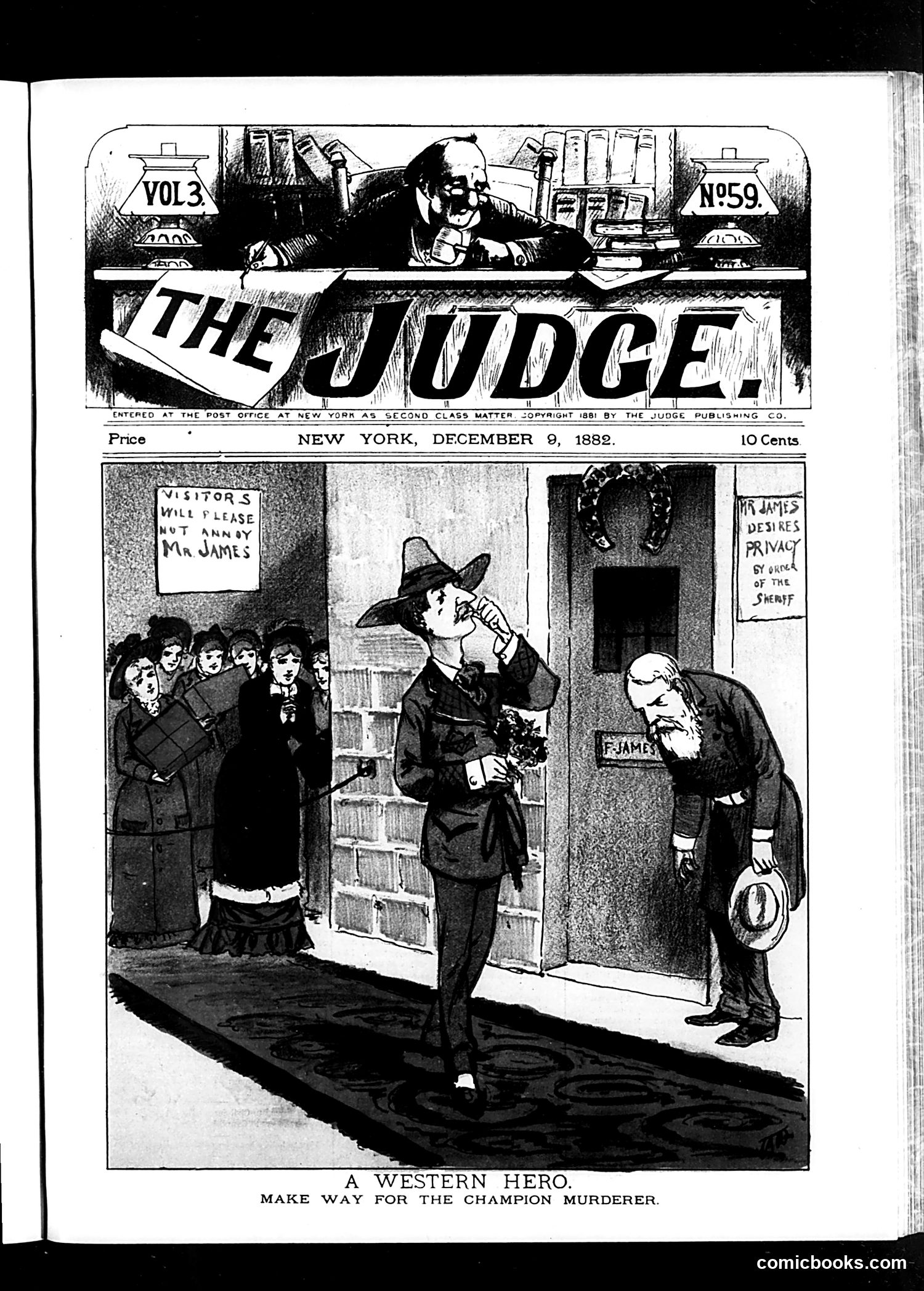
This satirical cartoon critiques frontier violence and the glorification of gunfighters. A cowboy in a wide-brimmed hat stands outside "Mr. James' Private" residence (the door nameplate reads "JAMES"), while onlookers inside peer out nervously. The man on the right, appearing to be a sheriff or official, removes his hat respectfully—a gesture typically reserved for dignitaries or heroes. The satire is sharp: the caption "Make Way for the Champion Murderer" sarcastically elevates a violent criminal to heroic status. This likely references the contemporary romanticization of outlaws and gunfighters in Western folklore, which newspapers and dime novels were actively promoting. Judge mocks this cultural tendency to celebrate brutal men as folk heroes simply because they were skilled at killing.
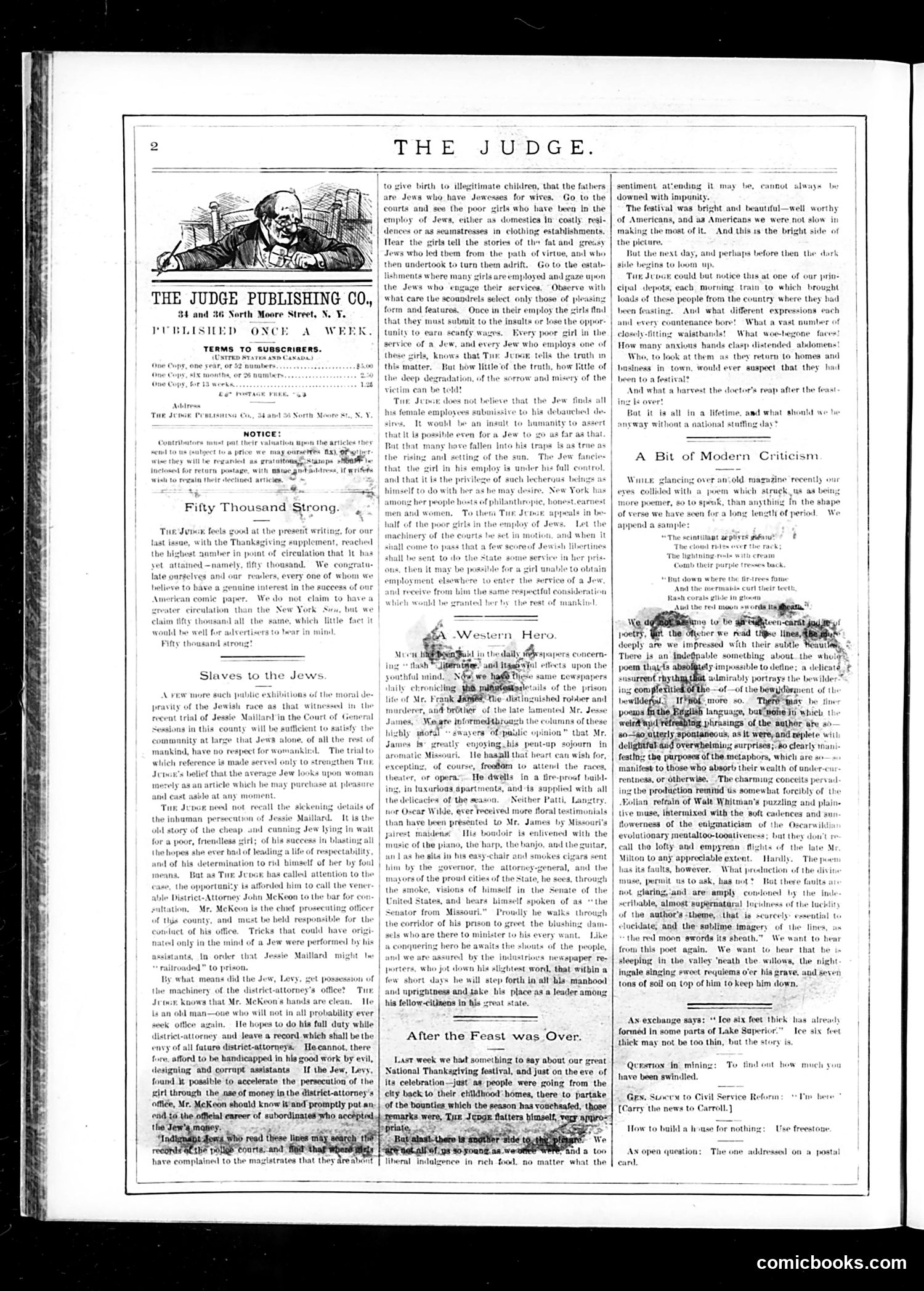
This page contains a lengthy editorial titled "Slaves to the Jews," attacking Jewish men—particularly a man named Levy working in the District Attorney's office—for allegedly exploiting young women employed as domestics and seamstresses. The article makes sweeping accusations that Jewish employers systematically seduce and abuse vulnerable girls, then abandon them. It demands District Attorney McKeon investigate and prosecute Levy and other Jews in his office. **Context**: This appears to reflect late-19th-century antisemitic conspiracy theories portraying Jewish men as predatory toward Christian women. The piece conflates individual criminal behavior with ethnic/religious identity, using it to justify broader prejudice against Jewish people. The accompanying illustrations (a caricatured face at top) appear designed to reinforce these stereotypes visually. This content represents the casual, virulent antisemitism that Judge magazine sometimes published, reflecting prejudices common in that era but now recognized as bigotry.
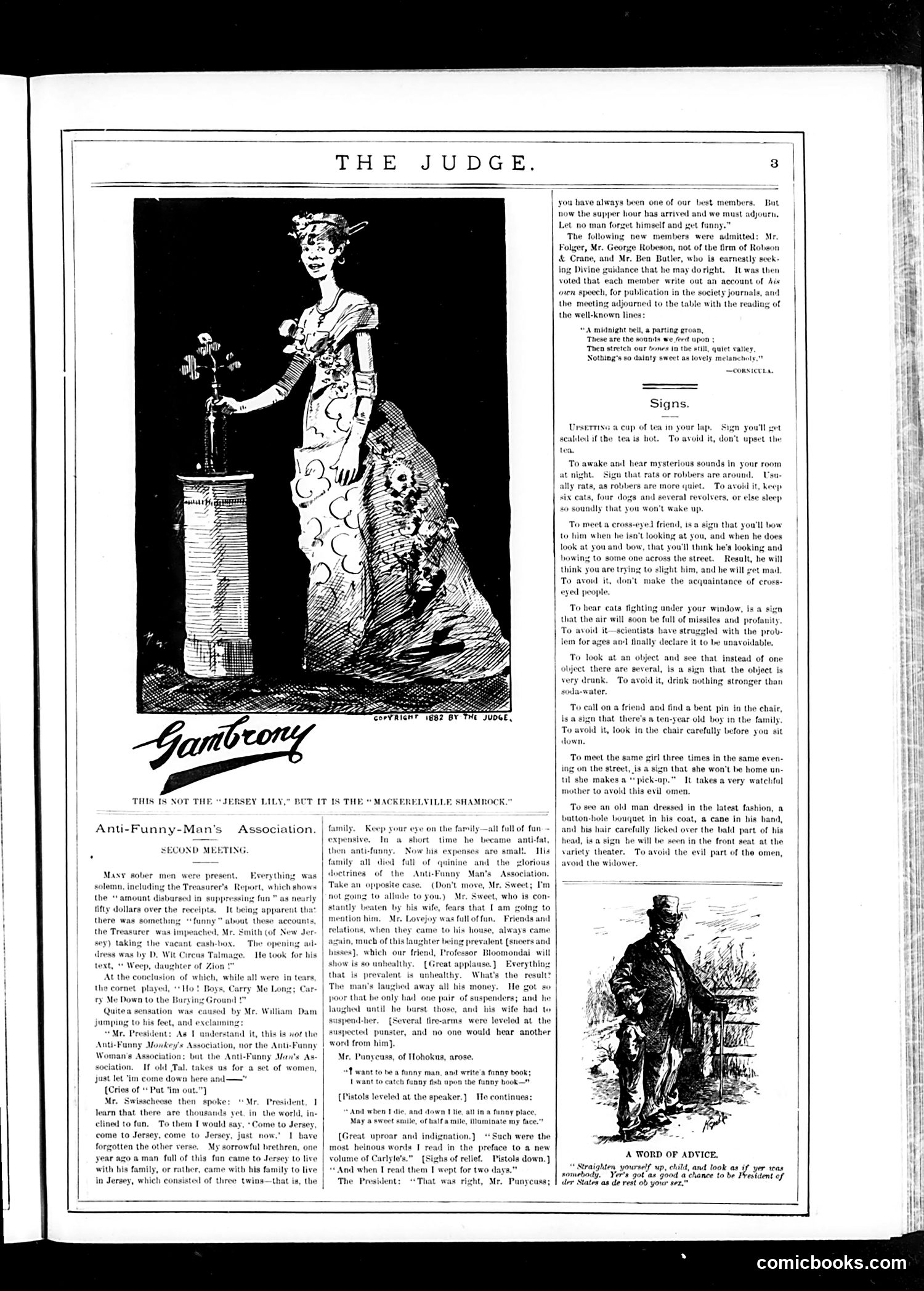
This *Judge* page satirizes the "Anti-Funny-Man's Association," a fictional group dedicated to suppressing humor. The main cartoon depicts a glamorous woman (caricatured in the style of the era) holding flowers, labeled "THIS IS NOT 'JERSEY LILY,' BUT IT IS THE 'MACKERELVILLE SHAMROCK'"—a joke contrasting a famous actress with a less prestigious alternative. The text describes the association's second meeting, where members solemnly discuss eliminating fun from society. Speakers make terrible puns (like "suspend-her" for "suspender"), which they then defend despite the group's anti-humor mission. The satire mocks both the prudishness of societies seeking to eliminate laughter and the speakers' own inability to resist wordplay. The "Signs" section offers humorous advice about avoiding various social mishaps, maintaining the comedic tone throughout. Overall, the page ridicules Victorian-era reformism and the notion that fun itself is dangerous.
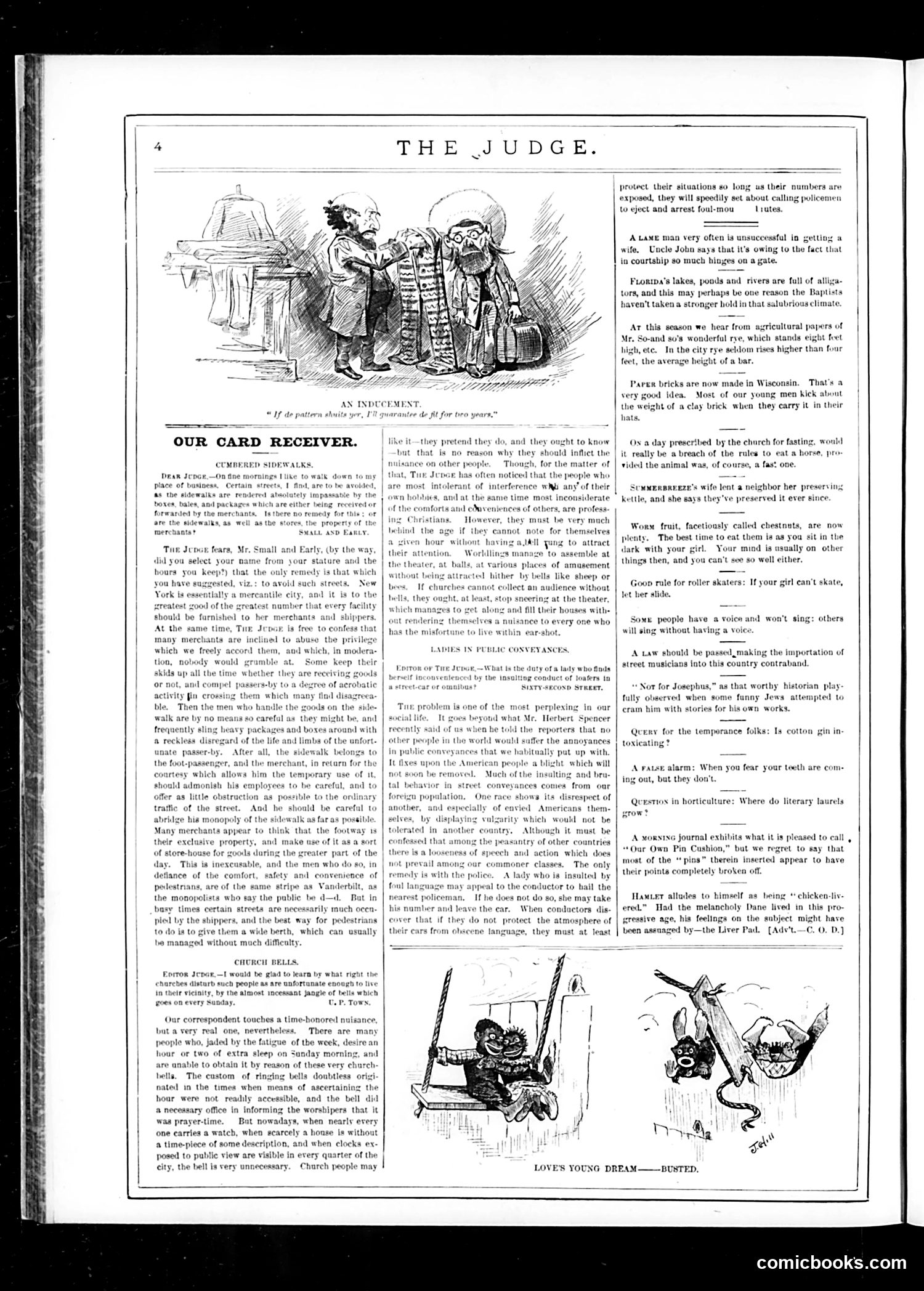
This page from Judge satirizes three urban inconveniences in 1880s America: **"Our Card Receiver"** (top): Mocks sidewalk congestion from merchant deliveries. Shop owners block public walkways with packages and goods, forcing pedestrians into dangerous street traffic. The satire targets merchants who monopolize public space for private business while claiming the sidewalk is a public right—hypocrisy Judge ridicules sharply. **"Church Bells"** (middle): Complains that Sunday church bell-ringing disturbs sleeping residents. Judge argues bells are obsolete—everyone now owns watches and clocks—making the noise merely a nuisance rather than a necessary public service. **Minor items** (right column): Include complaints about lazy neighbors protecting property lines, Wisconsin's new brick industry, and humorous observations on daily life. The overall theme: urban life is increasingly cluttered by unreasonable private interests (merchants, churches) imposing inconveniences on the public. Judge adopts the voice of an exasperated city resident demanding accountability.
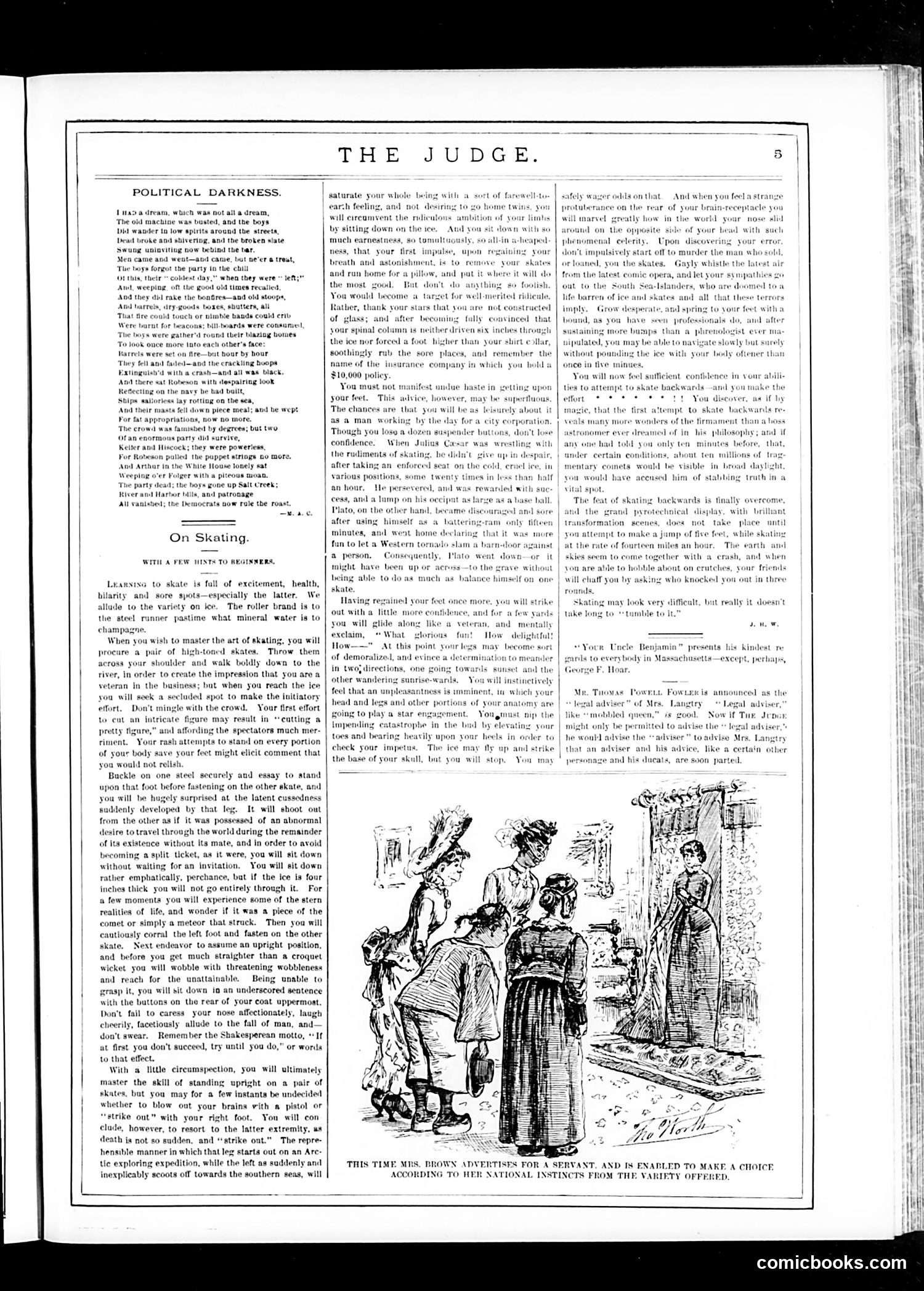
**"Political Darkness"** is a lengthy poem satirizing the Grant administration's failures. It references Secretary of the Navy George M. Robeson (depicted as a puppet-master controlling President Grant), critiquing naval deterioration—"Ships sailorless lay rotting on the sea." The poem mourns departed Republican leaders (Kelter and Hiscock mentioned) while Democrats gain power, ending with the White House "lonely sat" as Grant weeps. This appears to address Republican political collapse during Grant's presidency. **"On Skating"** is humorous instructional verse mocking beginners' inevitable falls and mishaps on ice. The joke relies on physical comedy—readers expecting skating tips get detailed descriptions of repeated tumbles instead. The accompanying illustration shows people awkwardly falling or struggling on ice, reinforcing the satirical contradiction between the advisory tone and the comic inevitability of failure. Both pieces use wordplay and exaggeration typical of Judge's satirical approach.
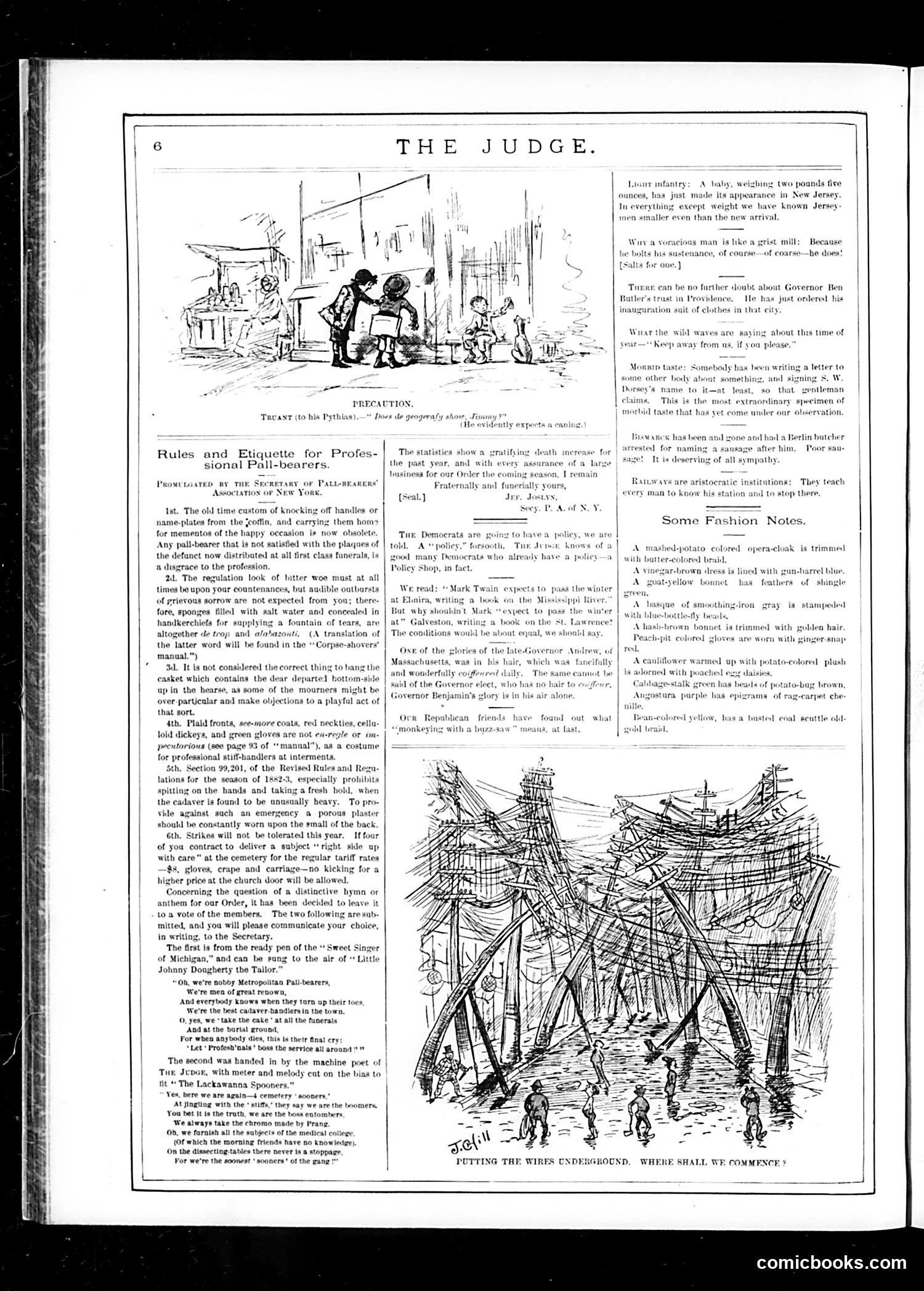
This is a satirical mock-rulebook mocking the commercialization and unprofessional conduct of funeral workers in late 19th-century New York. The piece ridicules pall-bearers for: - **Stealing mementos** from coffins (handles, nameplates) - **Faking grief** with concealed sponges to simulate tears - **Mishandling corpses** carelessly - **Dress code violations** (plaid, garish colors, false shirt-fronts) - **Striking for higher pay** at the cemetery door - **Selling cadavers** to medical colleges The humorous bylaws and the two comic "hymns" (including one credited to Michigan's "Sweet Singer") parody official fraternal order regulations while exposing corruption within the funeral industry. The satire suggests pall-bearers operated as an organized, profit-driven guild more interested in money and grave-robbing than respectful service—a serious social problem treated through exaggerated comic rules.
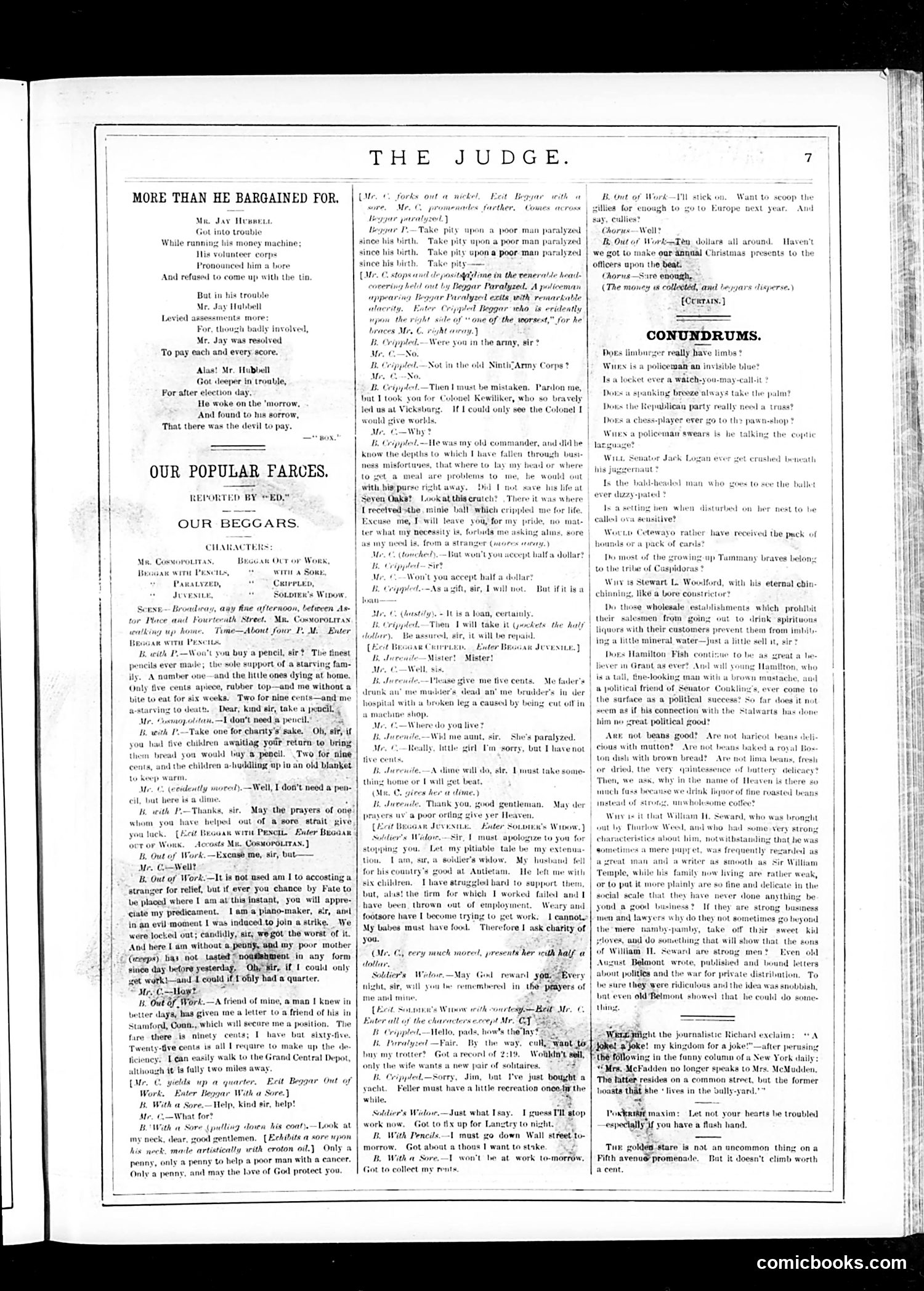
This satirical sketch ridicules the proliferation of street beggars in late 19th-century urban America—likely New York. A well-dressed gentleman ("Mr. Cosmopolitan") encounters successive beggars with increasingly implausible or theatrical hardship stories: a pencil-seller with starving children, a piano-maker locked out from a strike, a man with a deliberately-inflicted sore (created with caustic oil), a crippled veteran, a soldier's widow. The satire targets both the beggars' manipulation and the gentleman's performative charity—he offers coins while remaining emotionally detached. By the sketch's end, a policeman removes a "paralyzed beggar," suggesting authorities view street begging as criminal nuisance rather than genuine distress. The piece mocks urban poverty's visibility and beggars' stereotyped appeals while questioning whether charitable impulses address real need or merely assuage middle-class guilt.
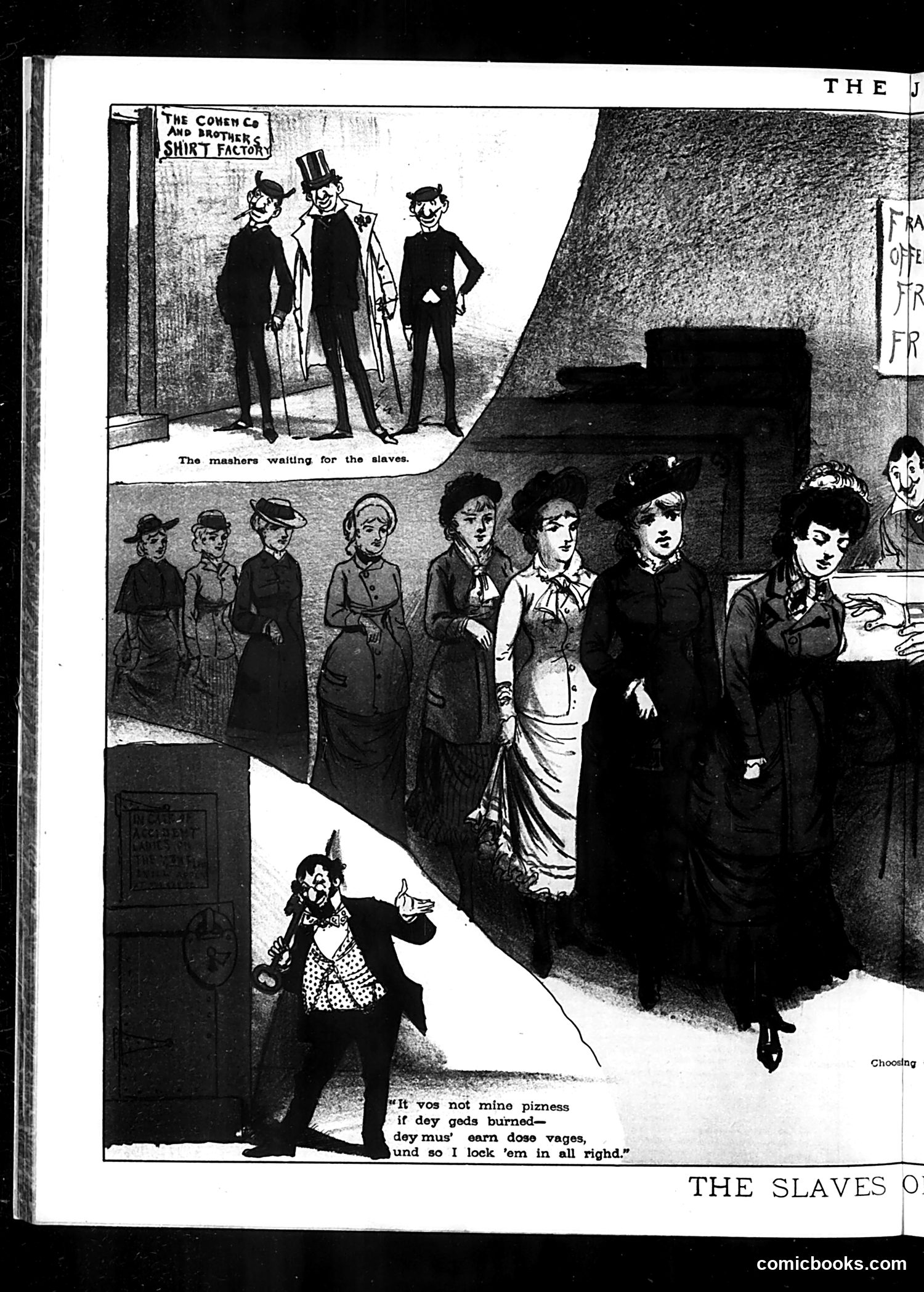
This page satirizes labor exploitation at the Coven Co. and Brothers Shirt Factory. The inset shows well-dressed male factory owners ("the mashers waiting for the slaves") in top hats—a visual metaphor equating them to slave traders. The main scene depicts female factory workers (likely immigrant women, suggested by the dialect text) in a cramped workspace. The bottom panel features a factory owner with a Yiddish accent defending locked doors and poor wages, claiming workers must "earn" their meager pay. The satire targets: exploitative factory conditions, the systematic locking-in of workers (a fire hazard), poverty wages, and the casual indifference of wealthy owners. By labeling workers "slaves," Judge equates early 20th-century factory labor with chattel slavery, critiquing how industrial capitalism reduced human workers to commodified labor with no regard for safety or dignity.
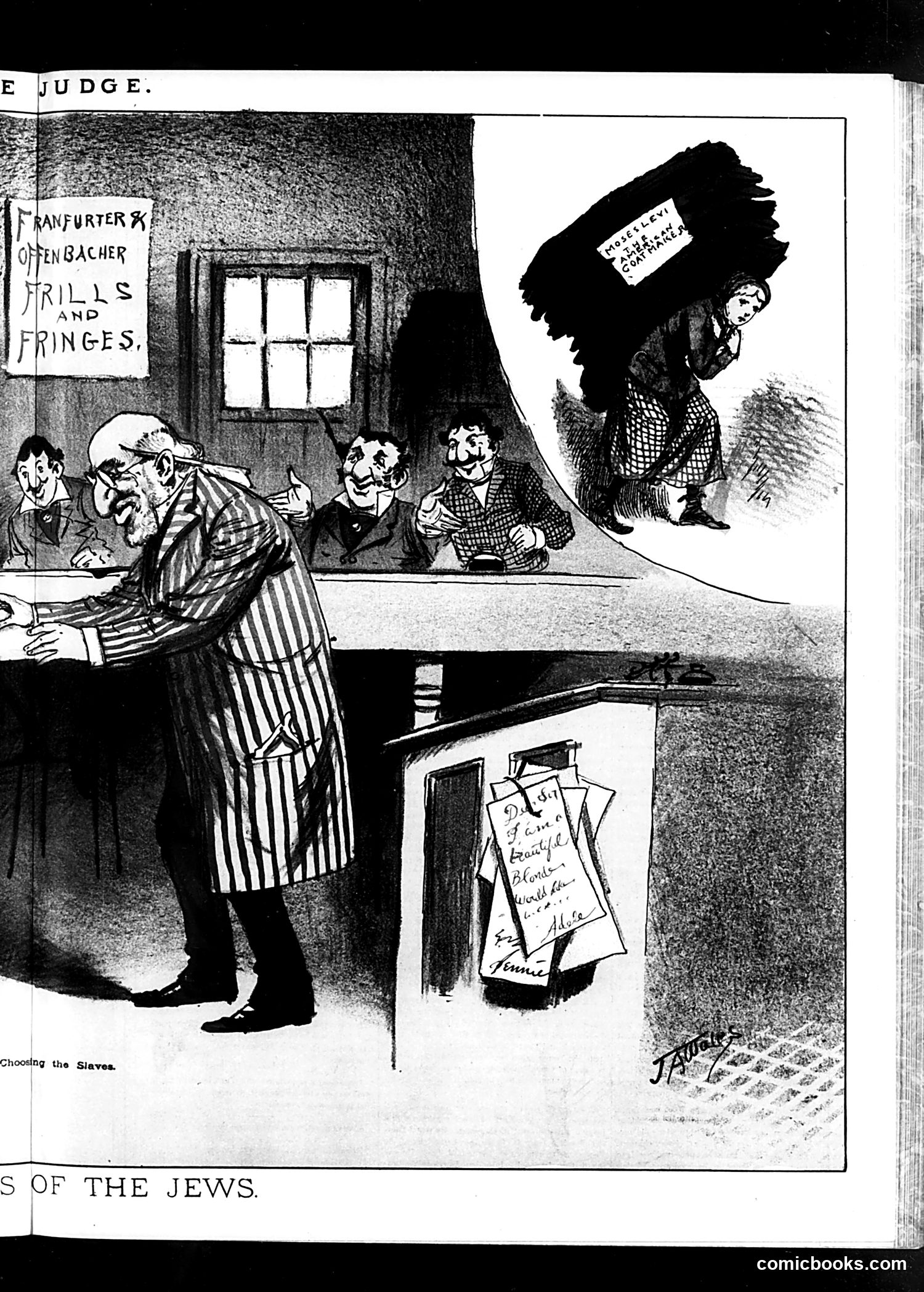
This appears to be an antisemitic cartoon from *Judge* magazine titled "Choosing the Slaves" and subtitled "Of the Jews." The image shows a figure with exaggerated Jewish caricature features (large nose, wild hair) displaying what appears to be a list of names or candidates on the right side, while a man in striped clothing (possibly representing a judge or authority figure) examines documents on the left, with observers visible in a window behind. The cartoon likely reflects late 19th/early 20th-century antisemitic conspiracy theories portraying Jewish people as manipulating labor, selecting workers, or controlling systems—harmful stereotypes common in period satirical publications. The specific context regarding "Danfurter & Offenbacher" (visible in OCR) remains unclear without additional historical documentation.
This page from *Judge* magazine contains brief satirical character sketches of prominent public figures, likely from the 1880s-1890s based on references and style. The cartoonist/writer addresses various named individuals with mock compliments and pointed criticisms. Examples include: - **Judge Fullerton**: Praised for improved appearance, mocked for past moral lapses - **Ernest Harrıbie**: Called contemptible, compared unfavorably to historical villains - **Judge Saloman**: Criticized for anti-Semitic treatment during his campaign - **John P. Foley**: Complimented as a practical journalist with refined taste in food The humor relies on **personal attacks disguised as praise**—backhanded compliments about appearance, character flaws, alleged affairs, and business dealings. References to specific restaurants (Delmonico's), foods (canvas-back duck), and local scandals suggest a readership familiar with New York society gossip. The satire targets **judicial figures and newspaper editors**, suggesting *Judge* positioned itself as arbiter of public morality while engaging in character assassination of rivals and enemies.
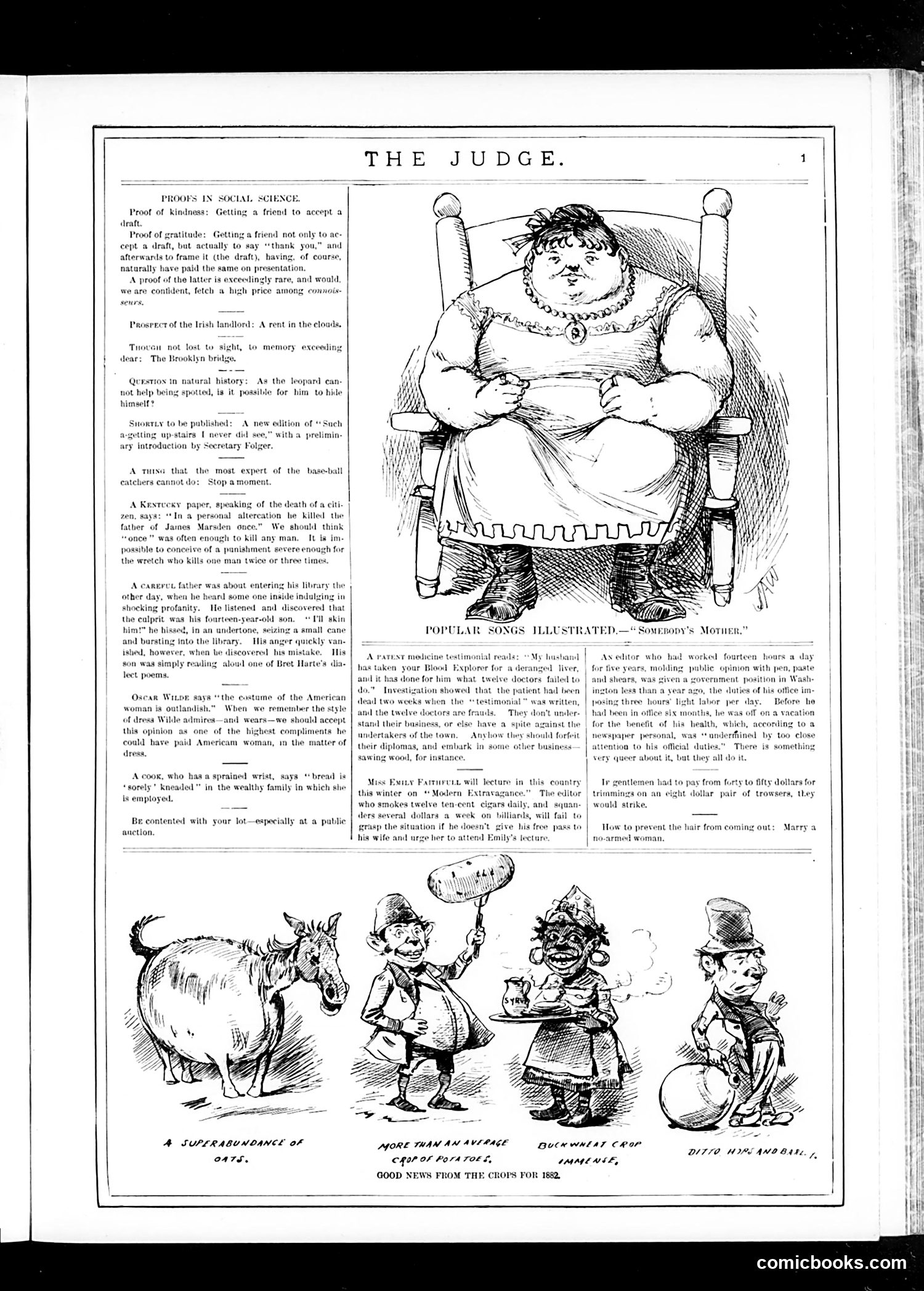
This satirical page from Judge magazine uses humor to comment on 1880s American social issues and absurdities. **Upper cartoon:** "Smokey's Mother" depicts an obese woman in a chair—likely satirizing excessive consumption or gluttony as a social problem. **Text section:** Contains humorous "proofs" mocking various social pretenses: accepting a friend's bad draft as proof of kindness, Irish landlord exploitation, and the impossibility of a leopard hiding its spots (likely referencing unchangeable human nature). **Bottom cartoons:** "Good News from the Crops for 1882" shows four figures representing agricultural abundance—exaggerated characters celebrating good harvests. The captions ("Superabundance of Oats," "More than Average Crop of Potatoes," etc.) celebrate agricultural success, suggesting farmer prosperity. **Overall:** The page mixes cynical social commentary with celebratory economic news, typical of Judge's blend of satirical wit and topical humor for educated American readers.
This page reviews the simultaneous London-Broadway premiere of Gilbert & Sullivan's opera *Iolanthe* (1882). The critic praises the satirical wit and bright dialogue but offers mixed reviews of the cast. **Key figures mentioned:** - **Miss Augusta Rodie** (Lady Jane from *Patience*) - praised for her droll humor in the fairy role - **Mr. Ryley** (Lord Chancellor) - commended as a brilliant interpreter of Gilbertian wit - **Carleton** (Strephon, the half-fairy/half-mortal lead) - criticized as inadequate, with the critic humorously wishing he were actually invisible to improve the performance **The satire:** The review mocks Carleton's inflated ego, suggesting he believes the theater would collapse without him. The critic's backhanded compliments and witty comparisons to other Gilbert works (*Pinafore*, *Patience*) were typical of Judge's theatrical coverage—sophisticated mockery aimed at theater professionals' vanities.
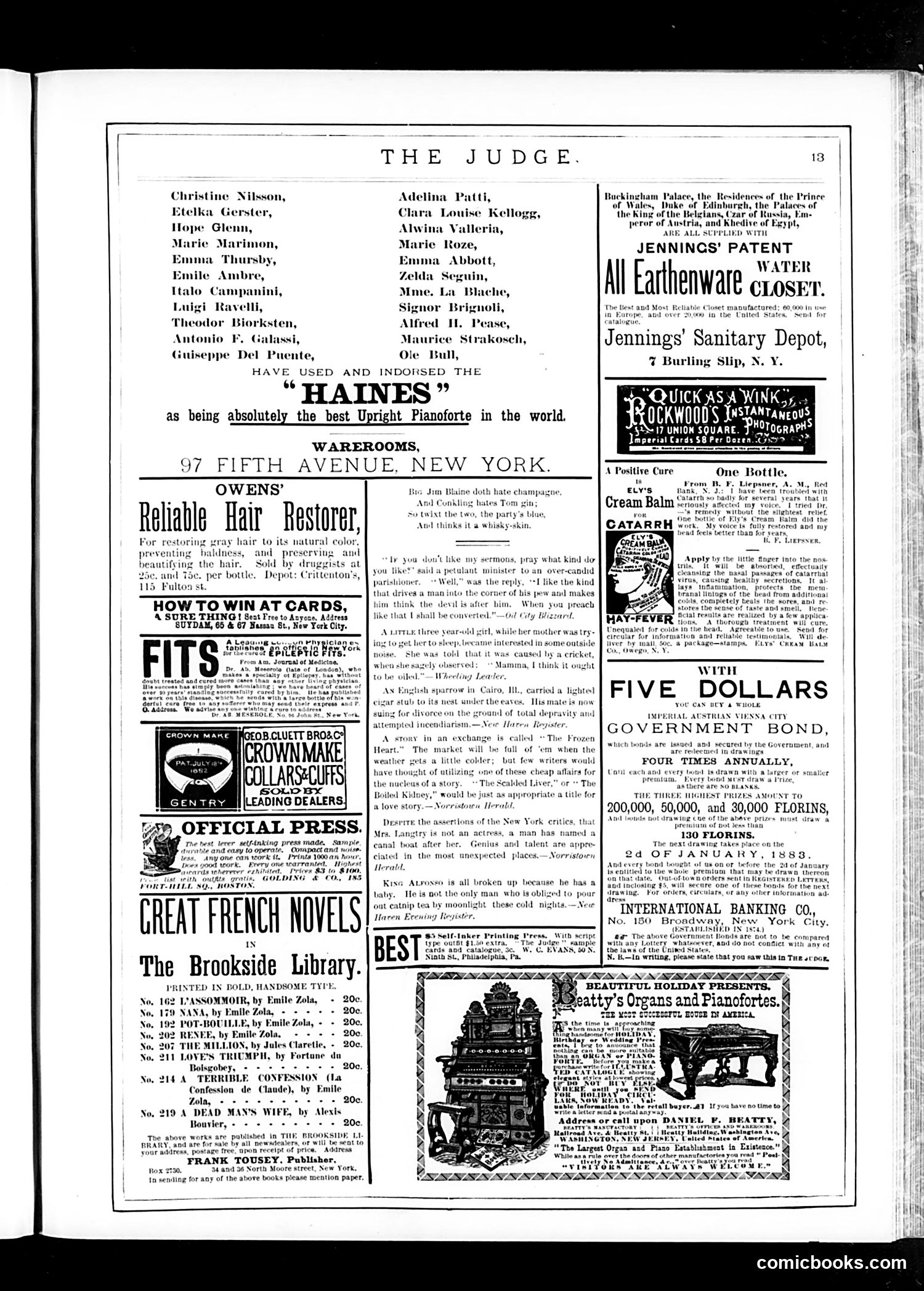
This is primarily an **advertising page** rather than a satirical cartoon page. The content consists almost entirely of commercial advertisements from the 1880s. The notable editorial element is a **testimonial section** listing famous opera singers and musicians of the era (Christine Nilsson, Adelina Patti, Clara Louise Kellogg, etc.) who endorsed the "Haines" upright pianoforte as "absolutely the best" in the world. This was a common advertising tactic—leveraging celebrity endorsements. The remaining content advertises period products: hair restorer, card-playing guides, printing presses, French novels, organs and pianofortes, lottery bonds, and various patent medicines and devices. **For modern readers**: This reflects how 19th-century magazines monetized through dense advertising. The celebrity endorsements mirror modern celebrity product placement. The prominence of lottery bonds and dubious "systems" (card-winning guides, medical products with vague claims) reveals fewer consumer protections existed then. There are **no political cartoons or satirical commentary visible** on this particular page.
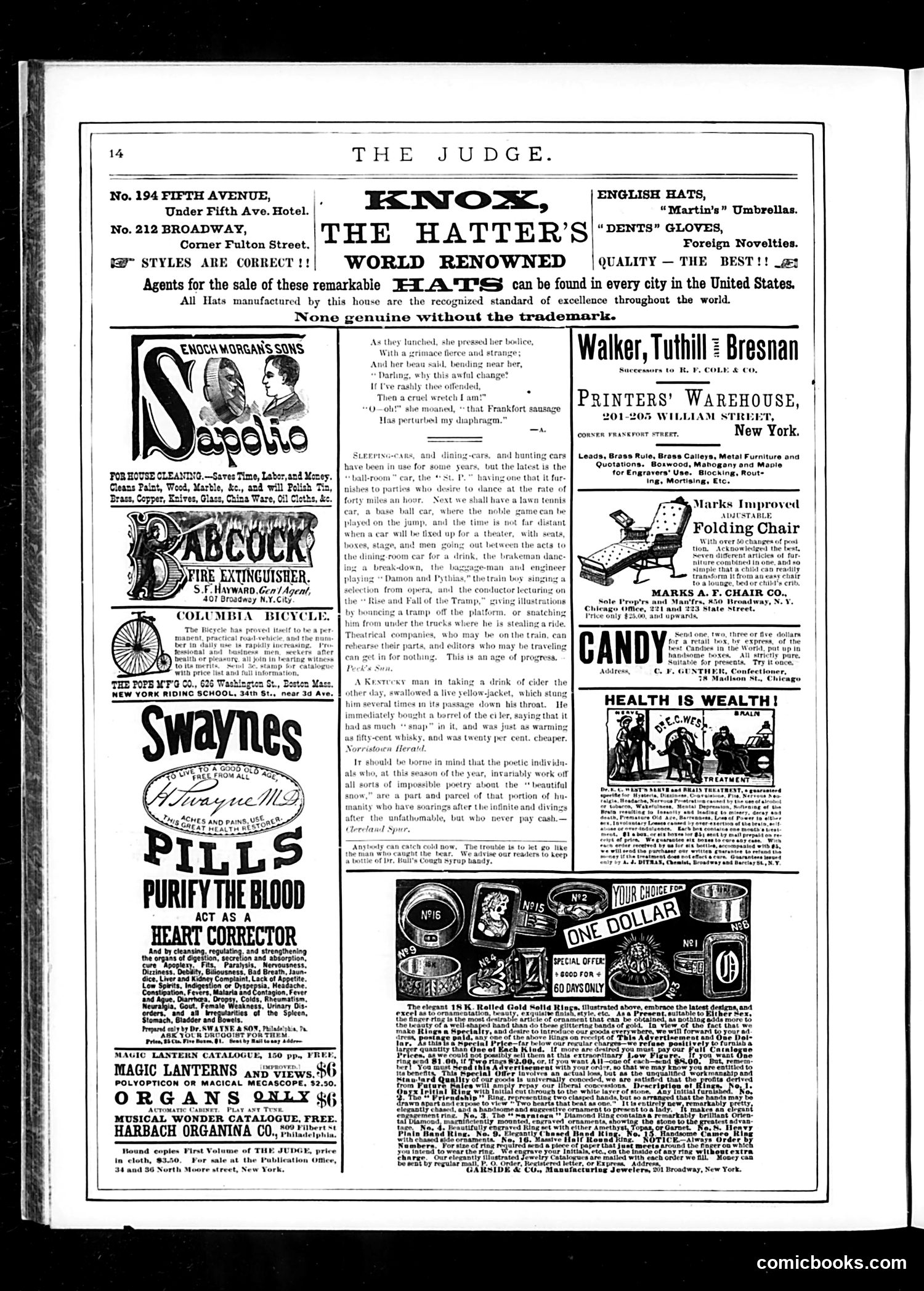
This is primarily an **advertising page** rather than editorial content. The page showcases various commercial advertisements typical of late 19th-century American magazines, including: **Notable Advertisements:** - Knox hats (prominently featured at top) - Swaynes Pills (blood purifier/"heart corrector") - Enoch Morgan's Sons soap - Columbia bicycles - Magic lanterns and organs - Marks adjustable folding chair - Various other merchandise **Editorial Content:** The small text snippets appear to be humorous anecdotes or brief satirical pieces—typical Judge filler material—including references to sleeping cars, theatrical scenarios, and a Kentucky man's misadventure with a yellow-jacket in cider. These are lighthearted social observations rather than political satire. **Overall Character:** This reflects Judge's business model: a satirical magazine sustained largely by advertising revenue from manufacturers and retailers, with humor supporting the commercial enterprise.
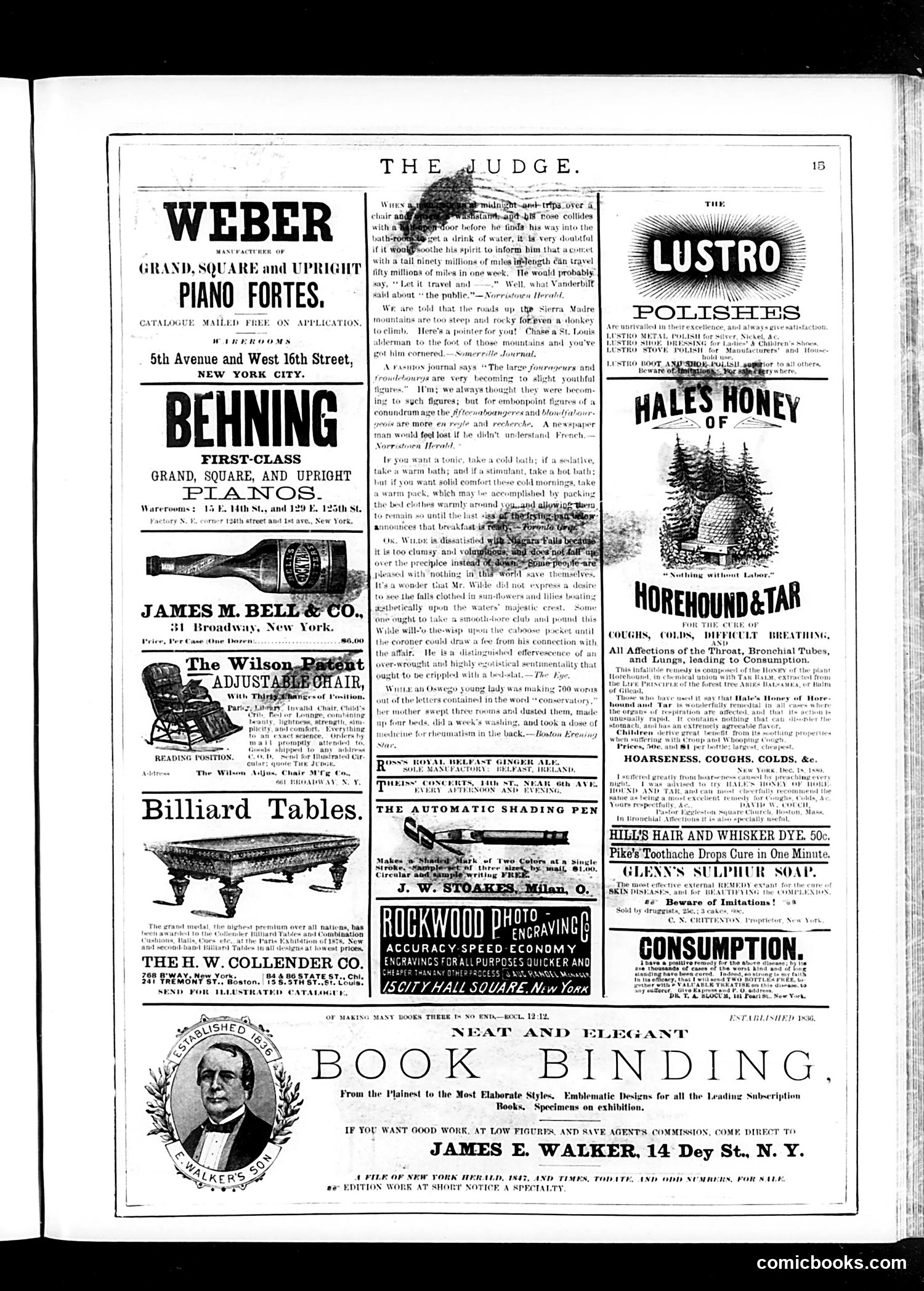
This is primarily an **advertising page** from Judge magazine, not a satirical cartoon section. The page contains numerous commercial advertisements typical of late 19th-century publications: piano manufacturers (Weber, Behning), billiard tables, patent furniture, polishes, patent medicines (Hales Honey, Horehound Tar, consumption remedies), hair dye, and book binding services. The only editorial content visible is a brief text snippet about Niagara Falls and travel costs, which appears to contain mild satire mocking wealthy travelers like Vanderbilt, but the passage is fragmentary and difficult to interpret fully from this OCR. The page reflects Judge's business model: satirical editorial content subsidized by advertisements for consumer goods, medicines (many of dubious efficacy), and services. The ads themselves offer unintentional humor through exaggerated claims typical of the era—such as instant toothache cures and patent remedies for consumption.
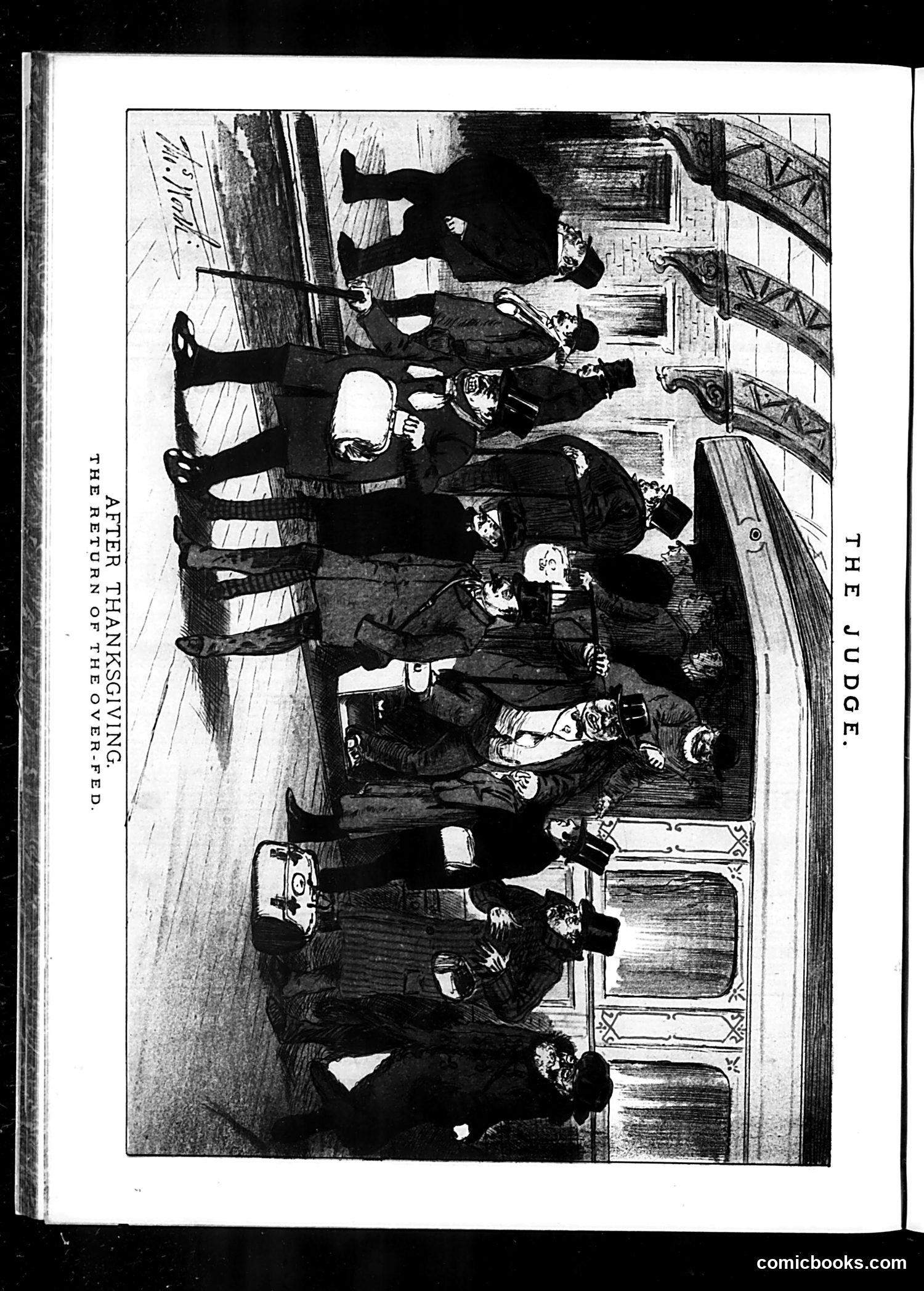
This is a satirical cartoon depicting the aftermath of Thanksgiving celebration. The image shows a group of men in formal attire appearing bloated and uncomfortably full, seemingly struggling with digestion after excessive eating. The figures are drawn in exaggerated poses suggesting discomfort and distress. The satire targets the American tradition of overindulgence during Thanksgiving—specifically the stereotype of men eating themselves into uncomfortable states. The joke plays on the contrast between civilized, formal dress and the undignified physical condition of being overstuffed. The title's phrase "over-fed" emphasizes the excess and gluttony that characterized the holiday celebration. This reflects period American humor mocking the physical consequences of holiday feasting.