
A complete issue · 16 pages · 1882
Judge — November 11, 1882
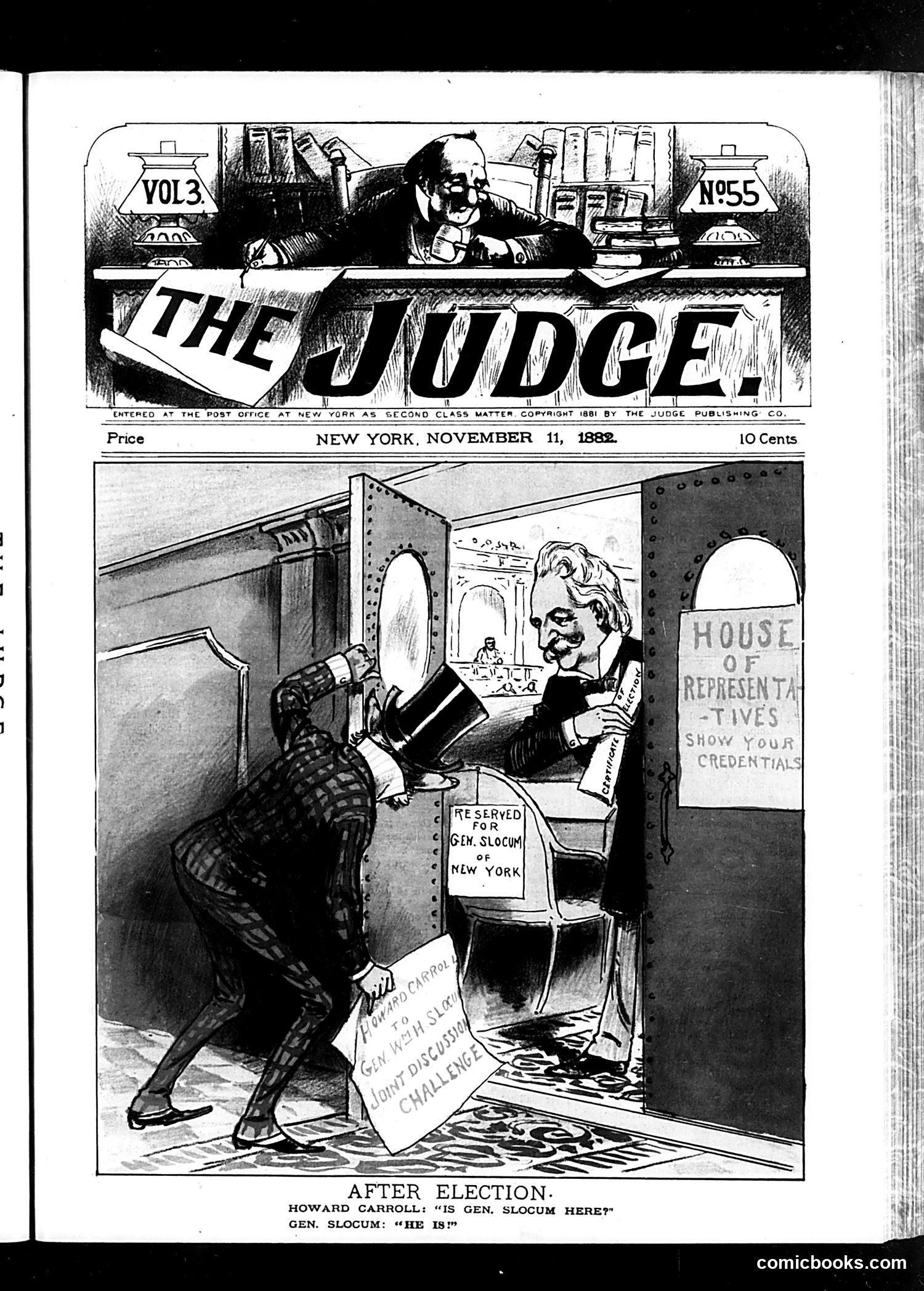
This cartoon satirizes post-election political access and patronage. Howard Carroll (likely a political figure or office-seeker) arrives at what appears to be General Slocum's office seeking admission. The sign reads "HOUSE OF REPRESENTATIVES—SHOW YOUR CREDENTIALS," indicating this depicts the newly elected Congress. General Henry Slocum was a prominent Civil War general and congressman. The cartoon mocks how politicians and favor-seekers must now present credentials to gain access to newly empowered officials after elections. The figure at the door appears to be blocking entry, suggesting gatekeeping and the competitive scramble for political favor following electoral outcomes. The satire targets the post-election rush of petitioners and their jockeying for influence with victorious politicians.
This page contains editorial commentary and brief satirical pieces rather than traditional political cartoons. The main content addresses: **"Where Carroll will find Slocum"**: References Howard Carroll (apparently a notable figure) and General Slocum, suggesting Carroll will soon have opportunity to ask about Slocum's whereabouts—likely a topical political or social reference unclear without additional context. **"The Harmony Ball"**: Satirizes political harmony before elections. Mentions Kelly, Tilden, and Thompson dancing together pleasantly, but warns this camaraderie will dissolve after voting occurs—typical pre-election political theater. **"The Vanishing Glories of Jerome Park"**: Criticizes emerging moral reformism, specifically laws against smoking and betting on horse-racing. The piece mocks what it calls "Puritan asininity"—progressive restrictions on personal freedoms—while defending working-class leisure activities. The underlying theme: Judge defends individual liberty against expanding regulatory moralism.
This page from Judge magazine consists primarily of lengthy satirical character assessments addressing various prominent political and public figures of the era (likely 1880s based on references to figures like James G. Blaine and General McClellan). The large black oval image appears to be either a portrait placeholder or a deliberate visual joke—its purpose unclear from the text alone. The satirical text mocks numerous politicians and public figures through pointed criticism disguised as mock advice. References include Henry Ward Beecher's eating habits, James G. Blaine's political ambitions, General McClellan's military record, and various other prominent men's physical appearances and character flaws. The humor relies on readers' familiarity with these figures and contemporary political scandals. The "Listen" section at bottom appears to be a separate, shorter satirical item about an overheard conversation. Without clearer visual elements or dated masthead information visible, precise historical context remains somewhat obscured, though the tone is unmistakably critical of Republican politics and prominent public figures.
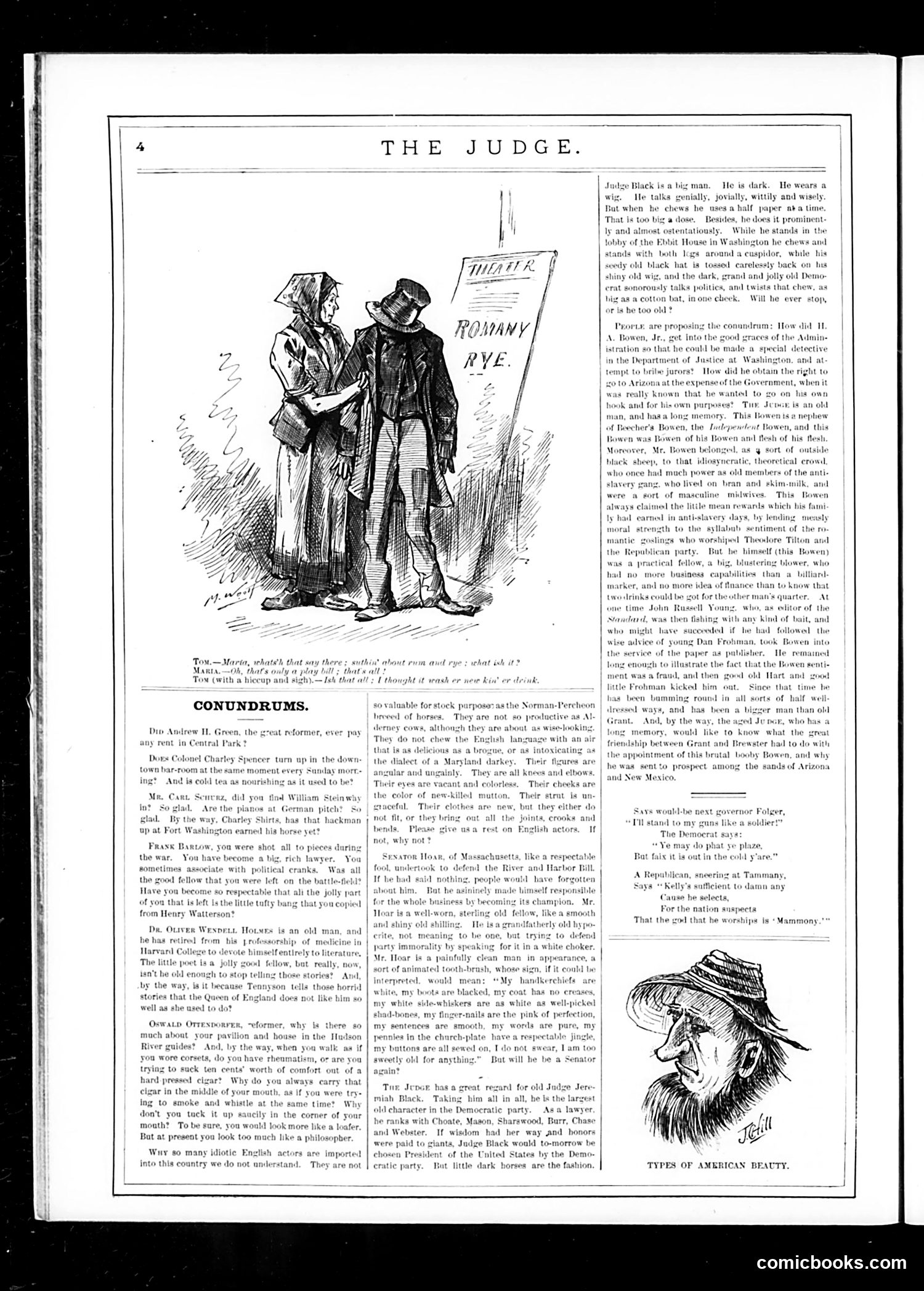
This page from *Judge* magazine satirizes Democratic politicians and figures, primarily through the section titled "CONUNDRUMS"—rhetorical questions mocking various public officials. The main cartoon depicts two figures examining a publication labeled "THEATRE ROMANTIQUE RYE," likely commenting on theatrical pretension or political performance. The text attacks Judge Jeremiah Black, described as a large, dark man who chews tobacco ostentatiously in Washington's Ebbit House. The satire criticizes H.A. Bowen Jr.'s appointment to the Justice Department despite allegedly attempting bribery and taking unauthorized government-funded trips to Arizona. Bowen is portrayed as incompetent—descended from anti-slavery activists but lacking actual business ability. Additional "conundrums" mock Andrew H. Green, Colonel Charley Spencer, Frank Barlow, and others, questioning their qualifications and integrity. The satire reflects Republican criticism of Democratic appointees during the post-Reconstruction era, emphasizing incompetence, nepotism, and moral failings rather than substantive policy disagreement.
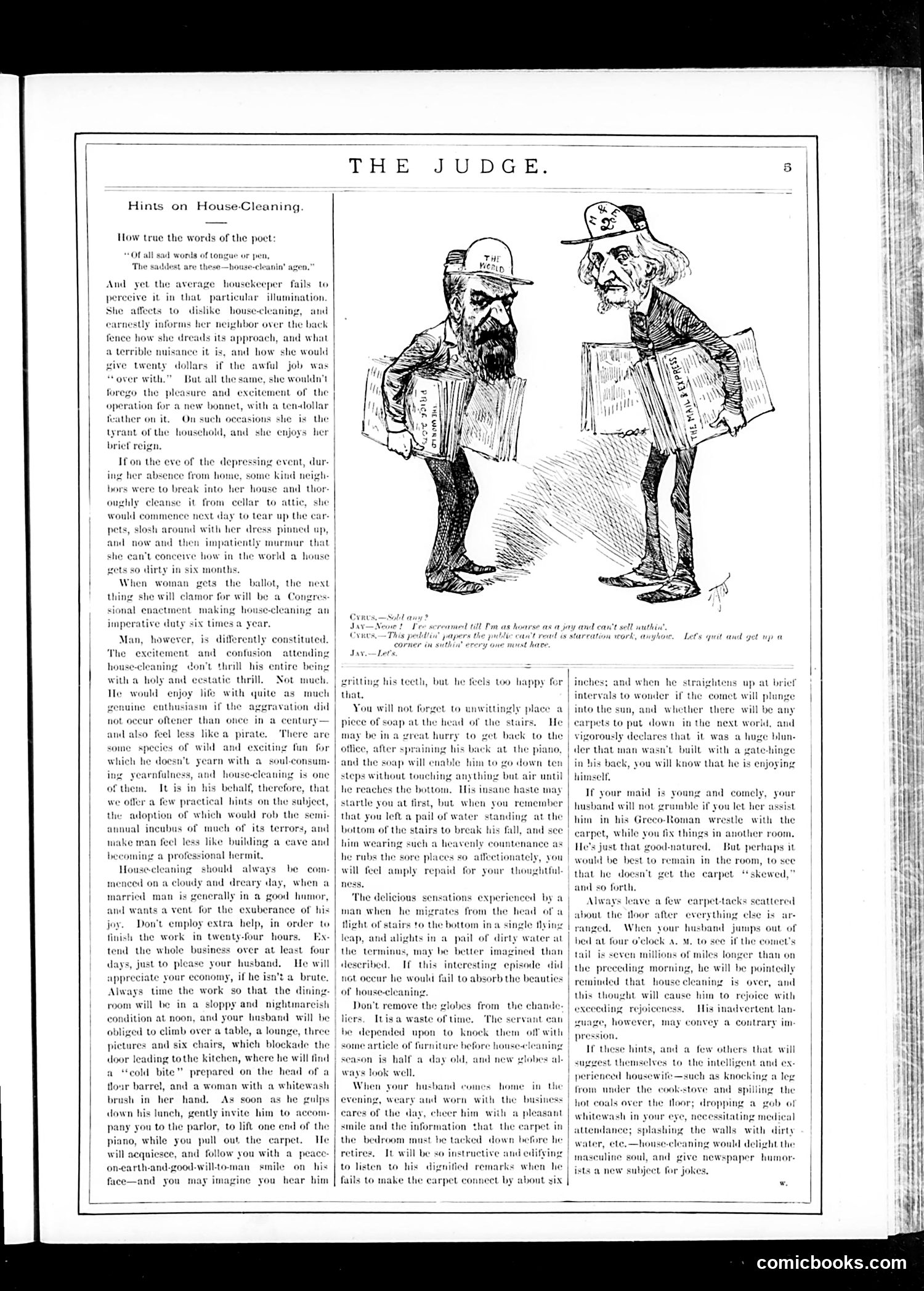
This page satirizes the drudgery of house-cleaning and, more pointedly, women's suffrage anxieties of the era. The cartoon depicts two working-class men (likely laborers or servants, based on their attire) discussing their wives' housecleaning obsessions. The accompanying text mockingly advises wives on how to conduct spring cleaning while manipulating their husbands into helping—having them crawl through cluttered rooms, slip on soapy water, etc. The political jab appears in a passing reference: "When woman gets the ballot, the next thing she will clamor for will be a Congressional enactment making house-cleaning an imperative duty six times a year." This reflects anti-suffrage sentiment—the implication being that giving women voting power would lead to absurd, tyrannical legislation. The satire suggests women are obsessed with trivialities (housecleaning) rather than serious civic matters, a common argument *against* women's suffrage in this era.
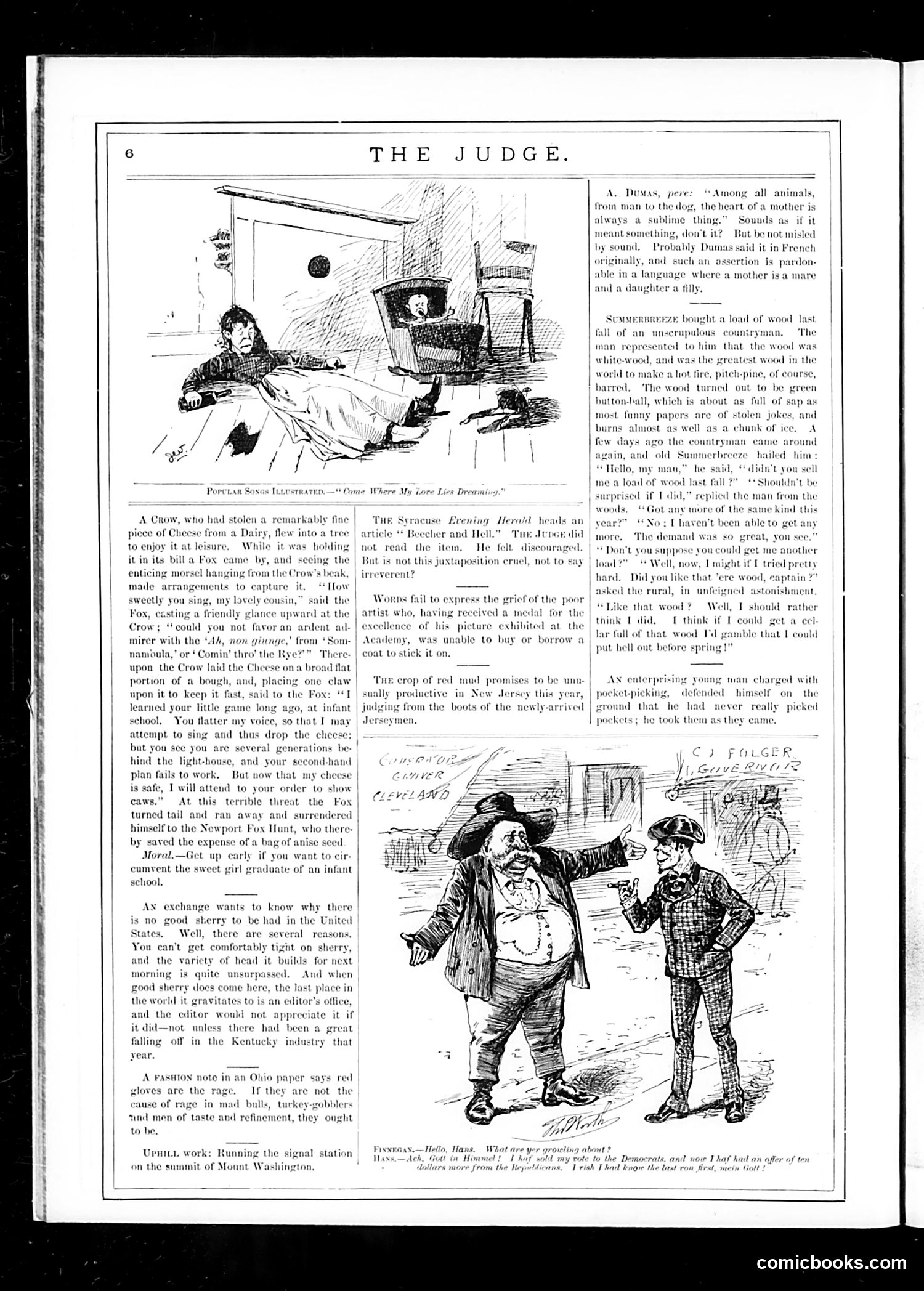
This page from the satirical magazine *Judge* contains several distinct pieces: **Top cartoon**: Illustrates Aesop's Fable of the Crow and the Fox. A crow holding stolen cheese is tricked by a flattering fox into dropping it. The moral criticizes gullible readers who fall for empty flattery—a commentary on human foolishness. **Middle section**: Satirizes a countryman who sold inferior "green button-ball" wood (useless for fires) instead of quality white-wood. When confronted about this fraud, he denies it happened, mocking rural dishonesty and failed comeuppance. **Bottom cartoon**: Shows two figures discussing wood—one appears to be the swindler from the story above, demonstrating how the con-artist escapes justice. **Other brief items**: Include jabs at Alexandre Dumas for making sentimental claims about motherhood, mockery of a newspaper headline pairing "Becher and Hell," and observations about American sherry quality and editorial tastes. The page's overall tone targets rural fraud, gullibility, and journalistic pretension.
This story satirizes the stereotypical struggling small-town newspaper editor and mocks the endless stream of amateur poets submitting unsolicited verse to publications. The editor of the *Crabapple Junction Patriot* sits in his sanctum facing multiple calamities: a demanding mother-in-law visit, a $10,000 lawsuit, broken equipment, and an absent compositor on a drinking spree. When a pale, nervous man enters carrying a manuscript roll, the editor immediately recognizes the situation—another amateur poet seeking publication. The satire targets both figures: the desperate editor running a one-man operation barely surviving, and the persistent, delusional poet convinced his work is publishable. The editor's preemptive rejection, before the poet can even speak, highlights how routine and predictable these submissions have become. Judge's audience would recognize this as universal small-press experience—the comic desperation of amateur writers refusing to accept rejection.
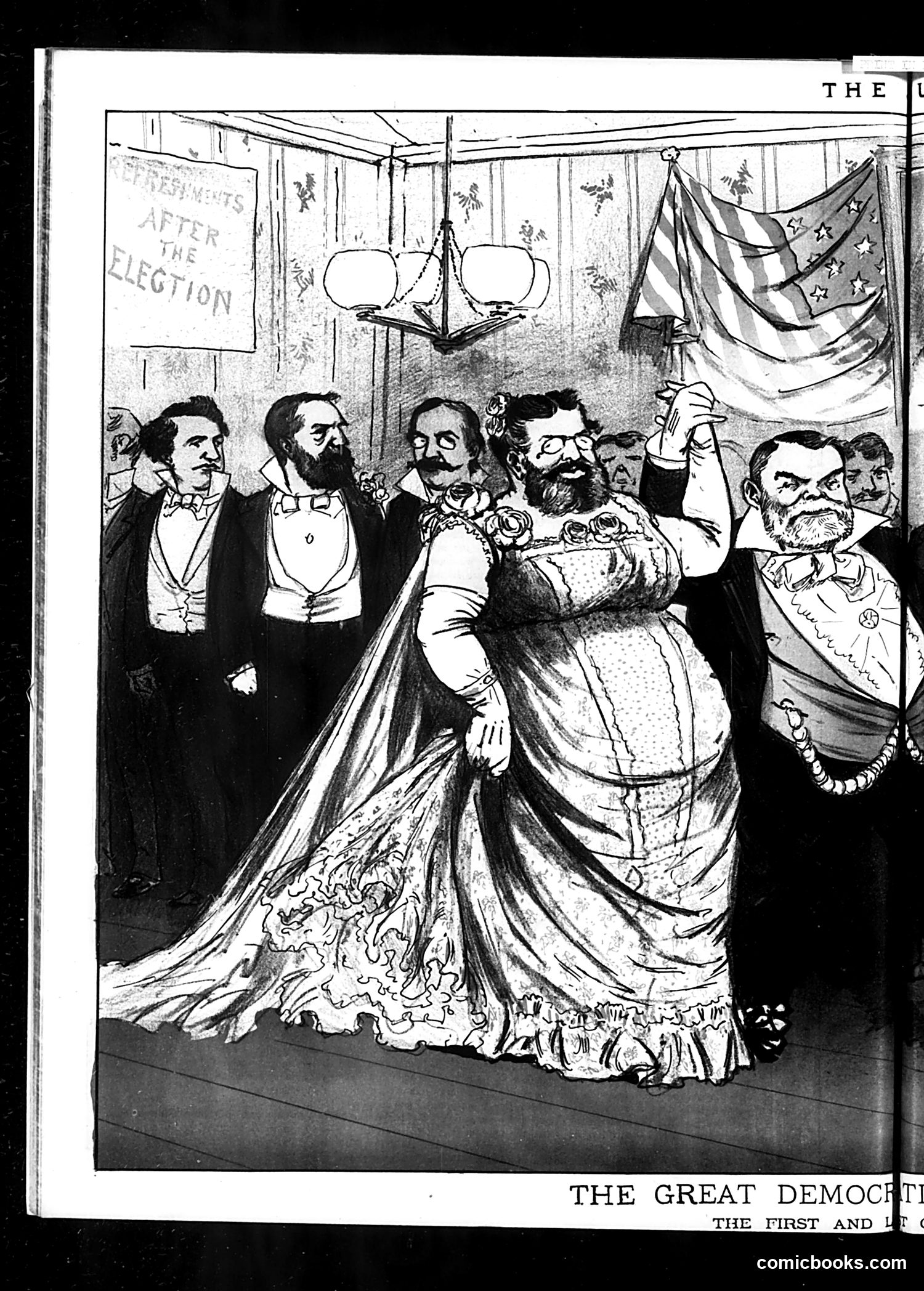
This satirical cartoon depicts what appears to be a post-election celebration or government gathering. The title "The Great Democracy" (text partially cut off) suggests ironic commentary on democratic processes. A large woman in an elaborate ball gown dominates the center—likely personifying the nation or Democracy itself. She's surrounded by formally-dressed men in tuxedos, some bearded, appearing as politicians or statesmen. An American flag hangs prominently above. A sign reading "SENTIMENTS AFTER THE ELECTION" indicates this cartoons satirizes how politicians behave following electoral results. The exaggerated styling and crowded composition suggest mockery of political pageantry and the disconnect between democratic ideals and actual governmental conduct. The specific political context—which election and which figures are caricatured—remains unclear without additional dating or attribution.
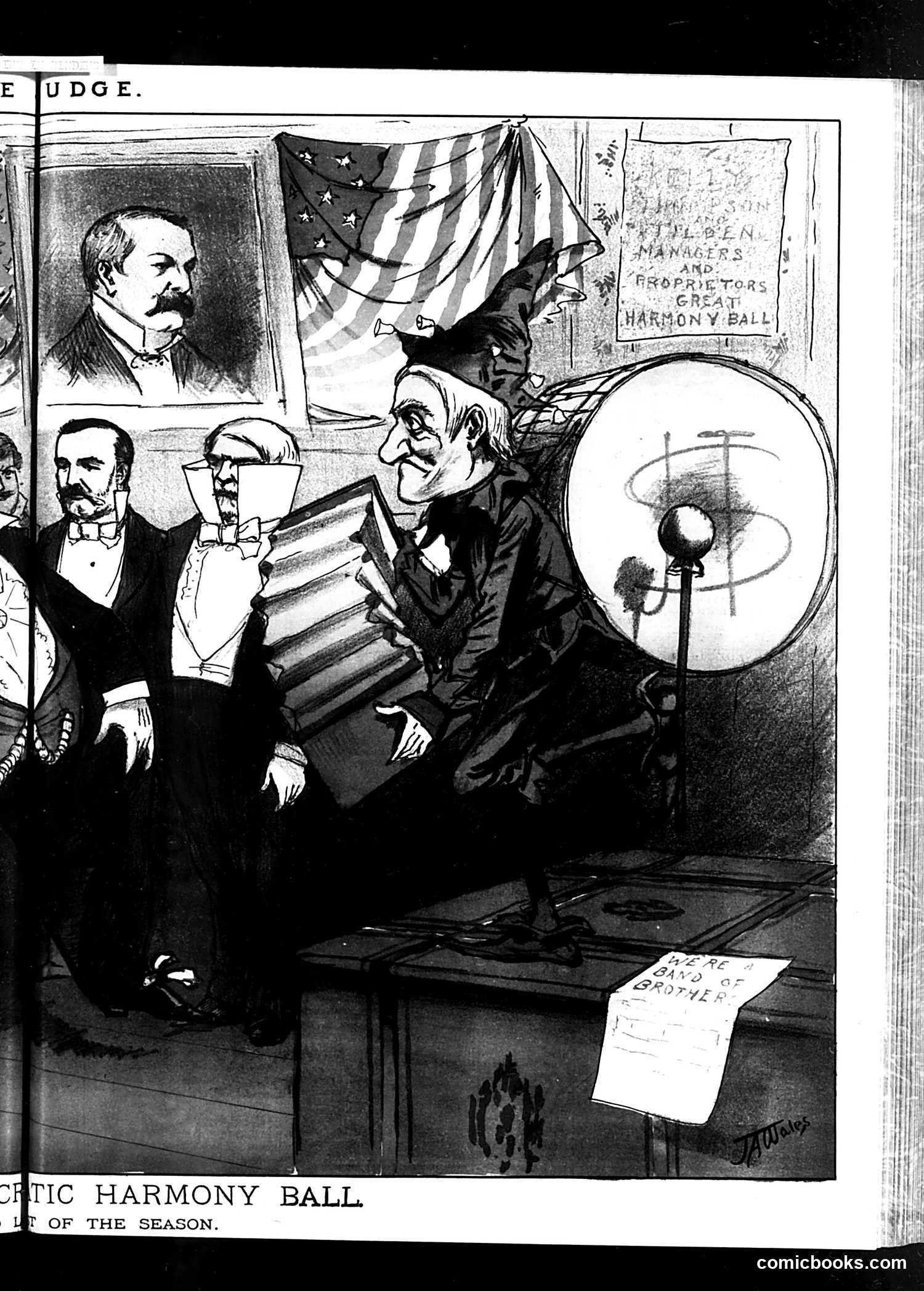
This cartoon satirizes a formal event—the "Harmony Ball"—attended by well-dressed gentlemen in tuxedos. A caricatured figure with exaggerated features (appearing to be a critic or satirist) holds what looks like a megaphone or horn, positioned prominently among the attendees. An American flag hangs above, and there's a sign referencing "Managers and Proprietors of [the] Great Harmony Ball." The satire likely mocks the pretensions of high society events or theatrical gatherings, with the grotesque critic figure suggesting mockery of arts criticism or social commentary itself. The "harmony" theme appears ironic—the critic's prominent, possibly discordant presence suggests discord rather than harmony at this elite gathering. The exact historical event referenced is unclear without additional context.
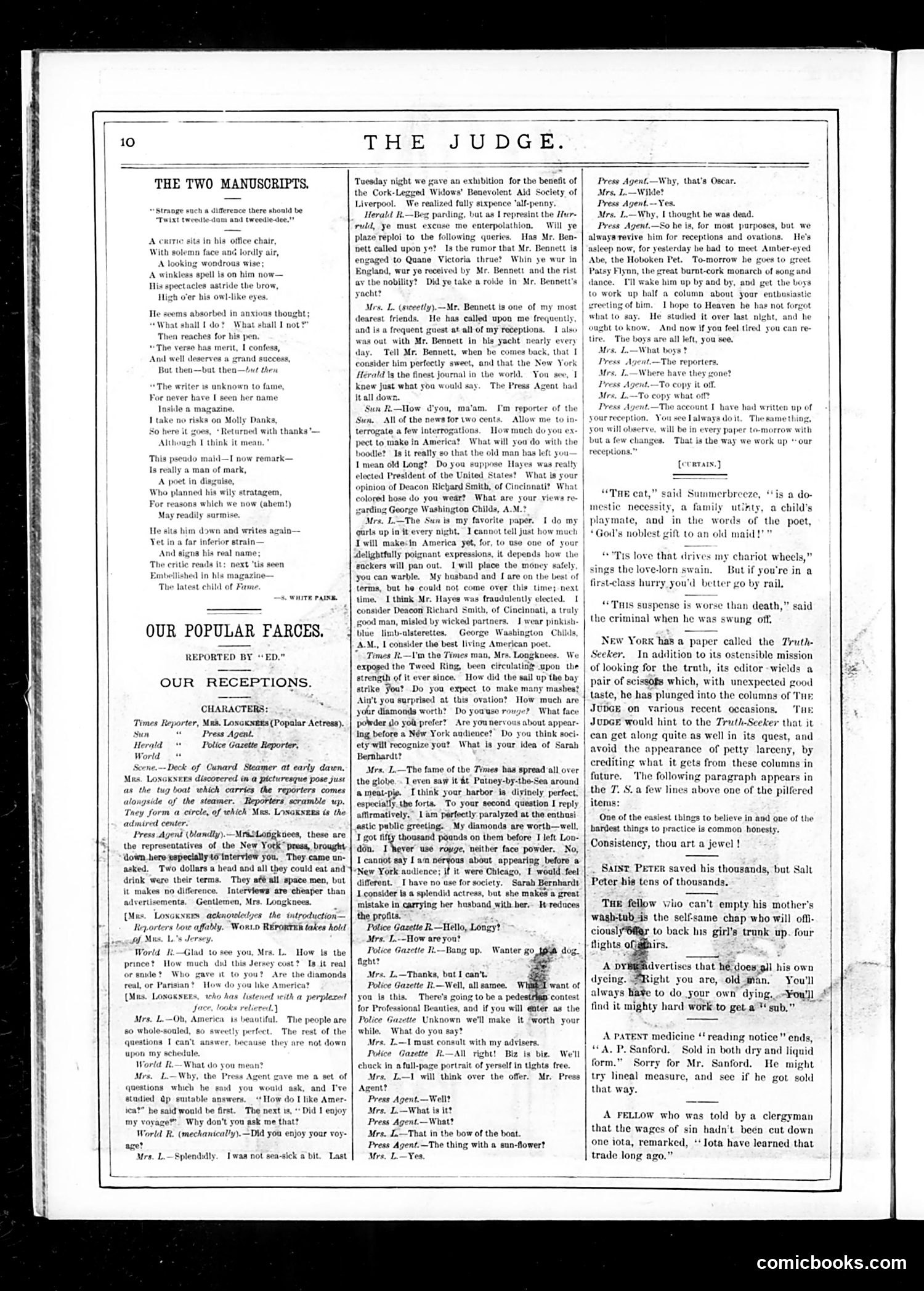
This page satirizes the theatrical press reception industry of the era. The main sketch, "Our Receptions," depicts how celebrity interviews were orchestrated and scripted. **The Setup:** Mrs. Longknees (a popular actress) meets reporters from major New York papers (World, Herald, Police Gazette) aboard a steamship. The "Press Agent" controls the interaction, having literally coached the actress with pre-written answers to anticipated questions. **The Satire:** The joke exposes how manufactured these celebrity encounters were. Reporters ask canned questions ("Did you enjoy your voyage?"), and the actress delivers pre-approved responses praising Mr. Bennett (likely newspaper magnate James Gordon Bennett) and the Herald. The Press Agent has scripted everything "all down." **The Point:** Judge mocks both the complicity of newspapers in staged publicity and the absurdity of treating such hollow interactions as genuine news. The "receptions" are pure theater—transactional performances where reporters get content, actresses get favorable coverage, and truth plays no role. The accompanying "Two Manuscripts" poem satirizes editors rejecting verse while secretly praising it under false names.
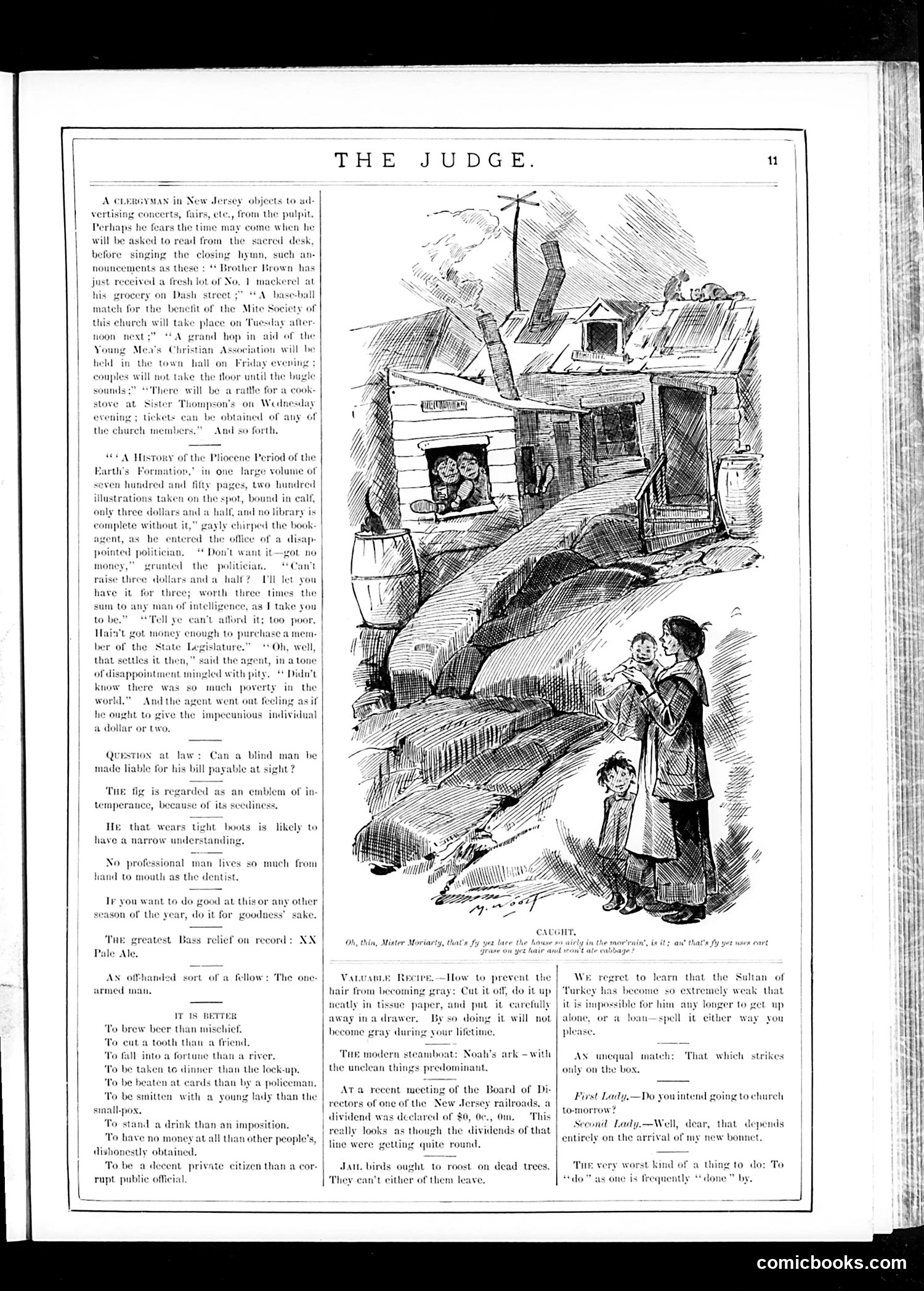
This page contains several satirical pieces typical of 19th-century American humor: **Main Cartoon**: Shows a tenement building with residents, likely satirizing urban poverty and overcrowded housing conditions common in American cities during this era. **Political/Social Commentary**: The text criticizes clergy for using church announcements to advertise commercial goods (groceries, baseball matches) from the pulpit—mocking the commercialization of religious spaces. **Recurring Humor**: Multiple brief satirical observations mock various social types: a poor politician who can't afford a book, clergy mixing commerce with religion, and absurd "advice" pieces (like how to prevent gray hair). **"Valuable Recipe"** section jokes about the Sultan of Turkey becoming weak—likely referencing Ottoman Empire decline, a common 19th-century political anxiety. The page exemplifies *Judge*'s approach: sharp social criticism wrapped in accessible humor targeting middle-class readers' attitudes toward poverty, commercialism, and political/international affairs. The cartoons and text work together to expose hypocrisy in American institutions.
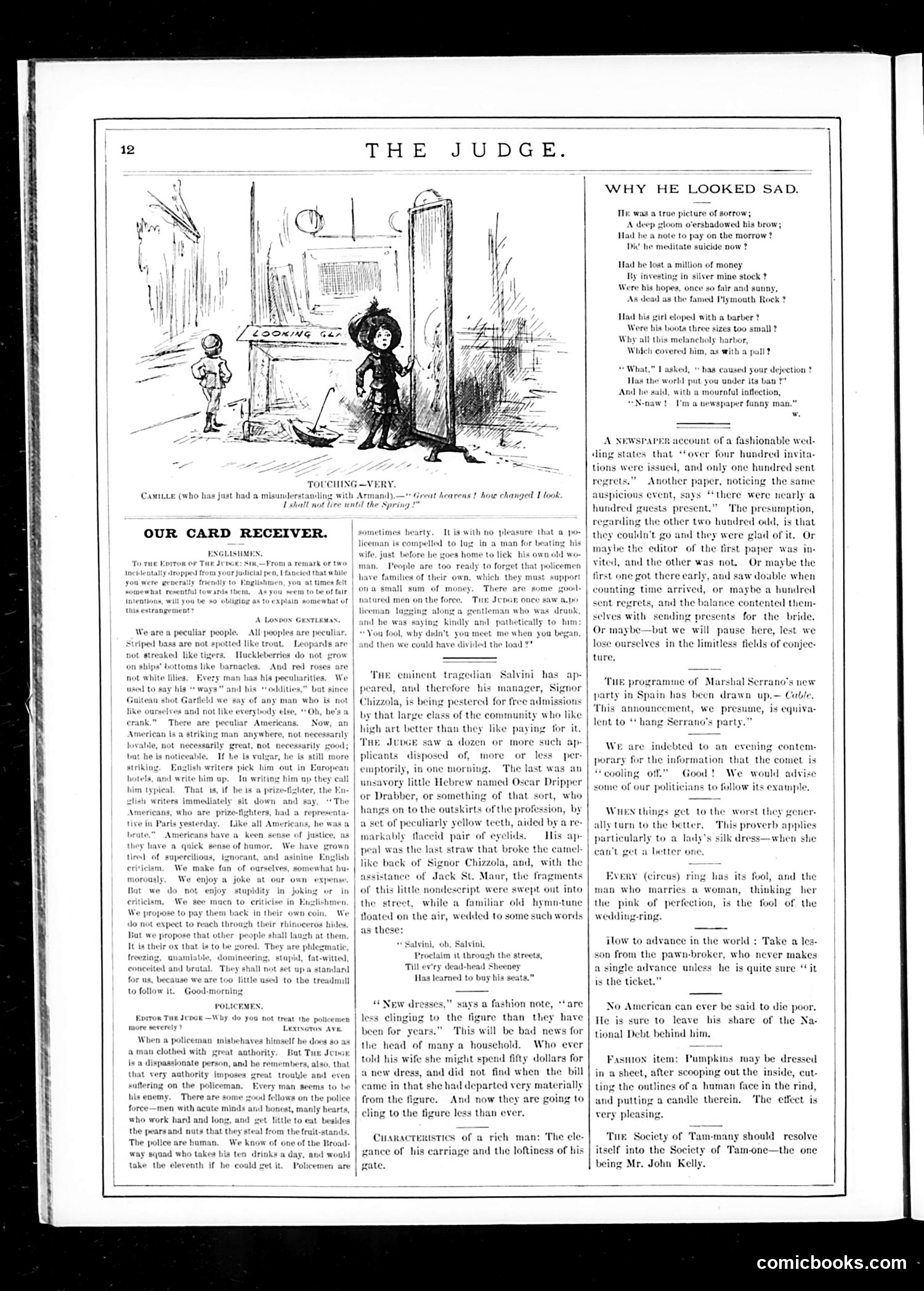
This page from the satirical magazine *Judge* contains two main sections: **"Touching Very" (cartoon):** A figure labeled "Carlile" appears disheveled after a "misunderstanding with Arrange," suggesting comedic romantic or social embarrassment. The joke title plays on Victorian propriety. **"Our Card Receiver" (letter section):** A London gentleman writes criticizing American writers for sensationalizing English eccentrics. He argues Americans over-dramatize quirky individuals, whereas the English treat their oddities as routine. The letter humorously defends English stolidity against American journalistic exaggeration—a common Anglo-American cultural jab of the era. The piece satirizes transatlantic stereotypes: Americans as sensationalistic showmen; English as phlegmatically indifferent to their own peculiarities. Additional brief pieces mock fashion trends and social pretension, typical of *Judge*'s light satirical commentary on contemporary manners and society.
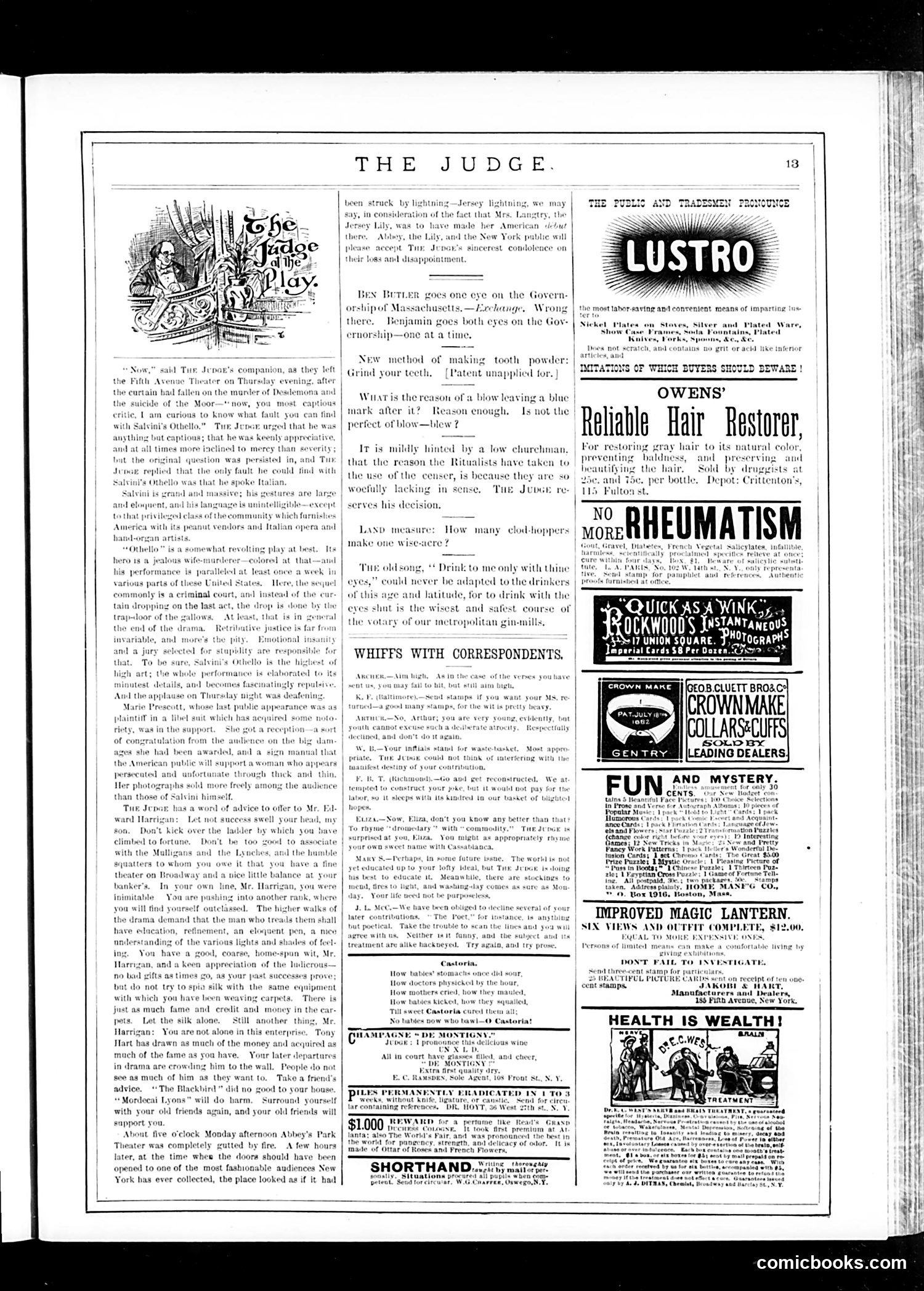
The main cartoon shows **Ben Butler** (Massachusetts governor candidate) with both eyes focused on the governorship—a visual pun on political ambition and double-dealing. Below that is a joke about tooth powder: "Grind your teeth"—satirizing the frustration caused by some unnamed situation. The bulk of the page consists of **"Whiffs with Correspondents,"** a humor column where Judge editors mock reader submissions with brief, cutting responses. These reveal period anxieties: a correspondent worried about plagiarism, another seeking theatrical advice, someone asking about rheumatism treatments. The editors' replies are dismissive and witty—typical of the magazine's irreverent tone. The right side is dominated by **advertisements** for patent medicines, hair restorer, and magic lanterns—standard 19th-century commercial fare. The content reflects Judge's core formula: political satire, literary mockery, and advice-column humor targeting middle-class readers and aspiring writers.
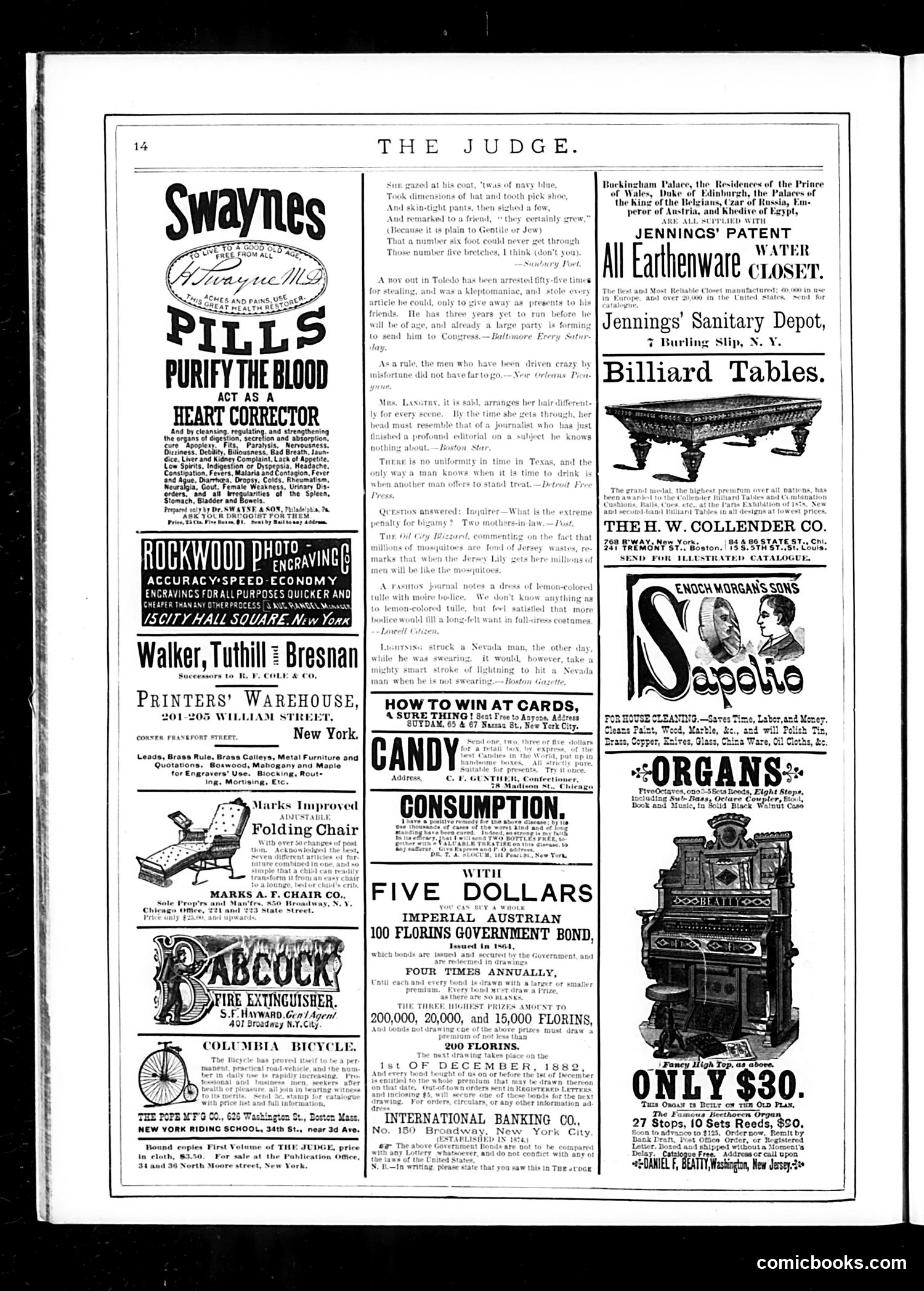
This page is **primarily advertising** rather than political satire or comics. It consists almost entirely of late-19th-century commercial advertisements for patent medicines, office equipment, furniture, bicycles, and financial instruments. The ads reflect period concerns: Swayne's Pills promise to cure numerous ailments by "purifying the blood" (a common medical claim of the era). Other products include billiard tables, an organ, and a folding chair. Notably, there's an advertisement for an **Imperial Austrian 100 Florins Government Bond**, presented as a lottery-style investment with multiple prize drawings. This appears to be a financial scheme marketed to American readers. The page's header reads "THE JUDGE," identifying it as from the satirical magazine, but this particular page contains no visible political cartoons or satire—only commercial pitches typical of 1880s periodical advertising.
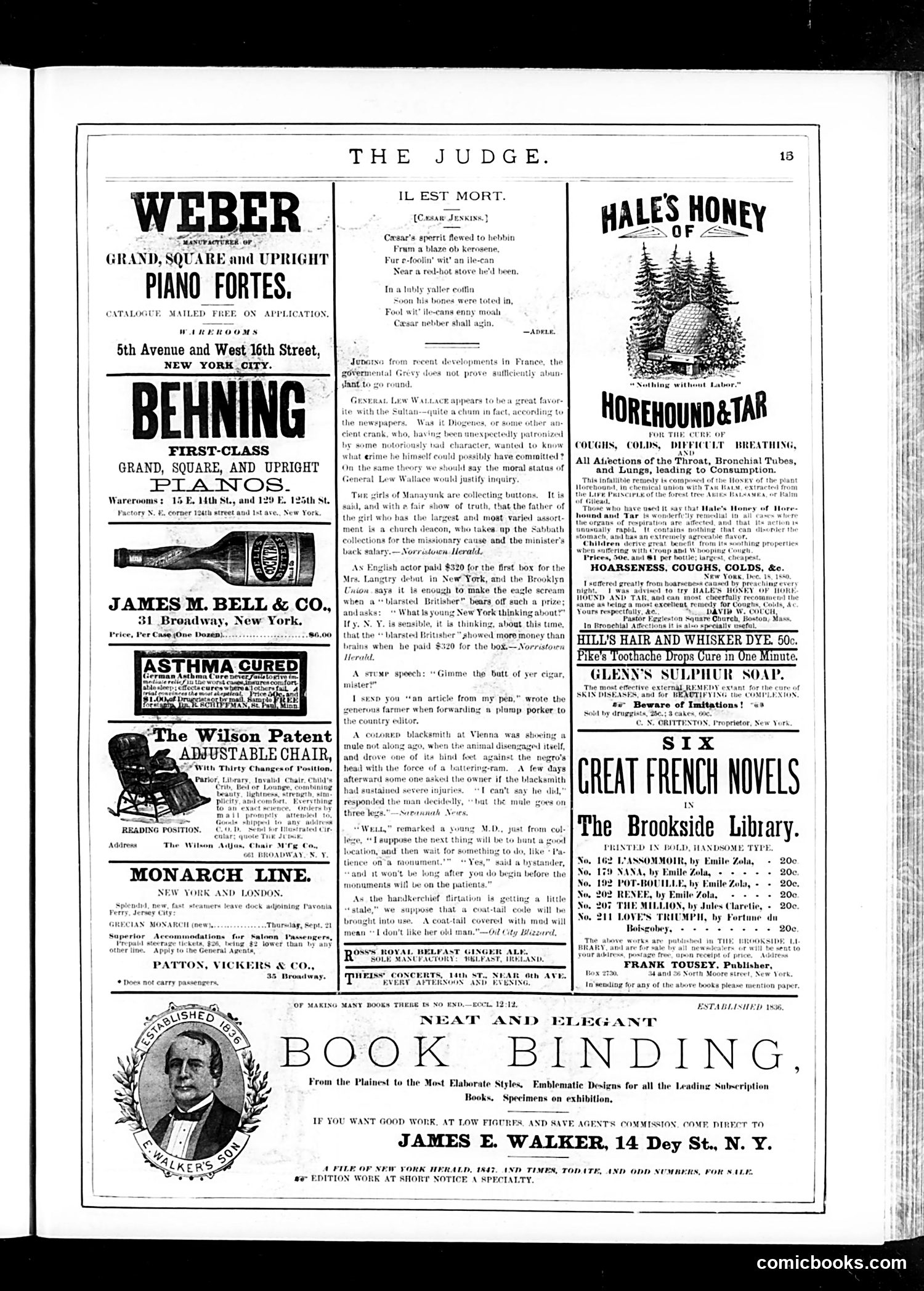
This page is primarily **advertising**, typical of Judge magazine's revenue model. However, the header contains a political cartoon titled "IL EST MORT" (He is Dead), credited to Caesar Jenkins. The cartoon appears to reference **Caesar's death in ancient Rome**—likely a satirical commentary on a contemporary political figure or event in France, given the OCR text mentions "recent developments in France" and references to a Sultan and General Lew Wallace. The joke seems to involve a comparison between Caesar's historical assassination and current French political turmoil, though the specific target is unclear from this fragmented text. The remainder of the page consists of period advertisements for pianos, patent chairs, asthma cures, book binding services, and other late-19th-century products—typical commercial content supporting the magazine's publication. Without clearer OCR or date information, the precise political reference remains ambiguous.
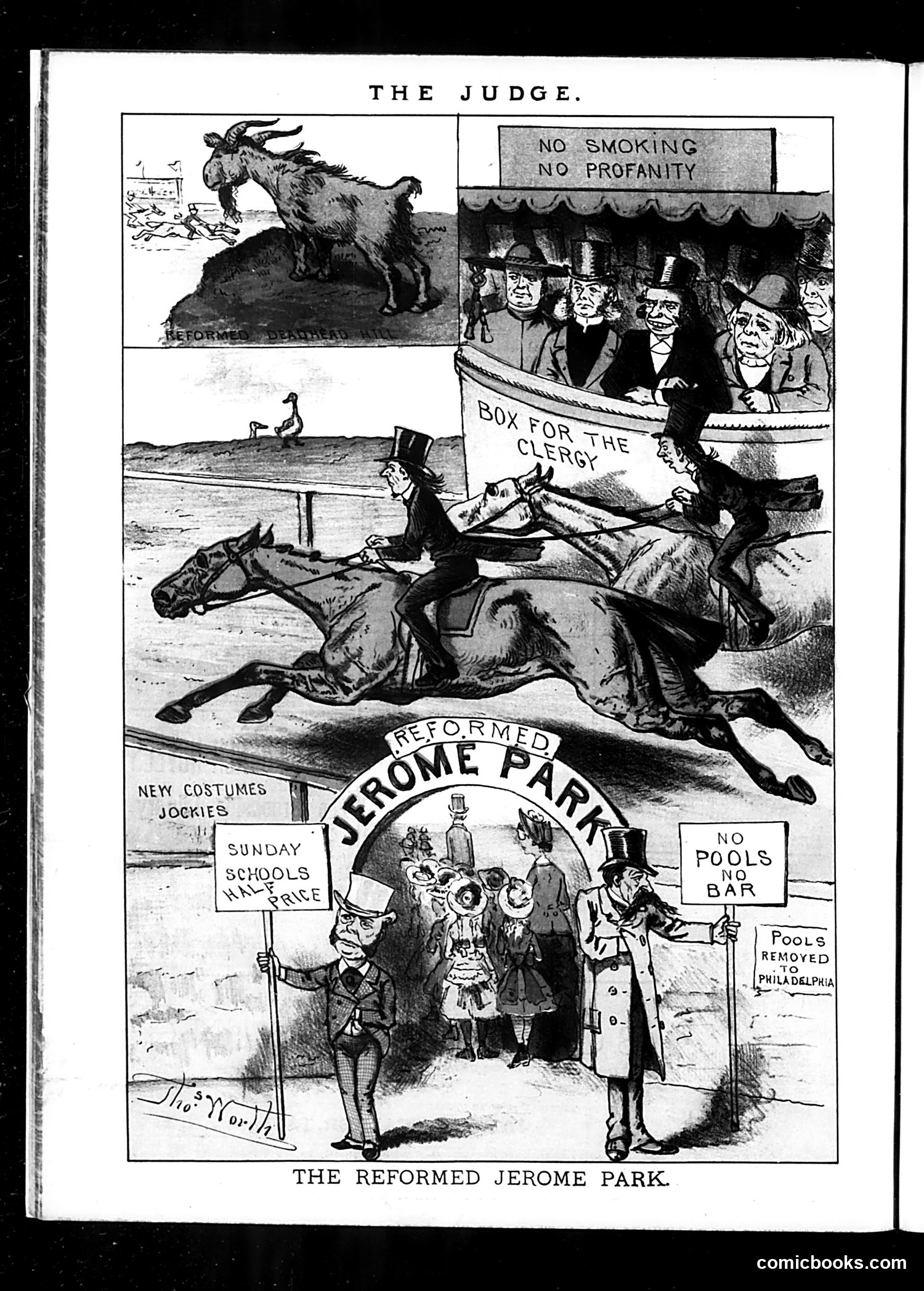
This satirical cartoon critiques proposed reforms to Jerome Park, a famous New York racetrack. The top panel shows a reformed goat, suggesting moral improvement through discipline. The middle section depicts horse racing with spectators in a viewing box labeled "Box for the Clergy"—satirizing religious leaders' involvement in reform efforts. The bottom panel illustrates Jerome Park's "reforms": new jockey costumes, Sunday school pricing, removal of pools to Philadelphia, and prohibition of bars. Signs reading "NO SMOKING, NO PROFANITY" mock the park's attempted moral sanitization. The cartoon ridicules both the impracticality of these restrictions for a racetrack and the hypocrisy of clergy endorsing gambling venues while demanding moral reforms. The satire suggests that Jerome Park cannot be genuinely "reformed" while maintaining its essential nature as a gambling destination.