
Judge, 1882-11-11 · page 7 of 16
Judge — November 11, 1882 — page 7: what you’re looking at
What you’re looking at
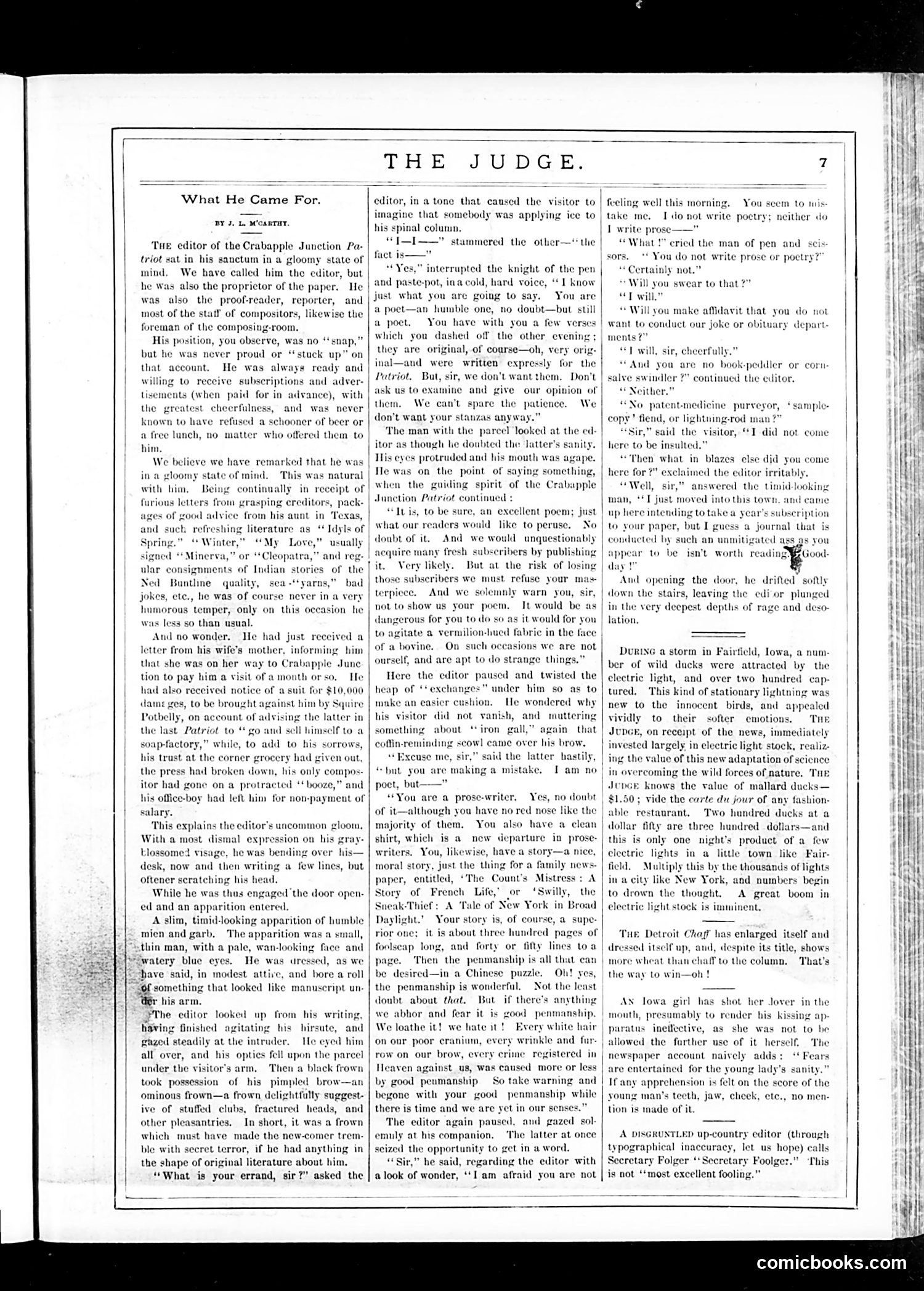
This story satirizes the stereotypical struggling small-town newspaper editor and mocks the endless stream of amateur poets submitting unsolicited verse to publications. The editor of the *Crabapple Junction Patriot* sits in his sanctum facing multiple calamities: a demanding mother-in-law visit, a $10,000 lawsuit, broken equipment, and an absent compositor on a drinking spree. When a pale, nervous man enters carrying a manuscript roll, the editor immediately recognizes the situation—another amateur poet seeking publication. The satire targets both figures: the desperate editor running a one-man operation barely surviving, and the persistent, delusional poet convinced his work is publishable. The editor's preemptive rejection, before the poet can even speak, highlights how routine and predictable these submissions have become. Judge's audience would recognize this as universal small-press experience—the comic desperation of amateur writers refusing to accept rejection.
📄 Transcribed text from this page (OCR, searchable)
Machine-transcribed from the original scan — historical spelling and the odd misread are preserved.
What He Came For. BY J, L, M’canTuT. ‘Tue editor of the Crabapple Junction Pa- triot sat in his sanctum in a gloomy state of mind, We have called him the editor, but he was also the proprictor of the paper. He was also the proof-reader, reporter, and most of the stall of compositors, likewise the foreman of the composing-room. His position, you observe, was no “snap,” but he was never proud or ‘stuck up” on that account. He was always ready and willing to receive subscriptions and adver- nents (when paid for in advance), with the g and never known to have r of beer or who offered them to net atest. che Iness, wa fused a schoone lunch, no matter a fre him. We believe we have re ina gloomy state of mind. with him. rked that he was This was natural pt of in grasping creditors, pack- ages of good advice from his aunt in Texas, and such refreshing literature as ‘ Idyls of “Winter,” “My Love," usually signed ‘* Minerva,” or “Cleopatra,” and reg- ular con: Indian stories of the ed Bunthne quality, sea-‘yarns,” bad jokes, ete., he was of course never in a ve humorous temper, only on this occasion he was less so than usual. And no wonder. He had just received a letter from his wife's mother, informing him that she was on her way to Crabapple June tion to pay him a visit of a month or so. He had also received notice of a suit for $10,000 dam¢ ges, to be brought against him by Squire Potbelly, on account of advising the latter in the last. Patriot to “ go and sell himself to a soapfactory,” while, to add to his sorrows, his trust at the corner grocery had given out the press had broken down, his only compos- itor had gone on a protracted ‘ booze,” and his office-boy had left him for non-p salary ‘This explains the editor's uncommon gloom, With a most dismal expression on his gray- blossomed visage, he was bending over his— desk, now and then writing a few lines, but oftener scratching his head. While he was thus engaged 'the door open- ed and an apparition entered. Being continually in rece furious letters fi ignments of ymneut of mien and garb, The apparition was a small, thin man, with a pale, wan-looking face and watery blue eyes, He was uressed, as we have said, in modest attire, and bore a roll “Of something that looked like manuscript un ‘Ger his arm. *The editor looked up from his writing, having finished ating his hirsute, and gazed stear at the intruder. He eyed him all over, and his optics fell upon the parcel under the visitor's arm, ‘Then a black frown took possession of his pimpled brow—an ominous frown—a frown delightfully suggest- ive of stuffed clubs, fractured heads, and other pleasantries, In short, it was a frown which must have made the new-comer trem- ble with secret terror, if he had anything in the shape of original literature about him, im, timid-looking apparition of humble | | and paste-pot, ina cold, hard voice, “1 know just what you are going to sa poet. You have with you a few verses which you dashed off the other evening; the: Patriot. But, sir, we don’t want them, Don't ask us to examine and give our opinion of them. We can't sj the patience. We don't want your stanzas anyway.” The man with the parcel looked at the ed- 4 | itor as though he doubted the latter's sanity, His eyes protruded and his mouth was agape. He was on the point of saying something, when the guiding spirit of the C dJunetion Patriot continued : abapple | “Iis, to be sure, an excellent poem; just what our readers would like to peruse. doubt of it, And we would juire many fresh subseribe unquestionab Tit. Very likely. But at the risk of losing | those subscribers we must refuse your mas terpiece. And we solemnly warn you, sir, not to show us your poem. It would be as dangerous for you to do so as it would for you to agitate a vermilion-hued fabric in the face of a bovine. On such occasions we are not ourself, and are apt to do strange things, ~ Here the editor paused and twisted the heap of exchanges” under him muke an easicr cushion. so as to He wondered why his visitor did not vanish, and muttering somethin about “iron gall,” again that coftin-reminding scowl came over his brow. “Excuse me, sir,” said the latter hastily, “but you are making a mistake. I am no poet, but——” “You are a prose-writer, Yes, no doubt of it—although you have no red nose like the majority of them, You have a clean shirt, which is a new departure in prose- writers, You, likewise, have a story—a ni moral story, just the thing for a family n paper, entitled, ‘The Count’s Mistress Story of French Life,” ‘Swilly, the Sneak-Thief: A ‘Tale of New York in Broad Daylight.’ Your story is, of course, a supe- rior one: it is about three hundred pages of foolseap long, and forty fity lines toa r Then the penmanship is all that can be desired—in a Chin © puzzle. Oh! yes, the penmanship is wonderful. Not the least doubt about that. But if there's anything we abhor and fear it is good penmanship. We loathe it! we hate it! E on our poor erani row on our brow Heaven by good penmanship begone with your good there is time and we are yet in our senses.” The editor again paused, and gazed s emuly at his companion, ‘The latter at once seized the opportunity to get in a wor “Sir,” he said, regarding the editor with also or age. ery white hair . every wrinkle and fur- every erine registered in take warning and penmanship while “What is your errand, sir?” asked the a look of wonder, “Iam afraid you are not y. You are poet—an humble one, no doubt—but still | > original, of course—oh, very orig: | inal—and were written expressly for the | by publishing | ainst_us, Was caused more or less | editor, in atone that caused the visitor to | feeling well this morning. em to tis: imagine that somebody was applying ice to | take me, Ido not write poetry; neither do his spinal column. I write prose——" “1I—I——" stammered the other—‘the |‘ What!" cried the man of pen and scis- fact is: sors. ** You do not write prose or poetry? “Yes,” interrupted the knight of the pen | —* Certainly not.” Will you swear to that ?” “T will.” “Will you make affidavit that you do rant to conduct our joke or obitu ments ¢ “Twill, sir y depa peerfully.” And you are no book-peddler or cor continued the editor, | salve swindler ¢ Neither.” “No ent-medicine pury or,‘ sample- copy ' fiend, or lightuing-rod man ?” r,” said the visitor, “1 did not here to be insulted.” “Then what in blazes else did you come | here for ?” exclaimed the editor i “Well, man, *T just moved into this tow up here intending to te to come sir,” answered the timid-looking eay your paper, but I guess a jour conducted by such an unmitigated ppear isn’t worth day ! ‘ to be reading And opening the door, he drifted’ softly down the stairs, leaving the edior plang in the very deepest depths of r lation, A and deso- DvrtsG a storm in Fairfield, lowa, a num- ber of wild ducks were attracted by the electric i it, and over two hundred cap- tured. This kind of stationary lightning was new to the innocent birds, and appealed vividly to their softer emotions, Tne JUDGE, On receipt of the news, immediately | invested largely in electric light stock, realiz- | ing the value of this new adaptation of science in overcoming the wild forces of nature. Tue Jepce knows the value of mallard ducks— $ vide the carte du jour of any fashion- restaurant. Two hundred ducks at a dollar fiy are three hundred dotlars—and this is only one night’s product of Jelectrie lights in a little town like Fi | field. Multiply this by the thousands of lights | in a city like New York, and numbers begin | to drown the thought. A great boom in | electric light stock is imminent. | Tue Detroit Ch dressed itself up, more wheat than c the way to win—oh ! able f has enlarged itself and id, despite its title, shows Tto the column, That's AN mouth, lowa girl has shot her Jover in the presumably to render his kissing ap us ineilective, she to be wed the further use of it The newspaper account naively adds ars re entertained for the young lady’s sanity.” | If any apprehension is felt on the score of the man’s teeth, cheek, et tion is made of it. was not herself, w you A DISGRUNTLED up-country editor (through typographical inaccuracy, let us hope) calls retary Folger ‘Secretary Foolge: is not “most excellent fooling.” , no men- | comicbooks.com