
A complete issue · 16 pages · 1882
Judge — August 12, 1882
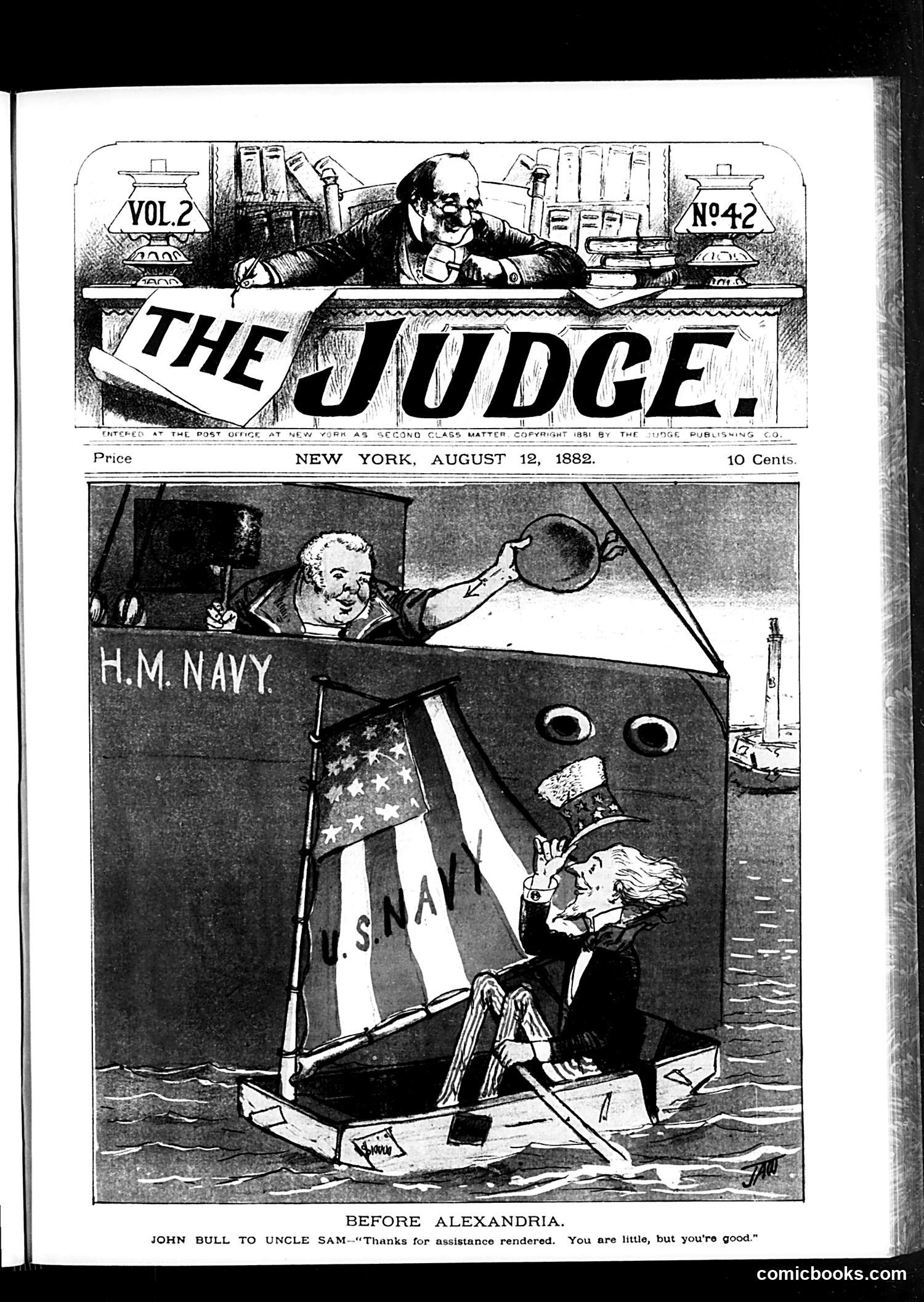
This cartoon depicts **John Bull** (personification of Britain) in a small boat labeled "H.M. NAVY," receiving assistance from **Uncle Sam** (America) during what appears to be a naval crisis "Before Alexandria." This likely references the **1882 British bombardment of Alexandria, Egypt**, during a nationalist uprising. The cartoon sarcastically portrays America as providing minor but appreciated help to Britain's military efforts. John Bull's comment—"You are little, but you're good"—is a backhanded compliment, suggesting America's naval power was modest compared to Britain's, yet still useful. The satire mocks both British naval prestige (needing American help) and American aspirations for naval influence, while commentary on American-British relations during imperial interventions in the Middle East.
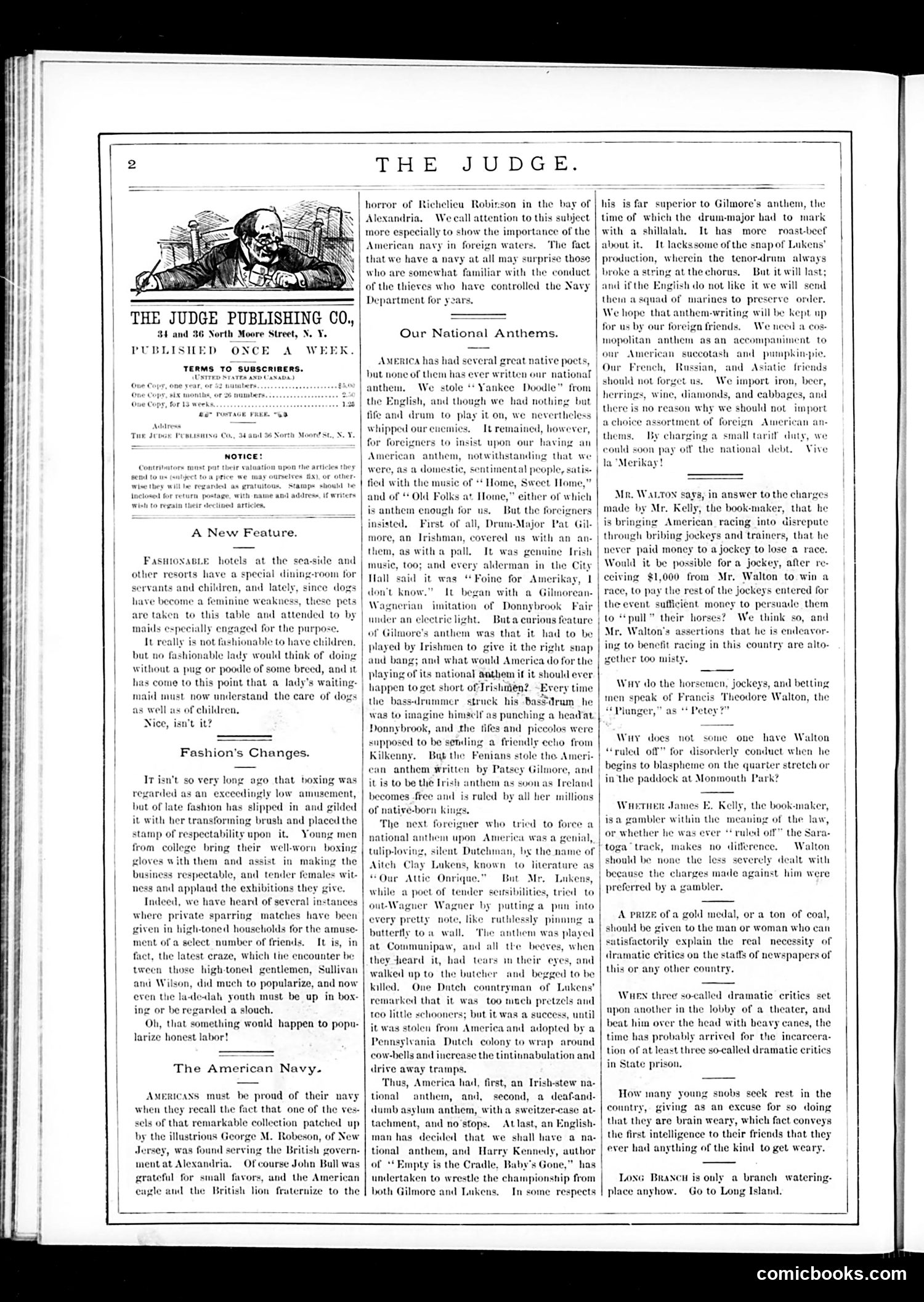
This page from *Judge* satirizes several contemporary American issues circa the 1870s-80s: **"The American Navy" section** mocks Secretary of the Navy George M. Robeson (mentioned by name), criticizing naval mismanagement. It references a U.S. Navy vessel found serving the British government at Alexandria, suggesting corruption or incompetence in the Navy Department under Robeson's tenure. **"Our National Anthems"** satirizes Irish-American cultural influence. The piece jokes that while America stole "Yankee Doodle" from the British, Irish immigrants have imposed their own anthem ("Garryowen" or similar Irish music) on American culture. The satire suggests Irish-Americans dominate civic institutions—every alderman plays Irish music—and ridicules the notion of an American anthem being drowned out by Irish music and Fenian associations. The humor derives from anti-Irish prejudice common in the era, mocking Irish-American prominence in urban politics and culture as an unwelcome foreign intrusion.
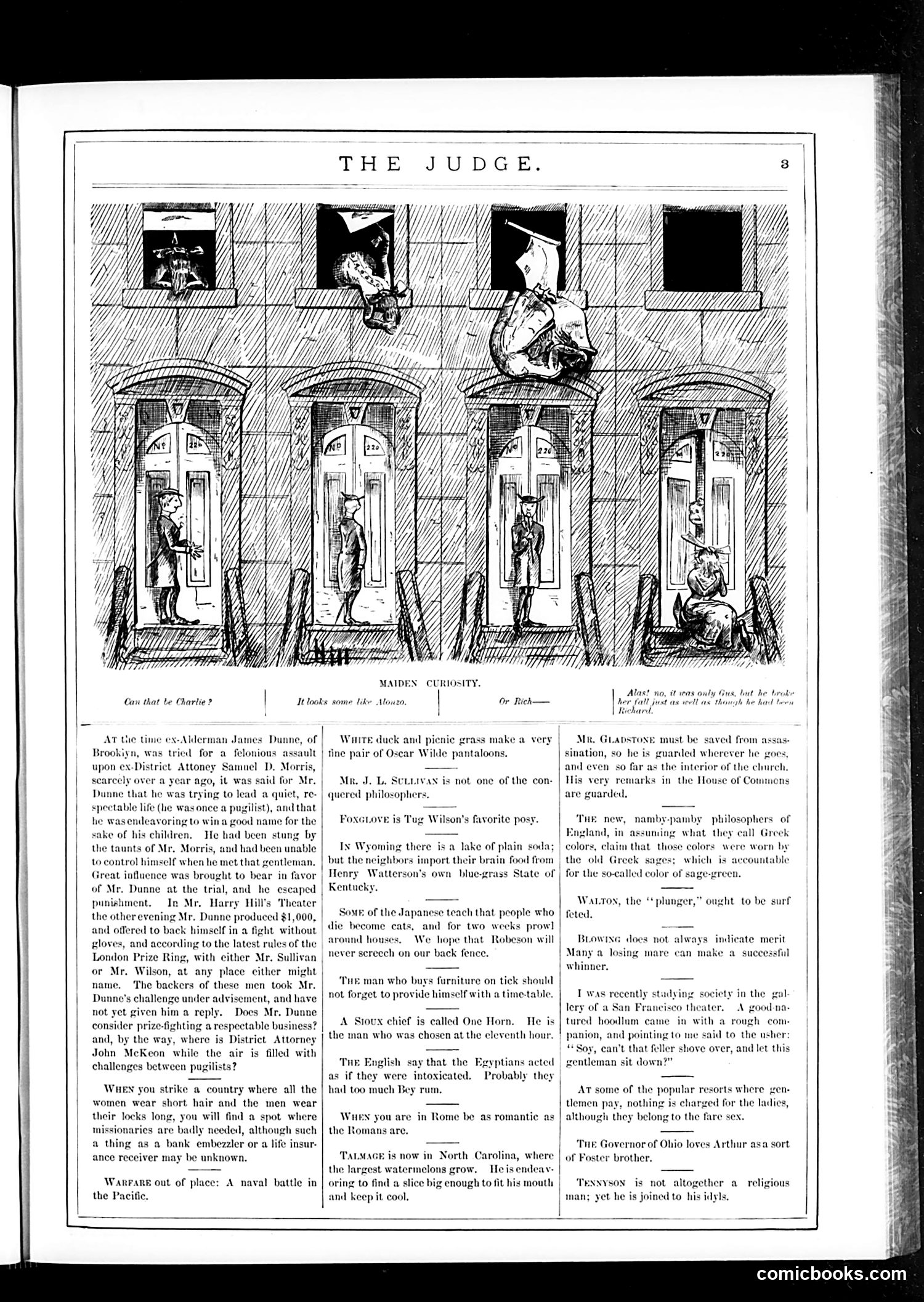
This page from *Judge* contains a multi-panel cartoon titled "Maiden Curiosity" depicting four women peering into doorways at men inside, with the caption "Can that be Charlie?" The satire mocks women's nosiness and curiosity about men's private activities. The surrounding text consists of brief satirical "items"—humorous one-liners commenting on contemporary figures and social absurdities. Key references include: - **Ex-Alderman James Dunn**: A Brooklyn politician/former boxer who recently escaped punishment for assault, now offering $1,000 to fight prizefighters—satirizing his claimed reformation. - **Oscar Wilde**: The Irish playwright's distinctive fashion (particularly his pants) is mocked. - **J.L. Sullivan**: The heavyweight boxer, referenced as unconquerable. - **Gladstone**: The British Prime Minister, satirized as needing protection even in church. - **Tennyson**: The poet humorously criticized as religiously insincere despite his "idyls." The humor relies on readers' familiarity with 1880s-90s celebrities and scandals. The overall tone is gossipy and irreverent toward public figures and social pretensions.
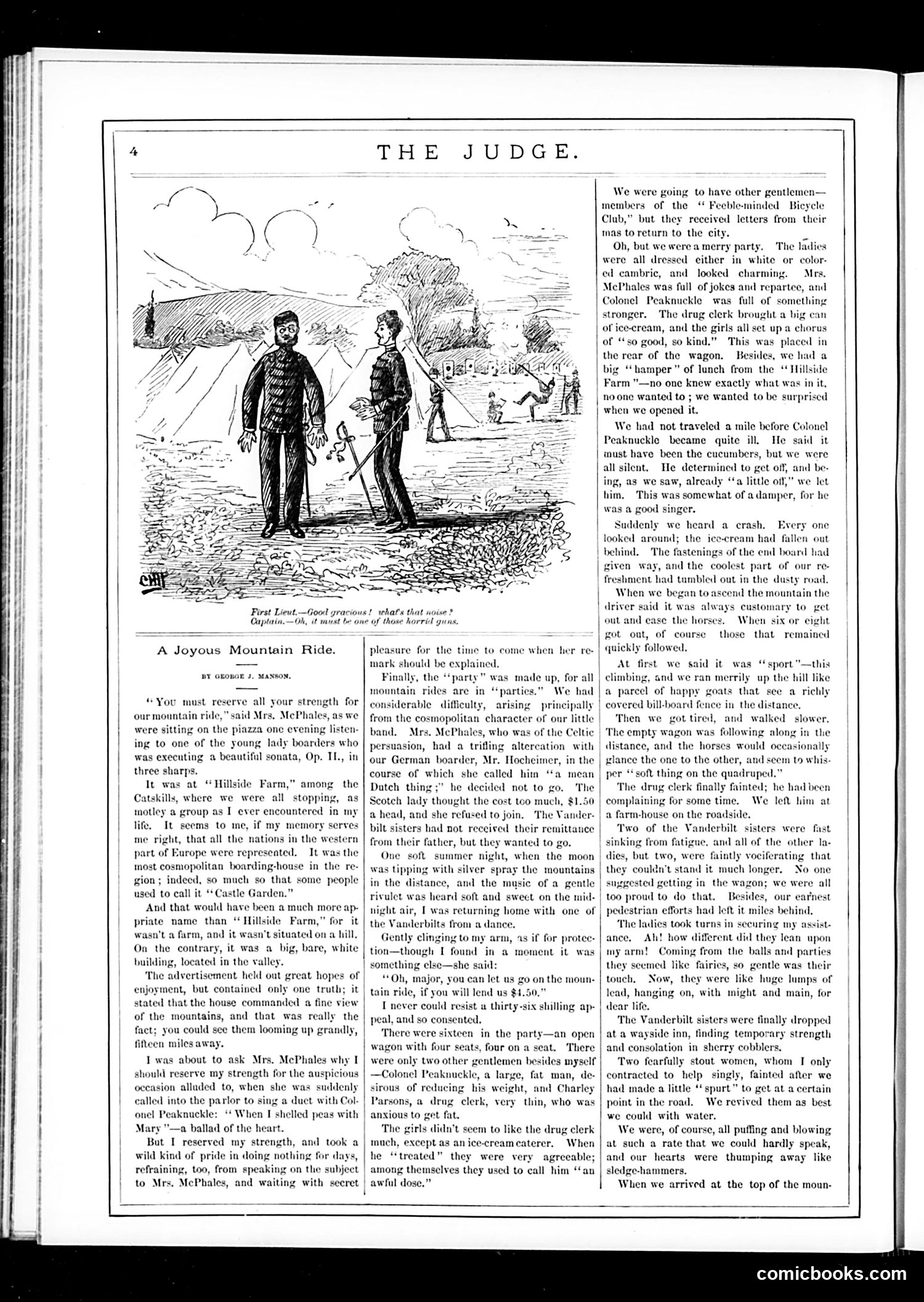
This is a humorous short story illustrated with a sketch of two men in period dress (appearing to be late 19th century). The narrative satirizes the chaos of organizing a group outing at a cosmopolitan boarding house called "Hillside Farm" in the Catskills. The satire targets: 1. **False advertising**: The "farm" isn't a farm and isn't on a hill—it's a bare white building in a valley that merely *views* distant mountains. 2. **Ethnic stereotyping**: Various nationalities are represented among boarders (Celtic, German, Scottish, Dutch, etc.), each portrayed through period caricature—the German refuses to go calling Mrs. McPhales a "mean Dutch thing"; the Scotch lady balks at cost; the Vanderbilt sisters lack funds. 3. **Social pretension**: References to "Castle Garden" (an actual immigrant processing center) and people's contradictory desires for luxury and cheapness. 4. **Romantic comedy**: A young woman clings to the narrator's arm, requesting $4.50 for the ride—a thinly-veiled financial proposition. The joke depends on recognizing period-appropriate ethnic humor and social climbing anxieties now considered offensive.
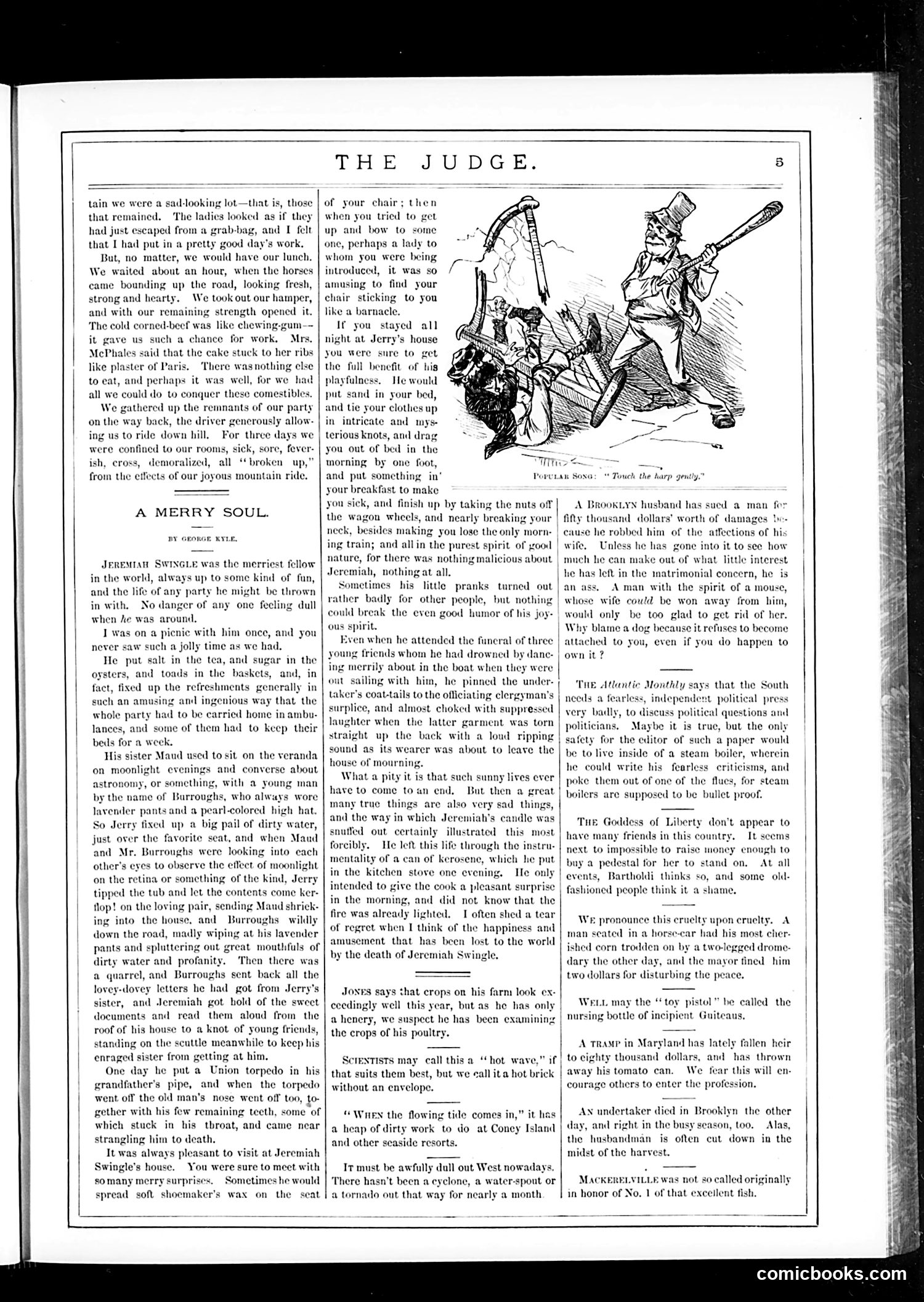
This is a humorous short story satirizing a character named Jeremiah Swingle, presented as the ultimate "practical joker." The satire mocks Victorian-era pranking culture by escalating Swingle's "jokes" to absurd, dangerous extremes. The humor works through contrast: Swingle is described as "the merriest fellow," yet his "pranks" cause serious harm—guests requiring ambulances after a poisoned picnic, his sister's romantic prospects ruined by dumping dirty water on her suitor, his grandfather's nose blown off by a torpedo in his pipe, guests poisoned and exhausted. The story satirizes how society tolerated—even celebrated—cruel behavior when framed as "fun" or "playfulness." By pushing these pranks to grotesque extremes (explosions, poisoning), Kyle ridicules the actual cruelty masked by genteel humor. The repeated phrase "amusing" becomes darkly ironic as consequences escalate. The accompanying illustration shows the violent chaos of such "merrymaking"—the exaggerated chaos visual representation of the joke's bitter point.
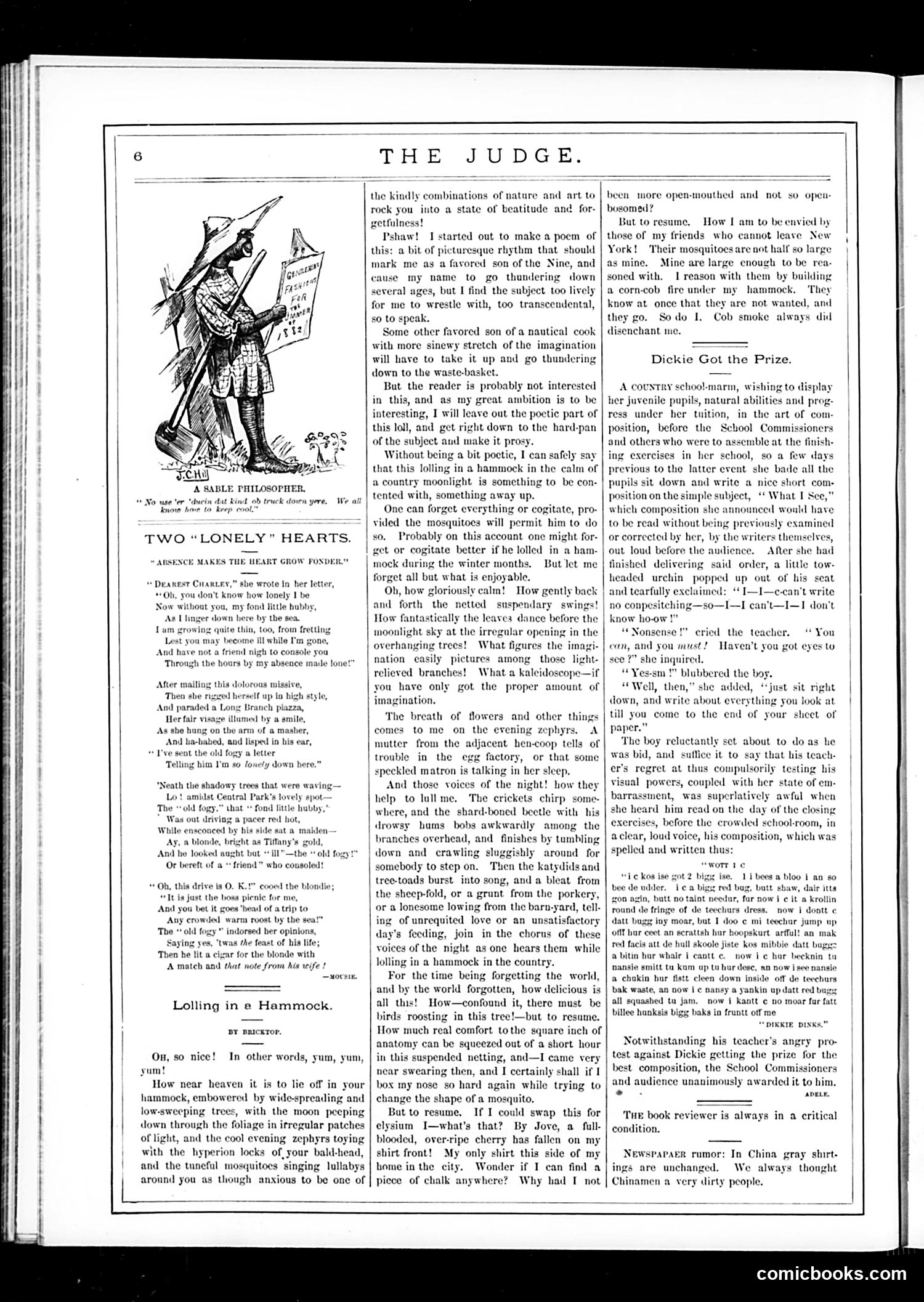
This page contains two distinct satirical pieces typical of late 19th-century American humor magazine content. **"Two 'Lonely' Hearts"** depicts marital hypocrisy: a wife writes her husband a plaintive letter claiming loneliness while secretly enjoying the city with other men; simultaneously, the husband claims to be working but is actually out driving with a blonde woman. The satire mocks both spouses' infidelity and transparent deception—each pretends faithfulness while actively betraying the other. This reflects Victorian anxieties about marital fidelity and changing social freedoms. **"Lolling in a Hammock"** is humorous domestic philosophy about the simple pleasures of summer relaxation, though comically undermined by mosquitoes and other annoyances. The piece pokes fun at romantic idealization of nature versus messy reality. **"A Sable Philosopher"** appears to be a brief illustrated comment (the exact text is unclear in OCR), likely offering folk wisdom in vernacular style. These pieces exemplify Judge's typical blend of relationship satire, social observation, and gentle mockery of middle-class pretension.
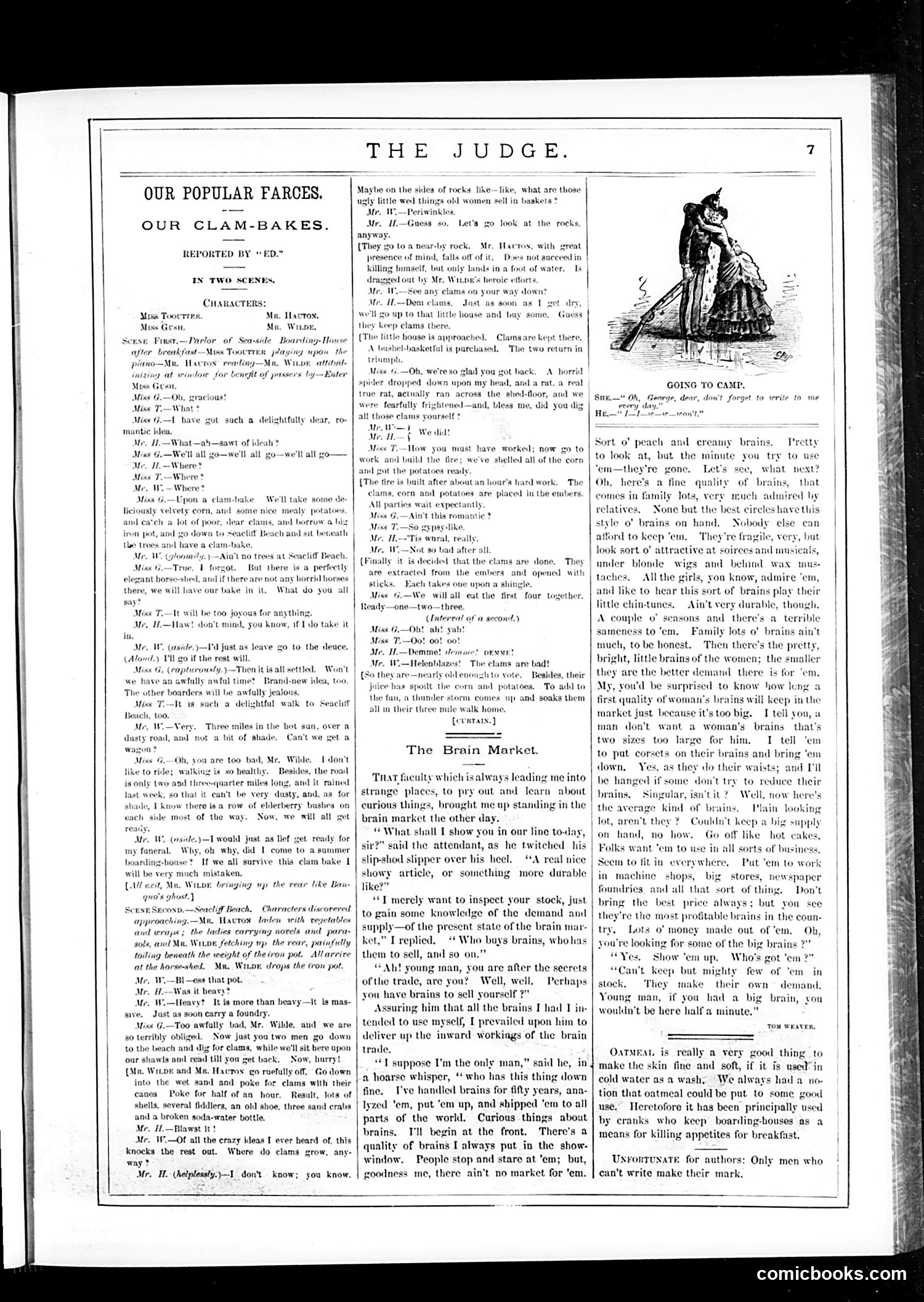
This two-scene theatrical sketch satirizes genteel Victorian leisure culture and the gap between romantic expectations and reality. **The Setup**: Boarding-house guests—Miss Tourer, Miss G., Miss T., Mr. Harton, and Mr. Wilde—excitedly plan an elegant clam-bake at Seacliff Beach, imagining delicious food, scenic beauty, and refined leisure. **The Satire**: The actual excursion becomes farcical. The journey itself is arduous (Mr. Wilde complains about carrying the heavy iron pot). When they arrive, the men's search for clams is comically fruitless, yielding only shells, fiddlers (small crabs), an old shoe, and a broken soda bottle. Mr. Harton literally falls off rocks into shallow water. **The Point**: The sketch mocks Victorian pretension—how bourgeois holidaymakers romanticize simple outdoor activities as cultured "adventures," while the messy reality involves physical discomfort, failed expectations, and undignified labor. The contrast between the ladies' refined anticipation and the men's grimy, unsuccessful work underscores the gap between social aspiration and actual experience.
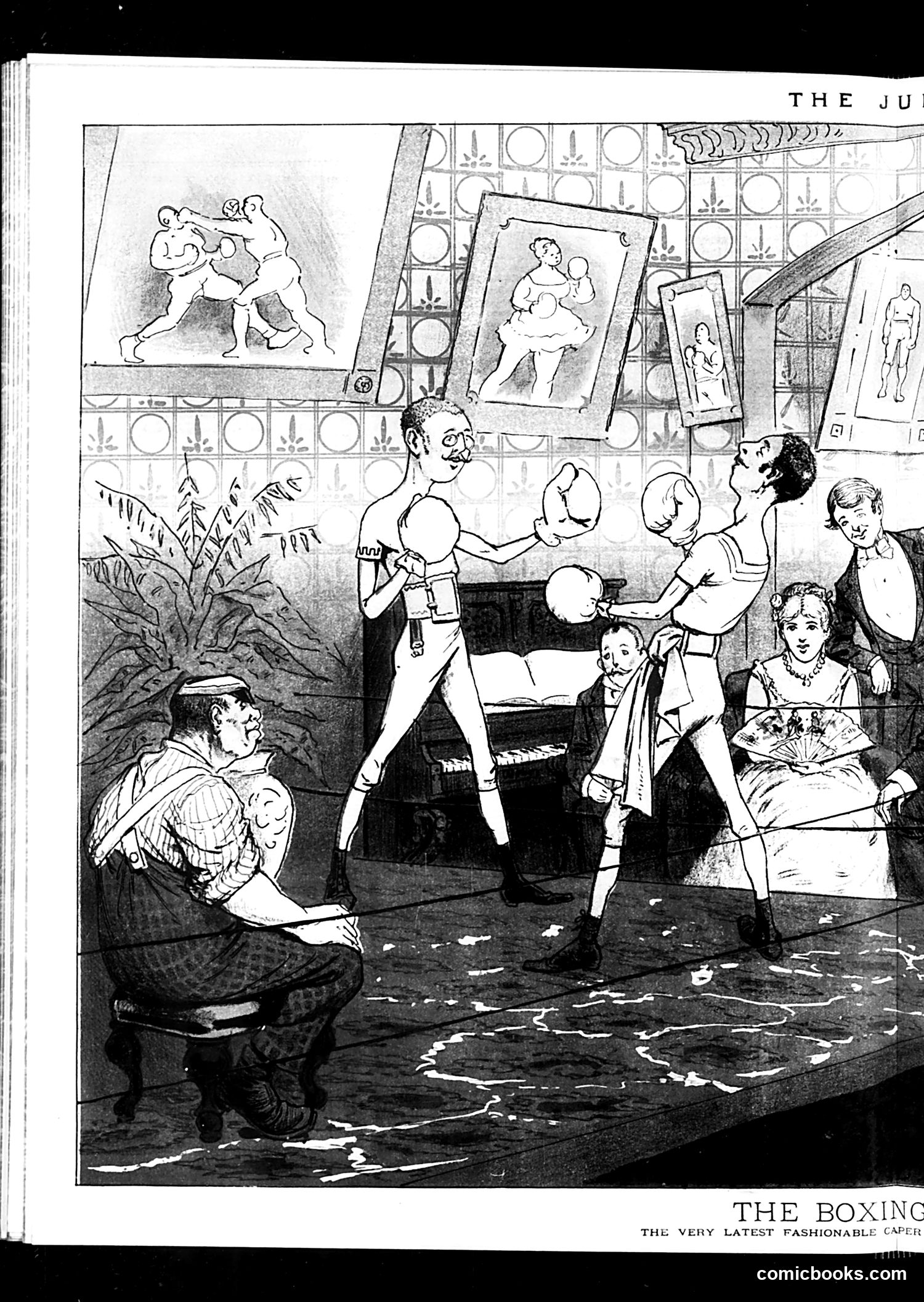
This satirical cartoon depicts an indoor social gathering where a shirtless male boxer is juggling large spheres while entertaining fashionably-dressed guests. The title "The Very Latest Fashionable Caper" suggests this is mocking a trendy upper-class entertainment fad. The satire appears to target wealthy society's adoption of boxing—traditionally a working-class sport—as fashionable entertainment. The scene shows the incongruity of a professional pugilist performing circus-like juggling acts for refined guests in an ornate interior, complete with decorative wall panels and plants. The joke likely criticizes how the elite appropriated and trivialized boxing culture, reducing an athletic discipline to novelty entertainment for their amusement. This reflects broader turn-of-the-century tensions between emerging leisure culture and class boundaries.
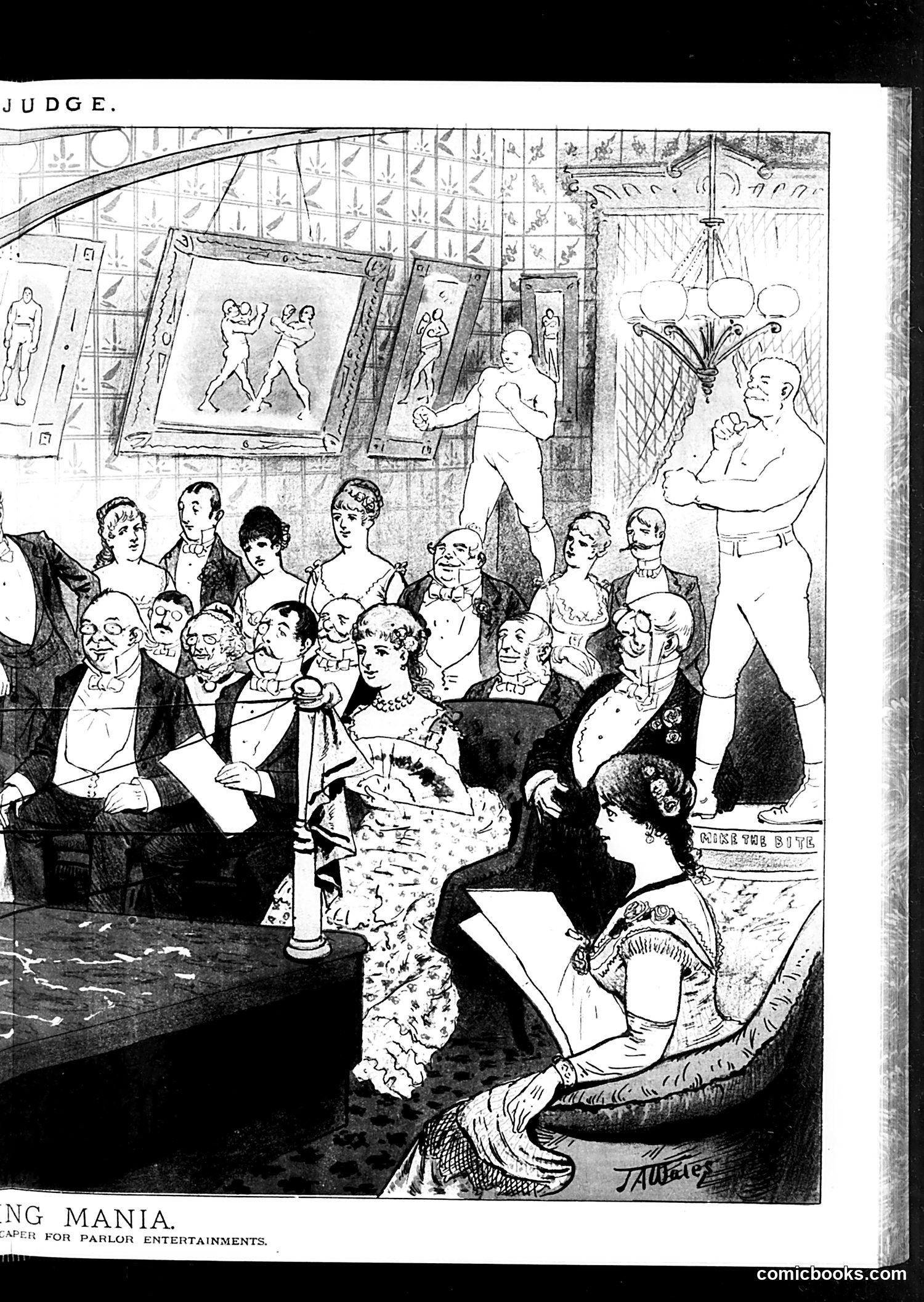
This satirical cartoon depicts fashionable society attending what appears to be an indoor boxing match or exhibition. The title "Boxing Mania" suggests the satire targets the upper-class obsession with prizefighting as entertainment. The scene shows well-dressed men and women gathered around a shirtless boxer, with additional boxing illustrations displayed on the walls above. The exaggerated facial expressions and caricatured features emphasize how ridiculous the artist finds this trend among the wealthy elite. The subtitle indicates this was "paper for parlor entertainments"—suggesting Judge magazine itself provided satirical content for drawing-room discussion. The cartoon mocks the fashionable classes' adoption of boxing as parlor amusement, treating a working-class sport as genteel entertainment, likely reflecting early 20th-century debates about boxing's respectability.
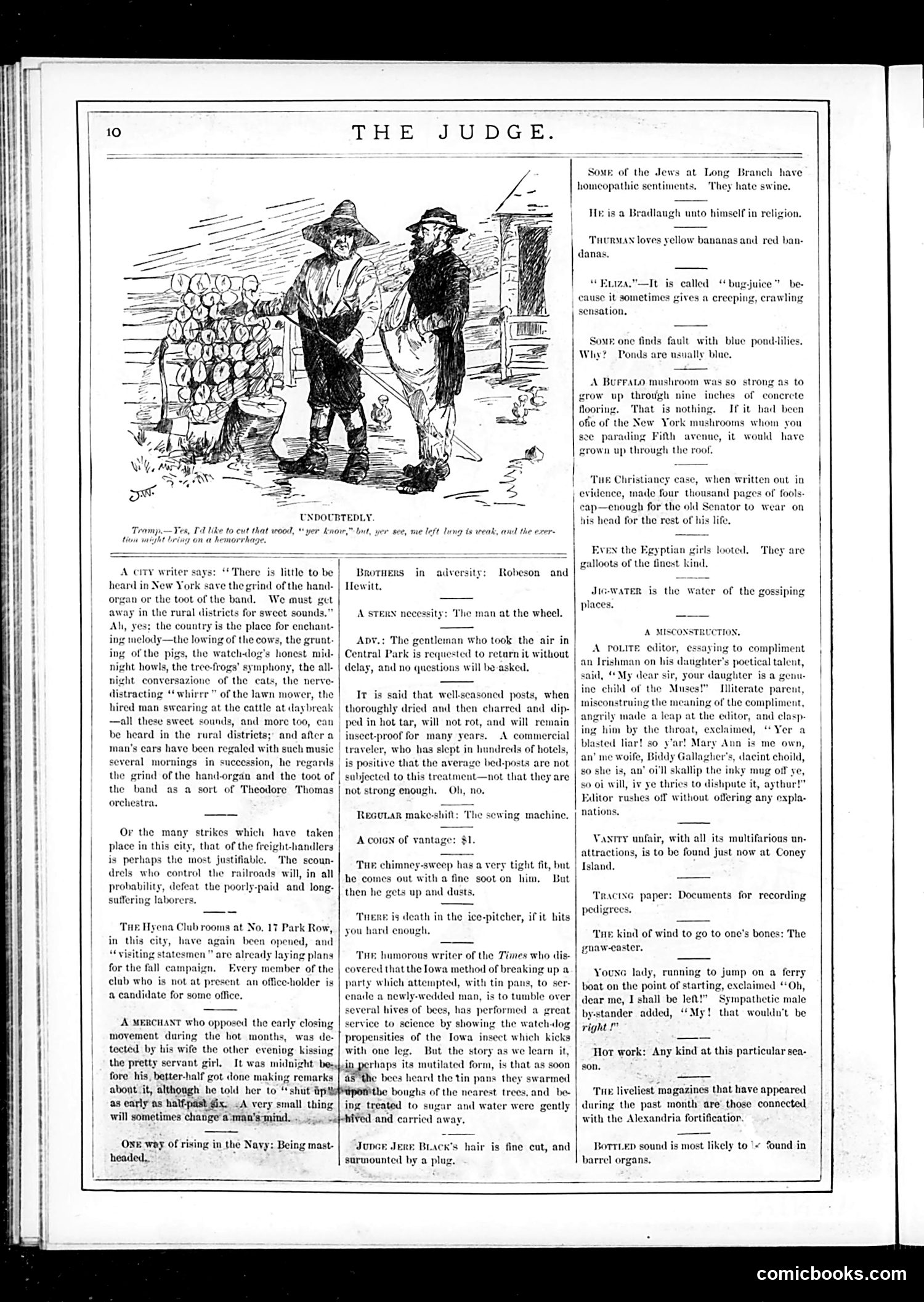
This page from *Judge* magazine contains a central cartoon titled "UNDOUBTEDLY" depicting what appears to be street vendors or working-class figures, alongside numerous brief humorous observations about New York life, rural customs, and contemporary absurdities. The cartoon's caption references a tramp's comment about cutting wood and a "hemorrhage"—likely mocking working-class speech patterns or desperation. The surrounding text consists of *Judge*'s signature format: short, punchy satirical items targeting: - Urban noise versus idealized rural life (mocking city-dwellers' romantic notions of countryside quiet, which is actually filled with animal sounds and farm commotion) - Political office-seeking among club members - A merchant caught kissing his servant girl, suddenly supporting early closing times - Various absurdist observations about bed-posts, chimney sweeps, and bees attacking serenaders The humor relies on irony, class observations, and contemporary New York social commentary rather than identifying specific public figures. It's typical *Judge* content: satirizing middle-class pretensions and urban life.
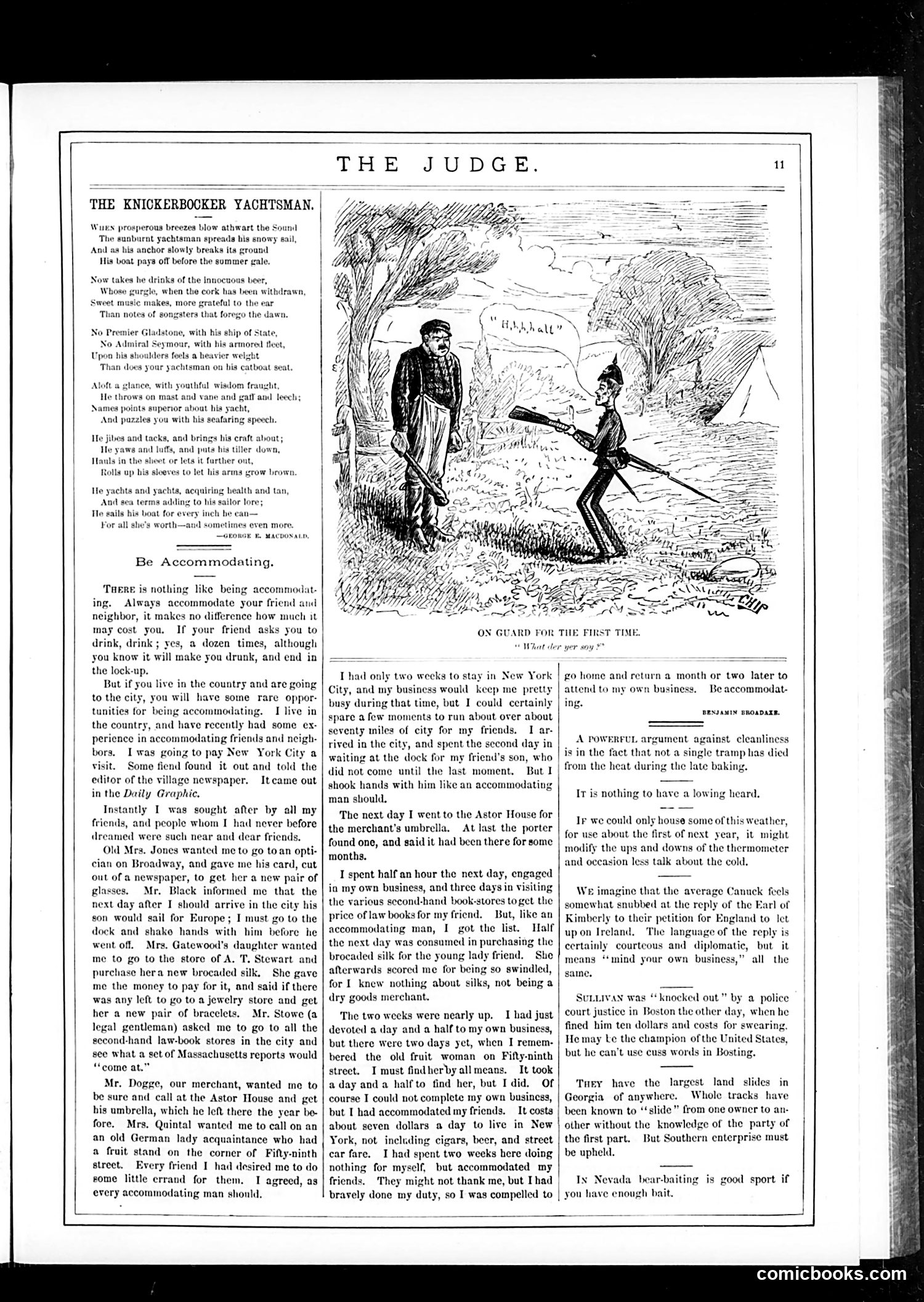
**The Cartoon:** The illustration depicts a wealthy yachtsman in elegant dress encountering a ragged, thin figure on shore (likely representing a poor person or laborer). The yachtsman says "Hello all" with apparent condescension. This satirizes the leisure-class sportsman who sails Hudson River yachts while oblivious to working-class hardship. **The Poem:** George K. MacDonald's verse mocks the pretentious yachtsman who adopts nautical jargon, performs needless maneuvers, and generally affects expertise while remaining fundamentally self-absorbed. **"Be Accommodating"** (prose satire): This piece ridicules the social pressure to be endlessly obliging. The narrator agrees to run dozens of errands for village friends visiting New York—buying glasses, fetching umbrellas, purchasing silk—only to realize he's been manipulated into free labor. The satire targets both the presumptuous friends exploiting hospitality and the weak-willed narrator who cannot refuse. Together, these pieces critique Gilded Age social hypocrisy: the wealthy's performative leisure and the abuse of obligation in social relations.
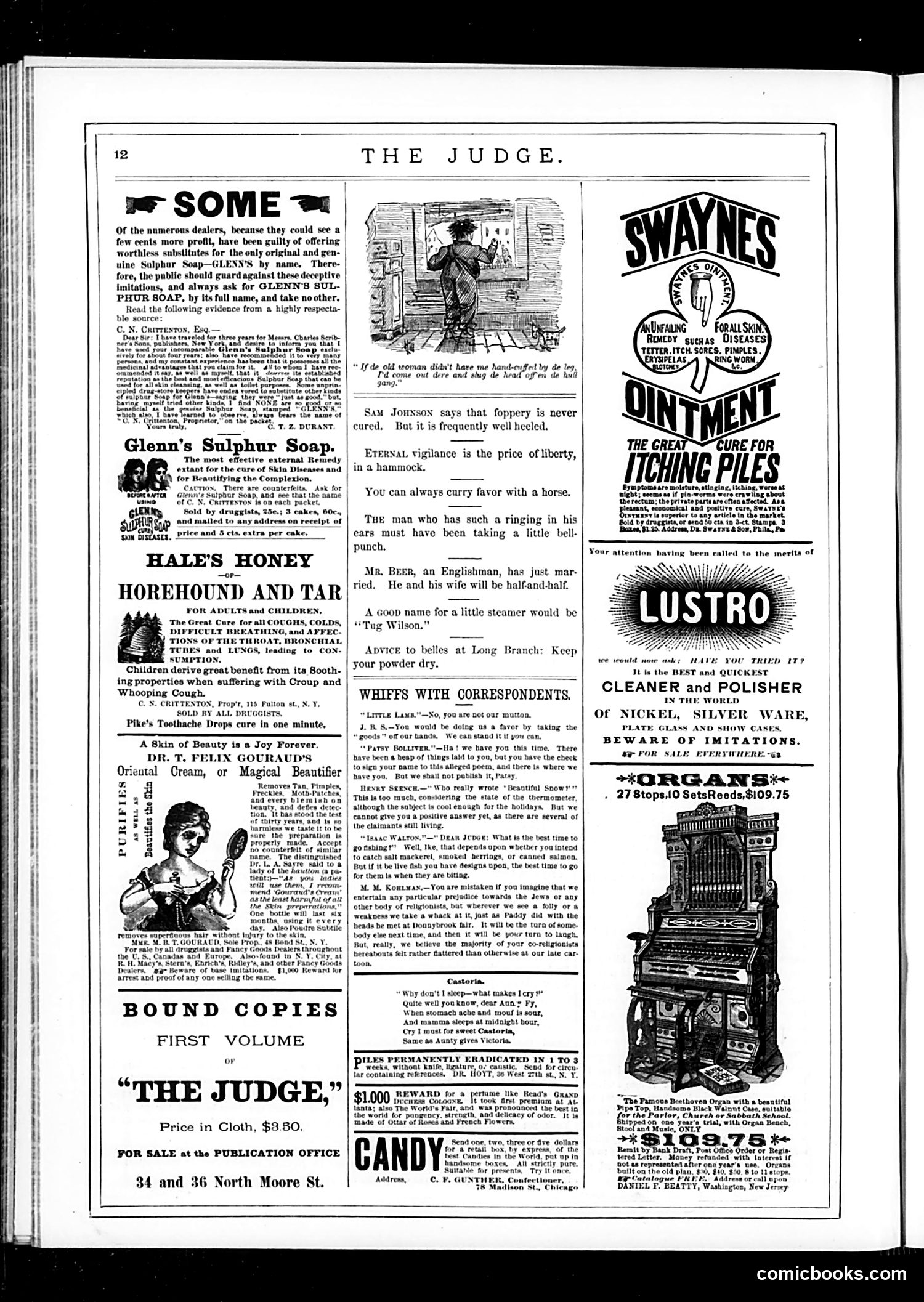
This is primarily an **advertising page** from Judge magazine, with one small cartoon at top center. ## The Cartoon The single illustrated cartoon shows a Black man in what appears to be a jail cell, with a caption quoting him saying he'd fight others if not shackled. This reflects the **racist stereotypes and minstrelsy conventions** common in 19th-century American humor publications—depicting Black individuals through demeaning caricature and dialect. ## The Content The page is dominated by patent medicine and beauty product advertisements (Glenn's Sulphur Soap, Hale's Honey, Dr. Gouraud's skin cream, etc.)—typical of Judge's revenue model. The "Whiffs with Correspondents" section contains brief humorous quips and reader responses, including period-appropriate wordplay and social commentary about fashionable behaviors. **Modern context**: This page illustrates how thoroughly racist imagery was embedded in mainstream American humor and advertising of this era, presented without irony or apparent awareness of harm.
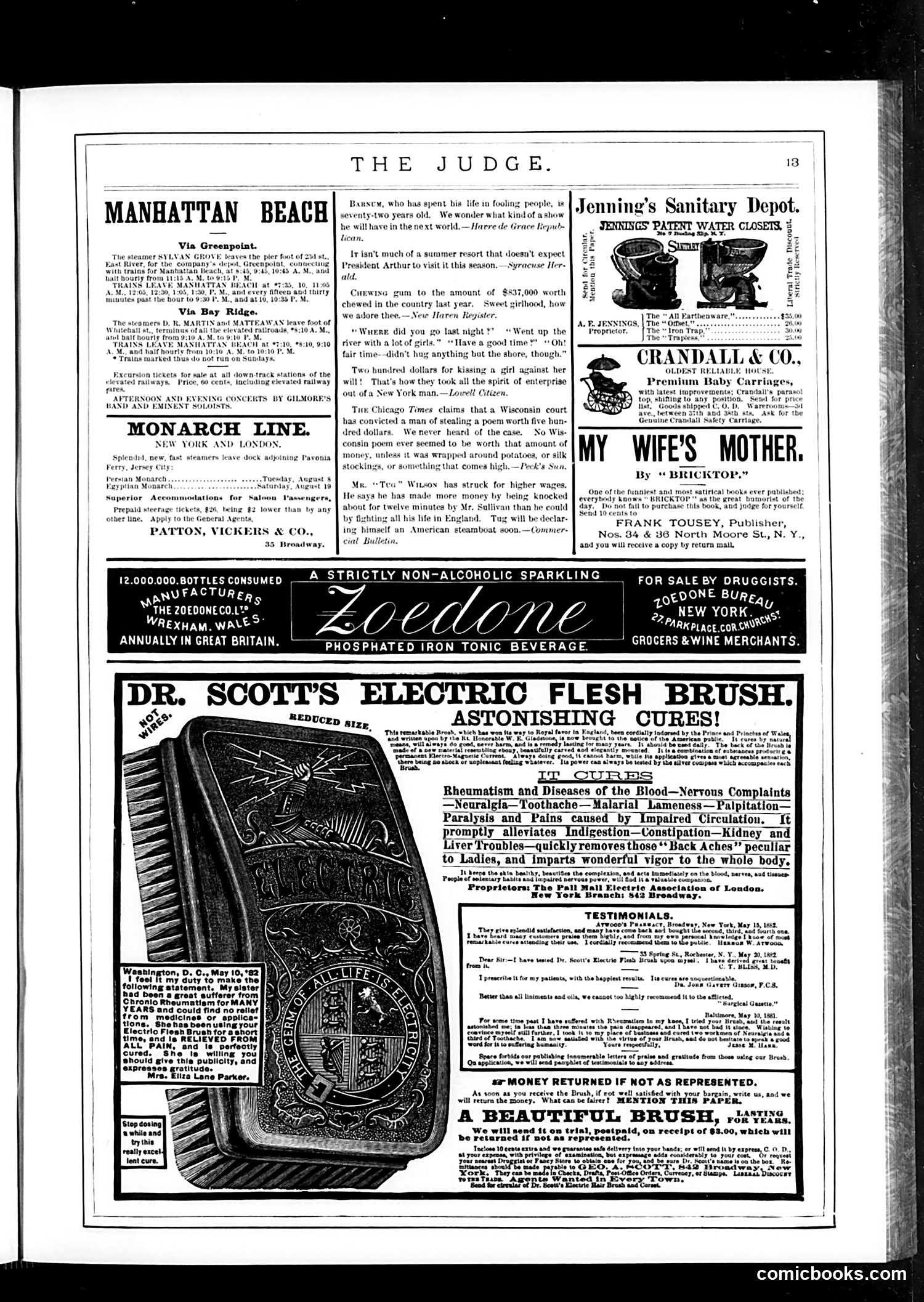
This page is primarily **advertisements with minimal editorial content**. The small satirical items at the top are brief, disconnected quips rather than a coherent cartoon. ## Key Content: **Editorial Snippets**: The scattered one-liners mock contemporary figures and behaviors—references to President Arthur not visiting Manhattan Beach as a summer resort, gum-chewing culture, and a Wisconsin court case about stealing a poem. These appear to be filler jokes rather than focused satire. **Dominant Content**: The page is dominated by **patent medicine and consumer product advertisements** typical of late-19th-century publications, including: - Dr. Scott's Electric Flesh Brush (claiming to cure rheumatism, neuralgia, paralysis) - Zoedone phosphated iron tonic - Jennings' sanitary water closets - Various transportation services **Historical Context**: This reflects the era's ubiquitous dubious medical claims and lack of FDA regulation. The advertisements are as prominent as any editorial content—standard for Judge magazine's business model. The page demonstrates how satirical publications of this period subsidized their humor through aggressive advertising for questionable remedies.
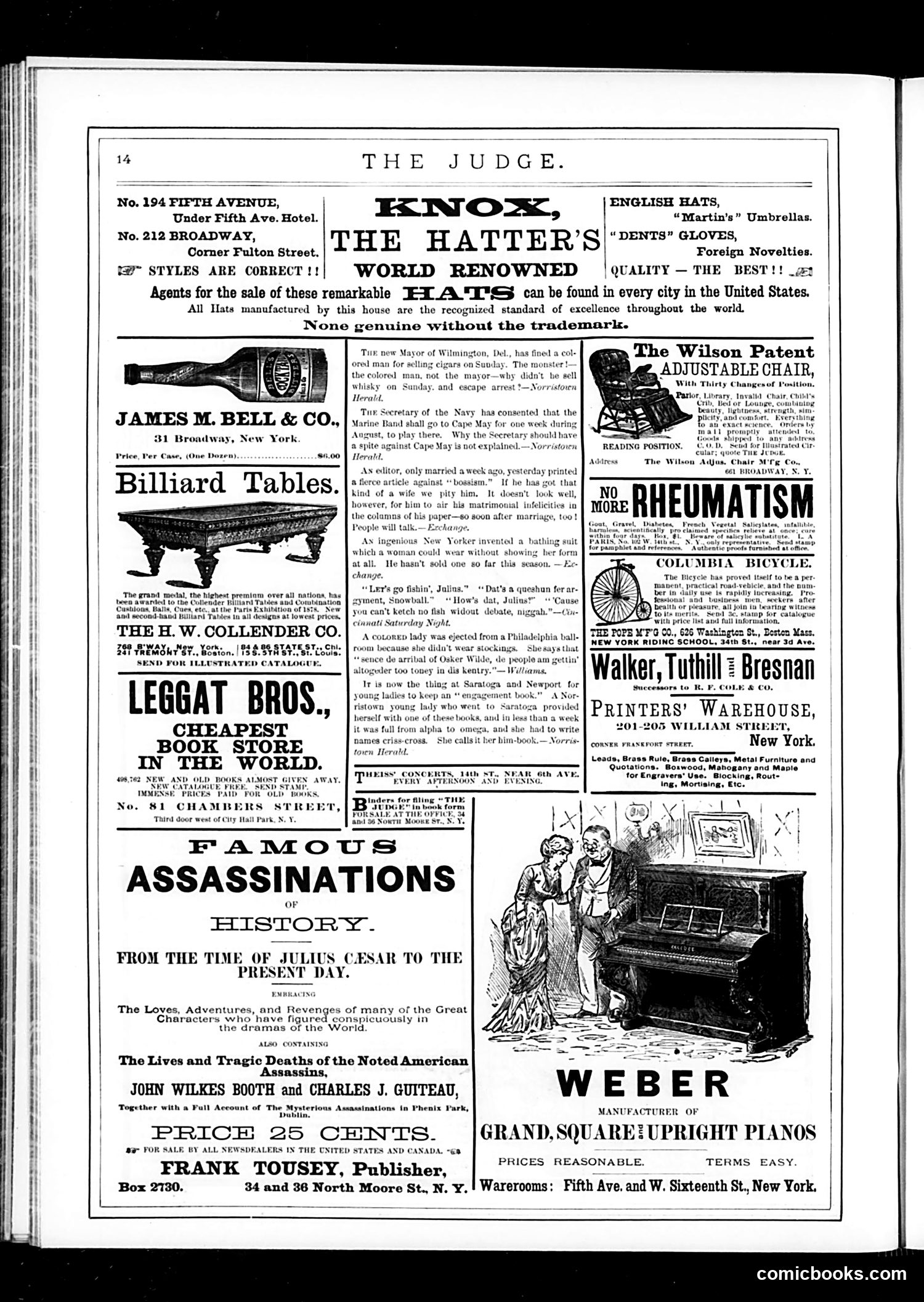
This page is **primarily advertisements** with minimal editorial content. The main items are: **Central Content:** A brief gossip column mentioning the new Mayor of Washington, D.C., and Navy Secretary anecdotes—typical light social commentary for *Judge*, a satirical weekly. **Advertisements:** Knox hats, James M. Bell & Co. (whisky), billiard tables, Leggat Bros. books, and Weber pianos dominate the layout. One ad notably promotes a book on "Famous Assassinations of History" featuring John Wilkes Booth and Charles J. Guiteau, reflecting 19th-century public fascination with political violence. **Notable Detail:** The Wilson Patent Adjustable Chair advertisement includes imagery of elderly figures, marketing it for comfort—standard product promotion of the era. **Overall:** This is a typical *Judge* magazine page blending light satirical commentary with commercial advertisements, lacking significant political cartoons or caricatures worth detailed analysis.
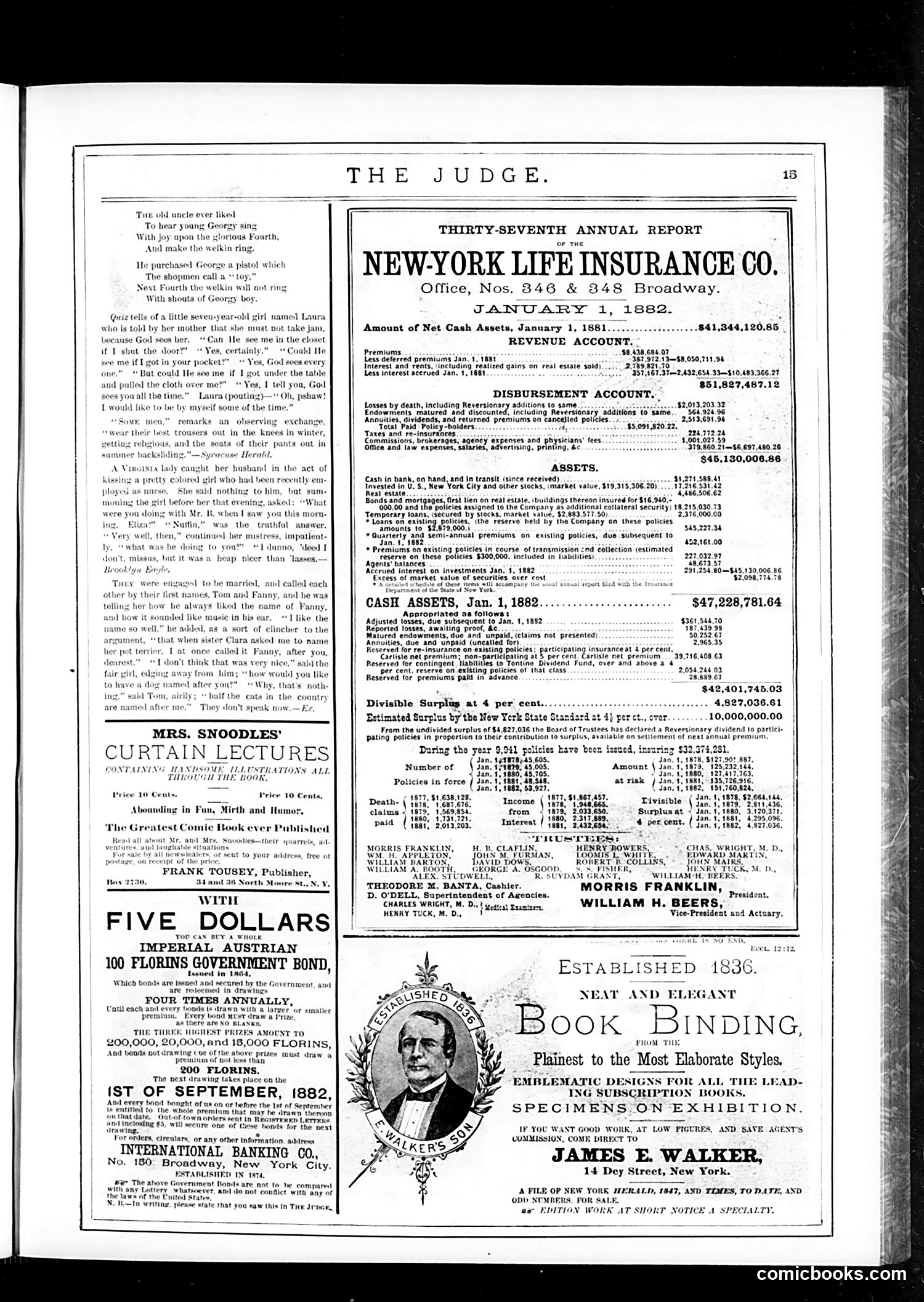
This page is primarily **advertising and financial reporting**, not a satirical cartoon feature. The dominant content is the New-York Life Insurance Company's thirty-seventh annual report (dated January 1, 1882), displaying detailed financial statements including assets of $45.1 million and revenue accounts. The **cartoon content is minimal**—brief humorous anecdotes in the upper left margin, including a dark joke about a child named George receiving a toy pistol that will prevent him from celebrating Independence Day (Fourth of July), and various other domestic comedy sketches lacking clear political satire. The page also features advertisements for Mrs. Snoodles' Curtain Lectures (a humor book) and an Austrian Government Bond lottery investment opportunity. **The satire here, if any exists, is subtle**—possibly mocking Americans' financial investments in foreign bonds or domestic insurance practices. Without identifying specific caricatures or clearer political references, the page reads primarily as a mixed advertising/reporting document rather than a pointed satirical commentary.
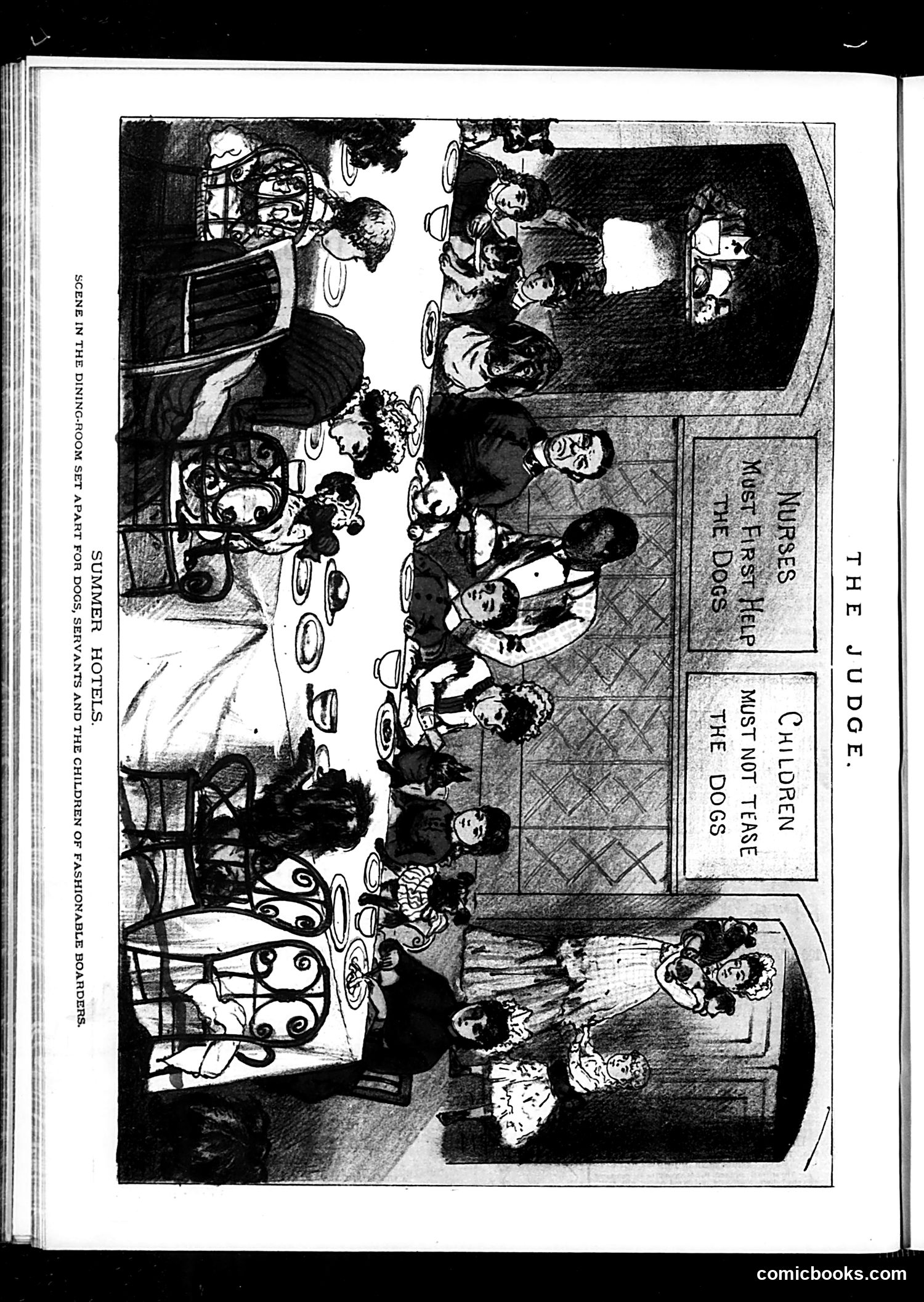
This satirical cartoon critiques class discrimination at summer hotels. The caption "Children Must Not Tease the Dogs" is ironic—the scene shows children, servants, and dogs literally segregated in a separate dining room from wealthy guests. The joke targets the snobbery of "fashionable" hotel owners who treat children of paying guests as low-class, grouping them with servants and animals. This reflects Gilded Age social hierarchies where hotels maintained strict class boundaries. By lumping together children, servants, and dogs as equally undesirable for the main dining room, Judge exposes the absurdity and cruelty of such pretentious segregation. The satire suggests that wealthy hotel patrons considered even their own children less worthy than maintaining the appearance of exclusive, elite dining spaces.