
A complete issue · 16 pages · 1882
Judge — July 15, 1882
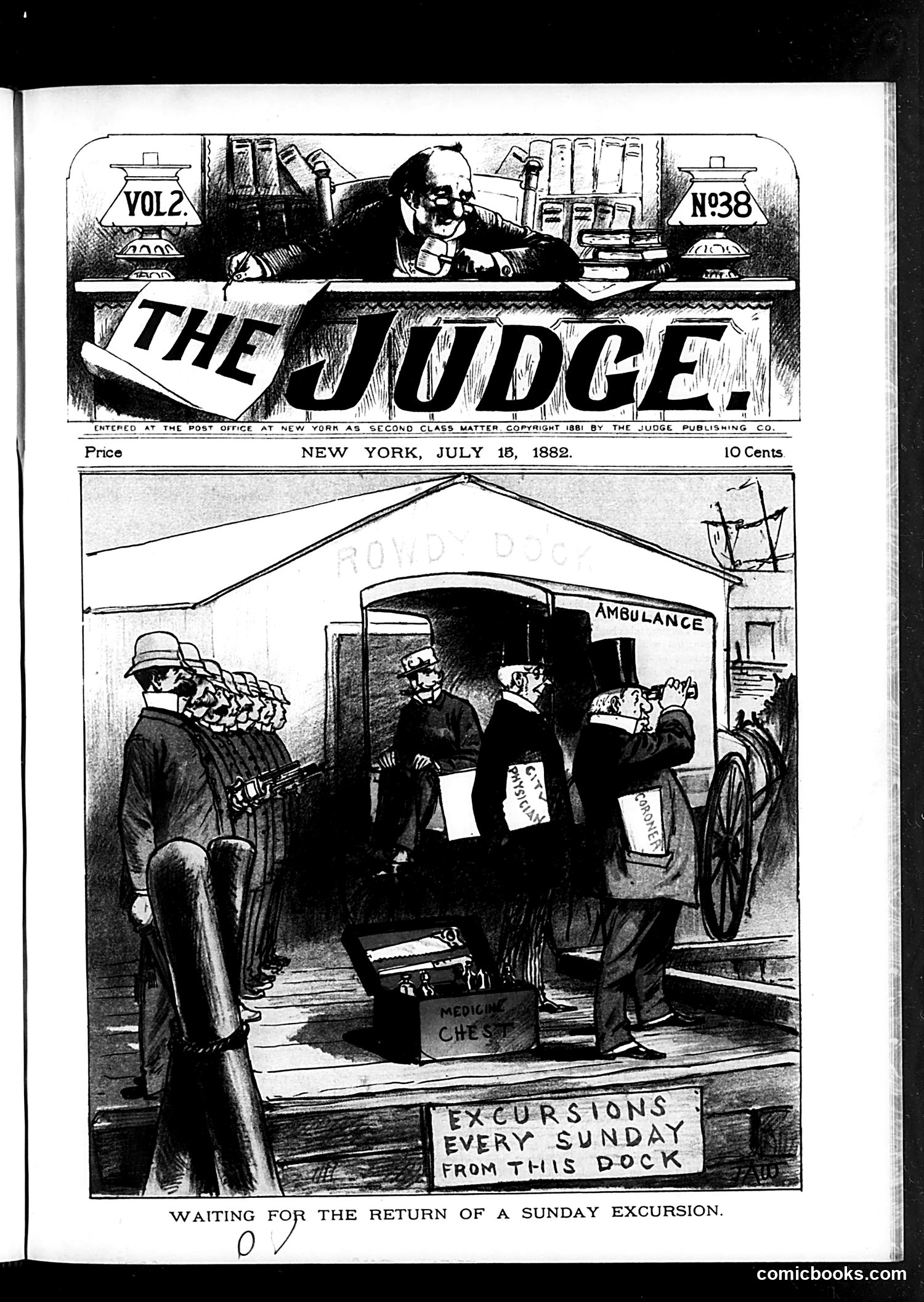
This cartoon satirizes the chaos and disorder of 1880s urban recreation. The image shows an ambulance dock where medical personnel and attendants wait to receive injured passengers returning from a Sunday excursion trip. Signs advertise "Excursions Every Sunday From This Dock," while spectators and officials gather anxiously. The satire mocks the danger and mismanagement of popular Sunday outings—a common leisure activity for working-class New Yorkers. The implication is darkly comic: these recreational trips are so hazardous that the ambulance staff routinely expects casualties. The cartoon critiques both poor safety standards and the grim humor of accepting injury as an inevitable consequence of entertainment, reflecting broader concerns about industrial-era public safety and transportation risks.
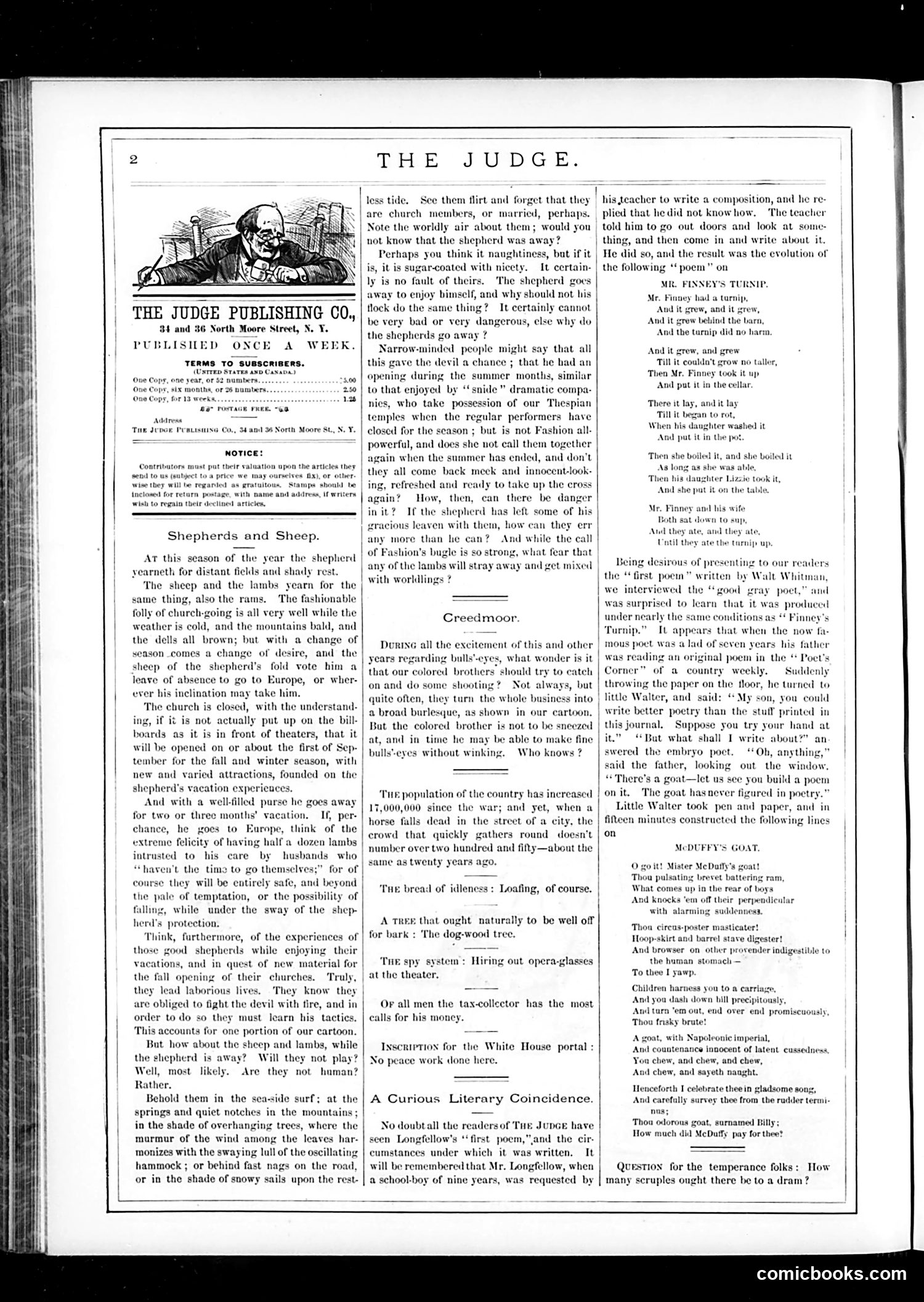
This page from the satirical magazine *Judge* contains two main articles mocking contemporary social hypocrisy: **"Shepherds and Sheep"** criticizes wealthy church pastors who abandon their congregations for extended European vacations during summer, leaving their "flocks" (parishioners) unsupervised. The satire suggests these sheep will inevitably misbehave without moral guidance—yet mysteriously return "meek and innocent-looking" when autumn arrives, paralleling how theatrical companies behave during off-season closures. The piece sardonically questions whether the pastor's "gracious leaven" (moral influence) truly protects his flock. **"Creedmoor"** ridicules African American participation in rifle shooting competitions. The author condescendingly acknowledges Black shooters' eventual competence while describing their current efforts as "broad burlesque," using dehumanizing language ("colored brothers") typical of late-19th-century racism. The page reflects *Judge*'s elite, white audience perspective—mocking both clerical privilege and contemporary racial attitudes.
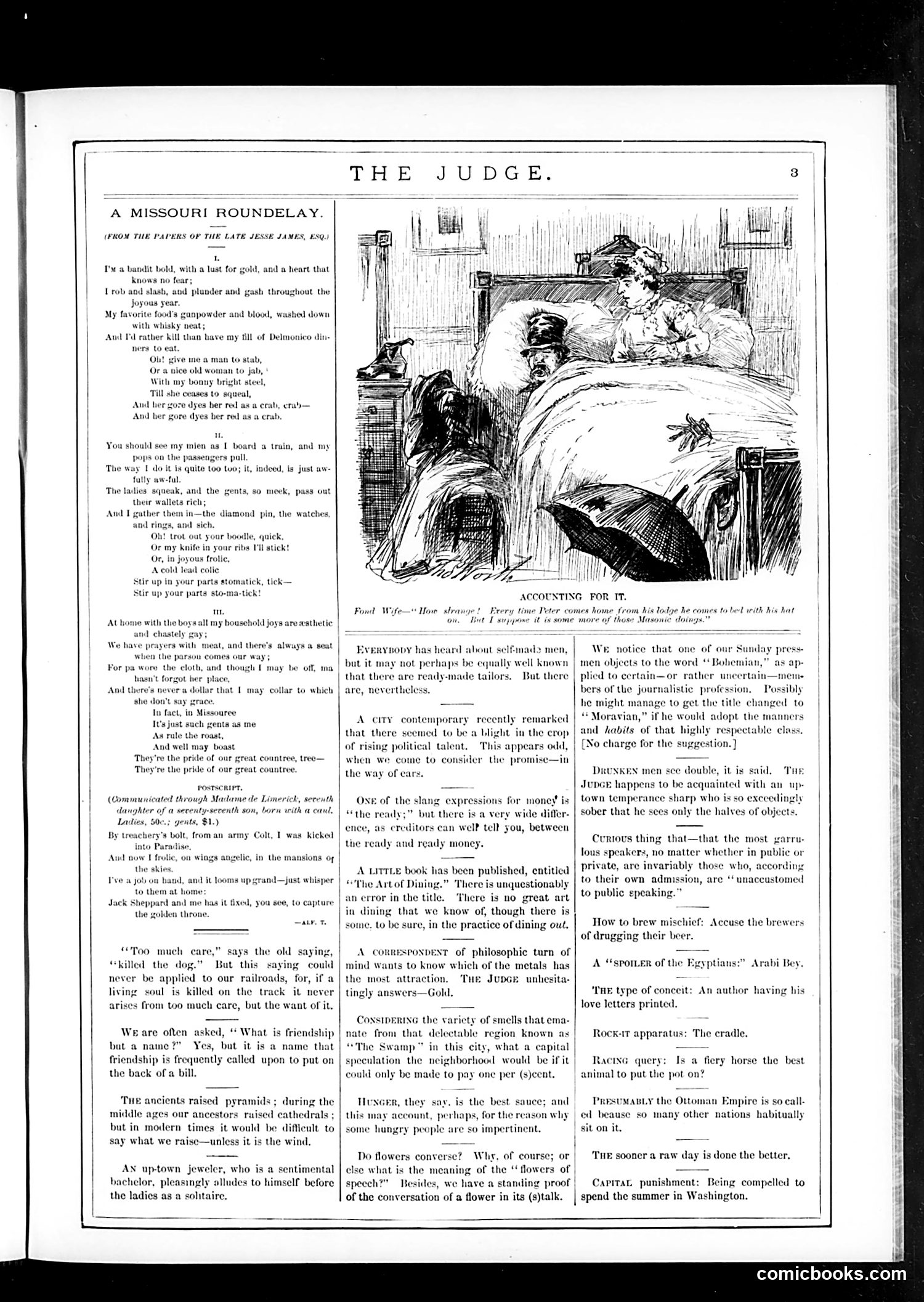
This page satirizes **Jesse James**, the famous Missouri outlaw, through a mock autobiographical poem titled "A Missouri Roundelay." The cartoon shows a bandit threatening a woman in bed, illustrating the violent persona described in the verse. The satire mocks James's brutal reputation by having him boast in exaggerated verse about robbing trains, murdering innocents, and terrorizing passengers—presenting criminal violence as gleefully casual. The poem includes absurd rhymes and crude humor typical of 19th-century satirical magazines. The accompanying text column contains unrelated short jokes and observations about various topics (tailors, railroads, friendship, etc.), which was standard Judge magazine format. **Context:** This likely appeared after James's death in 1882, when he'd become a legendary figure. Judge uses him to satirize frontier criminality and American violence, while the cartoonish treatment suggests mockery of James's mythologization in popular culture.
This *Judge* page contains two pieces of humorous writing with no political satire: **"After the Fourth"** is a sentimental poem by O.O. Shall lamenting the end of Independence Day celebrations—spent fireworks, silent cannons, and stored-away flags. It's nostalgic Americana, not political commentary. **"After You Get Acquainted"** is a comedic short story about a visitor to Concord, New Hampshire, whose friend Leonard Brown promises "fun" but delivers tedious local attractions instead: a schoolhouse, then a cemetery where they sit on tombstones watching for a cow. The humor lies in the anticlimax—the friend's earnest pride in mundane sights contrasted with the narrator's mounting boredom. Neither piece targets specific political figures or contemporary events. Both are general-interest humor pieces typical of *Judge*'s lighter content. The page appears to be primarily literary/entertainment rather than satirical commentary.
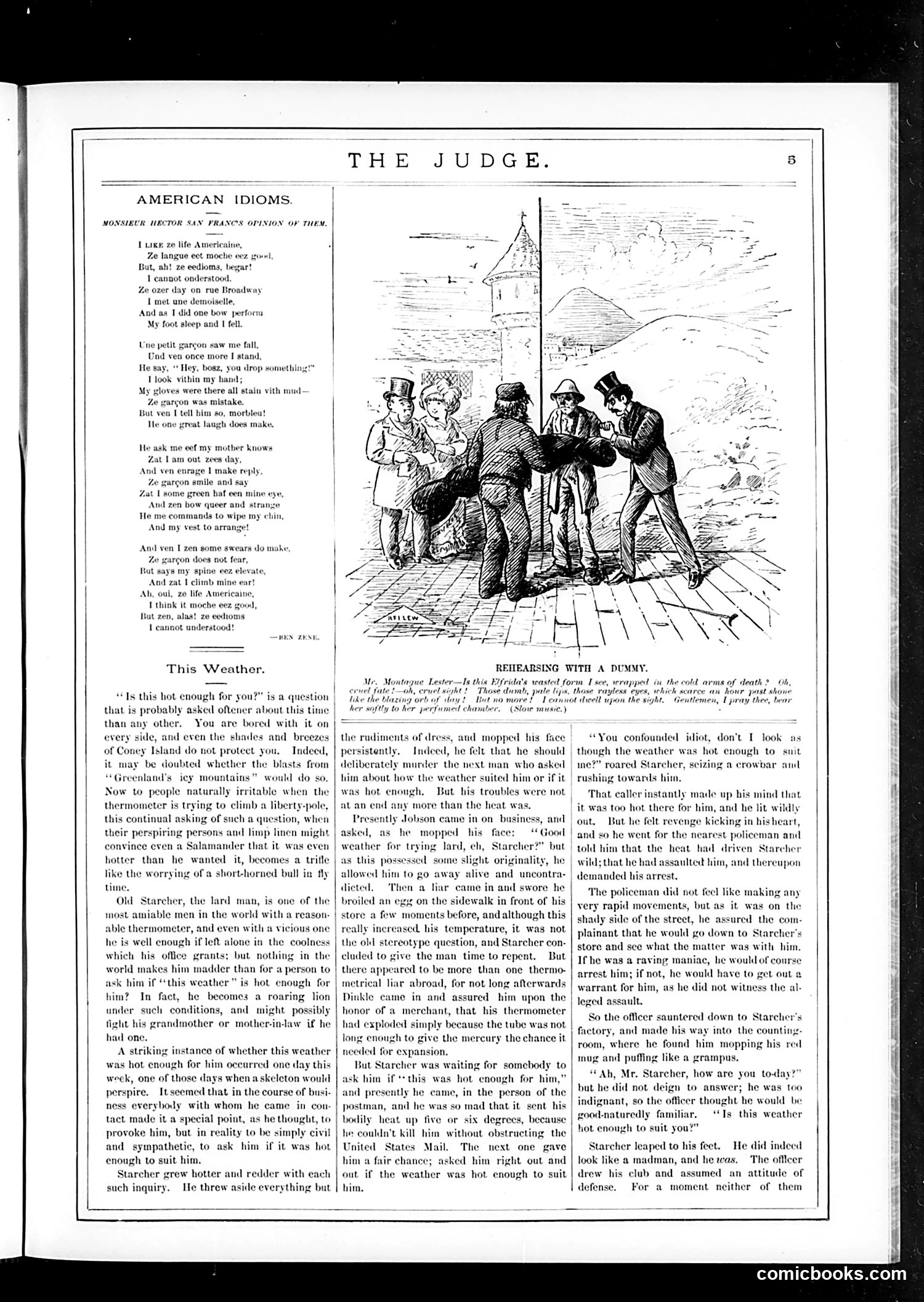
This page contains two distinct pieces: **"American Idioms"** (left): A French visitor satirizes American English expressions. The poem mocks how literal translations of French idioms fail comically in English—for example, "my foot slept and I fell" (from French "mon pied s'endormit"). The joke targets both American slang as incomprehensible to foreigners AND the pretentious European's inability to adapt, making fun of cultural snobbery on both sides. **"This Weather"** and "Rehearsing with a Dummy"** (right): The main cartoon depicts a hot-weather complaint scenario. Mr. Starcher, an irritable lard merchant, is repeatedly asked "Is this hot enough for you?"—apparently a tedious cliché even by 1880s standards. The satire ridicules how people obsessively repeat the same banal small-talk during heat waves, driving everyone around them to madness. The "dummy" reference suggests people mindlessly repeat phrases without originality. The page satirizes American conversational habits and immigrant perspectives on American culture.
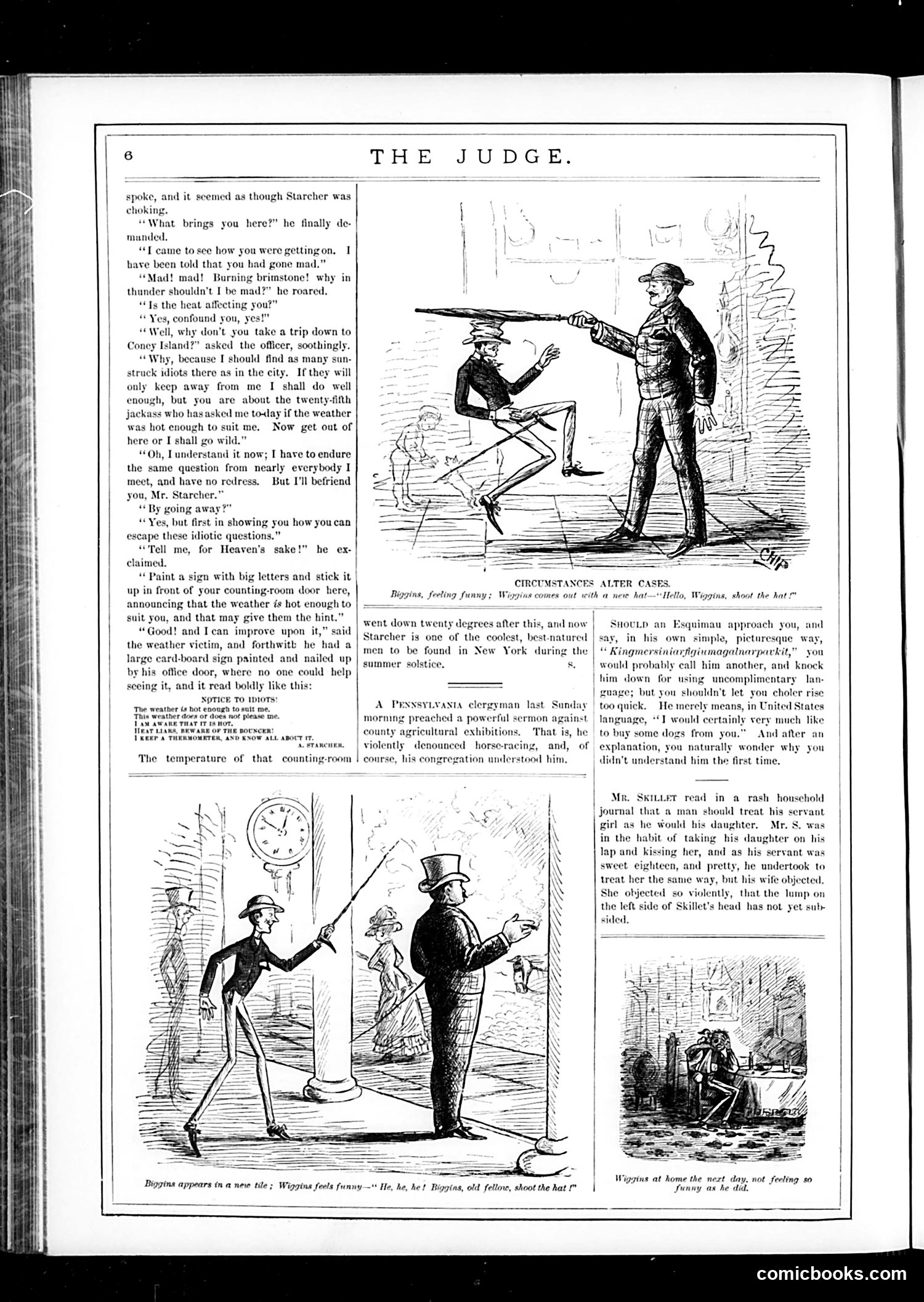
This page contains three separate humorous anecdotes typical of Judge magazine's satirical style: 1. **The Heat-Complaint Sign**: A man tormented by strangers asking "Is it hot enough for you?" posts a sarcastic sign announcing he finds the weather suitable. The joke satirizes mindless small talk and social convention—people ask the same inane question without thinking. 2. **"Circumstances Alter Cases"**: Two illustrations show men wearing new hats. The caption suggests vanity and how appearance changes social interactions—a common target of Victorian-era satire about pretension. 3. **Servant-Girl Misunderstanding**: A household advice column inspires a man to treat his servant like his daughter by kissing her on his lap. His wife responds violently. The satire mocks both naive interpretation of genteel advice and the awkward class/gender dynamics of domestic service. **Overall context**: These reflect late-19th-century American social anxieties about manners, class boundaries, and the gap between advice-column ideals and reality. The humor relies on readers' recognition of everyday social absurdities.
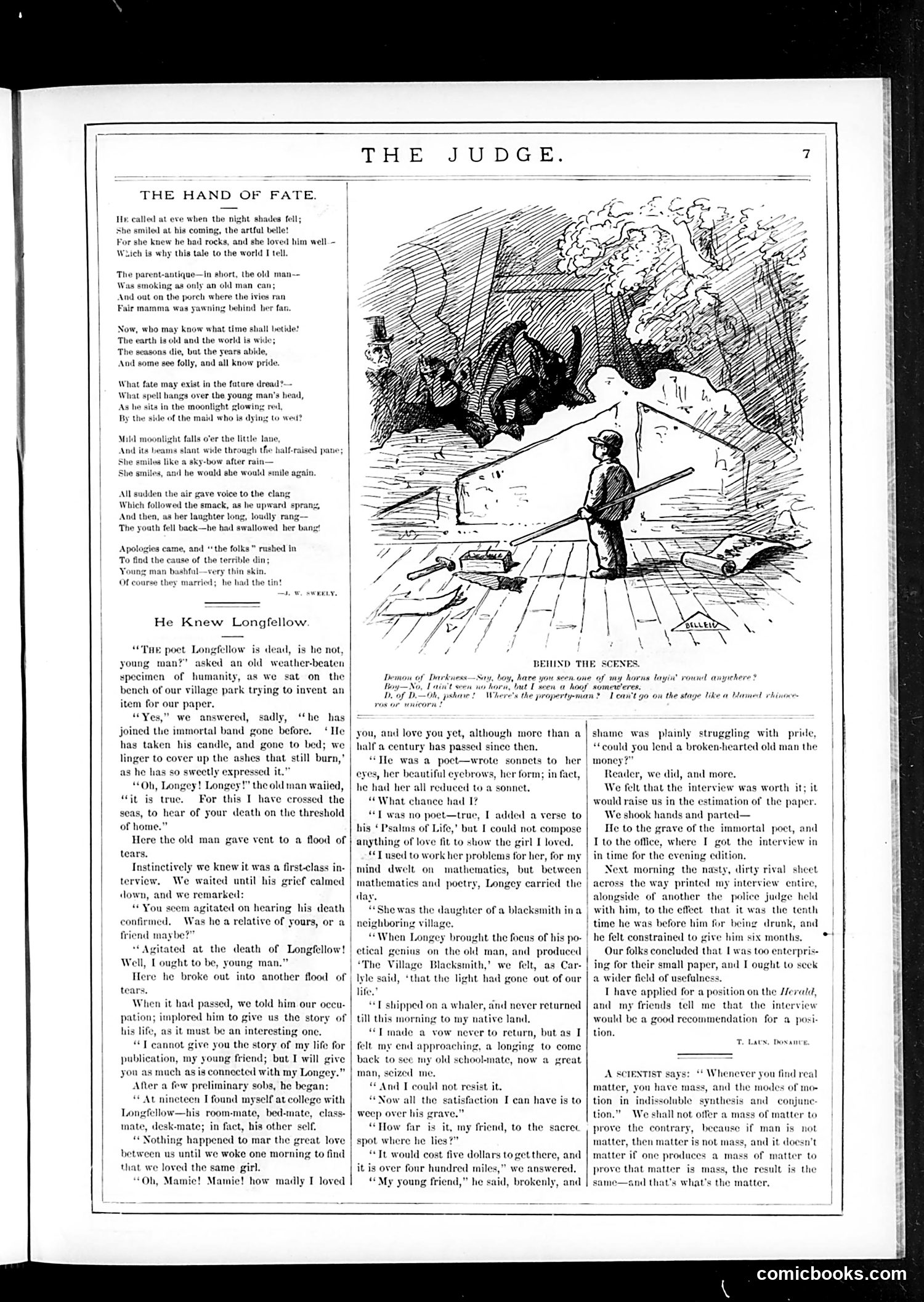
This is a literary magazine page featuring two separate pieces. "The Hand of Fate" is a sentimental poem with accompanying illustration about young romance interrupted by mishap (a girl's laugh causes a young man to swallow something). The main content, "He Knew Longfellow," is a satirical interview. A weathered old man visits a newspaper office claiming deep connection to the recently-deceased poet Henry Wadsworth Longfellow. He reveals he was Longfellow's college roommate who loved the same woman. While Longfellow won her heart through poetry (famously "The Village Blacksmith"), the narrator—a mere mathematician—could only solve her homework problems. He fled to sea for fifty years, and now returns seeking Longfellow's grave. The satire mocks both excessive Romantic sentimentality and the gap between artistic genius and ordinary accomplishment. It's a gentle joke about how Longfellow's poetic reputation made him irresistible where practical help could not.
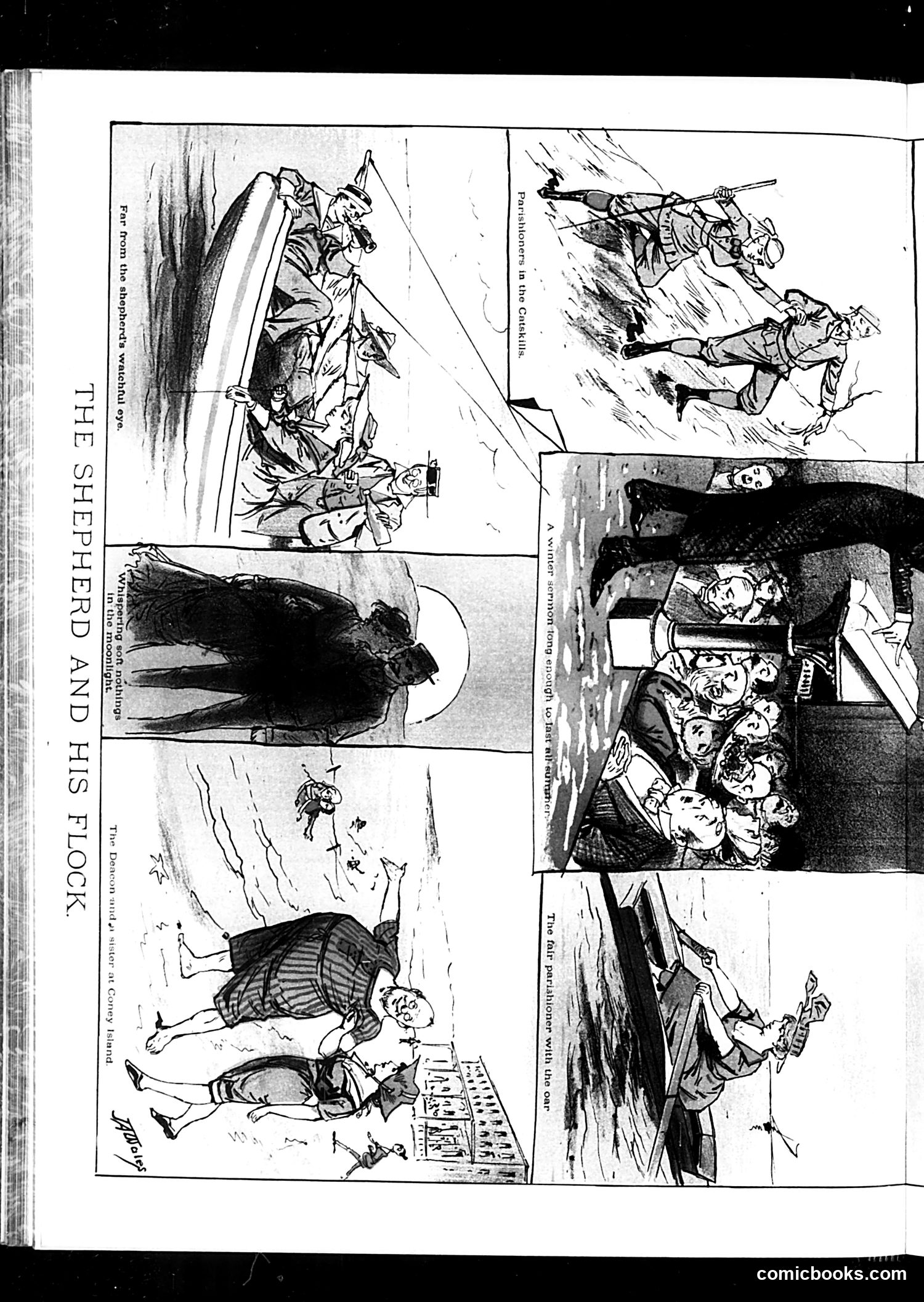
This multi-panel cartoon satirizes a political or religious leader's control over followers. The title character (appearing as a large, dark silhouette in one panel) represents a shepherd figure who manipulates his "flock"—depicted as ordinary people who follow him unquestioningly. The panels show various scenes of the flock's obedience and the shepherd's authority, likely commenting on blind devotion to leadership. The visual metaphor of shepherd and sheep was a common Judge magazine device to mock cult-like followings or authoritarian control. Without clearer OCR text or publication date, the specific target—whether a political leader, religious figure, or other public personality—remains unclear, but the cartoon's point is straightforward: criticism of unquestioning mass obedience and the manipulation of public opinion by a charismatic leader.
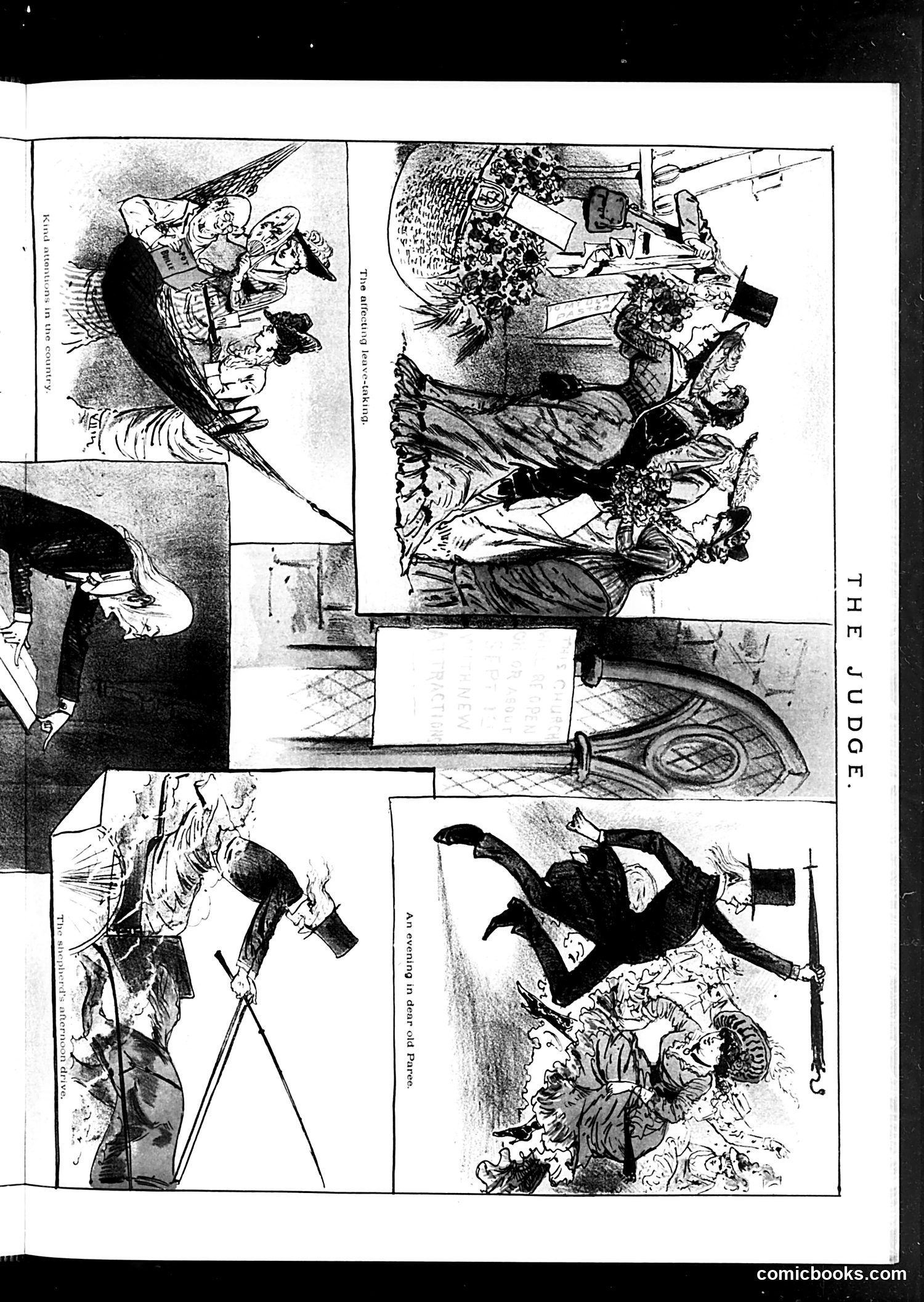
This page from *Judge* magazine contains multiple political cartoons titled "THE JUDGE" with the heading "The Shepherd's att[ention]" (text cut off). The cartoons appear to satirize judicial or legal proceedings, featuring caricatured figures in formal dress and judicial robes. The imagery suggests commentary on courtroom conduct or judicial authority—possibly critiquing how judges handle cases or manage courtroom proceedings. Without complete visible text labels identifying specific historical figures or dated events, I cannot definitively state which particular legal scandal, trial, or political figure this targets. The caricature style and formal settings indicate satire of the legal/judicial system circa the late 19th or early 20th century, but the specific context requires clearer text attribution than this reproduction provides.
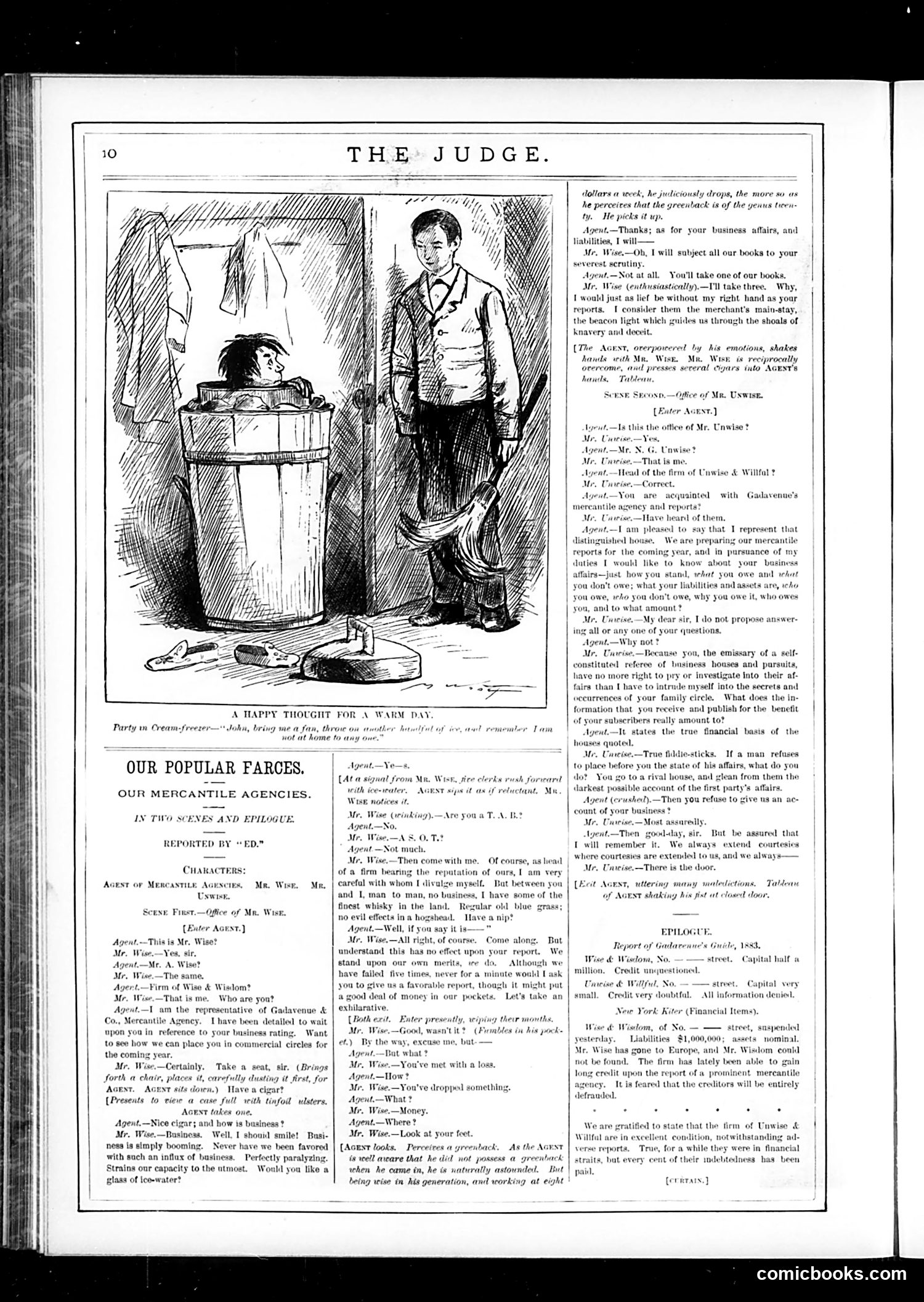
This two-scene satirical play mocks **mercantile credit-reporting agencies**—the predecessors of modern credit bureaus. **Scene 1** shows an Agent from a mercantile agency visiting Mr. Wise, whose business is "booming." The agent attempts to gather financial information while buttering up Wise with flattery and gifts (cigars). Wise is eager to cooperate, praising the agency's reports as a "beacon light" guiding merchants through dishonesty. **Scene 2** reveals the hypocrisy: when Agent visits Mr. Unwise (Wise's business partner), Unwise refuses to provide any information, arguing these agencies have no legitimate right to pry into private business affairs—it's as invasive as investigating someone's family secrets. He demands to know what their "published" reports actually accomplish. **The satire's point**: These agencies were largely unaccountable, gathering financial data selectively based on who cooperated with them, then selling reports as authoritative without real investigative standards. The cartoon exposes both the agencies' manipulation through flattery and the arbitrary, potentially unreliable nature of their supposed "expertise."
This page contains a humorous short story by "Bricktop" satirizing the experience of taking a seaside vacation during hot weather. The protagonist, Dottlesnap (a recurring character appearing to represent an everyman figure), attempts to board a steamship to Long Branch, New Jersey—a popular resort destination. The satire targets common urban frustrations: crowded travel, con artists, and the gap between vacation fantasy and reality. Dottlesnap, described as weighing "in the neighborhood of three hundred pounds," struggles through a mob at the ticket window. He's repeatedly swindled—first by a youth he pays to buy tickets, then by another man selling him a ticket for the "next boat." The humor lies in Dottlesnap's gullibility and the predictable scheming of opportunists preying on desperate travelers. The accompanying poem "My Boarding Mam" satirizes boarding house conditions: poor food, tiny rooms, exploitative landlords—reflecting working-class urban housing complaints of the era.
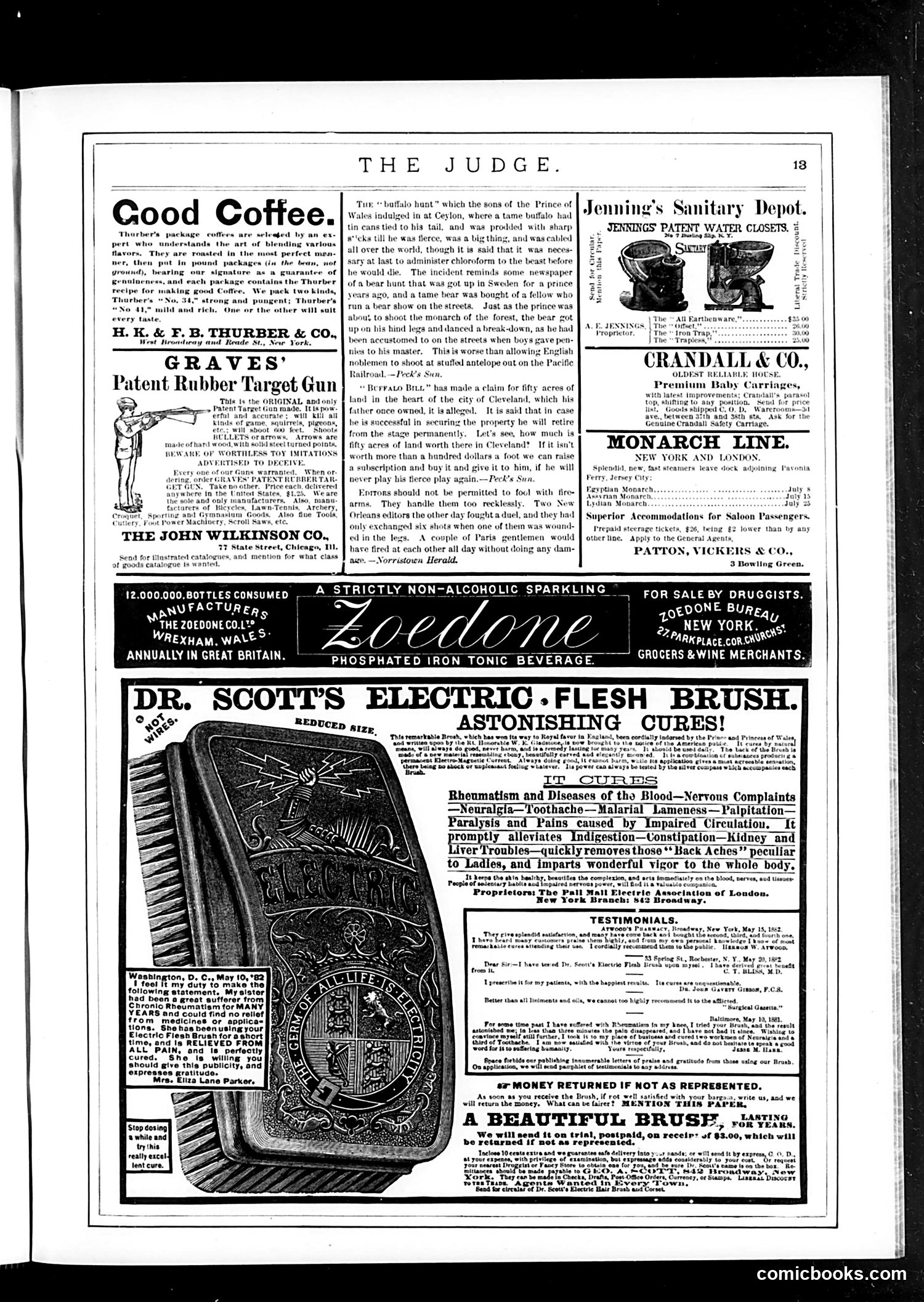
This page is primarily **advertising**, not editorial content or political cartoons. It contains multiple product advertisements typical of 1880s American magazines. The main featured advertisement is **Dr. Scott's Electric Flesh Brush**—a pseudoscientific health device claiming to cure rheumatism, neuralgia, paralysis, indigestion, and various ailments through "electricity." This reflects the late Victorian obsession with electrical cures, then considered cutting-edge medicine despite lacking scientific basis. Other ads include Zoeodone (an iron tonic), Jenning's Sanitary Depot (water closets/toilets), and the Monarch Line steamship service. The brief text snippets at top discuss hunting anecdotes (buffalo and bear hunts) and editorial quips about reckless newspaper editors, but these aren't central to the page. **For modern readers:** This page illustrates how 19th-century magazines monetized through dubious medical claims now recognized as fraud, before FDA regulation existed. The "electric brush" exemplifies quack medicine marketed with testimonials and pseudoscientific language.
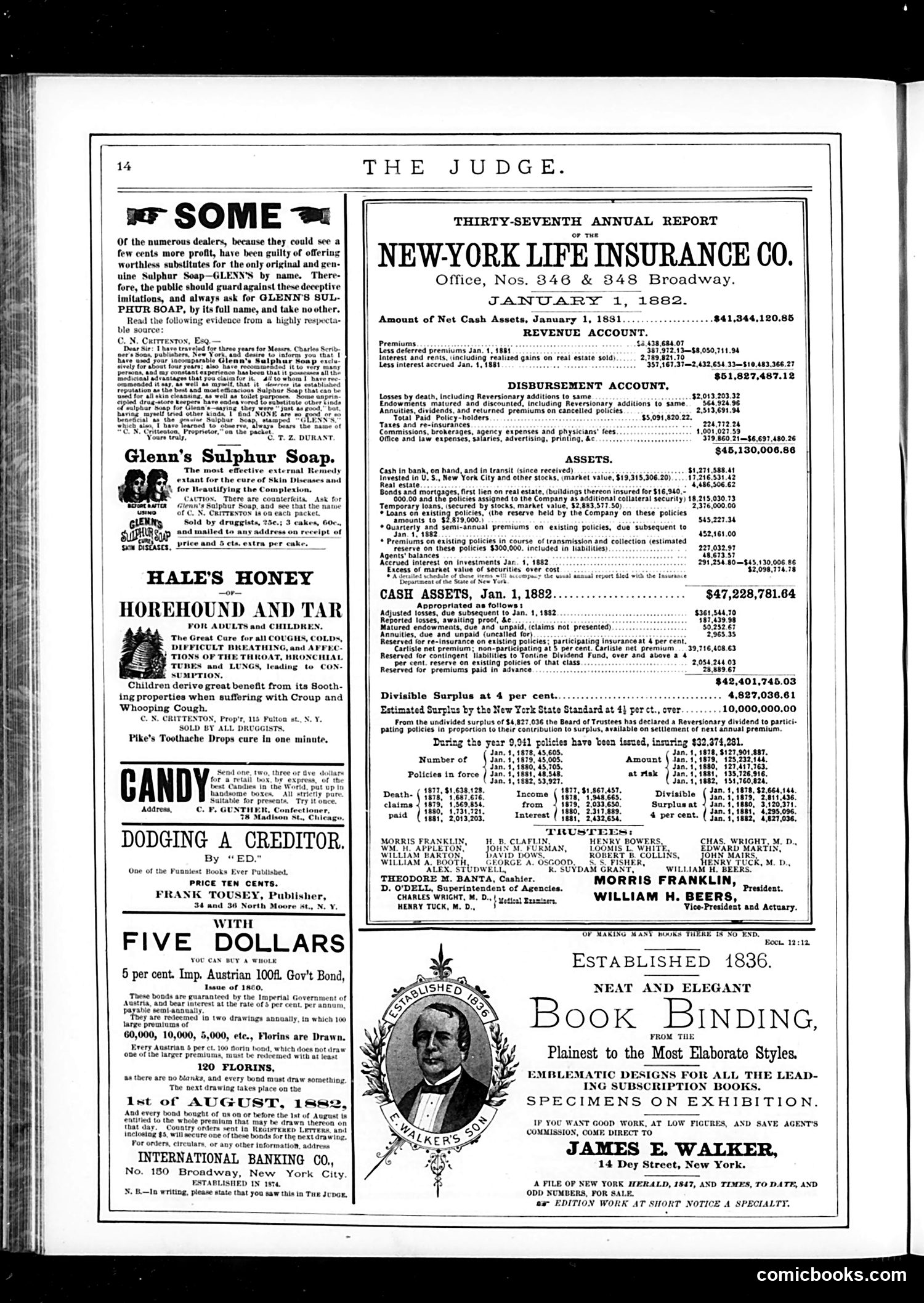
This page is primarily **advertisements and financial reports**, not political satire. The dominant content is the 37th Annual Report of the New-York Life Insurance Company (center), with surrounding advertisements for patent medicines (Glenn's Sulphur Soap, Hale's Honey Horehound and Tar), a book titled "Dodging a Creditor," and Austrian government bonds. The irony—likely intentional for a satirical magazine—is subtle: Judge publishes an ad for bonds promising reliable returns alongside an ad for a book about evading creditors, while insurance companies tout financial security. This juxtaposition may satirize the era's financial instability and the gap between promised security and actual economic reality. The page reflects 1882 American commercial culture: patent medicine advertising, insurance industry growth, and speculative foreign investments were all prominent features of the period.
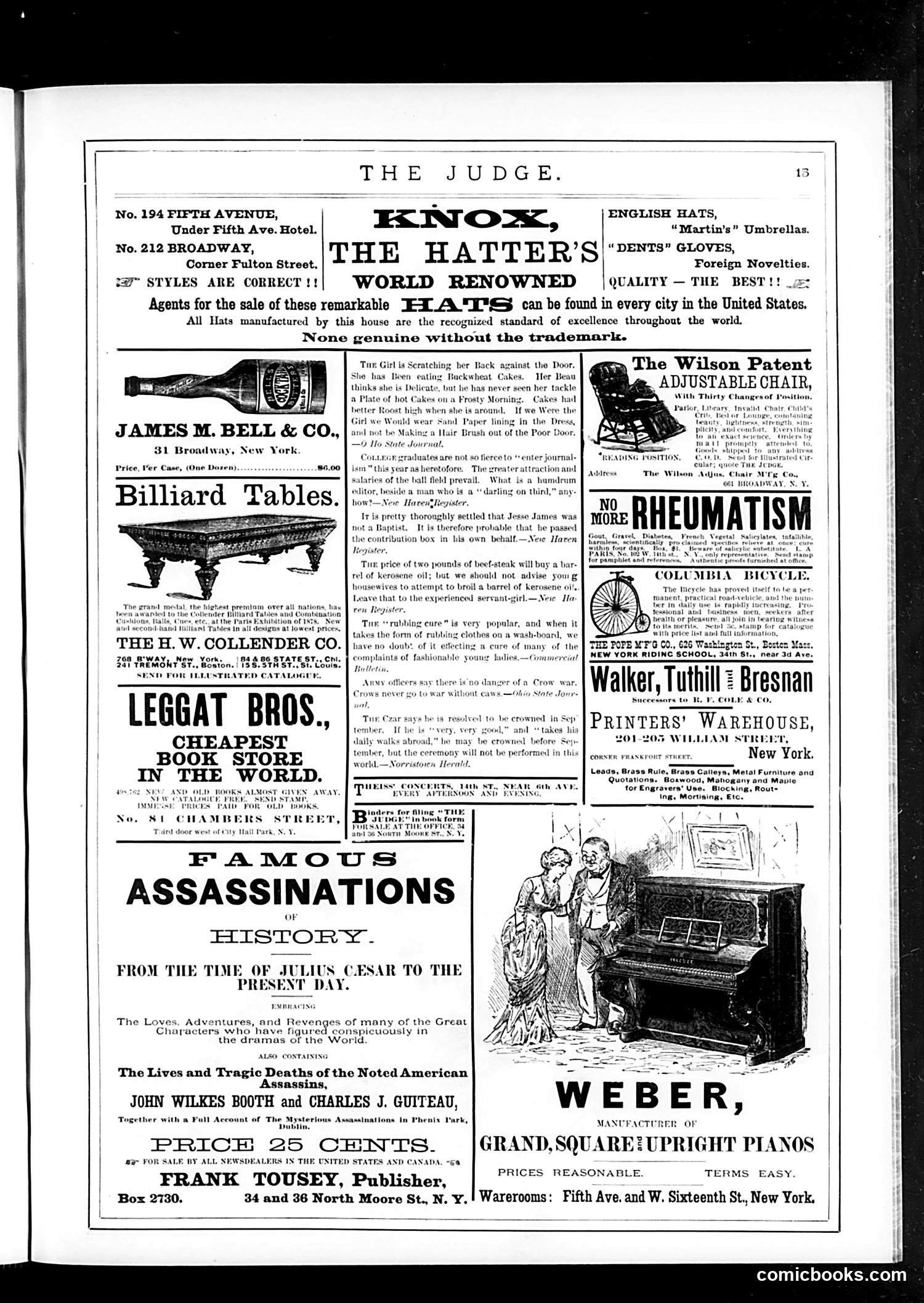
This page is primarily **advertisements** rather than editorial cartoons. The dominant content includes ads for Knox hats, billiard tables, a book about famous assassinations, pianos, and office furniture. The most notable editorial element is a small illustration accompanying an advertisement for the **Wilson Patent Adjustable Chair**, showing a figure scratching her back against a door. The accompanying text humorously describes a girl solving the problem of back-scratching by using the chair's design—a lighthearted domestic complaint solved by the product. The largest non-ad element advertises a 25-cent book about famous assassinations "from Julius Caesar to the present day," specifically highlighting **John Wilkes Booth** (Lincoln's assassin) and **Charles J. Guiteau** (who assassinated President Garfield in 1881). This reflects late-19th-century popular interest in sensational true crime literature. Overall, this is a typical Judge advertising page with minimal satirical content—the magazine relied heavily on commercial ads to fund publication.
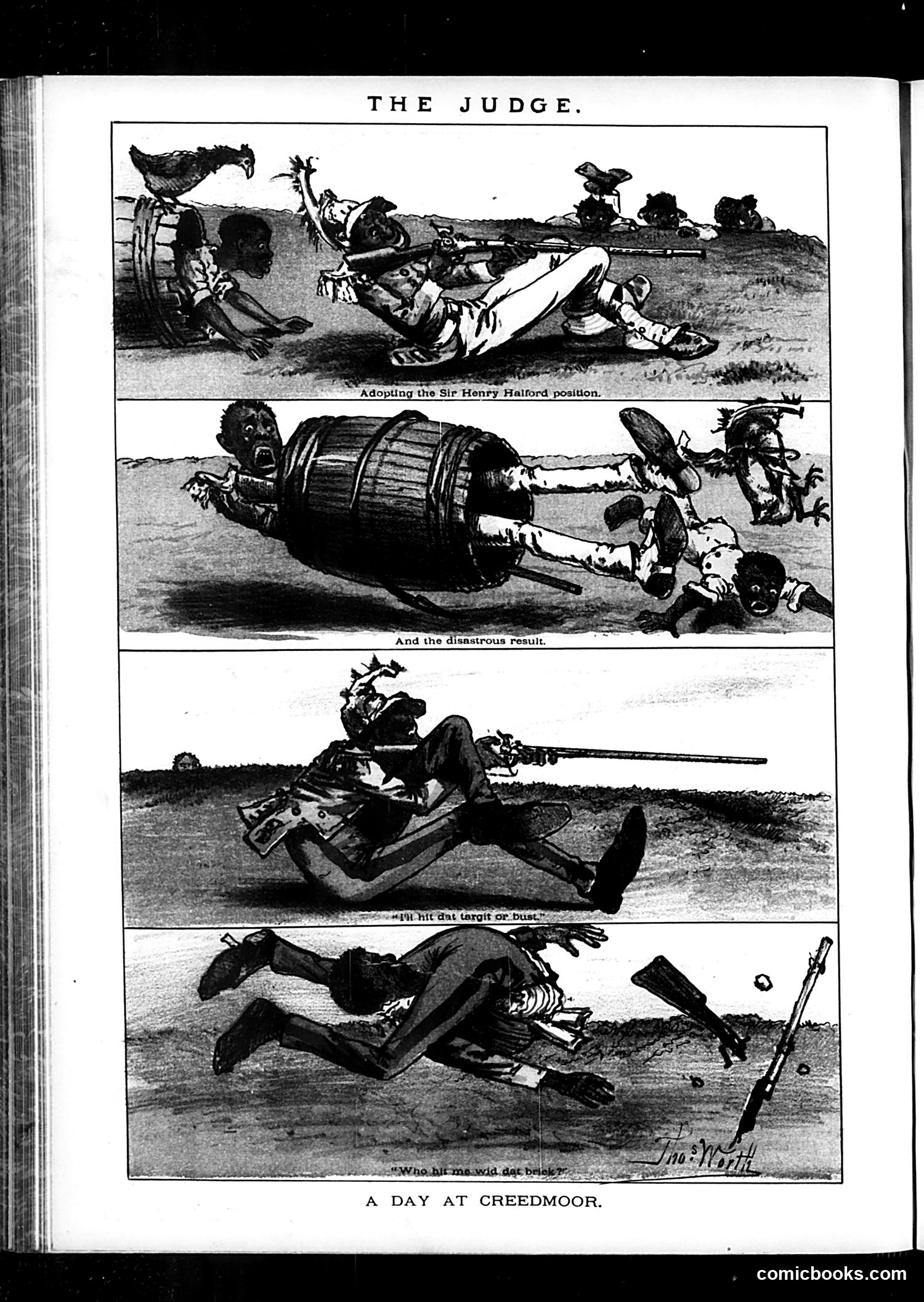
This satirical comic strip mocks incompetent marksmanship at Creedmoor, likely a shooting range or competition venue. The sequence shows a marksman attempting increasingly ridiculous shooting positions (the top panel references "the Sir Henry Halford position," apparently a real but comical stance), resulting in progressively disastrous outcomes. The humor escalates from the shooter simply falling over, to being struck by his own rifle's recoil, to complete physical collapse. The final panel's caption—"Who hit me wild dat bullet?"—suggests the marksman's shot wildly missed its target. The satire appears to target either amateur sportsmen, poor military training, or possibly gun safety advocates by exaggerating the chaos of incompetent shooting. The specific Creedmoor reference likely held contemporary meaning for 1880s readers familiar with that venue.