
Judge, 1882-07-15 · page 2 of 16
Judge — July 15, 1882 — page 2: what you’re looking at
What you’re looking at
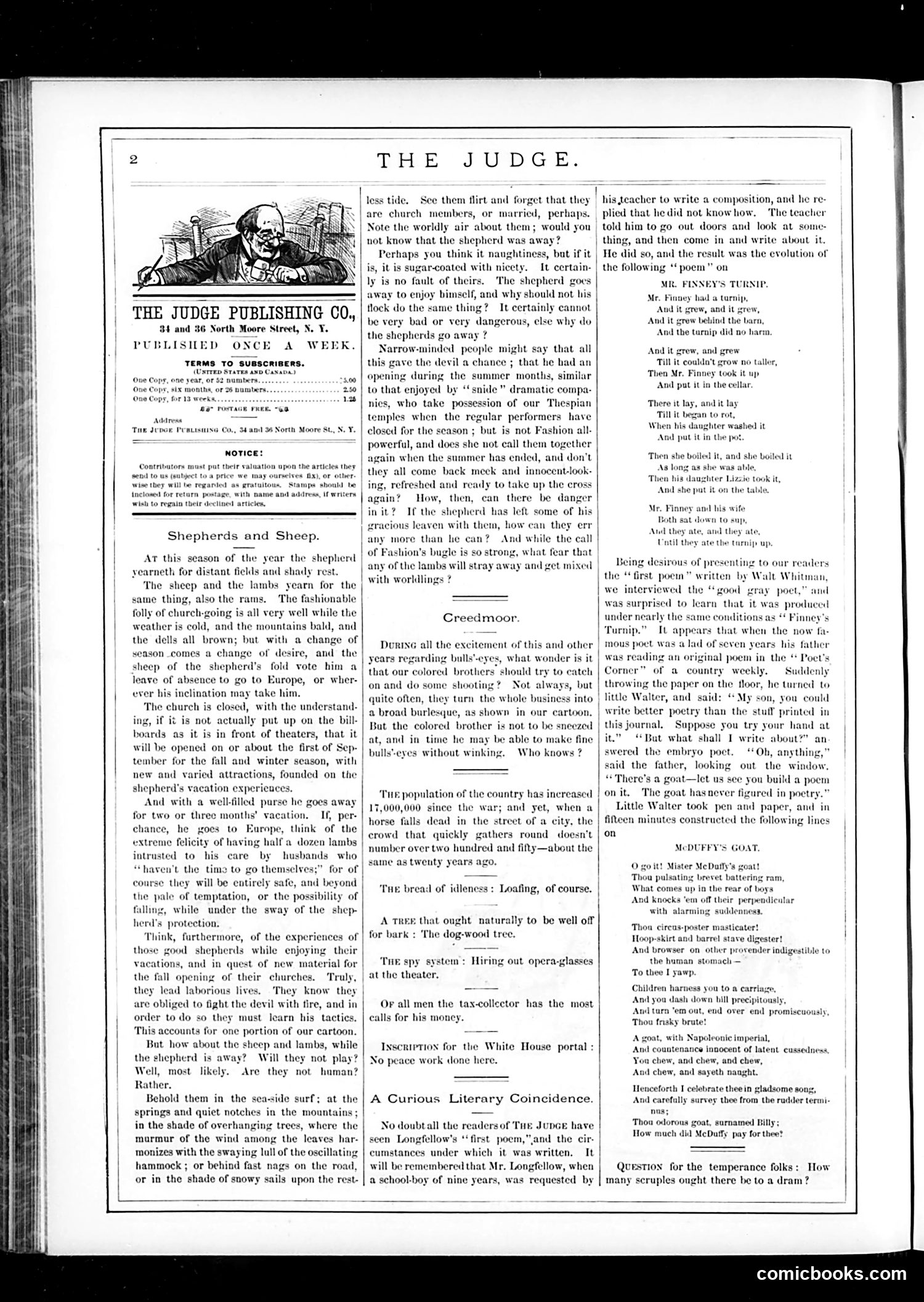
This page from the satirical magazine *Judge* contains two main articles mocking contemporary social hypocrisy: **"Shepherds and Sheep"** criticizes wealthy church pastors who abandon their congregations for extended European vacations during summer, leaving their "flocks" (parishioners) unsupervised. The satire suggests these sheep will inevitably misbehave without moral guidance—yet mysteriously return "meek and innocent-looking" when autumn arrives, paralleling how theatrical companies behave during off-season closures. The piece sardonically questions whether the pastor's "gracious leaven" (moral influence) truly protects his flock. **"Creedmoor"** ridicules African American participation in rifle shooting competitions. The author condescendingly acknowledges Black shooters' eventual competence while describing their current efforts as "broad burlesque," using dehumanizing language ("colored brothers") typical of late-19th-century racism. The page reflects *Judge*'s elite, white audience perspective—mocking both clerical privilege and contemporary racial attitudes.
📄 Transcribed text from this page (OCR, searchable)
Machine-transcribed from the original scan — historical spelling and the odd misread are preserved.
34 and 36 North Moore Street, PUBLISHED ONCE A TERMS TO SuUBSCR (Usrrep Staves axp Ca aber... ths, of 28 numbers... for 13 weeks, anes POSTAGE TREE. “6B $6 Co., 34 amd 36 NOTICE! ust put thelr valuation upon the artic ¢ we may ourselves fx), OF 6 they sen to us (s wise they will anied as grat Anclosed for return postage, with name ai wish to regain their declined articles, Shepherds and Sheep. At this season of the year the shepherd yearneth for distant fields and shady rest. he sheep and the lambs yearn for the same thing, also the rams. The fashionable folly of church-going is all very well while the weather is cold, and the mountains bald, and the dells all brown; but with a change of season comes a change of d and the sheep of the shepherd's fold vote him leave of absence to go to Europe, or wher- sire, of Fashion’: | years reg: ever his inclination may take him, The church is closed, with the understand- ing, if it is not actually put up on the Dill- boards as it is in front of theaters, that it will be opened on or about the first of Sep- tember for the fall and winter season, with ne nd varied attractions, founded on the shepherd's vacation experiences. And with a well-filled purse he goes away for two or three months’ vacation. If, per- chance, he yoes to Europe, think of the | extreme felicity of having half a dozen lambs | intrusted to his care by nds who “haven't the tims to go themselves;” for of course they will be entirely safe, and beyond | the pale of temptation, or the possibility of | falling, while under the sway of the shep- herd’s protection, furthermore, of the experiences of good shepherds while enjoying their ions, and in quest of new material for ning of their churehes. Truly, jaborious lives. They know they are obliged to fight the devil with fire, and in order to do so they must learn his tactics, accounts for one portion of our cartoon. But how about the sheep and lambs, while the shepherd is away? Will they not play? Well, most likely. Are they not Rather. Behold them in the sea-side surf; at the springs and quiet notches in the mountains ; in the shade of overhanging trees, where the murmur of the wind among the leaves har- monizes with the swaying lull of the oscillating hammock ; or behind fast nags on the road, haman? or in the shade of snowy sails upon the rest- THE JUDGE. | to that enjoyed by snide” dramatic compa nies, who take possession of our ‘Thes nples when the regular performers closed for the season ; but is not Fashion all- powerful, and does she not call them together again when the summer has ended, and don’t they all come back meek and innocent-look- ing, refreshed and ready to take up the cross again? How, then, can there be danger init? If the shepherd has left some of his gracious leaven with them, how can they err any more than he can? And while the call s bugle is so strong, what fear that any of the lambs will stray away and get mixed with worldlings ? Creedmoor. Dorine all the excitement of this and other ding bulls’-eyes, what wonder is it | that our colored brothers’ should try to catch Not always, but quite often, they turn the whole business into a broad burlesque, as shown in our cartoon. But the colored brother is not to be sneezed at, and in time he 1 be able to make fir bulls-eyes without winking. Who knows ? on and do some shooting ? ‘THe populati 17,000,000 since the 3 and yet, when a horse falls dead in the street of a city, the crowd that quickly gathers round doesn’t number over two hundred and fifty—about the saine as twenty years ago. ‘Tue bread of idleness : Loafing, of course. | | A TREE that ought naturally to be well off for bark : The dog-wood tree. THE spy 8) at the theater, tom: Hiring out opera-glasses Or all men the tax-collector has alls for his money. the most Inscriptios for the White House portal : No peace work done he A Curious Literary Coincidence. No doubtall the readers of Tuk Jupce have seen Longfellow's ‘first poem,”,and the cumstances under which it was written, It will be remembered that Mr. Longfellow, when | a school-boy of nine years, was requested by n of the country has increased | | How much did MeDutfy pay forth ss | less tide, See them flirt and fo that they are church members, or married, perhaps. Note the worldly air about them; would you not know that the shepherd was away? | Perhaps you think it naughtiness, but if it is, it is sugar-coated with nicety. It certain- | ly is no fault of theirs. ‘The shepherd goes away to enjoy bimself, and why should not his | flock do the same thing? It certainly cannot be very bad or very dangerous, else why do the shephe ? Narrow-minded people might say that all this gave the devil a chance ; that he had an opening during the summer months, similar his teacher to write a composition, and he re- plied that hedid not knowhow, ‘The te told him to go out doors and look thing, and then come in and write about it. He did so, and the result was the evolution of the following acher ne “poem” on MR. FINNEY’S TURNIP. Mr. Finney had a turnip, And it grew, and it And it grew bebind the L And the turnip did no harm, And it grew, Till it could: Mr. Finney took it up And put it in the cellar and grew t grow no alle TI There it lay, and it lay Till it began to rot, When his daughter washed it And put it in the pot Then she boiled it, As long as she was able, ‘Then his daughter Lizzie took it, And she put it on the table, and she boiled it Mr. Finney and his wife Both sat down t Awl they ate, and t Until sup, ey ate, ey ate the turnip up, Being desirous of presenting to our readers the first poem” written by Walt Whiunan, we interviewed the “good gray poet,” and was surprised to learn that it was produced under nearly the same conditions as Finney's | Turnip.” Tt appears that when the now fa- mous poet was a lad of seven years his father was reading an original poem in the “ Poct’s Corn of a country weekly, — Suddenly throwing the paper on the floor, he turned to little Walter, and said: “ My son, you could write better poetry than the stuff printed in this journal. Suppose you try your hand at jit.” “But what shall I write about?” an swered the embryo poet. ‘Ob, anything,” aid the father, looking out the window, “There's a goat—let us see you build a poem on it. The goat hasnever figured in poetry.” Little Walter took pen and paper, and in fifteen minutes constructed the following lines on MeDUFFY’S GOAT, O goit! Mist Thou pulsat What co And knocks with alarmi * MeDafly’s goat! et batteri up in the rear of boys of their perpendic Jdennesa, rare Thou circns-poster masticater! Hoop-skirt and barrel stave digester! And browser on other provender indi the human stomach — To thee I yawp. tible to Children harn And you dash « And turn ‘em out, Thou fnaky brute! 8 you to a carriasze, bill preeipit , nd over end promiscuously Napoleonic imperial, countenance innocent of latent cussedness chew, and chew, and chew, And chew, and sayeth naaght. prate thee in gladsome song, ‘ey thee from the rudder termi- Thou odorous goat, surnamed Billy Qvestioy for the temperance folks: How many scruples ought there be to a dram? comicbooks.com