
Judge, 1882-07-15 · page 4 of 16
Judge — July 15, 1882 — page 4: what you’re looking at
What you’re looking at
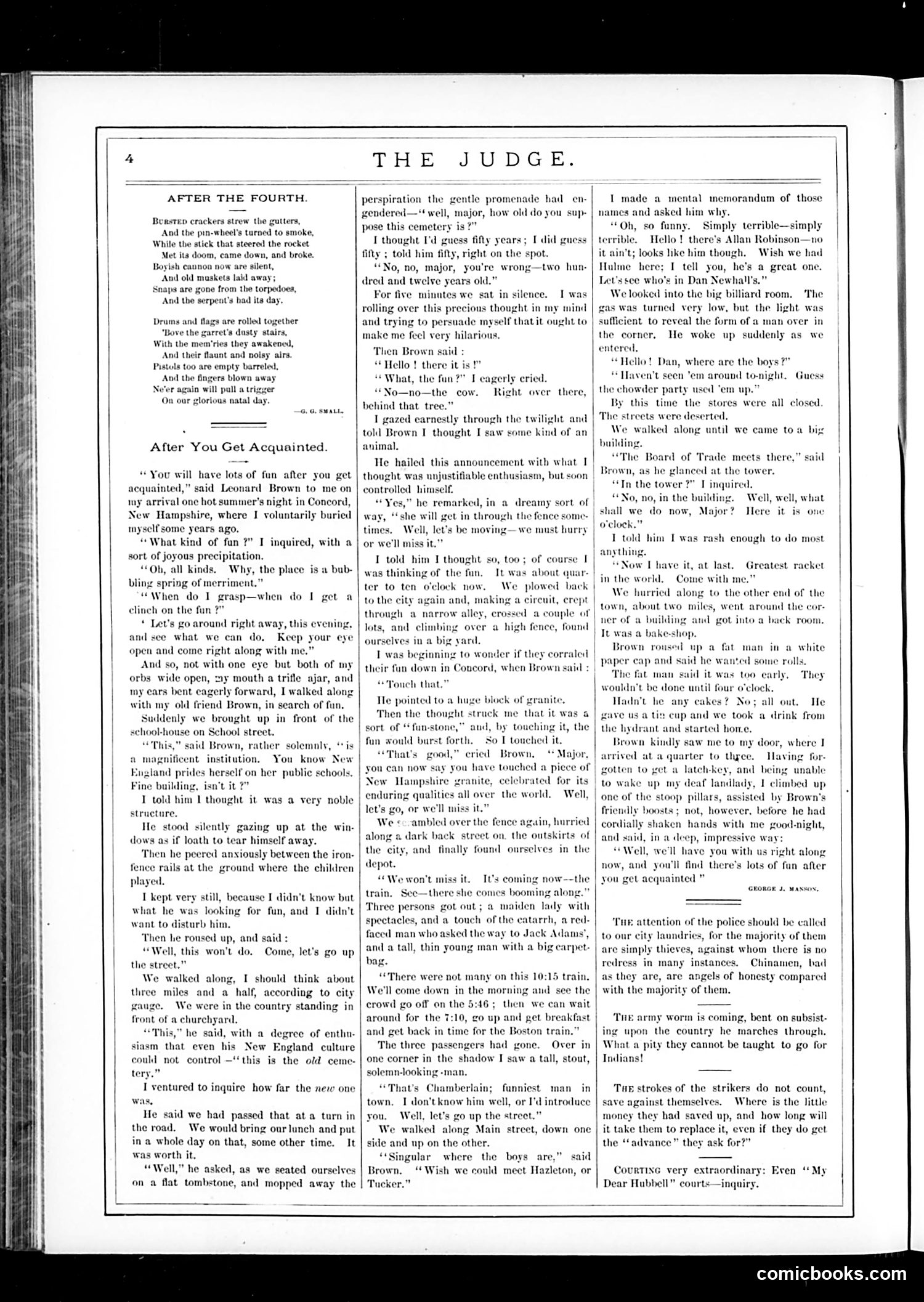
This *Judge* page contains two pieces of humorous writing with no political satire: **"After the Fourth"** is a sentimental poem by O.O. Shall lamenting the end of Independence Day celebrations—spent fireworks, silent cannons, and stored-away flags. It's nostalgic Americana, not political commentary. **"After You Get Acquainted"** is a comedic short story about a visitor to Concord, New Hampshire, whose friend Leonard Brown promises "fun" but delivers tedious local attractions instead: a schoolhouse, then a cemetery where they sit on tombstones watching for a cow. The humor lies in the anticlimax—the friend's earnest pride in mundane sights contrasted with the narrator's mounting boredom. Neither piece targets specific political figures or contemporary events. Both are general-interest humor pieces typical of *Judge*'s lighter content. The page appears to be primarily literary/entertainment rather than satirical commentary.
📄 Transcribed text from this page (OCR, searchable)
Machine-transcribed from the original scan — historical spelling and the odd misread are preserved.
AFTER THE FOURTH. Berstex rs strew the gutters, And the pin-wheel’s turned to smoke, While the stick that steered the rocket Met its doom, came down, and broke. Boyish cannon now are silent, And old muskets laid awa; Snaps are gone from the torpedoes, ‘And the serpent’s bad its day, cracl Drums and flags are rolled together "Bove the garret’s dusty stairs, With the mem'ries they awakened, And their flaunt and noisy airs. Pistols too are empty barreled, And the fingers blown away F again will pall a trigger On our glorious natal day. 0, 0. SHALL. After You Get Acquainted. “You will have lots of fun after you get acquainted,” said Leonard Brown to me on my arrival one hot summer's night in Concord, New Hampshire, where I voluntarily buried myself some years ago. “What kind of fun ?” I inquired, with a sort of joyous precipitation. “Oh, all kinds. Why, the place is bling spring of merriment.” “When do I grasp—when do 1 clinch on the fun 7 * Let's go around right away, this evening, and see what we can do, Keep your eye open and come right along with me.” And so, not with one eye but both of my orbs wide open, my mouth a trifle ajar, and my cars bent eagerly forward, I walked along with my old friend Brown, in search of fun. Suddenly we brought up in front of the school-house on School street. This,” said Brown, rather solemnly, ‘is magnificent: institution. You know Ne: zland prides herself on her public schools. “ine building, isn’t it 2” I told him I thought it was a very noble structure. He stood silently gazing up at the win- dows as if loath to tear himself away. Then he peered anxiously between the iron- fence rails at the ground where the children played. a bub- a I kept very still, because I didn't know but what he was looking for fun, and I didn't want to disturb him. Then he roused up, and said: “Well, this won't do. the street.” We walked along, I should think about three miles and a half, according to city We were in the country standing in ont of a churchyard. Come, let's go up gauge. fi his,” he said, with a degree of enthu- siasm that even his New England culture could not control —‘this is the old ceme- tery.” I ventured to inquire how far the new one was, He said we had passed that ata turn in the road, We would bring our lunch and put in a whole day on that, some other time. It was worth it. “Well,” he asked, as we seated ourselves on a flat tombstone, and mopped away the THE JUDGE. perspiration the gentle promenade had en- gendered—* well, major, how old do you sup- pose this cemetery is ?” I thought I'd guess fifty yea fifty ; told him fifty, right on th “No, no, major, you're wron dred and twelve years old.” For five minutes we sat in silence, I was rolling over this precions thought in my mind and trying to persuade myself thatit ought to make me feel very hilarious. T did guess | spot. —two hun- Then Brown said “Hello ! there it is “What, the fun?” No—no—the cov behind that tree.” I gazed earnestly through the twilight and | told Brown I thought I saw some kind of an nimal. ly cried. Right ” 1 We over there, He hailed this announcement with what 1 thought was unjustifiable enthusiasm, but soon controlled himself. “Yes,” he remarked, in a dreamy sort of y, ‘she will get in through the fence some- times. Well, let's be movi or we'll miss it.” we must hurry I told him I thought so, too; of course I was thinking of the fun, It was about quar- ter to ten o'clock 1 We plowed back | to the city again and, making through a narrow alley, crossed a couple of and climbing over a high fence, found ourselves in a big yard. inning to wont their fan down in Concord, when Brown “Touch that,” He pointed to a huge block of granite, Then the thought struck me that it w | sort of “fun-stone,” aud, by touching it, the | fun would burst forth. So T touched it. | “That's good,” eried Brown, | yon can now say you have touched a piece of | New Hampshire granite, celebrated for its enduring qualities all over the world. Well, Dw, circuit, crept | let's go, or we'll miss it.” We «ambled over the fence again, hurried along a dark back street on. the outskirts of the city, and finally found ourselves in the depot. It's coming now--the train. See—ther es booming alot Three persons got out; a maiden lady with spectacles, and a touch of the eatarrh, a red- faced man who asked the way to Jack Adams’, and a tall, thin young man with a big carp. bag. it. eshe ¢ “We won't mi: “There were not many on this 10:15 train, We'll come down in the morning and see the crowd go off on the 5:46 can wait around for the 7:10, go up and get breakfast | and get back in time for the Boston train.” The three passengers had gone. Over in one corner in the shadow I saw a tall, stout, solemn-looking «man, “That's town. then w Chamberlain; funniest man in I don'tknow him well, or I'd introduce Well, let's go up the street.” We walked along Main street, down one | side and up on the other. “Singular where the Brown. Wish we could Tucker.” you. boys are,” said mect Hazleton, or I made a mental memorandum of those names and asked him why. “Oh, so fanny. Simply terrible—simply terrible. Hello! there's Allan Robinson—no it ain't; looks ike him though. Wish we had Hulne here: I tell you, he’s a great one. Let's sce who's in Dan Newhall’s.” We looked into the big billiard room. ‘The gas was turned very low, but the light v sufficient to reveal the form of a man over in the corner. He woke up suddenly as we entered. Hello! Dan, where are the boys “Haven't seen ‘em around to-night. the chowder party used ‘em up.” By this time the stores were all closed The streets were deserted, Guess We walked along until we came toa bis building. “The Board of Trade meets ther Brown, as he glanced at the tower. “In the tower 2” I inquired. “No, no, in the building. Well, well, what shall we do now, Major? Here it o'clock.” I told him I anything. “Now [have it, at last. Greatest racket in the world. Come with me.” We hurried along to the other end of the town, about two miles, went around the ¢ ner of a building and got int It was a bake-shop. Brown roused) up a fat man in a white reap and said he wanted some rolls. id it was too early, They $s rash enough to do most a back room. ut mnvsann wouldn't be done until four o'clock, Hadn't he any cakes? No; all ont. ¢ us atin cup and we took a the hydrant and started hore. Brown kindly saw me to m Ile drink from door, where arrived at a quarter to three. Having for- gotten to get a lateh-key, and being unable to wake up my deaf landlady, 1 climbed up sisted by Brown's friendly boosts; not, however. before he had cordially shaken hands with me good-night, and said, in a deep, impressive way: “Well, we'll have you with us right along now, and you'll find there's lots of fun afer you get acquainted " one of the stoop pillars, a GRORGE 4, MANSON. should be called for the majority of them ‘Tur: attention of the polic to our city laundrie | are simply thieves, against whom there is no redress in many instances. Chinamen, bad as they are, are angels of honesty compared with the majority of them. ‘The army worm is coming, bent on subsist- ing upon the country he marches through, What a pity they cannot be taught to go for Ind ! Tur strokes of the strikers do not count, save against themselves. Where is the little money they had saved up, and how long will it take them to replace it, even if they do get the “advance” they ask for?” CourTING very extraordina Dear Hubbell” courts—inquiry Even “My comicbooks.com