
A complete issue · 16 pages · 1882
Judge — July 8, 1882
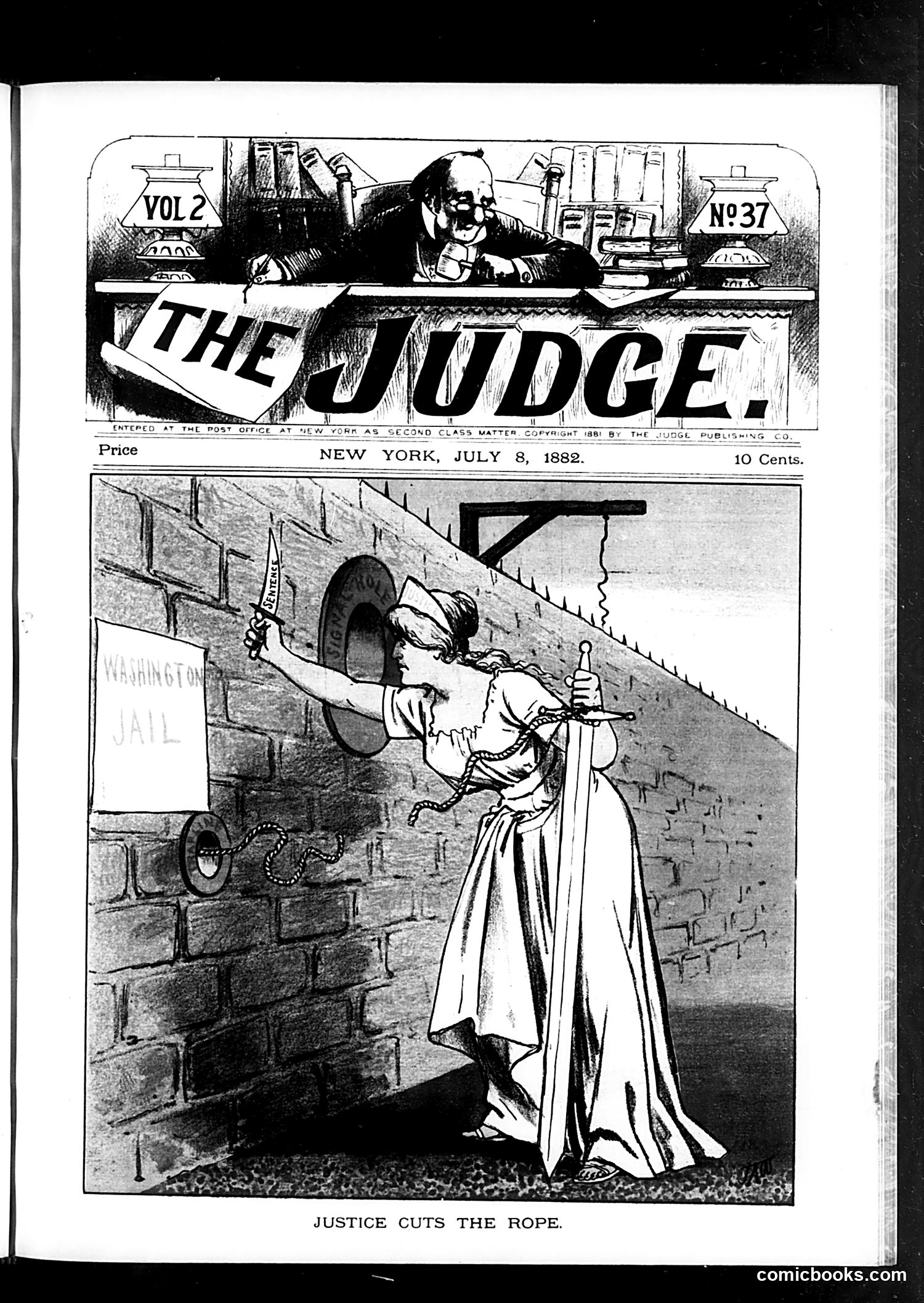
This satirical cartoon depicts Lady Justice cutting a noose from a Washington Jail sign, likely referencing a high-profile legal case or execution stayed in summer 1882. Justice, personified as a blindfolded woman with sword and scales, intervenes to prevent what the cartoonist implies was an unjust hanging. The title suggests the satire criticizes either: - An execution the cartoonist viewed as miscarriage of justice - Political corruption preventing proper legal proceedings - A controversial death sentence being carried out Without identifying the specific 1882 case, the cartoon's message is clear: Judge magazine's editors believed legal intervention was necessary to correct a grave judicial wrong. The imagery of Justice herself acting emphasizes the moral imperative to overturn the decision.
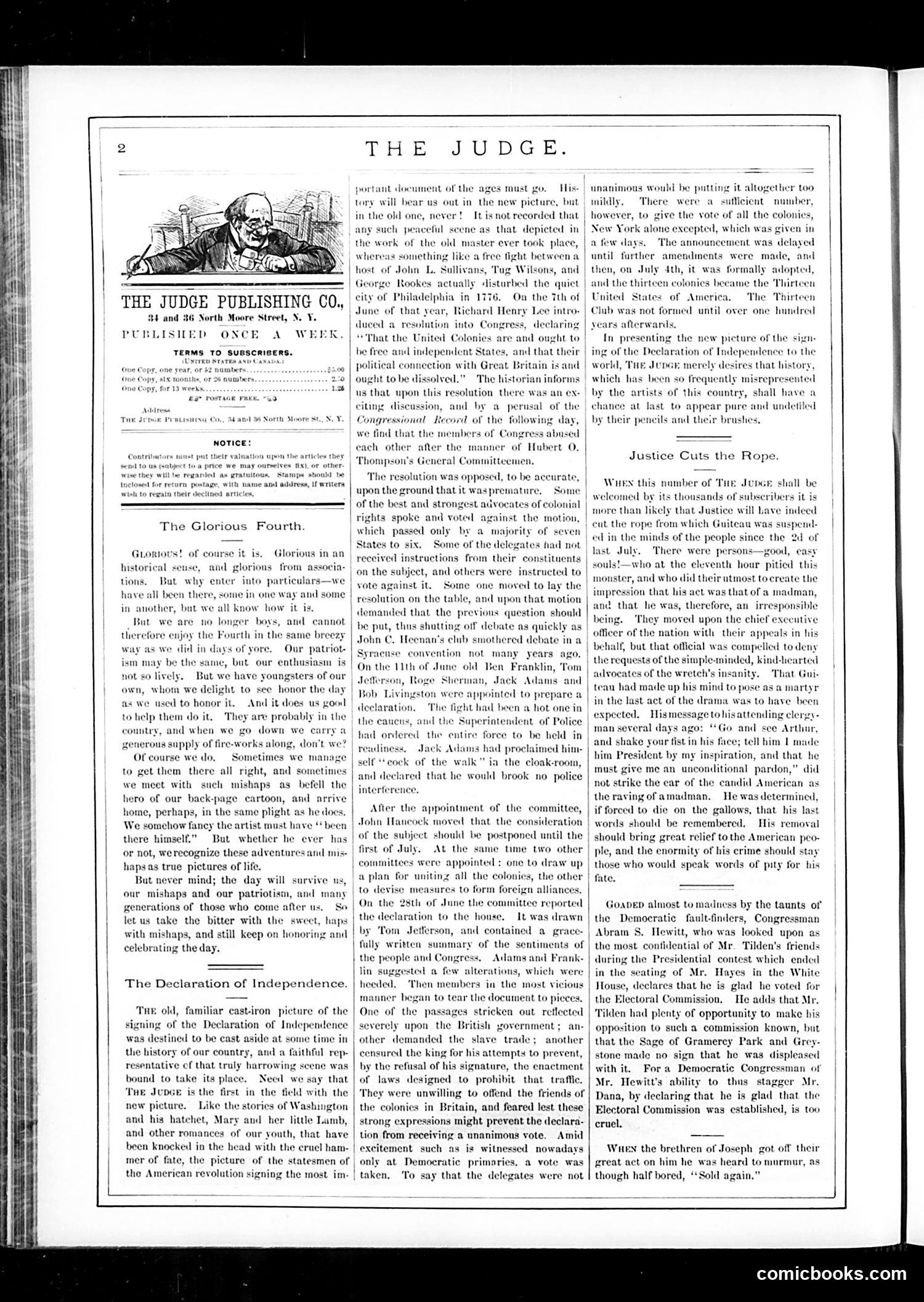
This page from *Judge* magazine contains two main pieces of political satire: **"The Glorious Fourth"** (top): A humorous essay about celebrating Independence Day as adults. The author notes that while Fourth of July celebrations remain important, adults no longer enjoy them with childish enthusiasm—though they dutifully arrange fireworks for their own children. The accompanying back-page cartoon apparently depicts someone arriving home injured from firecracker mishaps, illustrating the essay's tongue-in-cheek point about the hazards of patriotic celebration. **"The Declaration of Independence"** (bottom): *Judge* claims to present a "new picture" of the Declaration signing, arguing the famous Trumbull painting is historically inaccurate. The satire suggests the actual event resembled a violent brawl—comparing it to contemporary street fights involving boxers like John L. Sullivan. The piece mocks Congressional debate as crude name-calling, comparing it to disputes in Hubert O. Thompson's (likely a political figure's) committee meetings. The implicit joke: the Founders were no more dignified than modern politicians.
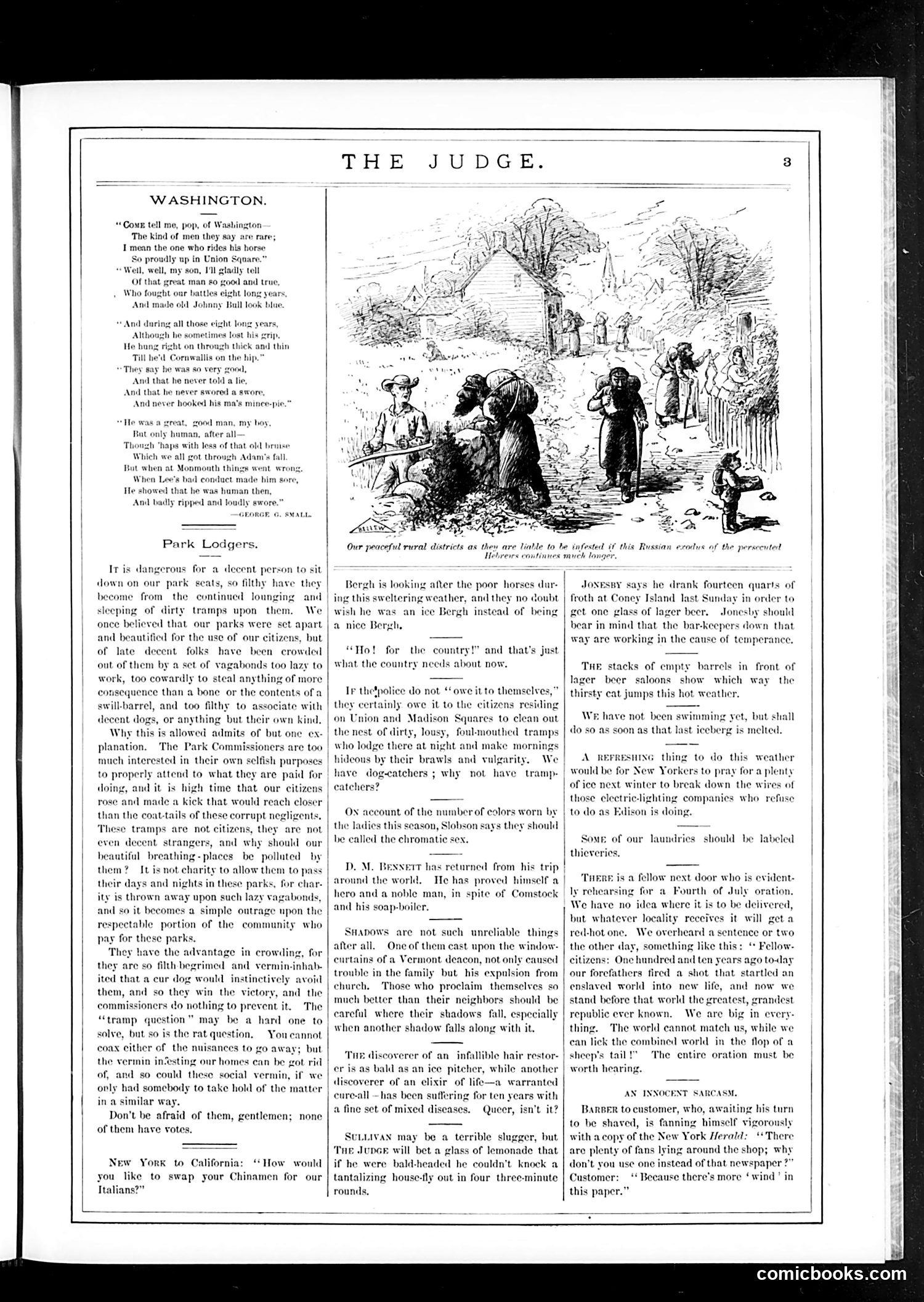
This page contains satirical commentary on several 1880s social issues: **"Washington" poem**: Mocks the idealized myth of George Washington, contrasting his legendary virtue with his actual human flaws—specifically his swearing and anger during the Revolutionary War battle of Monmouth when General Lee's conduct infuriated him. The satire punctures the hagiographic image. **"Park Lodgers"**: A scathing editorial attack on vagrant tramps occupying New York City parks, rendering them unusable for respectable citizens. The piece condemns park commissioners as negligent and suggests vagrants should be removed like vermin—harshly advocating against charity toward the homeless as counterproductive. **Brief items**: Include a jab at Henry Bergh (animal welfare activist) conflating his name with "ice," commentary on women's colorful fashion, and a joke about shadows causing scandal. The page reflects Gilded Age anxieties about urban decay, vagrancy, and social disorder, while defending established authority and dismissing compassion for the poor.
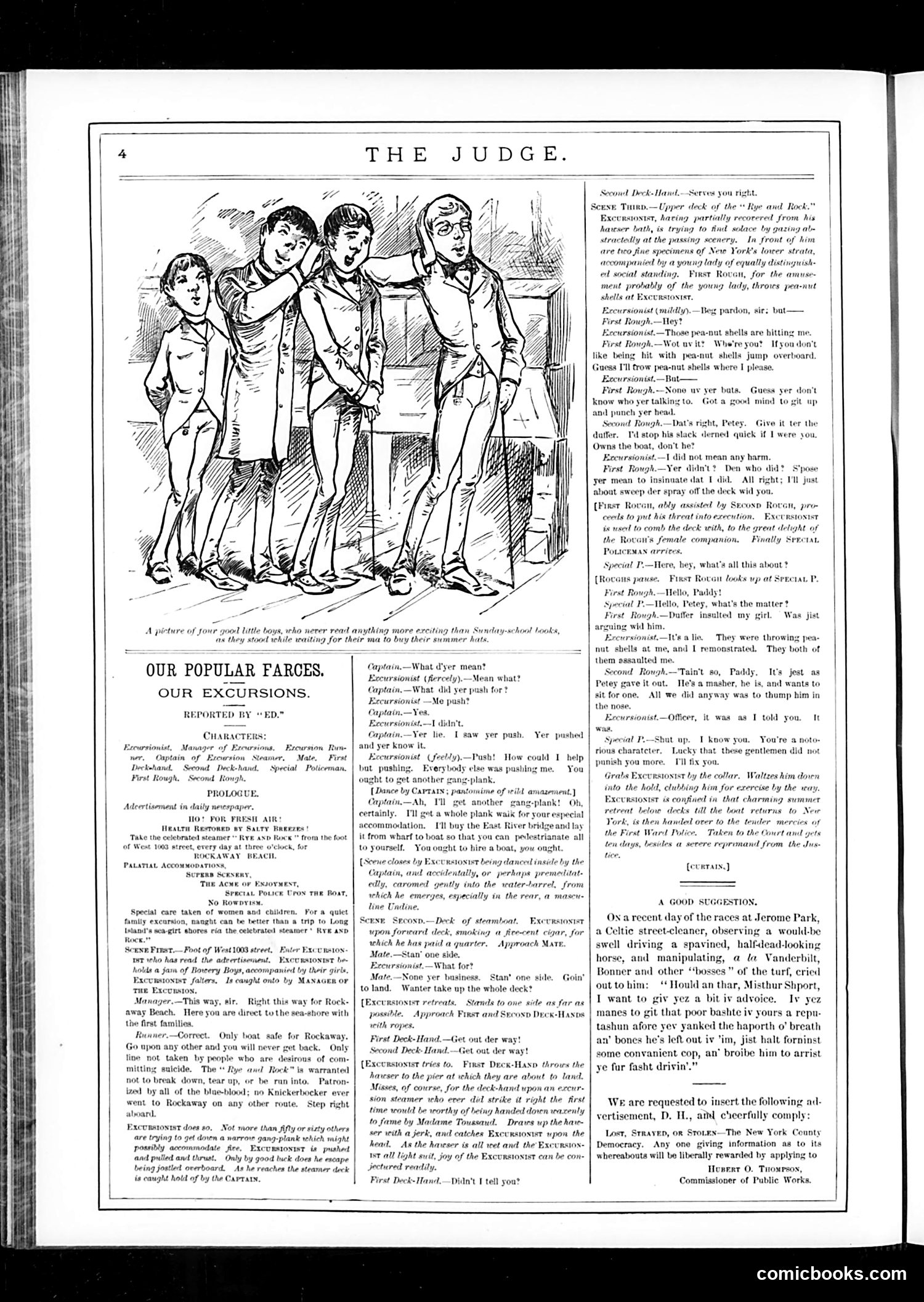
This page satirizes the false advertising and poor service of excursion steamboat trips in late 19th-century New York. The cartoon "Our Popular Farces: Our Excursions" mocks the gap between promotional promises and reality. **The Setup:** Advertisements promise a luxurious journey on the "Rye and Rock" steamer to Rockaway Beach with "palatial accommodations" and "superior scenery." **The Reality:** An excursionist boarding the boat experiences chaos—overcrowded gangplanks, aggressive crew members, and indignities. He's shoved around, insulted by the captain, ordered about by deckhands, and ultimately struck in the head by a wet rope. **The Point:** Judge ridicules both the deceptive advertising and the working-class tourists ("Bowery Boys") who fall for it. The comedy lies in exposing how vacation promises dissolve into humiliation—a commentary on commercial dishonesty and the rough treatment of paying customers by indifferent laborers.
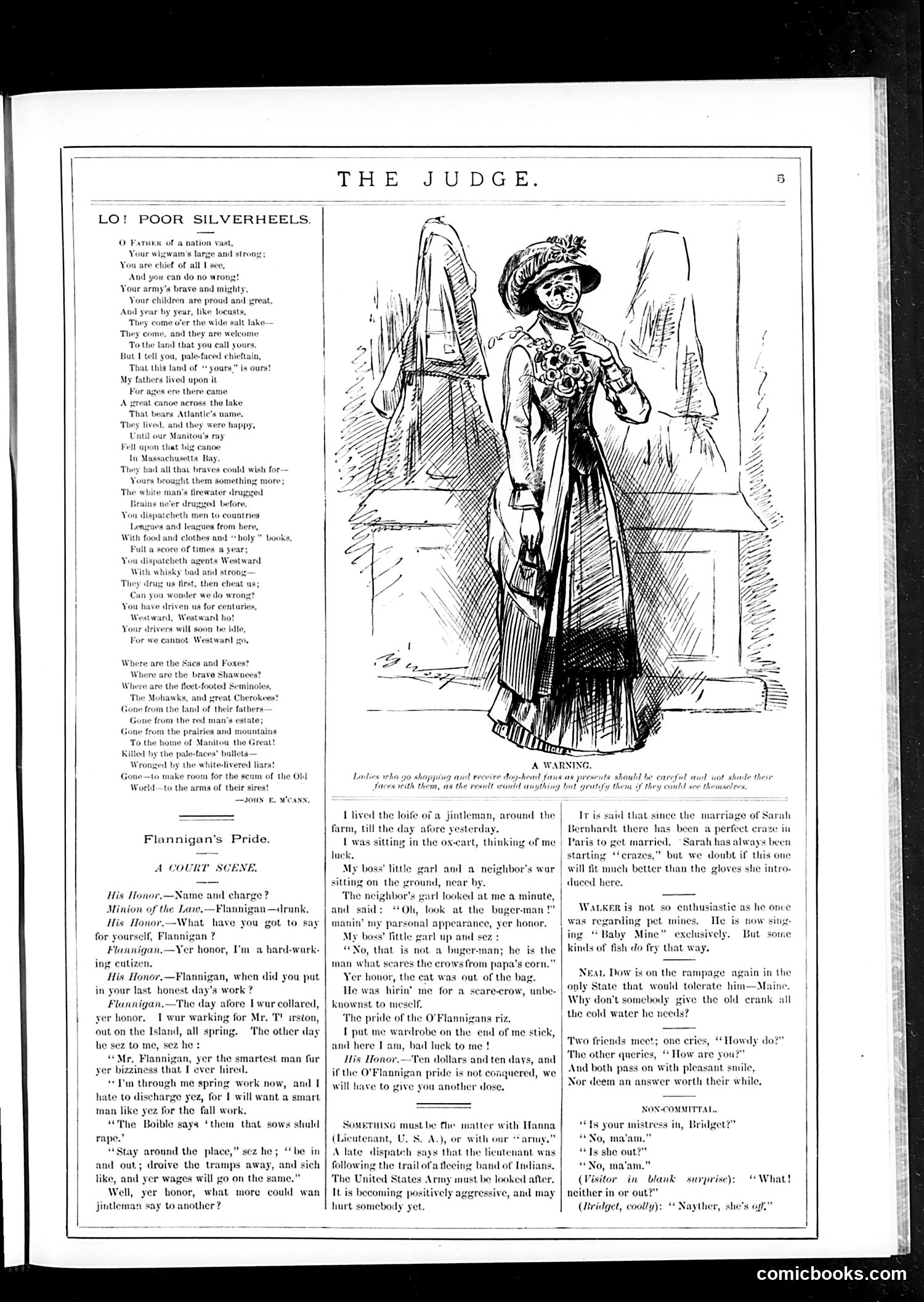
The main poem on this page is a Native American lament about westward expansion and forced removal. Speaking through an indigenous voice, it catalogs historical injustices: broken treaties, alcohol-fueled manipulation, systematic westward displacement of tribes (Sac, Fox, Shawnee, Seminole, Mohawk, Cherokee), and the broken promise that Indians could keep their ancestral lands. The satire critiques American expansion rhetoric by inverting it—showing expansion not as "progress" but as systematic theft and cultural destruction. The repeated "Westward, Westward ho!" mockingly echoes the era's expansionist slogan while documenting its human cost. The accompanying cartoon "A Warning" depicts an elegantly-dressed woman, likely representing civilization or America, standing over what appears to be the dispossessed—illustrating the violent contradiction between America's self-image and its treatment of Native peoples. The page's other content (a court humor piece about "Flannigan's Pride") is unrelated social satire about Irish immigrants, a common Judge magazine target.
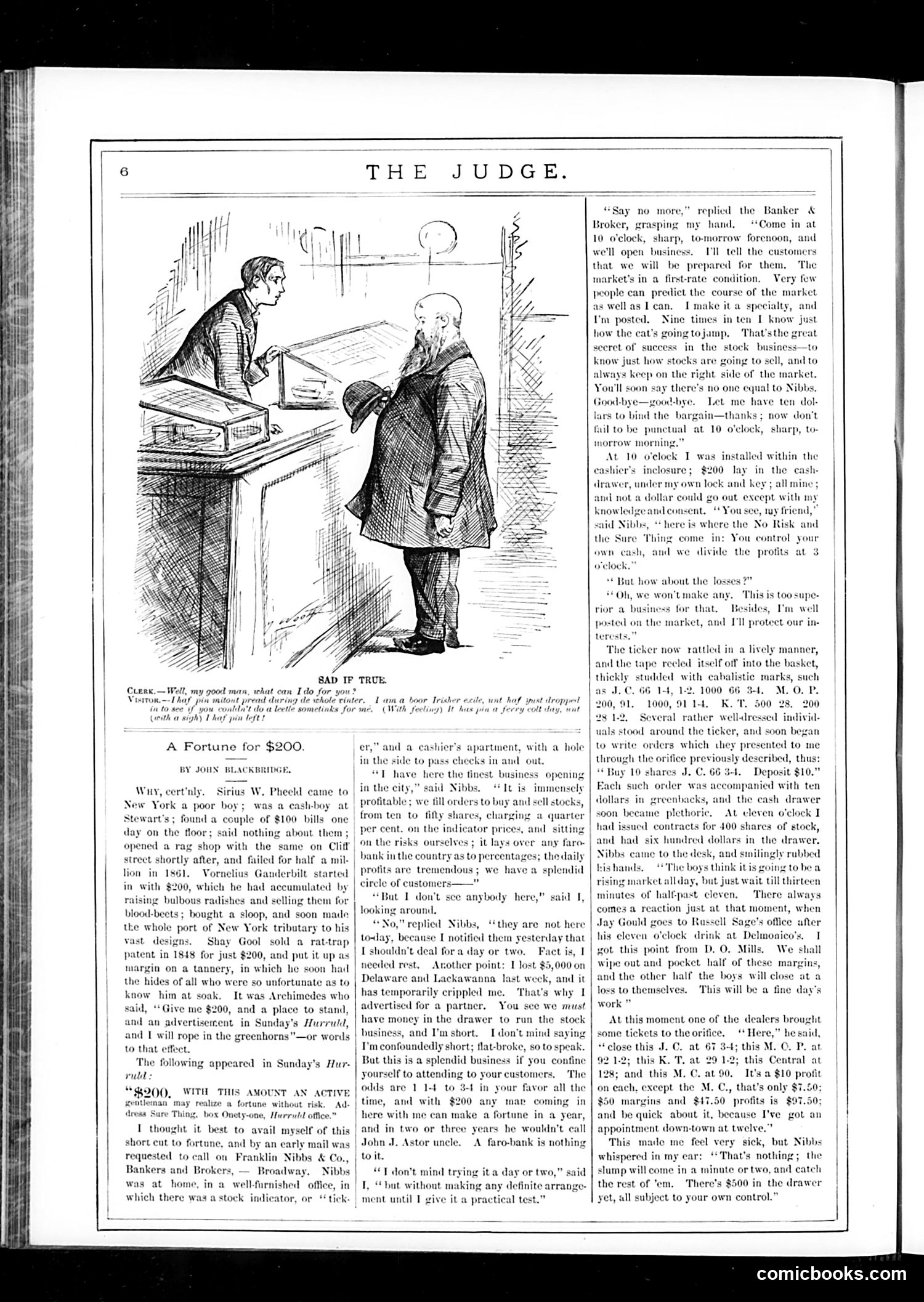
This page satirizes fraudulent stock-market investment schemes popular in the Gilded Age. The story, by John Blackbridge, follows a naive man who responds to an advertisement promising quick wealth with just $200 capital. The con artist "Franklin Nibbs" (a Banker & Broker) uses classic fraud tactics: flattery, exaggerated promises of easy profits, claims of insider knowledge about market movements, and urgency ("come in at 10 o'clock sharp"). Crucially, Nibbs admits he's "flat-broke" and lost $5,000—yet still pitches himself as an infallible predictor of stock movements. The illustration shows Nibbs at his desk with the mark, while the text reveals the setup: the victim controls money in a locked drawer, but Nibbs handles actual trading. The scheme's appeal to ordinary people seeking rapid wealth, combined with obvious red flags the protagonist ignores, illustrates how such scams exploited financial ambition and ignorance during this era of rampant market manipulation.
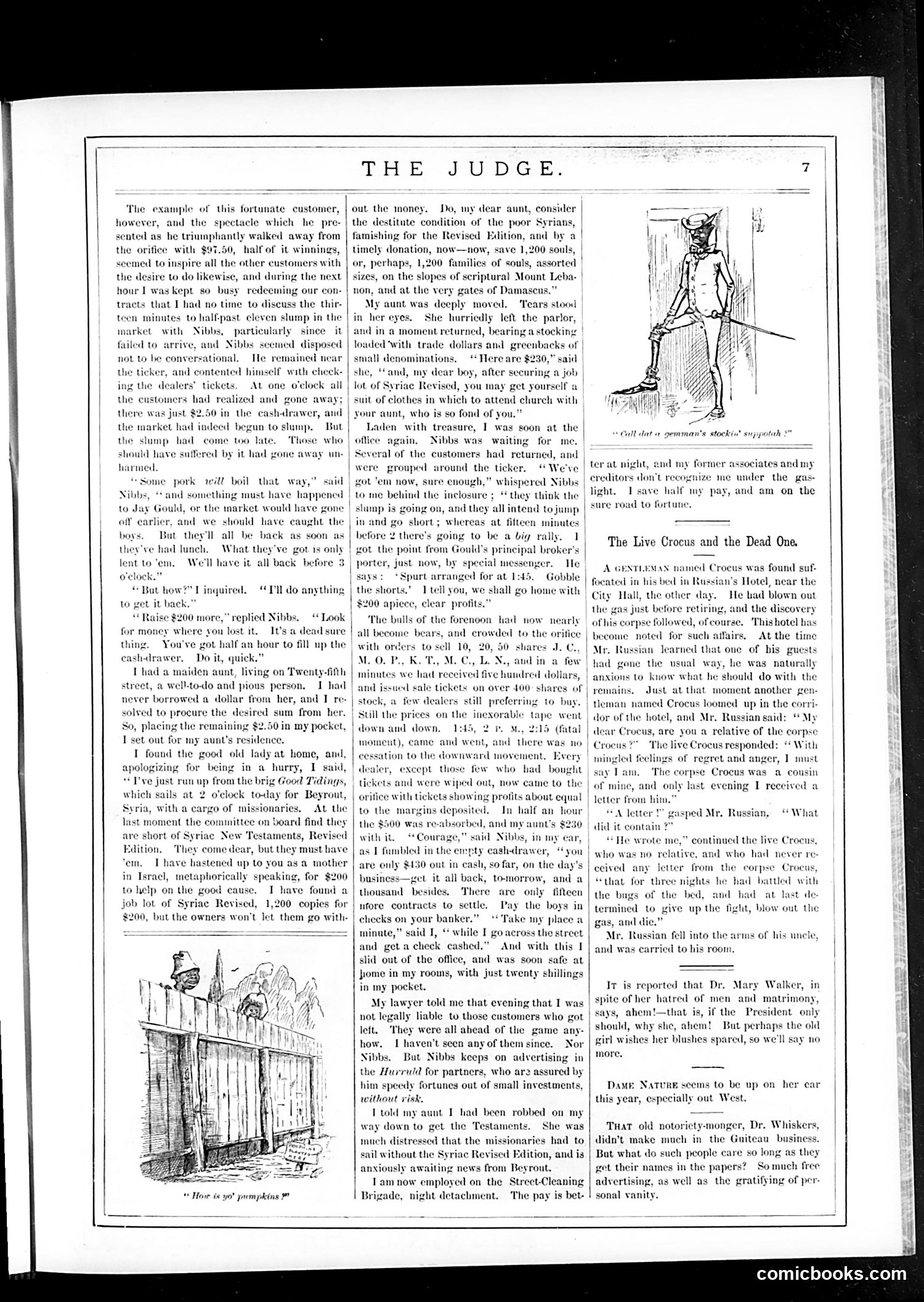
This page from *Judge* satirizes financial speculation and religious hypocrisy in the late 19th century. The main narrative concerns a stock-market bucket shop (illegal gambling operation on price movements) where customers place bets on market fluctuations. The satire centers on the protagonist's aunt—a "pious person" who donates $200 believing she's funding Christian missionaries and Bibles for Syrian relief. In reality, her nephew uses the money to cover gambling losses at the bucket shop. The joke exposes how easily the religious and wealthy were duped by fabricated charitable causes, and how their sanctimoniousness made them vulnerable to manipulation. The accompanying illustrations show scenes from this financial scheme. The satire mocks both greedy speculators betting on stocks and self-righteous donors whose charitable impulses could be exploited through appeals to religious duty—a commentary on Gilded Age excess and moral compromise.
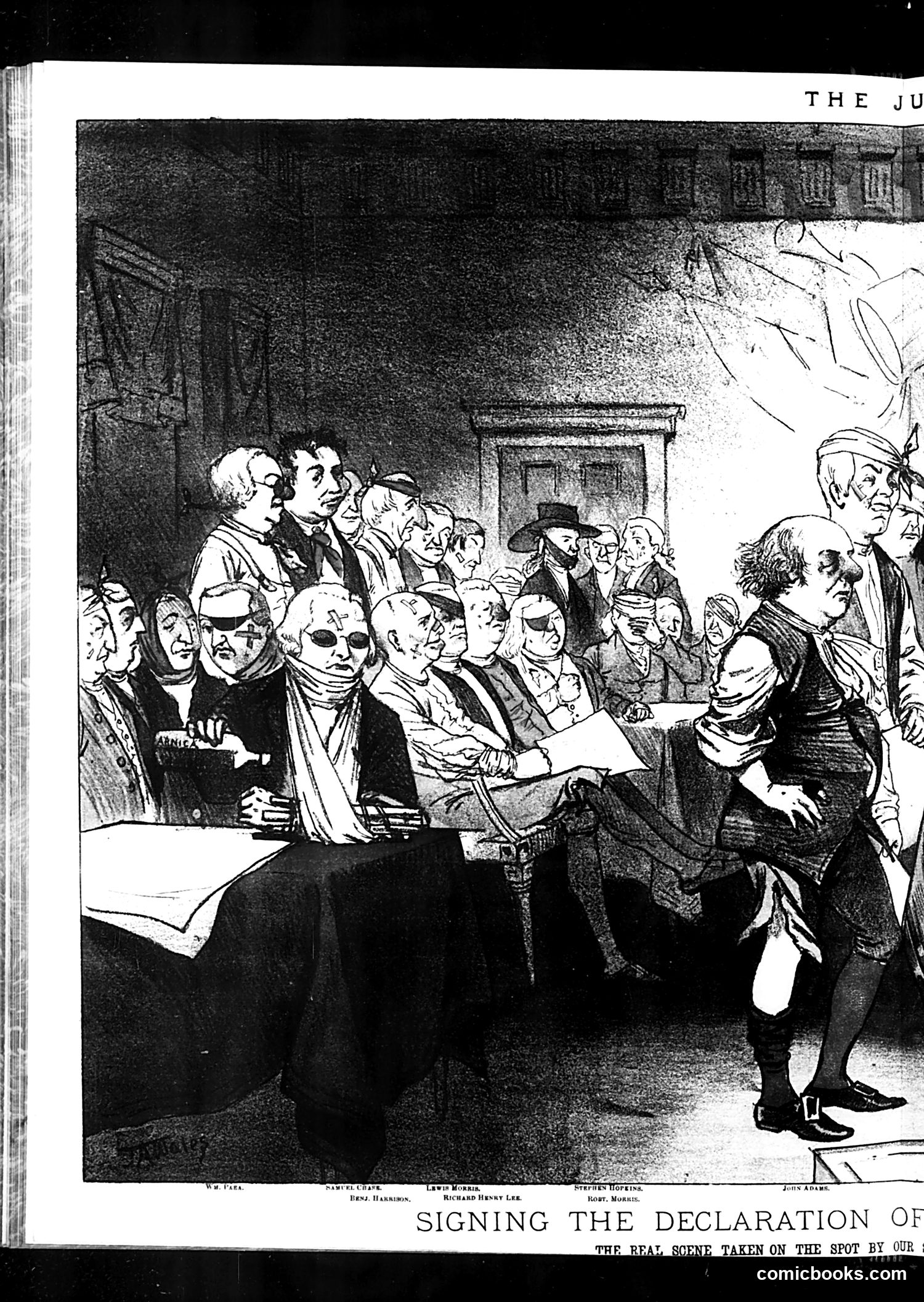
This is a satirical illustration titled "Signing the Declaration of Independence," presented as though it depicts the historical event. However, the caption indicates this shows "the real scene taken on the spot," suggesting Judge magazine is offering a humorous, fictionalized version of what actually occurred. The image depicts a crowded indoor scene with numerous figures in period clothing gathered around a table. The satire likely mocks the solemn historical narrative by portraying the Founding Fathers in an undignified, chaotic manner—showing the event as messy, crowded, and informal rather than the dignified historical moment typically portrayed. The OCR text is partially unclear, but names visible appear to be historical figures, though verification is difficult from this reproduction quality. The joke appears to contrast the idealized historical memory with a more cynical, comedic reimagining.
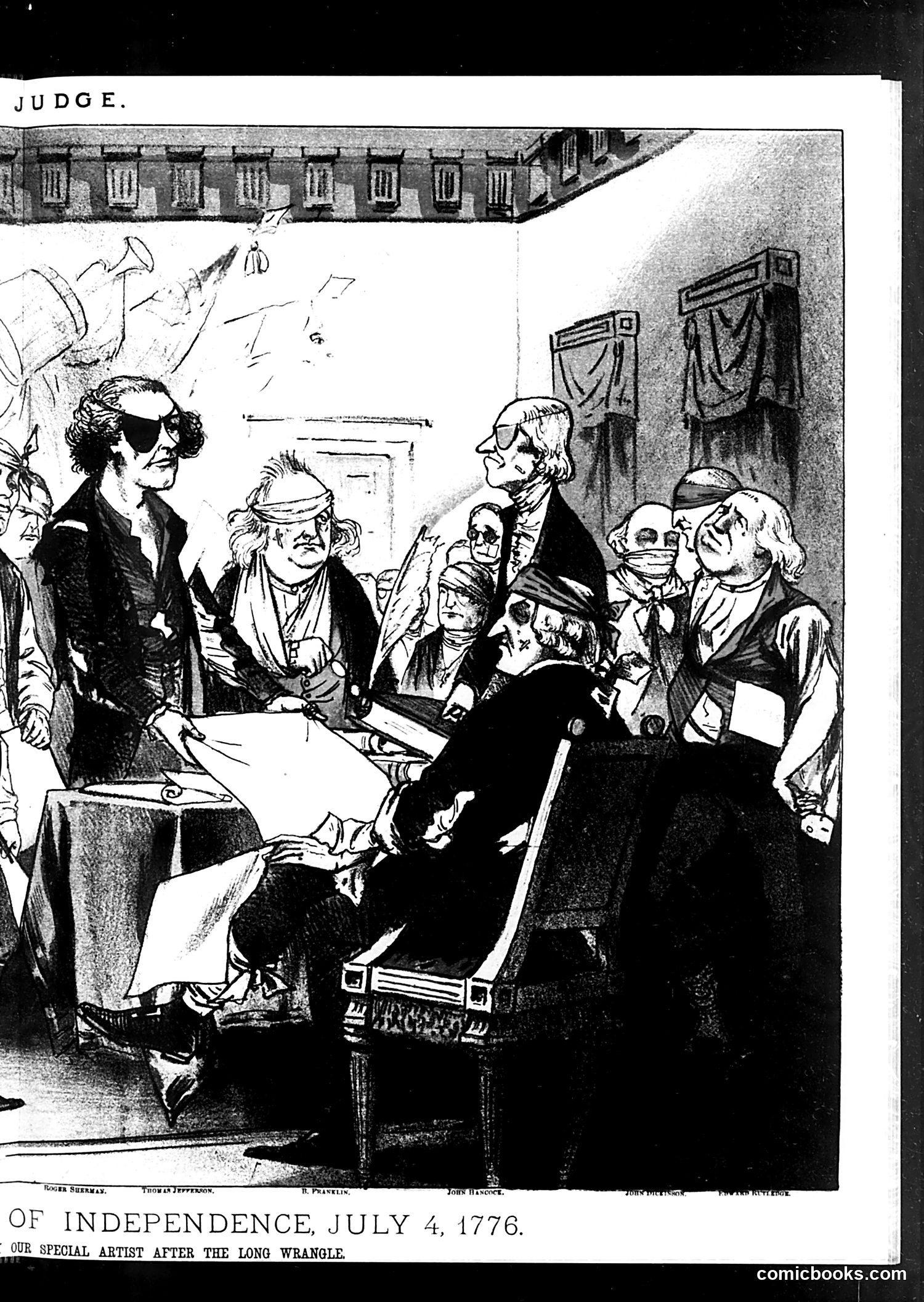
This satirical cartoon depicts the signing of the Declaration of Independence as a courtroom scene. The title "Judge" (the magazine's name) is a pun—here, a literal judge presides over the document's approval. The image shows various Founding Fathers gathered around a seated figure, apparently reviewing the Declaration. The "long wrangle" referenced in the subtitle suggests the cartoon satirizes the extended, contentious debates before the document's adoption on July 4, 1776. The cartoon likely mocks the difficulty of achieving consensus among strong-willed founders with competing interests, presenting their negotiation as a legal proceeding requiring judicial judgment. The specific identities in the crowd are difficult to confirm from the partially legible names at the bottom, but the setting invokes the formal, somewhat absurd nature of this crucial historical moment.
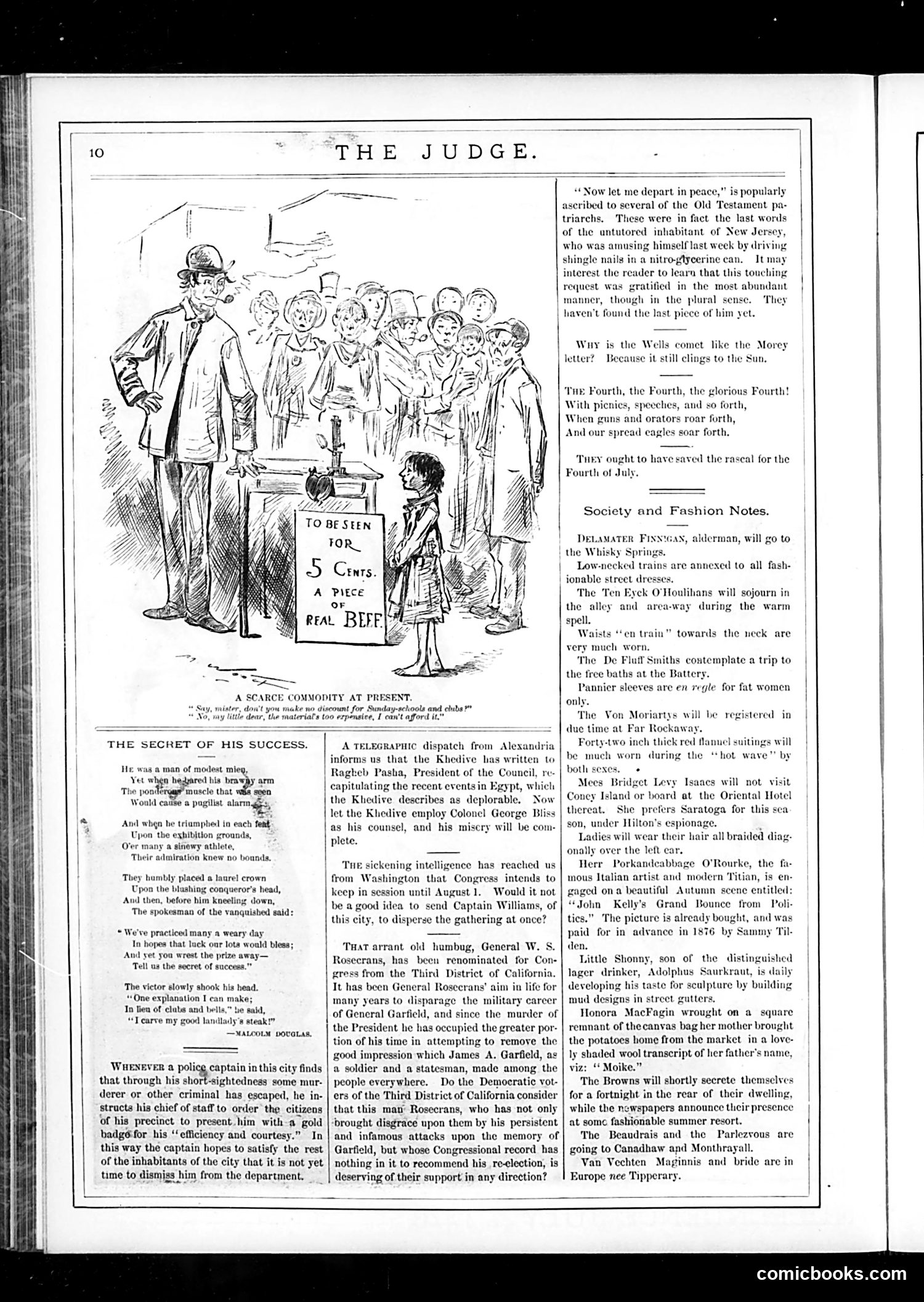
This page contains multiple satirical pieces typical of 1880s American humor journalism. **Main Cartoon ("The Secret of His Success"):** A muscular strongman attributes his wrestling victories to his landlady's steak—a joke about physical vigor derived from good nutrition rather than training or talent. The satire mocks both competitive boasting and working-class dependency on domestic care. **Political Commentary:** The page attacks General W.S. Rosecrans, a Civil War general nominated for Congress, for repeatedly disparaging General Garfield's military record and continuing to attack Garfield's memory even after his assassination. The writer questions why California voters would support someone whose only distinction is denigrating a fallen president. **Other Jokes:** Satirical jabs at police captain incompetence (rewarding himself with badges), Congressional inefficiency, and a dark joke about a New Jersey man killed by nitroglycerin. **Society Notes:** Brief gossip about fashionable elites and working-class Irish families, typical filler content. The overall tone reflects Gilded Age cynicism toward politics, institutions, and social pretension.
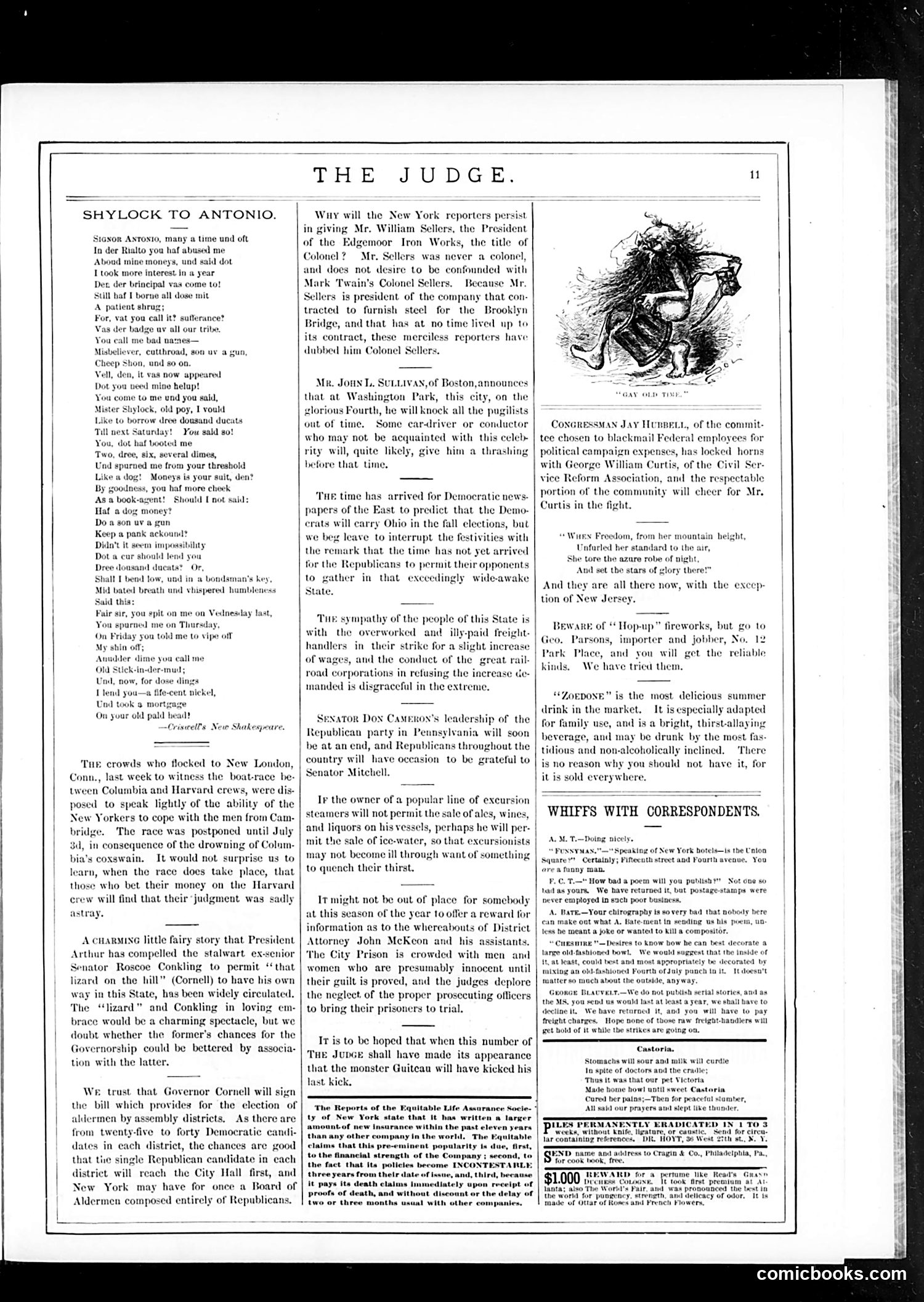
The main cartoon on this page is a dialect-heavy parody of Shakespeare's *Merchant of Venice*, reimagining Shylock's complaint in a heavy Yiddish-inflected accent. This appears to be social satire targeting anti-Semitic stereotypes circulating in 1880s America—by exaggerating the "Jewish moneylender" caricature from Shakespeare's play, the magazine likely mocks both the stereotype itself and contemporary prejudices. The accompanying text discusses various political matters (President Arthur, Roscoe Conkling, Cornell), a complaint about reporters misidentifying William Sellers as "Colonel," and boxing champion John L. Sullivan. The illustration shows an old figure—possibly representing Shylock or a generic Jewish stereotype. Without clearer context about *Judge* magazine's editorial stance on these topics, it's difficult to determine whether this ridicules antisemitism or perpetuates it. The crude dialect transcription suggests the latter is likely.
This is primarily an **advertising page** from Judge magazine, not a satirical cartoon page. The bulk of the content consists of commercial advertisements for E. Ridley & Sons (a New York department store selling summer clothing, millinery, and accessories) and various other products like Lustro polish, Jennings water closets, and Thurber's coffee. However, the page includes a **small illustrated section** in the center featuring brief satirical commentary on social matters: Clara Louise Kellogg (an opera singer) breaking off an engagement with a Philadelphia man of questionable character; criticism of a minister's idea to fill Sunday newspapers with sermons; and jokes about a summer drink called "Jumbo Julep" and Speaker Keifer's funeral expenses. The cartoon illustration appears to show two figures in period dress, likely accompanying one of these brief satirical items, though the specific reference is unclear from the image quality.
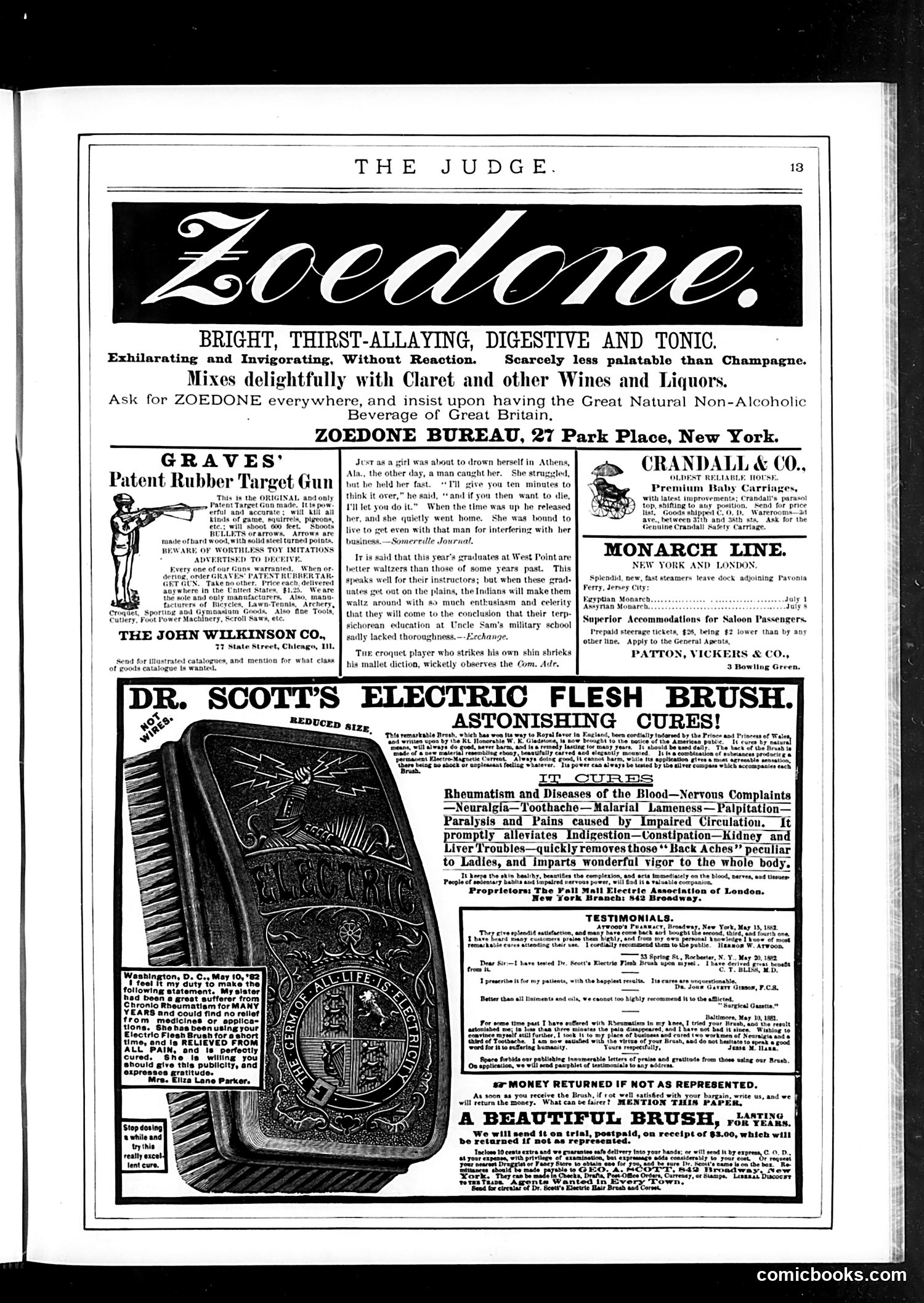
This is primarily an **advertising page** from Judge magazine, not a political cartoon. The page contains multiple product advertisements typical of late 19th-century publications: **Key Advertisements:** - **Zoedone**: A non-alcoholic "digestive tonic" beverage marketed as an alternative to champagne - **Graves' Patent Rubber Target Gun**: A children's toy gun with safety warnings - **Dr. Scott's Electric Flesh Brush**: A pseudoscientific electrical device claiming to cure rheumatism, neuralgia, paralysis, and various ailments through "electric" stimulation **Historical Context:** These ads reflect the era's fascination with electrical devices as cure-alls and the prevalence of dubious patent medicines. The testimonials and money-back guarantees were common sales tactics. Minor humorous filler text appears (anecdotes about West Point graduates and croquet), but this page is primarily commercial rather than satirical content.
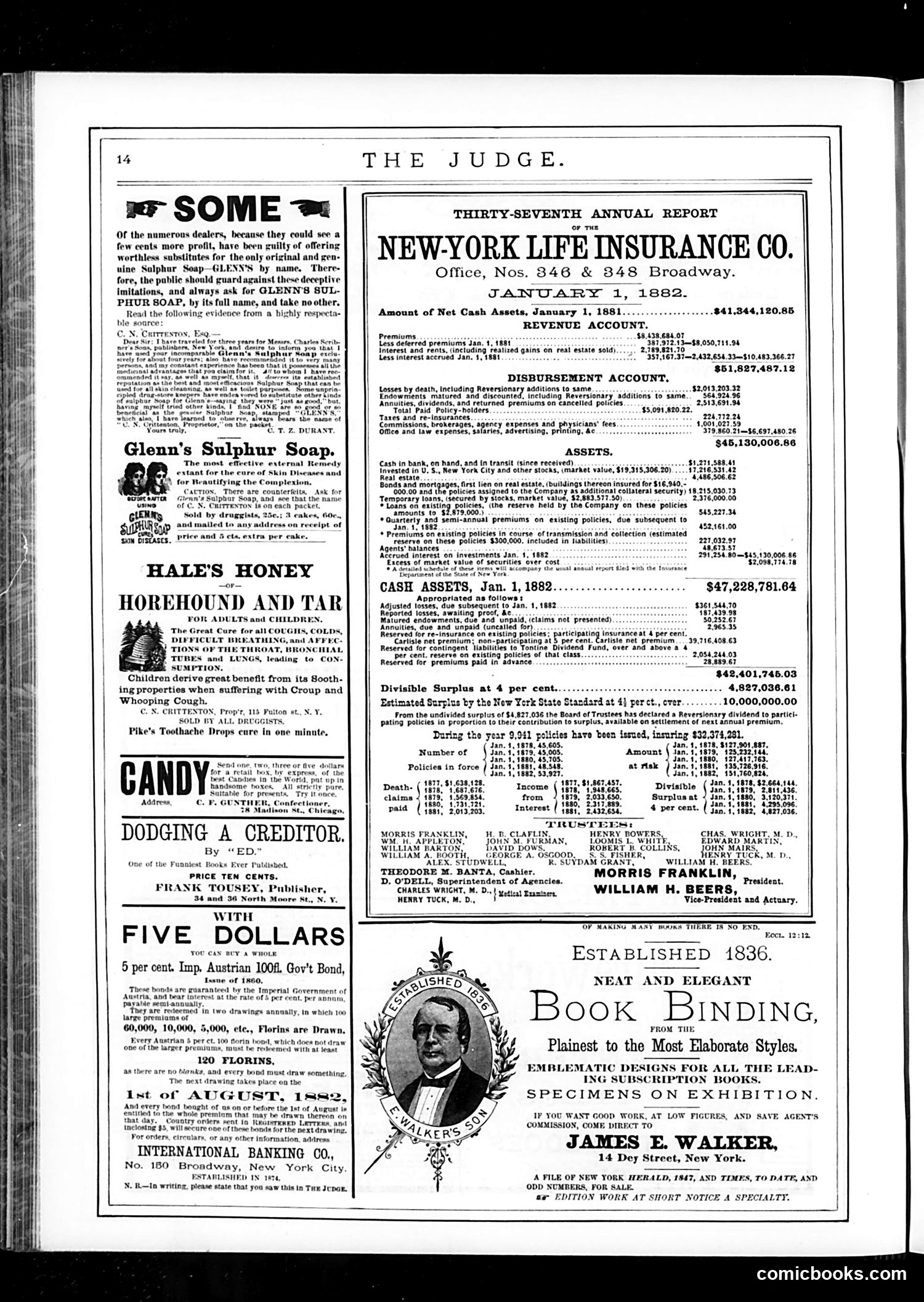
This is primarily a **financial/corporate page**, not a satirical cartoon. It contains the 37th annual report of New York Life Insurance Company (January 1, 1882), detailing assets, revenues, and disbursements—essentially a corporate financial statement. The page is **surrounded by period advertisements** (Glenn's Sulphur Soap, Hale's Honey, candy, toothache drops, and Austrian bonds), which was typical for Judge magazine's revenue model. There is **no political cartoon or satire visible** on this page. The small item titled "DODGING A CREDITOR" by "ED" appears to be a short humorous story (not shown in detail), but it's ancillary to the insurance report. **For modern readers**: This page illustrates how 19th-century satirical magazines funded themselves through advertising while also publishing financial notices and corporate reports alongside humor and social commentary.
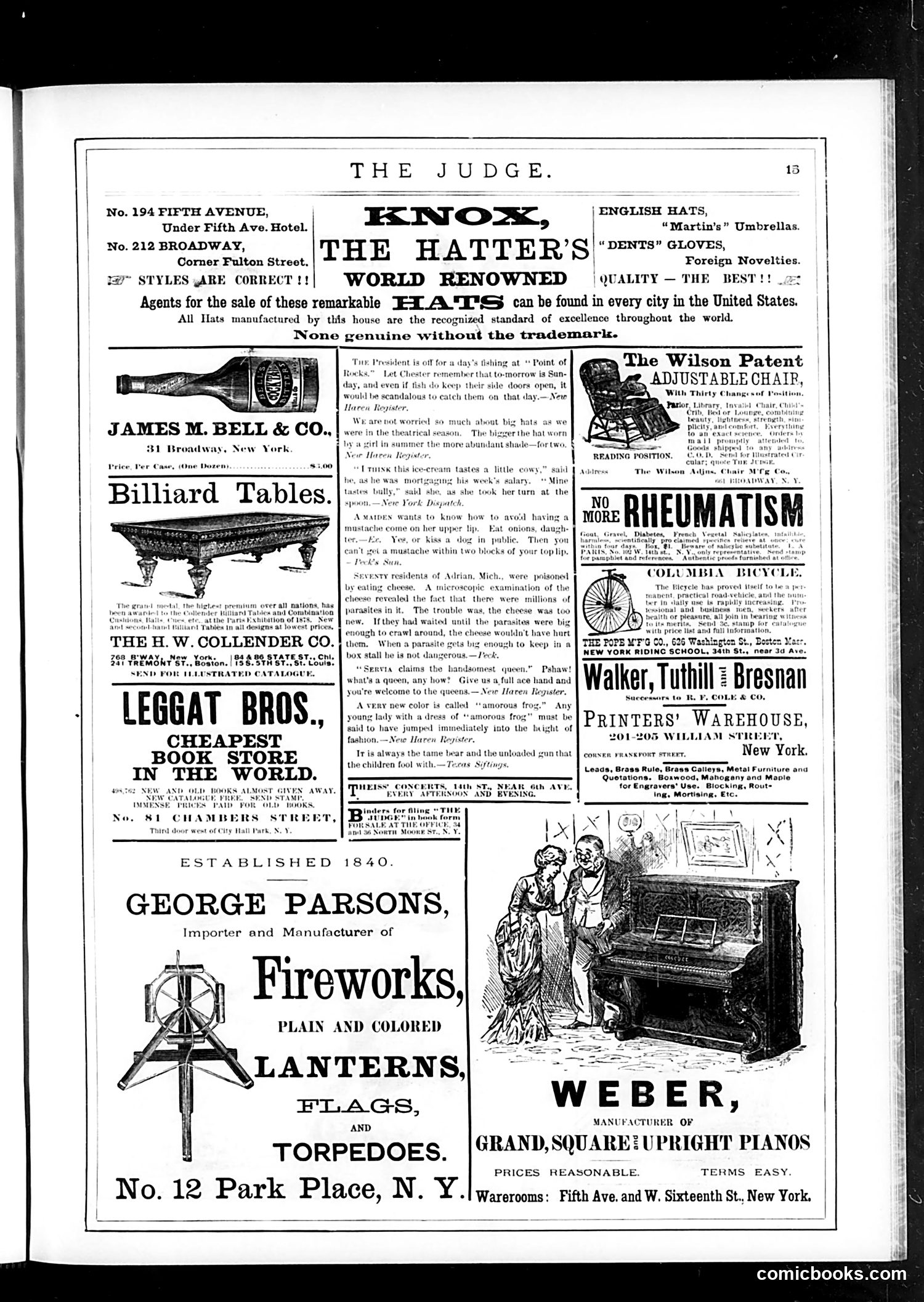
This is primarily an **advertising page** from Judge magazine, not a political cartoon. The page consists almost entirely of commercial advertisements for products and services circa the 1880s-1890s. Key advertisers include Knox (a famous hat manufacturer), James M. Bell & Co. (billiard tables), Leggat Bros. (book store), George Parsons (fireworks and lanterns), and Weber (pianos). There's also an advertisement for the Wilson Patent Adjustable Chair and the New York Riding School. The only apparent editorial content is a small humorous anecdote about visiting the theater—appearing to be a brief joke about avoiding the actress's "song" by keeping a pet bird in the theater box. **For modern readers:** This reflects 19th-century New York commercial life, showing products and entertainment venues that were popular among the magazine's audience. The page demonstrates how Judge subsidized satirical content through extensive paid advertising.
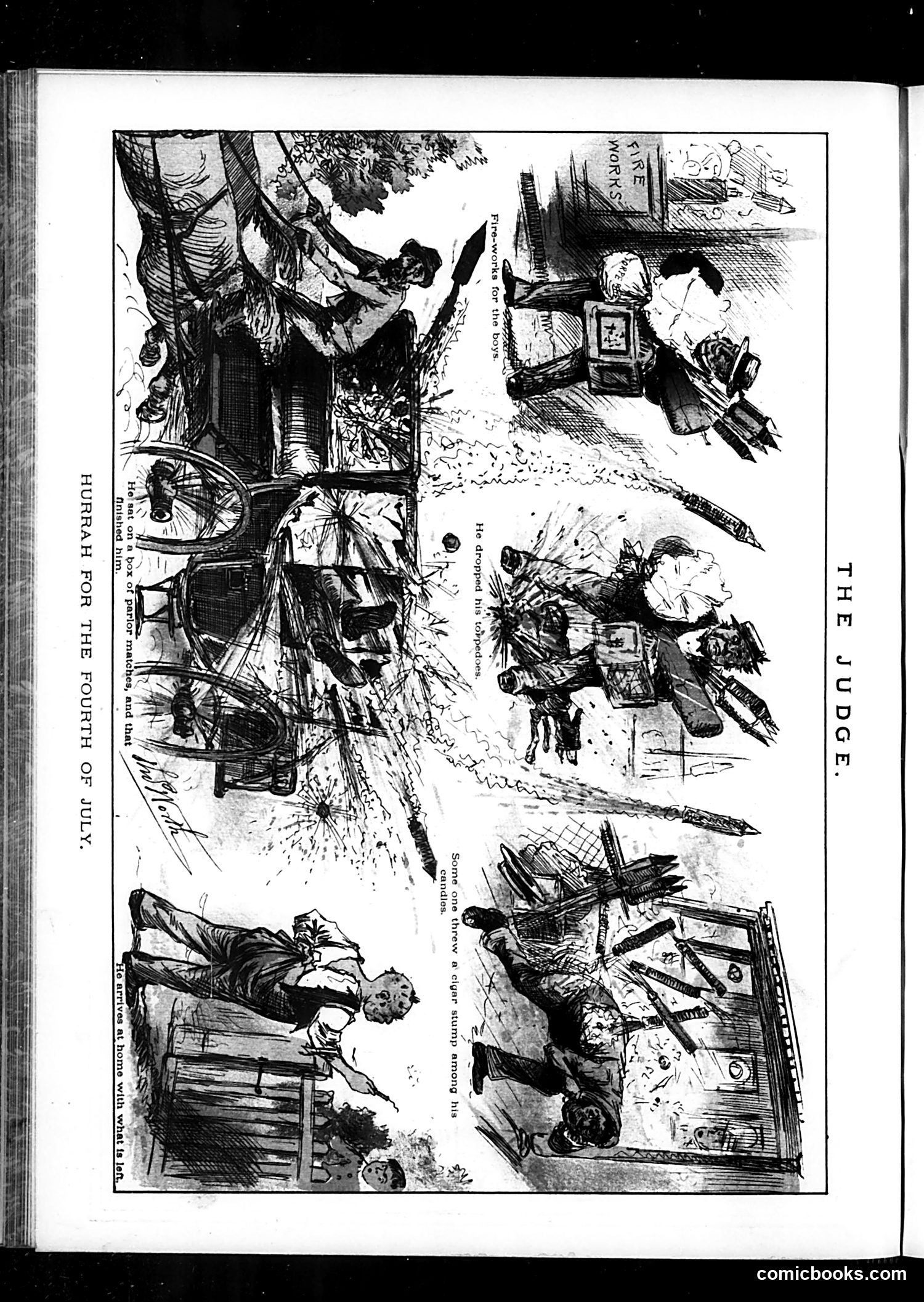
This page contains four satirical cartoon panels titled "Hurrah for the Fourth of July." The cartoons appear to depict July 4th celebrations going dangerously wrong, likely satirizing careless Independence Day festivities of the era. The visible caption references "someone threw a cigar stump among his candles," suggesting the cartoons show consequences of fireworks and fire hazards during holiday celebrations. The panels depict various chaotic scenes involving figures, some appearing to be in distress or amid explosions/fires. The satire targets public recklessness during Independence Day celebrations—a recurring social concern in late 19th-century America when fireworks caused numerous injuries and deaths. The cartoons mock the dangerous, uncontrolled nature of holiday festivities among common citizens.