
Judge, 1882-07-08 · page 2 of 16
Judge — July 8, 1882 — page 2: what you’re looking at
What you’re looking at
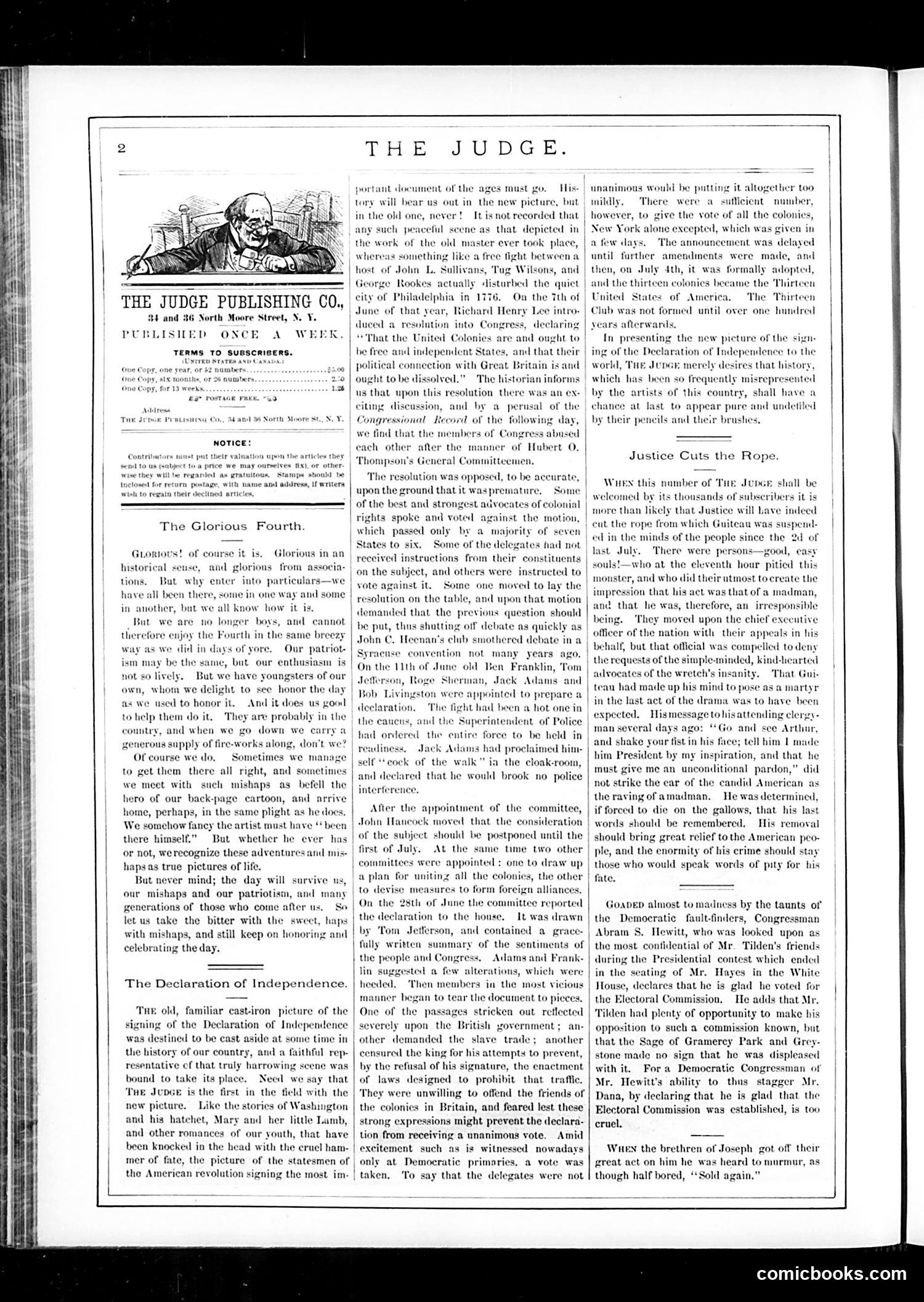
This page from *Judge* magazine contains two main pieces of political satire: **"The Glorious Fourth"** (top): A humorous essay about celebrating Independence Day as adults. The author notes that while Fourth of July celebrations remain important, adults no longer enjoy them with childish enthusiasm—though they dutifully arrange fireworks for their own children. The accompanying back-page cartoon apparently depicts someone arriving home injured from firecracker mishaps, illustrating the essay's tongue-in-cheek point about the hazards of patriotic celebration. **"The Declaration of Independence"** (bottom): *Judge* claims to present a "new picture" of the Declaration signing, arguing the famous Trumbull painting is historically inaccurate. The satire suggests the actual event resembled a violent brawl—comparing it to contemporary street fights involving boxers like John L. Sullivan. The piece mocks Congressional debate as crude name-calling, comparing it to disputes in Hubert O. Thompson's (likely a political figure's) committee meetings. The implicit joke: the Founders were no more dignified than modern politicians.
📄 Transcribed text from this page (OCR, searchable)
Machine-transcribed from the original scan — historical spelling and the odd misread are preserved.
THE JUDGE PUBLISHING CO. 34 and 36 North Moore Street, N.Y. LISHED ONCE A WEEK, TERMS TO SUBSCRIGERS. Aix months, of 26 numbers. 126 NOTICE: + net put thelr valuation upon seni to us (sntyect toa price we may ourselves fx), 6 wise they will be reganiel as gratuitous, Stamps shoukl be jlres, If writers The Glorious Fourth. Rios! of course it is, prious in an historical seuse, and glorious from associ tions. But why enter into particulars—we 11 been there, some in one way and some I know how it is. But we are no longer boys, and cannot therefore enjoy the Fourth in the same breezy way as we did in days of yore. Our patriot- ism may be the same, but our enthusiasm is not so lively. But we have youngsters of our own, whom we delight to see honor the as we used to honor it. And it does us goo to help them do it, ‘They are probably in the country, and when w ous supply of fire-works along, don't we? Of course we do, Sometimes we manage to get them there all right, and sometimes we meet with such mishaps as befell the hero of our back-page cartoon, and arrive home, perhaps, in the same plight as he docs. We somehow fancy the artist must have “been there himself.” But whether he ever has or not, werecognize these adventures | hapsas true pictures of li | But never mind; the day will survive us, | our mishaps and our patriotism, and many generations of those who come after us. let us take the bitter with the sweet, haps with mishaps, and still keep on honoring and celebrating the day. have in another, but we go down we carry a gen nel mise The Declaration of Independence. Tue old, familiar cast-iron picture of the signing of the Declaration of Independence was destined to be cast aside at some time in the history of our country, and a faithful rep- resentative ef that truly harrowing scene was bound to take its pla 1 we say that Tue Jupee is the first in the field with the new picture. Like the stories of Washington and his hatchet, Mary and her lite Lamb, and other romances of our youth, that have been knocked in the head with the cruel ham- | mer of fate, the picture of the statesmen of the American revolution signing the most im- THE JUDGE. portant document of the ages must go. His: but tory will bear us out in the new pictul in the old ¢ It is not recorded that any such 4 ne as that depicted in the work of the old master ever took place, whereas something like a free fight between a | host of John L. Sullivans, Tag Wilsons, and George Rookes actually disturbed the quiet city of Philadelphia in 1 On the 7th of June of that year, Richard Henry Lee intro- duced a resolution into Congress, “That the United Colonies nd ought to be free and independent States, and that their political connection with Great Britain is and ought to be dissolved.” The historian informs us that upon this resolution there was an ex- nd by e, never! acetal se declaring citing discussion, a perusal of the Congressional Record of the following day, we find that the members of Congress abused each other afer the manner of Hubert O. Thompson's General Committeemen, The resolution was opposed, to be accurate, upon the ground that it waspremature. of the best and strongest advocates of colonial rights spoke and voted against the motion, which passed only by a majority of seven States to come of the delegates fad not ceived instructions from their constituents on the subject, and others were instructed to vote against it. Some one moved to lay the resolution on the table Some demanded that the previons question should be put, thus shutting off debate as quickly as John C, Heenan’s elub smothered debate in a Syracuse convention not many years On the Hth of June old Ben Franklin, ‘Tom Jet Jack Adams and Bob Livingston were appointed to prepare a dicclaration, Th the caucns, and th r readiness, Jack | self “cock of mn, » Sherm! fight had been a hot one in uperintendent. of Police ordered the entire force to be held in Adams had proclaimed him- the walk” ia the cloak-room, red that he would brook no police rferenc in After the appointment of the committee, John Hancock moved that the consideration of the subject should be postponed until the first of July. At the same time two other committe © appointed : one to draw up a plan for uniting all the colonies, the other to devise measures to form foreign alliances, On the 28th of June the committee reported | the declaration to the house. It was drawn by Tom Jetferson, and contained a grace- | fully written summary of the sentiments of the peop Adams and Frank- lin saggy ions, which were heeded, nbers in the most viei n to tear the document to pieces, One of the passages stricken out reflected severely upon the British government; an- | other demanded the slave trade; another censured the king for his attempts to prevent, by the refusal of his signature, the enactment of laws designed to prohibit’ that traffic, ‘They were unwilling to offend the friends of the colonics in Britain, and feared lest these strong expressions might prevent the declara- | tion from receiving a unanimous vote. Amid excitement such as is witnessed nowadays only at Democratic p | taken, sw and Congres few alter; ste ‘Then me manner be naries, a vote was To say that the delegates were not nd upon that motion | unanimous would be putting it altogether too mildly, There were a sufficient’ number, however, to give the vote of all the colonies, New York alone excepted, which was given in a few days. The announcement was delayed until further amendments were made, and then, on July 4th, it was formally adopted, and the thirteen colon Thirte The Thirte 3 not formed until over one hundred Is. In presenting the new picture of the ing of the Declaration of Independence: 3 became tl United States of Americ Club w years aterwa to the world, THE JUDGE merely desires that history, which has been so frequently misrepresen by the artists of this country, shall have a chance at last to appear pure and undetiled by their peneils and their br Justice Cuts the Rope. Wuey this number of Tne Jupce welcomed by its thousands of more than likely that Justice will have indeed cut the rope from which Guiteau was suspend- ed in the minds of the people since the 2d of last July. There were | oul, easy souls!—who at the eleventh hour pitied this monster, and who did their utmost toer impression that his act was that of a madman, and that he was, therefore, an irr being. ‘They moved upon the chief executive officer of the nation with their appeals in his behalf, but that official was compelled to deny the requests of the simple-minded, kind-hearted advocates of the wretch’s insanity. That Gui- tean had made up his mind to pose as a martyr in the last act of the drama was to have been expected. His message to his attending clerg man several days ago: “Go and sce Arthur, and shake your fist in his face; tell him Im him President by my inspiration, and that he must give me an unconditional pardon,” did not strike the ear of the candid Ameri the raving of amadman, He was determined, if forced to die on the gallows, that his last words should be remembered. His removal should bring great relief tothe American peo- ple, and the enormity of his crime should stay those who would speak words of pity for his fate. shall be ubseribers it is rsons— fe the esponsible nas Goabep almost to madness by the taunts of” the Democratic fault-finders, Congressman Abram §. Hewitt, who was looked upon as the most confidential of Mr. Tilden’s friends during the Presidential contest which ended in the seating of Mr. Hayes in the White House, declares that he is glad he voted for the Electoral Commission. He adds that Mr. ‘Tilden had plenty of opportunity to make | opposition to such a commission known, but that the Sage of Gramercy Park and Grey- stone made no sign that he was displeased with it. Fora Democratic Congressman of Mr. Hewitt’s ability to thus stagger Mr. Dana, by declaring that he is glad that the Electoral Commission was established, is too cruel. Wuey the brethren of Joseph got off their great act on him he was heard to murmur, as though half bored, ‘Sold again.” comicbooks.com