
A complete issue · 17 pages · 1882
Judge — April 22, 1882
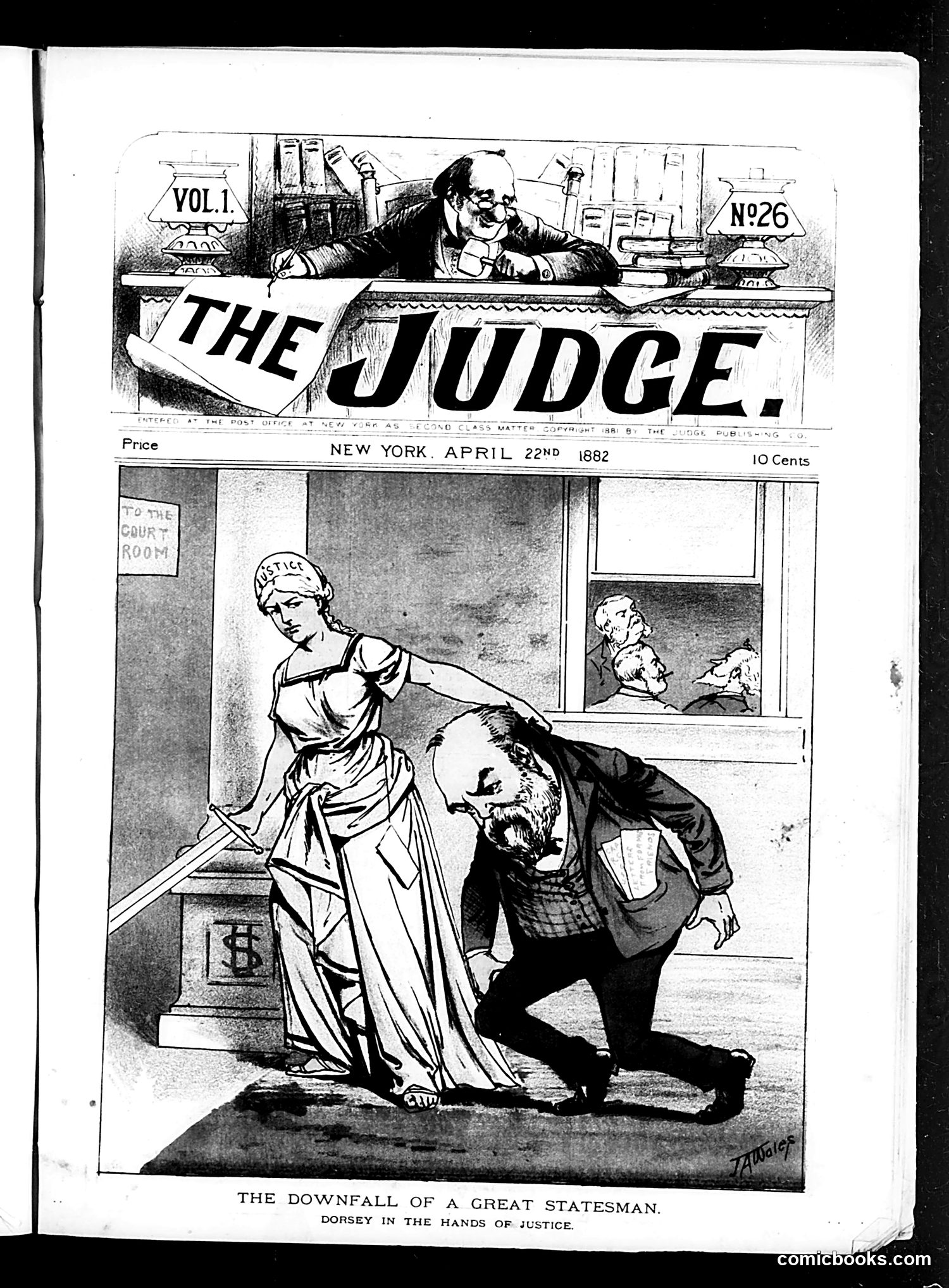
This April 1882 *Judge* cartoon satirizes the downfall of a prominent politician through the allegorical figure of Justice. A bearded man in formal dress is shown kneeling or bowing before Lady Justice, who wields her sword. The caption identifies the subject as "Dorsey"—likely referring to Stephen W. Dorsey, a Republican politician implicated in the Star Route mail fraud scandal of the early 1880s. The cartoon mocks Dorsey's fall from political power by depicting him brought low before Justice itself. Onlookers peer from a courthouse window, emphasizing the public nature of his humiliation. The satire suggests that even "great statesmen" face consequences when corruption is exposed, though the magazine's tone appears more mocking than genuinely celebratory of justice served.
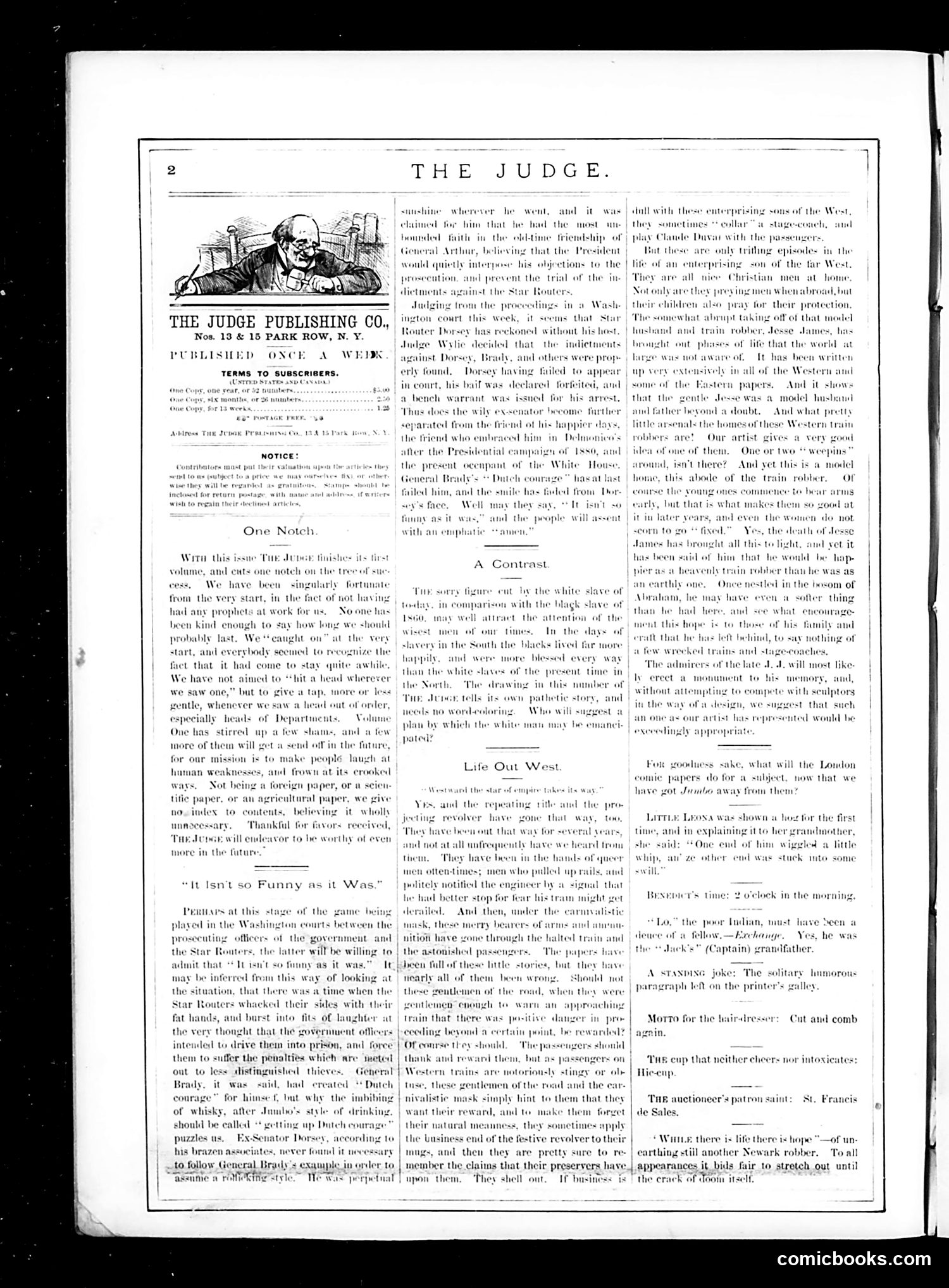
This page from *Judge* magazine contains several satirical pieces targeting late 19th-century American politics and social issues. **"It Isn't so Funny as it Was"** attacks the Star Route scandal, involving postal contractors (the "Star Routers") prosecuted for fraud. The piece mocks General Arthur (likely President Chester Arthur) and Senator Dorsey, suggesting they expected presidential protection. The satire centers on "Dutch courage" (drunken boldness)—Dorsey apparently relied on whiskey to face prosecution, now that protection has failed. **"A Contrast"** compares enslaved Black Americans to poor white Americans ("white slaves"), arguing that Southern enslaved people were paradoxically treated better than Northern poor whites. This reflects period arguments attempting to justify slavery, presented here satirically to expose the hypocrisy. **"Life Out West"** apparently discusses frontier train robberies and dangerous conditions, though OCR errors obscure specifics. The cartoons use visual caricature and sharp editorial commentary typical of *Judge*'s style, targeting political corruption and social contradictions.
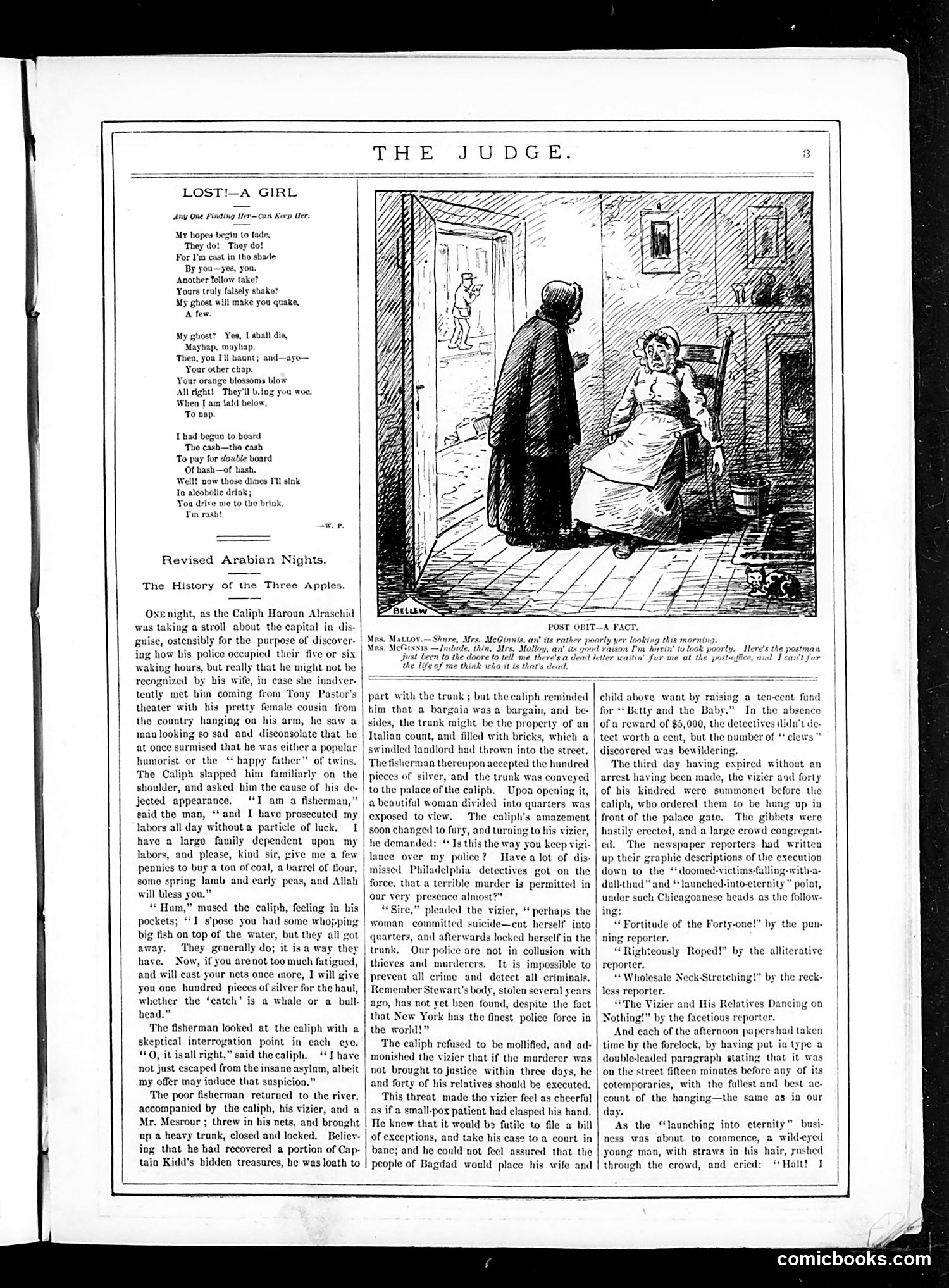
This page contains two satirical pieces from *Judge* magazine: **"Lost! A Girl"** (poem, top left): A jilted lover threatens suicide and haunting if his girlfriend leaves him for another man. The satire mocks melodramatic male desperation—he threatens to "die" and return as a ghost to torment her new relationship, claiming he'll waste his savings on alcohol rather than support their planned life together. It's dark comedy about possessive, manipulative courtship behavior. **"Revised Arabian Nights"** (main story): This adapts the classic *Arabian Nights* tale "The Three Apples," transplanting it to contemporary New York. The satire pokes fun at the city's incompetent police force by having the Caliph (disguised as a wanderer) discover a murdered woman in a trunk. The story ridicules police ineffectiveness and suggests corruption—humorously implying the woman committed suicide and locked herself in the trunk, an absurd coverup. The piece satirizes both police incompetence and the Gilded Age's callous indifference to crime. The accompanying illustration appears to depict the trunk discovery scene.
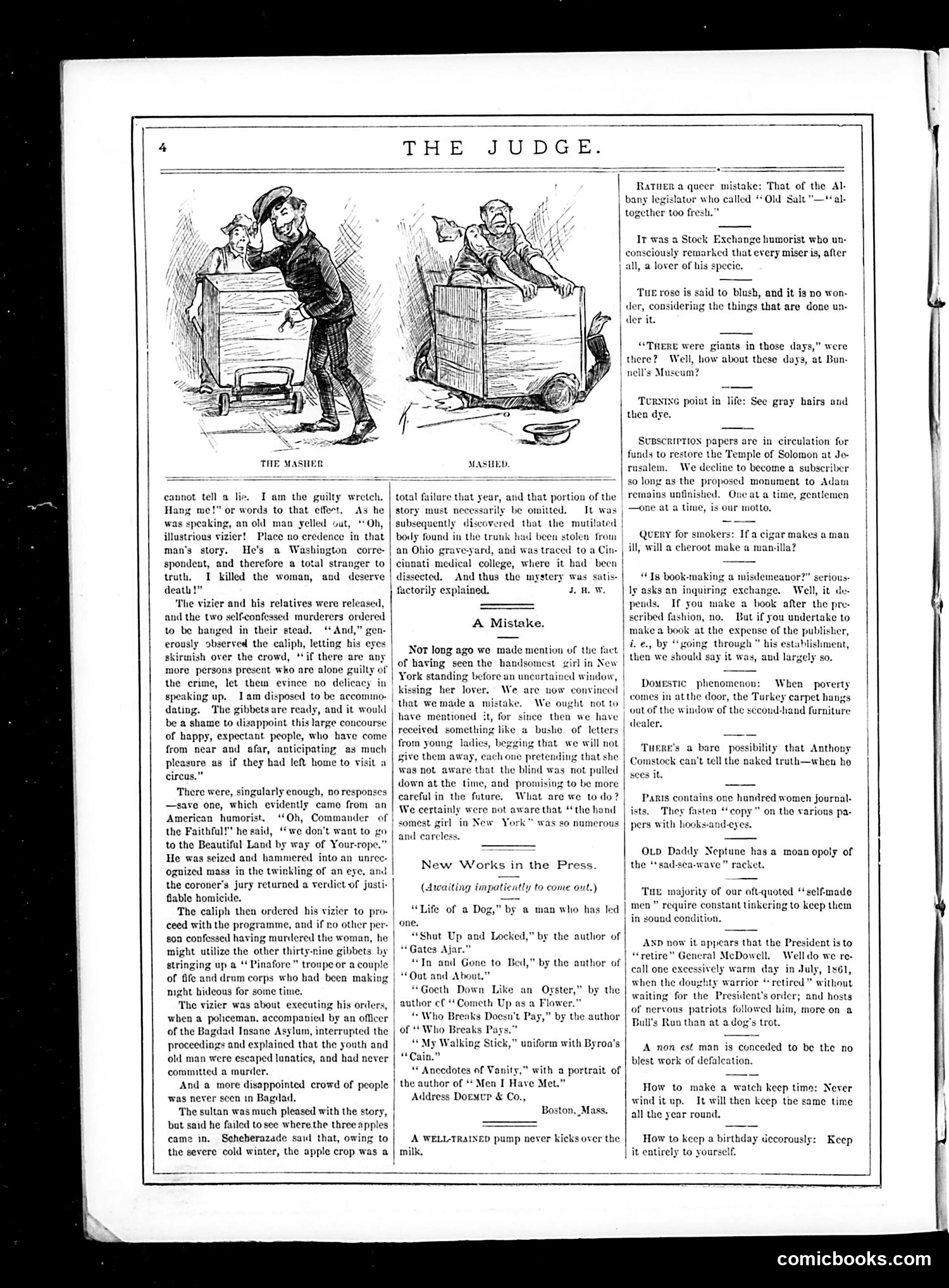
This page from *Judge* contains two main cartoons and satirical commentary. **The cartoons** ("The Washer" and "Mashed") depict a man disposing of a body in a trunk—dark humor about a crime. The accompanying story is a Scheherazade-style moral tale mocking Washington correspondents as incorrigible liars. A caliph offers gibbets to anyone confessing to murder; a American humorist gets executed for a wisecrack about "Your-rope" (Europe). The joke: even in a fictional Baghdad court, truth-telling is impossible. **"A Mistake"** satirizes the magazine's own prior mention of seeing "the handsomest girl in New York" at a window—implying voyeurism. Young women flooded them with letters claiming to be that girl, each pretending innocence. The satire mocks both the original creepy observation and the women's obvious dishonesty. **"New Works in the Press"** parodies contemporary book titles through absurdist variations (e.g., "Who Breaks Doesn't Pay" vs. "Who Breaks Pays"). The overall tone: cynical, misanthropic humor treating deception as universal.
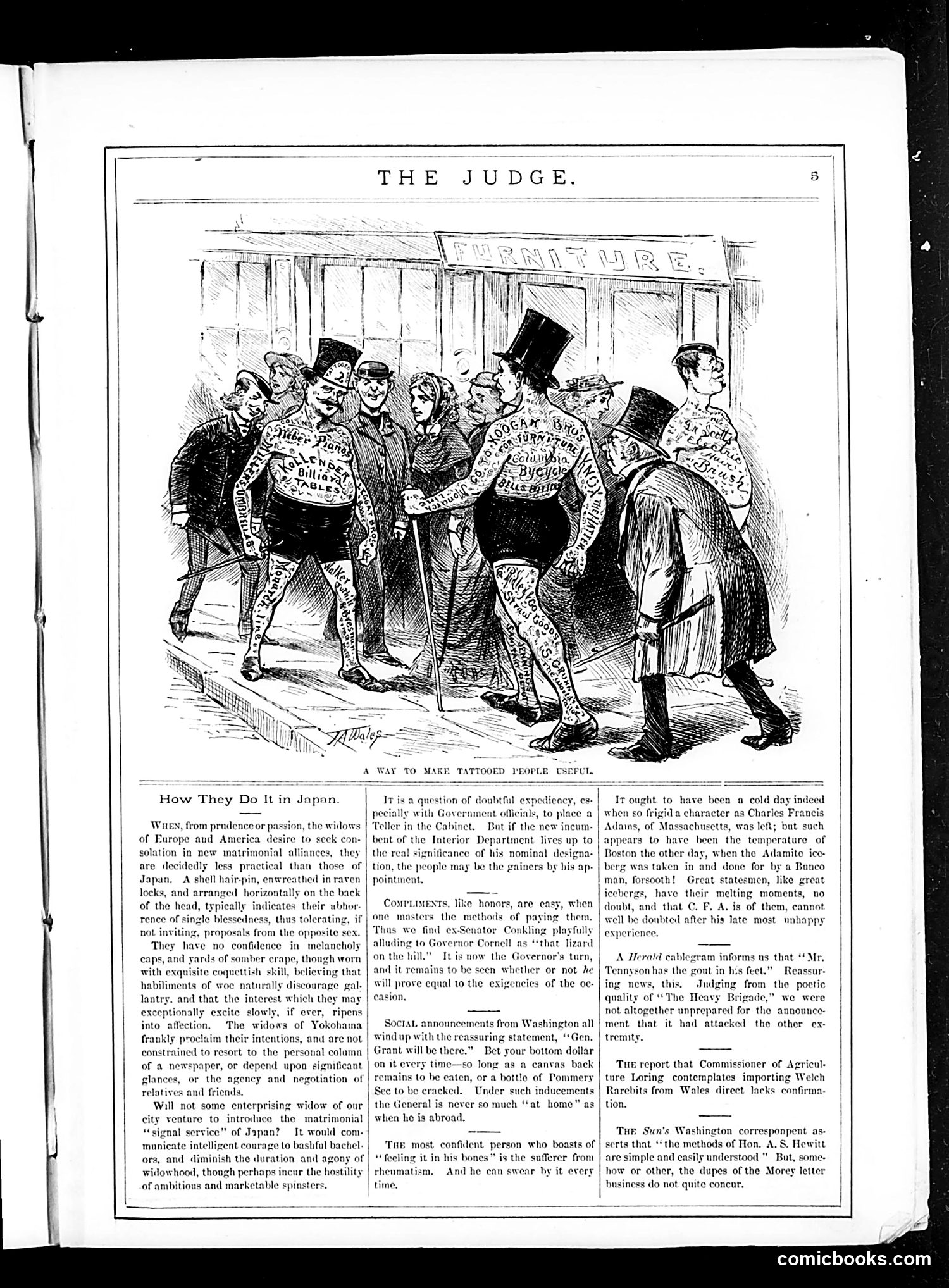
This satirical cartoon depicts men covered in tattoos labeled with corporate names and scandals—a visual metaphor for corruption in American politics and business. The sketch mocks the practice of using prominent figures as walking advertisements for dubious enterprises. The accompanying text column contains brief satirical commentary on contemporary political figures: Senator Conkling's flattery of Governor (likely Cornell), General Grant's predictable attendance at fancy dinners, and Charles Francis Adams being unexpectedly charmed by a "Banco man" (banker). The jokes rely on readers recognizing these figures' reputations—Conkling's obsequiousness, Grant's appetites, Adams's austere reputation. The overall message criticizes how American public figures allow themselves to be compromised by commercial and political interests, becoming like human billboards for scandal and corruption. It's social satire targeting elite hypocrisy.
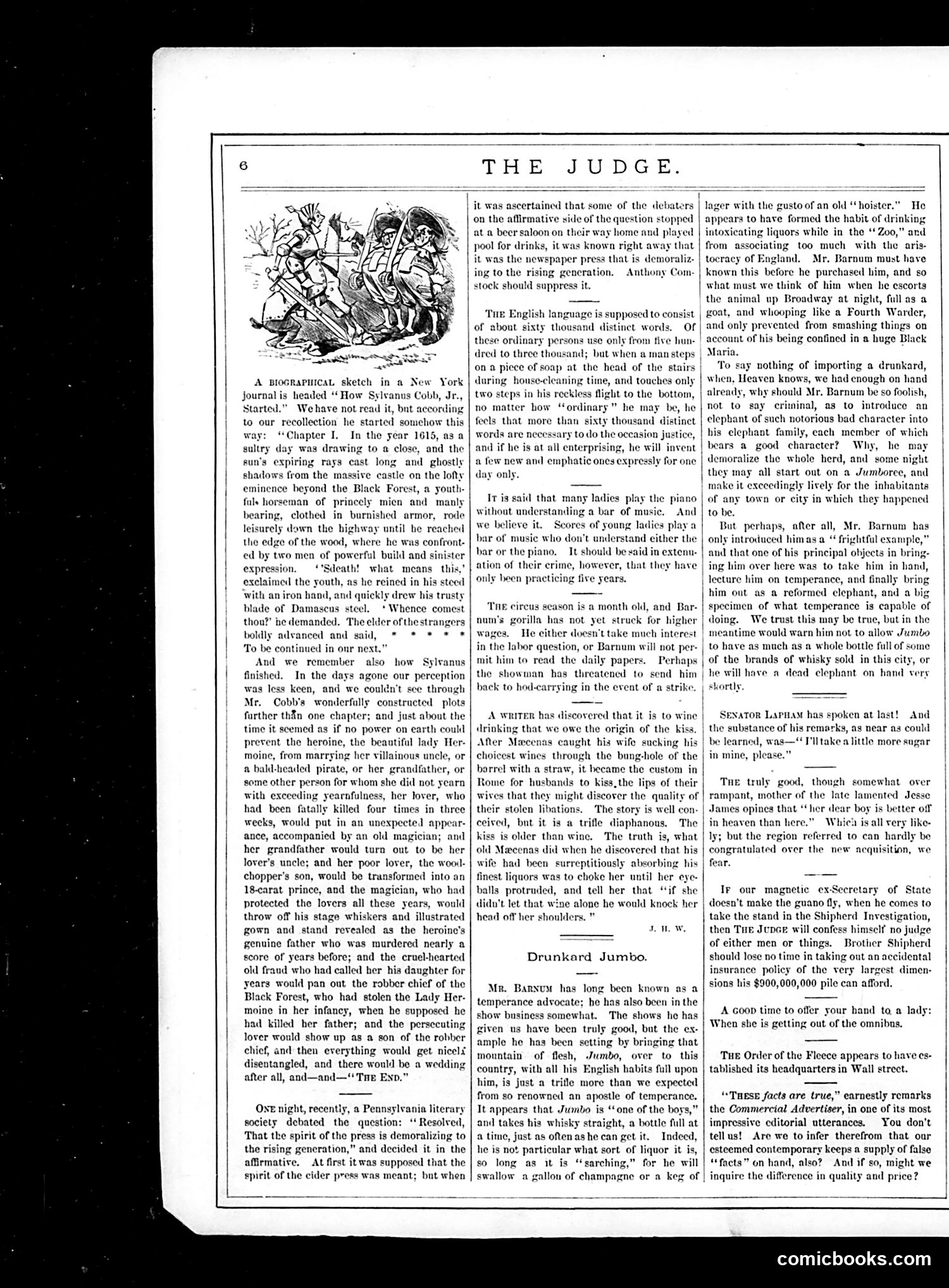
This page from the satirical magazine *Judge* contains several satirical pieces mocking contemporary culture: **"A Biographical Sketch"**: Parodies melodramatic serialized fiction popular in dime novels and newspapers. The text ridicules the overwrought plotting of pulp writer Sylvanus Cobb Jr., where contrived coincidences constantly rescue heroines—murdered lovers reappear, evil uncles are revealed as robber chiefs, etc. This mocks both the predictable formulas and readers' appetite for such escapism. **The Pennsylvania Literary Society Debate**: Satirizes hypocrisy. A group debated whether newspaper press "demoralizes youth," yet debaters themselves stopped at beer saloons and gambled afterward—proving the press wasn't actually their concern. The reference to "Anthony Comstock" (famous censor) underscores the irony. **Other Brief Jokes**: Poke fun at linguistic excess (men inventing colorful language when injured), women playing piano without musical knowledge, and the pretension of "ordinary" educated discourse. The overall tone targets both penny-dreadful literature and society's moral hypocrisy.
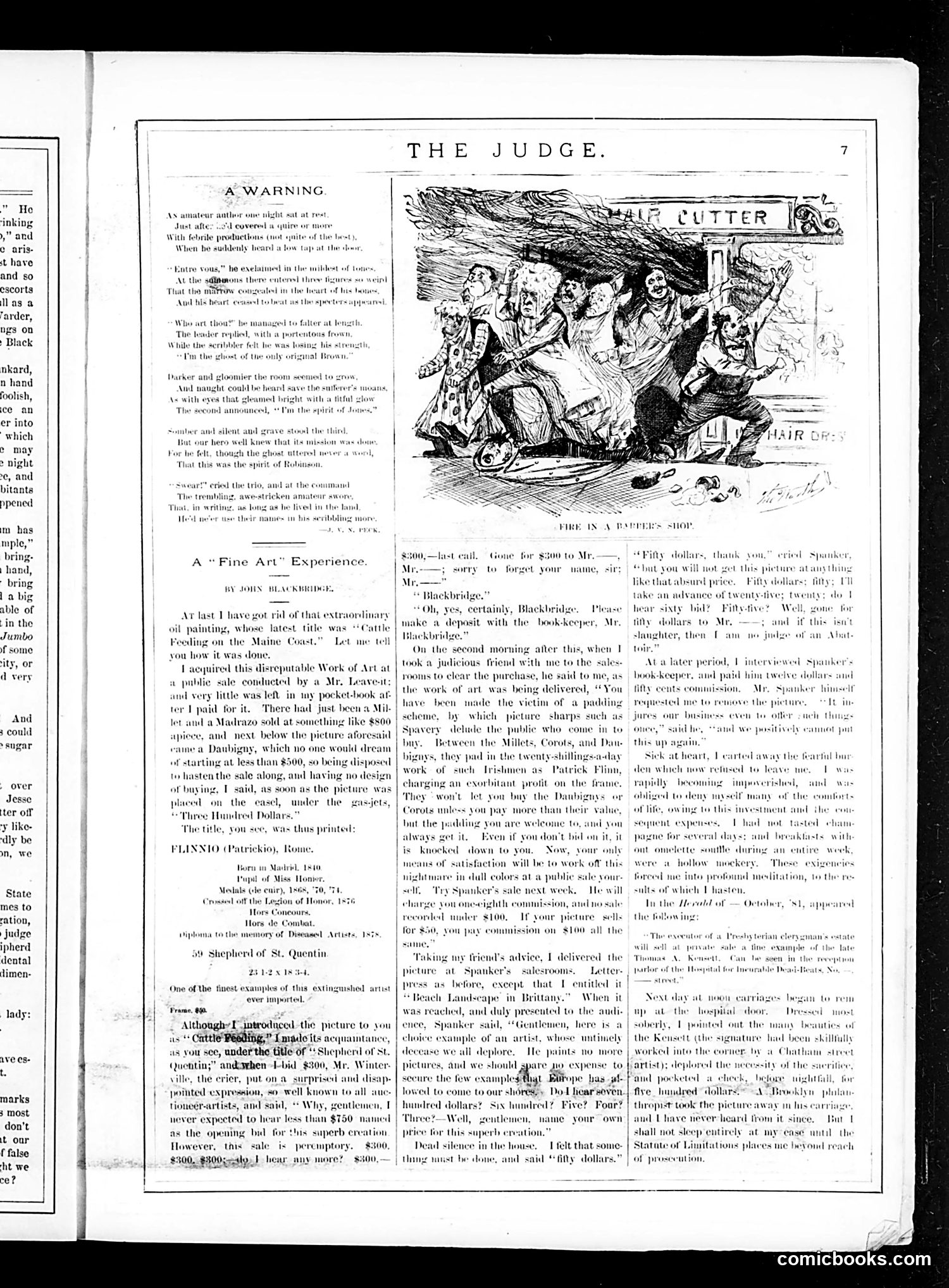
This page from *Judge* magazine contains two distinct pieces: **"A Warning" (poem)**: A cautionary verse about an amateur artist who sits at rest, then suddenly paints with frenzied energy. The poem warns of the consequences—other artists ridicule him, calling him mad. It's satirizing poorly-trained or pretentious amateur artists who lack skill. **"A 'Fine Art' Experience" (story with cartoon)**: The main narrative mocks art auction fraud. An author acquires a worthless painting titled "Cattle Feeding" (labeled "Shepherd of St. Quentin") at auction for $300. A dishonest auctioneer and art dealer named Spanker manipulate the sale, padding bids and later demanding inflated "commissions." The author is repeatedly swindled. The cartoon shows figures in what appears to be a barbershop or salon—likely depicting the con artists at work. **The satire targets**: Corrupt art dealers, fraudulent auctions, inflated art valuations, and the gullibility of wealthy buyers during the Gilded Age when "art investment" schemes flourished. The humor lies in exposing how easily collectors could be duped by unscrupulous merchants.
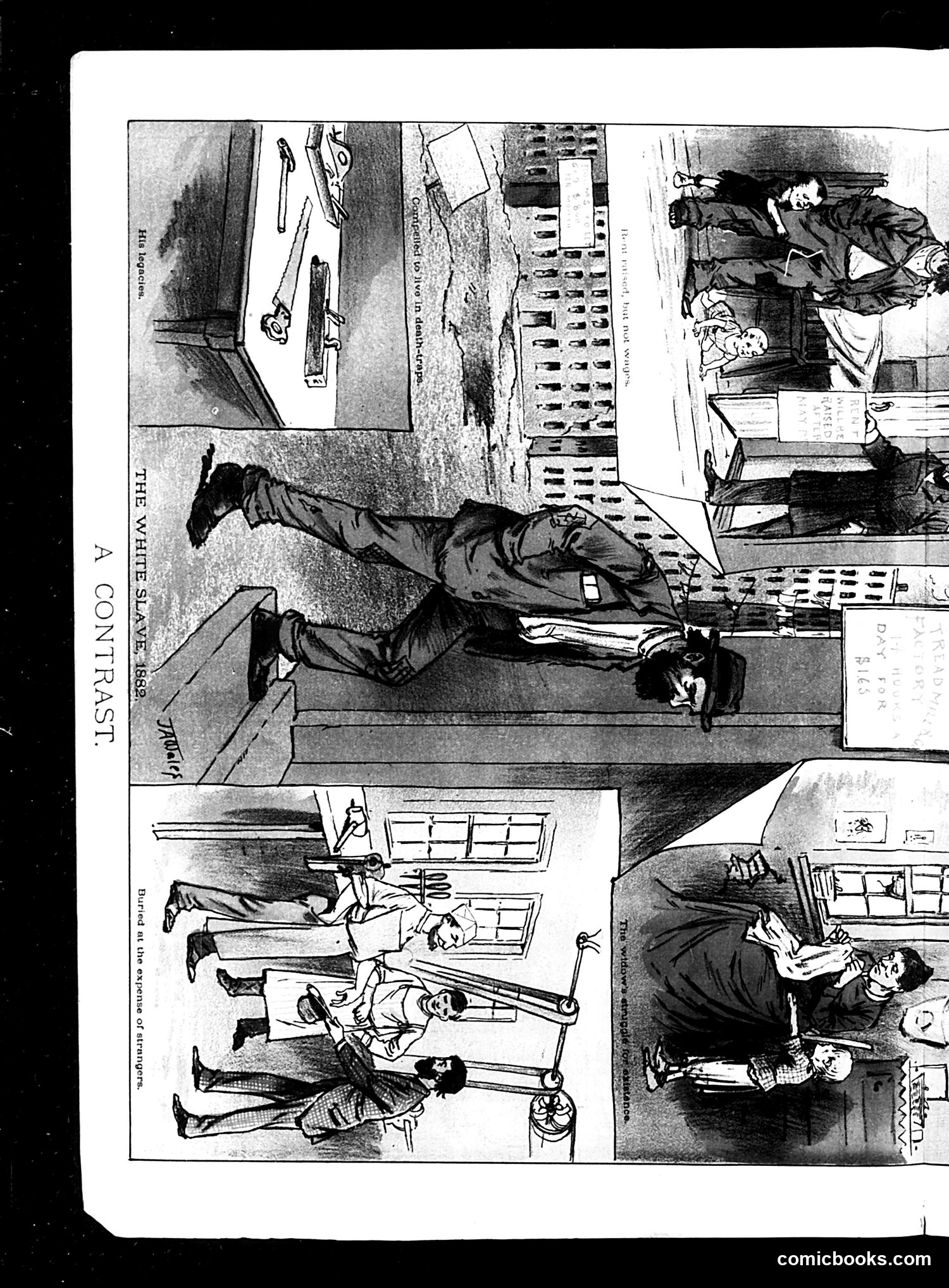
This page presents a satirical comparison between two contrasting scenes, likely depicting wealth inequality or class differences in early 20th-century America. The top panels show an elegantly-dressed man in formal attire in refined surroundings, while the lower panels depict working-class or poor individuals in modest circumstances. The title "A CONTRAST" makes the social commentary explicit: the cartoon critiques the stark disparity between the wealthy and working classes. Judge magazine frequently used such juxtapositions to satirize American social conditions and economic inequality. The OCR text is largely illegible, preventing identification of specific political figures or events referenced. Without clearer text, the precise social commentary target remains unclear, though the visual contrast alone communicates the satirist's point about class division.
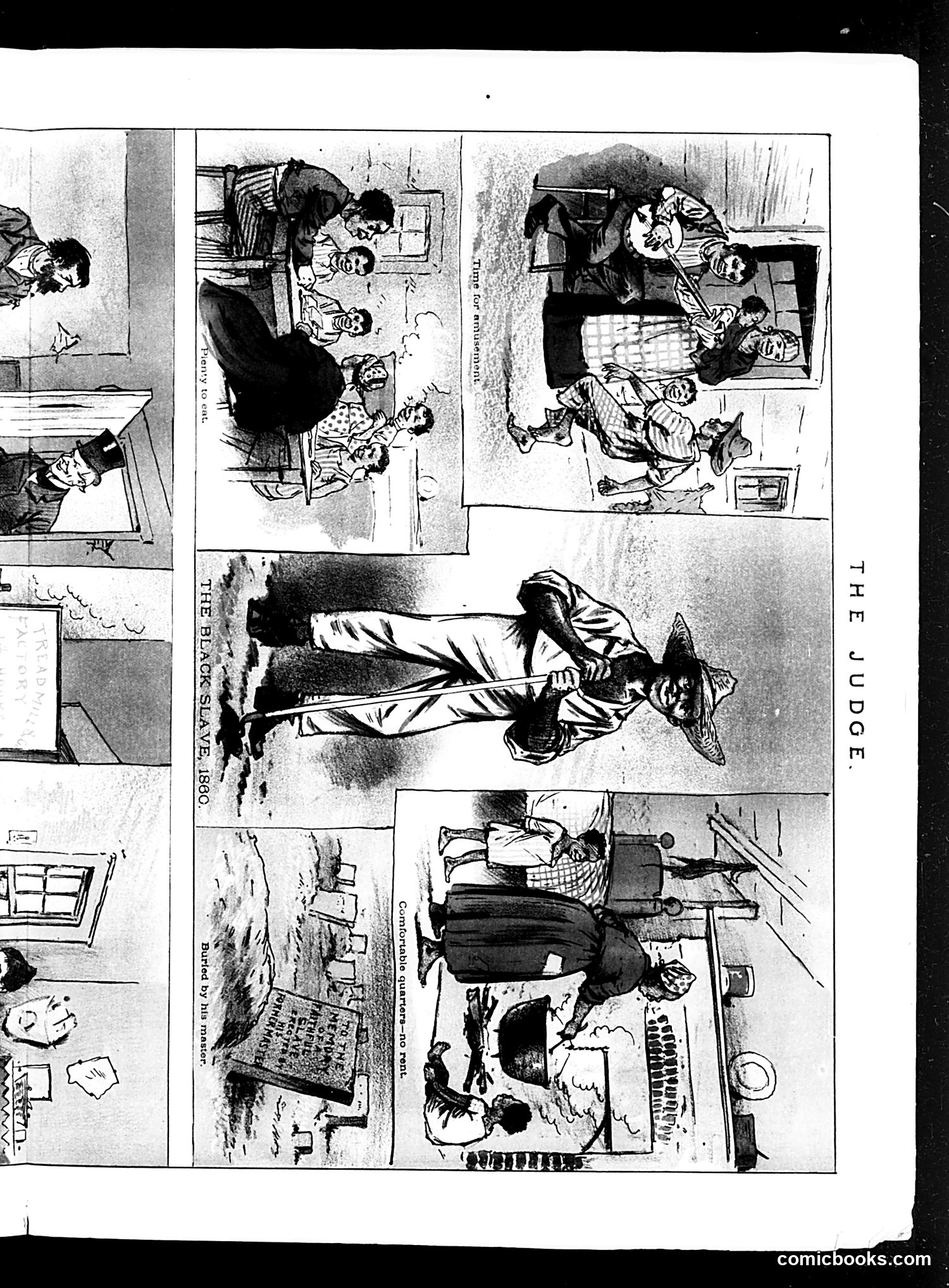
This appears to be a multi-panel satirical cartoon from *Judge* magazine titled "The Judge," with a subtitle referencing "Black Slave, 1860." The page uses historical contrast as its satirical device, likely comparing conditions or treatment across time periods. The central image shows a well-dressed man in formal attire standing prominently. The surrounding panels depict various domestic and social scenes, though the specific details are difficult to discern clearly in this reproduction. The 1860 reference suggests commentary on slavery or racial issues, possibly arguing that modern conditions (whenever this was published) represented progress or, conversely, that exploitation continued in new forms. Without clearer text or identified figures, the exact political argument remains uncertain, though the juxtaposition of historical versus contemporary scenes indicates social criticism.
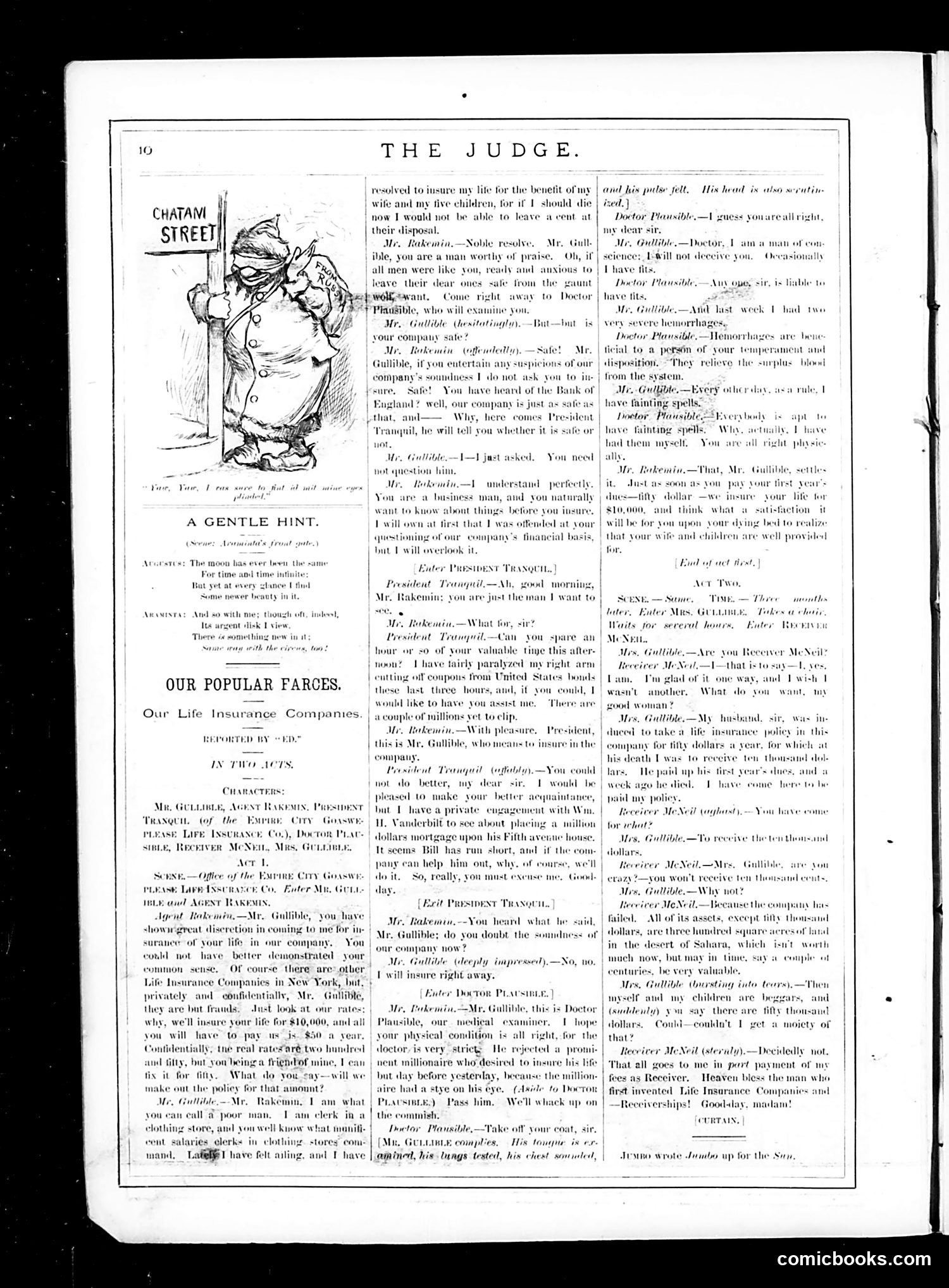
This page satirizes **life insurance company fraud** through a comedic sketch titled "Our Popular Farces: Our Life Insurance Companies." The plot exposes a scam: Agent Rakemin convinces a naive client (Mr. Gullible) to purchase life insurance by praising the company's safety and legitimacy. However, when President Tranquil enters, he's immediately distracted by a lucrative financial scheme with a wealthy client (Vanderbilt), abandoning Gullible mid-conversation. The doctor's final entrance—conducting a cursory medical examination—completes the picture of institutional carelessness. The satire's point: Insurance companies prioritized wealthy clients and speculative investments over ordinary customers' protection. The character names themselves ("Gullible," "Rakemin," "Tranquil") telegraph the dishonesty. The sketch mocks both the companies' predatory practices and the public's gullibility in trusting them during an era of minimal financial regulation.
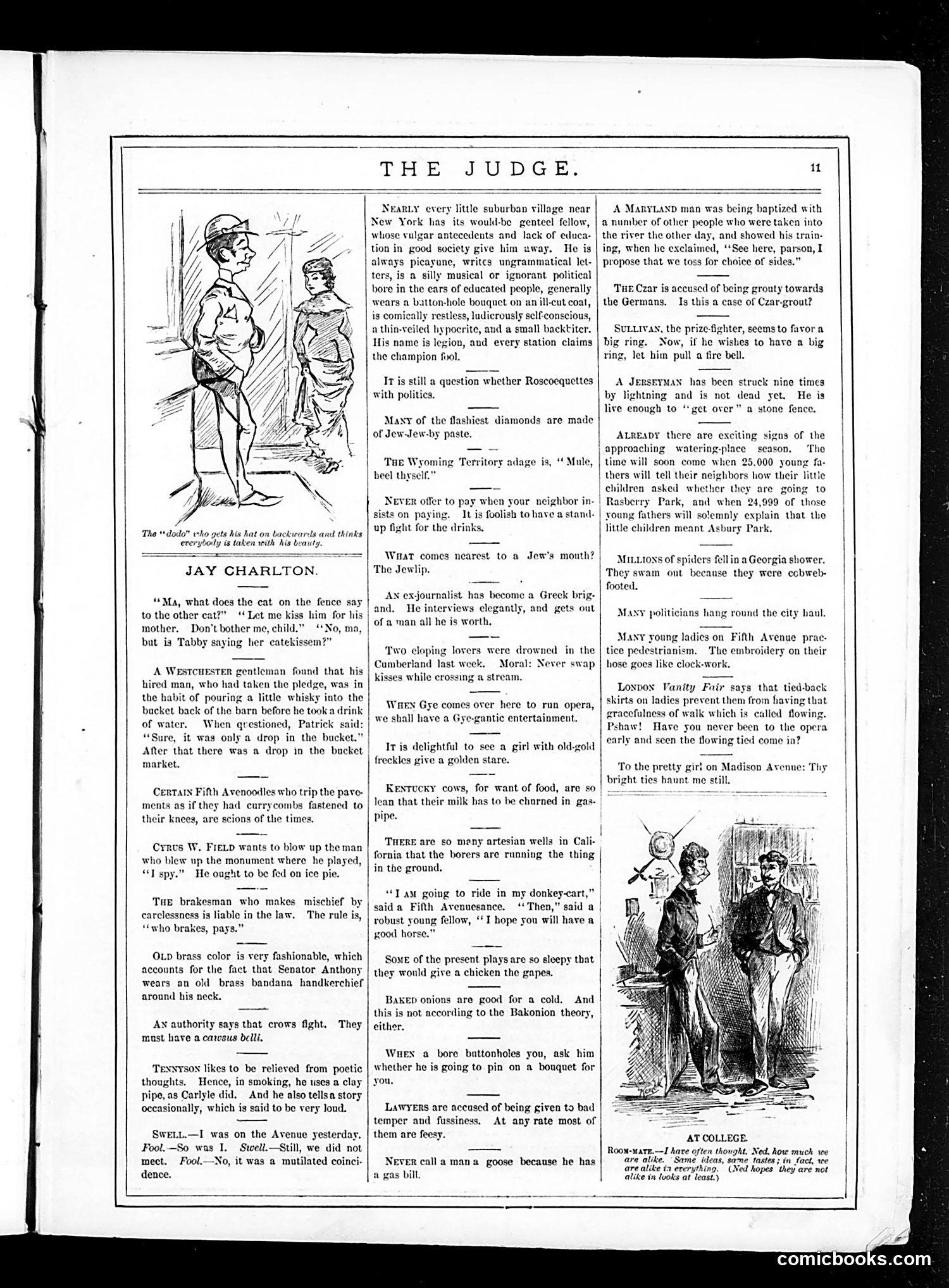
This page from *Judge* magazine contains satirical short jokes and quips rather than a single unified cartoon. The main illustrated piece (top left, credited to Jay Charlton) shows a well-dressed gentleman in conversation with what appears to be a working-class man, captioned with a pun about cats and "catekissem" (a play on "Catholicism"). The bulk of the page consists of brief, society-focused jokes mocking: - **Social climbers**: suburban nouveaux riches with poor manners and education - **Fashionable absurdities**: exaggerated walking styles, jewelry, clothing - **Contemporary figures**: references to Senator Anthony, Tennyson, Cyrus W. Field - **Ethnic stereotypes**: jokes about Jews ("Jewlip") and Greeks - **Legal and professional satirizing**: lawyers, journalists, brakemen The humor relies heavily on wordplay, puns ("who brakes, pays"), and mocking observations of Gilded Age social pretension. A secondary illustration shows college students. The satire targets vanity, pretension, and social climbing among the wealthy and upwardly mobile.
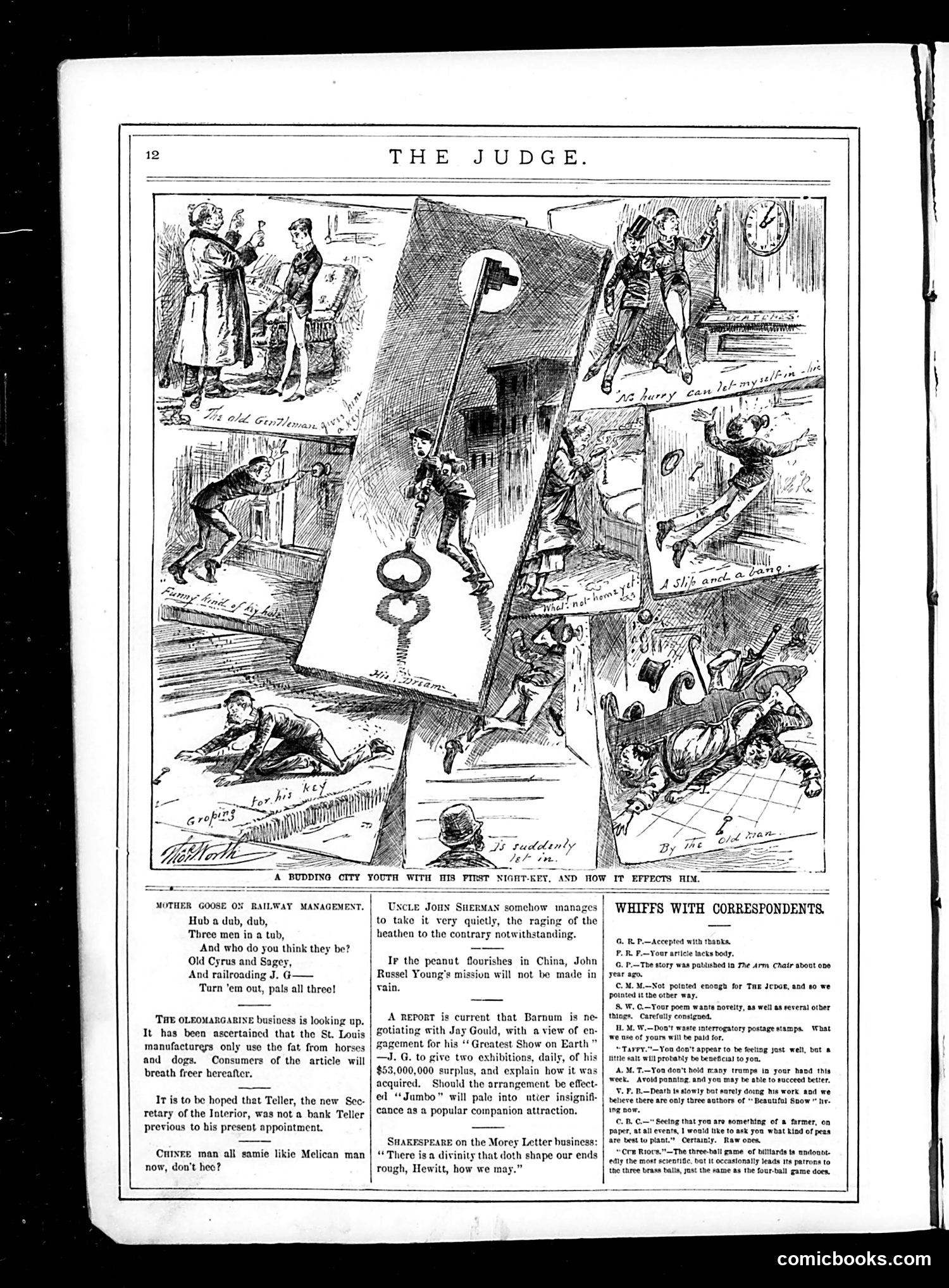
The main cartoon, "A Budding City Youth with His First Night-Key," is a humorous series of vignettes showing a young man experiencing urban life after receiving his first house key—depicting various misadventures and comic situations that befell him. The satirical text sections mock contemporary figures and issues: - **Railway management**: A "Mother Goose" parody mocking railroad executives (Cyrus Field, Jay Gould, and "J.G."), suggesting they should be removed. - **Oleomargarine scandal**: Sarcastically notes that St. Louis manufacturers only use horse and dog fat—reflecting 1880s food safety concerns about this then-controversial product. - **John Sherman**: References the Secretary of the Treasury's calm demeanor despite international tensions. - **Jay Gould's wealth**: A joke proposing Gould display his $53-million surplus as a circus attraction bigger than Barnum's "Jumbo" elephant. - **"Whiffs with Correspondents"**: Rejections of reader submissions with witty dismissals. This represents typical Judge content: topical political satire mixing railroad monopolies, food scandals, and wealthy industrialists with period humor.
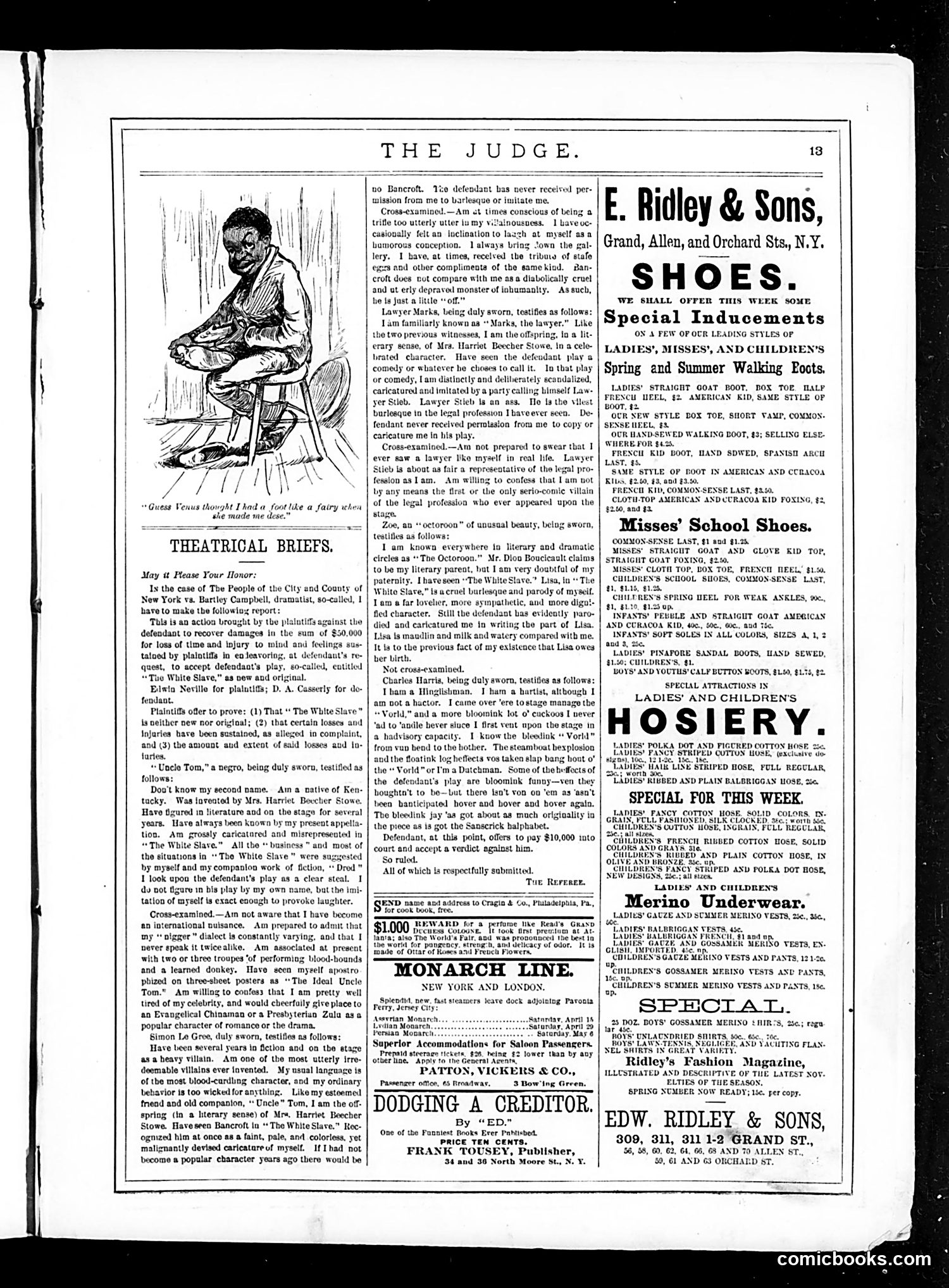
This page satirizes playwright Bartley Campbell's 1882 play *The White Slave*, which was criticized as derivative of Harriet Beecher Stowe's *Uncle Tom's Cabin*. Judge presents a mock lawsuit where famous literary characters from Stowe's novel—Uncle Tom, Simon Legree, and Lawyer Marks—testify that Campbell plagiarized their characterizations without permission. The satire works on two levels: it mocks both Campbell's unoriginality and the absurdity of fictional characters suing for copyright infringement. The cartoon's caption ("Guess Venus thought I had a foot like a fairy") appears to be an unrelated theatrical joke about performance. The "Theatrical Briefs" section uses legal language to accuse Campbell of stealing plot elements and character types while changing minor details—a common 19th-century dramatic practice Judge found ridiculous enough to warrant mockery.
This is primarily an **advertising page** from Judge magazine, dated around 1882 (based on the Hungarian bond drawing date of April 15, 1882). The page contains **no significant political cartoons or satire**—instead it's a collection of commercial advertisements for period goods: billiard tables, pianos, bicycles, hatters, bookstores, and notably a Hungarian government bond investment scheme. The only visual content beyond advertisements is an **illustration of two women at a piano** (for Weber pianos), which appears to be standard product marketing rather than satirical commentary. The text snippets scattered throughout appear to be **extracted quotes or anecdotes** (referencing Boston newspapers, stories about landlords and boarders), likely filler material between ads—a common magazine practice of the era. For a modern reader: this page demonstrates how 19th-century magazines mixed editorial content with advertising revenue, and the prevalence of financial speculation (foreign bonds) marketed to American readers.
This is primarily an **advertising page** from Judge magazine, not a satirical cartoon page. The layout features commercial advertisements for late 19th-century products and services: **Major advertisers include:** - **Coogan Bros.** (furniture, carpets, bedding) - emphasizing affordable payment terms and fair customer treatment - **Jennings' Sanitary Depot** - patent water closets (toilets) - **Dr. L. Gouraud's Oriental Cream** - a skin beautifier - **Wilson Patent Adjustable Chair** - **S. Gruhn, "The World's Tailor"** - custom tailoring services **Context for modern readers:** The advertisements reflect Gilded Age consumerism. The emphasis on "reasonable terms" and "credit" suggests these retailers competed aggressively for working and middle-class customers. The beauty cream advertisement targeting women and the tailoring service for gentlemen show gendered marketing. The repeated focus on payment flexibility indicates many consumers couldn't afford full-price purchases. This page demonstrates how satirical magazines like Judge funded themselves—not primarily through humor, but through paid advertisements.
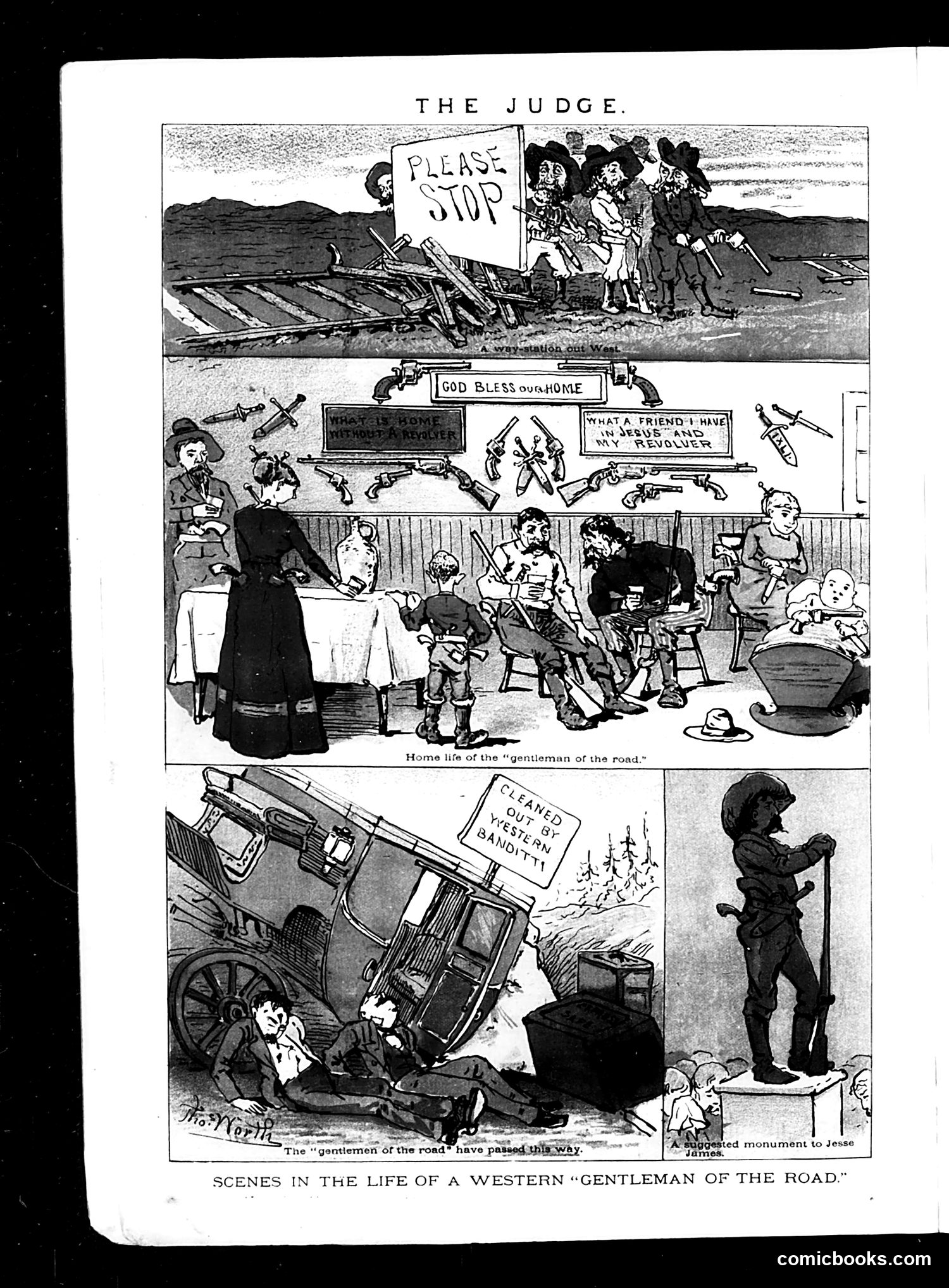

I can see this is a blank or nearly blank page from Judge magazine, with only "comicbooks.com" visible at the bottom right. The page appears to be either: 1. A blank interior page from the original magazine publication 2. A back cover or advertising space that contained no visible content in this scan 3. A page where the original content did not reproduce clearly in digitization Without visible cartoon imagery, text, or identifiable figures, I cannot provide analysis of satirical content, political references, or the intended joke. To offer meaningful interpretation of this Judge page, I would need a version where the actual cartoon(s) or article content are legible.