
A complete issue · 16 pages · 1882
Judge — April 15, 1882
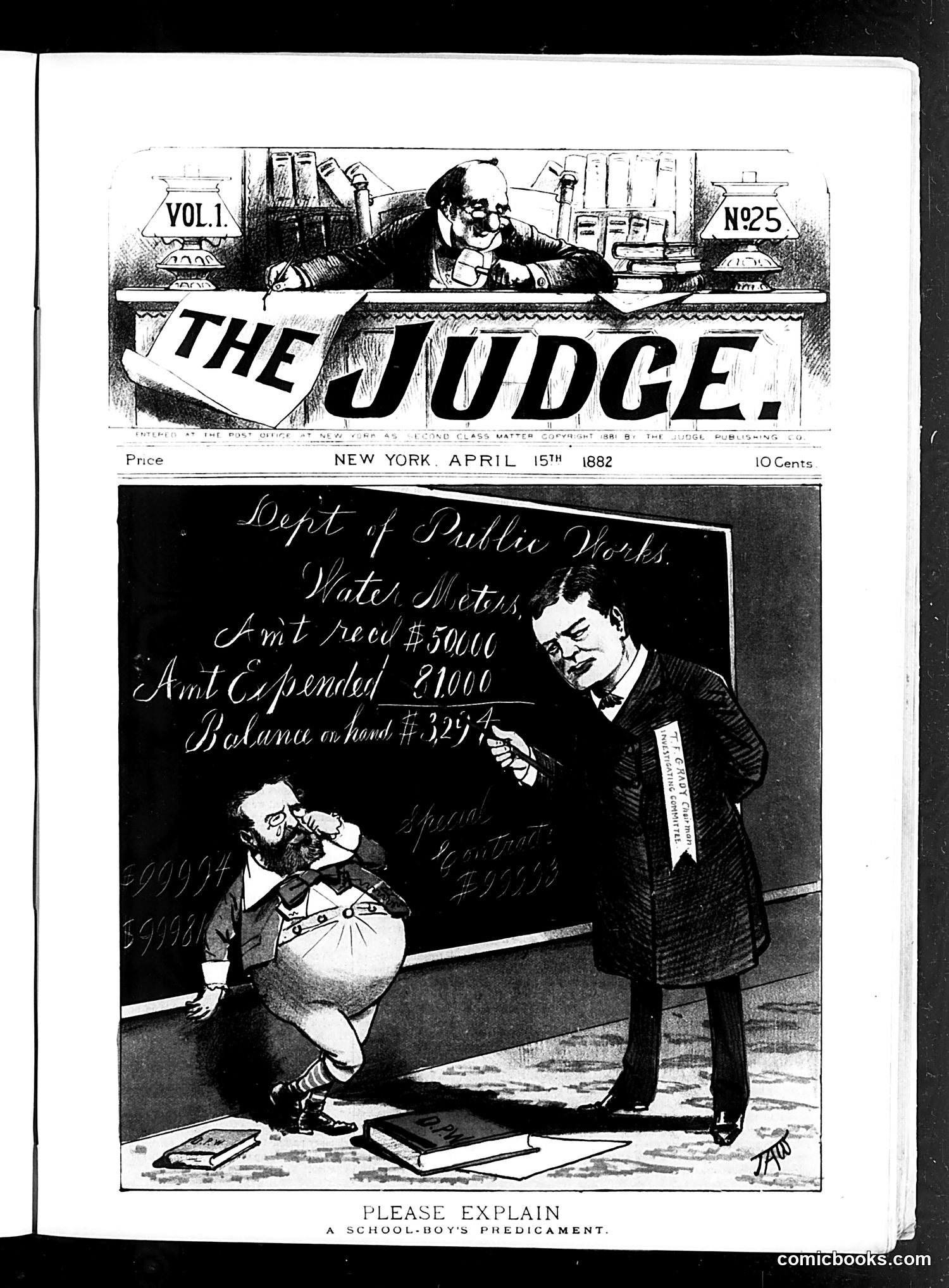
This cartoon satirizes public financial mismanagement. The scene depicts a schoolboy confronted by a stern authority figure pointing to a blackboard listing Department of Public Works expenditures: water meters, unpaid debts ($5,000), and expenses ($21,000), with a balance of $329. The "school-boy's predicament" is the boy being forced to explain massive discrepancies and overspending in municipal accounts—depicted as if he were a negligent student. The satire suggests that city officials responsible for public funds are performing as poorly as a failing student, unable to account for money or control expenses. This likely critiques New York City's Tammany Hall political machine, notorious in 1882 for corruption and financial waste in public works projects.
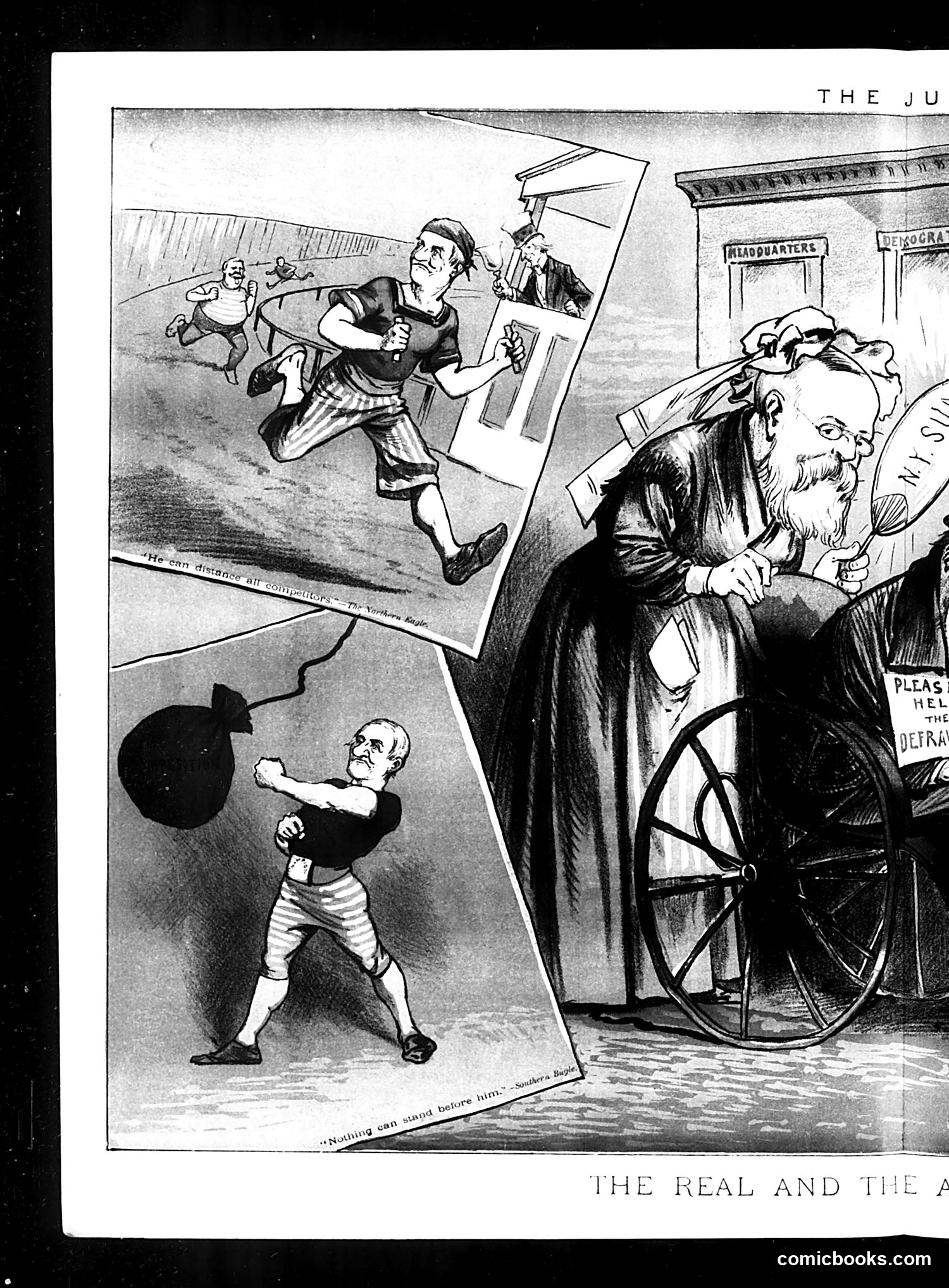
This 1880s satirical page attacks **Commissioner Hubert O. Thompson**, a Tammany Hall operative who faced a Senate investigation into corruption in New York City's Department of Public Works. ## The Main Cartoon The skull-faced figure represents Thompson being exposed by the investigation. The "Boss" (likely referring to Tammany Hall leadership) sent **Colonel George Bliss**, a notorious "bully," as Thompson's counsel—not for legitimate defense, but to intimidate and threaten senators through intimidation and abuse. Judge ridicules this transparent attempt to obstruct justice. ## "The Real and the Artificial" This section mocks the Democratic "literary bureau" for spreading propaganda about **former President Samuel J. Tilden**, claiming he's in robust health and training for political office. Judge suggests this is obvious fiction meant to position Tilden for New York's governorship—contrasting the "real" (actual corruption) with the "artificial" (Democratic propaganda). The overall message: Tammany Hall uses intimidation and propaganda rather than honest governance.
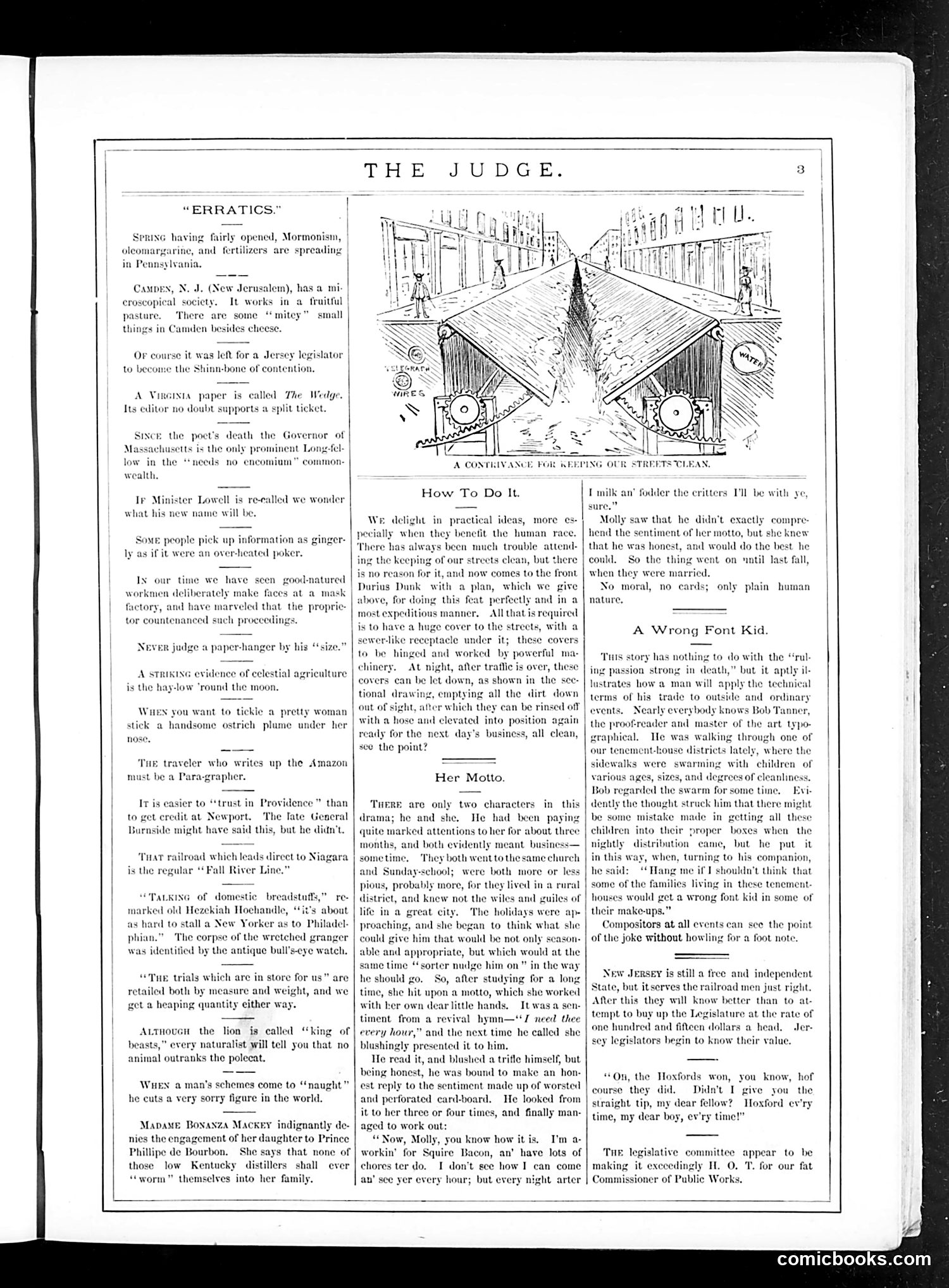
This page's main cartoon satirizes an impractical street-cleaning proposal. The drawing shows an elaborate mechanical system with hinged street covers and underground receptacles, operated by pulleys and machinery. The accompanying text proposes that streets be covered at night, dirt funneled below, then everything rinsed clean by morning. The satire targets the gap between grand mechanical "solutions" and practical reality—a common Judge theme mocking inventors and city planners who proposed increasingly complex contraptions for simple problems. The exaggerated engineering, shown in technical detail, would obviously be expensive, cumbersome, and impractical for actual urban use. The page also contains "Erratics"—brief satirical quips about current events: Mormonism and oleomargarine spreading in Pennsylvania, a Jersey legislator becoming contentious, and references to poets Longfellow and Lowell. These are lightweight topical jabs typical of Judge's style.
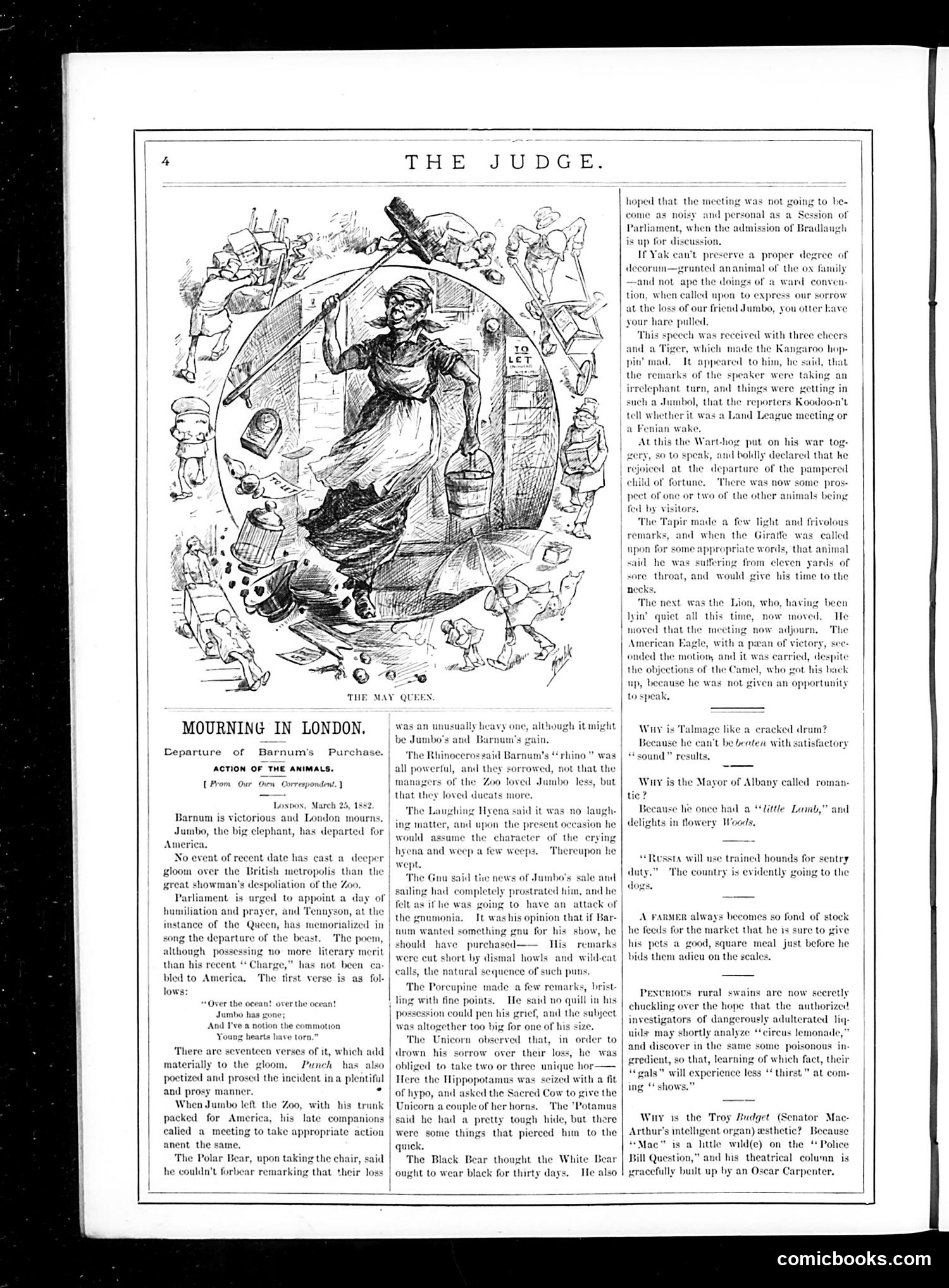
This satirical piece mocks the public outcry over P.T. Barnum's purchase and removal of Jumbo, the famous London Zoo elephant, to America. The central cartoon depicts Jumbo as a May Queen surrounded by grieving zoo animals. The text describes a mock-serious "meeting" of zoo animals expressing sorrow through puns and wordplay: the Lion won't speak, the Hyena cries, the Porcupine makes pointed remarks, the Hippopotamus has "hypo" (melancholy), and various animals debate whether the White Bear should wear mourning black. The proceedings dissolve into chaos—reporters can't distinguish it from a Land League meeting or Fenian wake. **The satire targets:** - British public sentimentality over losing Jumbo - Parliament's proposed "day of humiliation and prayer" - The idea that zoo officials valued money ("ducats") over the animal - Absurd parliamentary and political ceremony The joke: treating animal reactions to Jumbo's departure as seriously as actual political proceedings, ridiculing both British emotionalism and theatrical parliamentary procedure.
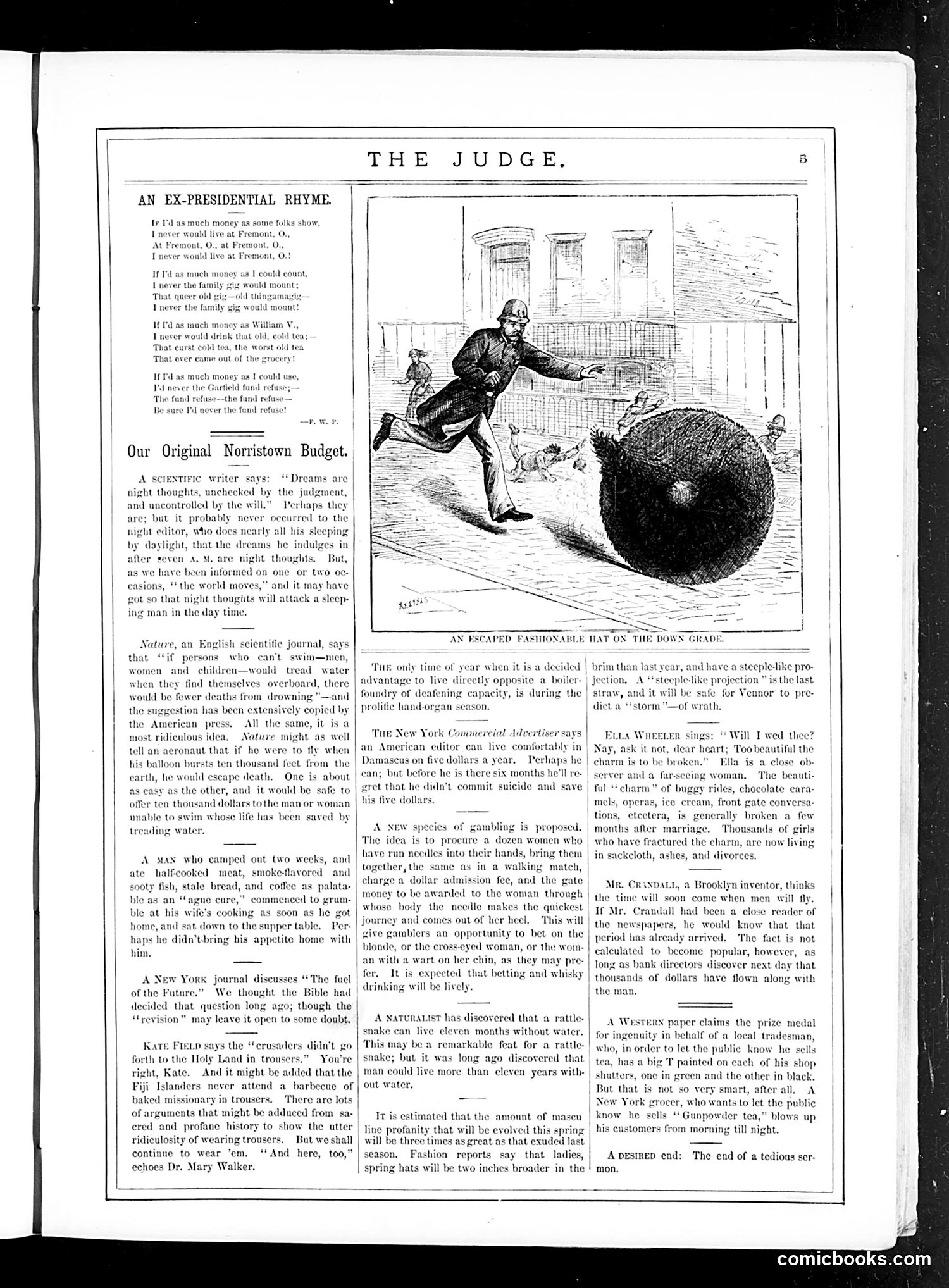
This page satirizes an unnamed ex-president (likely referring to recent administrations) through a mocking poem expressing regret about not accumulating wealth to avoid living in modest circumstances like "Fremont, O." The rhyme mocks the figure's financial situation and apparent complaints about ordinary life details (cold tea, family expenses). The central cartoon, titled "An Escaped Fashionable Hat on the Down Grade," depicts a well-dressed man chasing his blown-away hat down a street—a visual gag about loss of dignity and control. The surrounding "Norristown Budget" section collects miscellaneous satirical items: mocking Victorian-era scientific claims (drowning victims treading water), the absurdity of Dr. Mary Walker's women's dress reform advocacy, and New York newspaper editorial peculiarities. These snippets target contemporary social pretensions and journalistic excess rather than specific political events. The overall tone ridicules both ex-presidential irrelevance and period social absurdities.
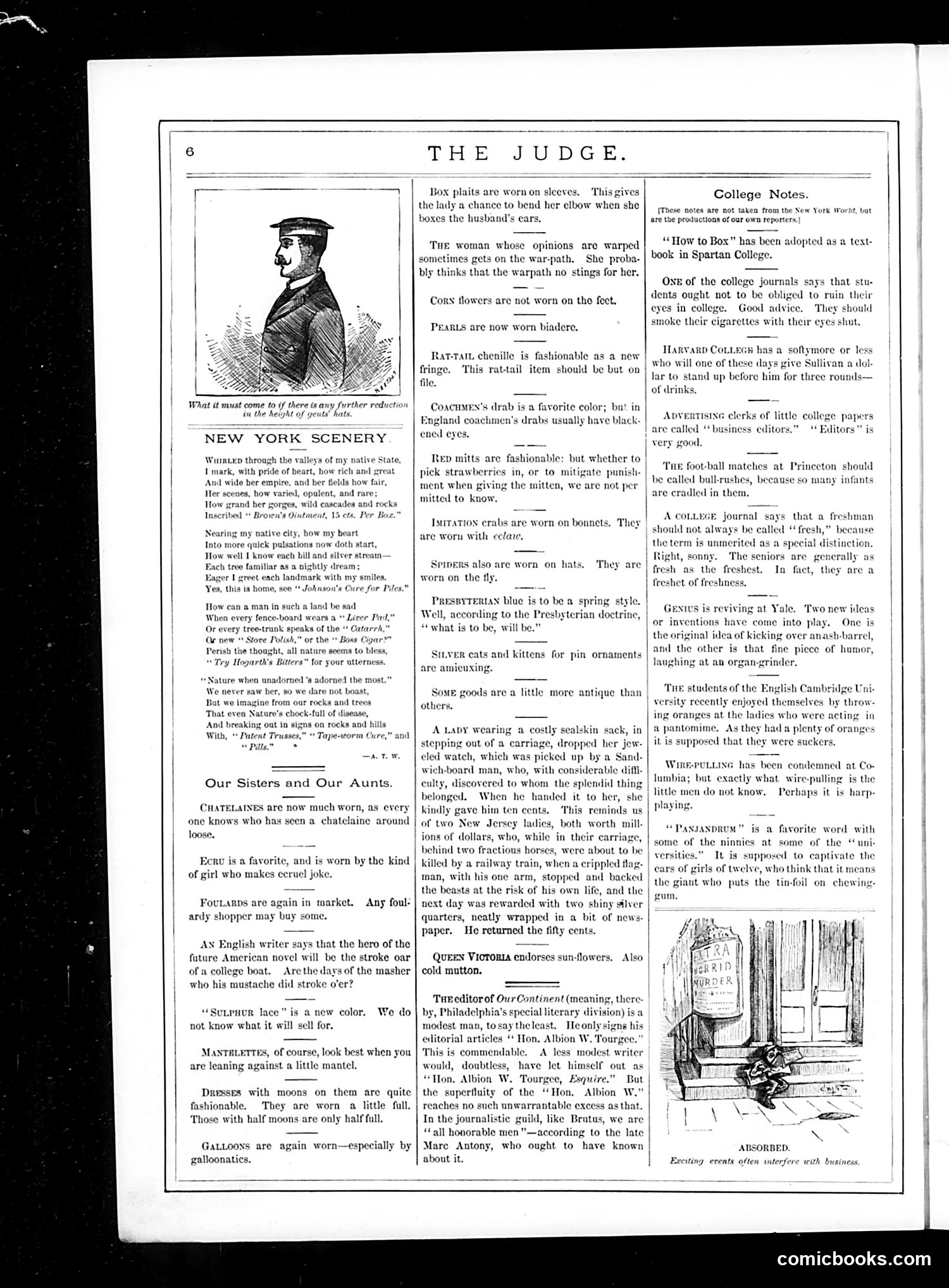
This page from the satirical magazine **Judge** contains mostly fashion commentary and social satire rather than political cartoons. The main illustrated cartoon shows a man's hat that has shrunk to absurdly tiny proportions, captioned as a warning about further reductions in gentlemen's hat heights—satirizing contemporary fashion trends toward smaller hats. The bulk of the page consists of witty observations about current fashions (box plaits, rat-tail chenille, various colored fabrics) with tongue-in-cheek commentary. For example, "box plaits...give the lady a chance to bend her elbow when she boxes the husband's ears" jokes about marital discord. **"Our Sisters and Our Aunts"** section mocks women's fashion choices through puns: "Ecru is a favorite, and is worn by the kind of girl who makes ecruel [cruel] joke." Two brief anecdotes mock wealthy women's stinginess: a lady who drops an expensive watch and rewards the honest finder with only ten cents, contrasted with millionaires giving a disabled man two quarters (fifty cents total) for saving their lives—satirizing the hypocrisy of the wealthy regarding charity.
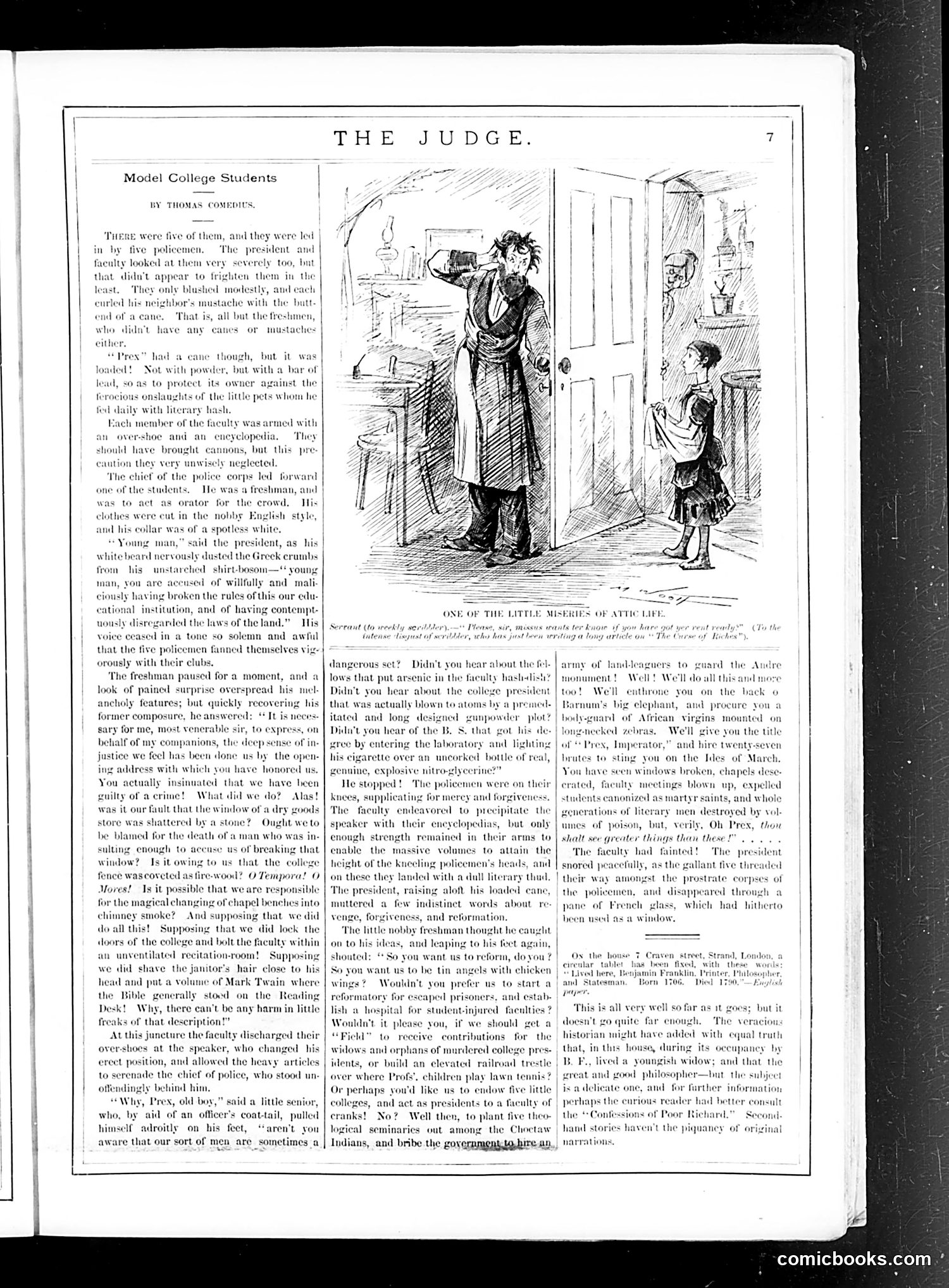
This satirical story mocks undisciplined college students arrested for various destructive pranks. Five students are brought before the college president ("Prex") by police for breaking rules and causing chaos—including breaking windows, damaging property, and endangering faculty members. The humor lies in the students' absurd defense: they attempt to justify their destructive behavior through elaborate, tongue-in-cheek reasoning, claiming they bear no responsibility for the consequences of their actions. One student sarcastically suggests they should instead be running reform institutions and hospitals. The satire targets both the students' arrogance and entitlement, and implicitly critiques lenient college discipline of the era. The cartoon (showing the confrontation between a tall adult and small child) reinforces the theme of immature, childish behavior masquerading as adult student conduct. This appears to be social commentary on late 19th or early 20th-century college life and youth culture.
This Judge magazine cartoon satirizes political opposition to constitutional distance in what appears to be a progressive-era piece. The image shows a bearded Democratic Party official (identifiable by the "HEADQUARTERS" and "DEMOCRA[TIC]" signs) dismissing concerns, while outside his office, figures—including what appears to be a boxer and a child—struggle with a large bomb labeled "Nothing can stand before [this]—Sandow's Boycott." The satire critiques Democratic leadership for ignoring or minimizing public concern about an external threat or boycott campaign. The contrast between the officials' dismissive posture inside versus the chaos outside suggests the party leadership is disconnected from real consequences affecting ordinary citizens. The specific reference to "Sandow's Boycott" remains unclear without additional context, but the cartoon's point is clear: leadership underestimating a genuine problem.
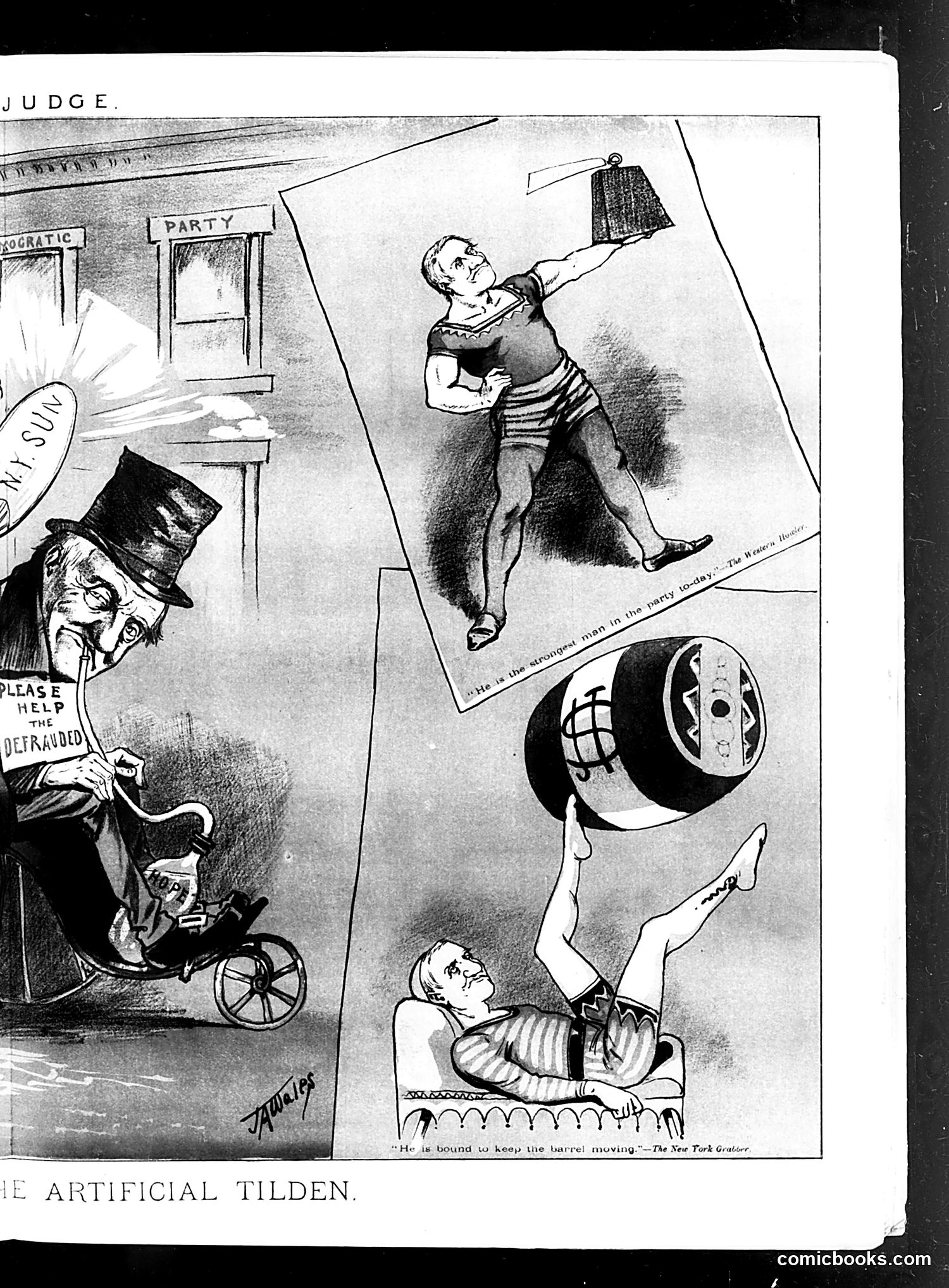
This Judge magazine cartoon satirizes what appears to be a political figure being artificially kept in motion—likely referencing Samuel J. Tilden, the Democratic presidential candidate. The central image shows a man being juggled like a barrel, controlled by unseen forces. On the left, a caricatured figure (possibly representing political manipulation or a specific political operative) pulls strings, while text reads "PLEASE HELP THE DEFRAUDED," suggesting electoral fraud allegations. The "Party" building appears in the background. The satire mocks the notion that Tilden—or his political movement—is artificially sustained by party machinery rather than genuine popular support. The barrel-juggling metaphor suggests he's being kept in constant, hollow motion for political purposes, not authentic leadership.
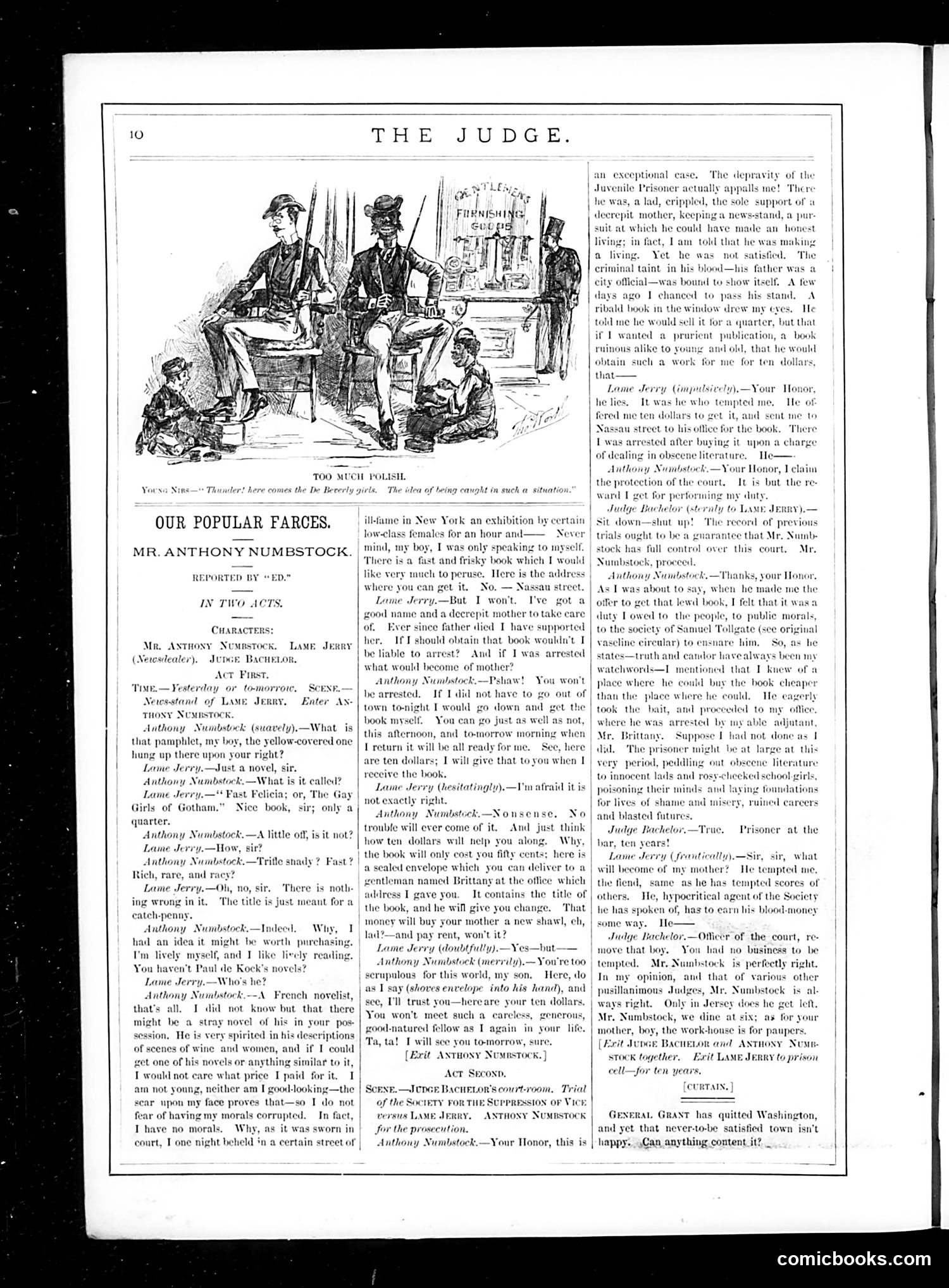
This page satirizes **Anthony Numbstock**, a lecherous, hypocritical newsdealer who poses as morally upright while profiting from obscene literature. **The Setup**: Numbstock attempts to buy a "fast and frisky" French novel from Lame Jerry, a crippled boy supporting an elderly mother. When Jerry refuses, Numbstock bribes him with ten dollars, then has him arrested for dealing in obscene literature—claiming he acted to "protect public morals." **The Satire's Point**: The joke exposes the contradiction: Numbstock is the actual corruptor (he initiated the transaction), yet he uses the legal system to punish the vulnerable poor boy while protecting himself. He frames his own moral corruption as civic duty. **Context**: This reflects Gilded Age anxieties about obscene literature's danger to youth, and critiques how wealthy individuals could weaponize morality laws against the poor while escaping consequences themselves. Judge magazine frequently attacked such hypocrisy in the business class.
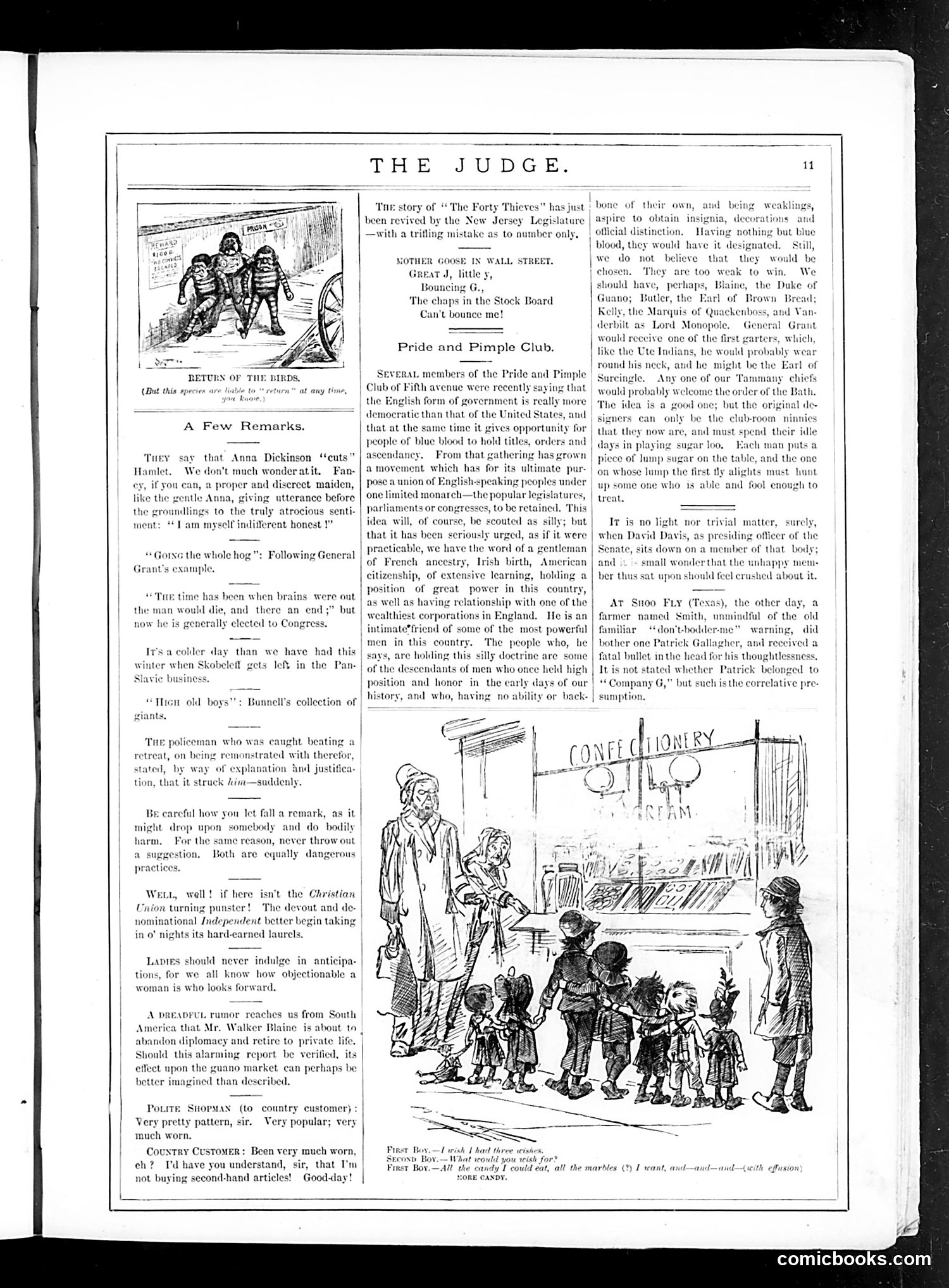
This page from the satirical magazine *Judge* contains several distinct pieces of social and political commentary: **"Mother Goose in Wall Street"** mocks the New Jersey Legislature, comparing them to "The Forty Thieves"—suggesting legislative corruption or incompetence in financial matters. **"Pride and Pimple Club"** satirizes wealthy Fifth Avenue elites proposing a union of English-speaking peoples under a limited monarchy. The piece ridicules these aristocratic descendants—people of "blue blood" but no actual ability—who romanticize British government as more democratic than American democracy, despite lacking merit for their positions. **"A Few Remarks"** contains scattered quips: Anna Dickinson is praised for intellectual boldness; a comment on fools being elected to Congress; and advice against indiscreet remarks. **The main illustration** depicts what appears to be street vendors or performers with a "Confectionery" sign, with working-class figures and children—likely contrasting common people with the elite subjects of other pieces. The overall theme critiques both legislative incompetence and aristocratic pretension among America's wealthy.
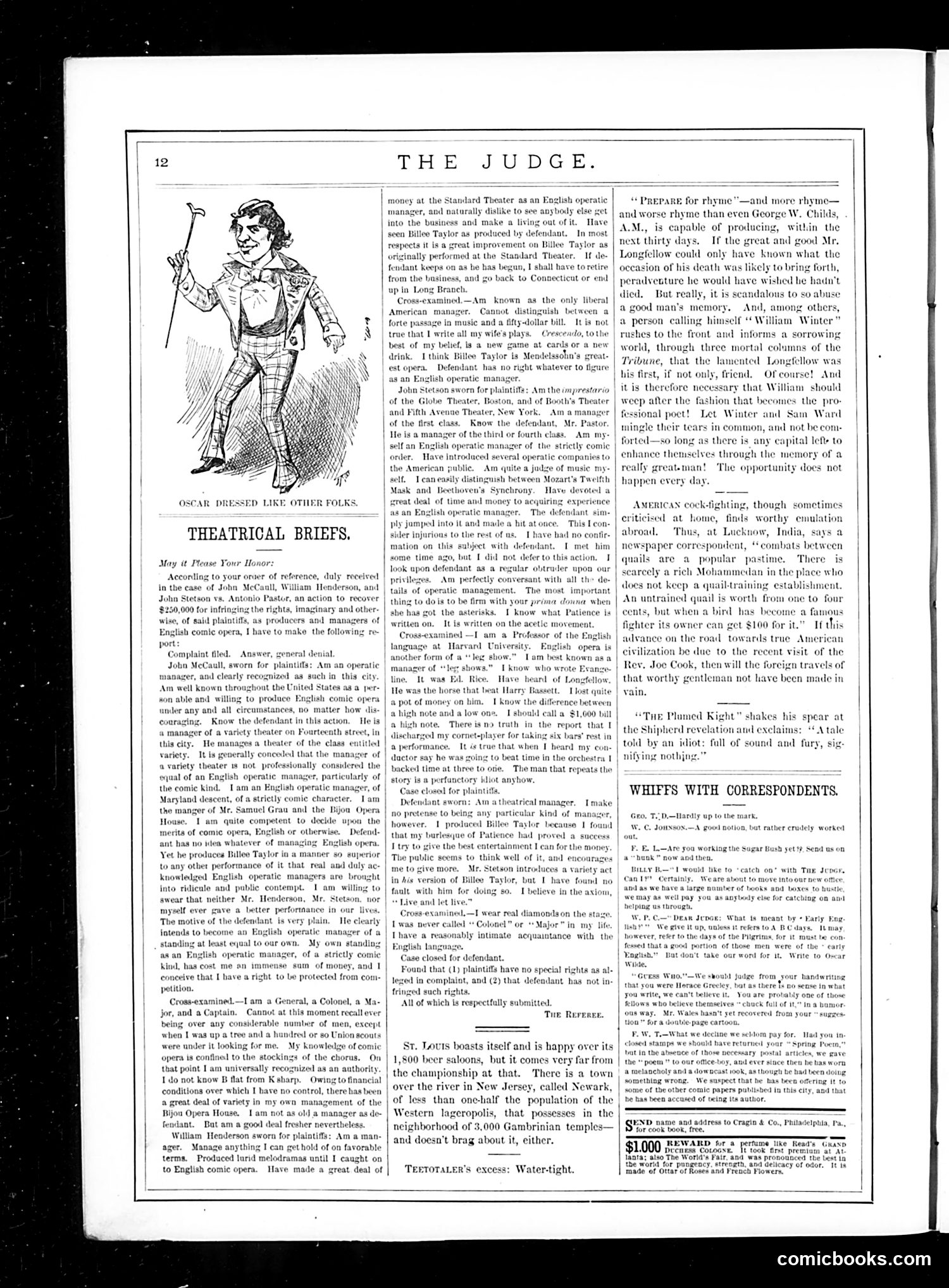
This page from *Judge* magazine features "Theatrical Briefs"—a satirical legal proceeding about operatic management disputes. The main text mocks competing claims over management of "Billee Taylor," an English comic opera. The cartoon depicts "Oscar Dressed Like Other Folks"—a caricatured figure in fashionable attire, likely satirizing someone in theatrical management who pretends to sophistication despite lacking genuine credentials. The satire targets the operatic world's pretensions: various self-proclaimed managers boast of experience while admitting ignorance (one claims he "don't know B flat from K sharp"). The piece ridicules American theatrical entrepreneurs who mimicked English opera while possessing no real musical knowledge or professional standing. The humor lies in exposing the gap between theatrical managers' inflated self-importance and their actual incompetence—a common *Judge* target during the Gilded Age, when American entertainment was rapidly commercializing and charlatans frequently posed as cultured impresarios.
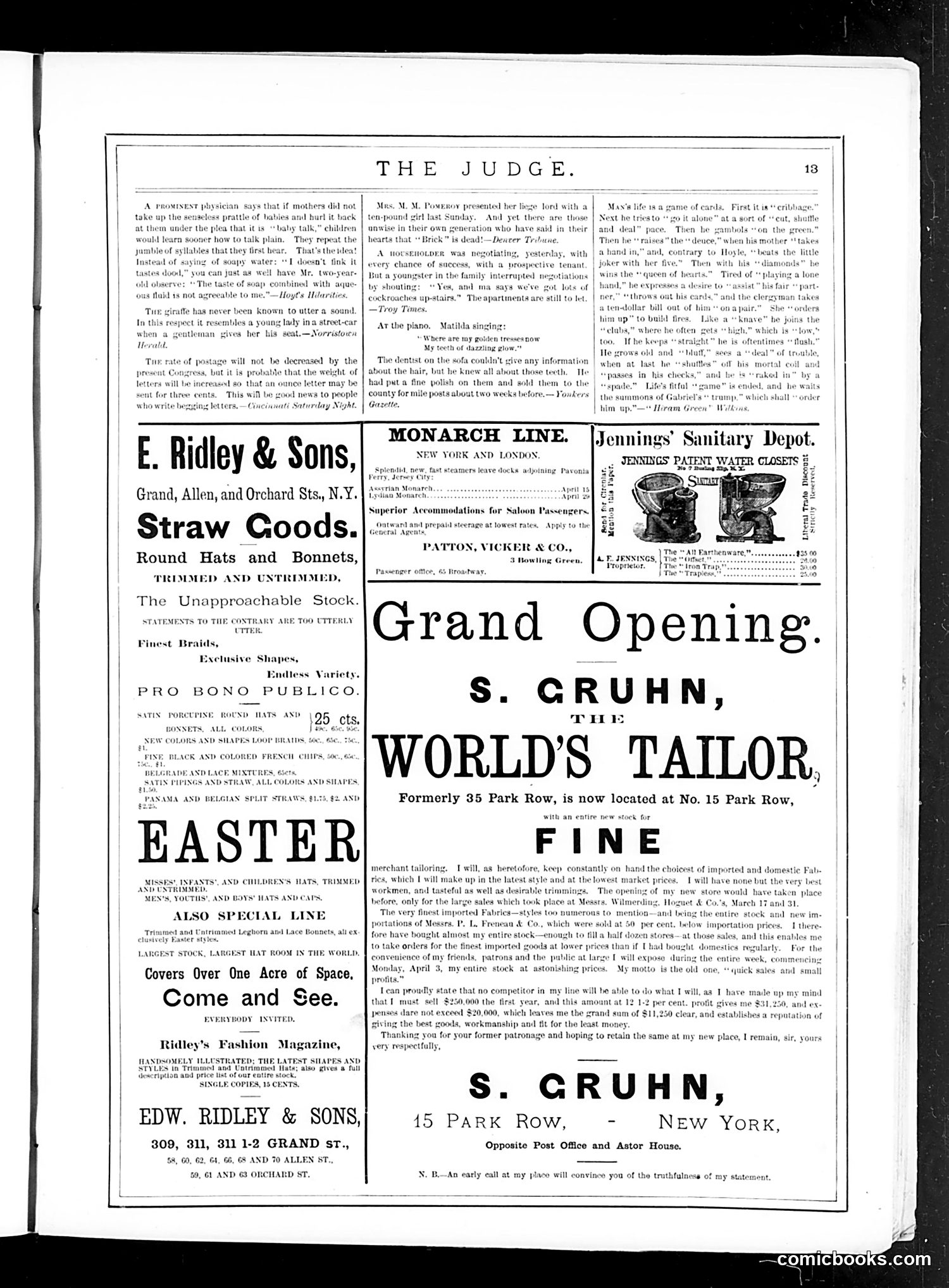
This page is **primarily advertisements** rather than editorial content or political cartoons. The visible text fragments at the top appear to be from humor columns or joke sections typical of Judge magazine, but they're largely illegible in the OCR. The dominant content consists of commercial advertisements for: - **E. Ridley & Sons**: A straw goods and hat retailer - **Monarch Line**: Steamship passage between New York and London - **S. Cruhn**: "The World's Tailor," announcing a relocation and grand opening with inventory clearance The humor fragments visible discuss domestic life—mothers and children's speech patterns, a woman's piano playing, and card games—reflecting typical late 19th-century satirical observations of middle-class life. **Without clearer images or complete text, specific political satire or caricatures cannot be identified with certainty.** This appears to be a typical Judge magazine page mixing editorial humor with commercial advertisements aimed at urban, middle-class readers.
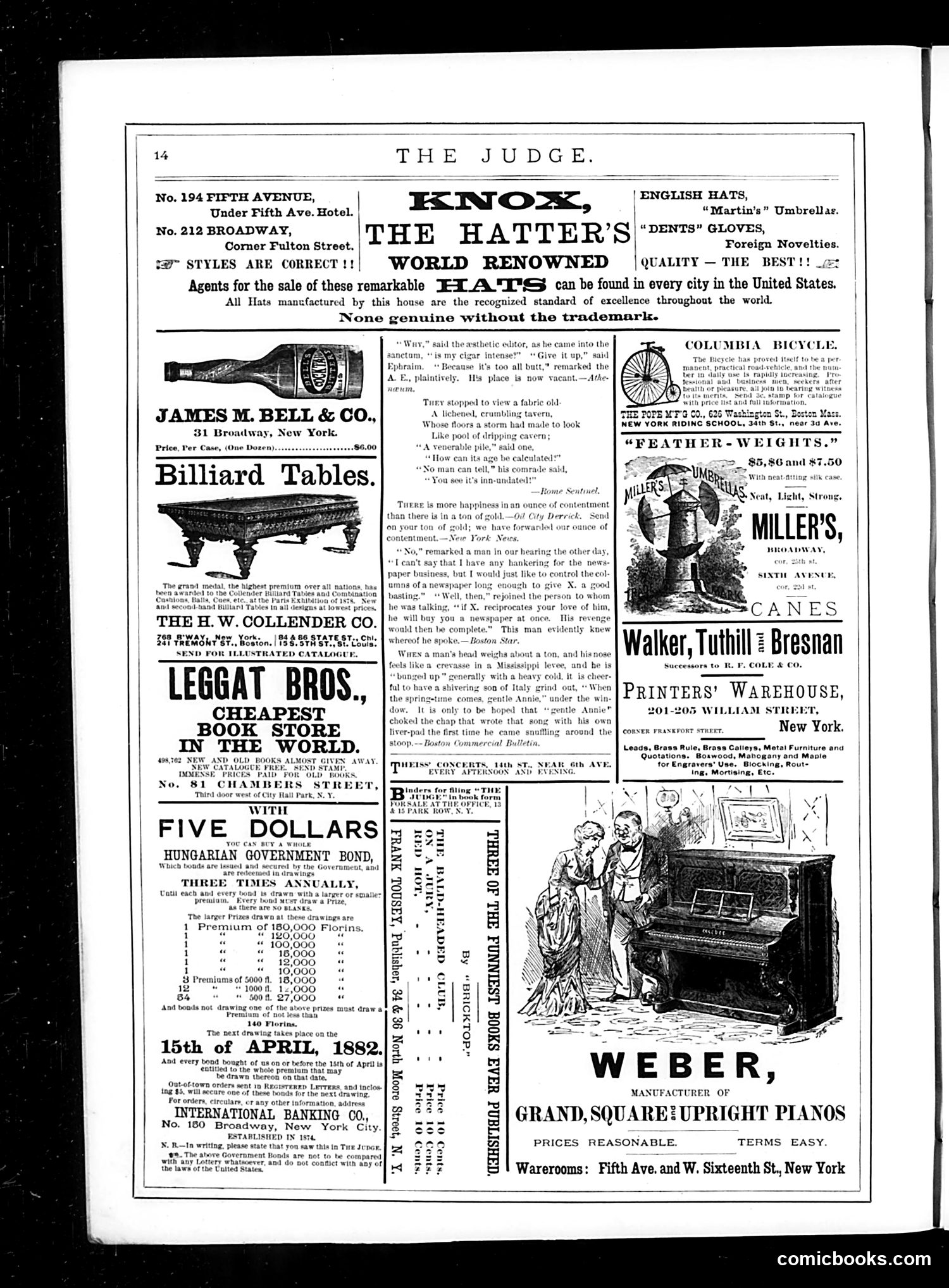
This is primarily an **advertising page** from Judge magazine (dated around 1882, based on the Hungarian bond drawing date). The page contains no political cartoon or satirical content—instead it features commercial advertisements for various products and services. The ads include Knox hats, billiard tables, a book store, pianos by Weber, bicycles, and financial instruments (a Hungarian government bond lottery). There is a small illustrative vignette showing two figures examining a piano, but this is simply promotional imagery for Weber pianos, not political satire. The only textual content that might be considered commentary consists of brief anecdotal quotes scattered among ads—humorous observations about aging, newspaper business, and such—but these are disconnected filler material, not connected satire. This page represents the **commercial side of Judge magazine**, demonstrating how 19th-century publications funded themselves through advertising rather than relying solely on editorial content.
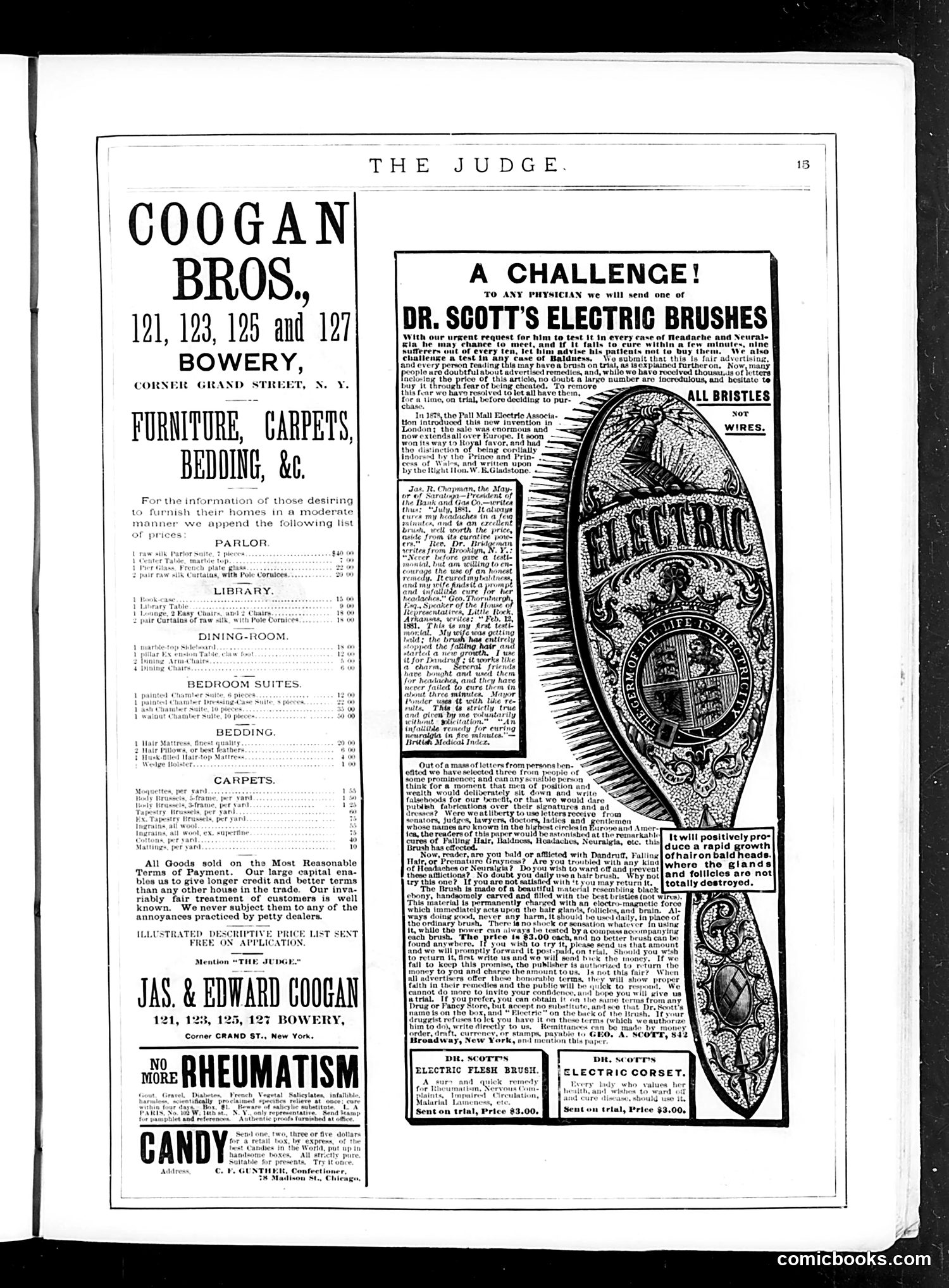
This page is primarily **advertising**, not satire or political commentary. It features furniture and household goods ads alongside Dr. Scott's Electric Brush—a patent medicine advertisement typical of the late 19th century. **The Main Content:** The large center advertisement is a challenge from Dr. Scott's Electric Brush company, claiming their device cures headaches, neuralgia, baldness, and dandruff through electrical stimulation. They offer a money-back trial period to skeptical customers. **Historical Context:** This reflects the era's widespread promotion of "electric" remedies—devices marketed as scientifically advanced cures using electricity. Such products were largely ineffective but capitalized on public fascination with new electrical technology. The testimonial letters cited (from "judges" and "lawyers") were common marketing tactics to establish credibility. **Judge Magazine's Role:** By publishing these ads, Judge—a satirical publication—generated revenue, though the patent medicine itself might be viewed skeptically by modern readers familiar with this period's medical quackery.
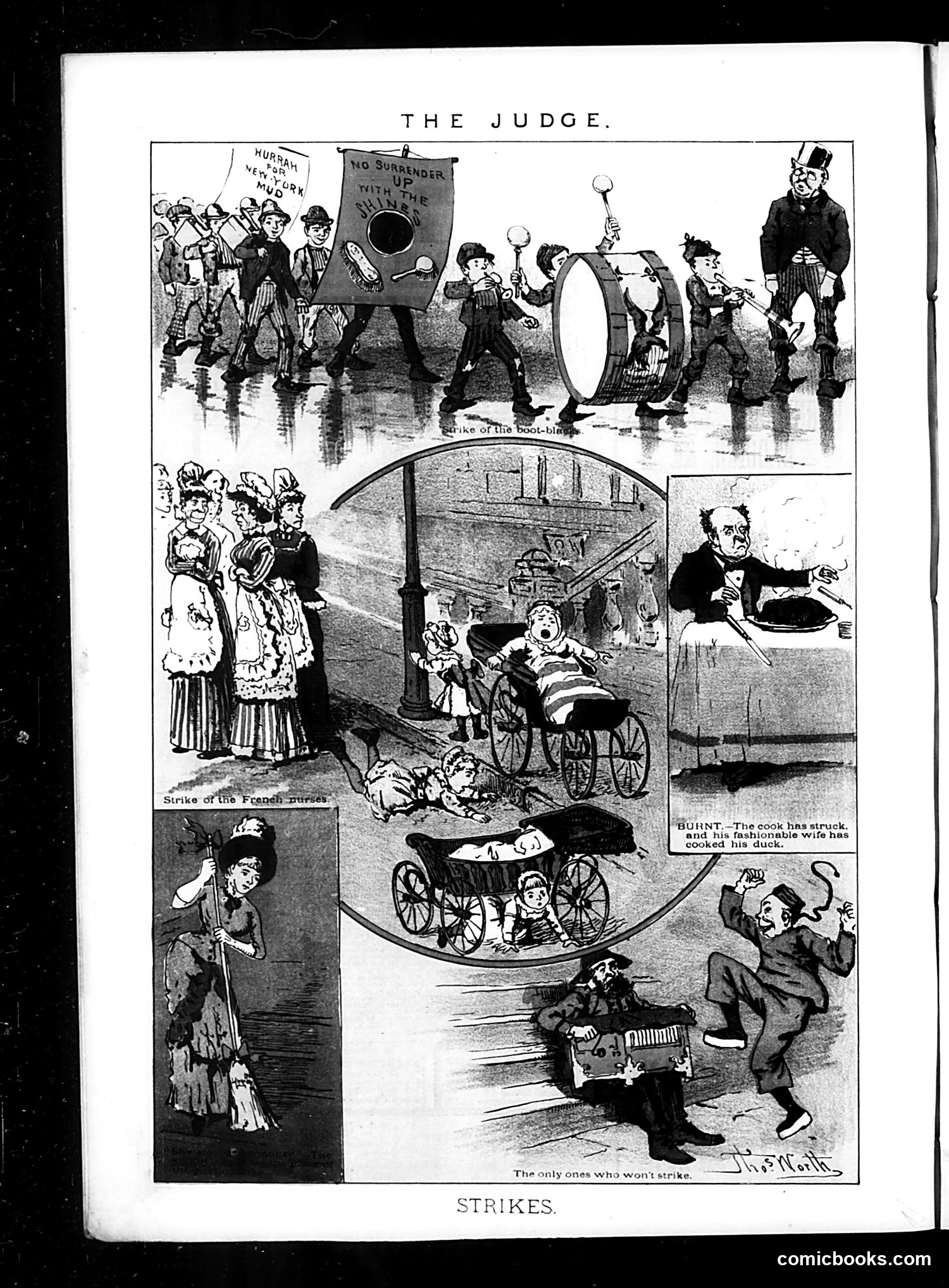
This satirical cartoon critiques labor strikes, likely from the early 1900s when strike activity was widespread. The top panel shows various striking groups—bootblacks, French nurses, and others—holding signs demanding "No Surrender" and fair treatment. The middle and lower panels mock the consequences: a judge presides over chaos; French nurses strike while children suffer; a cook strikes, forcing his fashionable wife to cook instead; and notably, dogs and cats continue working peacefully, labeled "The only ones who won't strike." The satire suggests strikes cause collateral damage to innocent parties (children, families) and create ridiculous inversions of social order. The final panel's joke—that only animals remain reliable workers—implies strikers are unreasonable or that labor unrest threatens civilization itself. The cartoon reflects an anti-strike, pro-establishment editorial stance common in mainstream publications of the era.