
A complete issue · 16 pages · 1882
Judge — March 25, 1882
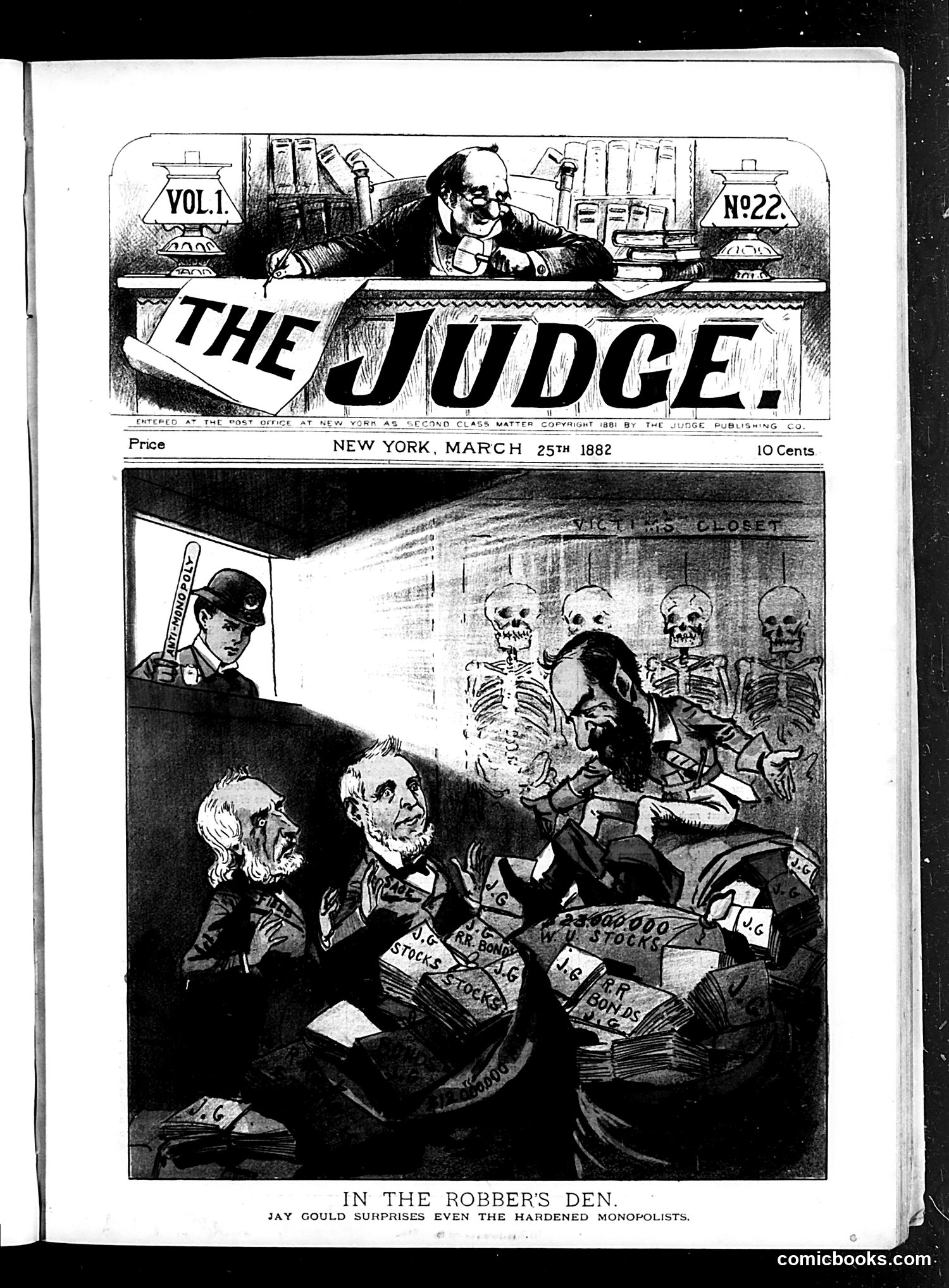
This satirical cartoon depicts **Jay Gould**, the notorious railroad magnate and financier, surprising even other wealthy monopolists with his ruthlessness. The scene shows Gould (center-left, with distinctive features) surrounded by skeletal figures representing death and financial ruin—visualizing the destructive impact of his business practices. Stacks of money and bonds labeled "stocks," "bonds," and "RR" (railroad) litter the scene. The skeleton imagery suggests Gould's aggressive monopolistic tactics literally kill competitors and harm ordinary investors. The caption's irony—that Gould "surprises even the hardened monopolists"—implies his methods exceeded even his wealthy peers' moral boundaries. This reflects 1882 public outcry against Gould's consolidation of railroad power and his reputation for ruthless financial manipulation and stock manipulation schemes.
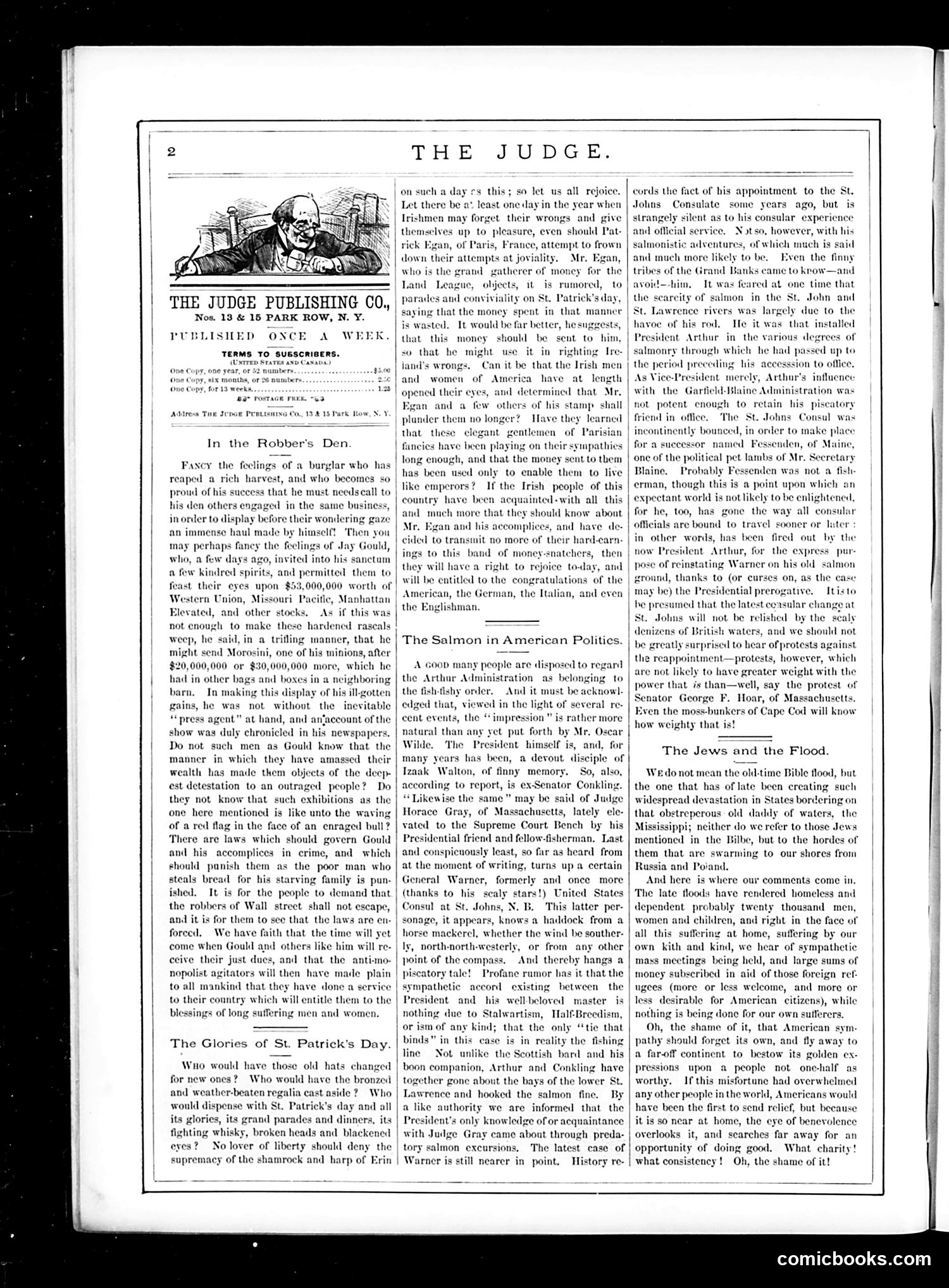
This page from *Judge* magazine contains several political satires attacking the Arthur Administration (President Chester Arthur, 1881-1885). **"The Glories of St. Patrick's Day"** mocks Patrick Egan, a Irish-American Land League fundraiser in Paris, for allegedly discouraging Irish-Americans from celebrating St. Patrick's Day, wanting instead to redirect festive spending toward Irish nationalist causes. The satire suggests Egan and similar activists are manipulating Irish-American sympathies. **"In the Robber's Den"** uses a burglar metaphor to attack Jay Gould and wealthy industrialists, condemning their ostentatious display of ill-gotten stock wealth ($53 million mentioned) and comparing their behavior to criminals bragging about heists. **"The Salmon in American Politics"** satirizes President Arthur and associates (ex-Senator Conkling, Judge Horace Gray, General Warner) as obsessed with fishing rather than governance—implying the Administration is composed of dilettantes neglecting serious duties. The overall message: Arthur's administration prioritizes leisure over leadership, while corrupt robber barons flaunt stolen wealth.
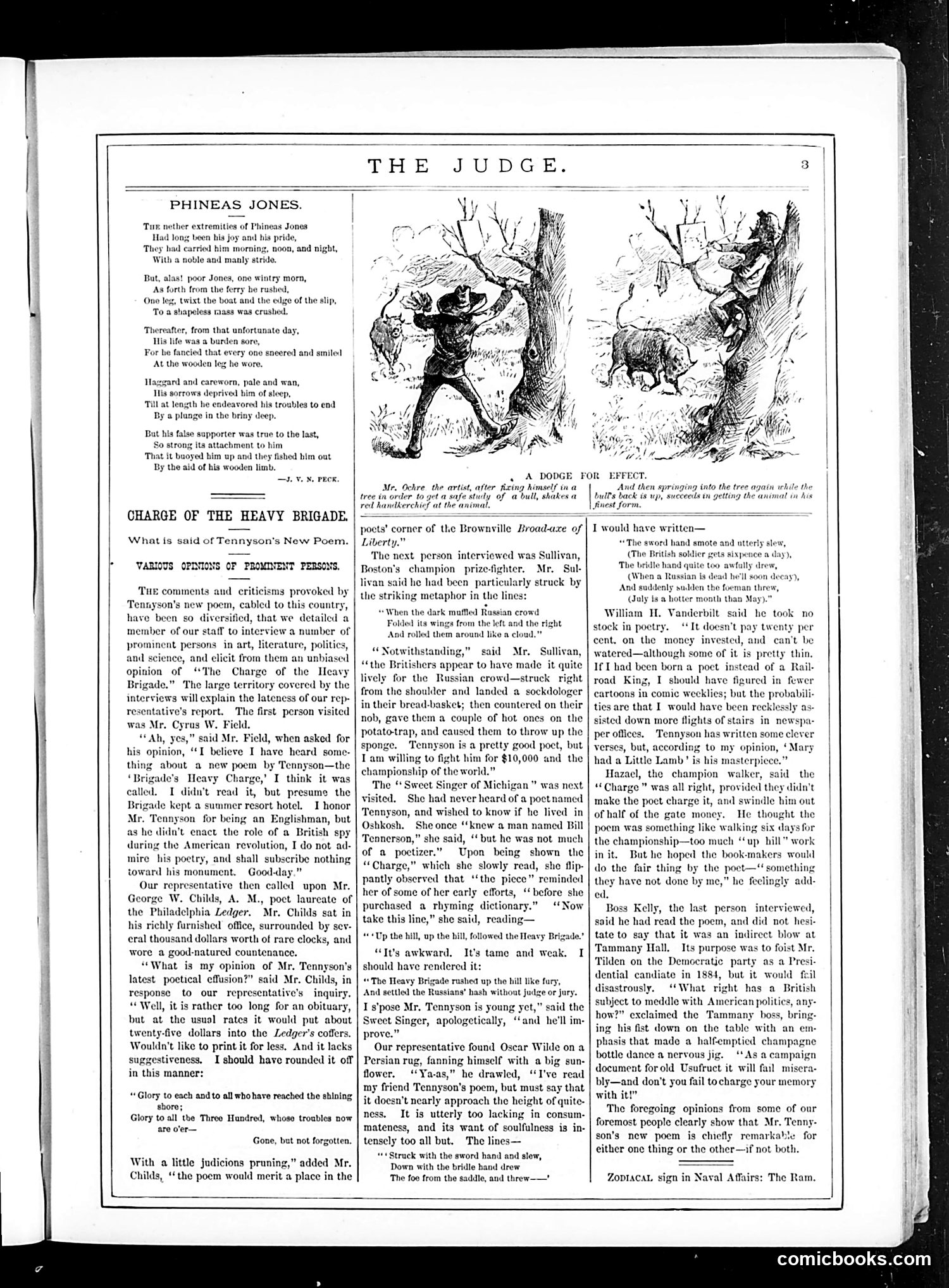
This page from *Judge* satirizes Alfred Tennyson's poem "The Charge of the Light Brigade" (the text says "Heavy Brigade," likely a deliberate joke). The content mocks prominent American figures' varying reactions to Tennyson's work. **Key satirical targets:** - **Cyrus W. Field** (telegraph magnate): Dismisses Tennyson because he didn't spy for America during the Revolution—shallow patriotism masquerading as principle. - **George W. Childs** (Philadelphia newspaper editor): Reveals his mercenary nature, calculating payment rates rather than literary merit. - **John L. Sullivan** (famous boxer): Interprets the poem's military metaphor through prizefighting vocabulary ("sockdologer," "bread-basket"), reducing poetry to brutish combat. The "Phineas Jones" poem above tells a sentimental story about a war amputee saved by his wooden leg—contrasting genuine patriotic sacrifice with the self-interested commentary below. The satire targets American philistinism and materialism disguised as cultural opinion.
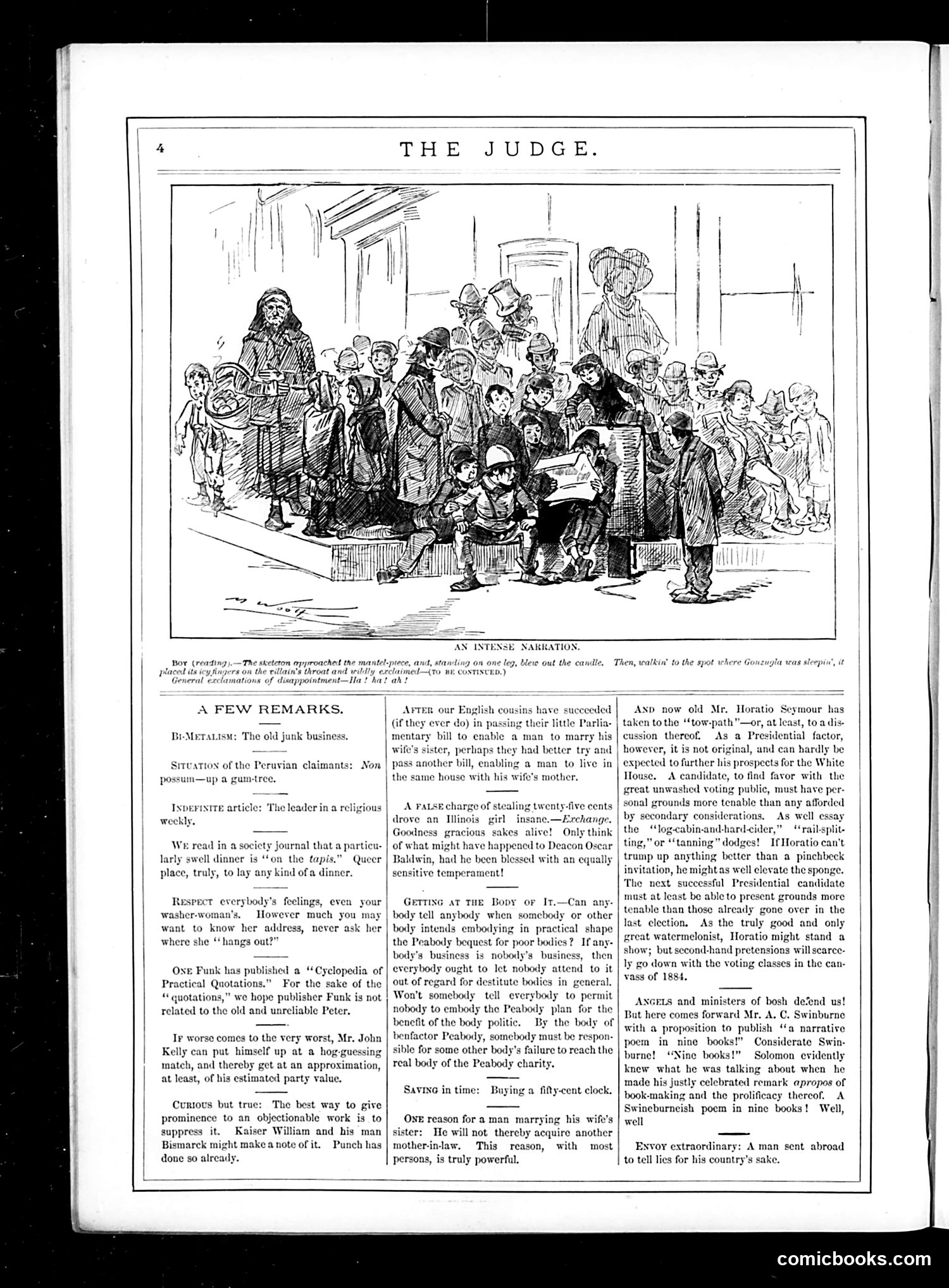
This page from *Judge* magazine contains satirical commentary on 1880s American politics and social issues. The main cartoon depicts a crowded scene with figures gathered around what appears to be a narrative or announcement (caption references "An Intense Narration"). The "Few Remarks" section below offers brief satirical jabs at contemporary topics: - **Bimetallism** jokes about currency debate as "junk business" - **Peruvian claimants** references a specific diplomatic dispute - **Horatio Seymour** (likely the 1868 Democratic presidential candidate) is mocked for relying on weak campaign justifications - **Peabody bequest** satirizes bureaucratic confusion over philanthropic funds - **A.C. Swinburne's proposed "nine-book poem"** ridicules artistic excess - Various social commentary on marriage, dinner etiquette, and journalism The satire assumes readers recognize specific political figures and recent events. Without that contemporary context, the references feel obscure to modern audiences.
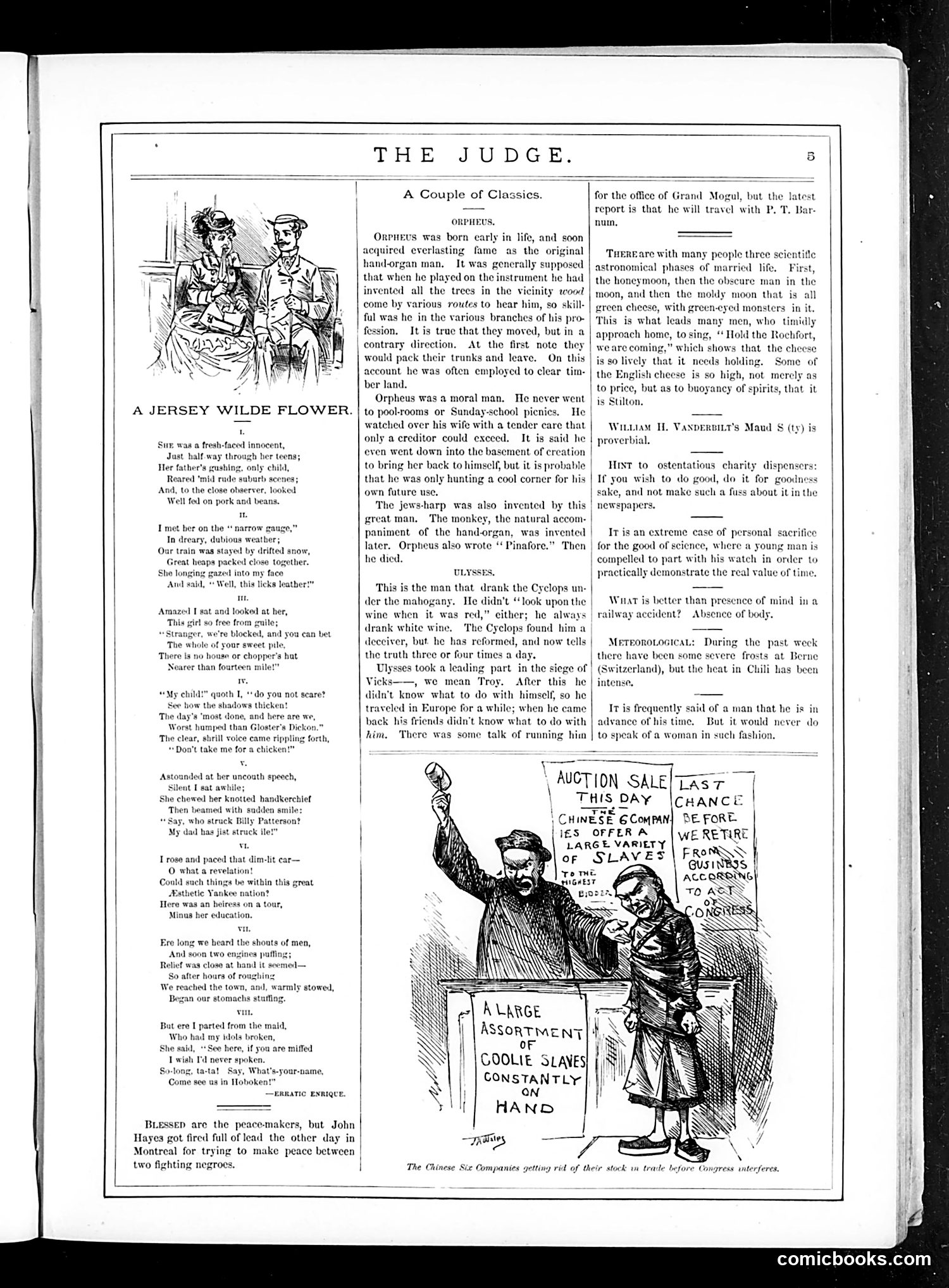
This page contains satirical literary and social commentary typical of *Judge* magazine. The main content includes: **"A Jersey Wilde Flower"** — A humorous poem about an encounter with an outspoken, unconventional woman on a train who challenges the narrator's expectations of female propriety and delicacy. **"A Couple of Classics"** — Irreverent retellings of Greek mythology (Orpheus and Ulysses), mocking classical literature by giving absurd, anachronistic details—suggesting Orpheus invented the hand-organ and that Ulysses will tour with P.T. Barnum's circus. **The cartoon** depicts a Chinese company auctioning enslaved people, satirizing both the slave trade and Chinese immigration/labor practices—a xenophobic commentary reflecting 1880s-90s American attitudes. **Brief satirical notes** mock marriage, charity, and railway accidents with dark humor. The page's overall tone is irreverent toward cultural institutions (classics, matrimony, propriety) and reflects period prejudices toward immigrants and racial groups.
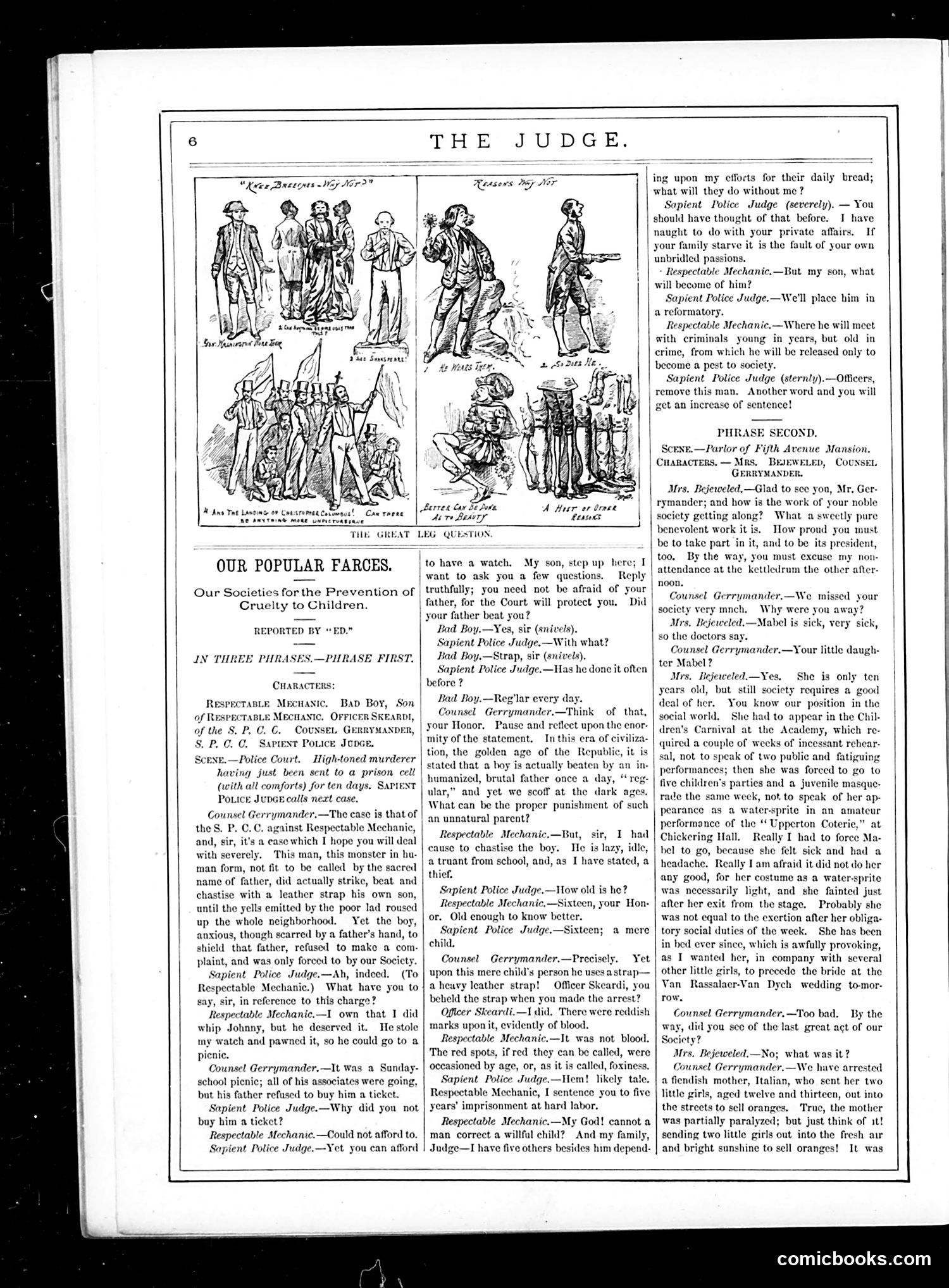
This satirical piece criticizes child protection societies—organizations like the Society for the Prevention of Cruelty to Children (S.P.C.C.)—as overreaching and absurd. A working-class mechanic is sentenced to five years hard labor for beating his 16-year-old son with a leather strap after the boy stole his watch to attend a Sunday school picnic. The judge prioritizes the child's welfare while dismissing the father's poverty and responsibility for five other dependents. The satire targets what *Judge* magazine viewed as self-righteous, zealous child-welfare advocates who ignore economic hardship and parental authority. The "Counsel Gerrymander" character represents these activist lawyers using flowery rhetoric ("golden age of the Republic") to prosecute working fathers for traditional discipline. The joke: reform movements meant to protect vulnerable children are instead destroying families through excessive punishment of poor parents.
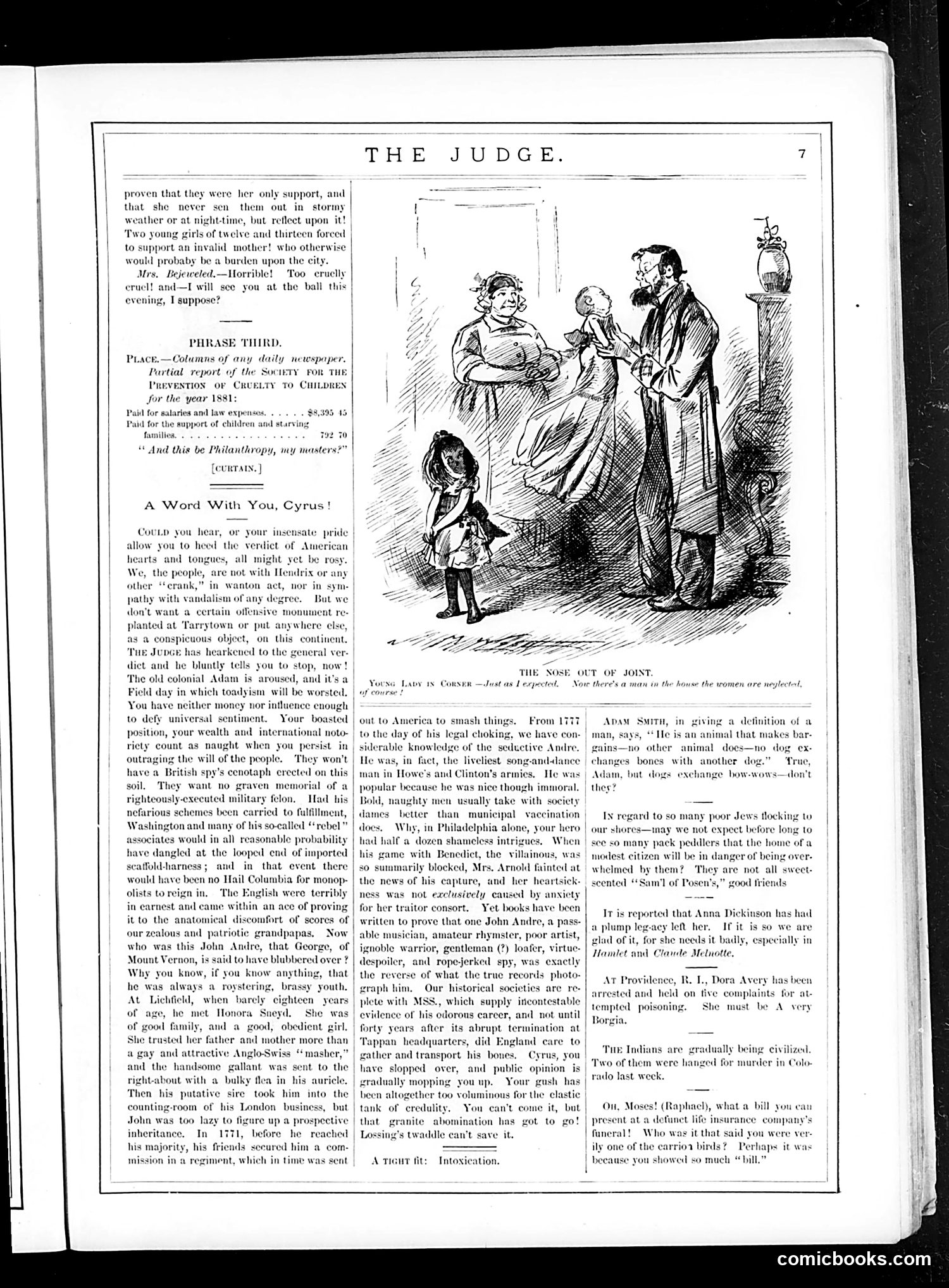
This page satirizes American hypocrisy regarding charity and monuments. **The main cartoon ("The Nose Out of Joint")** depicts a wealthy, bejeweled woman dismissing child labor as "cruel"—yet she'll attend a ball that evening, revealing her indifference to actual suffering. The accompanying text mocks this performative charity: a children's welfare society spent only modest sums on starving families while the woman's concern is theatrical. **"A Word With You, Cyrus"** attacks someone (likely Cyrus Field, a wealthy industrialist) for attempting to erect a monument to John André, the British spy executed during the American Revolution. The article argues this is offensive to American patriots and that Field's wealth shouldn't override public sentiment. It portrays André as an immoral seducer who deserved execution. **The satire targets:** wealthy philanthropists who perform charity for social status rather than genuine compassion, and the attempt to honor a British traitor—both seen as un-American arrogance by the moneyed class. The page reflects 1881 debates about labor, class, and national memory.
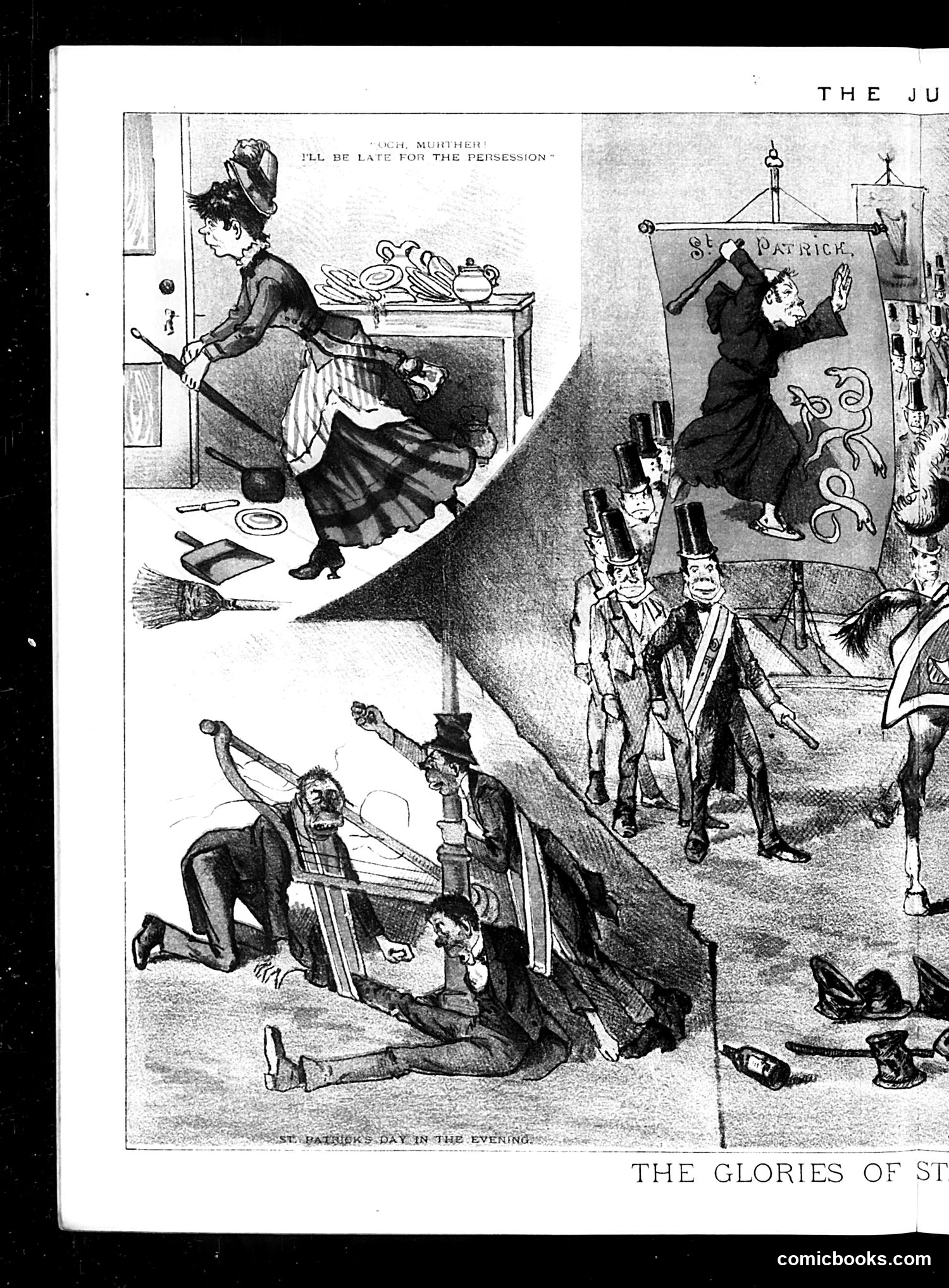
This satirical cartoon from *Judge* magazine depicts "St. Patrick's Day in the Evening." The top panel shows a woman frantically cleaning her kitchen after chaos, with text "Och, murther! I'll be late for the possession" — a pun on "procession." The bottom panel illustrates the aftermath of Irish-American St. Patrick's Day celebrations, showing intoxicated men in disheveled states among scattered bottles and debris, with what appears to be a parade banner for "St. Patrick." The satire stereotypes Irish immigrants as prone to drunkenness and rowdy behavior during their national holiday. The humor relies on ethnic caricature common to the era's satirical magazines, contrasting the "glorious" public celebration with the chaotic domestic consequences. This reflects period attitudes toward Irish-American communities.
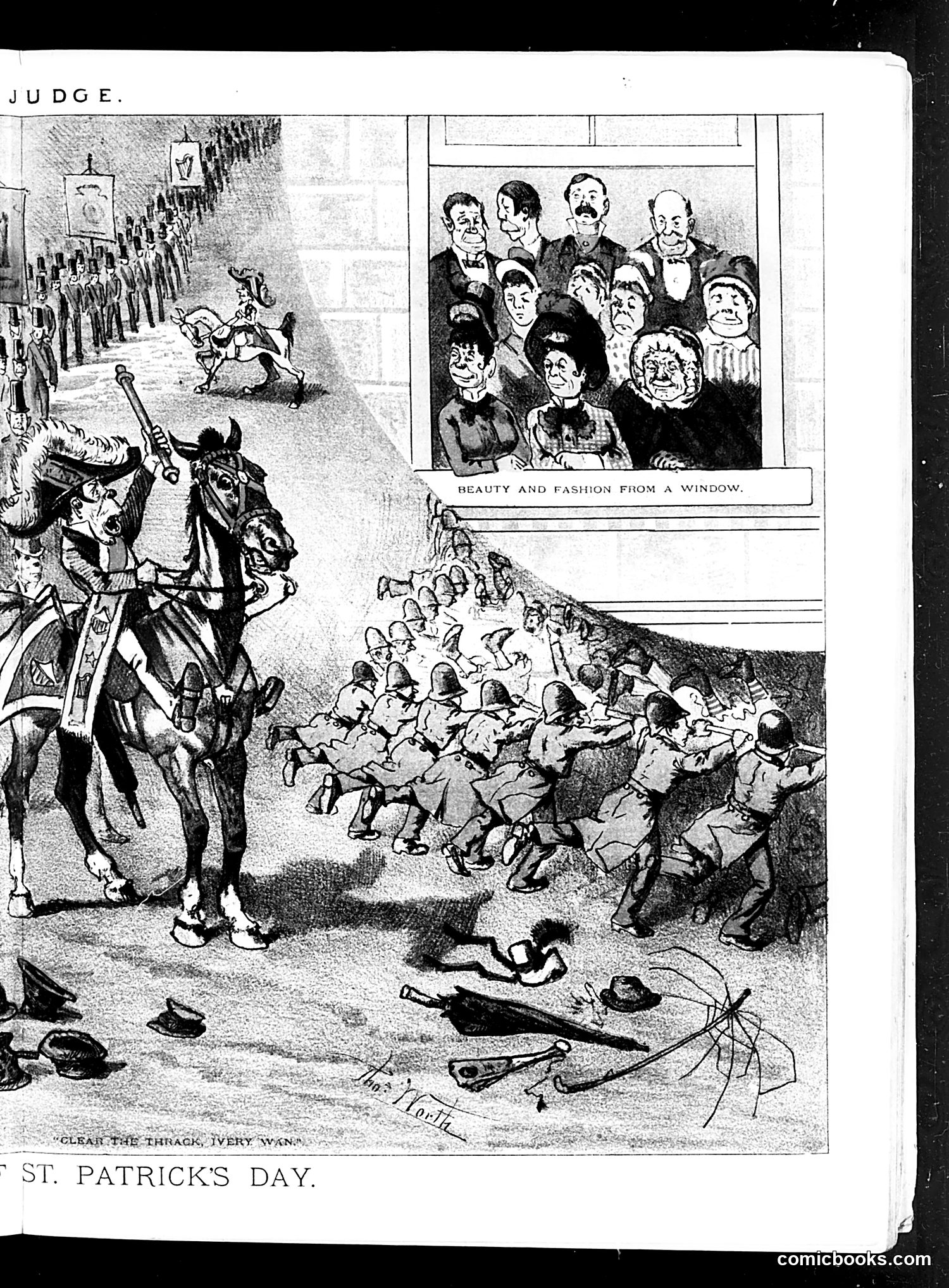
This Judge magazine page satirizes St. Patrick's Day celebrations, likely depicting Irish-American participation in parades and public festivities. The main cartoon shows a military or police figure on horseback clearing a street while crowds of figures (caricatured as Irish) scatter. The caption "Clear the thrack, ivery wan?" uses Irish dialect, mocking Irish speech patterns common in period satire. The upper panel titled "Beauty and Fashion from a Window" shows well-dressed observers watching from above—likely contrasting refined society with the rowdy street celebration below. The overall satire appears to mock Irish-American St. Patrick's Day celebrations as chaotic and disorderly, reflecting anti-Irish prejudice prevalent in late 19th/early 20th-century American media. The hierarchical composition (refined observers above, unruly crowds below) reinforces social stereotypes.
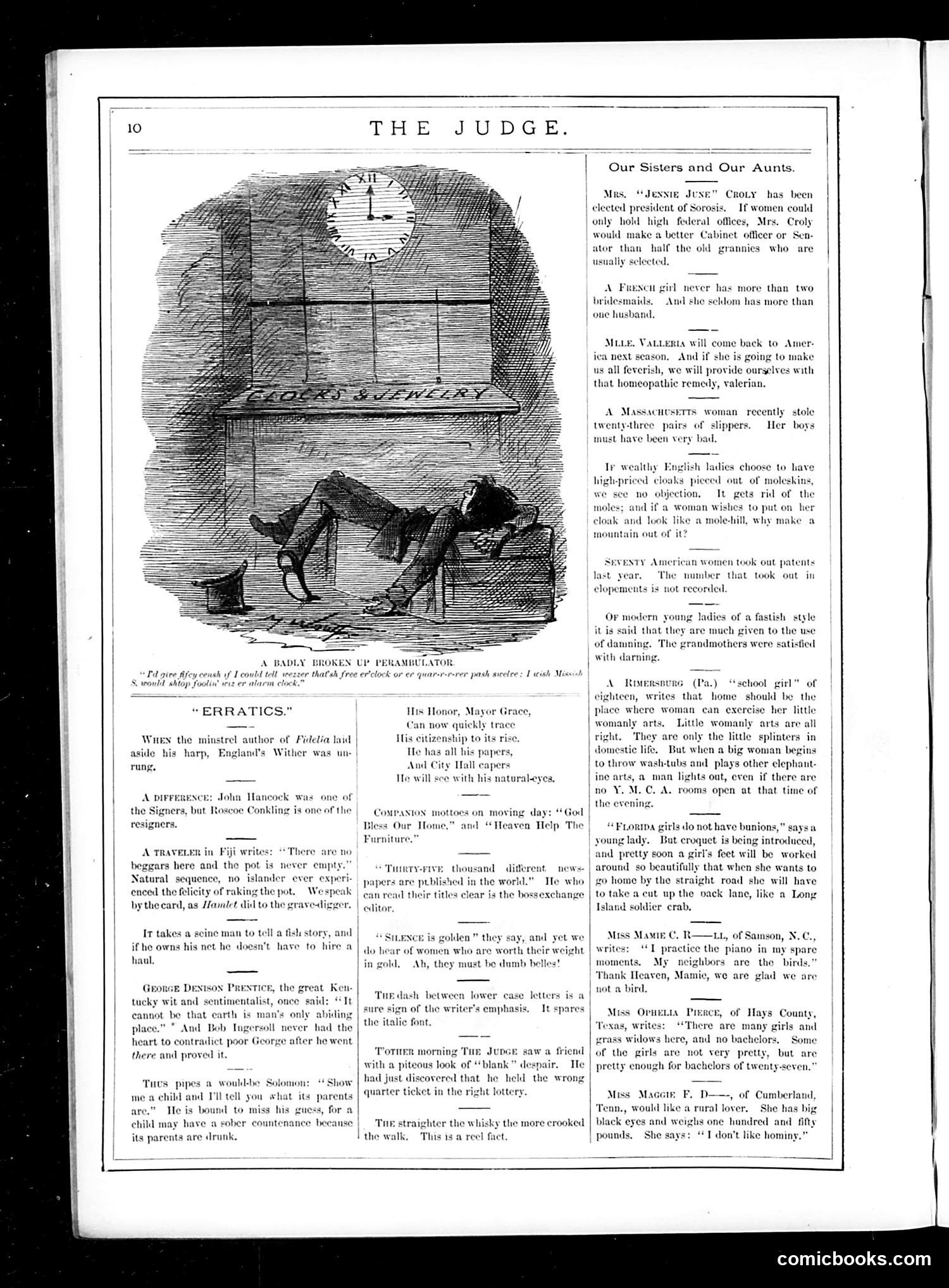
The main illustration shows a **broken pawnbroker's scale/balance**, labeled "A BADLY BROKEN UP PAWNBROKER." This appears to be satirizing financial instability or unreliable dealing, likely referencing contemporary pawnbroking scandals or fraud. The page is primarily **"ERRATICS"**—a humor column of brief satirical observations on social and political matters. Notable targets include: - **Mayor Grace** of New York, mocked for tracing his citizenship rise through political patronage - **Roscoe Conkling**, a famous Republican politician, contrasted unfavorably with John Hancock - Various social commentary on women's rights (Jessie Jane Croly's election as Sorosis president), fashion absurdities, and contemporary behavior The "Our Sisters and Our Aunts" section offers biting commentary on women's issues—sometimes progressive (supporting women in high office), sometimes mocking (women stealing slippers, croquet causing bunions, excessive piano practice). The humor relies on wordplay, exaggeration, and topical references to 1870s-80s American politics and society that would have been immediately recognizable to contemporary readers.
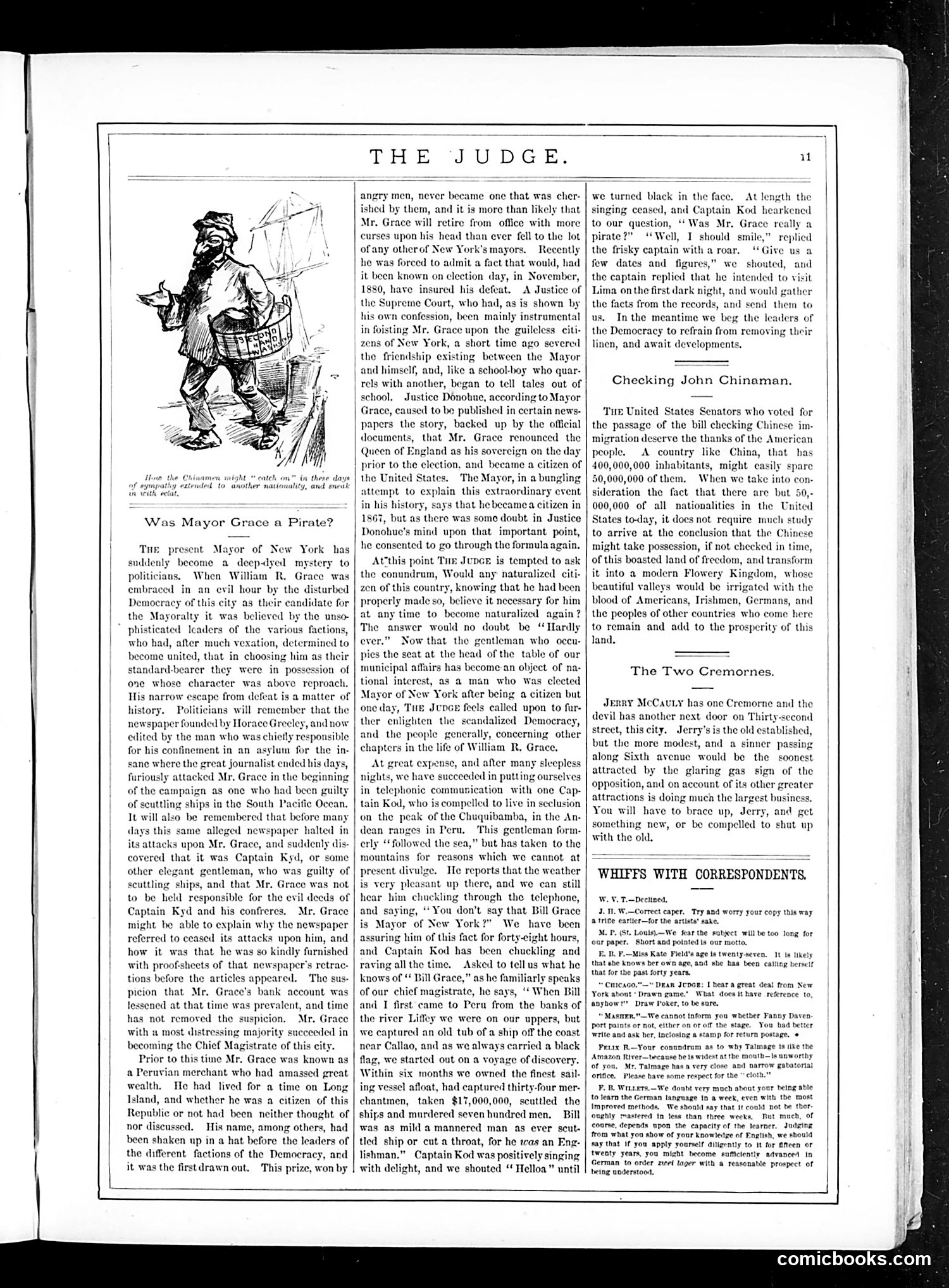
This satirical article attacks **William R. Grace**, Mayor of New York, questioning his fitness for office through several scandals: **The Main Charges:** 1. **Piracy accusations**: A newspaper (likely the Tribune, edited by someone connected to Horace Greeley's confinement) initially accused Grace of "scuttling ships in the South Pacific Ocean," then mysteriously retracted—suggesting Grace paid them off. 2. **Citizenship fraud**: Grace concealed that he was a British subject until forced to admit it by Justice Donohue just *before* the 1880 election. He then hastily renounced the Queen and became a U.S. citizen—raising questions about whether he was even legally eligible to run. 3. **Corruption**: The article implies Grace used his bank account to silence critics and manipulate the press. **The Cartoon**: Shows a disheveled, pirate-like figure—likely Grace—suggesting his disreputable character. The satire mocks both Grace's shadowy background and the Democratic Party's desperation in nominating him.
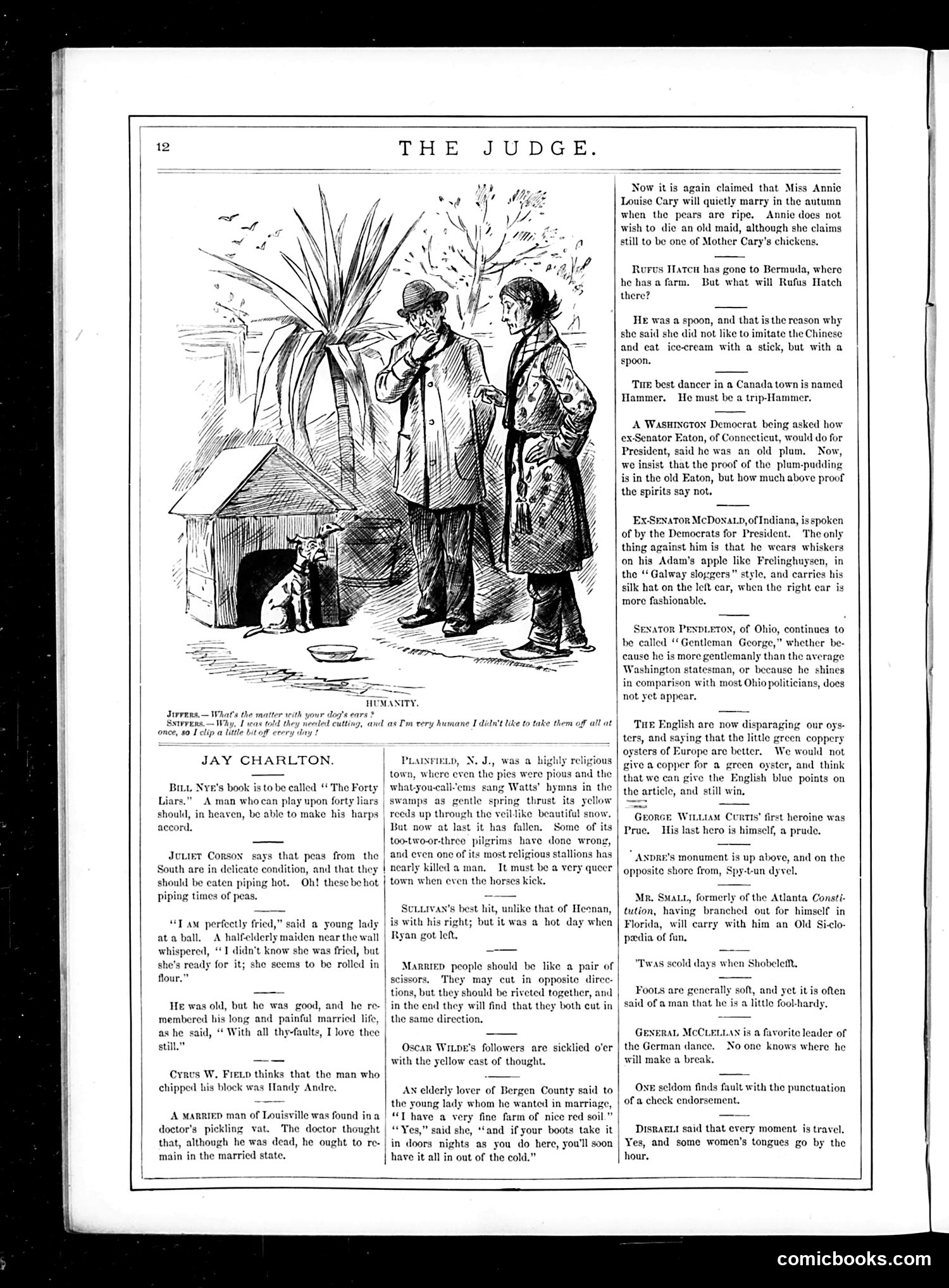
The main cartoon depicts a humorous domestic scene where a man and woman discuss a dog's ears. The woman explains she clips bits off the dog's ears periodically—a joke playing on the absurdity of the practice for cosmetic reasons. The rest of the page consists of brief satirical commentary on contemporary American political figures and social topics. References include: - **Bill Nye's book** "The Forty Liars"—mocking politicians or public figures - **Ex-Senator Eaton** (Connecticut Democrat)—called "an old plum," questioned as presidential material - **Ex-Senator McDonald** (Indiana Democrat)—criticized for his whisker style, proposed for President - **Senator Pendleton** (Ohio)—nicknamed "Gentleman George," with ambiguous praise - Various quips about oysters, marriage, dancers, and religious hypocrisy in New Jersey The satire targets Democratic political candidates and 1870s-era social pretensions, using wordplay and personal ridicule typical of Judge magazine's irreverent style.
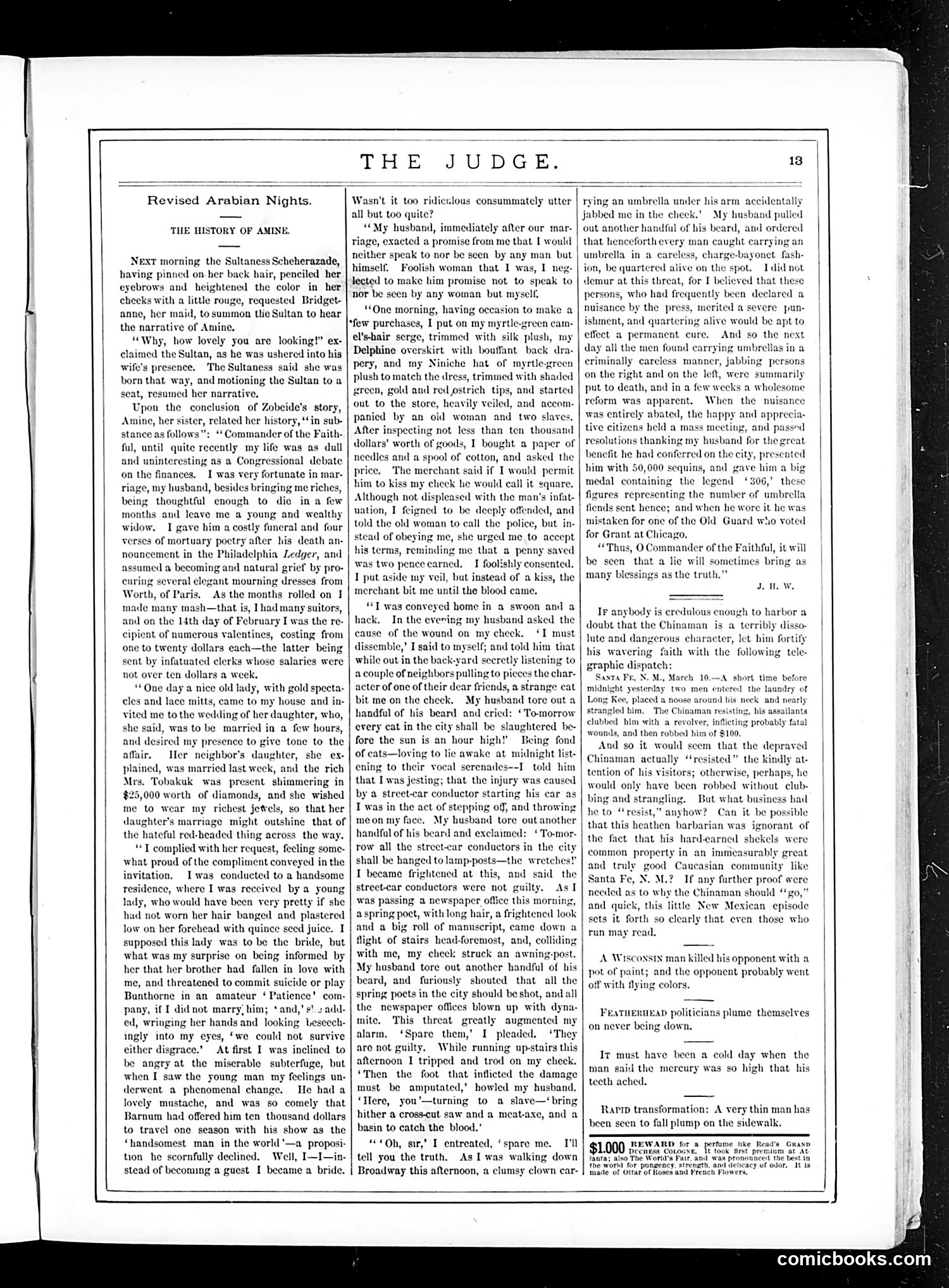
This page presents a satirical retelling of an Arabian Nights tale, mocking Victorian marriage customs and women's social constraints. The narrative follows "Amine," a wealthy widow whose remarriage becomes a cautionary tale about marital control. The satire targets several contemporary issues: the absurdity of restrictive marriage vows (the husband demands she never speak to other men, while he faces no such restriction), the commercialization of romance (valentines costing up to twenty dollars), and upper-class pretension (the "Mrs. Tobakuk" subplot mocking competitive materialism among wealthy women). The tale also ridicules women's beauty practices—powdering, rouging, and the "quince seed juice" hair treatment—suggesting these cosmetic efforts are vain and sometimes comical. By framing these critiques within an exotic Arabian Nights setting, Judge magazine could safely satirize contemporary American society's hypocrisies regarding gender, marriage, and class.
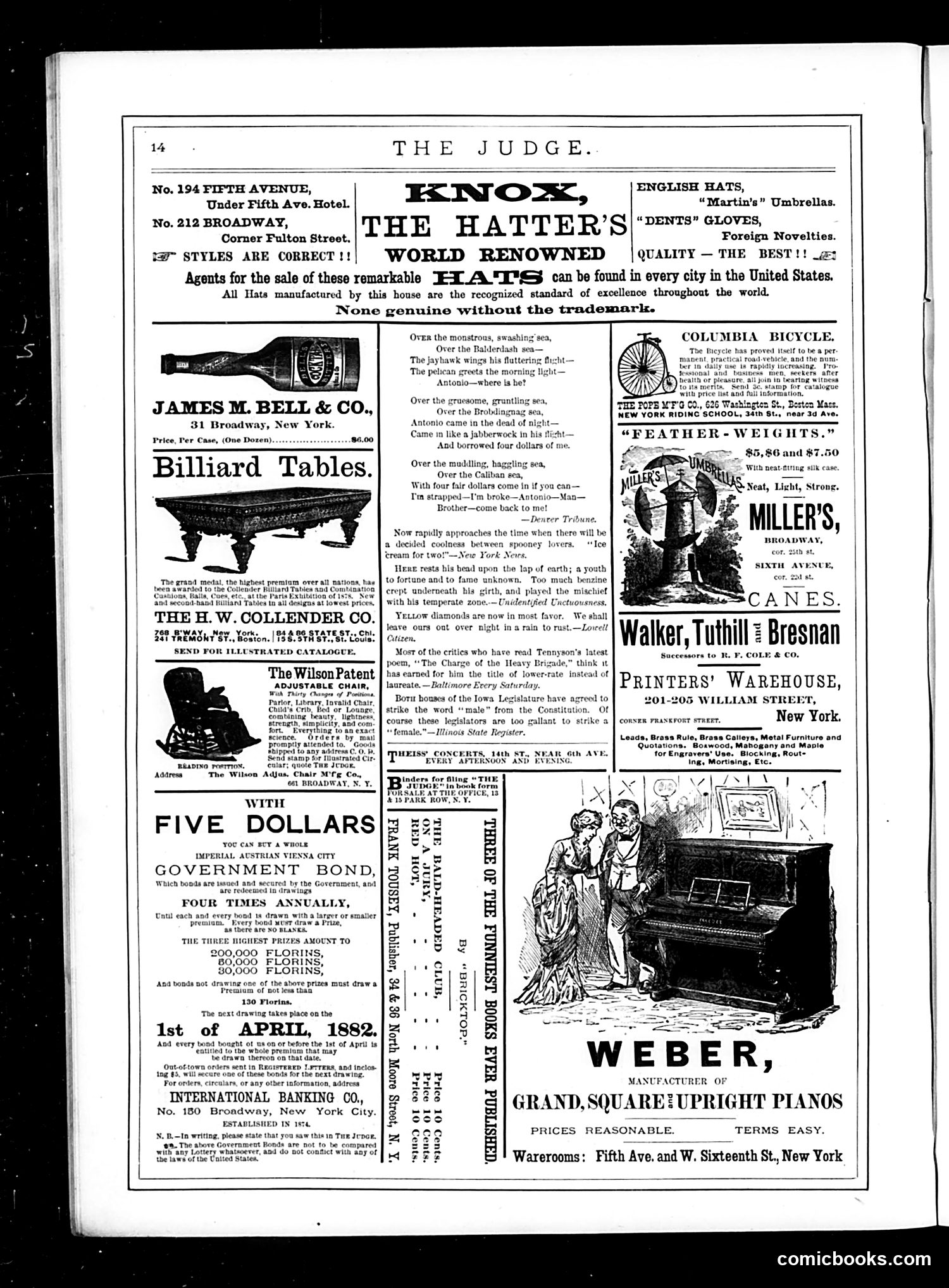
This is primarily an **advertising page** from Judge magazine, not a satirical cartoon page. The content consists almost entirely of commercial advertisements for late 19th-century products and services: Knox hats, billiard tables, pianos, bicycles, government bonds, and printing supplies. The only substantial editorial content appears to be brief **humorous verse and quips** scattered between ads—short comedic observations typical of Judge's satirical style. These include a poem about someone named Antonio borrowing money ("came in like a Jabberwock in his flight"), jokes about yellow diamonds, references to Tennyson's poetry, and commentary on Iowa legislators. However, **the specific satirical targets and context are unclear** from this page alone. Without knowing the original publication date or having fuller context, it's difficult to identify what political or social issues these brief quips reference. The page functions primarily as revenue-generating advertising space with filler humor, rather than as a platform for coherent political satire.
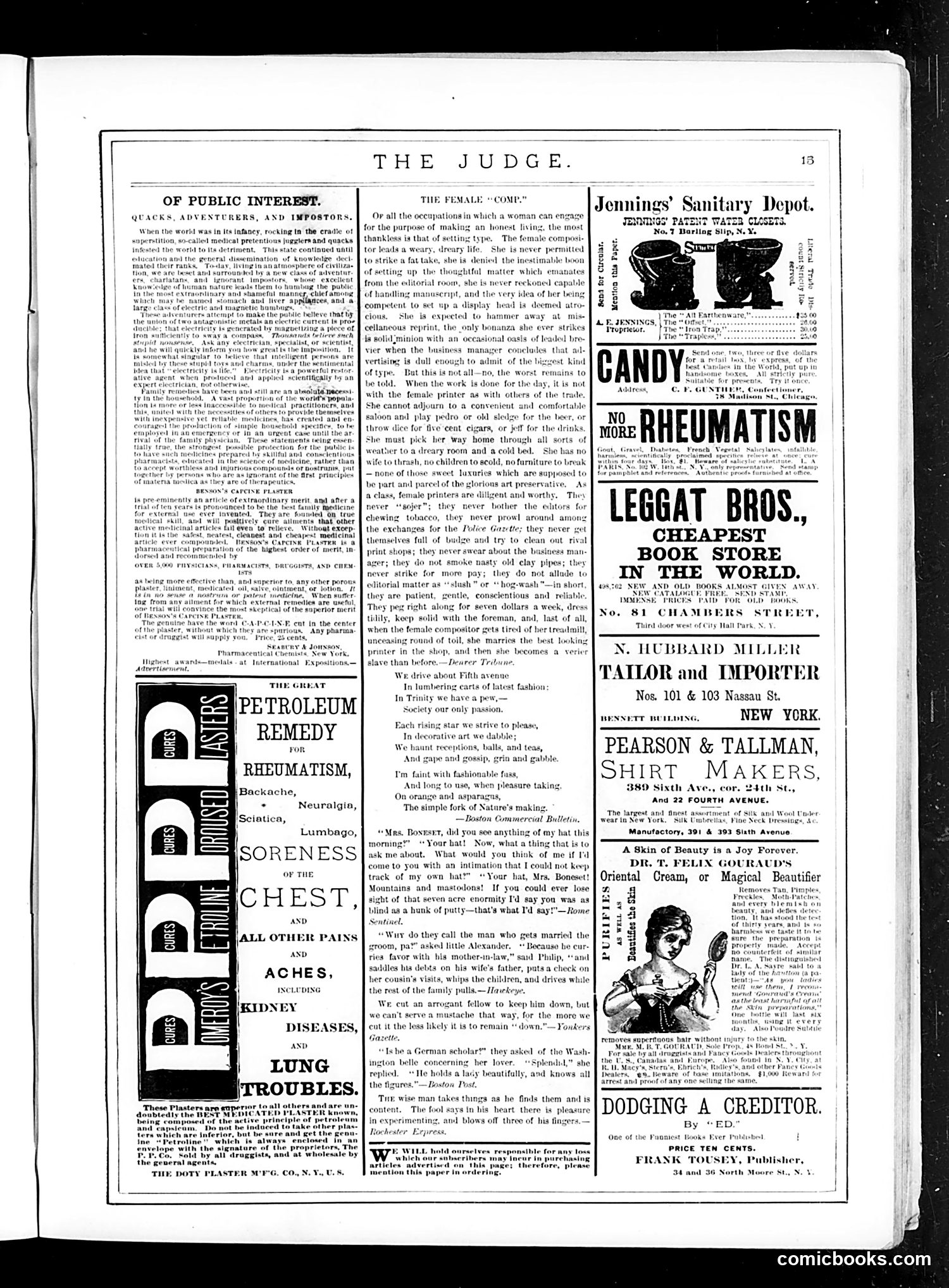
This page is primarily **advertisements and filler content**, not satirical cartoons. The main editorial piece is "The Female 'Comp'" (compositor)—a lengthy complaint about the poor treatment of women typesetters in printing shops. ## The Satire The article ironically praises female printers as virtuous and patient workers, contrasting them with male printers who drink, gamble, and bother editors. However, the underlying point is criticism: women compositors earn meager wages ("seven dollars a week"), work in miserable conditions, and receive no respect—they cannot even use the saloon or socialize like male workers. The piece satirizes both the exploitation of these women and society's gendered assumptions about their capabilities. ## Context for Modern Readers In the late 19th century, women entered printing trades as cheap labor but faced systematic discrimination and poor wages. This piece uses ironic praise to expose the hypocrisy: society valorizes women's "patience" and "reliability" while denying them dignity and fair compensation—a common satirical technique in *Judge* magazine. The rest of the page consists of period advertisements for patent medicines and commercial services, typical of magazines from this era.
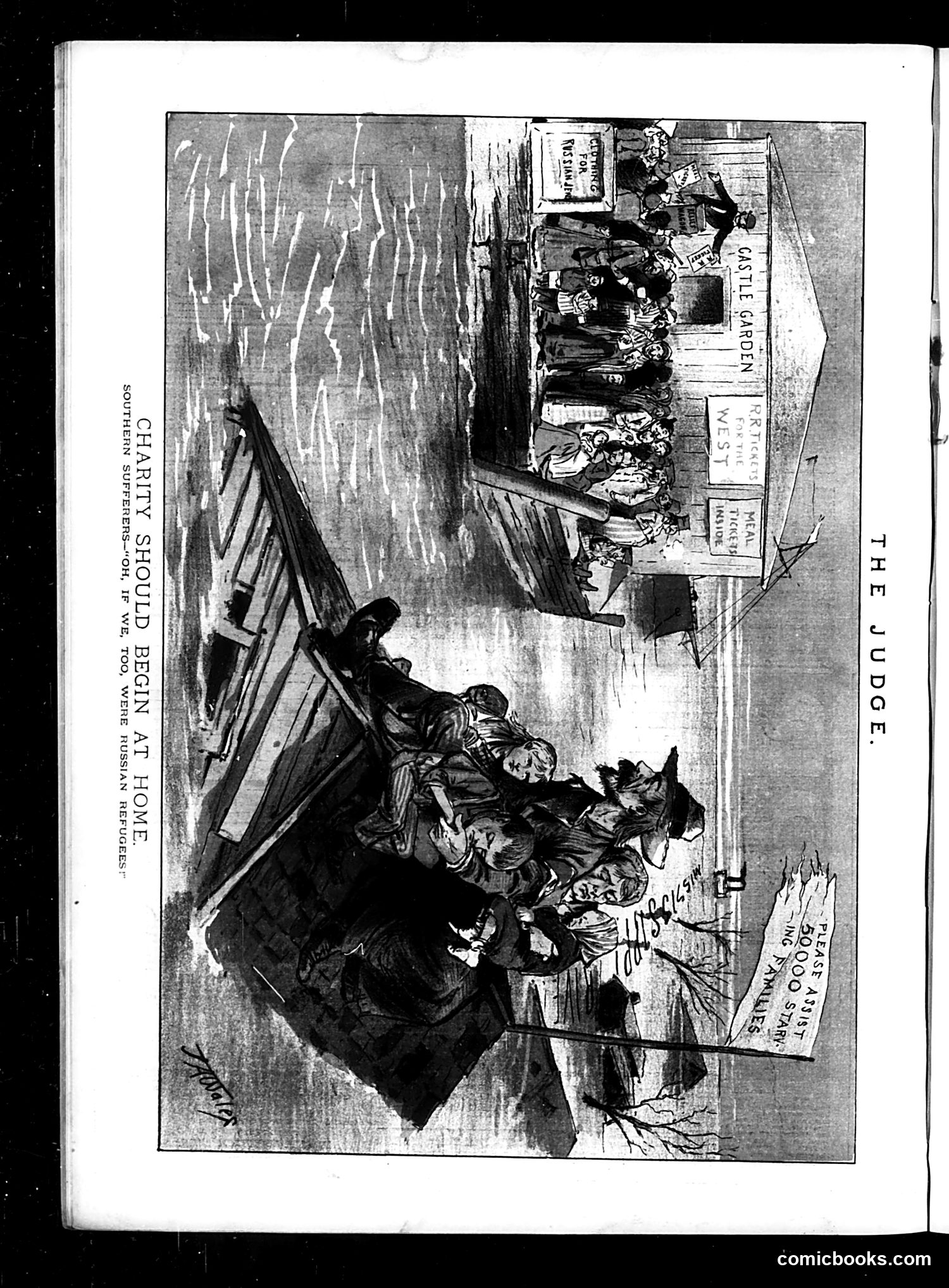
This political cartoon satirizes American charity priorities. It depicts poor Southern citizens in distress, with a caption suggesting they wish they were "Russian refugees" instead—implying that Russian refugees receive more charitable attention and aid than struggling Americans. The cartoon critiques the disconnect between domestic and foreign charity work. The "Southern sufferers" appear to be impoverished Americans (likely post-Civil War or during economic hardship), while the opposite side shows what appears to be a charitable organization or institution focused on helping Russian refugees. The cartoon's title, "Charity Should Begin at Home," reinforces the traditional adage suggesting Americans should prioritize helping fellow citizens before aiding foreigners. This reflects broader late 19th/early 20th-century debates about immigration, foreign relief efforts, and national priorities.