
Judge, 1882-03-25 · page 3 of 16
Judge — March 25, 1882 — page 3: what you’re looking at
What you’re looking at
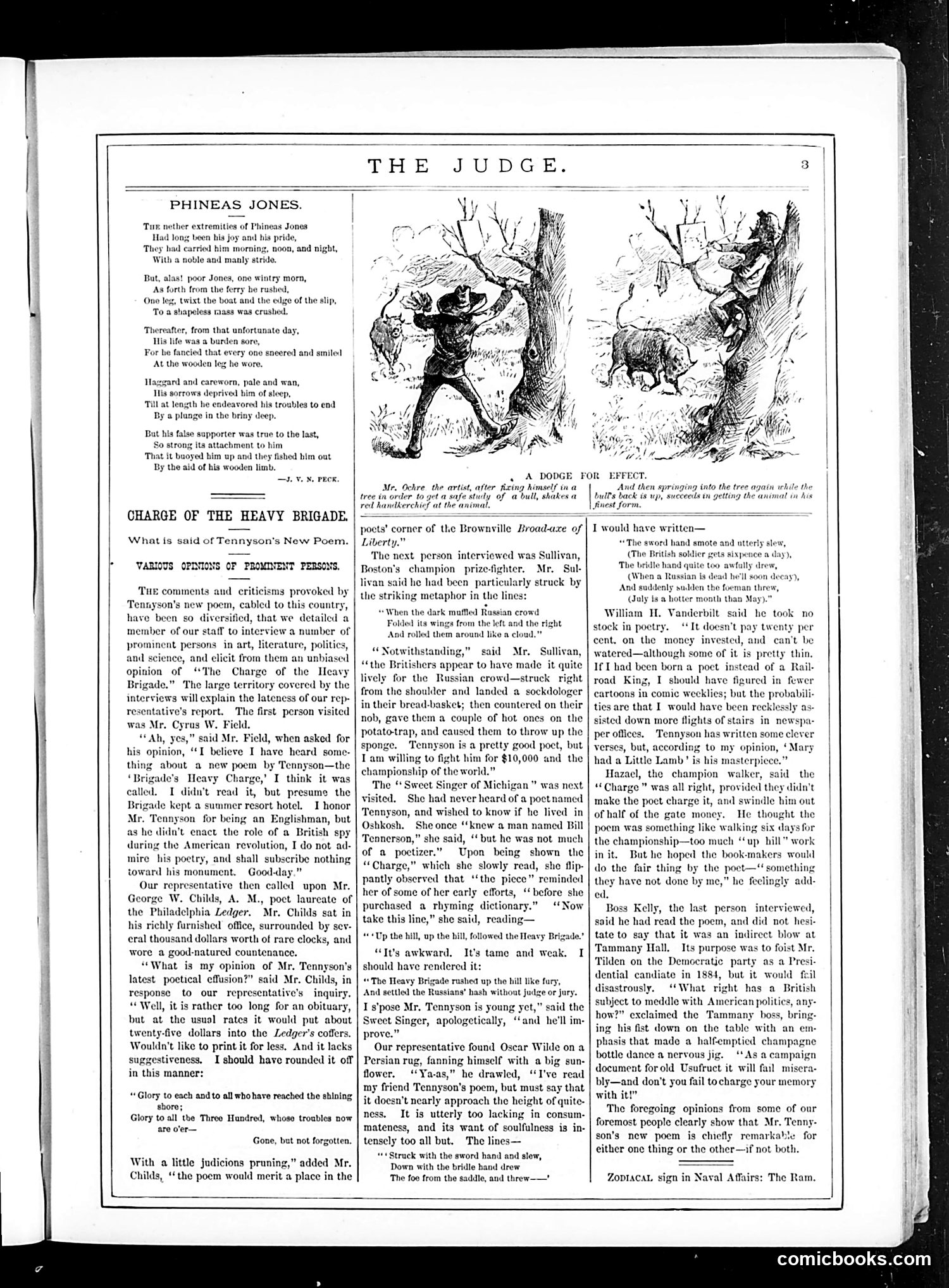
This page from *Judge* satirizes Alfred Tennyson's poem "The Charge of the Light Brigade" (the text says "Heavy Brigade," likely a deliberate joke). The content mocks prominent American figures' varying reactions to Tennyson's work. **Key satirical targets:** - **Cyrus W. Field** (telegraph magnate): Dismisses Tennyson because he didn't spy for America during the Revolution—shallow patriotism masquerading as principle. - **George W. Childs** (Philadelphia newspaper editor): Reveals his mercenary nature, calculating payment rates rather than literary merit. - **John L. Sullivan** (famous boxer): Interprets the poem's military metaphor through prizefighting vocabulary ("sockdologer," "bread-basket"), reducing poetry to brutish combat. The "Phineas Jones" poem above tells a sentimental story about a war amputee saved by his wooden leg—contrasting genuine patriotic sacrifice with the self-interested commentary below. The satire targets American philistinism and materialism disguised as cultural opinion.
📄 Transcribed text from this page (OCR, searchable)
Machine-transcribed from the original scan — historical spelling and the odd misread are preserved.
a an | | | PHINEAS JONES. Tur nether extremities of Phineas Jones een his joy and his pride, ried him morning, noon, and night, With a noble and manly stride. But, alas! poor Jones, one wintry morn, ‘As forth from the ferry he rushed, poat and th 4a burden sore, ‘ery one sneered and smniled At the wooden leg he wore. rd and careworn, pale and wan, His sorrows deprived bim of sleep, ‘Tal at length he endeavored his troubles to end By a plunge in the briny deep. But his false supporter was true to the last, So strong its attachment to him ‘That it buoyed him up and they By the aid of his wooden limb. 3. v8, PECK, hed bim out CHARGE OF THE HEAVY BRIGADE. What is said of Tennyson's New Poem. VARIOUS OPINIONS OF PROMINENT PERSONS, comments aud criticisms provoked by son's new poem, cabled to this country, have been so diversified, that we detailed a member of our staff to interview a number of prominent persons in art, literature, politi and science, and elicit from them an unbias: opinion of “The Charge of the Heavy Brigade.” ‘The large territory covered by the interviews will explain the lateness of our rep- resentative’s report. The first person visited was Mr. Cyrus W. Field. “Ah, yes,” said Mr. Field, when asked for his opinion, “I believe I have heard some- thing about a new poem by Tennyson—the “Brigade’s Heavy Charge,’ I think it was called. I didn’t read it, but presume the Brigade kept a summer resort hotel. I honor Mr. Tennyson for being an Englishman, but as he didn’t enact the role of a British spy during the American revolution, I do not ad- mire his poetry, and I ribe nothing toward his monument. Good-day Our representative then called upon Mr. George W. Childs, A. M., poct laureate of the Philadelphia Ledger. Mr. Childs sat in his richly furnished office, surrounded by sev- cral thousand dollars worth of rare clocks, and wore a good-natured countenance. “What is my opinion of Mr. Tennyson's latest poetical effusion?” said Mr. Childs, in response to our representati inquiry. “Well, it is rather too long for an obituary, but at the usual rates it would put about twenty-five dollars into the Ledger's coffers Wouldn't like to print it for less. And it lacks suggestiveness. I should have rounded it off in this manner: Glory to each and to all whohave reached the shining shore; Glory to all the Threo Hundred, whoso troables now are o’er— Gone, but not forgotten, With a little judicions pruning,” added Mr. Childs, “the poem would merit a place in the « A DODGE FOR I Mr. Ochre the artist, after fixing himself in a tree in order to get a safe stuly of a bull, shakes a red handkerchief at the animal. pocts’ corner of the Brownville Broad-axe of iberty.” ne next person interviewed was Sullivan, Boston's champion prizesighter. Mr, Sul- livan said he had been partic the striking metaphor in the lines: “When the dark muffled Russian crowd Folded its wings from the left and the And rolled them around like a cloud “Notwithstanding,” said Mr. Sullivan, “the Britishers appear to have made it quite y for the Russian crowd—struck right from the shoulder and landed a sockdologer in their bread-basket; then countered on their nob, gave them a couple of hot ones on the potatotrap, and caused them to throw up the sponge. Tennyson is a pretty good poet, but Tam willing to fight him for $10,000 and the championship of the world.” The “Sweet Singer of Michigan” was next sited. She had never heard of a poctnamed ‘Tennyson, and wished to know if he lived in Oshkosh, he once ‘‘knew a man named Bill ‘Tennerson,” she said, ‘but he was not much of a poctizer.” Upon being shown the “Charge,” which she slowly read, she flip- pantly observed that ‘the piece” reminded her of some of her early efforts, “before she purchased a rhyming dictionary.” “Now take this line,” she said, reading— “Up the hill, up the hill, followed the Heavy Brigade, “It's awkward. It’s tame and weak. I should have rendered it: +The Heavy Brigade rushed up the hill like fury, And settled the Russians’ hash without judge or jury. I s'pose Mr. Tennyson is young yet,” said the Sweet Singer, apologetically, “and he'll im- prove.” Our representative found Oscar Wilde on a Persian rug, fanning himself with a big sun- flower. “Ya-as,” he drawled, “I've read my friend Tennyson's poem, but must say that it doesn't nearly approach the height of quite- ness. It is utterly too lacking in consum- mateness, and its want of soulfulness is in- tensely too all but. The lines— “+ Struck with the sword hand and slow, Down with the bridle hand drew ‘The foe from the saddle, and threw——' And then springing into the tree again while the bulls back is up, succeeds in getting the animal in his finest form. I would have written— “The sword hand smote and ntt (The British soldier gets sixpence The bridle hand quite too awfully drew (When a Russian is And suddenly sudde uly isa hot William Hf. Vanderbilt stock in poetry. ‘It doe twenty per cent. on the money invested, and can’t be watered—although some of it is pretty thin. IfT had been born a poet instead of a Rail- road King, I should have figured in fewer cartoons in comic weeklies; but the probabili- ties are that I would have been reckles sisted down more flights of stairs in newspa- per oflices. ‘Tennyson has written some clever verses, but, according to my opinion, ‘Mary had a Little Lamb’ is his masterpi Hazael, the champion walker, “Charge ” was all right, provide make the poct charge it, and swindle of half of the gate money. He thought the poem was something like walking si sfor the championship—too much ‘up bill” work init. But he hoped the book-makers would do the fair thing by the poct—“ something they have not done by me,” he feclingly add- ed, day), he'll soon decay), be foeman threw 1 he took no him out person interviewed, said he had read the poem, and did not hesi- tate to say that it was an indirect blow at Tammany Hall. Its purpose was to foist Mr. Tilden on the Democratic party as a Pre: dential candiate in 1884, but it would fe disastrously. ‘What right has a British subject to meddle with American politics, any how?” exclaimed the Tammany. boss, bring- ing his fist down on the table with an em- phasis that made a halfemptied champagne bottle dance a nervous jig. ‘As a campaign document for old Usufruct it will fail misera- bly—and don't you fail tocharge your memory with it!” ‘The foregoing opinions from some of our foremost people clearly show that Mr. Tenny- son's new poem is chiefly remarkahte for either one thing or the other—if not both. ZopiacaL, | = comicbooks.com