
A complete issue · 16 pages · 1882
Judge — March 18, 1882
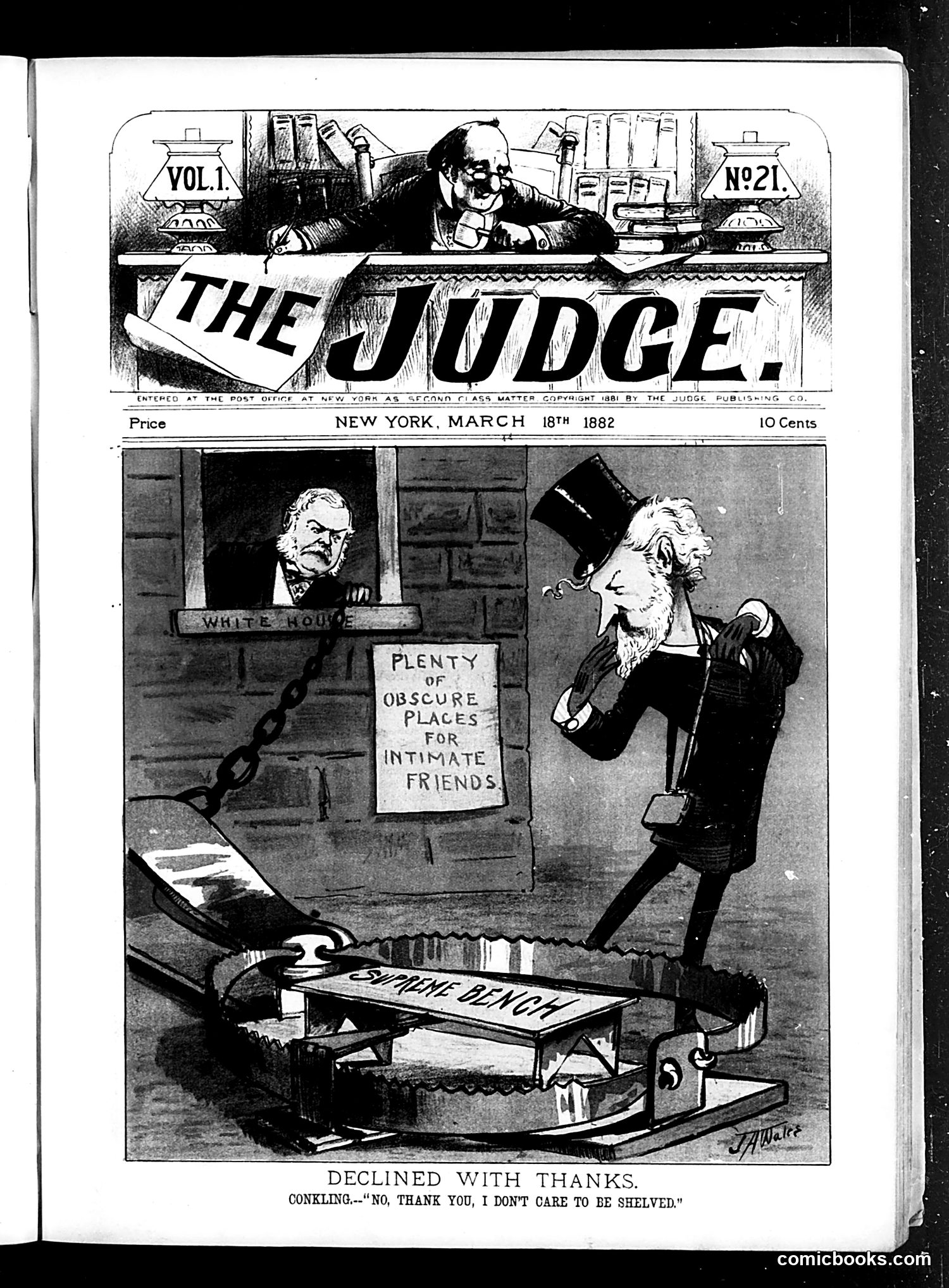
This cartoon satirizes **Roscoe Conkling**, a prominent Republican politician, who is being offered a position at the White House (shown in the window). The sign advertising "plenty of obscure places for intimate friends" suggests the administration is offering him a minor or deliberately undesirable post. Conkling's response—"No, thank you, I don't care to be shelved"—indicates he's rejecting what he views as political exile. The "Sphinx Bench" mechanism depicted as a trap suggests the offer is designed to remove him from power and influence. This likely references Conkling's real political struggles during the 1880s, when he lost influence within the Republican Party after disputes over patronage and party leadership. The cartoon mocks his wounded pride and his refusal to accept a diminished role, portraying him as too proud to accept anything less than a position of real power.
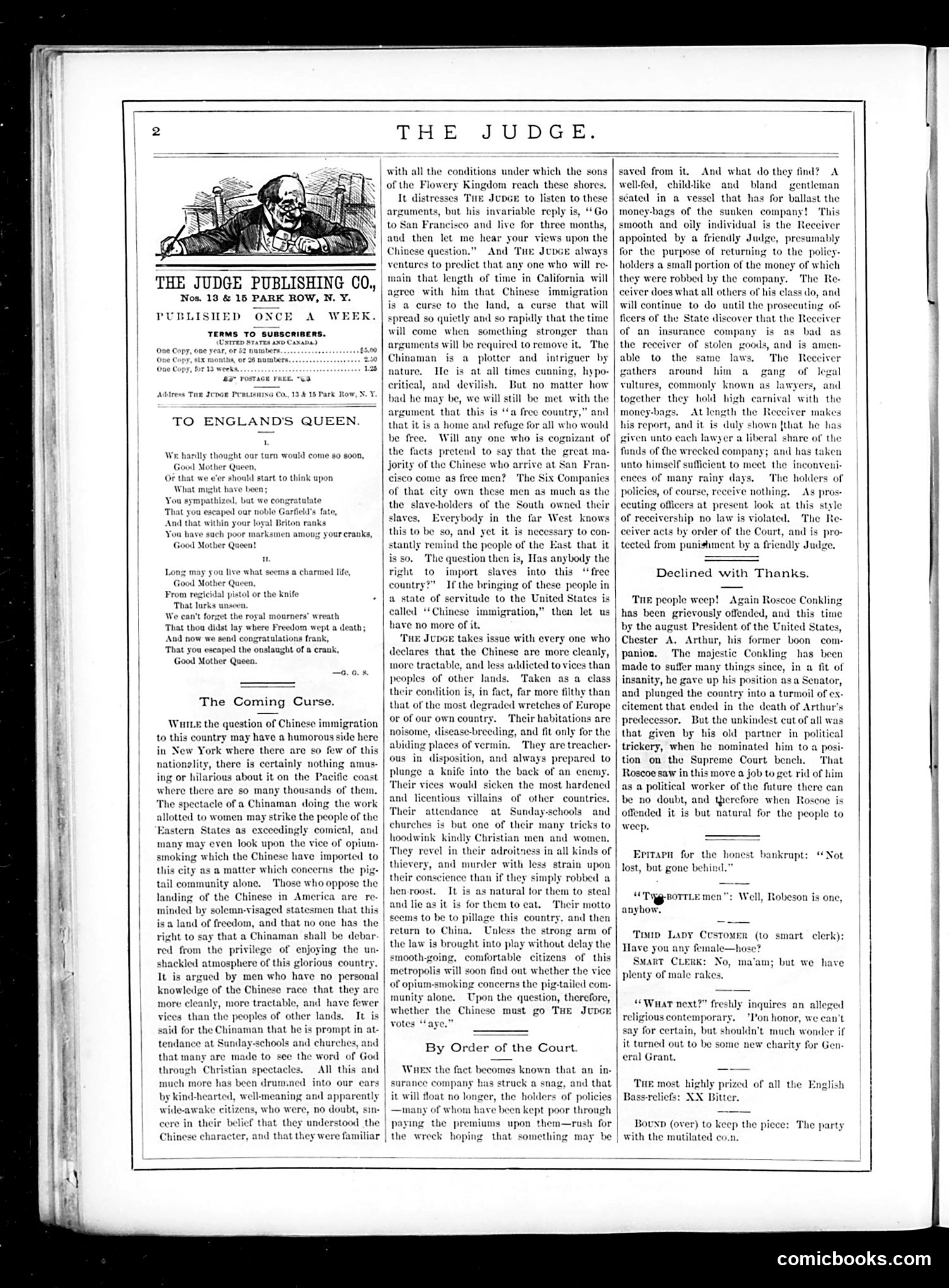
This page contains **two distinct pieces**: a patriotic poem "To England's Queen" congratulating Queen Victoria on surviving an assassination attempt, and a satirical editorial "The Coming Curse" attacking Chinese immigration. ## The Immigration Satire The main satirical content criticizes arguments defending Chinese immigration to America. Judge mocks Eastern intellectuals and "kind-hearted" citizens who defend Chinese workers as "cleanly" and "tractable," comparing such defenses to pre-Civil War pro-slavery arguments. The editorial makes these points: Chinese workers are essentially enslaved by "Six Companies" (similar to Southern slaveholders), opium-smoking represents a moral plague, and Chinese immigration will spread like a curse. Judge dismisses the "free country" argument for admitting immigrants, suggesting Chinese arrivals aren't truly free men but indentured workers. **The satire's target**: Progressive reformers defending immigrant rights. Judge presents anti-Chinese racism as enlightened realism versus naive idealism—arguing West Coast experience proves Chinese immigration is inherently destructive, regardless of abstract freedom principles. This reflects 1880s anti-Chinese sentiment that culminated in the 1882 Chinese Exclusion Act.
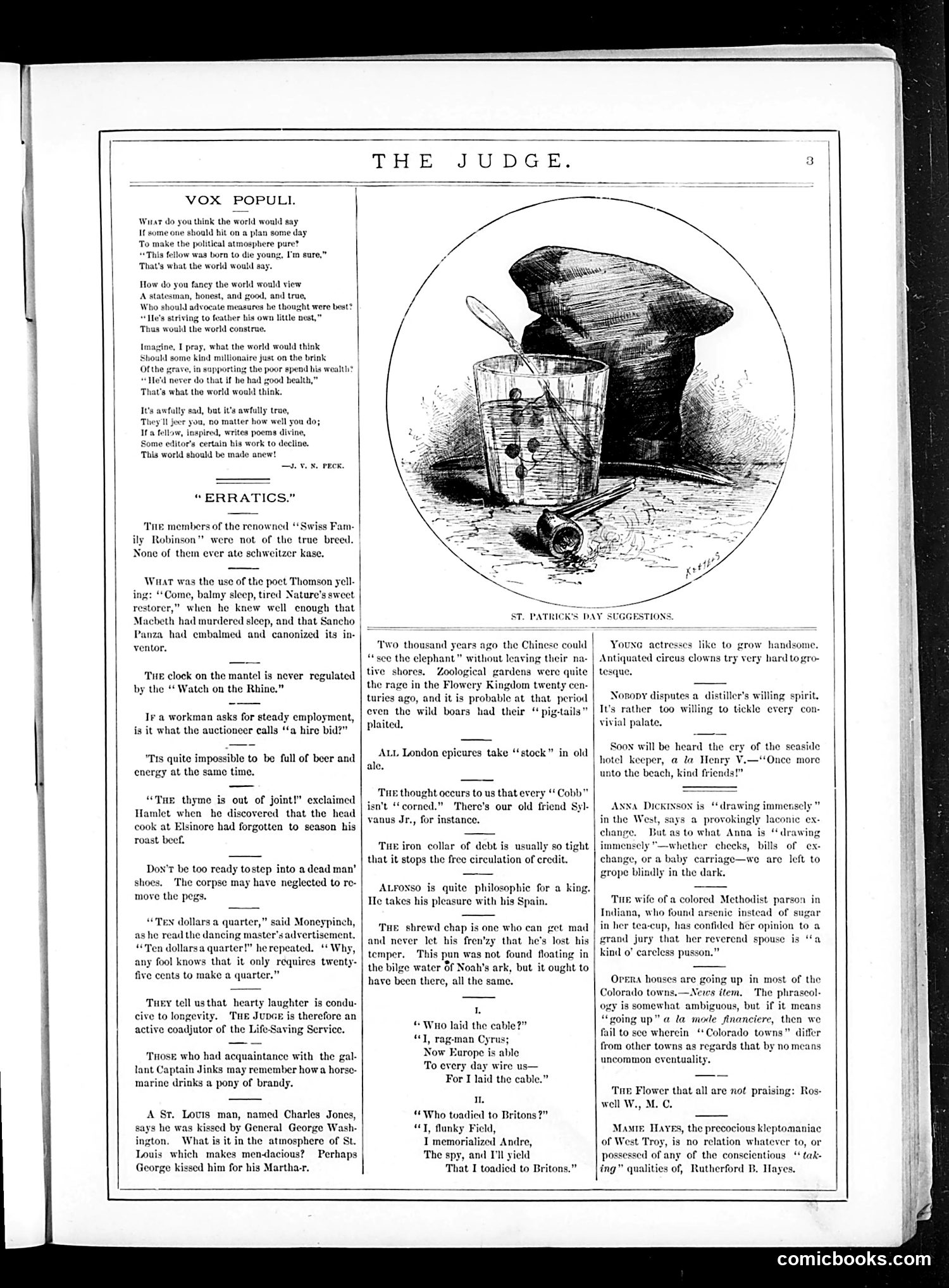
This page from *Judge* magazine contains satirical commentary and humorous observations ("Erratics") rather than a single political cartoon. The main illustrated piece shows **St. Patrick's Day Suggestions**—a circular vignette depicting leprechaun-themed imagery with a pot and hat. The text satirizes universal human nature: people cynically criticize any action, whether selfish or altruistic. A reformer is mocked; an honest politician is accused of hidden motives; a wealthy philanthropist is dismissed as desperate. The satire suggests the world's reflexive negativity makes constructive action impossible. The "Erratics" section contains literary and cultural puns—mocking Swiss Family Robinson for not eating Swiss cheese, joking about Hamlet's seasoning, and playing on words like "thyme" (time). A reference to "the Watch on the Rhine" likely alludes to German patriotic sentiment circa this publication period. The cable-laying jokes reference Cyrus Field (historical telegraph pioneer) and possibly political figures, though without dates, specific attributions remain unclear. Overall, the page emphasizes witty social commentary over explicit political targets.
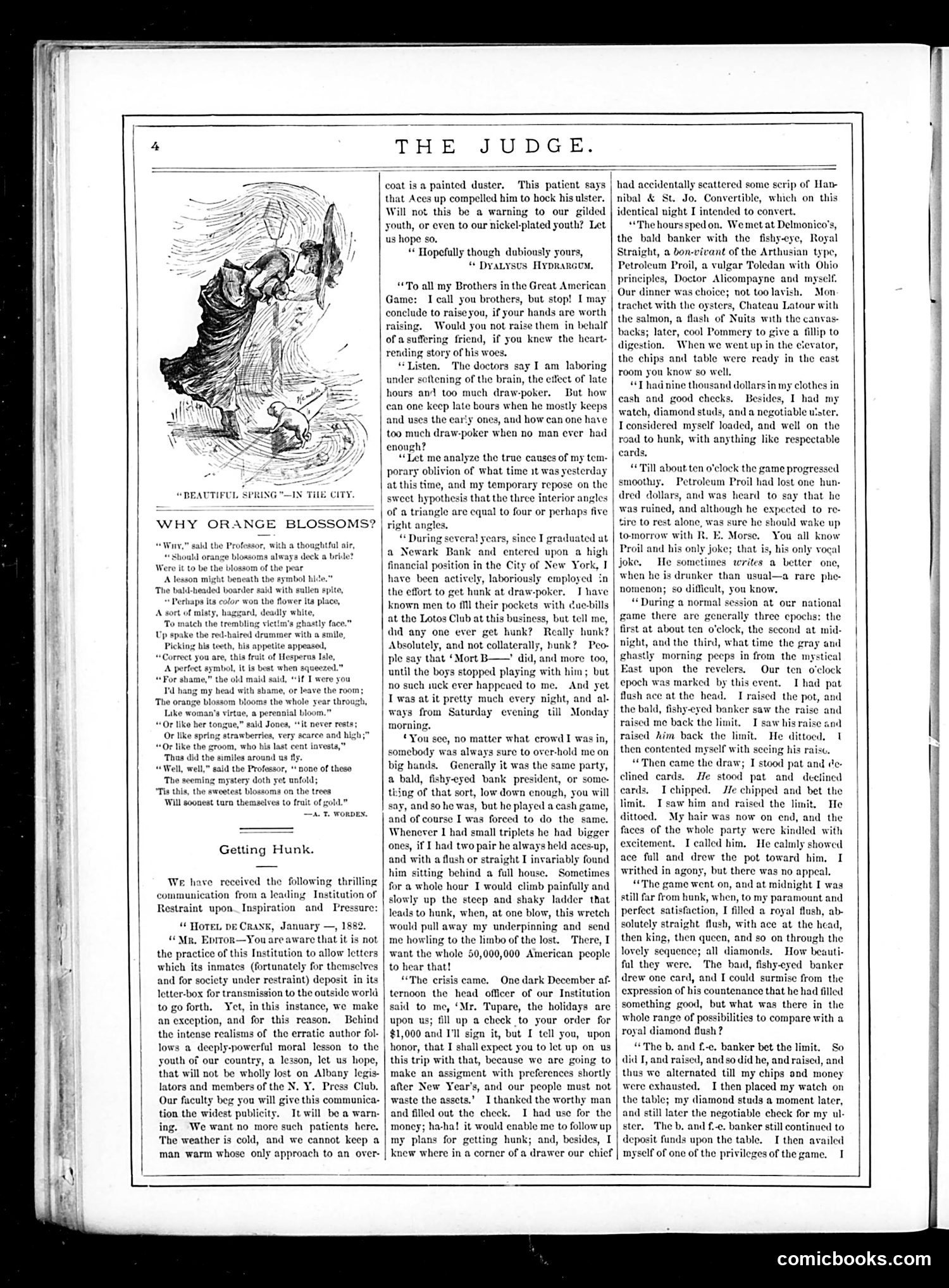
The left cartoon depicts an urban scene titled "Beautiful Spring—in the City," showing a disheveled figure amid trash and urban decay. The accompanying poem by A.T. Worden satirizes spring's romantic associations by contrasting them with gritty city reality—muddy streets, prostitutes, and squalor replacing pastoral imagery. The right section, "Getting Hunk," presents a lengthy anecdote from an Institution of Inebriation about men gambling and drinking at clubs like the Lotus. The narrator describes losing substantial sums ($20,000) in poker games while intoxicated, later "getting hunk" (regaining financial standing) through successful gambling. The piece satirizes wealthy men's careless excess, addiction to gambling, and casual attitude toward enormous financial losses.
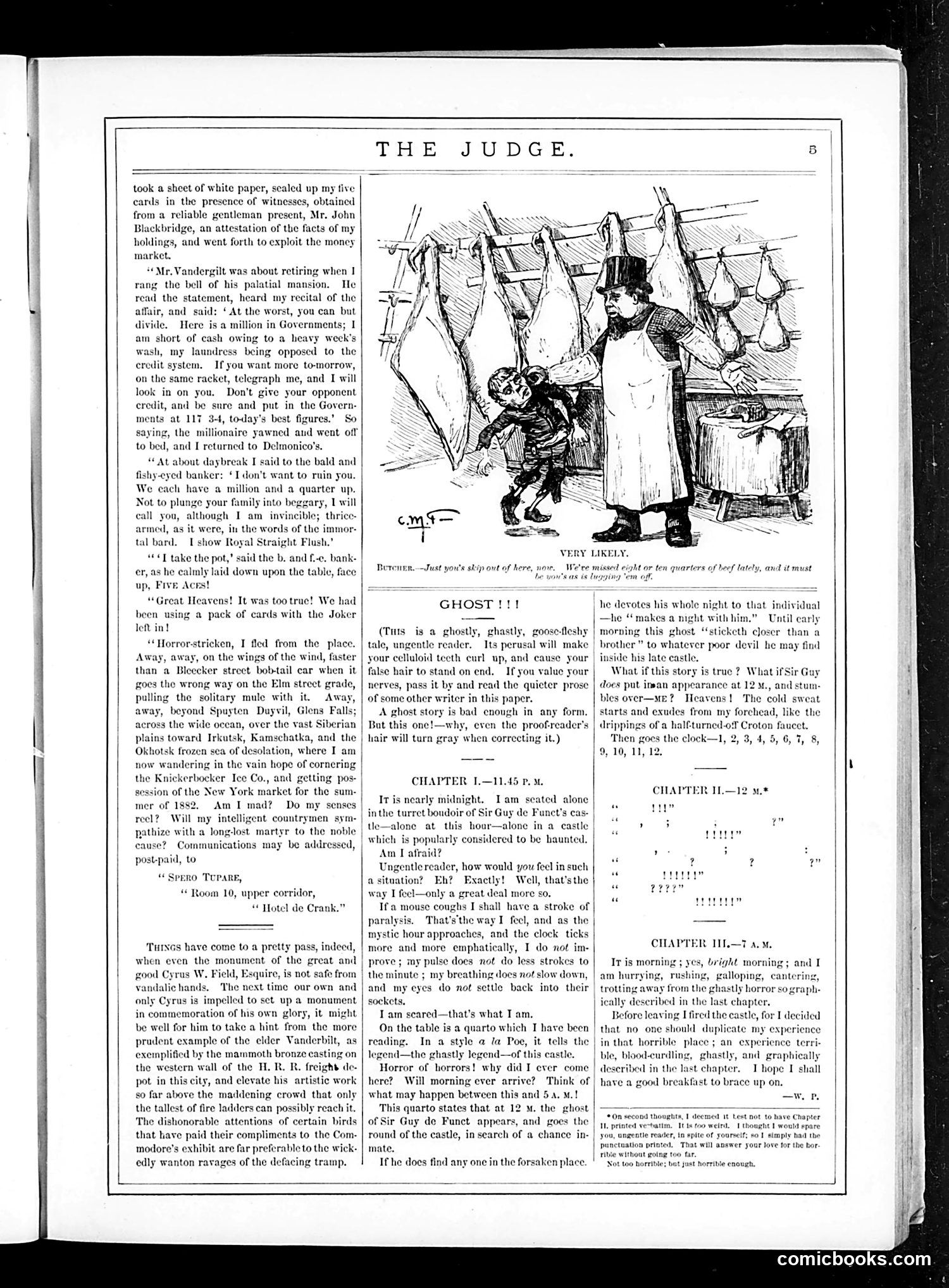
This page contains two satirical pieces: **"The Judge" (main story):** A humorous tall tale about a man who gambles with Vanderbilt (the wealthy industrialist) using forged credentials. He claims Vanderbilt lent him money to exploit the market, then loses catastrophically to a banker holding five aces—revealing he'd been cheated all along. The narrator flees across the continent in disgrace. The satire mocks both get-rich-quick schemes and the gullibility of those who believe they can exploit financial markets through dishonesty. **"Ghost!!!" (lower section):** A meta-satirical introduction to a ghost story that self-consciously warns readers the tale is frightening. It includes commentary on vandalism of monuments (referencing Cyrus Field and Vanderbilt properties), treating the ghost story as deliberately overwrought entertainment. The cartoonish illustration shows a butcher scene, likely supporting one of these narratives about deception and financial folly.
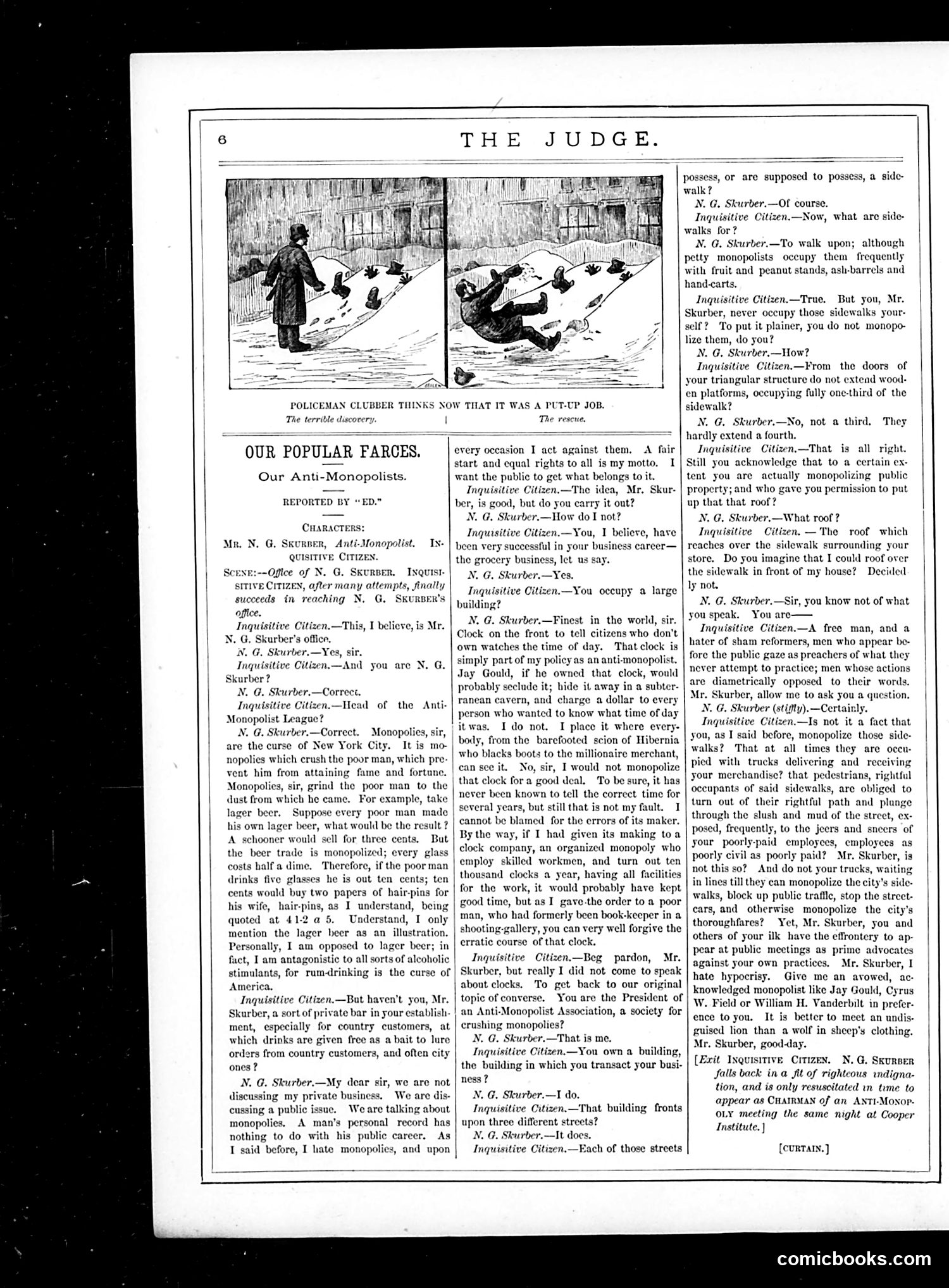
This page satirizes **anti-monopoly politicians and activists who preach against corporate monopolies while hypocritically engaging in monopolistic practices themselves**. The cartoon depicts a confrontation between an "Inquisitive Citizen" and N.G. Skurber, self-proclaimed "Anti-Monopolist." Skurber loudly condemns monopolies—particularly lager beer monopolies—as crushing the poor. However, the citizen catches him in blatant contradictions: Skurber owns a large grocery business building, operates a public clock (admittedly broken for years) as self-promotion, and maintains a private bar offering free drinks to customers—precisely the monopolistic practices he denounces. The satire exposes the hypocrisy of progressive-era anti-monopoly crusaders who use populist rhetoric to gain political advantage while personally profiting from the same market-controlling tactics they publicly attack. It's a pointed criticism of dishonest political posturing.
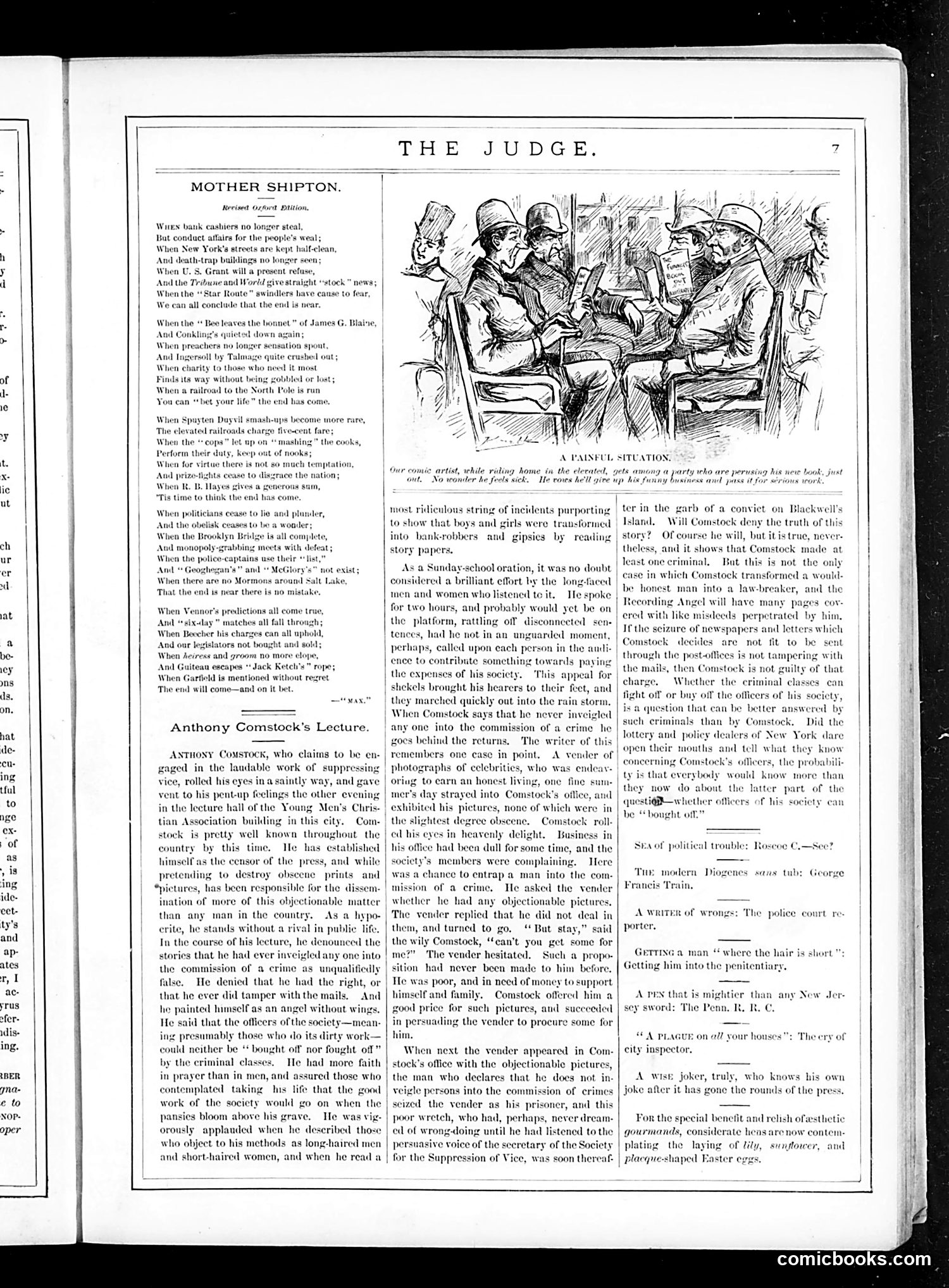
This page satirizes **Anthony Comstock**, a real American anti-vice crusader active in the 1870s-80s. The accompanying article mocks his self-righteous lecture at a YMCA hall, where Comstock—who claimed to suppress obscenity—denied ever entrapping anyone into crime. Judge's satire is biting: Comstock is portrayed as a hypocrite who, while posing as morally pure ("an angel without wings"), actually *spread* obscene material more than anyone else through his censorship work. The article suggests his claims of integrity are false—the magazine hints it has direct knowledge of his entrapment tactics. The cartoon shows Comstock's uncomfortable situation when his audience suddenly left after he asked for donations ("shekels"—a derisive term). The "Mother Shipton" poem above is unrelated satirical verse predicting society's end. **Context:** Comstock was a real figure whose aggressive tactics—including actual entrapment—made him controversial even among reformers. Judge attacks his sanctimoniousness and contradictions.
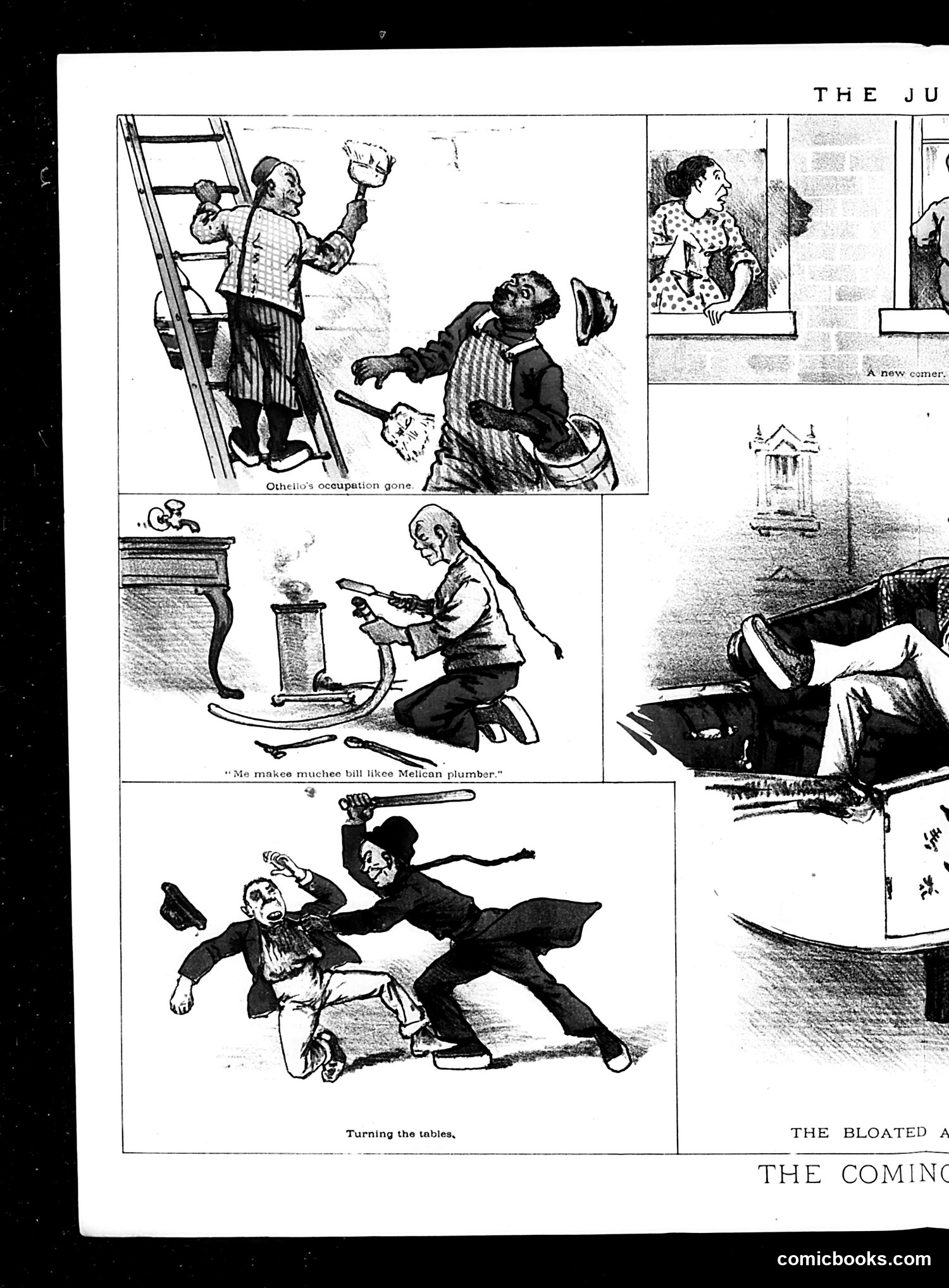
This page from *Judge* magazine appears to be a multi-panel satirical comic about occupational and class dynamics. The top panel, captioned "Othello's occupation gone," shows a man climbing a ladder while another man below gestures in frustration—likely referencing job displacement or lost employment. The middle panel, "'Me makes muchee bill likee Mexican plumber,'" depicts a figure working with plumbing tools, apparently satirizing immigrant workers or ethnic stereotypes in the trades. The bottom panel, "Turning the tables," shows what appears to be a violent confrontation, suggesting role reversal or social upheaval. The visible text fragments ("A new comer," "THE BLOATED," "THE COMING") suggest larger themes about immigration, economic competition, or social change, though without full context or dates, the specific political reference remains unclear.
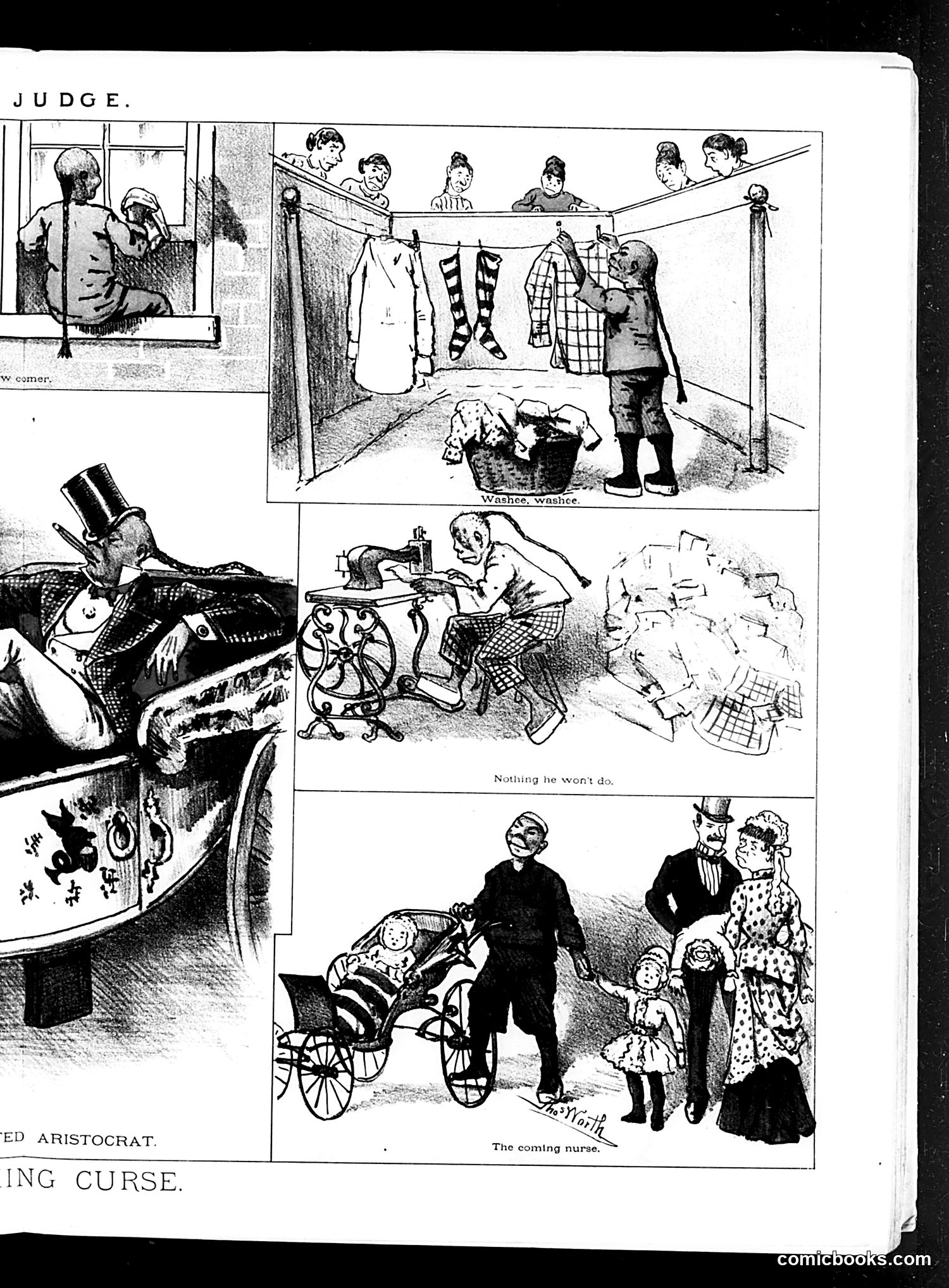
This satirical comic appears to critique wealthy aristocratic attitudes toward childcare and domestic labor. The page shows a sequence mocking an "educated aristocrat" (left panel) who refuses to perform household duties himself. The central panels show children doing laundry and a figure operating a mangle (clothes press), with the caption "Nothing he won't do"—likely sarcastic commentary on servants' exploitative working conditions. The bottom panel, titled "The coming nurse," depicts a well-dressed family with children and what appears to be hired help, suggesting anxiety about the future of domestic service and childcare labor. The overall satire critiques elite hypocrisy: wealthy families expect servants to handle all tasks ("nothing he won't do") while maintaining distance from manual labor themselves. The cartoon warns of social consequences when such arrangements face disruption.
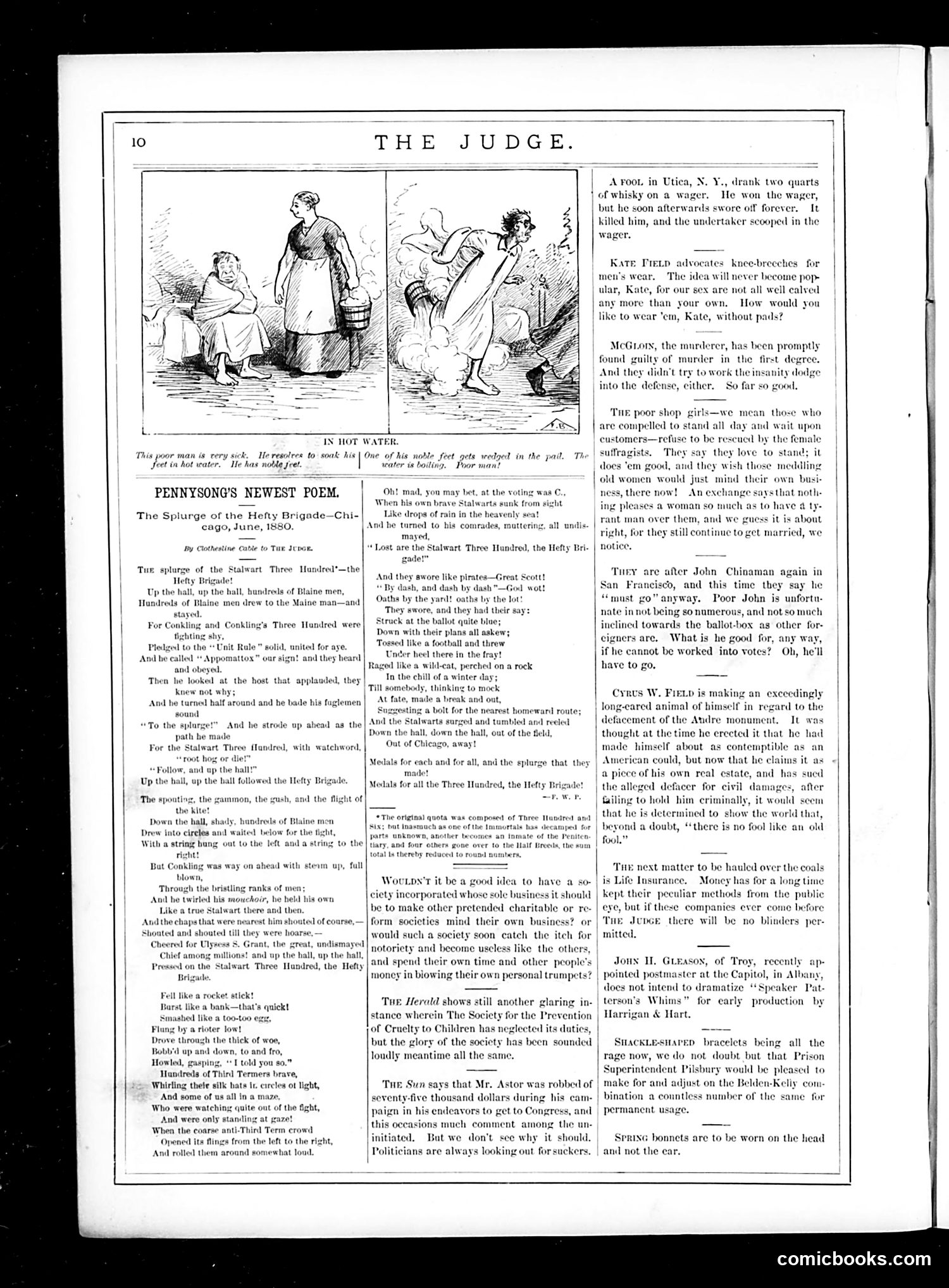
The page centers on political satire about the 1880 Republican convention. The cartoon "In Hot Water" depicts a sick man soaking his feet—a visual pun on political figures in hot water during the contentious battle between Blaine and Conkling factions. **Pennysong's poem** mocks the "Hefty Brigade" (Republican delegates loyal to Conkling, the "Stalwart" faction) as they clashed over presidential nomination. References to "Appomattox" and "Third Termers" suggest conflict over Ulysses S. Grant's potential third-term candidacy. The chaotic battle imagery satirizes the bitter factional infighting. The right column contains miscellaneous social commentary: critiques of women's dress advocates (Kate Field), condemnation of murderer McGloin, complaints about shop girls, and John Chinaman's status in San Francisco—typical 1880s Judge material mixing politics with general social sarcasm. The page exemplifies Judge's role as an illustrated satirical weekly targeting contemporary political and social absurdities.
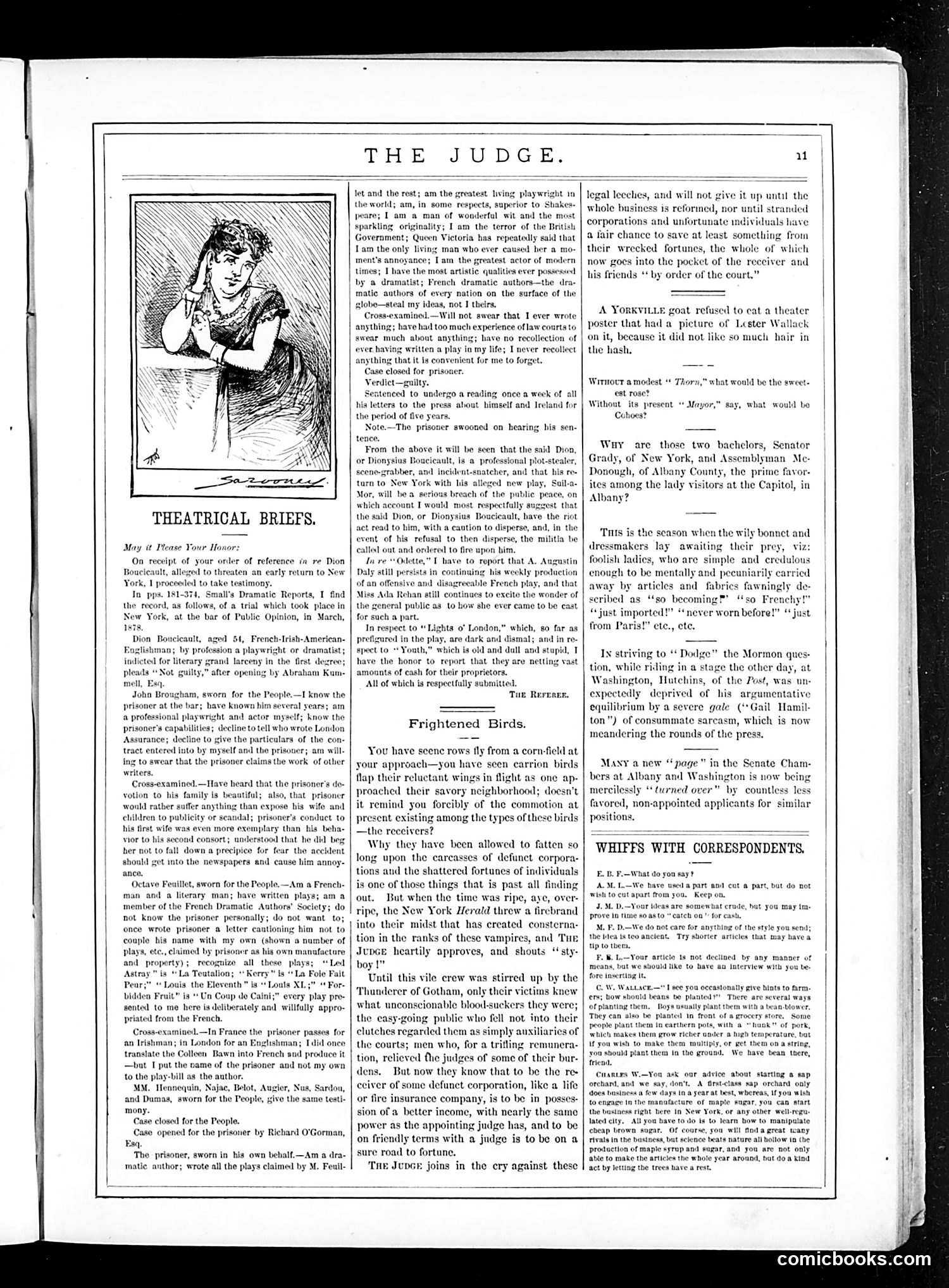
This page satirizes **Dion Boucicault**, a famous Irish-American playwright of the era, through a mock trial format. The text presents testimony from French dramatists (Octave Feuillet and others) accusing Boucicault of systematically stealing their plays and presenting them as his own original works—"London Assurance," "Led Astray," "Forbidden Fruit," etc. The satire targets Boucicault's notorious vanity and shamelessness. His own testimony is hilariously absurd: he claims to be "the greatest living playwright in the world," superior to Shakespeare, that Queen Victoria praised him, and that he wrote everything despite admitting he can't recall writing anything convenient to forget. The "verdict: guilty" and absurd sentence (reading his own letters weekly) mock both his brazen theft and his obvious guilt. The accompanying illustration appears to show a theatrical figure, likely representing Boucicault himself. This reflects genuine historical disputes over Boucicault's adaptation practices, which were common but controversial in 19th-century theater.
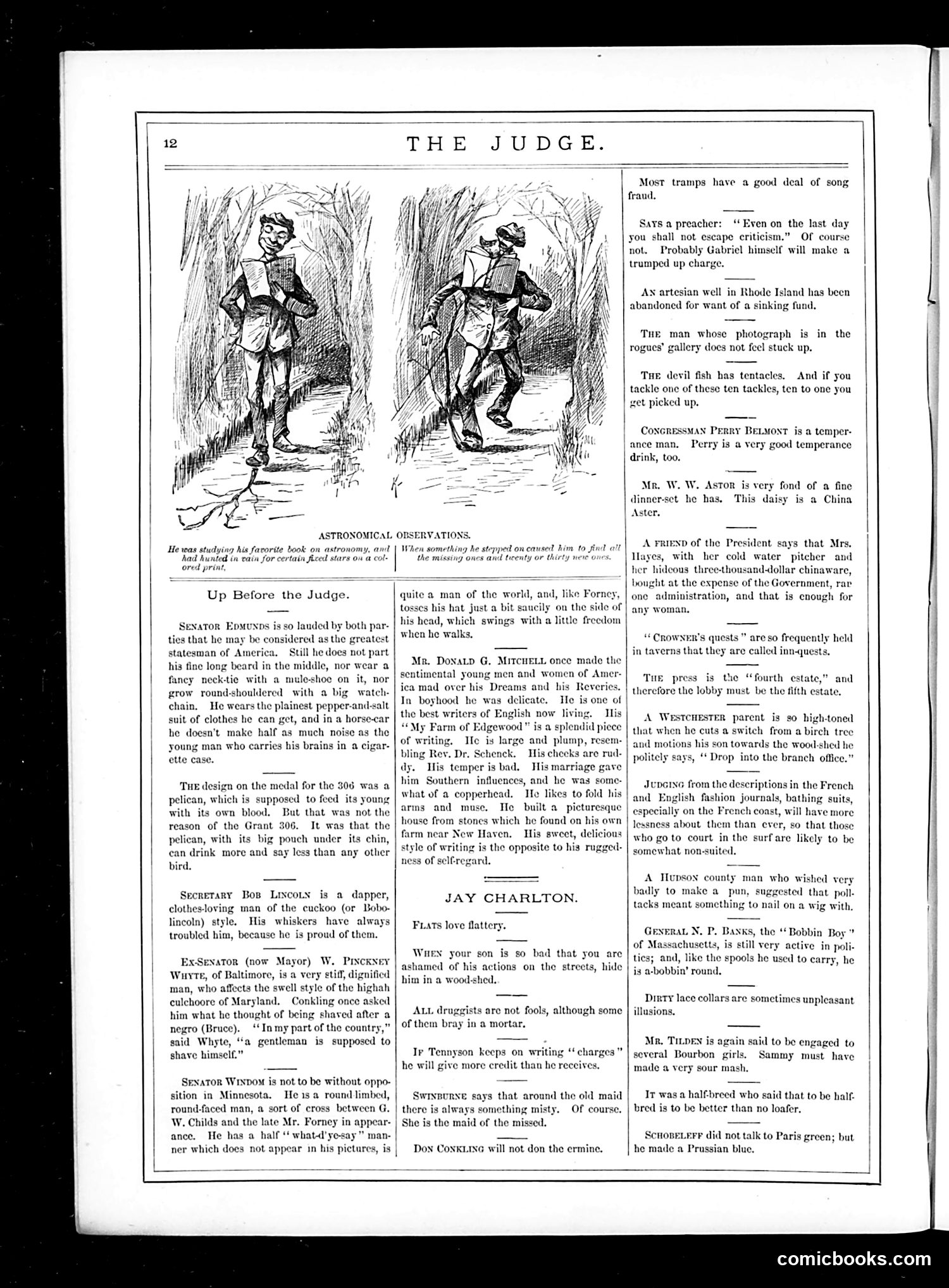
The main cartoon depicts a figure studying an astronomy book who falls and knocks over the chart he was using—a visual pun on "astronomical observations." The accompanying text is satirical commentary on contemporary American political and social figures. The page mixes brief biographical sketches of politicians (Senator Edmunds, Secretary Bob Lincoln, Senator Windom) with humorous one-liners and social observations. These sketches employ gentle mockery of public figures' personal habits and appearances—their beards, clothing choices, and mannerisms—typical of *Judge* magazine's satirical approach. The humor relies on readers recognizing these named individuals and appreciating the pointed but not vicious character commentary. References to specific events (Grant's 306 medal) and literary figures (Donald G. Mitchell's *Dreams and Reveries*) anchor the satire in contemporary culture, though some specific allusions now require historical context to fully appreciate.
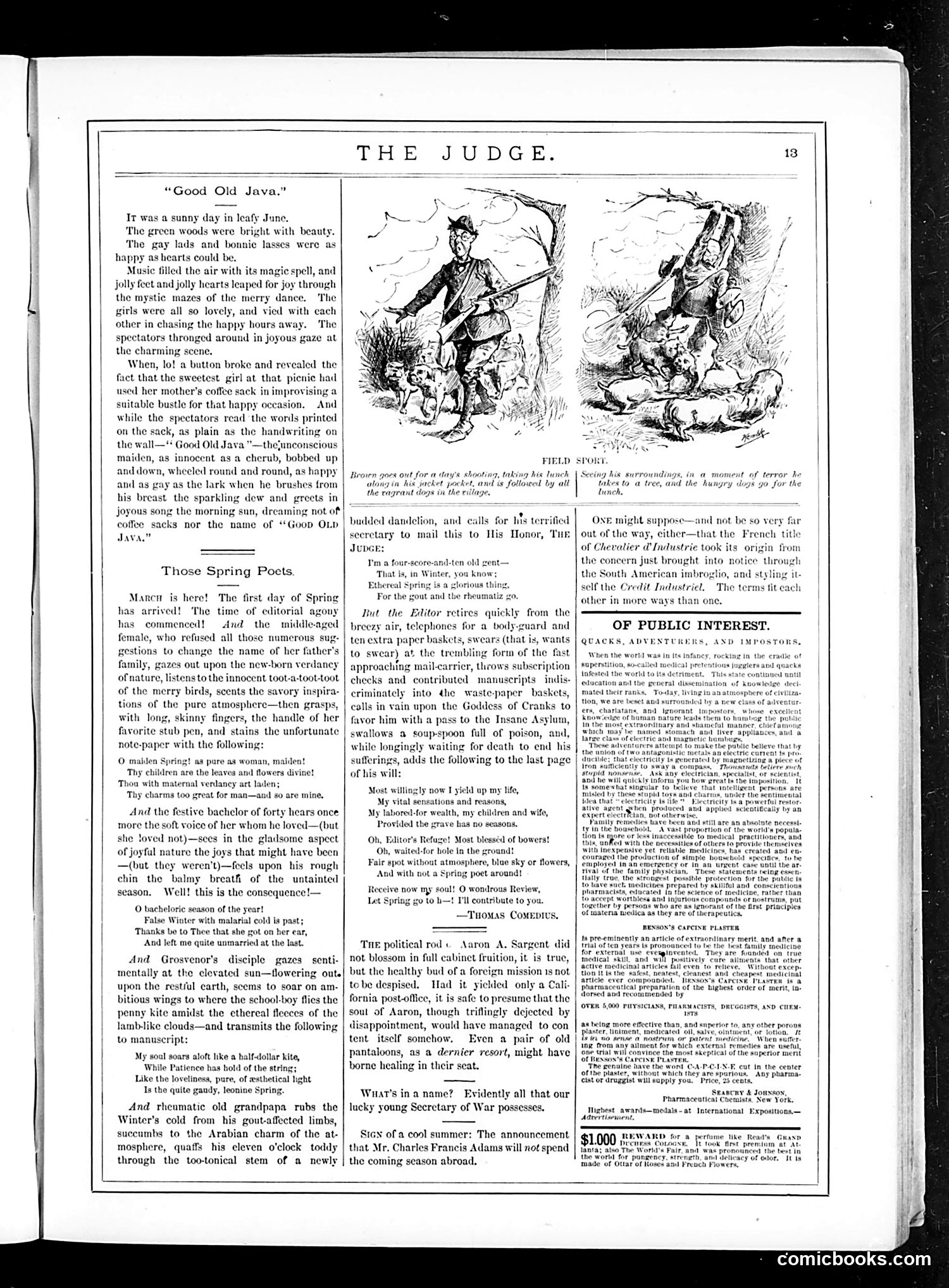
This page satirizes two aspects of American life circa Judge's era (late 1800s): **"Good Old Java"** mocks product advertising through a sentimental story: a young woman at a picnic is revealed to have fashioned her bustle from a coffee sack labeled "Good Old Java." The joke targets both the absurdity of using commercial packaging as fashion and the earnest marketing language companies deployed. **"Those Spring Poets"** ridicules the clichéd sentimental poetry that spring inspires. Judge parodies three stereotypes: the middle-aged spinster writing overwrought verse about maidenhood; the "Grosvenor disciple" (likely referencing aesthetic movement pretension) with grandiose metaphors; and the elderly man indulging in nostalgic spring sentiment. The Editor's frantic response—dumping mail into wastebaskets—suggests these submissions overwhelm publications each spring. Both sections mock earnest sentimentality and commercialism through exaggeration and bathos, Judge's characteristic satirical approach.
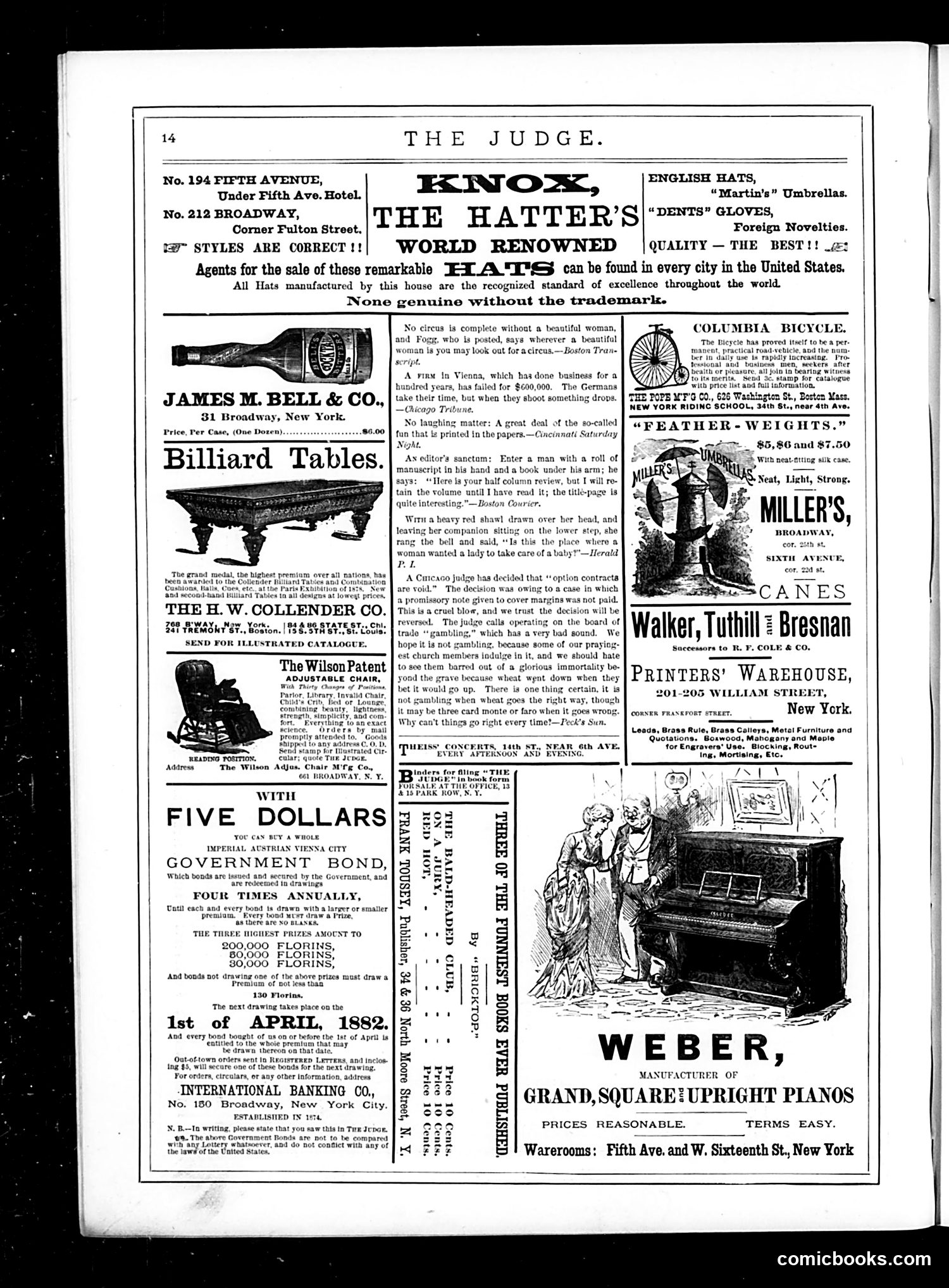
This page is primarily **advertisements**, not editorial cartoons. The main content consists of commercial notices for period products: Knox hats, billiard tables, bicycles, pianos, and financial bonds. The only satirical element is a small **cartoon illustration** (bottom right) showing a woman at a piano with a man beside her, accompanying a humorous anecdote about an editor receiving manuscript submissions. The joke appears to play on domestic/romantic comedy rather than political satire—a common theme in 19th-century humor magazines. The page's "satirical" content is minimal; Judge here functions primarily as a **advertising vehicle** for upscale consumer goods and services aimed at middle/upper-class readers. The scattered brief humorous quotes (from newspapers) scattered throughout lack enough context to decode specific contemporary references. Without clearer editorial matter or dated political cartoons, this page illustrates Judge's dual nature: part satirical periodical, part lucrative advertising platform.
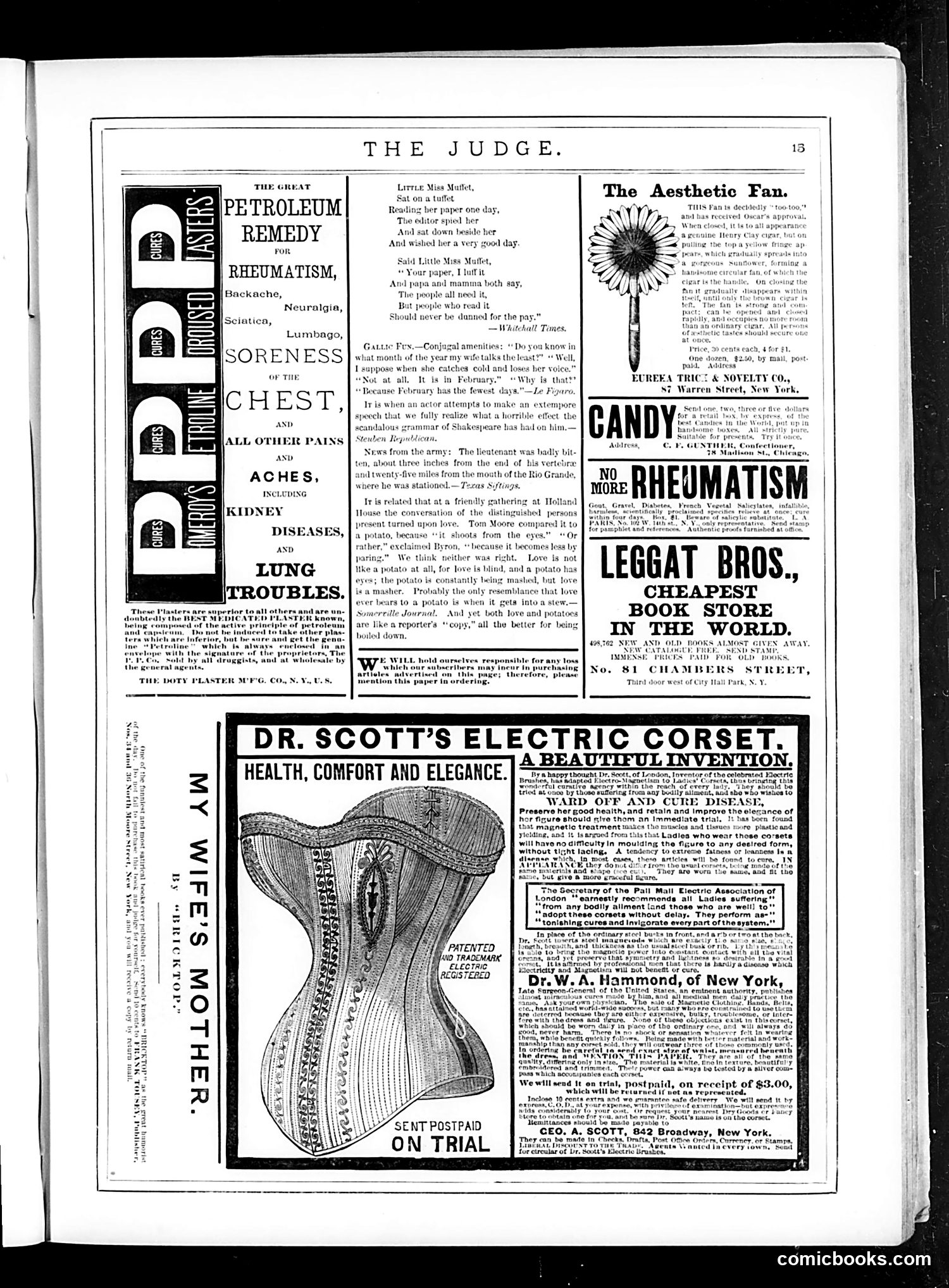
This page is primarily **advertising**, not political satire. It features patent medicine and novelty product ads typical of late-19th-century publications. The main content includes: - **Petroleum Remedy ads** (left column) for treating rheumatism and various ailments—representative of the era's dubious "cure-all" patent medicines - **Humorous filler items** (center): short jokes, including one about "Little Miss Muffet" and observations comparing love to a potato - **Dr. Scott's Electric Corset** (bottom): a "health" device claiming magnetic/electrical properties to cure ailments—a common medical fraud of the period exploiting pseudoscientific claims - **Book and candy store advertisements** The satirical *Judge* magazine's editorial content appears minimal here. The page reflects the commercial landscape of 1890s America, where questionable medical devices and patent medicines were aggressively marketed. The corset ad's claim that magnetism could cure disease exemplifies the scientific charlatanism that *Judge* and similar publications often mocked—though here it's presented straightforwardly as advertising rather than satirical commentary.
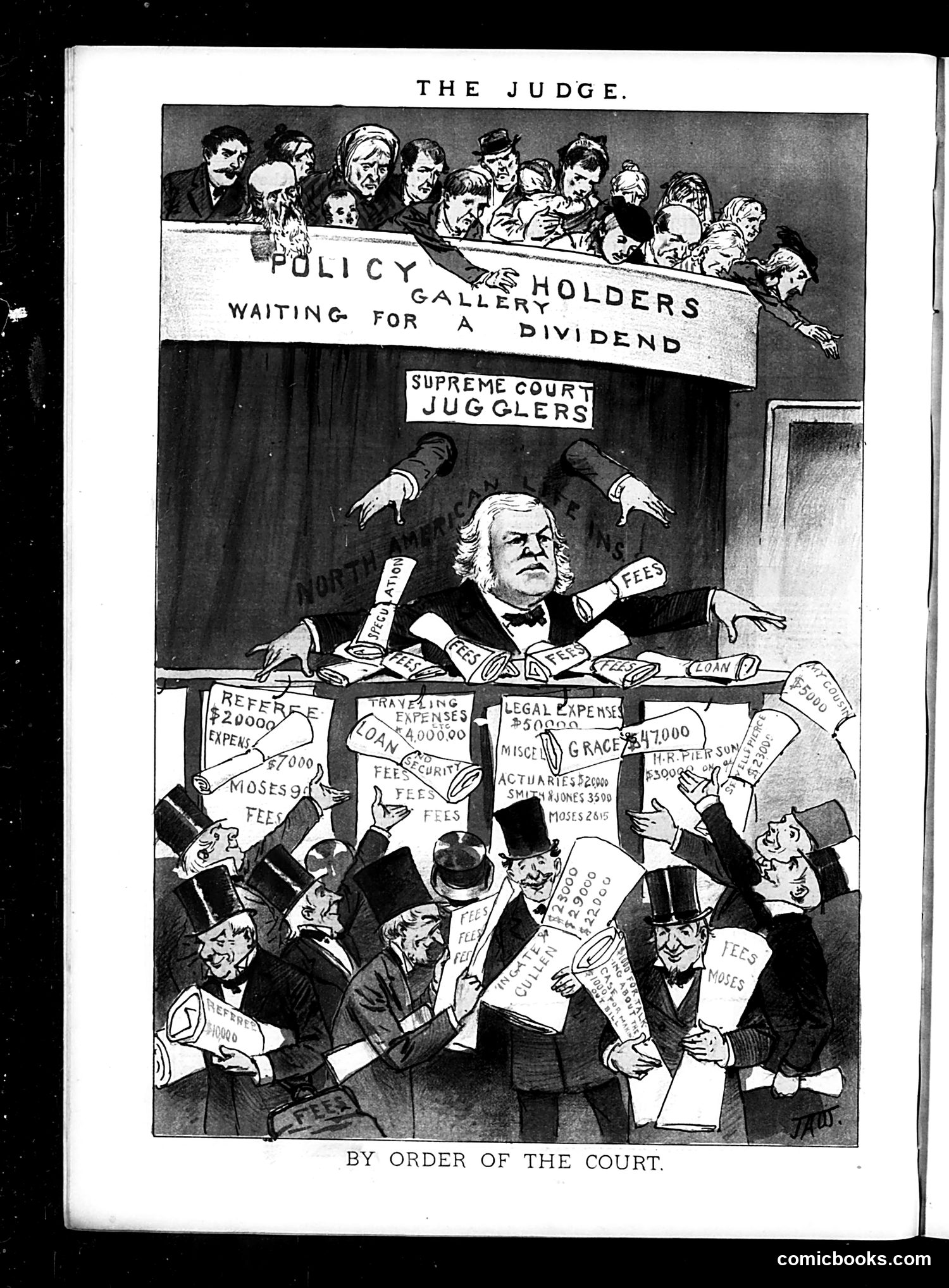
This political cartoon satirizes the U.S. Supreme Court as "Supreme Court Jugglers" drowning in fees and expenses. A central judge figure juggles multiple documents labeled with various costs: "Referee Expenses," "Traveling Expenses," "Legal Expenses," "Miscellaneous," and numerous "FEES" labels with dollar amounts. Above, "Policy Holders" peer down from a gallery "Waiting for a Dividend"—suggesting insurance companies or investors expecting returns while courts consume resources through excessive fees. The caption "By Order of the Court" ironically frames this spectacle. The cartoon critiques judicial inefficiency and the proliferation of court costs that drain funds meant for claimants, with the judge portrayed as a hapless juggler unable to manage the financial chaos. The satire targets systemic waste within the legal system circa the Judge magazine's publication era.