
Judge, 1882-03-18 · page 6 of 16
Judge — March 18, 1882 — page 6: what you’re looking at
What you’re looking at
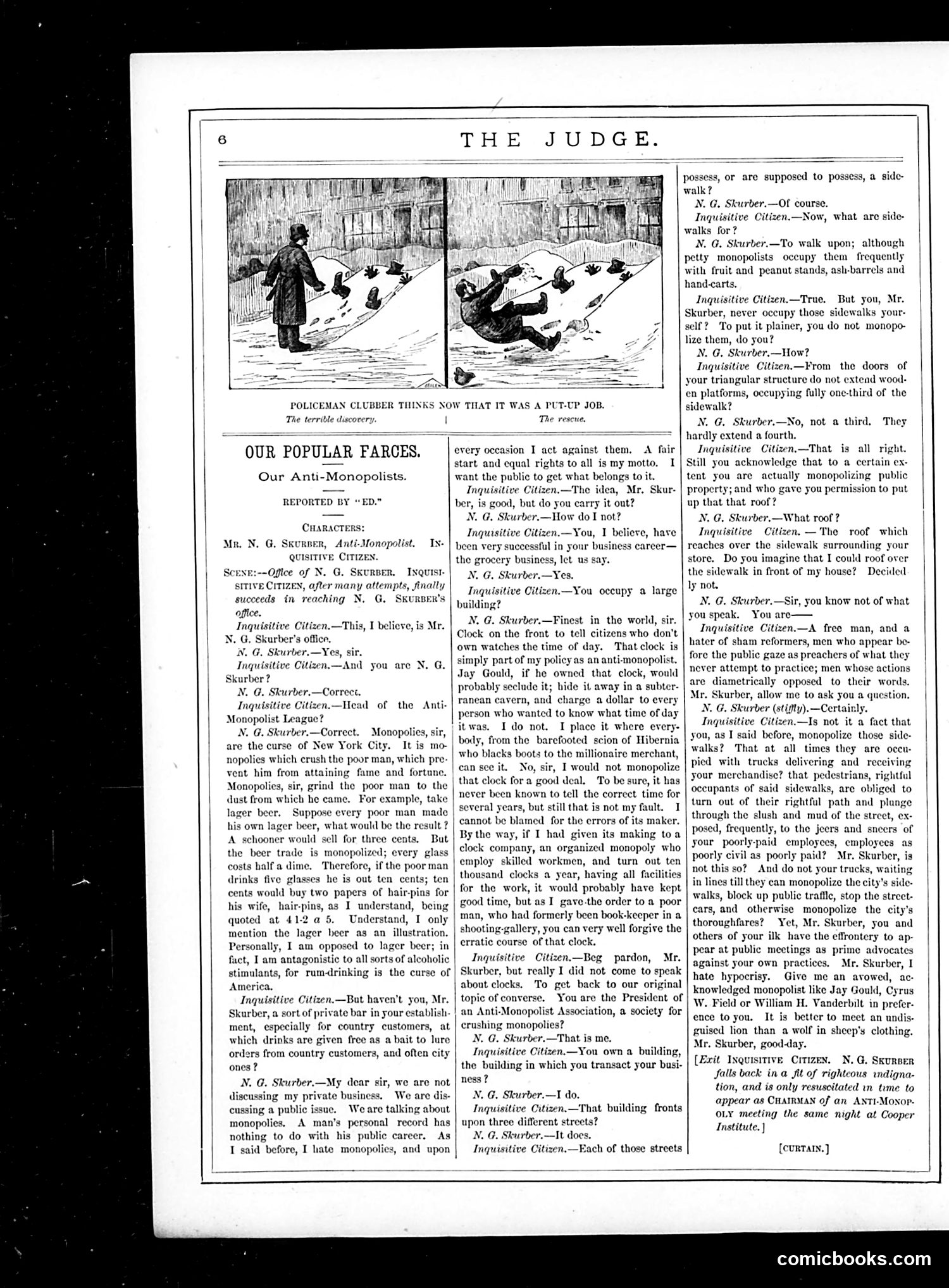
This page satirizes **anti-monopoly politicians and activists who preach against corporate monopolies while hypocritically engaging in monopolistic practices themselves**. The cartoon depicts a confrontation between an "Inquisitive Citizen" and N.G. Skurber, self-proclaimed "Anti-Monopolist." Skurber loudly condemns monopolies—particularly lager beer monopolies—as crushing the poor. However, the citizen catches him in blatant contradictions: Skurber owns a large grocery business building, operates a public clock (admittedly broken for years) as self-promotion, and maintains a private bar offering free drinks to customers—precisely the monopolistic practices he denounces. The satire exposes the hypocrisy of progressive-era anti-monopoly crusaders who use populist rhetoric to gain political advantage while personally profiting from the same market-controlling tactics they publicly attack. It's a pointed criticism of dishonest political posturing.
📄 Transcribed text from this page (OCR, searchable)
Machine-transcribed from the original scan — historical spelling and the odd misread are preserved.
POLIC! The terrible discovery. AN CLUBBER THINKS NOW THAT IT WAS A PUT-UP JOB. OUR POPULAR FARCES. Our Anti-Monopolists. REPORTED BY CHaRactel Mr. N. G. Skunner, Anti-Monopolist. quisitive Crriz Scrxe:--Opice of N. G. SkunBen. INQuist- SITIVE CITIZEN, after many attempts, finally succeeds in reaching N, G. SkURBER'S office. Inquisitive Citizen.—This, I believe, is Mr. N. G. Skurber’s office. N. G. Skurber.—Yes, sir. Inquisitive Citizen.—And you are N. G. Skurber? NG. Inquisitive Cit Monopolist League N. G. Skurber.—Correct. Monopolies, sir, are the curse of New York Cit, It is mo- nopolies which crush the poor man, which pre: vent him from attaining fame and fortune. Monopolies, sir, grind the poor man to the dust from which he came. For example, take lager beer. Suppose every poor man made his own lager beer, what would be the result ? A schooner would sell for three cents. But the beer trade is monopolized; every glass costs half a dime. Therefore, if the poor man | drinks five glasses he is out ten cents; ten cents would buy two papers of hair-pins for his wife, hair-pins, as I understand, being | quoted at 41-2 a 5. Understand, I only | mention the lager beer as an illustration, Personally, I am opposed to lager beer; in fact, I am antagonistic to all sorts of alcoholic stimulants, for rum-drinking is the curse of ED.” Is- ur Yorrect. n.—Head of the Anti- en.—But haven't you, Mr. Skurber, a sort of private bar in your establish ment, espet for country customers, at which drinks are given free as a bait to lure orders from country customers, and often city ones ? N. G. Skurber.—My dear s discussing my private busin cussing a public issue. Weare talking about monopolies, A man’s personal record has nothing to do with his public career. As I said before, I hate monopolies, and upon , We are not We are dis- every occasion I act against them. A fair start and equal rights to all is my motto. I want the public to get what belongs to it. Inquisitive Citizen.—The idea, Mr. Skur- ber, is good, but do you carry it out? N. G, Skurber.—Wow do I not? Inquisitive Citizen.—You, 1 believe, have been very successful in your business carcer— the grocery business, let us s N. G. Skurber.—Yes, Inquisitive Citizen.—You occupy a large building? G. Skurber.—Finest in the world, sir. Clock on the front to tell citizens who don't own watches the time of day. That clock is simply part of my policy as an anti-monopolist. Jay Gould, if he owned that clock, would ly seclude it; hide it away in a subter- vern, and charge a dollar to every person who wanted to know what time of day it I do not. I place it where every- body, from the barefooted scion of Hibernia who blacks boots to the millionaire merchant, can see it. No, sir, I would not monopolize that clock for a good d To be sure, it has never been known to tell the correct time for eral years, but still that is not my fault. I cannot be blamed for the errors of its maker. By the way, if I had given its making toa clock company, an organized monopoly who employ skilled workmen, and turn out ten thousand clocks a year, having all facilities | for the work, it would probably have kept good time, but as I gave-the order to a poor man, who had formerly been book-keeper in a | shooting-gallery, you can very well forgive the erratic course of that clock. Inquisitive Citizen.—Beg pardon, Mr. Skurber, but really I did not come to speak about clocks. To get back to our original topic of converse. You are the President of an Anti-Monopolist Association, a society for crushing monopoli N. G. Skurber.—That is me. Inquisitive Citizen.—You own a building, the building in which you transact your busi- ness? N. G. Skurber.—I do. Inquisitive Citizen.—That building fronts upon three different streets? N. G. Skurber.—It does. Inquisitive Citizen.—Each of those streets Inquisitive Citizen.—Now, what are sit walks for? N. G. Skurber.—To walk upon; although petty monopolists occupy them frequently with fruit and peanut stands, ash-barrels and hand-carts. Inquisitive Citizen.—True. But you, Mr. Skurber, never occupy those sidewalks your- self? To put it plainer, you do not_monopo- lize them, do you? N. G. Skurber.—How? Inquisitive Citizen.—From the doors of your triangular structure do not extend wood- en platforms, occupying fully one-third of the sidewalk? N. G. Skurber.—No, not a third, hardly extend a fourth, Inquisitive Citizen.—That is all right. Still you acknowledge that to a certain ex tent you are actually monopolizing public property; and who gave you permission to put up that that roof? N. G, Skurber,—What roof ? Inquisitive Citizen. —The roof which reaches over the sidewalk surrounding your store. Do you imagine that I could roof over the sidewalk in front of my house? Decided ly not. N. G. Skurber.—Sir, you know not of what k. You are— Citizen.—A free man, and a hater of sham reformers, men who appear be- fore the public gaze as preachers of what they never attempt to practice; men whose actions are diametrically opposed to their words. Skurber, allow me to ask you a question. urber (stigy).—Cert: e Citizen.—Is not it a fact that you, as I said before, monopolize those side- walks? That at all times they are occu- pied with trucks delivering and receiving your merchandise? that pedestrians, rightful occupants of said sidewalks, are obliged to turn out of their rightful path and plunge through the slush and mud of the street, ex- posed, frequently, to the jeers and sneers of your poorly-paid employees, employees as poorly civilas poorly paid? Mr. Skurber, is not this so? And do not your trucl aiting in lines till they can monopolize the city’s side- walks, block up public traflle, stop the street- cars, and otherwise monopolize the city’s thoroughfares? Yet, Mr. Skurber, you and others of your ilk have the effrontery to ap- pear at public meetings as prime advocates against your own practices, Mr. Skurber, I hate hypocrisy. Give me an avowed, ac- knowledged monopolist like Jay Gould, Cyrus W. Field or William H. Vanderbilt in prefer- ence to you. It is better to meet an undis- guised lion than a wolf in sheep's clothing. Mr. Skurber, good-day. (Exit Isquisitive CrmzeN. N. G. SkuRBER falls back ina fit of righteous indigna- tion, and is only resuscitated in time to appear as CHAIRMAN of an ANTI-Monop- OLY meeting the same night at Cooper Institute. } They Inquisiti (cunt. comicbooks.com