
A complete issue · 16 pages · 1882
Judge — February 25, 1882
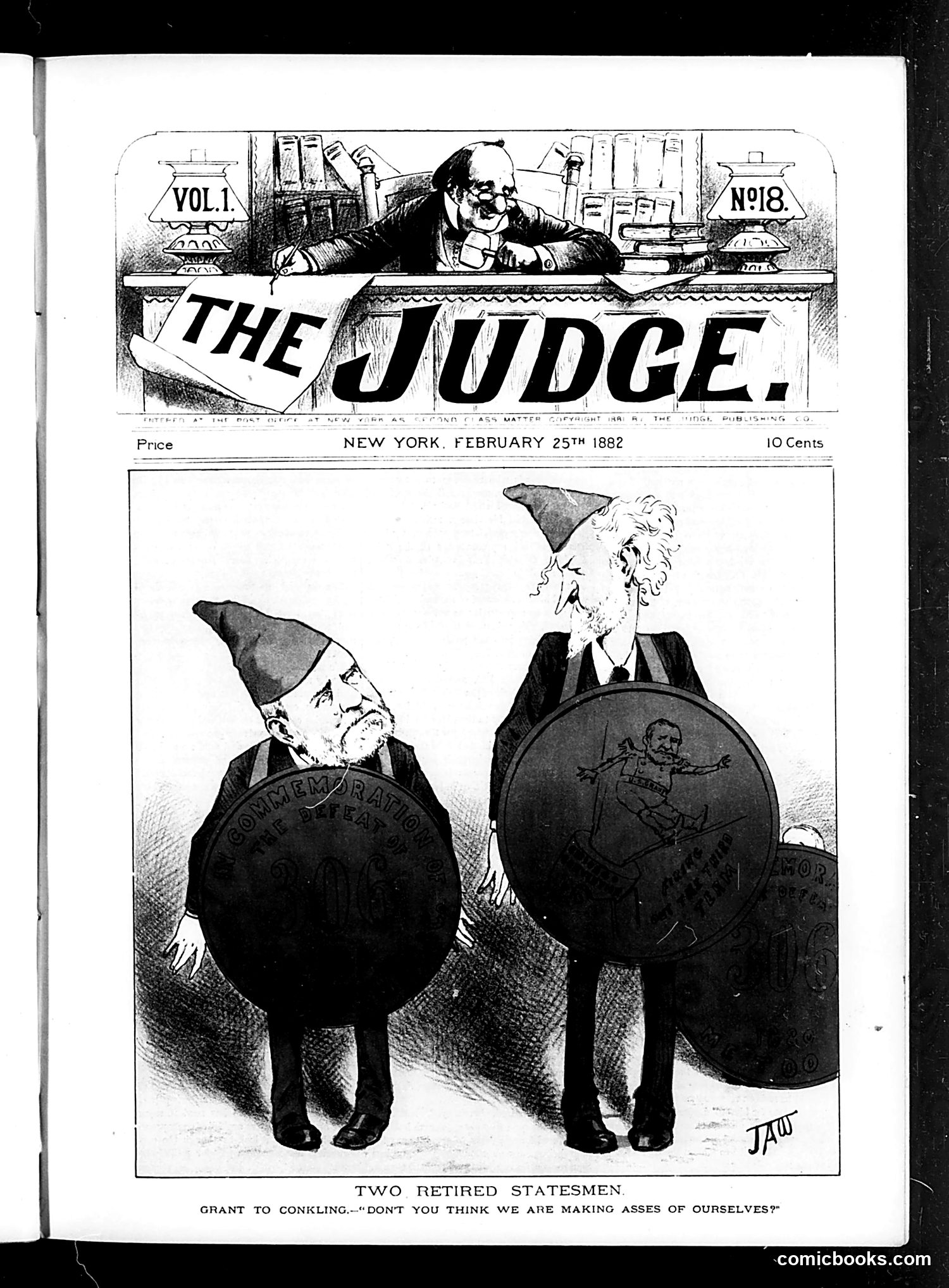
This cartoon depicts **Ulysses S. Grant** and **Roscoe Conkling**, two prominent Republican figures who had retired from public office. Both wear dunce caps and stand holding spheres labeled with their names/scandals—visual metaphors for foolishness. The satire mocks their post-political activities. Grant had embarked on an unsuccessful banking venture (which collapsed in 1884), while Conkling engaged in various controversial business dealings. The caption captures their self-awareness: Grant pointedly asks Conkling if they're making fools of themselves—suggesting both men's post-office pursuits appeared ridiculous to the public. The artist (signed "Jaw") uses classic satirical imagery: dunce caps and spheres represent diminished intellect and the "weight" of their poor judgment outside government.
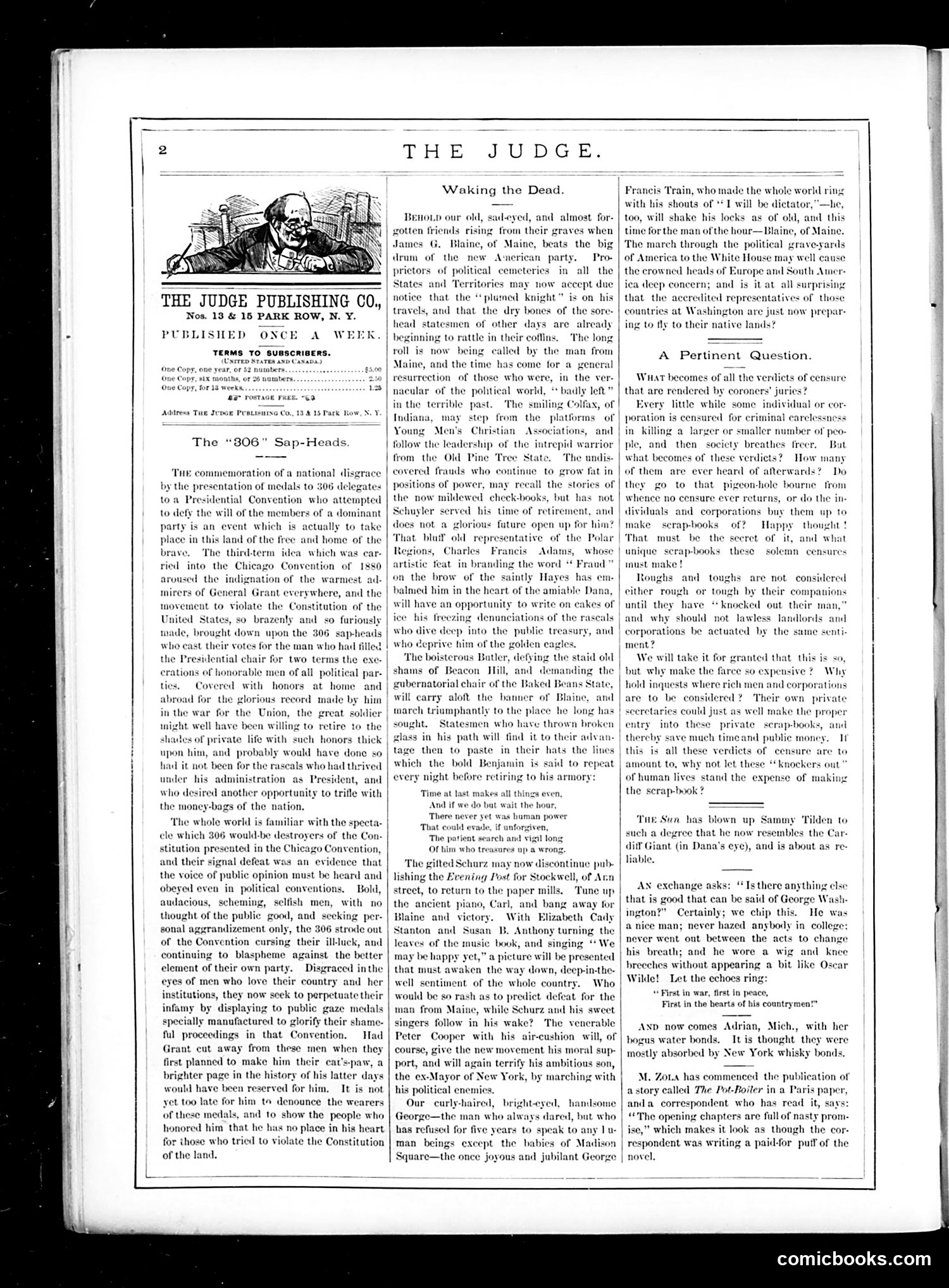
This page mocks the Republican Party's 1880 convention conflict. The main article, "The '306' Sap-Heads," attacks 306 delegates who voted for Ulysses S. Grant's third-term nomination despite party opposition. Judge ridicules these delegates for their "bold, audacious, scheming" attempt to overturn the party's will, calling them "disgraced" men now seeking to commemorate their defeat with medals—perpetuating their "infamy." The second article, "Waking the Dead," sarcastically notes that James G. Blaine's presidential candidacy is resurrecting forgotten political figures like Schuyler Colfax and Benjamin Butler. The tone suggests these politicians represent outdated, corrupt politics. Overall, Judge championed constitutional limits on executive power and mocked both Grant's would-be third term and the recycled politicians Blaine represented.
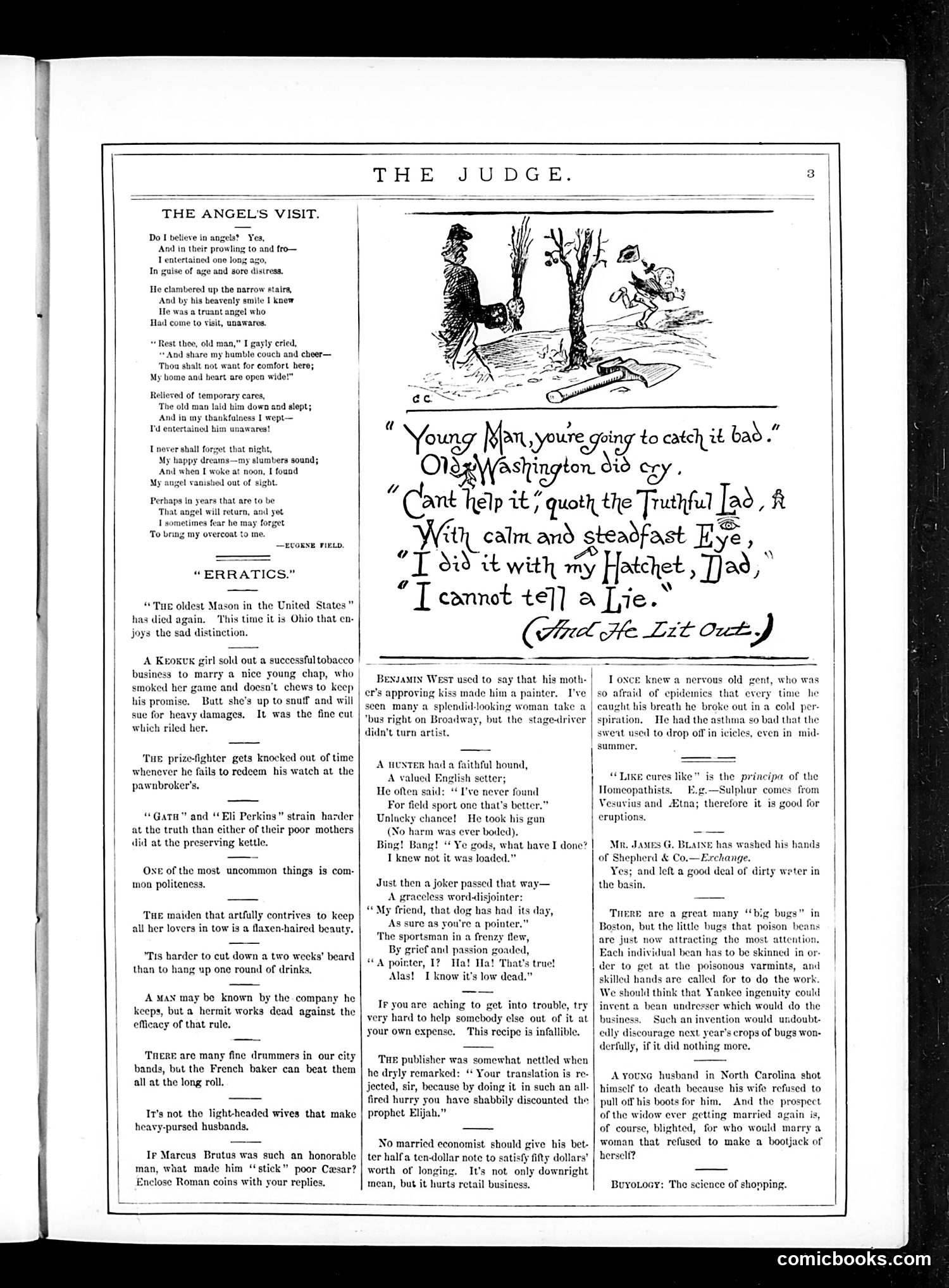
This page contains satirical poetry and humorous aphorisms typical of Judge magazine's content. **"The Angel's Visit"** is a sentimental poem by Eugene Field about hospitality toward a stranger, with an ironic twist—the narrator hopes the angel will return his overcoat. **"Erratics"** section offers random social commentary and light satire, including: - Jokes about liars ("Gath" and "Eli Perkins," likely contemporary public figures) - A woman divorcing a husband who promised to quit smoking - Wordplay about prizefighters, drummers, and marriages **The main cartoon** depicts a young man being warned by an older figure (possibly representing George Washington, given the "Washington did cry" caption) that he'll "catch it bad"—likely satirizing youthful folly or broken promises. The Washington reference suggests commentary on American ideals versus actual behavior. The page primarily offers gentle, domestic humor rather than hard political satire, reflecting Judge's mix of literary content and social observation.
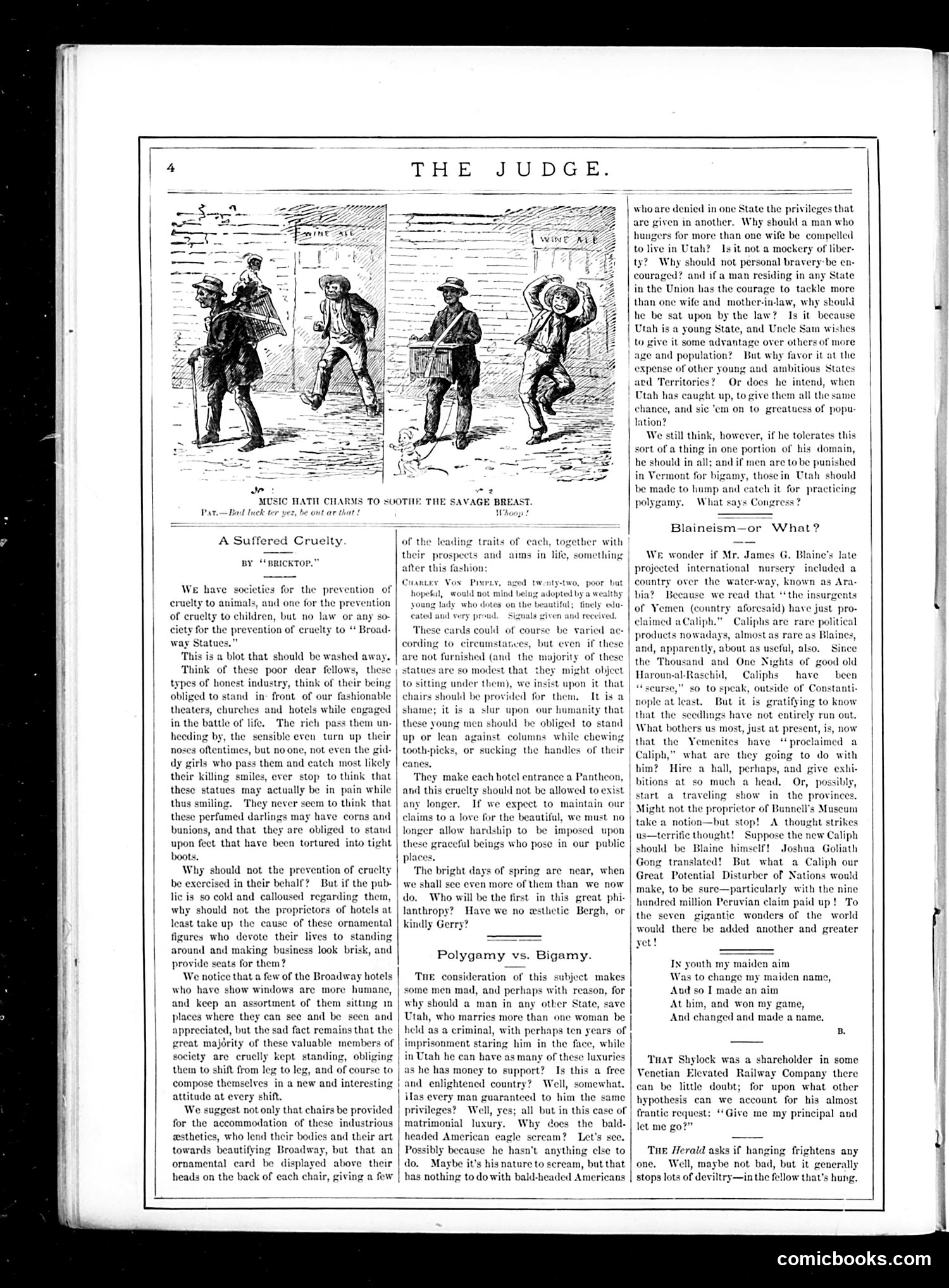
## "Music Hath Charms to Soothe the Savage Breast" The cartoon depicts four street musicians (likely Italian organ grinders or similar working-class performers) playing instruments outside what appears to be a saloon or establishment. The satire critiques the contrast between cultural pretension and working-class reality—these humble street musicians represent "civilized" entertainment, yet society treats them with contempt. ## "A Suffered Cruelty" This piece humorously argues for protection of ornamental human "statues"—men hired to stand motionless as living decorations outside hotels and theaters on Broadway. The satire mocks both the exploitation of these workers (forced to stand in tight boots without rest) and society's indifference to their suffering. The author calls for chairs and informational placards about these "industrious aesthetics," parodying contemporary animal welfare movements by extending their logic absurdly to human decoration labor. Both pieces satirize American class attitudes and labor conditions of the Gilded Age era, using humor to expose exploitation and social hypocrisy.
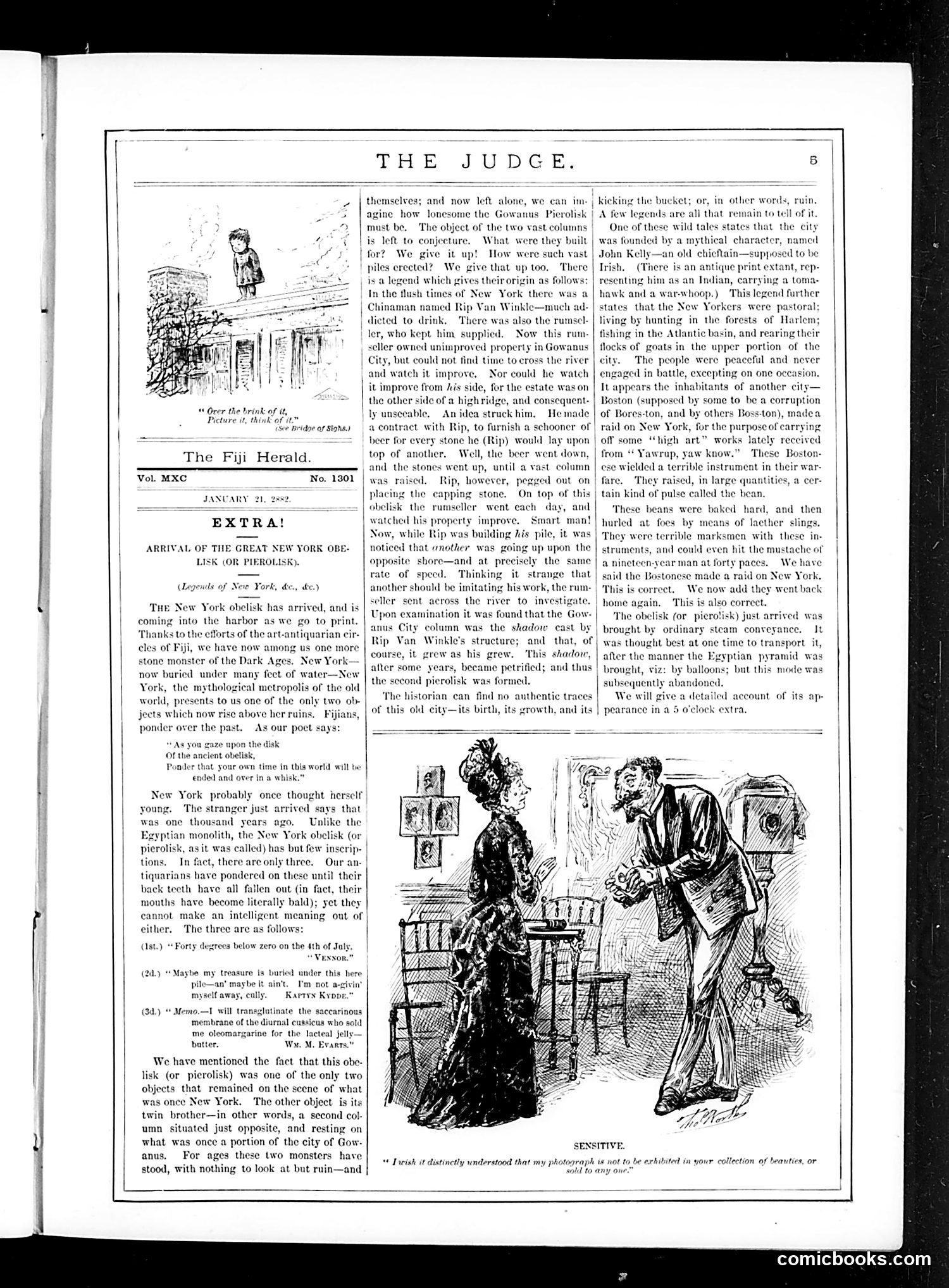
This piece imagines New York as a ruined ancient civilization, discovered by future Fijians in the year 2882. The "obelisk" is actually New York's monument—likely referencing the real Egyptian obelisk (Cleopatra's Needle) that arrived in New York in 1881, a major public event. The satire mocks New York's pretensions to permanence and grandeur. The three inscriptions on the "pierolisk" are deliberately absurd, ridiculing contemporary figures: cryptic weather observations, drunken rambling (attributed to "Kathy Kyppe"), and bureaucratic gibberish (credited to W. M. Evans, possibly referencing a real politician). The legend of Rip Van Winkle building stones for beer, with his shadow somehow petrifying into a second column, is nonsensical humor—suggesting New York's monuments are built on equally insubstantial foundations. The cartoon satirizes both New York's boastful self-importance and the era's fascination with ancient civilizations, implying that America's "great works" will eventually appear as ridiculous to posterity as we find ancient ruins today.
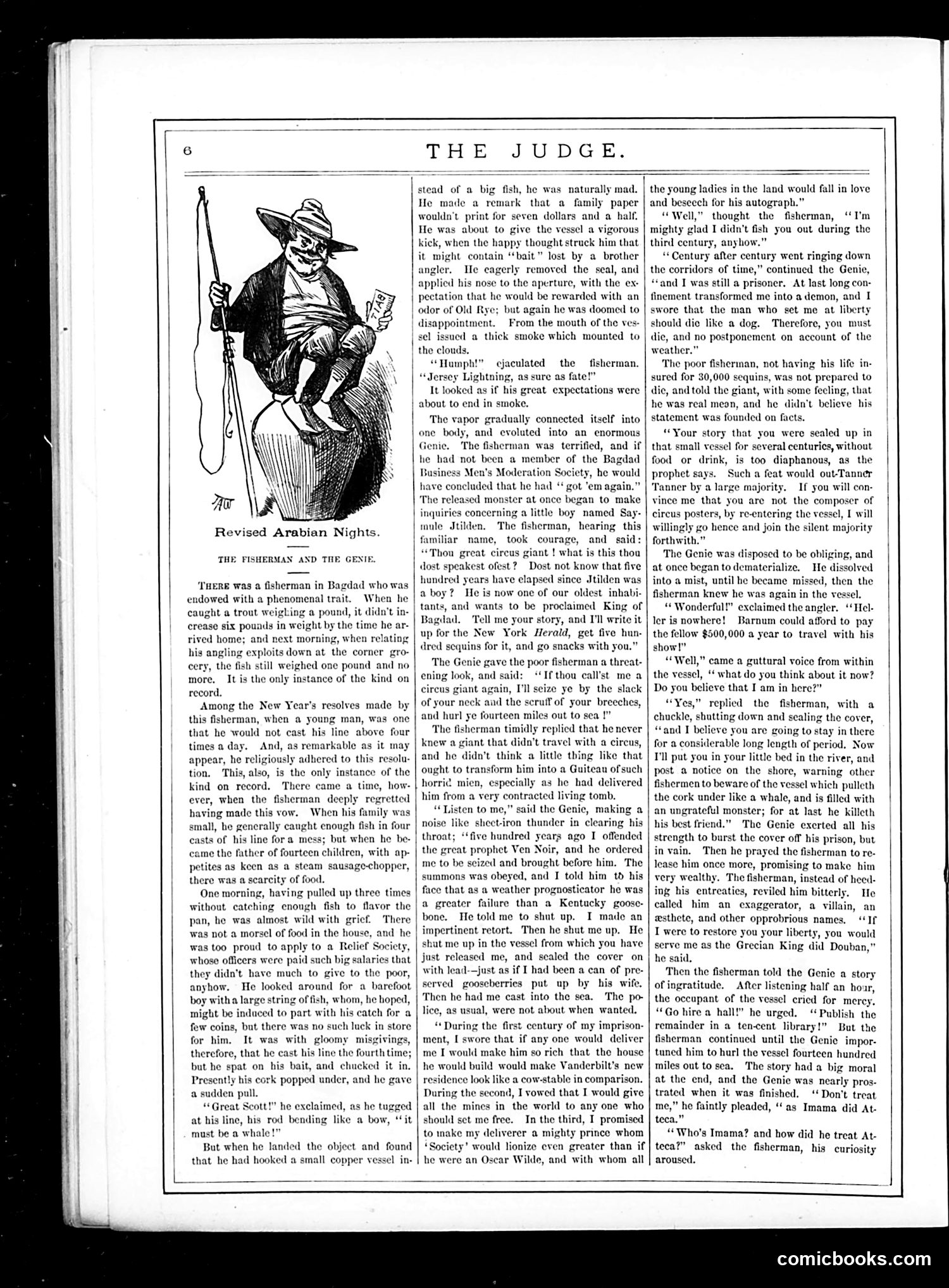
This is a comedic retelling of the classic Arabian Nights tale, reframed as contemporary American satire. The fisherman represents an everyman struggling with poverty and family obligations. When he catches a magical genie instead of fish, the joke pivots to mock contemporary American figures and institutions. The genie inquires about "Saymule Jilden" (Samuel Tilden), a real political figure from the Gilded Age era, whom the fisherman notes is now an "old inhabitant" seeking to become "King of Bagdad"—satirizing Tilden's political ambitions. The fisherman's immediate instinct to monetize the genie's story by selling it to the *New York Herald* lampoons American journalism's sensationalism and the era's get-rich-quick mentality. The satire mocks relief organizations with overpaid officers, the fisherman's pride preventing him from accepting aid, and the contrast between fantastical wishes and mundane American greed.
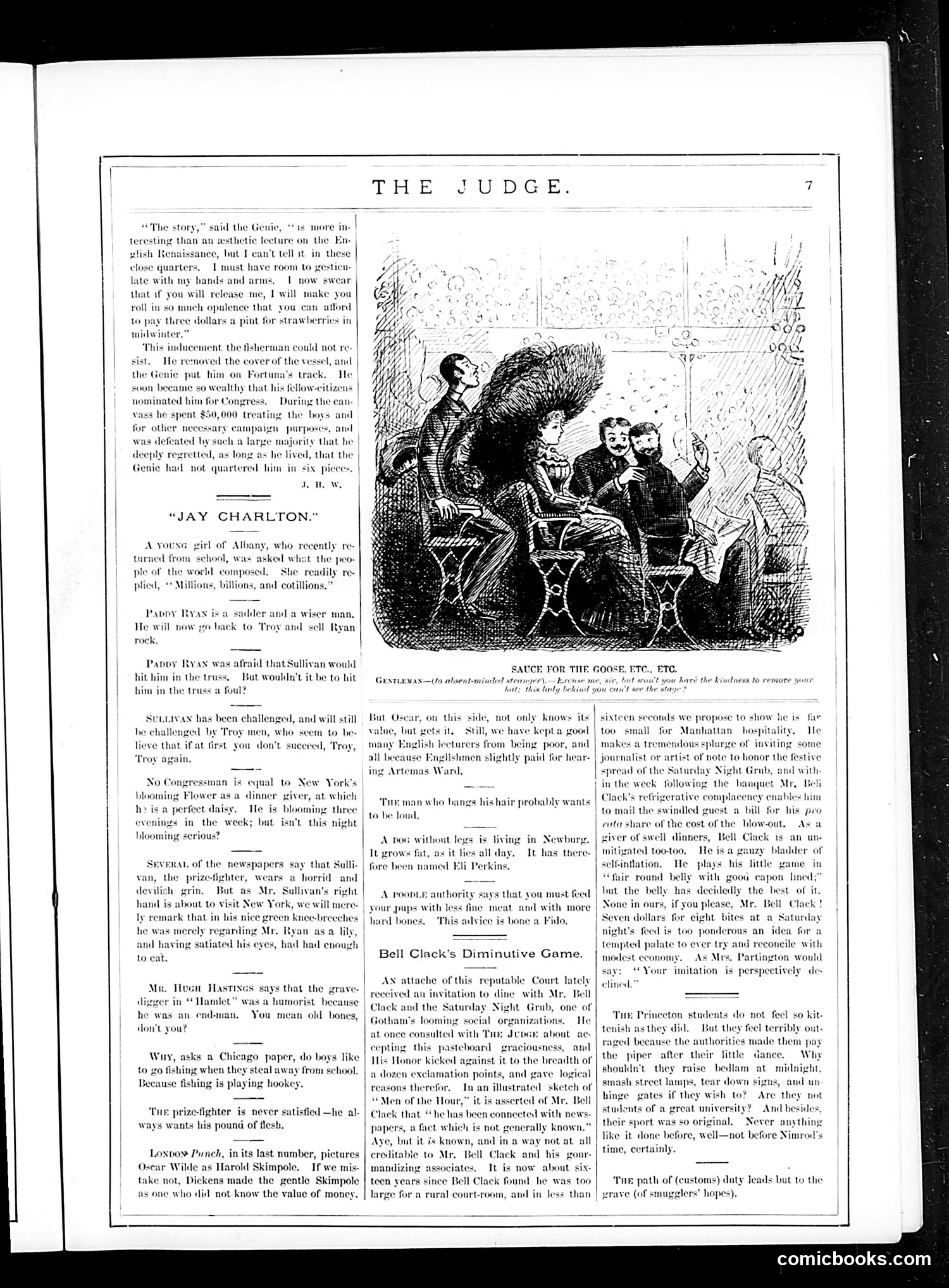
This page contains several satirical pieces about prominent figures and social issues of the era. **Main Cartoon ("Sauce for the Goose"):** The illustration depicts a gentleman addressing what appears to be a waiter or servant at a social gathering, with the caption making a pun about removing one's hat. The satire concerns social etiquette and hospitality standards. **"Jay Charlton" Section:** A young woman from Albany who has composed millions of lines of poetry is satirized for her prolific but presumably low-quality output—a dig at American literary pretension. **Boxing/Prize-fighting References:** Multiple items mock prize-fighters Sullivan and Ryan, playing on their "pound of flesh" demands and violent reputations versus refined society. **Bell Clack's Dinner Party:** The longest piece satirizes Bell Clack, a court figure who hosts lavish dinners while allegedly swindling guests and misrepresenting his social standing—critiquing nouveau riche pretension and dishonest social climbing. The overall tone targets American social climbers, questionable celebrities, and those performing respectability they don't genuinely possess.
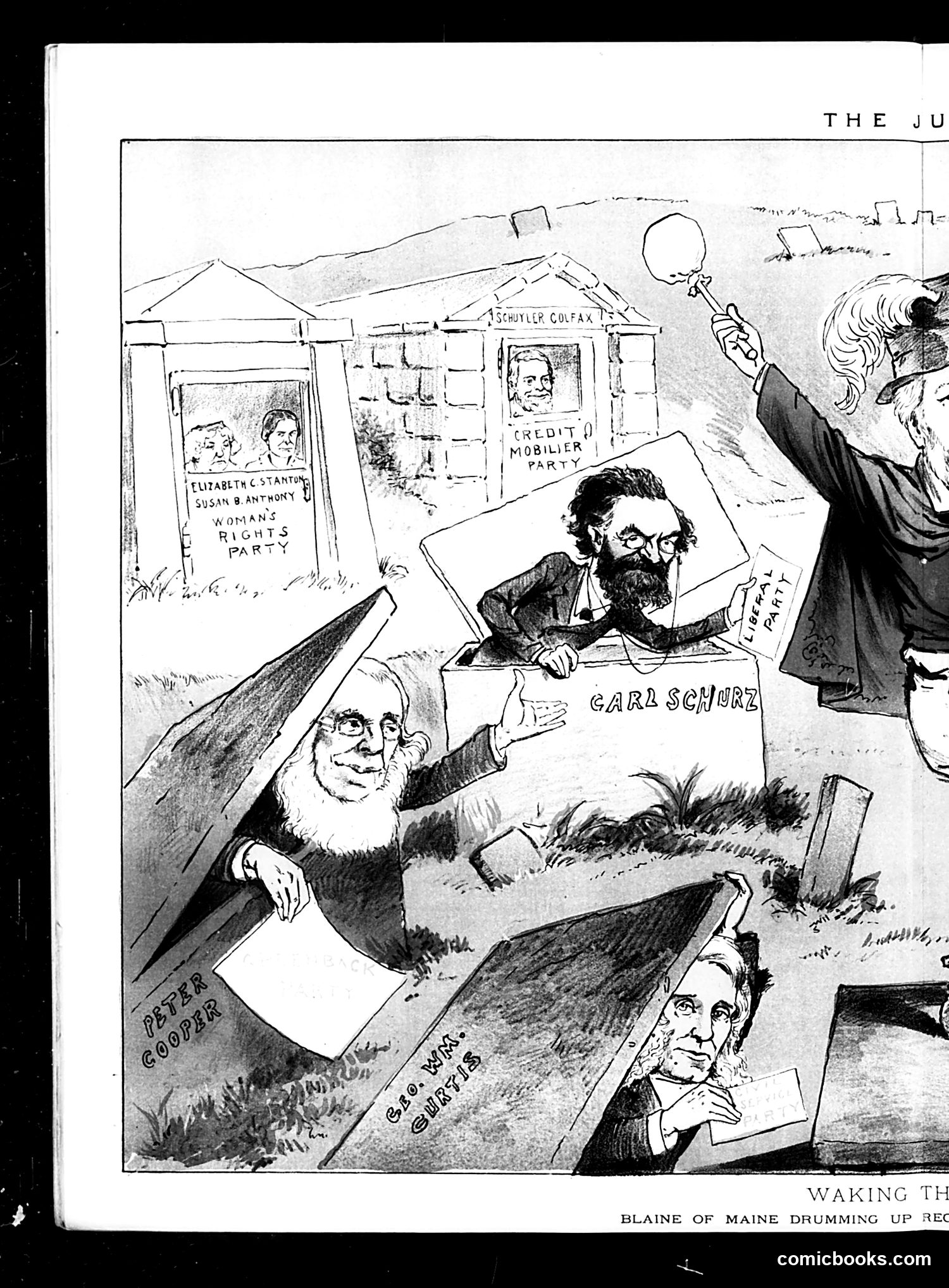
This cartoon depicts a cemetery scene where historical political figures are being "awakened" from their graves. Visible names include Susan B. Anthony (women's rights advocate), Elizabeth C. Stanton, Peter Cooper, Carl Schurz, and G.O. Blaine of Maine. The caption references "Blaine of Maine drumming up recruits," suggesting this is about James G. Blaine (likely a presidential candidate) attempting to revive support from deceased reformers and their causes—women's rights, the Populist/Greenbacker movement, and other Progressive positions. The satire mocks Blaine's political strategy as desperately attempting to resurrect old political movements and dead issues to gain voter support, portraying his campaign as relying on outdated or exhausted political causes rather than fresh ideas.
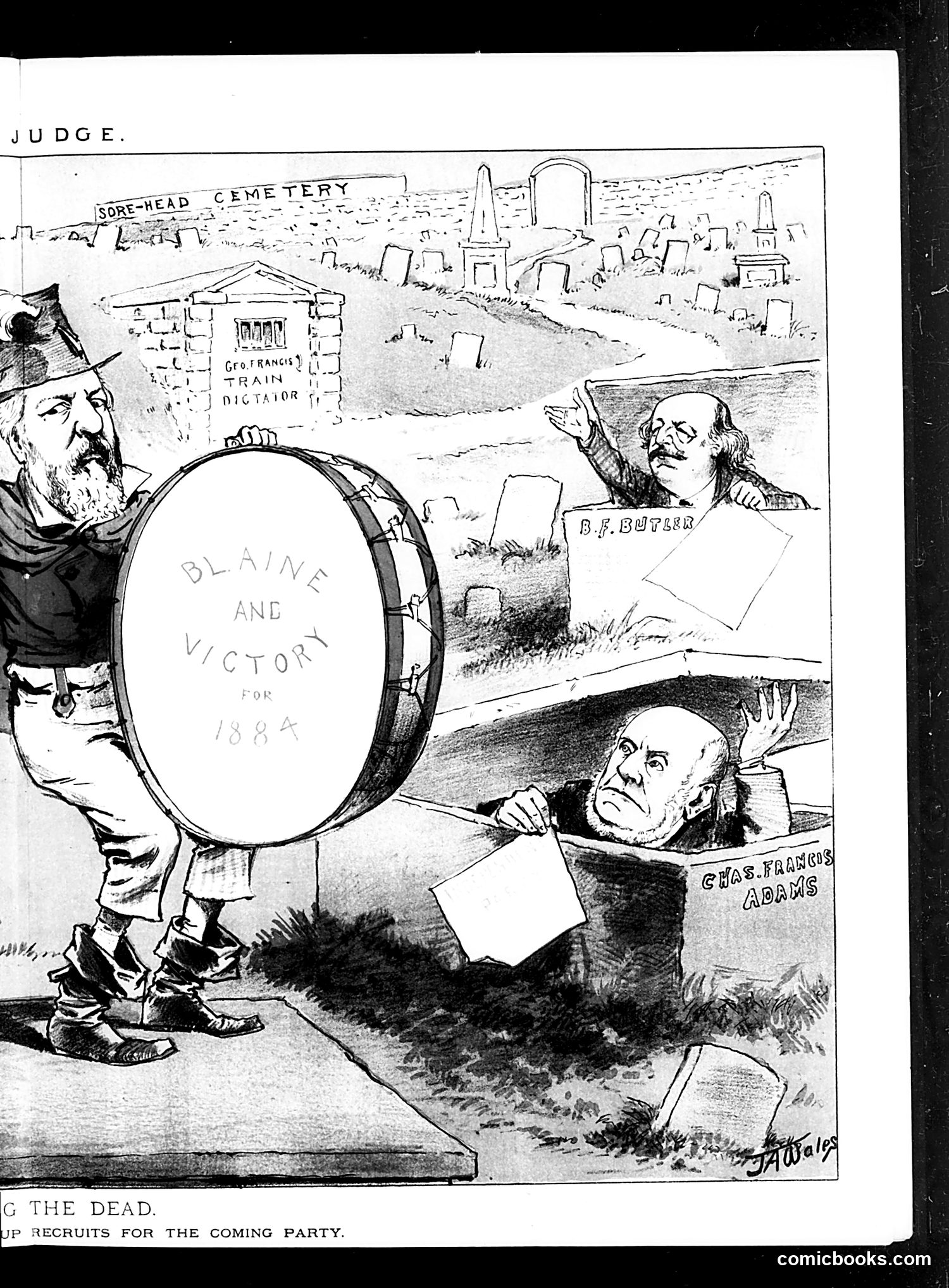
This 1884 satirical cartoon titled "Judge" depicts a military figure (left) drumming up recruits from a graveyard. The drum reads "Blaine and Victory for 1884," referring to James G. Blaine's presidential campaign that year. The cartoon mocks Blaine's political prospects by suggesting he must recruit "the dead"—literal corpses—to support his candidacy. Three figures emerge from graves labeled with names including "B.F. Butler" and "Chas. Francis Adams," likely representing deceased or politically defunct figures. The "Sore-Head Cemetery" sign indicates these are disaffected politicians. The satire suggests Blaine's campaign is so weak or unpopular that only the politically dead would support it—a harsh critique of his viability as a candidate.
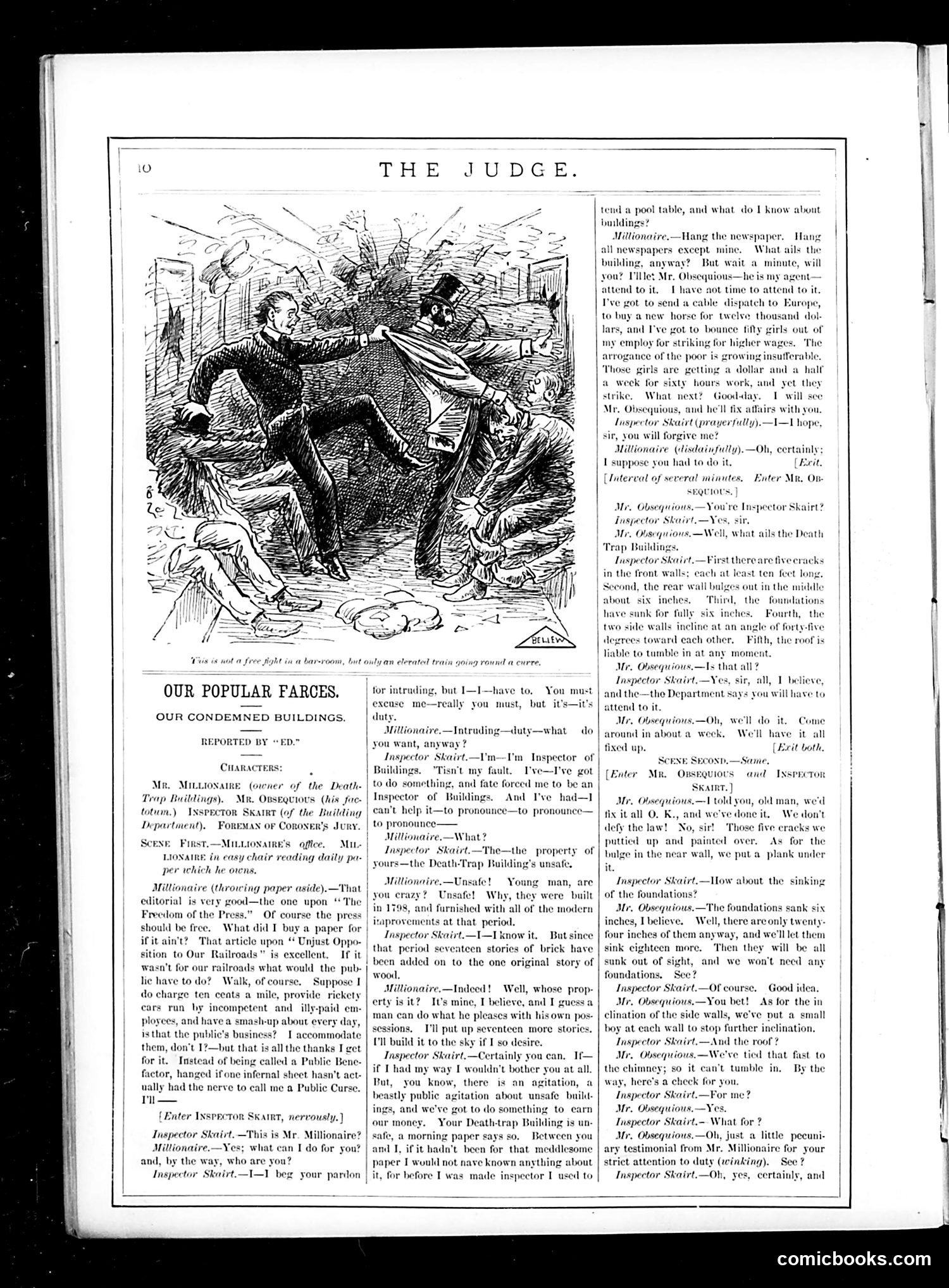
This Judge magazine page satirizes the conflict between wealthy building owners and public safety inspectors. The cartoon depicts a **Millionaire who owns a dangerously deteriorating building** (the "Death-Trap Building") dismissing an **Inspector Skairt's safety concerns** as inconvenient nuisances. The satire targets **corrupt indifference to worker and public safety**. The millionaire, overwhelmed with trivial complaints (buying horses, firing striking workers demanding higher wages), refuses to properly address critical building defects: cracks, bulging walls, sinking foundations, and leaning walls. Inspector Skairt's attempts to enforce safety standards are thwarted by **Mr. Obsequious** (the millionaire's yes-man), who proposes absurd "fixes"—painting over cracks, hiding foundation damage—rather than genuine repairs. The joke exposes how wealth and indifference allow dangerous conditions to persist unchecked, prioritizing profit over lives. This reflects genuine Progressive-era concerns about tenement housing and industrial safety violations.
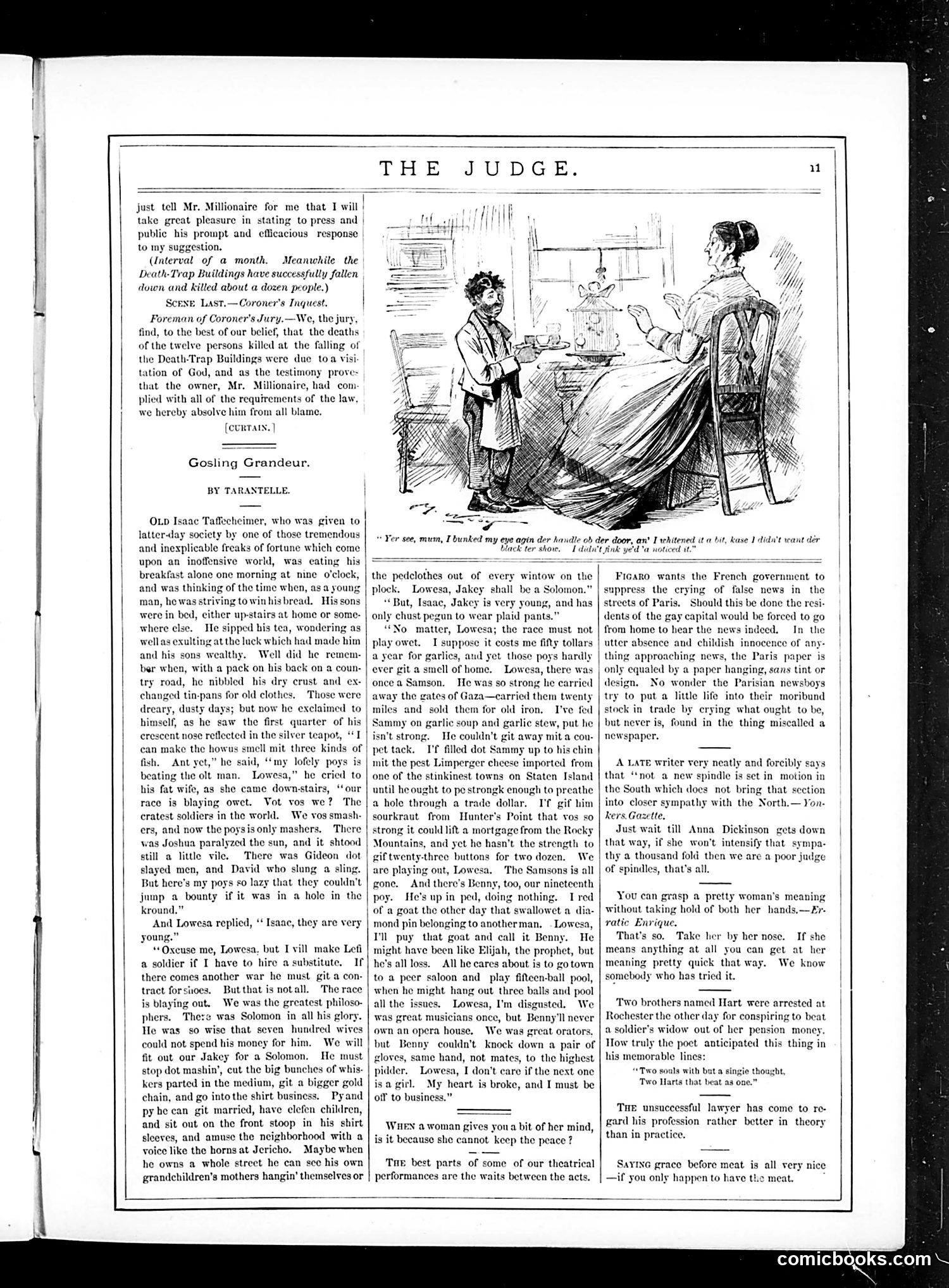
This page contains two distinct pieces of satire: **"Death-Trap Buildings" Cartoon (top):** A scathing critique of negligent building owners and corrupt legal systems. A wealthy "Mr. Millionaire" ignores safety concerns; when his unsafe building collapses and kills twelve people, a coroner's jury—finding he technically "complied with the law"—absolves him of blame, attributing deaths to "an act of God." The satire exposes how wealthy defendants exploited legal loopholes to escape accountability for deaths caused by their negligence. **"Gosling Grandeur" Story (below):** A comedic portrait of a newly wealthy Jewish immigrant, Isaac Taffecheimer, who grew rich but worries his Americanized sons have lost the strength and ambition of their ancestors (Solomon, Samson, Joshua). The dialect humor reflects period stereotypes, though the underlying theme concerns immigrant anxieties about assimilation and generational decline. Both pieces satirize aspects of Gilded Age America: wealthy indifference to worker safety and immigrant cultural anxieties.
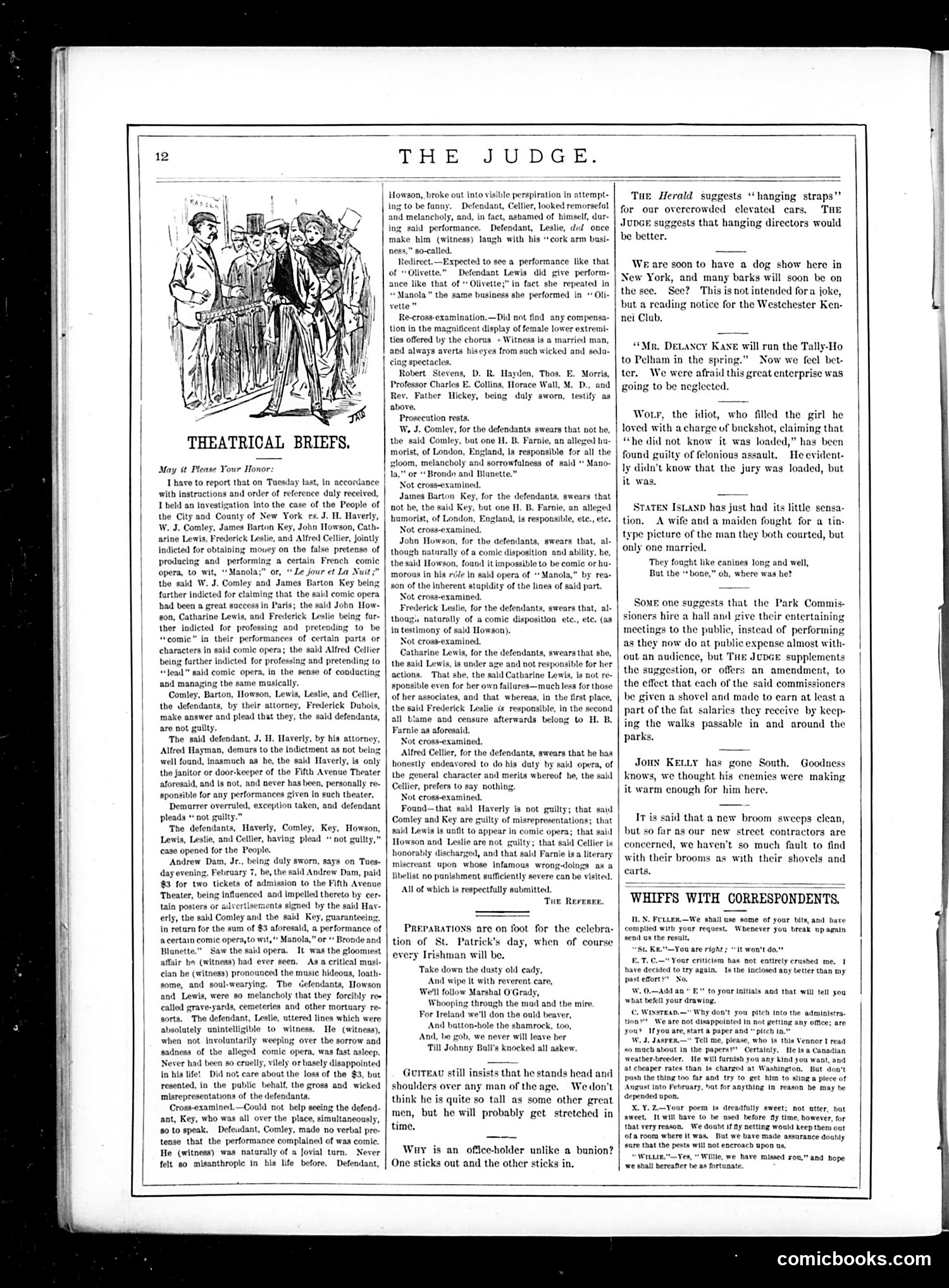
This page satirizes a failed theatrical production of a French comic opera called "Manola" (or "Le jour et La Nuit"). Judge presents the failure as a legal case—a mock trial indicting the producers and performers for obtaining money under false pretenses. The satire targets: - **J.H. Haverly** and **W.J. Comley** (producers) for falsely claiming the opera was a great Paris success - **John Howson, Catharine Lewis, and Frederick Leslie** (performers) for pretending to be "comic" when they performed miserably - **Alfred Cellier** (conductor) for claiming to "lead" the opera musically The humor lies in treating a bad show as criminal fraud. A witness testifies the performance was so gloomy and joyless that he fell asleep and wept—the opposite of entertainment. The defendants' "crime" was overpromising and underdelivering, making audiences miserable rather than amused. This reflects Judge's practice of satirizing theatrical flops through exaggerated legal language.
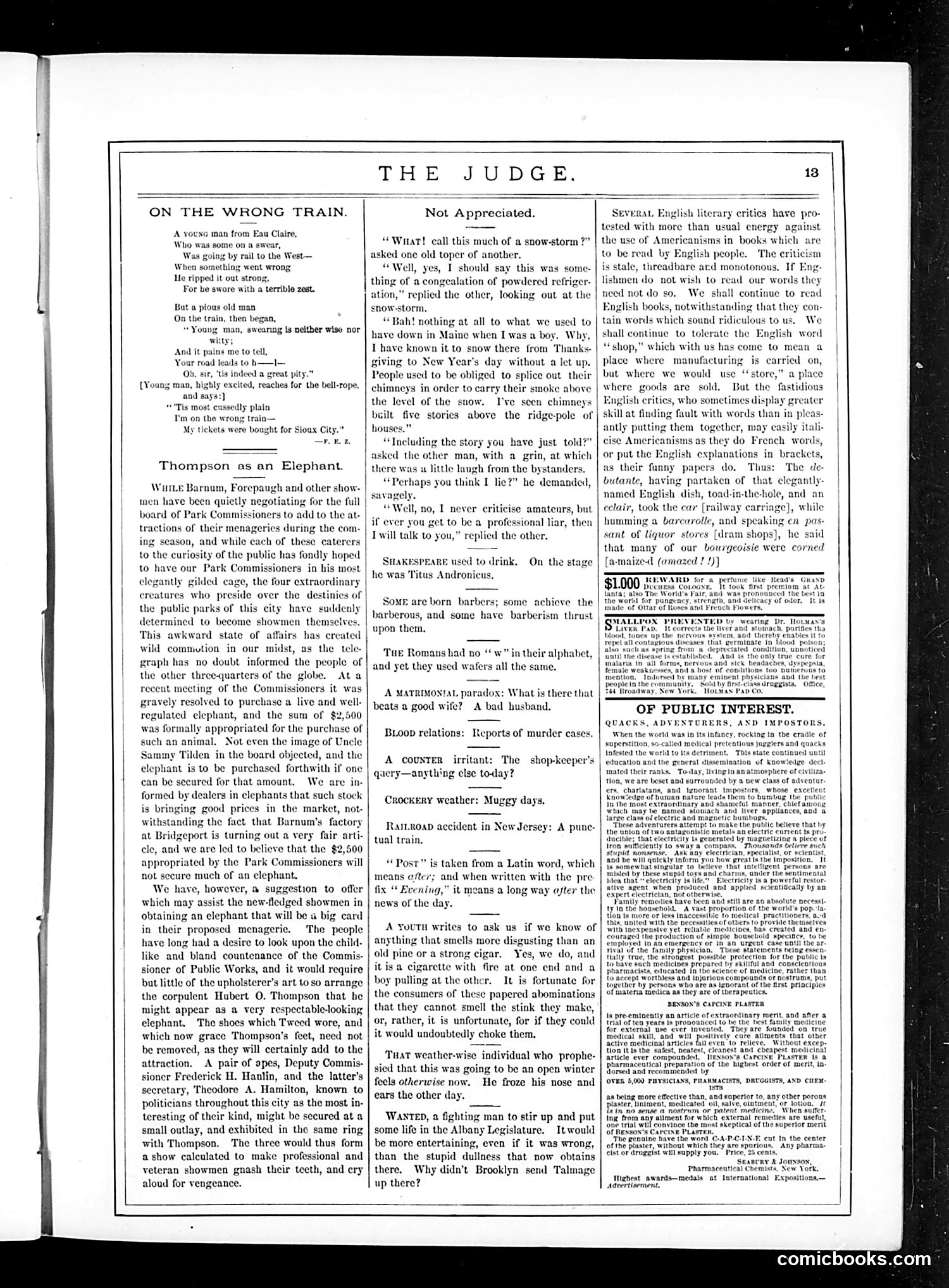
This page contains multiple satirical pieces typical of the magazine's format: **"On the Wrong Train"** and **"Thompson as an Elephant"** are the main items. The elephant piece is political satire targeting New York City's Park Commissioners, particularly **Hubert O. Thompson** (Commissioner of Public Works). The joke: the Commissioners want to buy a live elephant for the parks, but the author suggests they simply *use Thompson himself*—mockingly comparing him to an elephant based on his physical appearance ("corpulent"). The piece satirizes the Commissioners as ridiculous showmen unfit for public office. The other brief items are typical Judge humor: puns and anecdotes (wrong train, barbers, Romans' alphabet, etc.) poking fun at human foolishness. The right column discusses English literary critics objecting to Americanisms in books—a period debate about language purity. **Overall:** This is lighthearted political mockery of local NYC officials, combined with wordplay and social commentary—standard Judge fare of personal ridicule wrapped in humor.
This is primarily an **advertising page** from Judge magazine with minimal editorial content. The page contains advertisements for billiard tables, chairs, government bonds, and various consumer goods typical of 1880s America. The only identifiable satirical content is a brief anecdote about an **editor and visiting villagers**. The joke illustrates a common social tension of the era: rustic or working-class petitioners interrupting a busy professional. The editor tolerates their loud conversation about installing a town pump, then subtly suggests they leave by remarking that a sick person nearby (with smallpox) might be disturbed. The villagers quickly flee, and the editor congratulates himself on his "success in journalism" — the humor lying in his underhanded tactic. The remaining text includes mild commentary on boys' breathing habits and a street encounter about cold weather, but these lack clear satirical targets. The page is dominated by commercial notices rather than political or social satire.
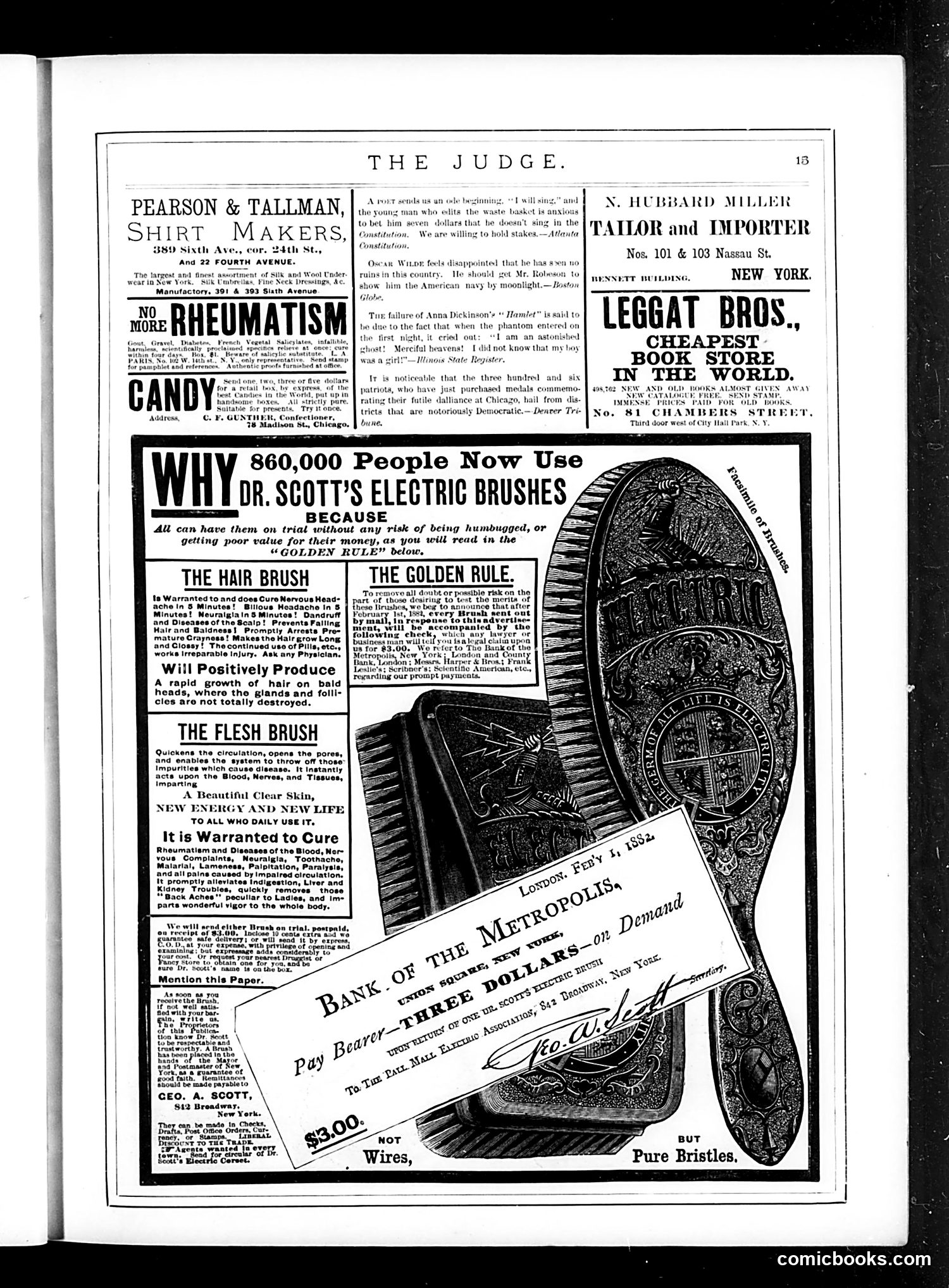
This page is primarily **advertising**, not political satire. It contains multiple commercial advertisements typical of late 19th-century publications. The dominant advertisement promotes **Dr. Scott's Electric Brushes**, claiming 860,000 users. The "Golden Rule" section promises the brushes will cure rheumatism, produce hair growth on bald heads, and provide "beautiful clear skin" — typical snake-oil medicine show claims of the era, offering trial purchases and money-back guarantees. Other ads include shirt makers (Pearson & Tallman), a tailor/importer (N. Hubbard Miller), and a used bookstore (Leggat Bros.). The only editorial content visible references **Anna Dickinson's failed theatrical production of "Hamlet"** and remarks about **Oscar Wilde** — brief theatrical gossip rather than political commentary. This page illustrates how 19th-century satirical magazines like *Judge* relied heavily on advertising revenue, mixing commercial pitches with entertainment content.
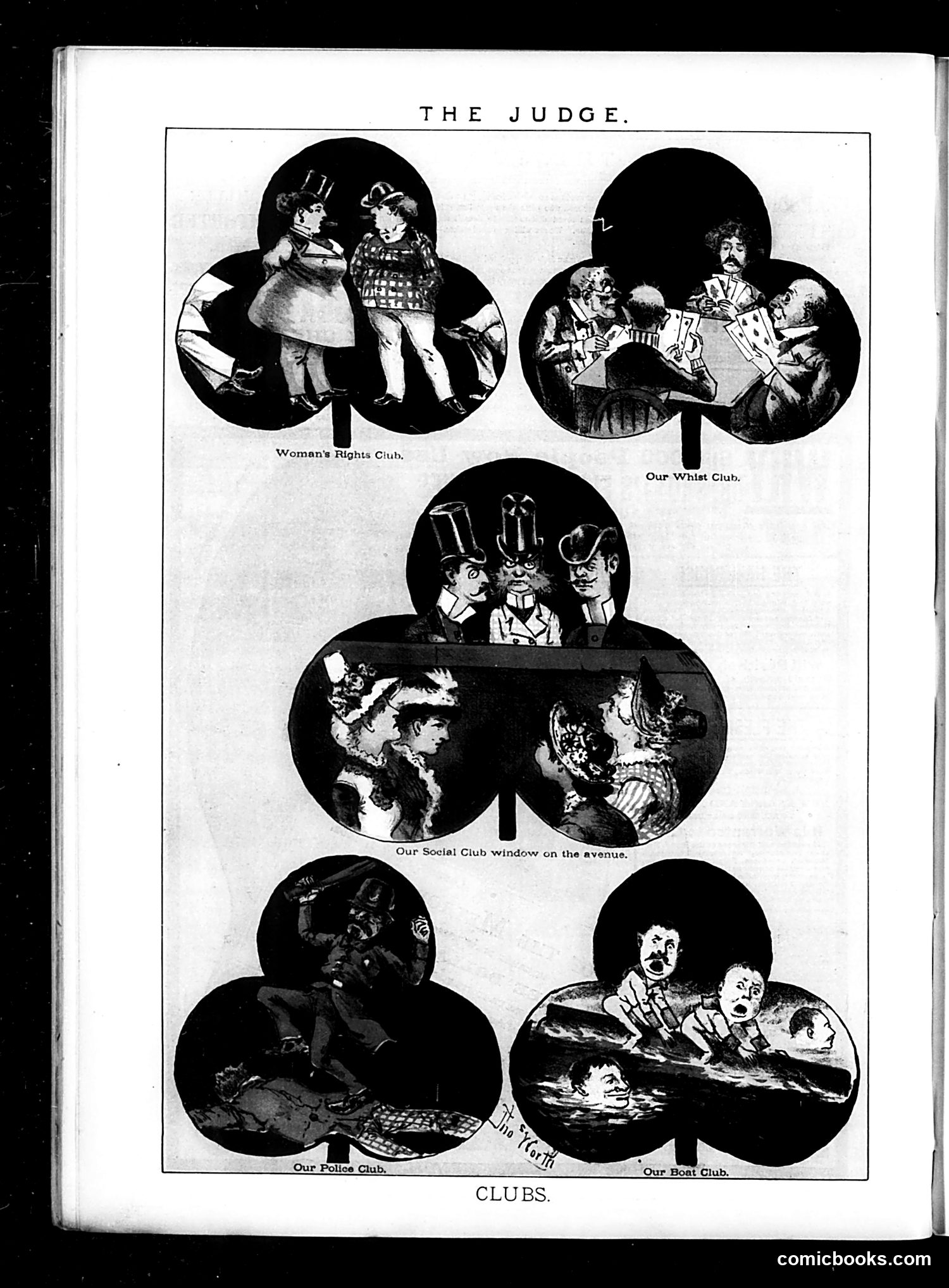
This satirical page depicts five clubs through exaggerated vignettes. The "Woman's Rights Club" shows women in aggressive postures, mocking the women's suffrage movement through unflattering caricature. "Our Whist Club" presents well-dressed men at cards, likely poking fun at upper-class leisure activities. "Our Social Club window on the avenue" depicts fashionable socialites preening, satirizing conspicuous display and vanity. "Our Police Club" appears to show officers in questionable conduct, suggesting corruption or misconduct. "Our Boat Club" depicts people in water, possibly mocking sporting clubs or their members. The overall satire targets various American social institutions and their members—from reformers to aristocrats to public officials—presenting them all as vain, absurd, or morally compromised. The style reflects Judge magazine's role as a vehicle for political and social mockery.