
Judge, 1882-02-25 · page 5 of 16
Judge — February 25, 1882 — page 5: what you’re looking at
What you’re looking at
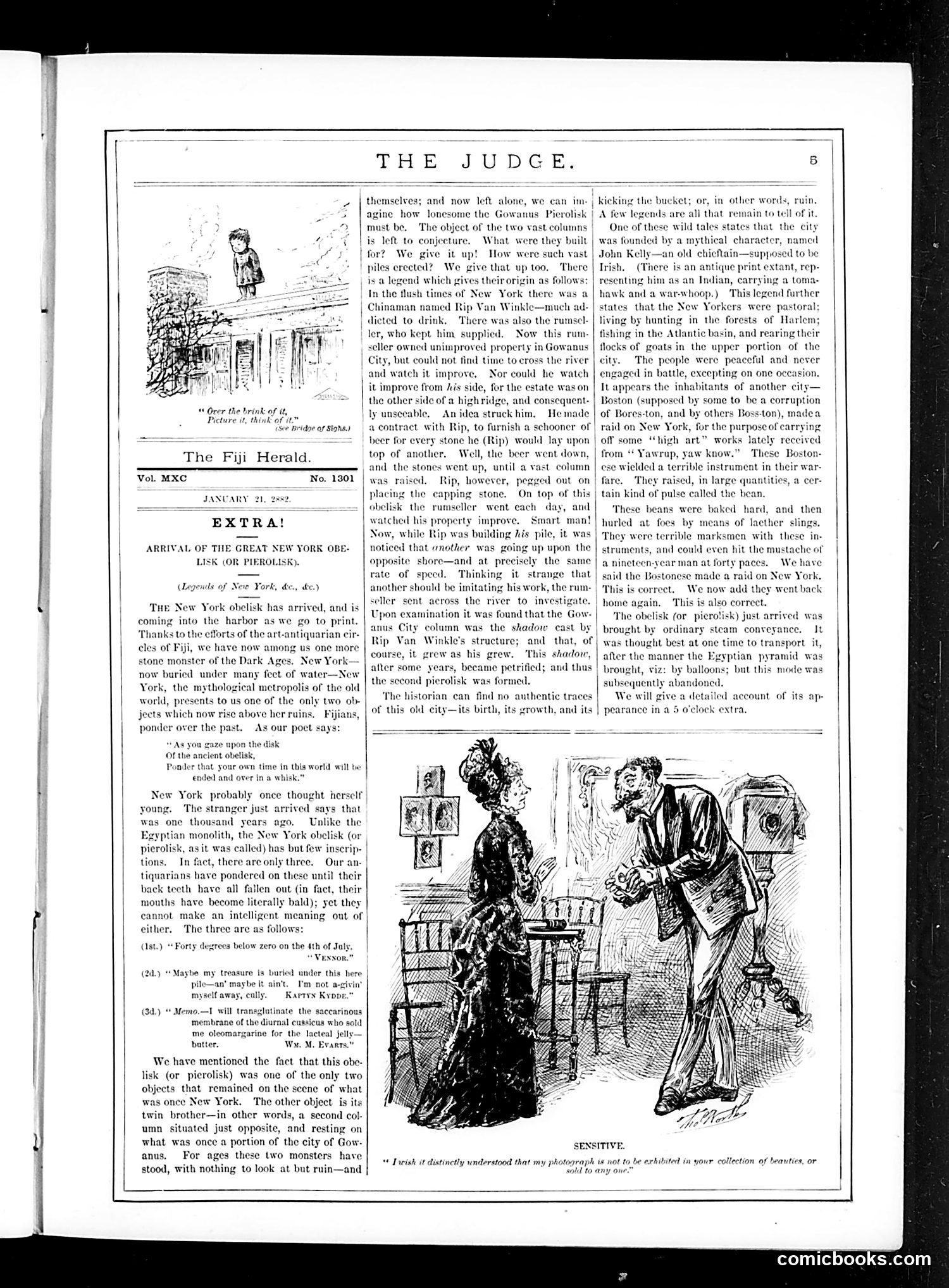
This piece imagines New York as a ruined ancient civilization, discovered by future Fijians in the year 2882. The "obelisk" is actually New York's monument—likely referencing the real Egyptian obelisk (Cleopatra's Needle) that arrived in New York in 1881, a major public event. The satire mocks New York's pretensions to permanence and grandeur. The three inscriptions on the "pierolisk" are deliberately absurd, ridiculing contemporary figures: cryptic weather observations, drunken rambling (attributed to "Kathy Kyppe"), and bureaucratic gibberish (credited to W. M. Evans, possibly referencing a real politician). The legend of Rip Van Winkle building stones for beer, with his shadow somehow petrifying into a second column, is nonsensical humor—suggesting New York's monuments are built on equally insubstantial foundations. The cartoon satirizes both New York's boastful self-importance and the era's fascination with ancient civilizations, implying that America's "great works" will eventually appear as ridiculous to posterity as we find ancient ruins today.
📄 Transcribed text from this page (OCR, searchable)
Machine-transcribed from the original scan — historical spelling and the odd misread are preserved.
o “ Over the brink of it, Picture it, think of it (See Bridge af Sighs.) The Fiji Herald. Vol. MXC No. 1301 | JANUARY 21, 2882, EXTRA! ARRIVAL OF THE GREAT NEW YORK OBE- LISK (OR PIEROLISK). Wh gents of New York, &e., &e.) Tue New York obelisk has arrived, and is coming into the harbor as we go to print. ‘Thanks to the efforts of the art-antiquari cles of Fiji, we have now among us one more stone monster of the Dark Ages, New York— | now buried under many feet of water—New York, the mythological metropolis of the old world, presents to us one of the only two ob- jects which now rise above her ruins. Fijians, ponder over the past. As our poct says: jan cir “As you gaze upon the Of the ancient obelisk, Ponder that your own time in this world will be ended and over ina whisk.” New York probably once thought herself young. The stranger just arrived says that was one thousand years ago, Unlike the Egyptian monolith, the New York obelisk (or pierolisk, as it was called) has but few inscrip- tions, In fact, there are only three. Our an- iquarians have pondered on these until their Kk teeth have all fallen out (in fact, their mouths have become literally bald); yet they cannot make an intelligent meaning out of | either. The three are as follows: (ist.) “Forty degrees below zero on the 4 of Jal; Vexsor. (2d) “Maybe my treasure is buried under this pile—an' maybe it ain't. Tm ni myself away, cally. a-givi Kartys Kyppe.” (3d.) “Memo. will transglatinate th membrane of the diurnal ¢ mo oleomargarine for the batter. accarinous jus who sold jacteal jelly— Ww. M. Evanrs.” We have mentioned the fact that this obe- lisk (or pierolisk) was one of the only two objects that remained on the scene of wh: was once New York. The other object is its twin brother—in other words, a second col- umn situated just opposite, and resting on what was once a portion of the city of Gow- anus. For ages these two monsters have stood, with nothing to look at but ruin—and | the other side of a high ridg THE JUDGE. themselves; and now left agine how lonesome the Gowanus Picrolisk must be. The object of the two vast columns is left to conjecture. What were they built for? We give it up! Mow were such vast | piles erected? We give that up too. There is a legend which gives theirorigin as follows: In the flush times of New York there was a ned Rip Van Winkle—muel dicted to drink, There was also the rumsel- ler, who kept him supplied. Now this rum- seller owned unimproved property in Gowanus City, but could not find time to cross the river and watch it improve. Nor could he watch it improve from Ais side, for the estate was on and consequent- ly unseeable. An idea struck him, He made acontract with Rip, to furnish a schooner of beer for every stone he (Rip) would lay upon | top of another, Well, the beer went down, and the stones went up, until a vast. column was raised. Rip, however, pegged out on | placing the capping stone. On top of this obelisk the rumseller went each day, and watched his property improve. Smart man! Now, while Rip was building his pile, it was noticed that unother was going up upon the opposite sbore—and at precisely the same rate of speed. Thinking it strange that another should be imitating his work, the rum- seller sent across the river to investigate. Upon examination it was found that the Gow- | nus City column was the shadow cast by ip Van Winkle’s structure; and that, of , it grew as his grew. This shadow, alter some years, became petrified; and thus the second pierolisk was formed. ‘The historian can find no authentic traces | of this old city—its birth, its growth, and its | alone, we can im: | SENS kicking the bucket; or, A few legends are all that remain tot One of the in other words, r of it. » wild tales states that the city was founded by a mythical character, named John Kelly—an old chicftain—supposed to be Irish. an antique print extant, rep- resentin san Indian, carryin; hawk and a warewhoop.) This legend further states that the New Yorkers were pastoral: living by hunting in the forests of Harlem; fishing in the Atlantic basin, and rearing their flocks of goats in the upper portion of the city. The people were peaceful and never engaged in battle, excepting on one occasion. Iv appears the inhabitants of another city— Boston (supposed by some to be a corruption a toma- | of Bores-ton, and by others Boss-ton), madea aid on New York, for the purpose of carrying off some “high art” works lately received from “ Yawrup, yaw know.” ‘These Boston- se wielded a terrible instrument in their war- fare. ‘They raised, in large quantities, a cer- tain kind of pulse called the bean These beans were hurlec i hard, and then at foes by means of lacther slings. They were terrible marksmen with these in- struments, and could even hit the mustache of a nineteen-year man at forty paces. We have id the Bostonese made a i on New York. This is correct. We now add they went back home This is also correct. ‘The obelisk (or pierotisk) just arrived was brought by ordinary steam conveyance. It was thought best at one time to transport it, after the manner the Egyptian pyramid was bronght, viz: by balloons; but this mode was subsequently abandoned. We will give a detailed account of its ap- nce in a 5 o'clock extra, TIVE. + Liwish it distinetly understood that my photograph is not to be exhibited in your collection of beauties, or sold to any one.” comicbooks.com