
A complete issue · 16 pages · 1882
Judge — February 18, 1882
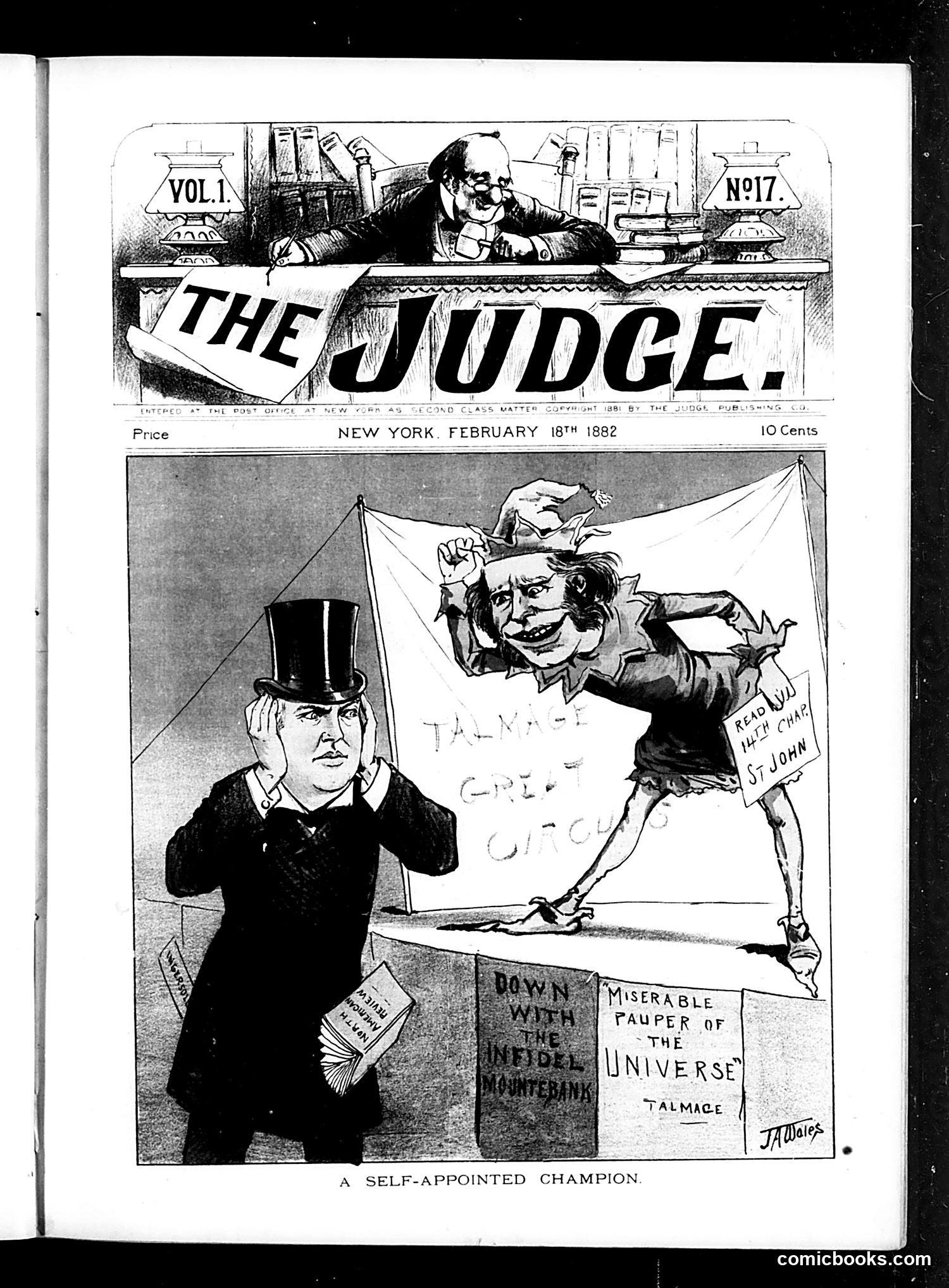
This cartoon satirizes **Thomas DeWitt Talmage**, a prominent Brooklyn clergyman known for vocal social criticism. The figure in the top hat appears distressed while holding what seems to be a banner or proclamation. Behind him, an acrobatic figure performs tricks, labeled "Pauper of the Universe" and credited to "Talmage." The satire targets Talmage's self-righteousness: he positioned himself as a moral champion fighting poverty and inequality, yet the cartoon suggests his activism was performative—mere theatrical acrobatics rather than substantive help. The "self-appointed" title mocks his unwarranted authority to speak for the poor without genuine connection to their suffering. This reflects broader 1882 skepticism toward religious figures who claimed moral authority while maintaining comfortable positions of privilege.
This page satirizes **James G. Blaine**, the Republican presidential candidate, as a hunted hare fleeing from political "hounds"—specifically President Chester A. Arthur's administration, which is actively working to block Blaine's 1884 presidential nomination. The "Hare and Hounds" cartoon metaphor depicts Blaine dropping "explanations by the wayside" as he flees, suggesting his political maneuvering leaves damaging evidence. The satire notes Blaine's resourcefulness in past controversies but speculates he might form a separate "National American party" if denied the Republican nomination. The text also addresses a **scandal involving Blaine's diplomatic correspondence**: Arthur claims ignorance of Blaine's (Blaine was Secretary of State) invitation to South American nations to meet in Congress, but the ex-Secretary contradicts him publicly. This exposé of the President's dishonesty—claiming he didn't authorize actions he actually did—is mocked as an embarrassing spectacle for both men. The satire's thrust: Blaine is dangerous but resilient; Arthur's attempt to destroy him may backfire by fracturing the Republican party itself.
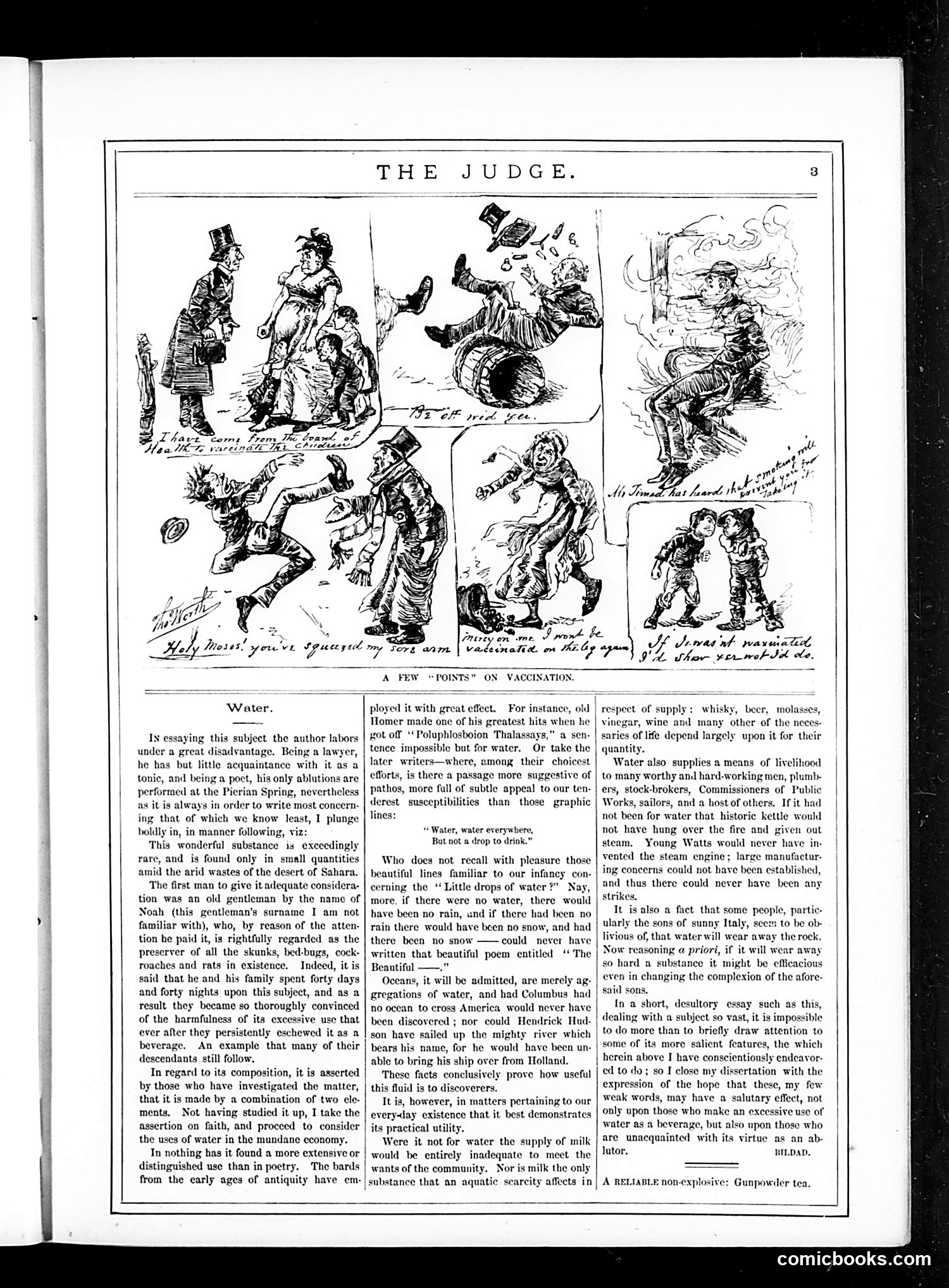
This page features satirical cartoons mocking anti-vaccination sentiment, paired with humorous text ostensibly "praising" water's importance. The six sketches show various mishaps befalling people—figures tumbling from barrels, being knocked about, and suffering indignities—apparently depicting the consequences of vaccination or anti-vaccination attitudes. The accompanying essay is mock-serious, written in deliberately overwrought, pseudo-intellectual language that parodies pompous arguments. By comparing vaccination debate to absurd claims about water (that Noah discovered it, that Homer wrote about it), the author ridicules opponents' reasoning as equally ridiculous. The cartoons' crude, chaotic imagery emphasizes how vaccination-related anxiety made people behave foolishly. The satire's point: anti-vaccine arguments lack substance and deserve mockery rather than serious engagement. This reflects late-19th-century public health debates when vaccination faced resistance.
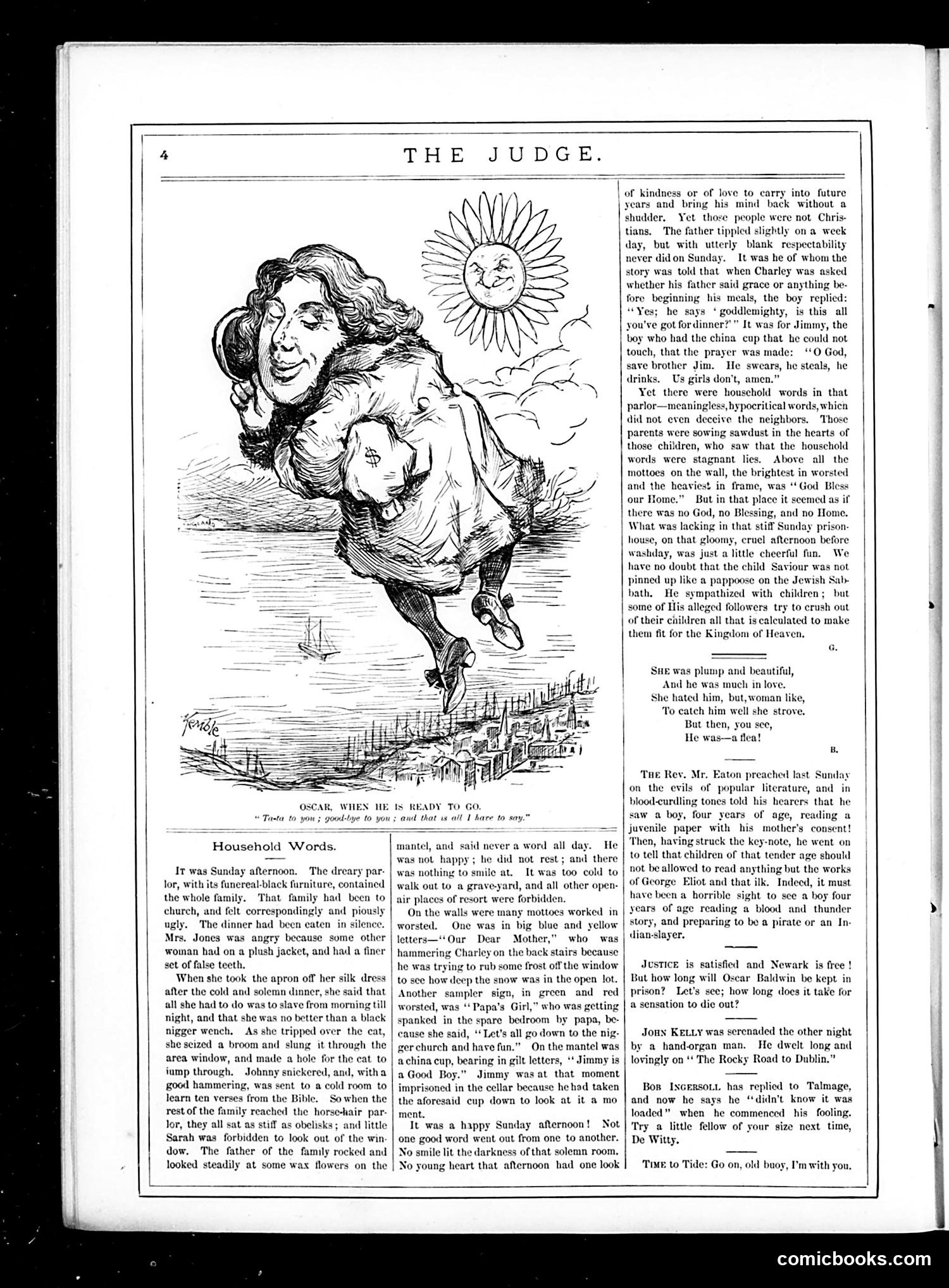
This page from *Judge* magazine contains two satirical pieces critiquing Victorian hypocrisy and religious rigidity. **The main cartoon** depicts "Oscar" (likely a social climber or pretentious figure) being ejected from respectable society, with the caption suggesting farewell. The accompanying story, "Household Words," is the real satire—a scathing indictment of a pious, joyless family that attends church and displays religious mottoes ("God Bless our Home") while practicing cruelty, dishonesty, and emotional coldness toward their children. The father drinks secretly on weekdays but maintains public respectability; the mother is vain and petty. The satire's point: their "household words"—pious platitudes—are meaningless lies masking genuine spiritual emptiness and hypocrisy. A secondary item mocks Rev. Mr. Eaton's sermon against children reading popular literature, sarcastically suggesting even age-appropriate juvenile papers corrupt youth. The satire targets Victorian moral pretense and rigid religiosity divorced from actual kindness or joy.
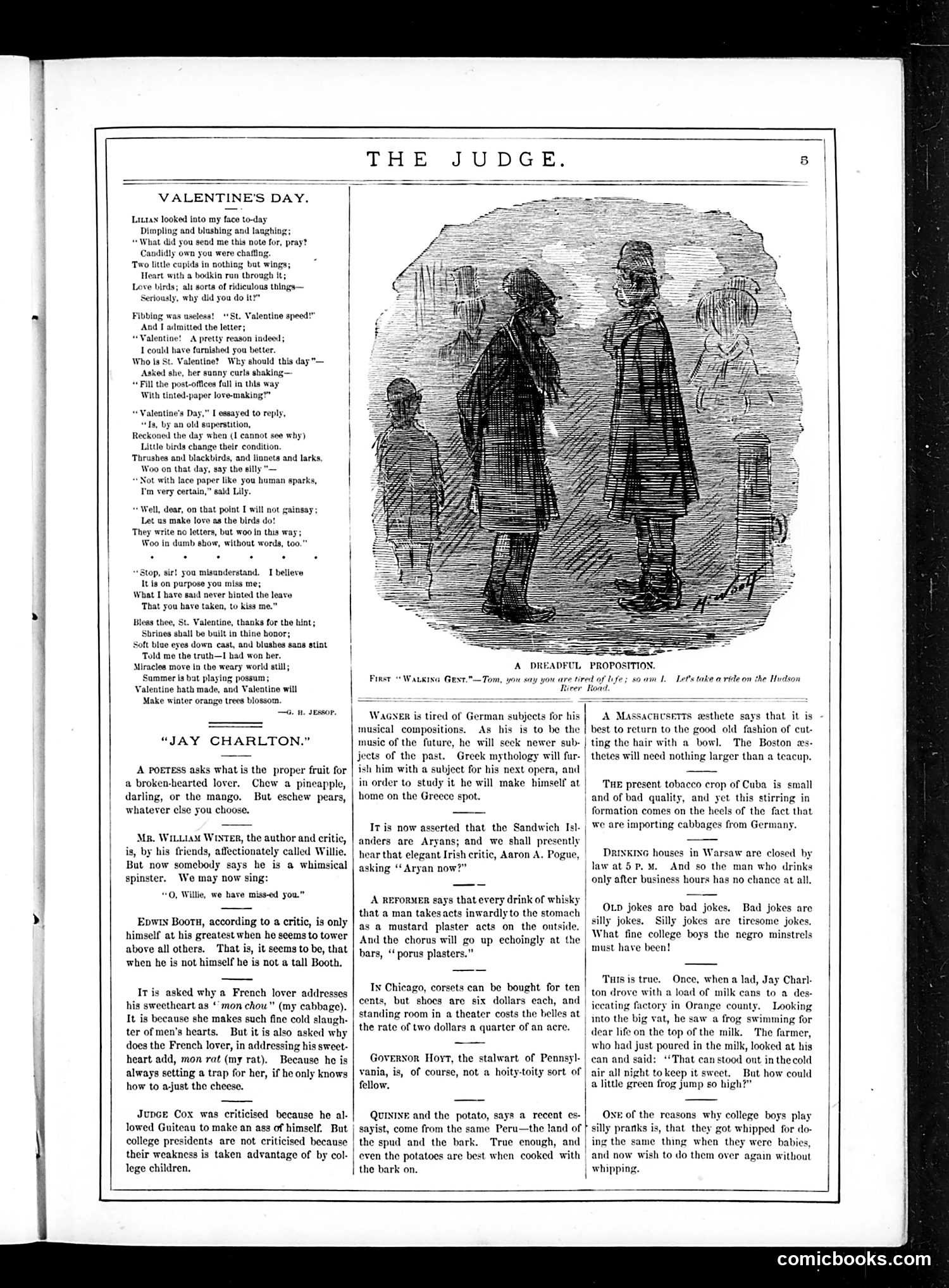
The main cartoon depicts a man attempting to propose to a woman during a walk. The caption, attributed to "First 'Walking Gent,'" reads: "Tom, you say you are tired of life; so am I. Let's take a ride on the Hudson River Road." **The satire:** This is a dark joke about suicide. The man's "proposal" is actually suggesting they end their lives together by riding off the Hudson River Road (implying a fatal plunge). The humor derives from presenting this macabre suggestion as romantic courtship language—a bitter commentary on failed romance and desperation. The surrounding text includes other brief satirical items: commentary on Wagner seeking new opera subjects, jokes about French lovers and their terms of endearment, criticism of college presidents, and observations about Boston aesthetes and tobacco crops. The page is primarily humorous commentary and light social satire typical of 19th-century Judge magazine.
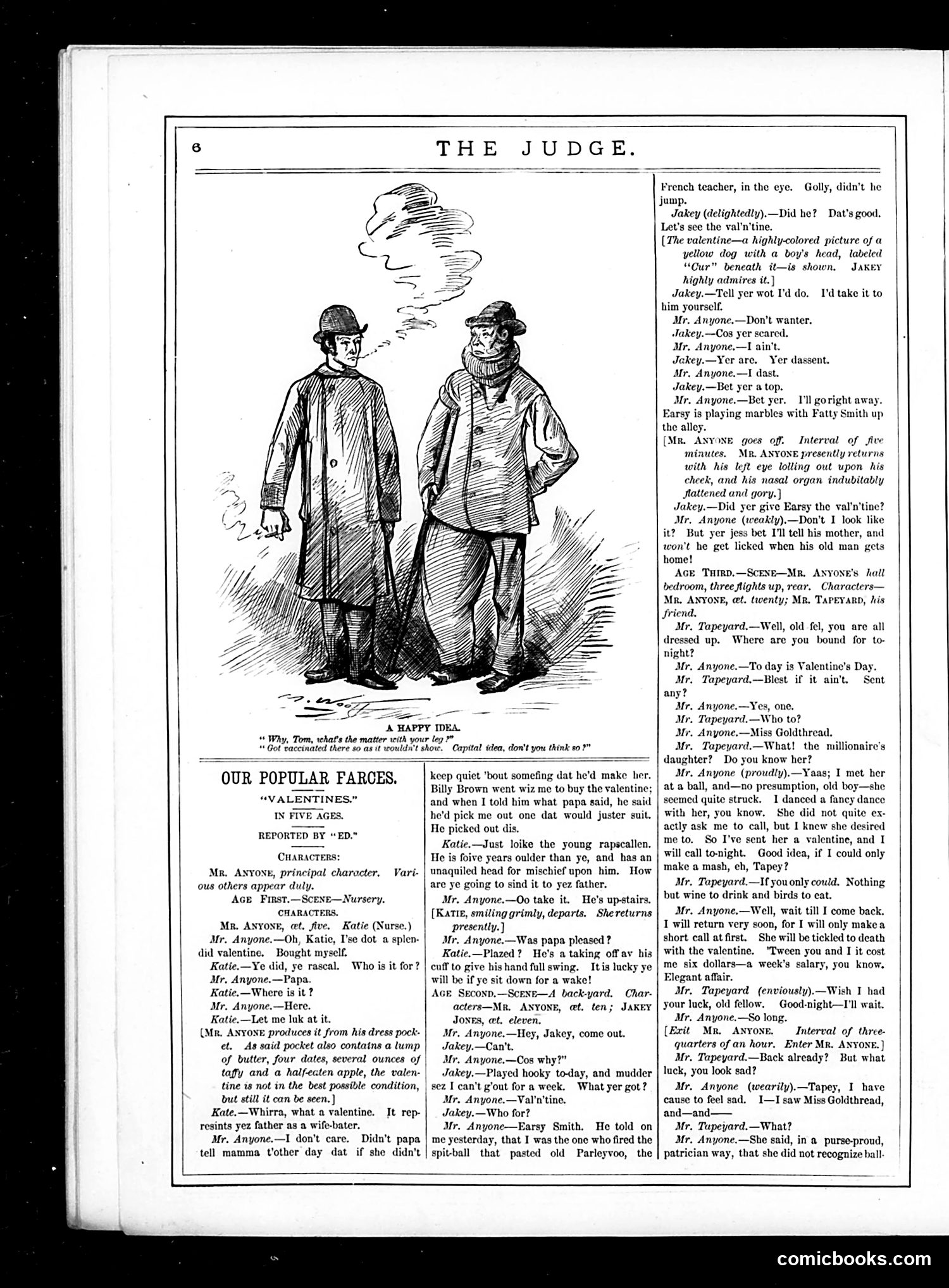
This page contains **two separate pieces** from Judge magazine: ## The Cartoon (top) A brief visual joke about **vaccination**. A man explains he got vaccinated on his leg so the mark "wouldn't show"—implying he's hiding evidence of the procedure, likely because some people viewed vaccination with suspicion or social stigma in this era. ## The Play Script ("Valentines") A satirical three-act farce mocking **sentimentality and courtship customs**. The humor follows a working-class boy (Mr. Anyone) through escalating romantic disasters: sending his father a crude valentine depicting him as a dog, getting beaten up when delivering a mean-spirited valentine to a rival, and finally—as an adult—presuming to court a wealthy girl (Miss Goldthread) after a single dance, having sent her an unsolicited valentine. The satire targets **presumptuous social climbing**, the **awkwardness of uninvited romantic advances**, and the **absurdity of Valentine's Day customs** generally. The exaggerated dialect and slapstick violence emphasize the working-class characters' social incompetence.
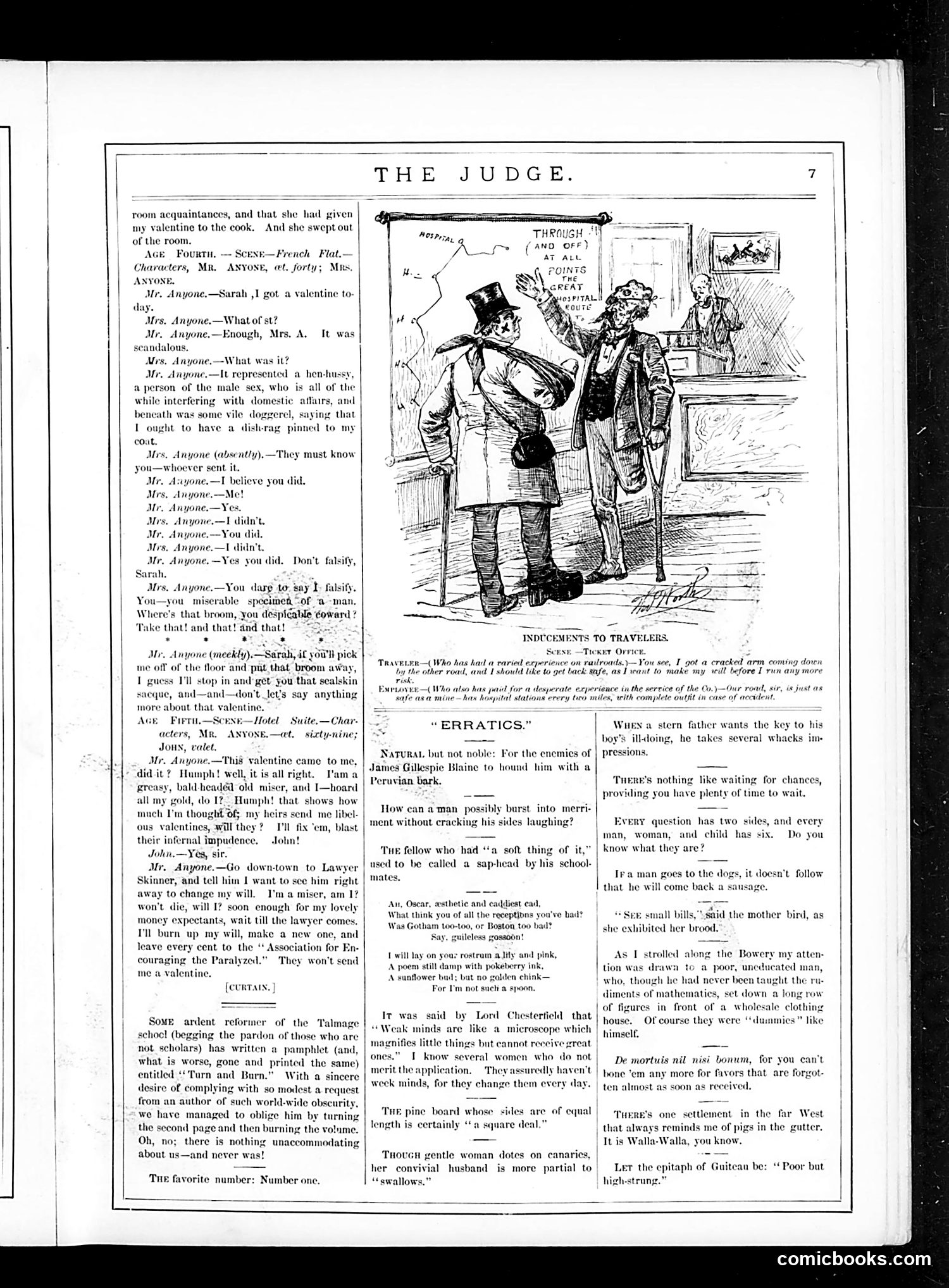
This page contains three satirical pieces typical of Judge magazine's humor: **Main Cartoon ("Inducements to Travelers")**: Two men discuss railway safety. One has injured his arm on a competitor's line and wants to survive long enough to change his will—dark humor about unsafe travel conditions and the economic anxiety surrounding railroads. **"Erratics" Section**: A collection of brief satirical quips, including one referencing **James G. Blaine** (likely the 1884 presidential candidate), where enemies "hound him with a Peruvian bark"—a pun on the anti-malarial medicine quinine, suggesting his political opponents are relentless. **Dialogue Sketches**: Two theatrical scenes about a husband receiving a insulting valentine depicting him as interfering in household affairs. The humor derives from marital bickering—a common Judge trope—where the wife initially denies sending it, then attacks him. The page reflects late-19th-century concerns: marital discord, industrial safety, and contemporary political figures. The satirical tone is genteel but cutting.
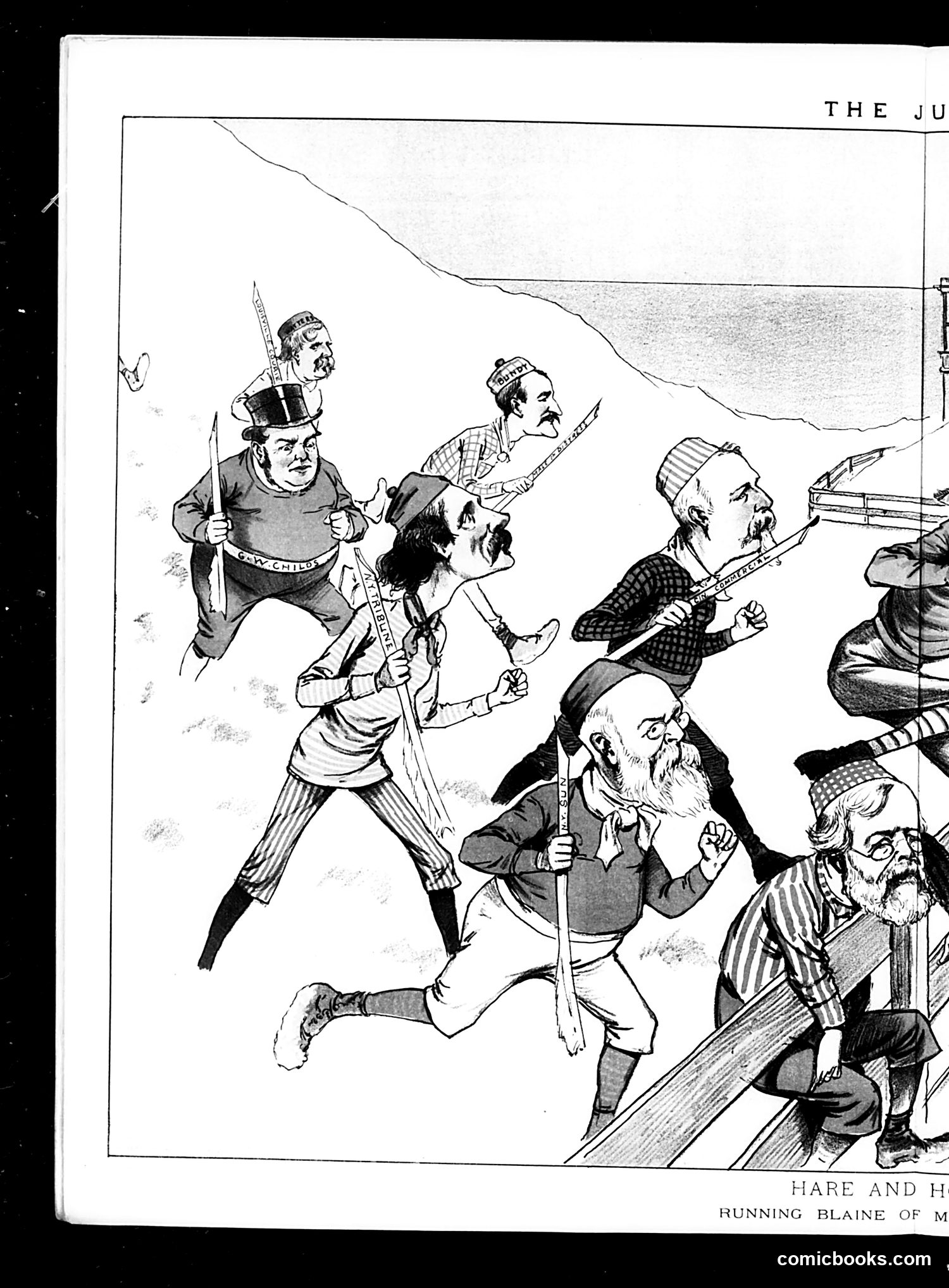
This appears to be a satirical cartoon from *Judge* magazine depicting what the caption identifies as "Running Blaine of M[aine]"—likely referring to James G. Blaine, a prominent 19th-century politician from Maine. The cartoon shows multiple caricatured figures in military or formal dress wielding weapons (bayonets, rifles), seemingly chasing or pursuing the central figure labeled as Blaine. The aggressive posturing and military imagery suggests the cartoon is satirizing political opposition or conflict surrounding Blaine—possibly related to a political campaign or controversial policy. The exaggerated caricatures and violent imagery are typical of *Judge*'s style of partisan political satire. Without the full page context and complete caption, the specific historical event being mocked remains unclear, though the tone is clearly derisive toward Blaine.
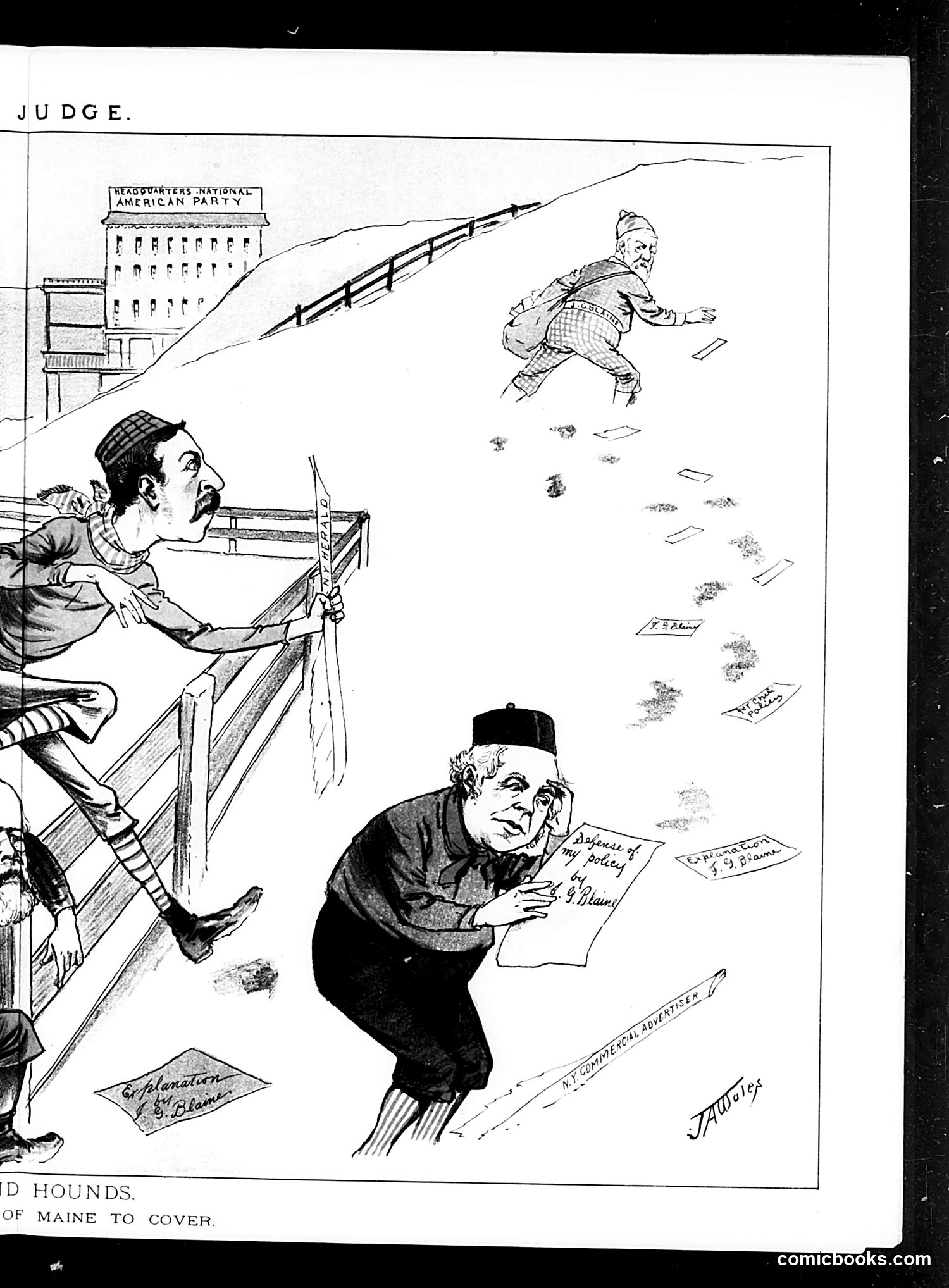
This Judge magazine cartoon titled "Judge" satirizes the Republican Party's internal divisions. The building labeled "Headquarters National American Party" represents Republican leadership. Two figures appear to be party officials or candidates in disarray—one leaping desperately across scattered papers (campaign materials and policy documents), while another crouches below, clutching documents with apparent dismay. The cartoon's title references "blood hounds of Maine to cover," likely alluding to a specific Maine electoral contest or scandal. The scattered papers symbolize chaos within party ranks. The figures' exaggerated postures and expressions convey panic and loss of control, suggesting the Republican Party was fractured or struggling with internal conflicts during this period. The satirical point: the party's leadership appears incompetent and scattered, unable to manage its own organization or messaging effectively.
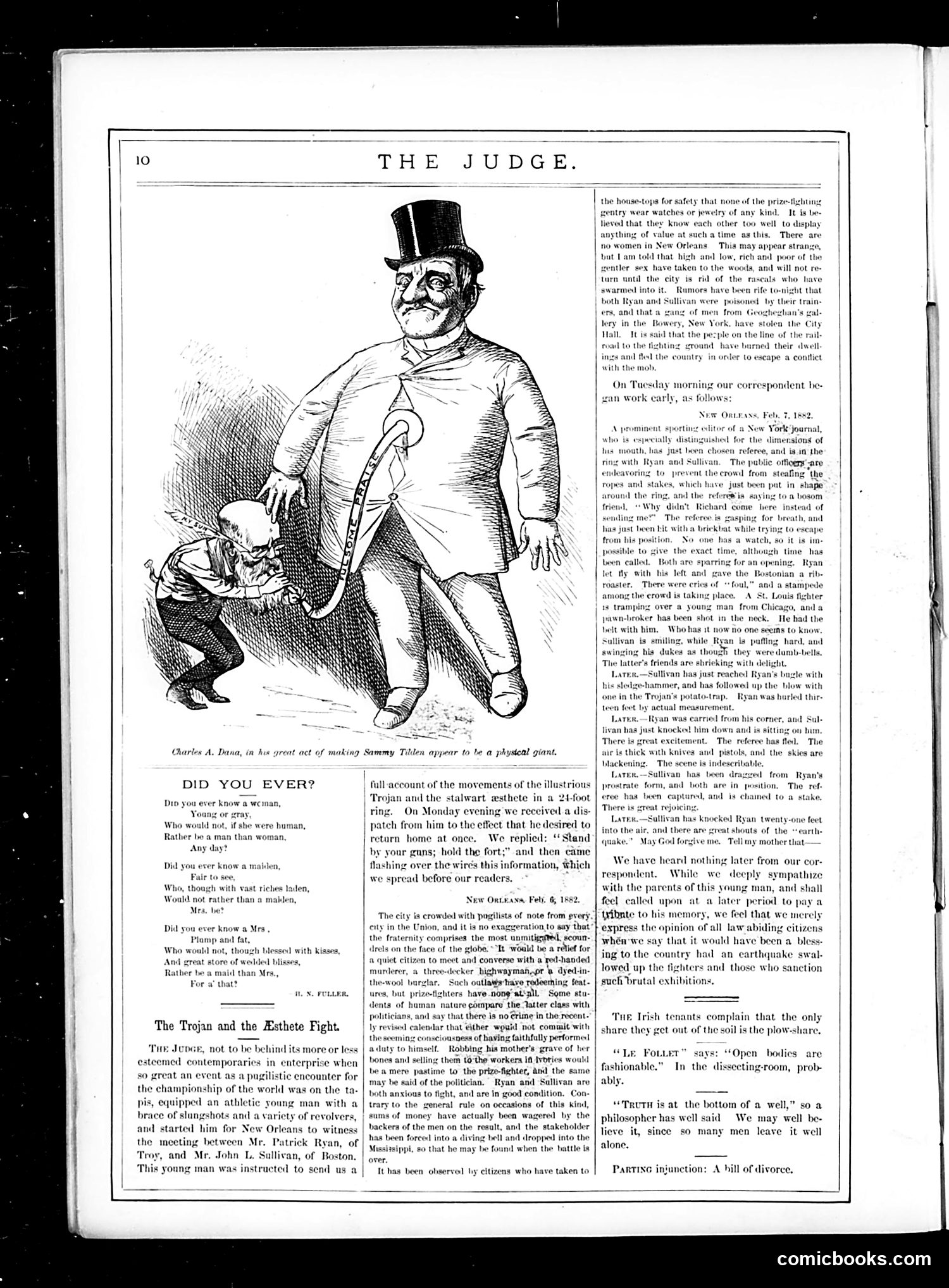
This *Judge* page from 1882 satirizes a famous boxing match between Patrick Ryan ("Troy") and John L. Sullivan (Boston) for the heavyweight championship. The main cartoon depicts **Charles A. Dana** (editor of the *New York Sun*), shown as an absurdly oversized man dwarfing a tiny boxer—mocking Dana's sensationalist coverage and self-importance in promoting the fight. The accompanying article ridicules prize-fighters as criminals worse than murderers and politicians, while also satirizing the public hysteria the match generated in New Orleans—women allegedly fled to the woods, citizens climbed rooftops fearing violence, and residents abandoned homes to escape the "mob." The humor targets both the brutish sport itself and Dana's bombastic journalism amplifying it. The "Did You Ever?" poem appears unrelated filler content typical of satirical magazines of the era.
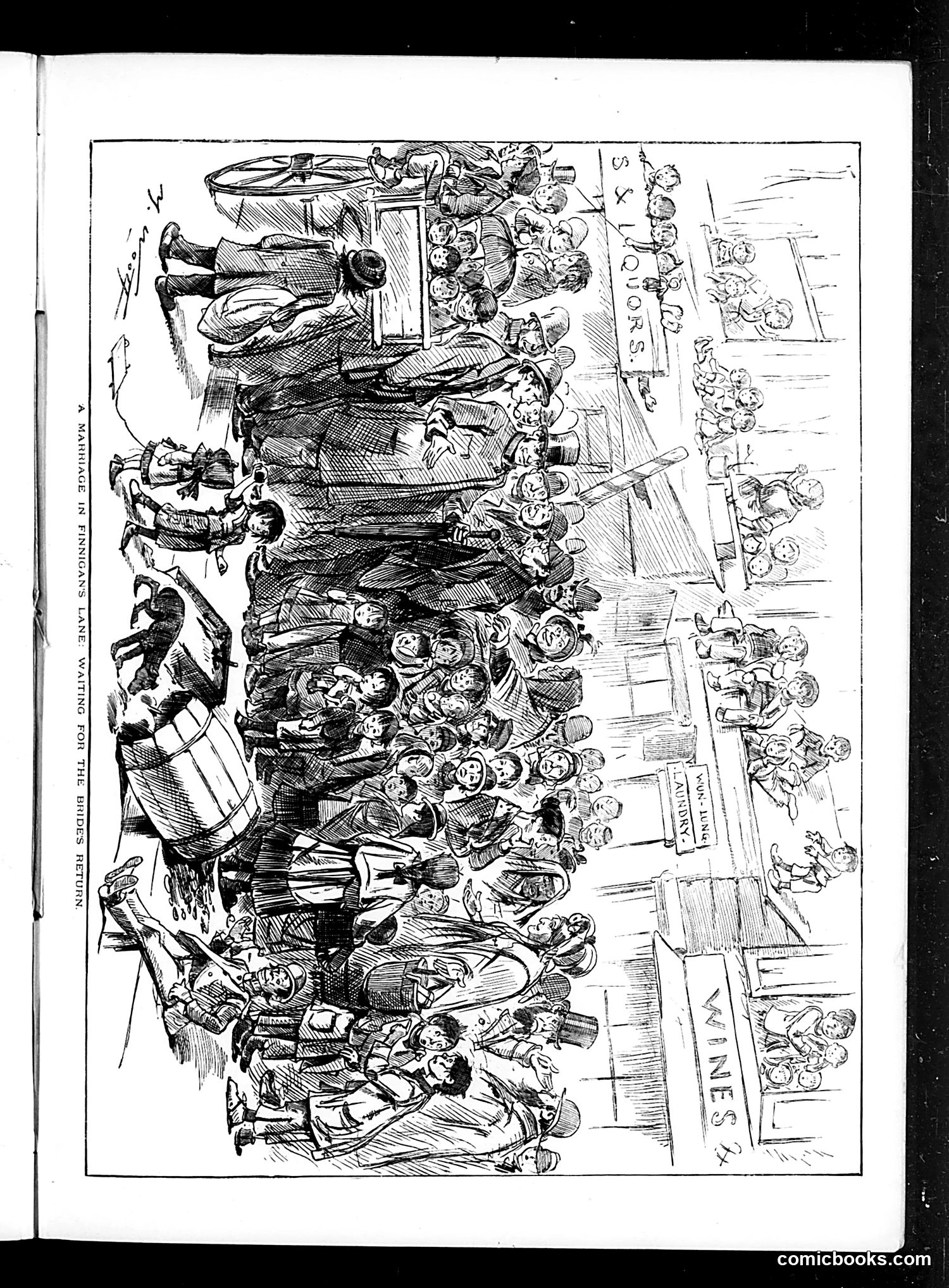
This appears to be a satirical illustration from *Judge* magazine depicting a crowded, chaotic scene of many figures arranged vertically (the page is rotated 90 degrees). The composition suggests social satire, possibly commenting on overcrowding, social disorder, or political confusion of the era. However, the OCR text is unintelligible—only containing formatting characters and symbols—making it impossible to read the actual caption or identify specific figures being caricatured. Without legible text labeling the characters or explaining the scenario, I cannot reliably identify which politicians, social groups, or events are being satirized. To properly explain this cartoon's meaning, a clearer image of the caption text would be essential.
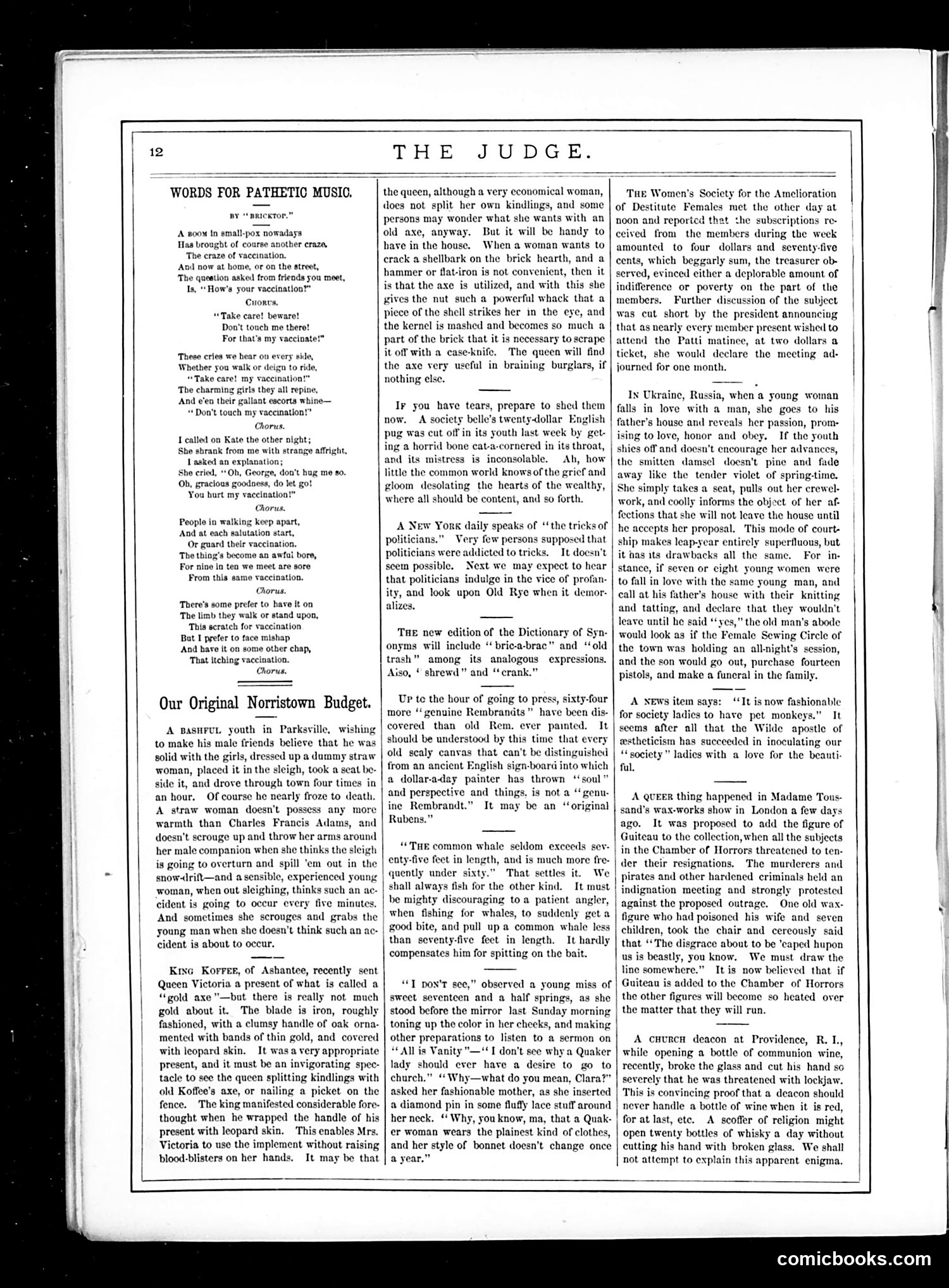
This page from Judge (a 19th-century American satirical weekly) contains primarily text-based humor rather than visual cartoons. **Main Content:** The lead piece is a satirical poem "Words for Pathetic Music" mocking the vaccination craze sweeping America. It humorously depicts people obsessing over their vaccination marks—refusing to be touched, guarding the site religiously, claiming soreness. The joke satirizes how society becomes momentarily hysterical about health fads, with people treating minor vaccinations as if they were serious injuries. The repeated chorus "Don't touch my vaccination!" emphasizes the absurd overreaction. **Additional Items:** "Our Original Norristown Budget" contains lighthearted anecdotes, including a bashful youth's embarrassing sleigh ride with a straw dummy, and a sarcastic commentary on King Koffee of Ashantee's gift of an ornamental axe to Queen Victoria—mocking both the impracticality of the gift and Victorian upper-class pretensions. The humor relies on exaggeration of contemporary social anxieties and class-based observations typical of Judge's satirical approach.
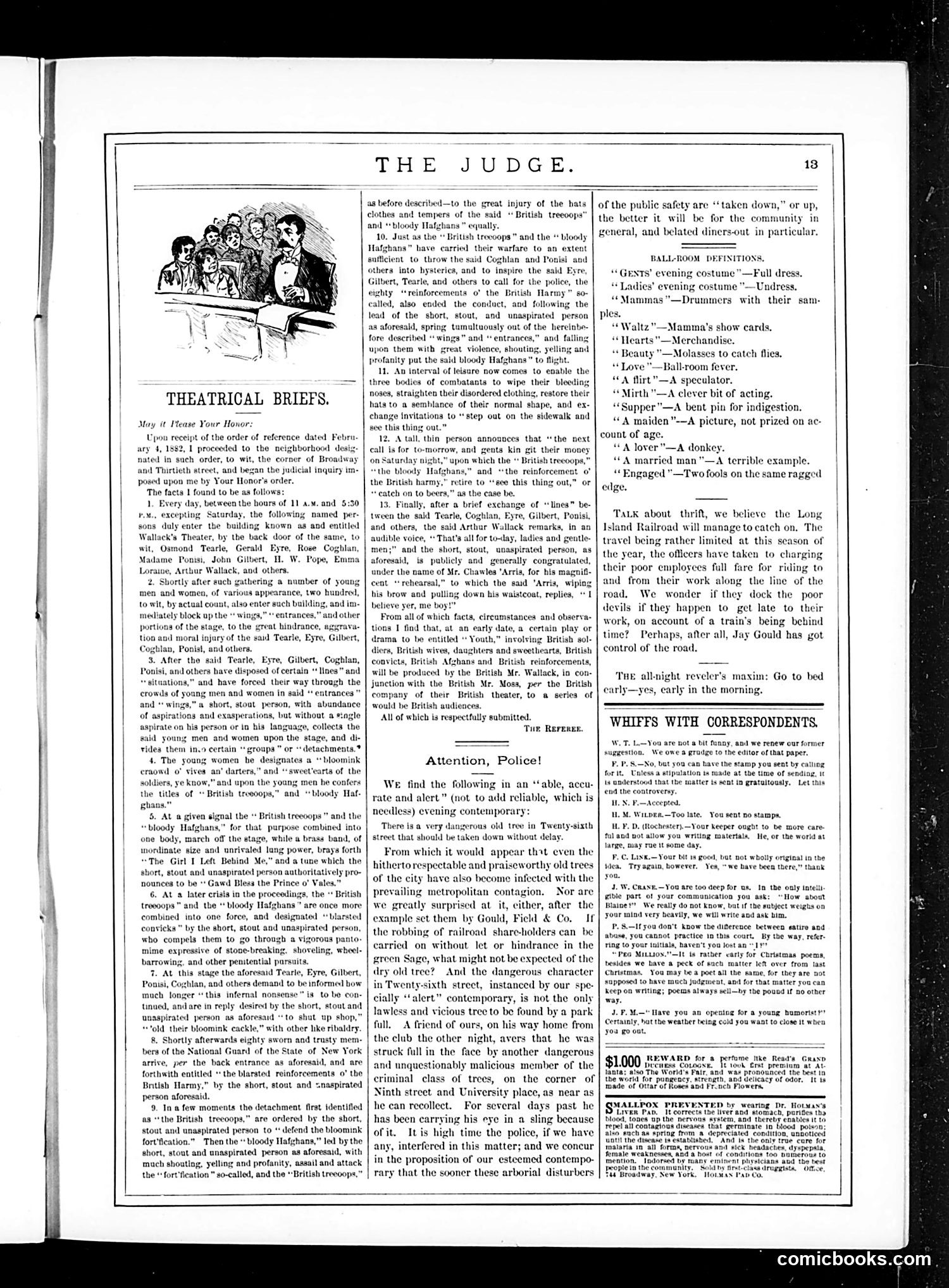
This page satirizes a theatrical production at Wallack's Theater through a mock judicial inquiry. The cartoon depicts what appears to be a rehearsal or performance of a military drama involving "British troops" and "bloody Afghans." The humor derives from presenting chaotic stage business—actors blocked by crowds, elaborate pantomime sequences (stone-breaking, shoveling), and a short, stout director barking orders with dropped H's ("bloomink," "eackle")—as if it were a serious legal proceeding. The "National Guard of the State of New York" apparently participated, adding to the absurdity. The satire targets theatrical excess and possibly mocks contemporary melodramatic war plays popular in the 1880s. The fractured dialect suggests the director's working-class background or foreign accent, adding comedic contempt. The piece trivializes actual stage chaos by documenting it with mock-legal solemnity, ultimately ridiculing both the theatrical production's incompetence and the bureaucratic language used to describe it.
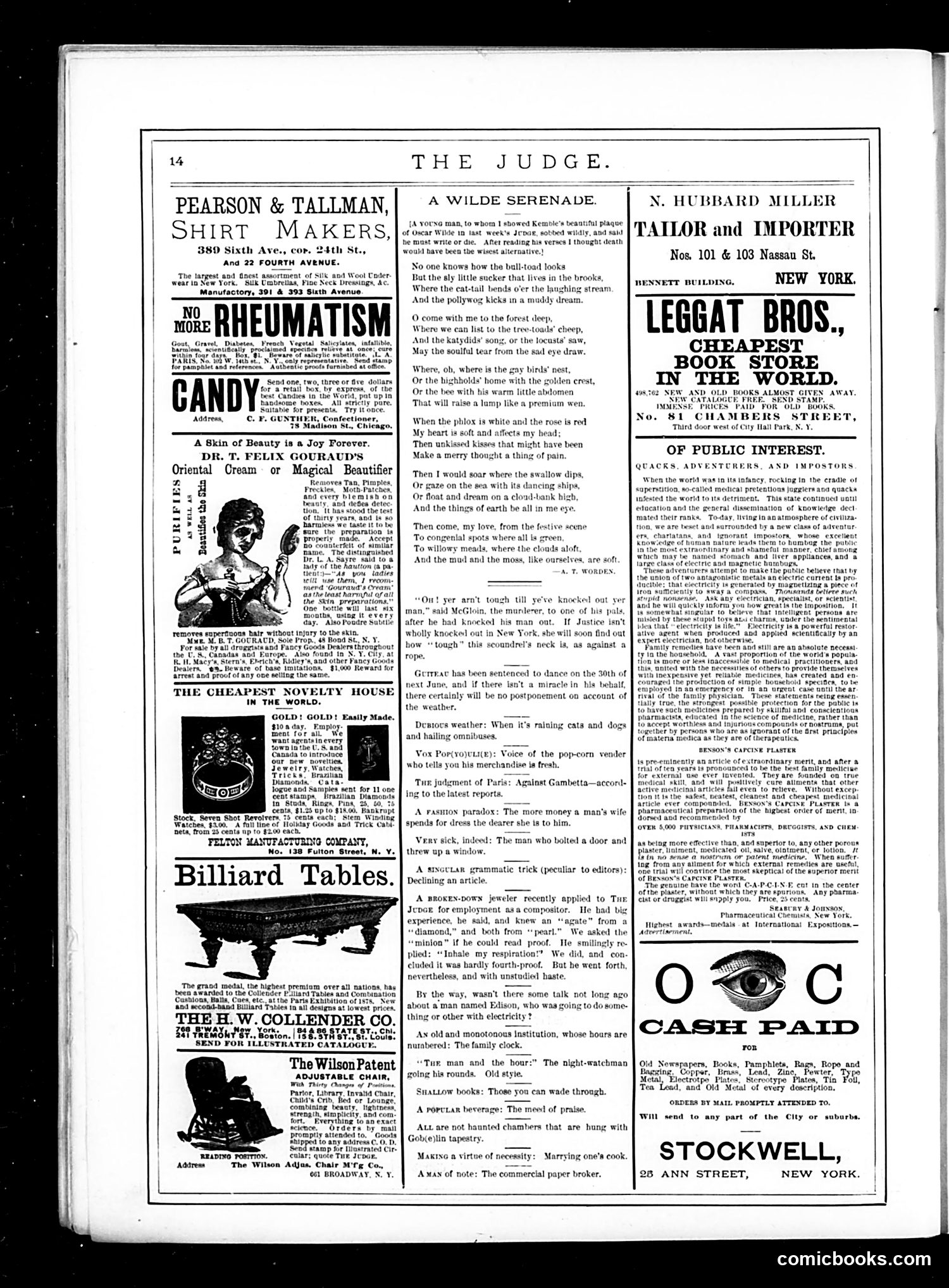
This page's central cartoon mocks **Oscar Wilde**, the Irish playwright and aesthete then famous (or infamous) in America. The poem parodies his famously overwrought, precious literary style—full of affected nature imagery ("the ball-toad," "the pollywog," "soulful tear"). The satire targets Wilde's excessive aestheticism: his tendency to poeticize trivial or ugly things ("skin of beauty"), his emotional affectation, and his mannered writing that contemporaries found ridiculous. The joke's opening ("he must write or die") suggests Wilde's compulsive, self-important theatricality. This reflects 1880s-90s American hostility toward Wilde's visit and his reputation for decadent art-for-art's-sake philosophy. The page surrounds this with period advertisements (beauty creams, billiard tables, books), treating Wilde's sentimental posturing as just another commodity to mock in Judge's satirical marketplace.
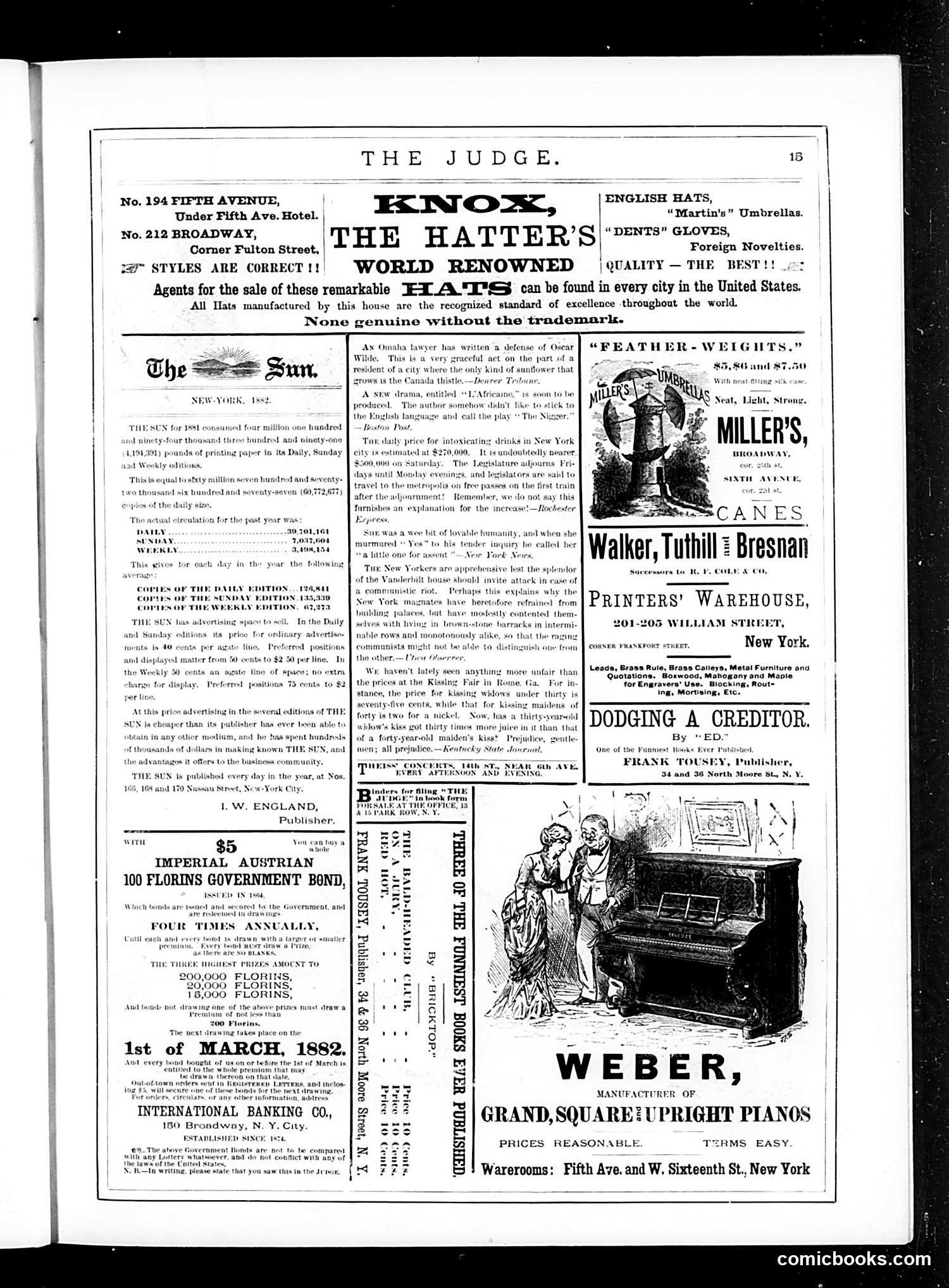
This page is primarily **advertisements** for Knox hats, pianos, printers' services, and financial bonds. However, the main cartoon titled **"Dodging a Creditor"** appears in the lower right. The illustration shows two figures at a piano—likely a debtor and creditor in a confrontational scene. The title's humor derives from the common 19th-century social anxiety about debt collection. The cartoon satirizes the awkward or deceptive tactics people employed to avoid creditors, a relatable concern for Judge's middle-class readers during the economic uncertainties of the 1880s. The specific identities of the figures are unclear from the image alone, but the scenario is universally recognizable: someone caught in an embarrassing financial situation, attempting to evade responsibility. The setting (a piano) may suggest domestic gentility contrasting with financial impropriety—a typical Judge satire device targeting middle-class pretense.
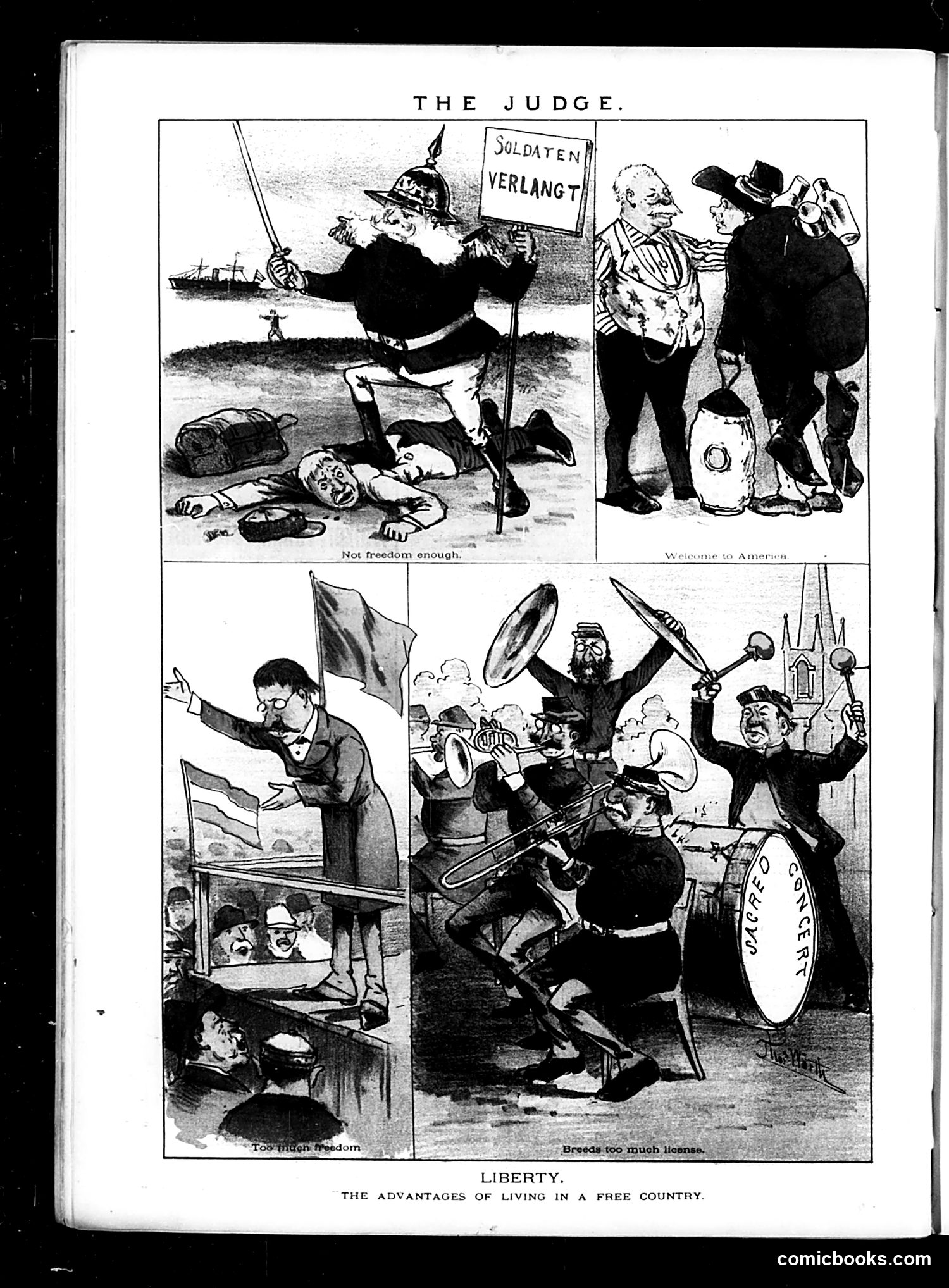
This satirical cartoon contrasts American "liberty" with German militarism during what appears to be the WWI era. The top panel shows a German military figure (identifiable by the spiked Prussian helmet) standing over a fallen soldier, holding a sign reading "Soldaten Verlangt" (German soldiers demanded), captioned "Not freedom enough." The right panel shows figures welcoming immigrants to America. The bottom panels depict ironic "advantages" of American freedom: "Too much freedom" shows chaotic street protests with flags, while "Breeds too much license" shows violent civil unrest with weapons. The cartoon satirizes that American liberty—while superior to German authoritarianism—produces its own social disorder through excessive freedom of expression and assembly. It critiques both extremes: oppressive militarism and anarchic freedom.